
← Back To Blog
Master B2B Lead Generation LinkedIn Strategies 2026
If your pipeline depends on referrals, repeat clients, and the occasional inbound lead, you already know the pattern. One month is full. The next month is quiet. Then you overcorrect, send a burst of outreach, and stop again when delivery work gets busy.
That’s why b2b lead generation linkedin matters so much for freelancers and small agencies. It gives you a channel where buyers already show their role, company, and context before you ever send a message. Used well, it becomes less of a social platform and more of a working prospecting system.
Why Your B2B Leads Are on LinkedIn Right Now
Most small teams don’t have a lead problem. They have a consistency problem. They know how to win work, but they don’t have a repeatable way to find the next qualified buyer before revenue starts dipping.
LinkedIn is where that changes. 89% of B2B marketers use LinkedIn for lead generation, and 80% of all B2B social media leads come from LinkedIn, according to Sopro’s LinkedIn lead generation statistics roundup. That’s the clearest reason to treat LinkedIn as a core acquisition channel instead of a side activity.
For freelancers, consultants, and agency owners, that matters because you don’t need massive budget or a full SDR team to make it work. You need a profile that speaks to buyer outcomes, a focused prospect list, a content rhythm that builds familiarity, and an outreach process you can repeat every week.
If you’re still depending on random networking and one-off cold emails, LinkedIn gives you a cleaner operating environment. Prospects expect professional conversations there. They can vet you quickly. You can qualify them quickly too.
A practical system usually looks like this:
- Foundation first: your profile needs to read like a service page, not a resume.
- Targeting next: build lists around buyer role, company type, and pain point.
- Content as support: publish enough useful material that prospects don’t land on an empty profile.
- Outreach with context: send messages that prove you looked at the person, the company, or the problem.
- Tracking: move real conversations into your pipeline fast.
If you want more channels feeding the top of funnel, these B2B lead generation ideas for service businesses pair well with LinkedIn, but LinkedIn is often the easiest place to build a steady outbound motion without sounding like a spammer.
Build Your High-Conversion Foundation
Your LinkedIn profile is not a bio page. It’s a landing page for a skeptical buyer.

A prospect clicks your name and asks one question. Can this person help with the problem I have right now? If your profile answers with your job history, software stack, and a vague line about being passionate, you lose them.
That’s expensive because LinkedIn profiles do real prospecting work. 53% of B2B marketers use LinkedIn to identify prospects and source contact details. Treat that as a signal that buyers and sellers both use profile pages to evaluate fit. Mentioning the number again doesn’t add anything. Acting on it does.
Rewrite the headline like an offer
Most headlines are weak because they describe the seller, not the outcome.
Bad example:
- Freelance SEO Consultant | Content Strategist | Helping brands grow
Better structure:
- I help B2B SaaS teams turn underperforming content into qualified pipeline
- Webflow developer for B2B agencies that need faster launches and cleaner handoff
- Fractional paid media support for lean teams that need lead flow without hiring in-house
Use this formula:
- Who you help
- What result you help create
- How you’re different
Keep it readable. Don’t stuff every keyword into it.
Write an About section buyers can scan
Your About section should do four jobs in this order:
- Name the problem
- Show the business impact
- Explain your process clearly
- Tell people what kind of conversations you’re open to
A useful structure looks like this:
- Opening line that names the pain
- Short explanation of how you solve it
- A few proof-style bullets about work you do
- Clear fit statement about client type
- CTA to message you
Practical rule: If a prospect can’t understand who you help and what you improve within a few seconds, your profile is still written for recruiters, not buyers.
Use the Featured section too. Add a case study, proposal deck, teardown post, or a one-page overview. Don’t leave it empty.
Build a company page only if you can maintain it
For solo operators, the personal profile usually does most of the selling. A company page helps when you have multiple team members, want brand legitimacy, or need a home for team posts and service pages.
If you can’t keep it active, keep it clean instead. Clear banner, service description, proof assets, recent branding. An abandoned company page can make a good personal profile look less current.
Here’s a walkthrough that covers profile positioning in a useful format:
Build lists before you write messages
Strong outreach starts with list quality. Don’t search for “marketing managers” and hope for the best.
Define your ideal client using practical filters:
- Company reality: industry, size, geography, and service model
- Buying role: founder, head of marketing, growth lead, operations lead
- Trigger: hiring, new funding, weak positioning, stale website, low content output
- Fit signals: active on LinkedIn, clear ownership of the problem you solve
Use LinkedIn search and Sales Navigator if you have it. Boolean search helps when titles vary. Save lists by niche and problem, not just by title. “B2B SaaS founders with weak demo pages” is far more useful than “founders.”
The cleaner your list, the less clever your outreach needs to be.
Create Content That Attracts Buyers
Content on LinkedIn works best when it supports sales conversations, not when it tries to become a full-time media business. You don’t need to post every thought you have. You need enough proof in public that a prospect sees competence when they check your profile.
Use three content pillars
Most service businesses do well with a simple mix.
The first pillar is pain-point content. Talk about the mistakes buyers are making, what those mistakes cost them, and what usually causes them. This type of post earns attention because prospects recognize themselves in it.
The second pillar is process content. Show how you work. Break down audits, onboarding, reporting, handoff, revisions, proposal logic, or campaign setup. Buyers want to know what working with you feels like before they reply.
The third pillar is proof content. That doesn’t require invented case-study stats. You can share before-and-after positioning, a teardown of a messaging fix, a screenshot of a workflow, a client question you solved, or a lesson from a recent project.

Pick formats buyers actually stop for
A lot of freelancers default to text-only posts because they’re fast. That’s fine, but don’t ignore richer formats.
Video posts receive 5x higher engagement than other content formats. That’s why short, useful video is worth adding to your mix. You don’t need polished studio production. A direct camera explanation, screen recording, teardown, or quick lesson is enough if the idea is specific.
Other formats that work well in practice:
- Text posts with a clear opinion: good for sharp observations and buyer pain
- Carousels: useful for frameworks, checklists, audits, and step-by-step process
- Screenshot-led posts: effective when you explain what the buyer should notice
- Short video: strongest when you teach one thing, not five
Don’t post to impress peers. Post so a buyer can think, “This person understands the problem I’m dealing with.”
Run a daily engagement habit
Posting helps, but comments warm up outreach faster than is generally anticipated. If you only have 15 minutes a day, spend it deliberately.
Try this routine:
- Three minutes on target accounts: check for posts from prospects or companies you want to work with
- Five minutes leaving useful comments: add a real opinion, example, or counterpoint
- Three minutes on peer creators: comment where your ideal clients are likely reading
- Four minutes on follow-up: reply to anyone who engaged with your content or profile
This works because comments create familiarity without forcing a direct ask. Prospects start seeing your name before your connection request arrives.
Keep the give-to-get ratio healthy
A lot of LinkedIn content fails because every post leans toward “book a call.” Buyers can feel the pitch coming.
Aim for content that gives away thinking, not just outcomes. Share checklists. Explain decisions. Show what you’d look for in an audit. The more clearly you teach, the less friction you face in outreach.
If your content attracts the wrong audience, tighten the language. Mention the niche, team size, and problem more often. Broad content gets broad attention. Specific content pulls in buyers who are closer to action.
Design Your Scalable Outreach Cadence
Outreach falls apart when people either underdo it or overdo it. They send one generic message and quit, or they blast a whole list with copy that sounds automated. Neither approach builds a reliable LinkedIn pipeline.
The better model is a light, multi-touch cadence. It feels personal to the prospect, but it’s still manageable for a solo operator or small team.
Start with warm signals, not the pitch
Before the first message, look at the prospect’s recent activity. Did they post? Change roles? Launch something? Hire for a related function? Those details matter because they give you a reason to speak.
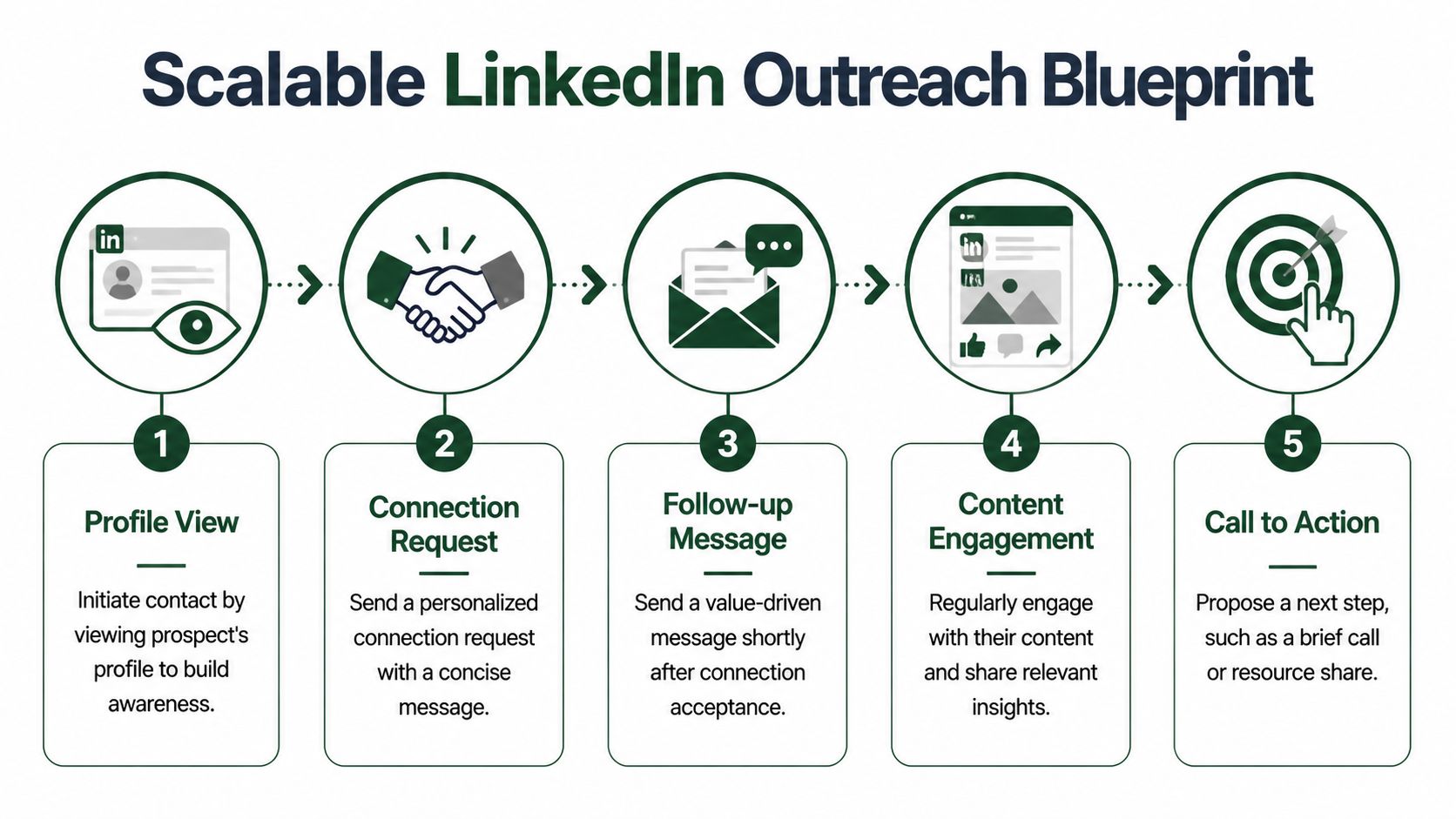
A practical cadence often looks like this:
- View the profile
- Send a personalized connection request
- After acceptance, send a short value-driven message
- Engage with content if they post
- Ask for a next step only after context exists
That sequence is scalable because the personalization can be lightweight. You don’t need to research every company for twenty minutes. You need one real observation.
Connection requests with a personalized message achieve a 9.36% reply rate, compared with 5.44% without personalization, according to Belkins’ 2025 LinkedIn outreach study.
That gap is big enough to settle the debate. Personalization is not polish. It changes outcomes.
Use personalization that’s fast to produce
Most bad personalization is fake personalization. It mentions the first name, company, and maybe job title, then sends the same pitch.
Good personalization usually pulls from one of these:
- Recent activity: a post, comment, hiring update, launch, or interview
- Company context: website friction, offer mismatch, weak messaging, outdated positioning
- Role-specific pressure: pipeline, delivery, hiring, utilization, lead quality
- Shared relevance: mutual connection, niche overlap, similar audience, common tool stack
Short beats clever. Your first message should sound like a human who noticed something.
Connection request template:
Hi [First name], saw your post on [topic] and liked your point about [specific detail]. I work with [type of company] on [problem you solve]. Thought it made sense to connect.
If they accept, don’t immediately drop a calendar link.
Follow up with value, not a disguised pitch
Your first post-acceptance message should continue the conversation. It shouldn’t force one.
Try structures like these:
Observation plus question
Noticed your site speaks to multiple audiences at once. Are you actively refining positioning right now, or is that parked until later in the quarter?Micro-audit angle
Took a quick look at your funnel. One thing stood out. Your offer is clear, but the CTA asks for a big commitment early. Happy to share the exact fix I’d test if useful.Resource angle
I put together a short breakdown on how B2B teams tighten [problem area]. If it’s relevant, I can send it here.
The trade-off is simple. Stronger directness can book meetings faster, but it also filters harder. Softer value-first messages produce more conversation. For freelancers and small agencies, conversation is usually the better first objective.
If you want to systematize the research and messaging side, this guide to AI for sales prospecting workflows is useful for reducing manual work without turning outreach into generic spam.
Know when to ask for the meeting
Don’t ask for a call because your sequence says it’s day four. Ask because the prospect gave you a signal.
Good signals include:
- they replied with context
- they asked how you’d approach it
- they mentioned an active initiative
- they engaged with your follow-up or content more than once
At that point, keep the CTA low friction.
Examples:
- Open to a quick chat if you want a second set of eyes on this
- Happy to send a short teardown, or talk live if that’s easier
- If this is on your list right now, we could discuss it briefly and see if there’s a fit
What usually fails
There are patterns that consistently underperform:
- Instant pitch slaps: “Thanks for connecting, here’s what we do”
- Long paragraphs: nobody wants a mini proposal in LinkedIn DMs
- Manufactured flattery: prospects can smell it
- No point of view: if your message could apply to any company, it feels disposable
A good LinkedIn message doesn’t try to close a deal. It earns the next reply.
That’s the standard to use.
Automate Your Outreach Safely and Smartly
Manual outreach breaks when client work gets busy. That’s the primary reason small teams look at automation. Not because they want to spam people, but because they need consistency they can’t maintain by hand every single day.
The problem is that most automation advice is either careless or unrealistic. One side says automate everything. The other says do it all manually forever. Neither reflects how lean service teams operate.

Bad automation looks obvious
You’ve seen it. Generic connection requests. Identical follow-ups. Robotic timing. Messages that reference the wrong niche or offer. That kind of automation doesn’t save time long term because it damages reply quality and creates account risk.
The biggest mistake is automating the part that should stay human. Your positioning, targeting logic, and conversation judgment still need a person involved.
Smart automation handles repetition
Used properly, automation should support tasks like:
- building and updating prospect lists
- sequencing profile views and connection requests
- drafting first-touch copy from prompts and prospect data
- reminding you when replies need a human response
- logging activity into a CRM or simple tracker
That’s very different from blasting a template to everyone with the same title.
There’s a real reason to take this seriously. Emerging data shows AI-augmented outreach can boost conversions by up to 2.5 times compared to purely manual efforts when implemented safely, according to 100 Pound Social’s analysis of LinkedIn B2B lead generation automation.
The phrase that matters there is when implemented safely.
Safety rules that actually matter
For freelancers and agency owners, safe automation usually comes down to behavior and workflow discipline.
Focus on these principles:
- Human-like pacing: don’t compress a full day of activity into a few minutes
- Small-batch testing: validate message quality before scaling volume
- Clean account separation: if your team handles multiple profiles, keep activity organized by user
- Draft first, review second: let AI prepare a message, then approve or edit it
- Personalization inputs: feed the system post context, niche data, or service angle so outputs aren’t empty
The best automation doesn’t replace your judgment. It preserves it for the moments where it matters most.
Another trade-off is volume versus relevance. Automation makes it tempting to increase sends before you’ve earned the right to scale. Resist that. If replies are weak, the fix is usually targeting or message quality, not more activity.
Where small agencies get the biggest lift
Agencies with multiple freelancers or outreach owners benefit most when automation connects LinkedIn activity to the rest of the sales workflow. The true win isn’t just more sends. It’s fewer dropped leads, faster handoff, and more consistent follow-up across accounts.
If one person writes messages, another qualifies leads, and another handles proposals, your system matters more than your copy. Safe automation gives structure to that handoff. It shouldn’t create distance between you and the buyer. It should remove the repetitive admin that slows the team down.
Track Your Results and Integrate Your Pipeline
Most LinkedIn efforts fail without notice because no one tracks the few numbers that matter. They remember a few good replies, a few ignored messages, and a post that got decent engagement. That’s not a pipeline. That’s scattered activity.
Track the small set of metrics that changes decisions
You don’t need a complicated dashboard. A spreadsheet is enough if you update it consistently.
Track these fields:
- Connection acceptance
- Reply rate
- Positive replies
- Meetings booked
- Qualified opportunities created
- Notes on why people replied or ignored
The notes matter more than people think. They show which niche, trigger, and message angle keeps creating traction.
Sales teams that actively engage prospects on LinkedIn are 51% more likely to hit sales quotas. That supports a simple point. Ongoing activity compounds when it’s tied to real follow-up, not just posting and hoping.
Move warm leads into your actual sales process fast
A positive LinkedIn conversation should not stay in LinkedIn for long. Once there’s buying intent, move it into the system you already use.
For most freelancers and small agencies, that means one of two paths:
- CRM path: create a contact, add the source, assign a stage, set the next task
- Proposal path: if you run work through Upwork or another structured sales flow, shift the conversation into that environment once the lead is warm and qualified
A simple handoff workflow works well:
- Prospect replies positively on LinkedIn
- Log them the same day
- Tag service interest and urgency
- Send either a booking link or a short qualification message
- Move them to proposal, call, or nurture
If your current process is loose, fix that before scaling outreach. This overview of sales pipeline management basics for lean teams is a good reference for building a cleaner handoff from conversation to revenue.
Review weekly, not emotionally
One bad day of replies means nothing. One good day means very little too. Look at weekly patterns.
Ask:
- Are the right people accepting?
- Are replies coming from the niche we want?
- Which opener starts conversations most naturally?
- Where do prospects stall?
- Are meetings turning into real opportunities?
Activity without review creates busyness. Review turns outreach into a system.
That’s what makes b2b lead generation linkedin sustainable for a small team. Not more hustle. Better loop closure.
If you want an always-on system that helps turn outbound effort into booked calls, Earlybird AI is built for lean teams that need more consistency without adding SDR headcount. It helps freelancers and agencies automate prospecting and follow-up workflows safely, especially in Upwork-driven sales motions, so your pipeline keeps moving even when delivery work gets busy.