
← Back To Blog
AI for Sales Prospecting: A Guide to Higher Conversions
If you’ve ever found yourself staring at a spreadsheet of potential leads, dreading the hours of manual research and cold outreach that lie ahead, you know the grind. It's a time-consuming, soul-crushing process that, more often than not, ends in a depressingly low response rate.
Using AI for sales prospecting is like hiring a tireless assistant who works 24/7, not just finding your ideal clients but also helping you figure out exactly what to say to them.
From Manual Grind to Automated Growth

Whether you're a freelancer, an agency owner, or a sales pro, your day is probably packed with manual tasks. Traditional prospecting has always been a numbers game played with tedious work: building lists, hunting for contact details, and then blasting out generic messages, hoping something sticks. This isn't just inefficient; it's a direct tax on your most valuable asset: time.
This old-school approach creates a massive bottleneck, slowing down your entire sales pipeline. It forces talented people to get bogged down in low-impact activities instead of doing what they do best—building relationships and closing deals. The end result is predictable: burnout, missed opportunities, and a revenue chart that looks like a rollercoaster.
The Shift to Intelligent Prospecting
AI completely flips this model on its head. Instead of you hunting for opportunities, AI platforms sift through massive amounts of data to pinpoint prospects who are a perfect match for what you sell. Think of it like swapping an old paper map for a live GPS that gives you turn-by-turn directions straight to your ideal customer.
But this technology does more than just find names. It actually qualifies them. By analyzing buying signals, company data, and other online cues, AI can score prospects on how likely they are to become a customer. This means you stop wasting time on dead ends and start focusing your energy only on high-potential leads.
AI fundamentally changes the sales equation. It moves teams from a "more is more" mindset of cold outreach to a "smarter is better" strategy focused on precision, personalization, and timing.
Reclaiming Your Most Valuable Asset
What would you do if you could get back the 40% of the week that sales reps typically spend on manual prospecting? That’s the real promise of AI in this space. Instead of reps spending hours digging through LinkedIn or company websites, AI tools can do that research automatically.
This recovered time is your new competitive edge. It frees you and your team up to focus on the high-value work that actually drives revenue:
- Building Genuine Relationships: Spend more quality time talking with qualified prospects instead of just looking for them.
- Perfecting Your Pitch: Use the insights AI uncovers to customize your message to solve each client's specific problems.
- Closing More Deals: Concentrate your expertise on the crucial final stages of the sales cycle, where a human touch makes all the difference.
When you bring AI into your prospecting workflow, you're not just adding another tool to your tech stack. You're building a system for consistent, automated growth. This guide will walk you through how to ditch the manual grind for good and build an efficient, revenue-generating engine. To get a better handle on how this all works, check out our guide on what is sales automation.
How AI Changes the Sales Prospecting Game

To really get why AI for sales prospecting is such a big deal, you have to look under the hood at what it's actually doing. It’s not just one thing; it's a whole toolkit of smart systems built to take on the toughest parts of finding new business. Think of it as an always-on sales intelligence engine working for you.
At its heart, AI gives you a massive advantage by sifting through information at a scale no human team possibly could. It finds connections and patterns that are otherwise invisible, turning mountains of raw data into real, actionable opportunities.
Let's break down the key ways this actually works in practice.
Intelligent Lead Discovery
Old-school prospecting feels like fishing with a small net in a huge ocean. Sure, you might catch something, but you're missing almost everything else just below the surface. AI-powered lead discovery is like upgrading your boat with advanced sonar that maps the entire ocean floor and tells you exactly where the big fish are schooling.
AI systems constantly scan the entire web—from company websites and job boards to social media and press releases—looking for prospects who perfectly fit your ideal customer profile. This goes way beyond a simple keyword search. The technology understands context and intent, sniffing out buying signals that reveal leads you would have never stumbled upon on your own. You end up spending less time hunting and more time talking to people who are already a great fit.
Automated Lead Qualification
Once you have a list of potential leads, the real work begins: figuring out which ones are actually worth your time. Doing this by hand is a soul-crushing time sink, and it’s often based more on gut feelings than hard data. AI automates this entire step with incredible precision.
Imagine having a hyper-efficient gatekeeper for your sales pipeline. The AI analyzes dozens of data points for each prospect—things like company size, recent funding rounds, the tech they use, and their recent online activity—to give each one a lead score. That score tells you how likely they are to become a customer.
This automated filtering ensures your team is only spending energy on high-potential leads. It’s no surprise that sales teams using AI see their revenue grow by up to 1.3 times compared to those who don’t. A huge part of that is simply because they stop wasting time on dead ends.
AI-driven prospecting flips the script from quantity to quality. Instead of blasting out a thousand cold emails, you can have meaningful conversations with a smaller, highly qualified group that is far more likely to convert.
This data-backed approach is how you build a more efficient and predictable sales engine. You can move forward knowing every conversation you start has a much higher chance of success.
Hyper-Personalization at Scale
Here’s one of the oldest challenges in sales: how do you send truly personal messages without spending all day writing them? It’s a paradox. Generic templates get ignored—in fact, 71% of decision-makers say a lack of relevance is a top reason they don't respond to outreach.
This is where AI is a true game-changer. It makes hyper-personalization at scale not just possible, but easy. It’s like having a personal assistant who crafts a unique, thoughtful message for every single person you contact.
The AI scans a prospect's digital footprint to understand their specific needs, challenges, and what they’ve been up to lately. It then helps draft outreach that feels genuinely personal and relevant. For a freelancer on Upwork, a tool like Earlybird AI can analyze a client’s job post and write a proposal that speaks directly to their stated pain points and project goals.
This level of customization creates a real one-to-one connection, even if you’re reaching out to hundreds of leads. The results speak for themselves:
- Higher Open Rates: A message that feels like it was written just for you is far more likely to get opened.
- Increased Reply Rates: When you show you’ve done your homework, people are much more inclined to respond.
- Shorter Sales Cycles: Building trust and rapport from the very first touchpoint naturally speeds up the entire sales process.
Predictive Analytics and Timing
Finally, AI adds a layer of foresight to your prospecting. By analyzing your past sales data and current market trends, it can predict which types of leads are most likely to convert and—this is the critical part—when the best time is to reach out.
It’s the closest thing we have to a crystal ball for sales. Predictive analytics helps you put your resources in the right place, focusing on the deals with the highest probability of closing. It takes the guesswork out of the equation and replaces it with data-backed strategy, giving you the confidence to build a consistently growing pipeline.
The Power of AI Personalization in Outreach
Let's be honest: generic outreach is dead. The old "spray and pray" method of blasting the same template to hundreds of people just doesn't cut it anymore. If you want to succeed in today's market, personalization isn't just a nice-to-have; it's the absolute core of your sales strategy. This is where AI for sales prospecting really shines, doing so much more than just slotting a {first_name} into an email.
Think of AI as a dedicated research assistant for every single person on your prospect list. It digs deep into their digital footprint to build a complete picture of who they are and what they care about right now. This isn't just surface-level stuff. We're talking recent social media posts, company press releases, and even the specific software their business is using.
Armed with this kind of intel, you can craft messages that aren't just personalized, but genuinely relevant and perfectly timed. You stop being a random stranger interrupting their day and become a problem-solver who shows up with a solution when they actually need it.
Beyond a First-Name Basis
Real AI-driven personalization helps you create a true one-to-one connection, even when you're reaching out at scale. It's the difference between getting a generic flyer in the mail versus a handwritten note that mentions a recent award you won. One goes straight into the recycling bin, and the other gets a reply.
So, how does AI pull this off? By connecting the dots between multiple data points to find the perfect angle for your message.
- Social and Professional Activity: AI can flag when a prospect posts on LinkedIn about a specific business challenge or when their company gets a big mention in the news.
- Company Data: It can instantly identify key details like company size, industry, or a recent funding round, helping you tailor your pitch.
- Technographic Information: AI can even figure out a company's current tech stack, which is huge. This lets you explain exactly how your solution integrates with or improves the tools they already use.
This level of insight is completely changing the game for sales teams. Personalization has become so critical that 58% of teams now use AI to help write their outreach messages. The best tools can analyze a prospect's behavior and company profile to draft messages that feel truly individual, which is the key to getting more responses. You can dig deeper into these trends and learn about the impact of AI on sales statistics.
A Practical Example for Freelancers
This is incredibly powerful for freelancers and small agencies, especially on platforms like Upwork. Let's say you're a web developer who builds e-commerce sites. An AI platform like Earlybird AI can connect to your account and, with a bit of simple feedback, learn exactly what your ideal project looks like.
Now, when a new job gets posted, the AI does more than just send you a notification. It actually analyzes the client's project description, understands their needs, and then drafts a proposal that speaks directly to them.
Before AI: "Hi, I'm a skilled web developer and I can build your e-commerce site. Here is my portfolio."
With AI: "Hi [Client Name], I saw you're looking for a developer to build an e-commerce store for your sustainable fashion brand. My experience creating high-converting Shopify sites for similar eco-friendly companies would be a great fit for your project goals."
The difference is night and day. The second message instantly shows you've done your homework and understand their world. It builds immediate trust and makes you stand out from the dozens of copy-paste bids they're about to receive. This is exactly how you start better conversations and write effective lead generation emails that people actually reply to.
By handling this deep personalization for you, AI doesn't just save a ton of time. It makes your outreach far more effective, leading to higher reply rates and a much shorter path to closing a deal.
Putting Your AI Prospecting Workflow Into Action
It’s one thing to understand the theory behind AI for sales prospecting, but it’s another thing entirely to build a system that actually brings in revenue. This is where the rubber meets the road—where you stop talking about concepts and start executing a workflow that puts artificial intelligence to work for you.
Think of it as giving your AI its marching orders. The whole process starts with a crystal-clear picture of your target. Without it, even the smartest AI is just shooting in the dark. You need to hand it a detailed blueprint of your ideal customer so it knows exactly who to go after.
This is a great visualization of how AI takes a generic, one-size-fits-all message and uses data to spin it into something that feels personal and relevant.
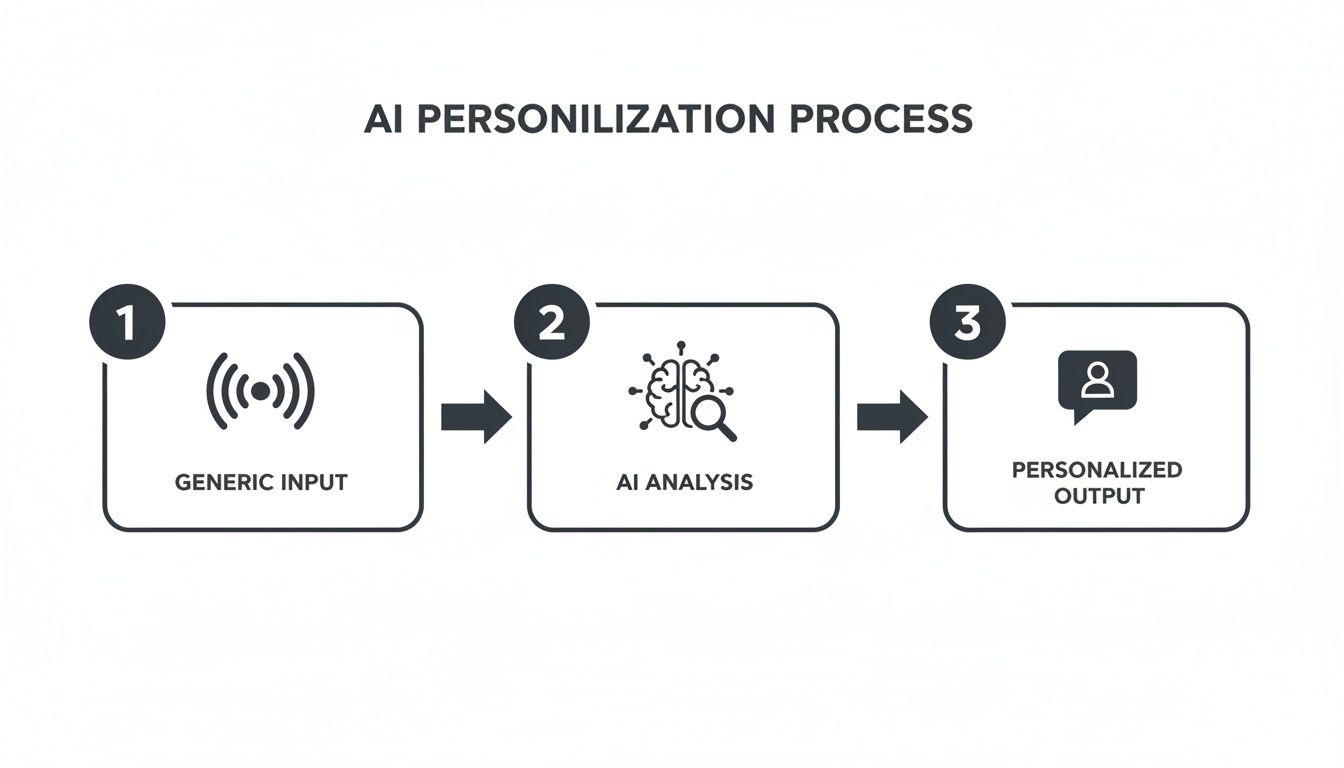
As you can see, the AI acts like an incredibly intelligent filter. It analyzes mountains of data to craft outreach that actually connects with people on a human level, which is what drives real engagement.
Defining Your Ideal Client Profile
First things first: you have to define your Ideal Client Profile (ICP). This is the most important step, period. Your ICP is the instruction manual you give your AI, and the more detailed it is, the better your results will be. A sharp ICP ensures your tool isn't just finding leads; it's finding the right leads.
Your ICP needs to go way beyond basic demographics. I'm talking about getting really specific with elements like:
- Firmographics: What's the sweet spot for company size, industry, or location?
- Technographics: What software or tech are they already using? This is gold for positioning your solution.
- Buying Signals: What’s happening that signals they might need you right now? Think recent funding rounds, hiring for specific roles, or a new product launch.
- Pain Points: What problems are keeping them up at night that you can solve?
Nailing this from the get-go is everything. A precise ICP empowers the AI to sift through millions of data points and pinpoint prospects with the highest chance of converting, saving you an incredible amount of time.
Configuring Your AI Tool
With your ICP locked in, it’s time to hook up your accounts and configure the AI platform. This usually involves securely linking your email or freelance accounts (like Upwork) and telling the AI how to behave. You're basically translating your ICP into a set of rules for the machine to follow.
This is where you'll fine-tune the AI’s personality. You'll set the tone of voice for the messages it writes, cap the number of daily outreach messages, and list keywords for projects you want to target (or avoid). It’s your chance to get the machine dialed in before you let it loose. For agencies juggling multiple clients, finding the right software for a digital marketing agency can make managing this process a whole lot smoother.
AI is a force multiplier, not a magic wand. Its effectiveness is directly tied to the quality of your initial setup and ongoing feedback. The goal is to automate repetitive work, freeing up human experts to focus on strategy and closing deals.
The Crucial AI Learning Phase
Once you’re all set up, you move into what I call the learning phase. This is where the real partnership between you and the AI begins. The tool will start finding prospects and drafting outreach based on your ICP, but it needs your guidance to get smarter.
Most of the best platforms use a simple feedback loop. You might give a "thumbs up" or "thumbs down" to the leads it surfaces. Every click trains the machine learning models, helping the AI zero in on what makes a perfect lead for you. This back-and-forth is absolutely vital for improving accuracy over time.
Launching and Monitoring Your Campaigns
Now for the fun part. With the AI trained and ready, you can launch your automated outreach campaigns. The system will start prospecting, personalizing, and engaging potential clients for you. But your job isn’t done. The last piece of the puzzle is keeping a close eye on performance through the platform's analytics.
You'll want to track a few key metrics:
- Reply Rate: Are people actually responding to the messages?
- Meeting Booked Rate: How many of those replies are turning into real sales meetings?
- Lead Quality: Is the AI consistently bringing you prospects that fit your ICP like a glove?
This data tells you what’s working and what isn’t. It allows you to go back and tweak your ICP, adjust your messaging, and give the AI more feedback to get even better results. It’s a cycle of continuous improvement that keeps your pipeline full.
Measuring Success and Calculating ROI
Let’s get down to brass tacks. Adopting any new tool, especially one powered by AI, always boils down to one question: is it actually worth it? It's easy to get excited about the features, but the real test is whether it impacts your bottom line.
To justify the investment in an AI sales tool, you have to connect the dots between what it does and the money it makes or saves you. It’s not about having a busier calendar; it’s about building a healthier business.
Identifying Your Key Performance Indicators
Before you can figure out your return on investment, you need to know what to measure. Every business has its own unique metrics, but for AI prospecting, a few KPIs tell most of the story. These numbers give you a clear, honest picture of what's working.
Start by keeping a close eye on these:
- Proposal Reply Rate: This is your first signal. When your reply rate starts climbing, you know the AI-driven personalization is hitting the mark.
- Lead-to-Meeting Conversion Rate: How many of those replies turn into actual sales calls? This metric separates the curious from the genuinely qualified. It tells you if you're talking to the right people.
- Sales Cycle Length: How long does it take to get from that first "hello" to a signed contract? A good AI process should shorten this time by teeing up better leads and keeping the follow-up consistent.
Success with AI prospecting isn't just about getting more leads; it's about getting the right leads faster. The goal is to build a more predictable and efficient sales engine that closes higher-quality deals in less time.
Tracking these KPIs shows you exactly where the AI is making a difference and where you might need to tweak your approach. And the market is certainly taking notice—the sales and marketing automation space, valued at USD 1,727.9 million in 2023, is expected to explode to USD 9,491.2 million by 2030. That growth is all about the power of AI in sales, a trend you can learn more about by checking out the rise of AI in sales on Exploding Topics.
Calculating Your Return on Investment
Once you have your metrics, calculating the actual ROI becomes straightforward. The simplest way to look at it is by weighing the cost of the tool against the value it brings in through cost savings and new revenue.
First, think about the time saved. How many hours were you or your team burning on manual prospecting every week? Multiply those hours by your hourly rate (or a team member's salary). That number is your immediate cost savings.
Now for the exciting part: the new business acquired. For freelancers and agencies, this is where the math gets really compelling.
Let's walk through a quick example:
- Cost of the AI Tool: Suppose you're paying $100 a month, which is $1,200 for the year.
- Value of a New Client: Let's say, on average, a new client is worth $5,000 to your business.
- ROI Calculation: In this scenario, landing just one new client from the AI platform covers its entire annual cost and then some—delivering a return of over 400%.
That single client makes the tool a no-brainer. Every other client you land after that is pure profit, generated directly by your smarter prospecting efforts. This simple math gives you the confidence to not just invest in the right tech, but to keep optimizing it.
Your Questions About AI Sales Prospecting, Answered
Jumping into AI for sales prospecting is a big move, and it's smart to have questions. You need to know you're making the right call for your business, your team, and your revenue. To help you get clear, we’ve answered the most common questions we hear from freelancers, agencies, and sales pros.
Think of this as your cheat sheet for moving forward with confidence. Let's get into it.
Is AI for Sales Prospecting Safe for My Accounts?
This is usually the first question people ask, and for good reason. The short answer is yes, it's completely safe—if you use a well-built, reputable tool. The best AI platforms are designed with account safety as their number one job. They aren't just dumb bots spamming messages; they're sophisticated systems that work within the rules of platforms like Upwork or your email provider.
They do this by focusing on a few key areas:
- Mimicking Human Behavior: The AI doesn't just blast out messages at lightning speed. It acts like a person, adding random delays between actions and varying its activity patterns to avoid setting off any alarms.
- Using Clean, Regional IPs: A top-tier tool will use dedicated, clean IP addresses that match your location. This makes the AI's activity look totally normal and prevents your account from getting flagged for logging in from a strange place.
- Securing Your Credentials: Your passwords are never stored in a way that can be easily read. Modern tools use secure methods like tokenization to authenticate, meaning your login info is never exposed and your account stays locked down.
When these features work together, you get a tool that’s not just effective, but also safe and compliant.
Can AI Completely Replace My Sales Team?
Not a chance. This is a huge myth that sees AI as a competitor to people, when it’s really a powerful collaborator. The best way to think of AI in sales is as a super-efficient assistant for your human experts. It’s built to take over the repetitive, soul-crushing parts of the job, not the parts that require genuine human connection.
AI is a beast at the top-of-funnel work that burns out even the best salespeople. It automates the grind of finding leads, doing the initial qualification, and drafting those first personalized messages. This frees up your team to focus on what they're truly great at—and what actually brings in money.
AI handles the science of prospecting so your team can master the art of selling. It takes the tedious work off their plate, letting them pour their energy into building relationships, running great demos, and closing complex deals.
In the end, AI doesn't replace your sales team; it makes them better, sharper, and more successful.
How Long Does It Take to See Results?
Everyone wants instant results, but it’s best to be realistic. While you’ll see activity right away, the real magic of AI for sales prospecting shows up after a short "training" period. It's a lot like bringing a new person onto your team—they need a little time to get the hang of things.
Most people see results in a few clear stages:
- Setup and Tuning (The First Few Days): This is when you'll dial in your Ideal Client Profile and give the AI its initial marching orders.
- The Training Phase (Weeks 1-4): This is the most important part. The AI starts finding leads, and you provide feedback. Every time you give a lead a "thumbs up" or "thumbs down," you're teaching the machine learning models. The system gets smarter and more accurate with every click.
- Ramp-Up and Scaling (Days 30-60): After that first month of training, you'll see a real, consistent jump in performance. Reply rates go up, lead quality gets sharper, and more meetings start hitting the calendar.
While every business is unique, most users see a tangible return and a steady stream of qualified leads within the first 30 to 60 days of consistent use and training. A little patience in that first month pays off big time down the road.
Ready to stop the manual grind and start closing more deals? Earlybird AI is your always-on sales team for Upwork, automating everything from lead discovery to personalized proposals and follow-ups. See how our members are doubling their reply rates and reclaiming their time.