← Back To Blog
Mastering Lead Generation Emails for Agency Growth
Lead generation emails are your direct line to potential clients. They're messages designed to spark interest and pull prospects into your sales funnel. When you get this right, it becomes a direct, predictable engine for revenue, giving you, the freelancer or agency owner, total control over how you find and sign new clients. You're no longer at the mercy of fickle social media algorithms.
Why Email Is Your Ultimate Client Acquisition Tool
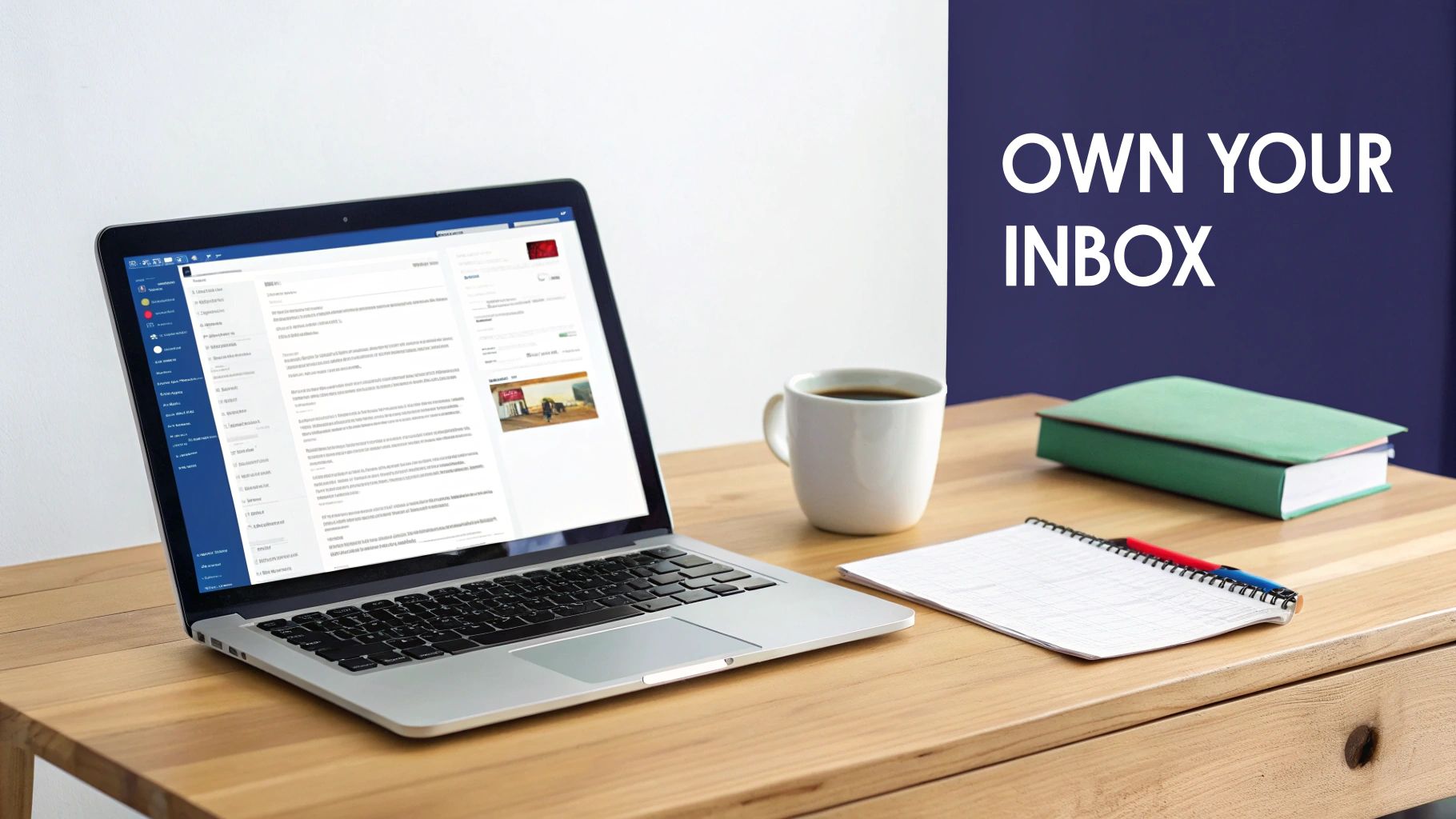
With a million different marketing channels out there, why does email still dominate? Simple: it delivers an incredible return on investment (ROI).
Unlike a social media following or a paid ad campaign, your email list is an asset you truly own. It’s a direct line to your ideal clients, a conversation that can't be throttled by a platform's changing rules.
This control is a game-changer, especially for freelancers and agencies slugging it out on platforms like Upwork. The moment a good project gets posted, the client is buried in proposals. Generic, copy-pasted messages are dead on arrival. A thoughtful, well-crafted email, on the other hand, cuts through the noise. It builds instant credibility and, most importantly, starts a real conversation.
This is how you turn outreach from a lottery ticket into a strategic client acquisition machine.
The Undeniable Power Of The Inbox
The numbers don't lie. Top agencies build their businesses on the back of email for a reason. In a recent industry deep-dive, a whopping 48% of marketers named email their single most effective tactic for generating leads.
This effectiveness hits your bottom line directly. You'll see figures all over the place, but a widely cited one is $36 returned for every $1 spent. Good luck finding that kind of return anywhere else.
Here’s a quick look at how email stacks up against other common channels.
Email Effectiveness Snapshot
ChannelTop Tactic RankingTypical ROIAudience OwnershipEmail Marketing#1 for Lead Gen$36 for every $1 spentHigh (You own the list)Social Media#3 for Lead GenVariable (often low without ad spend)Low (Platform owns the audience)PPC/Paid Ads#4 for Lead Gen~$2 for every $1 spentLow (Pay-to-play access)
As you can see, email not only leads the pack in effectiveness but also gives you an asset you control completely, which is invaluable for long-term growth.
Your email list isn’t just a spreadsheet of contacts. It’s a curated audience of potential high-value clients who have given you permission to talk to them. Nurturing that relationship is the secret to building a sustainable agency.
Building A Predictable Revenue Engine
Ultimately, a solid email strategy takes the "feast or famine" anxiety out of freelancing. It creates a predictable, repeatable system for finding leads and turning them into loyal, long-term clients.
If you’re just starting out, getting the basics right is everything. For a complete roadmap, check out our guide on starting an SEO agency. Every tip in this guide is another brick in the foundation of your very own client acquisition machine. Let's start building.
Writing Emails That Actually Get Opened and Read

Alright, let's get down to the brass tacks. You can have the most brilliant strategy in the world, but if your email never gets opened, it’s just digital noise. It all starts with the subject line.
Think of your subject line as the gatekeeper. Its only job is to get someone curious enough to click. It has to promise value without sounding like cheap clickbait. This is your first—and maybe only—chance to make an impression.
Interestingly, a bit of personalization goes a long way. Simply adding a prospect's name can skyrocket open rates from a dismal 10% to a much healthier 39%. Why? It instantly signals that this isn't just another generic email blast. It feels like you wrote it just for them.
Crafting a Compelling Subject Line
Your subject line is prime real estate in a crowded inbox. The goal is to be clear, intriguing, and brief enough to stand out. After sending thousands of these things, I’ve found a few approaches that consistently work.
Here are some formulas you can steal for your next campaign:
- Pinpoint a Need: "Idea for improving [Company Name]'s blog engagement"
- Ask a Smart Question: "Quick question about your current design workflow"
- Promise a Real Benefit: "Boosting [Metric] for companies like yours"
- Keep It Short and Sweet: Seriously. Subject lines with nine words or fewer almost always get higher click-through rates.
The common thread here is research. Each one connects your message to a specific goal or problem you know they have. It’s a simple way to show you’ve done your homework and builds instant credibility before they've even read the first sentence.
Nailing the Opening and Value Proposition
Once the email is open, the clock is ticking. You have maybe three seconds to prove it was worth their time. That means your opening line needs to hook them immediately by referencing their world.
Forget generic fluff like "I hope this email finds you well." It’s a one-way ticket to the trash folder.
Instead, lead with something that shows you get it. If you found them on Upwork, mention a specific detail from their project description. It’s a killer technique. You can find more real-world examples of how this works in these cover letter examples for Upwork.
Right after that personalized hook, get straight to your value proposition. Don't list your services. Explain how you solve their problem. Frame what you do as the clear, obvious solution to a headache they're dealing with right now.
Key Takeaway: Your value proposition isn't about you. It's about them. Stop saying "I offer SEO services." Start saying, "I help businesses like yours get more organic traffic and find new customers." See the difference?
Creating a Call-to-Action That Converts
Finally, every great email needs a clear, low-friction call-to-action (CTA). This is where so many people go wrong. They get aggressive with demands like "Book a call now!" and scare people off.
Instead, go for a "soft" CTA. Make it a simple, easy-to-answer question. You’re just trying to get a "yes" or "no" to start a conversation.
Here are some CTAs that actually get replies:
- "Are you open to a brief chat next week to explore this?"
- "Would you be interested in seeing a quick demo of how this works?"
- "Is improving [their goal] a priority for you right now?"
This approach makes it incredibly easy for a busy person to respond. By making the next step feel small and collaborative, you turn a cold email into the start of a real business relationship.
Combining Personalization and Automation for Maximum Impact
Let's be honest: generic, one-size-fits-all emails are dead. They're a one-way ticket to the trash folder. What actually starts a conversation is personalization, but who has the time to hand-craft hundreds of unique emails every week?
This is where the real magic happens—blending the human touch of a personalized message with the raw efficiency of automation.
The whole idea is to make every single prospect feel like you wrote an email just for them, without chaining yourself to your desk all day. You do this by automating the repetitive parts and injecting those specific, personal details right where they count. It’s a powerful combination that gives you a massive edge, especially on platforms like Upwork, where the first truly relevant proposal is often the one that lands the job.
Making Personalization Scalable
Scalable personalization isn't about faking a deep, long-lost connection. It's simply about showing you've done your homework. Instead of getting bogged down in every minor detail about a company, you zero in on high-impact "triggers" you can find in a minute or two.
These triggers are the perfect hook for your opening line. Here are a few I use all the time:
- Recent Company News: Did they just launch a new product or get a mention in a trade publication? A quick, "Saw the news about the X launch—congrats!" shows you’re paying attention.
- Publicly Stated Goals: Hit up their "About Us" or "Careers" page. If they mention plans to expand into a new market, you can directly tie your pitch to helping them achieve that goal.
- A Specific Blog Post or Social Update: Referencing something they just published is gold. "Loved your team's recent post on X" proves you’re genuinely engaged with what they're doing.
This approach lets you build a small library of personalized snippets. Your tools can then dynamically insert them into your automated sequences, making each email feel like it was built from scratch.
The goal of scalable personalization is simple: prove you aren't a robot, even when you're using automation to do the heavy lifting. A single, relevant sentence is often all it takes to stand out from the noise.
The Power Couple: Automation and Personalization
When you finally pair these two strategies, the results really do speak for themselves. Before we get into the "how," let's look at the "why." Here’s a quick breakdown of what happens when you move from generic outreach to a smarter, more targeted system.
Impact of Personalization and Automation
Campaign TypeRelative Open Rate LiftRelative Click-Through Rate LiftPotential Lift in Qualified LeadsGeneric OutreachBaselineBaselineBaselineSegmented & Automated~30%~50%Up to 451%
The data is pretty clear. Well-executed automation doesn’t just save you time; it dramatically improves every metric that matters, from opens to actual, high-quality leads.
This hybrid model lets you send a high volume of lead-gen emails without sacrificing the quality that actually gets replies. You create a solid core template, and your automation tool seamlessly pulls in the personalized details for each prospect. This is the very foundation of effective sales automation—a system designed to handle the grunt work so you can focus on building relationships and closing deals.
It’s all about working smarter, not just harder, to build a predictable stream of new clients.
Building a Follow-Up Sequence That Nurtures and Converts
Sending that first email is just the opening line. The real magic—where you actually win clients—happens in the follow-up. But this is exactly where most freelancers and agencies trip up and quit way too soon.
Think of a strategic follow-up sequence as your secret weapon for turning radio silence into a real conversation. The trick is to add new value with every single message. You're not just sending those annoying "just bumping this up" emails. Instead, you're building trust and staying on their radar without being a pest.
This whole process boils down to a simple workflow: you do your homework, make it personal, and then you can automate.
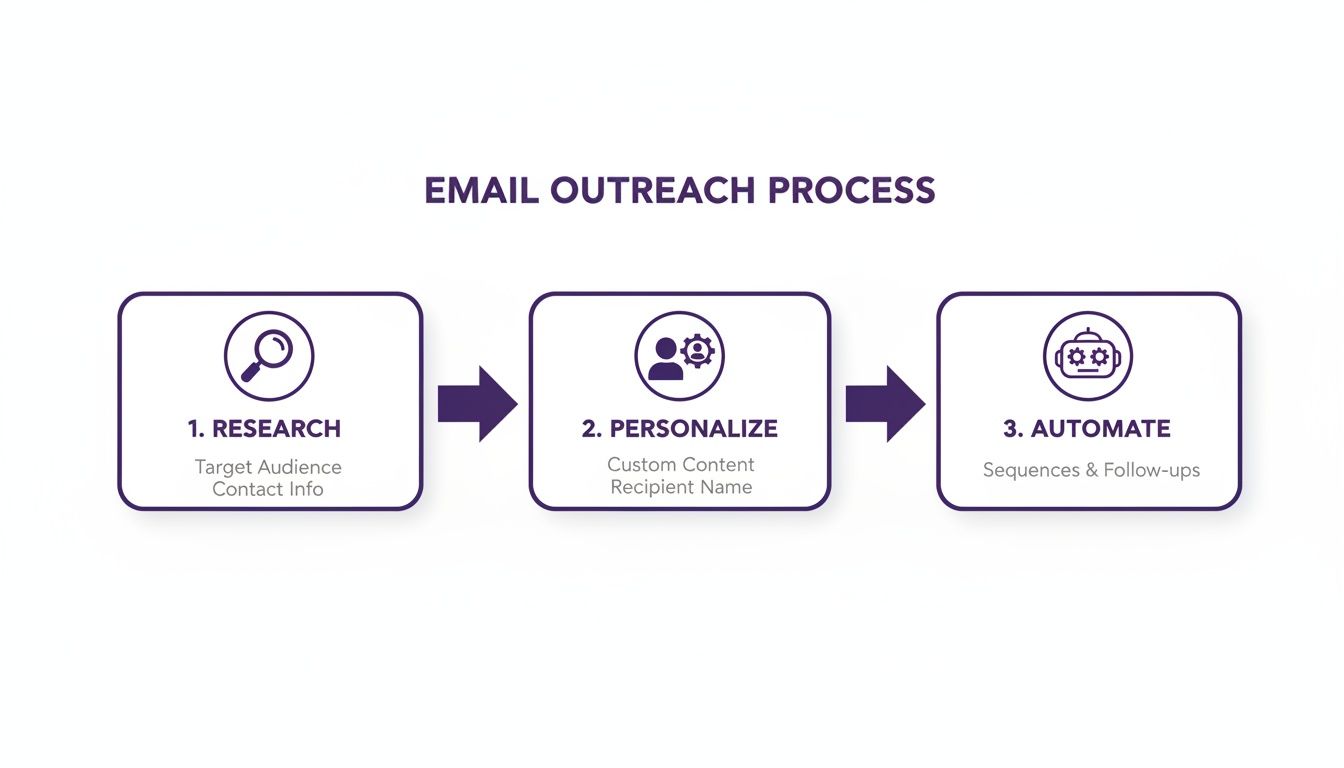
As you can see, automation comes last. It only works if it’s built on solid research and genuine personalization. That's the foundation for any follow-up sequence that actually gets replies.
Structuring Your Four-Part Follow-Up Cadence
So, what does a good sequence actually look like in practice? It’s all about polite, professional persistence. You’re not just re-sending your original pitch over and over. You’re coming at it from different angles, offering fresh insights, and giving them new reasons to engage.
Here’s a four-email framework I've used that works wonders with busy decision-makers:
- The Gentle Nudge (3 days later): This one is simple and friendly. Just a quick check-in where you rephrase your value proposition. Something like, "Just wanted to follow up on my email about boosting [Metric]. Have you had a moment to think it over?" works perfectly.
- The Value-Add (5-7 days later): Now it's time to give them something genuinely useful, for free. Share a relevant case study, a link to a great article, or a quick tip related to one of their goals. This flips the script from "what I want from you" to "here's something to help you."
- The Final Check-In (10-14 days later): This is a low-pressure way to make one last attempt. You can ask if the timing is off or if there’s someone else on their team who might be a better fit for this conversation.
- The Breakup Email (21+ days later): It sounds a little dramatic, but this is often the most effective email of them all. A friendly "closing the loop" message like, "Since I haven't heard back, I'll assume this isn't a priority right now..." often gets a reply from people who were just too swamped to respond earlier.
Knowing When and How to Follow Up
It’s shocking how much business gets left on the table simply because people don't follow up enough. Did you know that 70% of marketers give up after sending just one email? That’s a massive mistake when multi-step sequences can capture up to 76% of potential leads. A simple four-email sequence hits that sweet spot for grabbing those opportunities that would otherwise be lost. You can find more data on lead generation trends in this report.
The whole point of a follow-up isn't to pester—it's to serve. Every email is another opportunity to prove your expertise and show that you genuinely understand their problems. If you frame your outreach as helping, not selling, the entire interaction feels more authentic and will get you much better results.
By setting up an automated sequence, you create a safety net. No lead slips through the cracks because you got busy or forgot. It's a simple system that turns silence into opportunity and recovers business you would have otherwise lost.
How to Measure and Optimize Your Email Outreach
If you aren't measuring your outreach, you can't improve it. Sending out a bunch of emails without looking at the data is like driving blind—you’re moving, but you have no idea if you’re even on the right road. Let’s get you out of the dark and focused on the numbers that actually grow your freelance business or agency.
An open is nice, but it doesn't pay the bills. The real goal is to start a conversation that turns into a new client. To get there, you have to track the metrics that signal real engagement and intent from the people you’re contacting.
Moving Beyond Vanity Metrics
It's easy to get hung up on open rates. And sure, a terrible open rate can tell you something is wrong with your subject line or that you're landing in spam. But it's not the ultimate measure of success.
The numbers that really matter tell a story about how your message is connecting with potential clients. Here are the key performance indicators (KPIs) you should actually care about:
- Reply Rate: This is the big one. What percentage of people are actually hitting "reply"? A solid reply rate means your message was compelling enough to get them to take action.
- Positive Reply Rate: Let's drill down even further. This metric filters out the "not interested" or "unsubscribe" messages and shows you how many prospects are showing genuine interest or asking questions. This is the single most important indicator of a healthy pipeline.
- Meetings Booked: This is where outreach turns into real opportunity. How many of those positive replies are actually converting into discovery calls or sales meetings on your calendar?
- Client Conversion Rate: The final number. Of all the meetings you book, how many become paying clients? This tells you if your outreach is attracting the right kind of leads who value what you do.
Using A/B Testing to Find What Works
Once you're tracking the right numbers, you can start making your emails better, systematically, with A/B testing. This isn't some complex process reserved for huge marketing teams. It's just a simple method of testing one change at a time to see what your audience responds to.
You create two versions of an email (Version A and Version B), send each to a different segment of your prospect list, and see which one gets you more of what you want—usually, positive replies.
Don’t just guess what your prospects want to hear—let the data tell you. A simple A/B test on your call-to-action can reveal insights that double your reply rate without any other changes to your email.
Start by testing the elements that have the biggest impact. For example, you could test:
- A direct, benefit-driven subject line versus a question-based one.
- A formal value proposition versus a more casual, conversational opening.
- Asking for a "brief 15-minute chat" versus asking if they're "open to exploring this."
Small tweaks in wording can produce shockingly different results. By constantly testing and letting the data guide you, your outreach stops being guesswork and becomes a predictable, repeatable way to generate revenue.
Got Questions About Your Lead Gen Emails? Let's Get Them Answered
Even with the best strategy in place, you're bound to have questions as you start sending emails and refining your approach. Honestly, getting these details right is often what separates a packed calendar from a quiet inbox. Let’s dig into some of the most common hurdles I see freelancers and agencies face.
How Long Should My Emails Actually Be?
Keep it short. Seriously. You want to aim for somewhere between 50 and 125 words.
Think of it this way: your prospect is busy, and your email is an interruption. Your job is to respect their time while making it painfully obvious how you can help them. Anything longer is just asking to be deleted.
I've found a simple, three-part structure works wonders:
- Your opener: One or two sentences showing you know who they are. Personalization is king.
- Your pitch: Two or three sentences explaining the problem you solve and why you’re the one to solve it.
- Your ask: A single, clear call-to-action. Make it dead simple for them to take the next step.
This is especially true on platforms like Upwork. Clients are drowning in proposals. A message that cuts through the noise and gets straight to the point will always win.
What’s a “Good” Reply Rate for Cold Emails?
Everyone wants to know the magic number, and the industry benchmark sits around 1% to 5%. If you’re hitting that, you’re on the right track. But with really tight targeting and genuinely personal messages, you can absolutely blow that number out of the water.
Here’s a pro tip: Stop worrying so much about your overall reply rate and start tracking your positive reply rate. This is the metric that counts responses showing real interest—the "tell me more" or "yes, let's chat" replies. It's a much better signal that your campaign is actually attracting quality clients, not just generating noise.
Focusing on positive replies is how you shift from just getting responses to actually growing your business.
How Do I Keep My Emails Out of the Spam Folder?
Nothing kills a campaign faster than landing in the spam bin. First, you have to get the technical stuff right. Make sure your domain is properly set up with SPF, DKIM, and DMARC. These are basically trust signals that tell email providers you're legit.
From there, it’s all about what you write. Ditch the spammy trigger words like "free," "guarantee," or "sale" in your subject lines and email body. And always, always include a clear unsubscribe link.
But your best weapon against the spam filter? Genuine personalization. An email that’s clearly written for a specific person and their specific problem almost never looks like spam. A generic, blasted message almost always does.
Can I Really Automate My Upwork Proposals?
You can, but you have to be smart about it. Don't just use any old automation tool. You need a platform built specifically for Upwork that understands its rules and keeps your account safe. The good ones are designed to act like a human assistant, using clean regional IPs and integrating with your account without raising red flags.
This isn't about spamming every job post. It's about smart automation that finds the perfect jobs for your skillset and drafts a personalized, relevant proposal based on what you do best. This lets you be one of the very first applicants—often with a top-tier proposal—which dramatically boosts your odds of getting that initial conversation started.
Ready to stop manually searching for jobs and start automatically winning them? Earlybird AI connects directly to your Upwork account, learns what your ideal project looks like, and sends personalized proposals for you within minutes. See how freelancers and agencies are doubling their reply rates at https://myearlybird.ai.