← Back To Blog
The 12 Best AI Tools for Proposal Writing in 2026
In the competitive world of sales and freelancing, the speed and quality of your proposal often determine whether you win or lose a deal. Manually crafting a personalized, compelling proposal for every single opportunity is a significant time sink. This process acts as a bottleneck, often forcing you to submit rushed, generic documents that fail to capture a client's attention. The result is predictable: lost revenue, wasted hours, and missed opportunities as faster competitors get their foot in the door first.
This is the core problem that the best AI tools for proposal writing are designed to solve. These platforms are not just about saving time; they are about enhancing quality and increasing your win rate. They transform the tedious parts of proposal creation, automating everything from initial drafting and data-driven personalization to ensuring brand consistency and tracking client engagement. By integrating AI, you can produce superior proposals at scale, allowing you to focus your energy on strategic client communication and closing deals.
This comprehensive guide is built to help you navigate the crowded market and find the right solution for your specific needs. Whether you're a freelancer bidding on Upwork, a growing agency, or a large sales team managing complex RFPs, we've got you covered. We will dive deep into a curated list of the top platforms, analyzing their key features, ideal use cases, pricing, and practical limitations. Each review includes screenshots and direct links, providing a clear, actionable roadmap to help you select the best tool to streamline your workflow and win more business.
1. Earlybird AI
Earlybird AI positions itself not merely as a proposal writer but as a fully autonomous sales agent specifically for Upwork. It provides a comprehensive, end-to-end solution designed to manage the entire client acquisition funnel, from sourcing relevant jobs to securing booked meetings. This makes it a standout choice among the best AI tools for proposal writing for users who want to scale their Upwork presence with minimal manual intervention.
The platform connects directly to your Upwork account and uses a simple feedback loop (thumbs-up/down on job listings) to learn your ideal client profile. Once calibrated, it scans for new opportunities and submits highly personalized proposals, often within 10 minutes of a job being posted. This speed creates a significant "first-to-inbox" advantage, increasing the likelihood that your bid is seen and considered before the client is inundated with applications.

Key Features and Use Cases
Beyond initial outreach, Earlybird's capabilities extend deep into the sales cycle. Its AI handles client replies in under five minutes, engages in follow-ups, and integrates with your calendar to book meetings, effectively automating the role of a Sales Development Representative (SDR). For a deeper dive into its mechanics, you can explore the nuances of Upwork proposal automation and how it drives results.
The platform is built with agencies in mind, offering multi-user workflows, shared analytics, and profile optimization guidance. Each customer is paired with a dedicated Success Agent for personalized onboarding and ongoing strategy, a high-touch service model that differentiates it from self-serve tools.
Analysis and Recommendation
Pros:
- Full Sales-Cycle Automation: Manages job discovery, proposal writing, messaging, follow-ups, and meeting booking.
- Speed Advantage: Submits proposals (10 mins) and replies (5 mins) faster than manual efforts, boosting visibility.
- Agency-Ready: Includes multi-user support, real-time analytics, and collaborative workflows for scaling teams.
- High-Touch Support: Provides every user with a dedicated Success Agent for personalized coaching and profile tuning.
Cons:
- Premium Positioning: Pricing is not public, suggesting a significant investment best suited for established agencies or serious freelancers.
- Platform Dependency: Relies on a well-defined niche and profile to perform effectively; success requires careful initial setup and oversight.
Best For: Small to midsize agencies, freelancers aiming to scale, and anyone looking to automate the entire Upwork sales process rather than just proposal writing.
Website: myearlybird.ai
2. PandaDoc
PandaDoc is an all-in-one document workflow platform that excels at taking proposals from creation to collection. While not a pure AI-first tool, its expanding AI capabilities, combined with a robust feature set for drafting, e-signatures, and payments, make it a powerhouse for sales teams and agencies looking to streamline their entire proposal lifecycle. It's one of the best AI tools for proposal writing if your goal is to manage the end-to-end process in a single, secure environment.
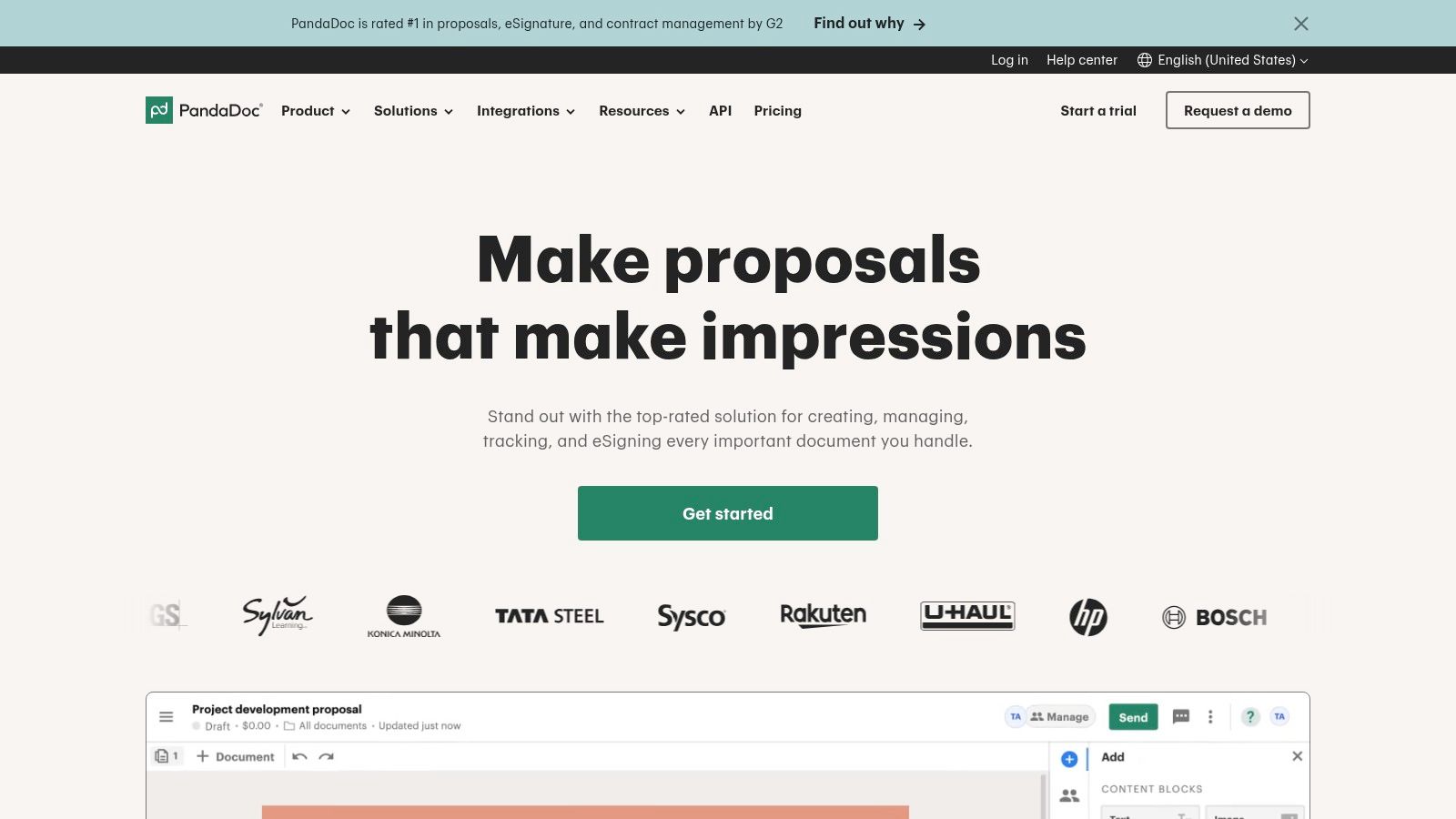
What truly sets PandaDoc apart is its integration of the entire sales document workflow. You can build professional-looking proposals using a drag-and-drop editor, leverage a content library for reusable sections, and then track opens, views, and time spent on each section. The platform’s AI Smart Organizer helps structure and manage your document library, while its AI Assistant can help you generate or refine content, ensuring your proposals are polished and effective.
Key Features & Use Cases
- Best For: Small-to-large agencies and sales teams needing a comprehensive solution that handles drafting, sending, tracking, e-signing, and payment collection.
- Standout Features: Integrated e-signatures and payment gateways (Stripe, PayPal), robust CRM integrations (Salesforce, HubSpot), and document analytics.
- Practical Tip: Use the content library to store pre-approved case studies, testimonials, and service descriptions. This ensures consistency and dramatically speeds up the creation of custom proposals. You can review some great examples of job proposal elements to include in your library for maximum impact.
Pros:
- Manages the full document lifecycle from draft to payment.
- High-level security and compliance (SOC 2, HIPAA).
- Scales effectively from individual users to enterprise teams.
Cons:
- AI features are still evolving and not as central as in dedicated AI writers.
- The per-seat pricing model can become costly for larger teams.
Pricing: Plans start with a free eSign option. Paid plans begin at $19 per user/month (billed annually) for the "Essentials" plan, with "Business" and "Enterprise" tiers offering more advanced features like CRM integrations and automation.
Website: https://www.pandadoc.com
3. Qwilr
Qwilr transforms traditional, static proposals into modern, interactive web pages that engage clients and close deals faster. While known for its beautiful design and analytics, Qwilr has embraced AI to accelerate the initial creation process. Its free AI Proposal Creator can scan your company website and generate a well-structured first draft, making it one of the best AI tools for proposal writing for teams that prioritize presentation and client experience.
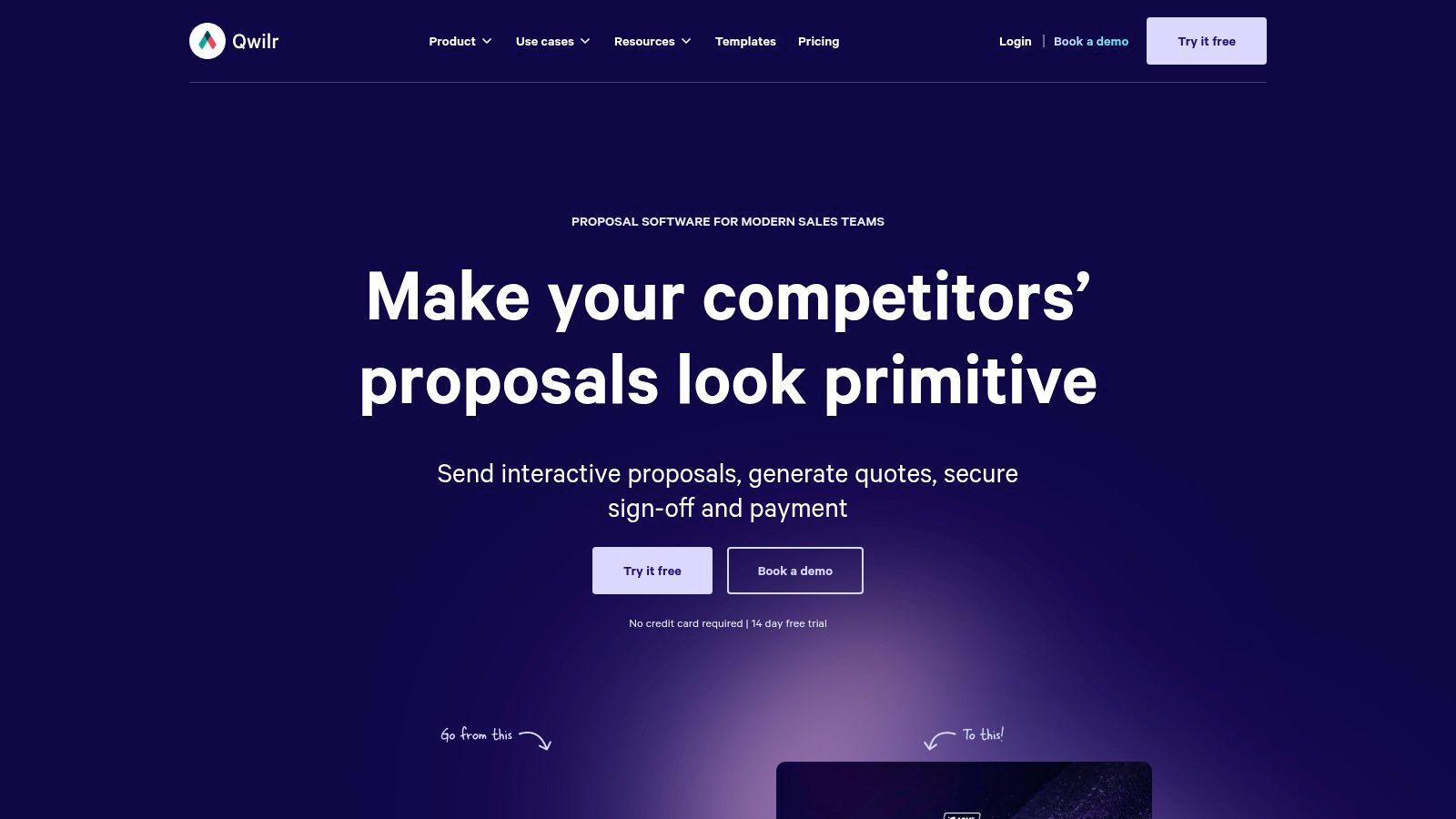
What sets Qwilr apart is its focus on the proposal as an interactive, data-driven sales asset. You can embed videos, dynamic pricing calculators, and calendars directly into your proposal page. The platform provides detailed analytics on who viewed your proposal, which sections they focused on, and for how long, giving you powerful insights for timely and relevant follow-ups. Integrating payments and e-signatures directly into the web page creates a seamless, low-friction path for your client to say yes.
Key Features & Use Cases
- Best For: Creative agencies, sales teams, and freelancers who want to present their services in a highly polished, interactive format that stands out from standard PDFs.
- Standout Features: AI Proposal Creator for rapid first drafts, interactive pricing tables, built-in e-signatures and Stripe payments, and detailed page analytics.
- Practical Tip: Leverage the interactive pricing feature to offer clients configurable packages or optional add-ons. This empowers them to build their own quote and can significantly increase the average deal size.
Pros:
- Produces stunning, client-friendly proposal presentations.
- AI-powered first-draft generation dramatically reduces formatting time.
- Strong analytics inform follow-up strategy and timing.
Cons:
- Per-user pricing and minimum seat requirements can be costly.
- Delivers the best experience when paired with a CRM for automation.
Pricing: Qwilr offers two main tiers. The "Business" plan is $35 per user/month (billed annually) with a 3-seat minimum, while the "Enterprise" plan is $59 per user/month (billed annually) with a 5-seat minimum.
Website: https://qwilr.com
4. Proposify
Proposify is a dedicated proposal software solution designed for growing sales teams that need control, consistency, and insight into their sales documents. While its core strength lies in traditional proposal management rather than generative AI, its structured workflow and robust features make it a strong contender for teams aiming to standardize their sales process. It’s an excellent choice for organizations where brand consistency, approval workflows, and proposal analytics are top priorities.
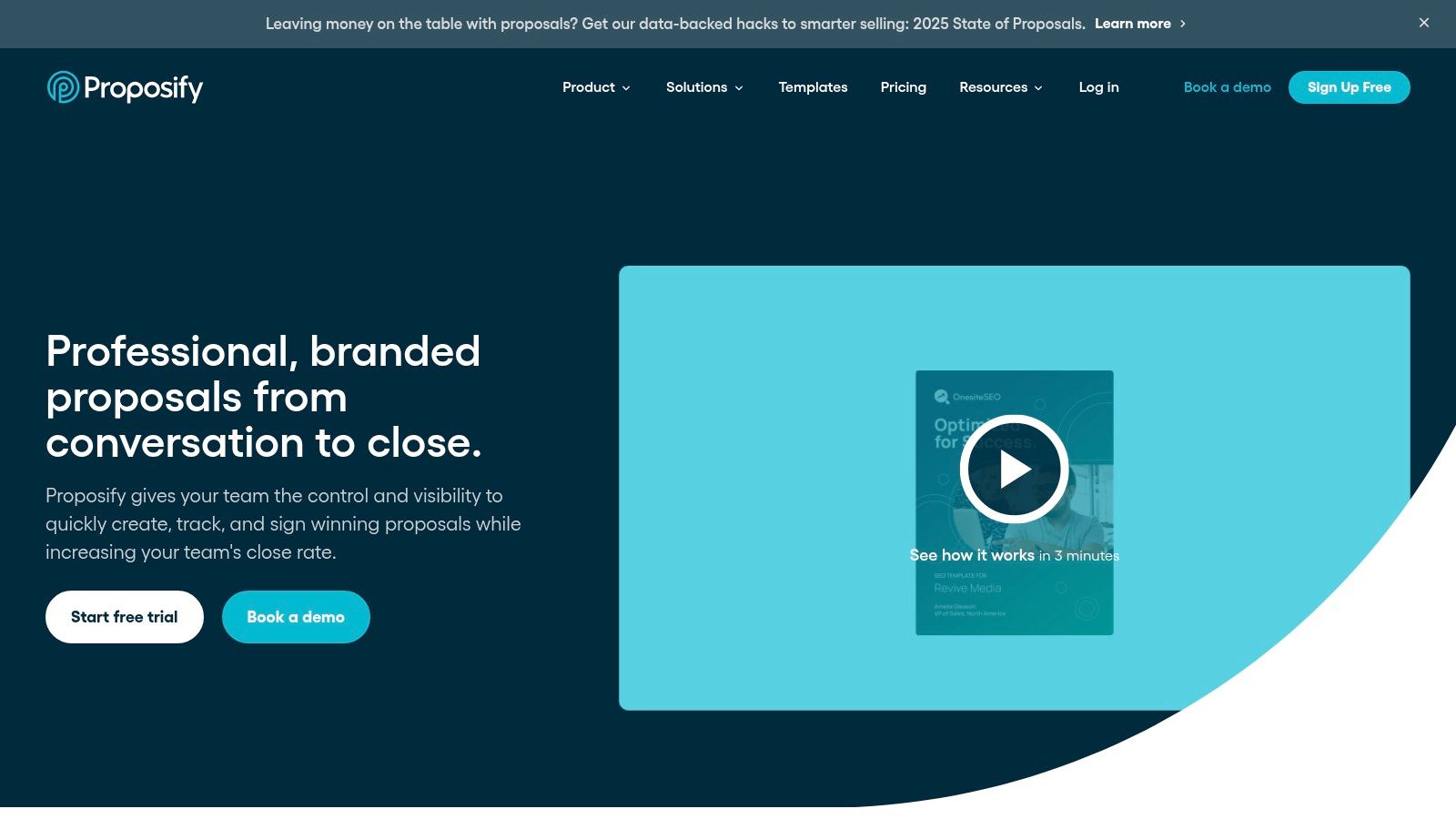
What makes Proposify stand out is its emphasis on team collaboration and governance. You can create a locked-down content library of pre-approved sections, fee tables, and templates, ensuring that every proposal sent by your team is on-brand and accurate. Its detailed analytics provide valuable data on which sections of your proposals are being viewed the most, helping you refine your content for better engagement and higher close rates.
Key Features & Use Cases
- Best For: Growing agencies and sales teams that require strong governance, approval workflows, and detailed analytics to manage multiple proposal writers.
- Standout Features: Centralized content library, role-based permissions and approval workflows, integrated e-signatures, and detailed proposal-level analytics.
- Practical Tip: Use the Roles and Permissions feature to set up an approval workflow. Have junior team members draft proposals from the content library, which can then be automatically routed to a manager for review before being sent to the client, ensuring quality control.
Pros:
- Strong governance and brand control features for multi-user teams.
- Useful analytics provide deep insights into proposal engagement.
- Transparent plan tiering makes it easy to choose the right fit.
Cons:
- AI features are not a primary focus compared to other dedicated tools.
- Lower-tier plans may have limits on the number of active documents.
Pricing: Offers a free plan for a single user with up to 5 active documents. The "Team" plan starts at $49 per user/month, offering unlimited documents, standard integrations, and templates. A "Business" plan provides advanced features like Salesforce integration and premium support.
Website: https://www.proposify.com
5. Better Proposals
Better Proposals is a streamlined platform designed to help freelancers and small agencies create, send, and manage professional-looking proposals quickly and affordably. While its AI is more instructional than integrated, it provides clear guidance on leveraging tools like ChatGPT to speed up drafting within its well-structured environment. This makes it one of the best AI tools for proposal writing if your priority is creating visually appealing, branded documents on a budget, without the complexity of an all-in-one suite.
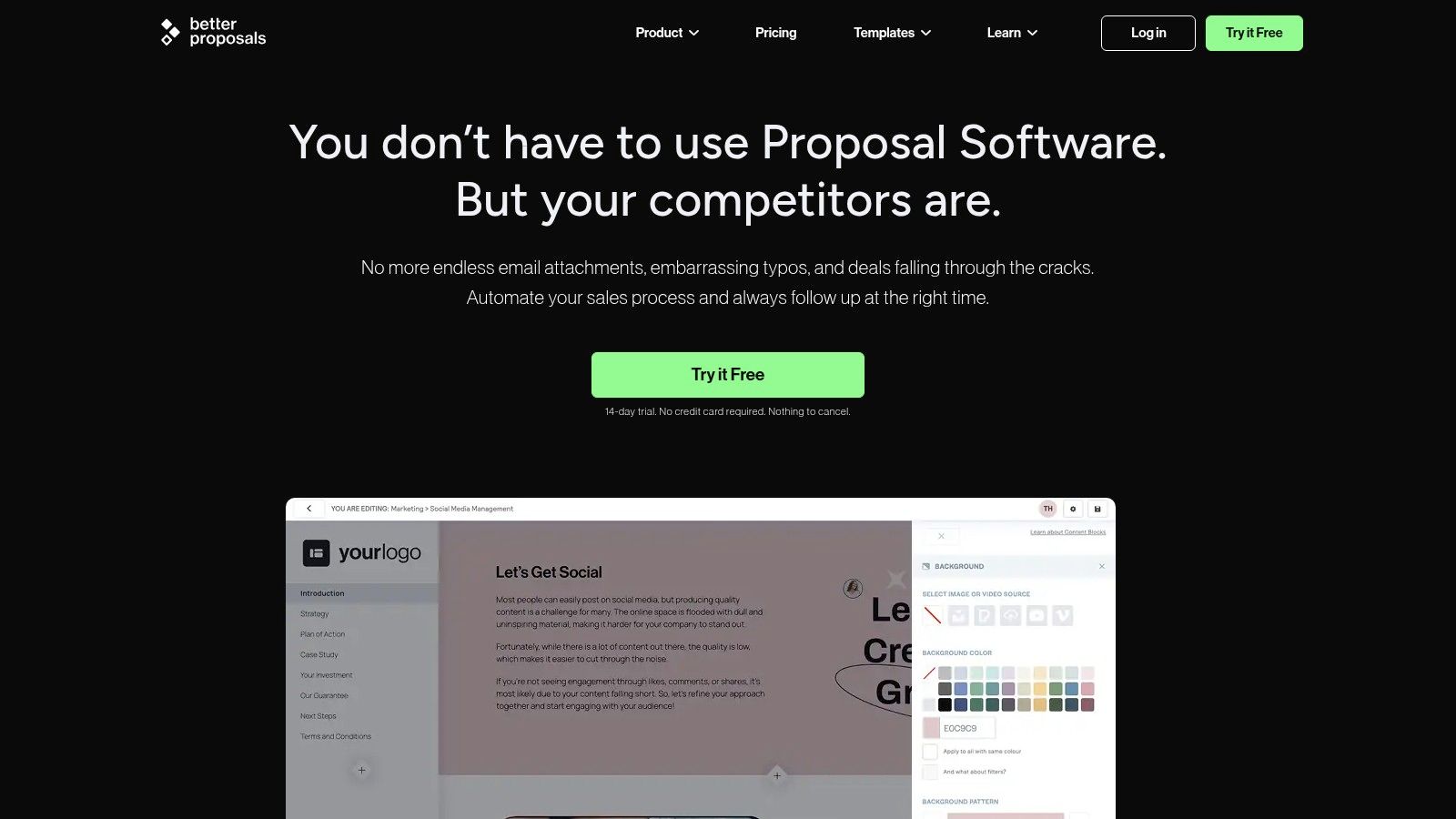
The platform’s strength lies in its simplicity and focus on the core proposal process. Users can choose from a library of templates, customize them with a drag-and-drop editor, and embed interactive pricing tables that clients can accept directly. It also includes essential features like document analytics, e-signatures, and payment integrations, which are crucial for closing deals efficiently. The AI guidance helps users quickly populate these templates with compelling copy.
Key Features & Use Cases
- Best For: Freelancers and small agencies who need an easy-to-use, budget-friendly tool for creating branded proposals with integrated signing and payment.
- Standout Features: Interactive pricing tables, a large library of professional templates, and payment gateway integrations (Stripe, PayPal, GoCardless).
- Practical Tip: Use the content library to save your best-performing sections, like your "About Us" or "Our Process" pages. This allows you to assemble new, customized proposals in minutes rather than starting from scratch each time.
Pros:
- Low entry price is highly accessible for solo operators.
- Very quick to produce consistent, branded proposals.
- Straightforward onboarding and easy to use.
Cons:
- AI is more assistive than deeply embedded in the workflow.
- Advanced features like CRM integrations and custom domains are gated on higher tiers.
Pricing: The "Starter" plan begins at $19 per user/month, with "Premium" and "Enterprise" plans offering more features like analytics and integrations.
Website: https://betterproposals.io
6. Responsive (formerly RFPIO)
Responsive is an enterprise-grade strategic response management platform designed for the complexities of RFPs, RFIs, security questionnaires, and large-scale proposals. It’s a specialized solution for organizations with high-volume or intricate response needs, using AI agents to interpret questions and draft tailored answers from a centralized content library. This makes it one of the best AI tools for proposal writing when dealing with structured, repetitive, and content-heavy documents.
What truly distinguishes Responsive is its focus on content governance and intelligent automation at scale. Instead of just generating new text, its AI leverages a meticulously curated "Answer Library" to pull the most accurate, up-to-date, and pre-approved information. This system ensures brand consistency, technical accuracy, and significant time savings across large teams, turning the daunting task of responding to a 200-question RFP into a streamlined, manageable workflow.
Key Features & Use Cases
- Best For: Enterprise sales and proposal management teams in sectors like tech, healthcare, and finance that regularly respond to complex RFPs, RFIs, and security questionnaires.
- Standout Features: AI-powered Content Library (Answer Library), automated response generation, collaboration workflows, requirements analysis, and enterprise-grade security with SSO.
- Practical Tip: Invest heavily in curating your Content Library. Tag entries with metadata like "last updated," "product line," and "approved by legal" to empower the AI to pull the most relevant and compliant answers automatically.
Pros:
- Purpose-built to accelerate complex, high-volume RFPs and proposals.
- Provides significant time savings and content governance for large teams.
- Strong integrations and enterprise-grade security features.
Cons:
- Pricing is not public and requires a custom sales quote.
- Can be overly complex for smaller businesses or simple proposals.
Pricing: Responsive does not list public pricing. You must contact their sales team for a custom quote based on your organization's specific needs and scale.
Website: https://www.responsive.io
7. Loopio
Loopio is an enterprise-grade proposal and RFP response platform designed for teams that handle high volumes of complex questionnaires. It excels by centralizing an organization's knowledge into an intelligent content library, which its AI then uses to automate first-draft answers. While its price point positions it for larger organizations, it is one of the best AI tools for proposal writing for dedicated teams needing structured workflows and repeatable accuracy.
What makes Loopio unique is its rigorous, library-centric approach. Instead of generating content from a broad LLM, its AI primarily drafts responses based on your company's curated and approved library entries. This ensures brand consistency, accuracy, and compliance. The platform layers this with sophisticated project management, including multi-step review workflows, SME assignments, and detailed progress tracking, making it a command center for large-scale proposal operations.
Key Features & Use Cases
- Best For: Enterprise and mid-market companies with dedicated proposal teams that frequently respond to RFPs, RFIs, and security questionnaires.
- Standout Features: Intelligent content library with AI-powered answer suggestions, multi-language capabilities with translation add-ons, and structured multi-step review workflows for quality assurance.
- Practical Tip: Invest time in curating and tagging your content library. The more high-quality, approved content the AI has to draw from, the more effective and automated your response process will become.
Pros:
- Specifically designed for teams handling frequent, complex questionnaires.
- Strong enterprise controls, security, and structured workflows.
- Add-ons for translation and structured onboarding are available.
Cons:
- High price point makes it unsuitable for freelancers or small agencies.
- Requires significant process setup and change management to realize full value.
Pricing: Loopio is an enterprise solution with custom pricing. Plans like "Foundations" reportedly start around $20,000 per year, with higher tiers available.
Website: https://loopio.com
8. Jasper
Jasper is an enterprise-grade AI writing platform designed to produce consistent, on-brand content at scale. While it's a general-purpose AI writer, its advanced features for brand control and collaboration make it a powerful choice for teams drafting detailed proposals, statements of work (SOWs), or other long-form sales documents. It’s one of the best AI tools for proposal writing when maintaining a strict brand voice and messaging consistency across all team-generated content is the top priority.

What sets Jasper apart is its robust governance layer over generative AI. Features like Brand Voice and Knowledge allow you to train the AI on your company’s specific messaging, style guides, and product information. This ensures that every piece of a proposal, from the executive summary to the detailed service descriptions, aligns perfectly with your brand identity, regardless of which team member is writing it.
Key Features & Use Cases
- Best For: Marketing and sales teams in mid-to-large companies that need strong brand governance and collaboration features for drafting consistent, high-quality proposal copy.
- Standout Features: Centralized Brand Voice and Knowledge assets, collaborative "Canvas" workspace for long-form documents, and extensive integrations with tools like Google Docs and Slack.
- Practical Tip: Create a detailed Knowledge asset with your company's core value propositions, case study summaries, and objection handlers. This gives Jasper the context it needs to generate highly relevant and persuasive proposal sections instantly. This approach is especially effective when combined with dedicated Upwork proposal software to tailor your messaging for specific platforms.
Pros:
- Excellent brand governance and content consistency controls.
- Designed for multi-stakeholder collaboration on complex documents.
- Enterprise-grade privacy and security, including SOC 2 compliance options.
Cons:
- Not a dedicated proposal platform; lacks e-signatures, analytics, or payments.
- Per-seat pricing can be expensive for teams with only light usage needs.
Pricing: Plans begin with the "Creator" tier at $39 per user/month (billed annually). The "Pro" and "Business" tiers offer more advanced collaboration, brand controls, and API access.
Website: https://www.jasper.ai
9. Copy.ai
Copy.ai is an advanced AI chat and automation platform designed for high-speed research, drafting, and personalization of proposal content. Rather than managing the entire document workflow, it specializes in generating the core components like executive summaries, project scopes, and case studies with remarkable speed. Its ability to access multiple AI models (including from OpenAI, Anthropic, and Gemini) makes it a versatile tool for teams needing to produce highly tailored content quickly.
What sets Copy.ai apart is its "Workflows" feature, which allows you to build custom agents that automate repetitive writing tasks, such as personalizing proposal intros based on a client's website or LinkedIn profile. This makes it one of the best AI tools for proposal writing if your bottleneck is creating unique, client-specific content at scale. The platform is built for team collaboration, enabling you to share projects and successful prompts.
Key Features & Use Cases
- Best For: Agencies and sales teams that need to rapidly generate and personalize proposal sections, follow-up emails, and other sales collateral.
- Standout Features: Access to multiple best-in-class AI models, a powerful Workflow builder for creating custom automations, and strong team collaboration features.
- Practical Tip: Create a "Proposal Section Generator" workflow. Feed it your client's company URL and job description, and program it to automatically research their pain points and draft a tailored introduction and "Our Understanding" section.
Pros:
- Excellent for fast first-draft generation and scaling personalization.
- Highly useful for assembling all proposal-related content, including follow-ups.
- Clear pricing plans that support both individuals and growing teams.
Cons:
- It is not an end-to-end proposal or e-signature platform; it must be paired with another tool.
- The credit system for workflows can be complex to manage initially.
Pricing: Offers a free plan with a 2,000-word limit. Paid plans start at $36 per month (billed annually) for the "Pro" plan, with "Team" and "Enterprise" tiers offering more seats, credits, and advanced automation features.
Website: https://www.copy.ai
10. Writesonic
Writesonic is a versatile AI writing assistant that offers a strong suite of tools for generating business and sales collateral, including proposals. While not a dedicated proposal management platform, it excels at rapidly creating content for various sections of a proposal, from executive summaries to detailed service descriptions. It stands out for its user-friendly templates and multi-language support, making it one of the best AI tools for proposal writing for freelancers and small teams needing to produce high-quality drafts quickly and affordably.
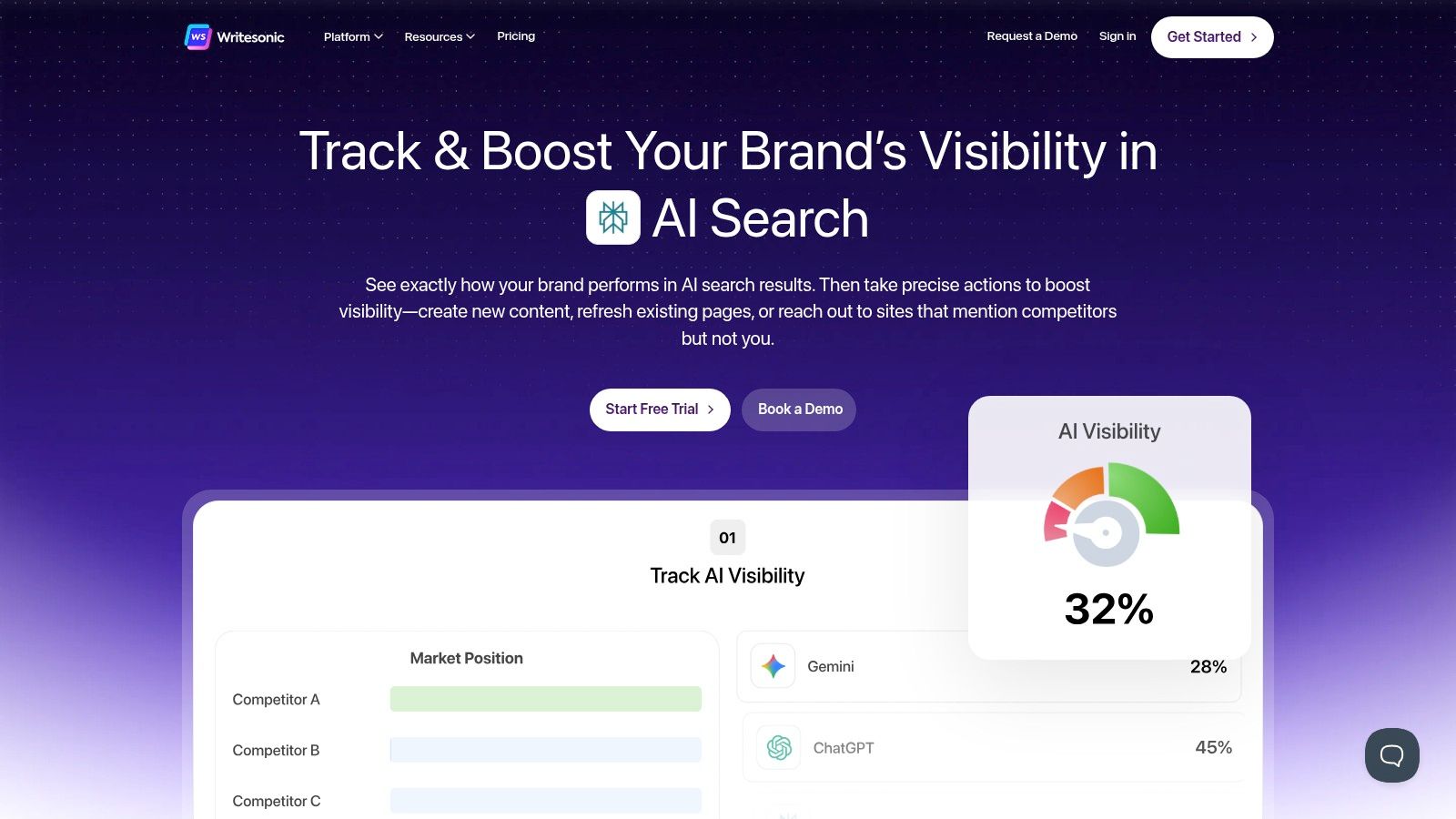
What makes Writesonic a valuable asset is its focus on structured content creation. Instead of starting from a blank page, users can leverage specific templates designed for sales copy and business documents. Its long-form writer, which can be trained on a brand's voice, helps ensure that all generated content remains consistent with your company's style. This combination of speed and brand alignment allows you to assemble professional proposals much faster than manual methods.
Key Features & Use Cases
- Best For: Solo freelancers, consultants, and small marketing teams who need a cost-effective tool to quickly draft content for proposals, emails, and other sales materials.
- Standout Features: A large library of specific writing templates, brand voice customization, multi-language generation, and various export options for easy integration into your final document.
- Practical Tip: Use the "Business Proposals" template to generate a solid first draft of your introduction and scope of work. Then, use the "Tone of Voice" feature to refine the text to match your client's industry, whether it's formal for a corporate client or creative for a startup.
Pros:
- Highly competitive pricing, especially for individual users.
- Generates content for common proposal sections very quickly.
- Offers multi-language support, beneficial for international clients.
Cons:
- It's a content generator, not a full proposal platform (no e-signatures or analytics).
- Feature limits and plan names can change, requiring you to check their site for the latest details.
Pricing: Offers a free plan with a word credit limit. Paid plans like "Individual" start around $16 per month, with "Teams" and "Enterprise" plans available for larger organizations. Annual billing provides a significant discount.
Website: https://writesonic.com
11. Notion (with Notion AI)
Notion has evolved from a popular note-taking app into a comprehensive all-in-one workspace, making it a strong contender for managing the entire proposal creation process. With the integration of Notion AI, it becomes a powerful environment for drafting, collaborating on, and organizing proposals. It shines as a central hub where teams can store reusable content, track opportunities, and leverage AI to refine their messaging from start to finish.
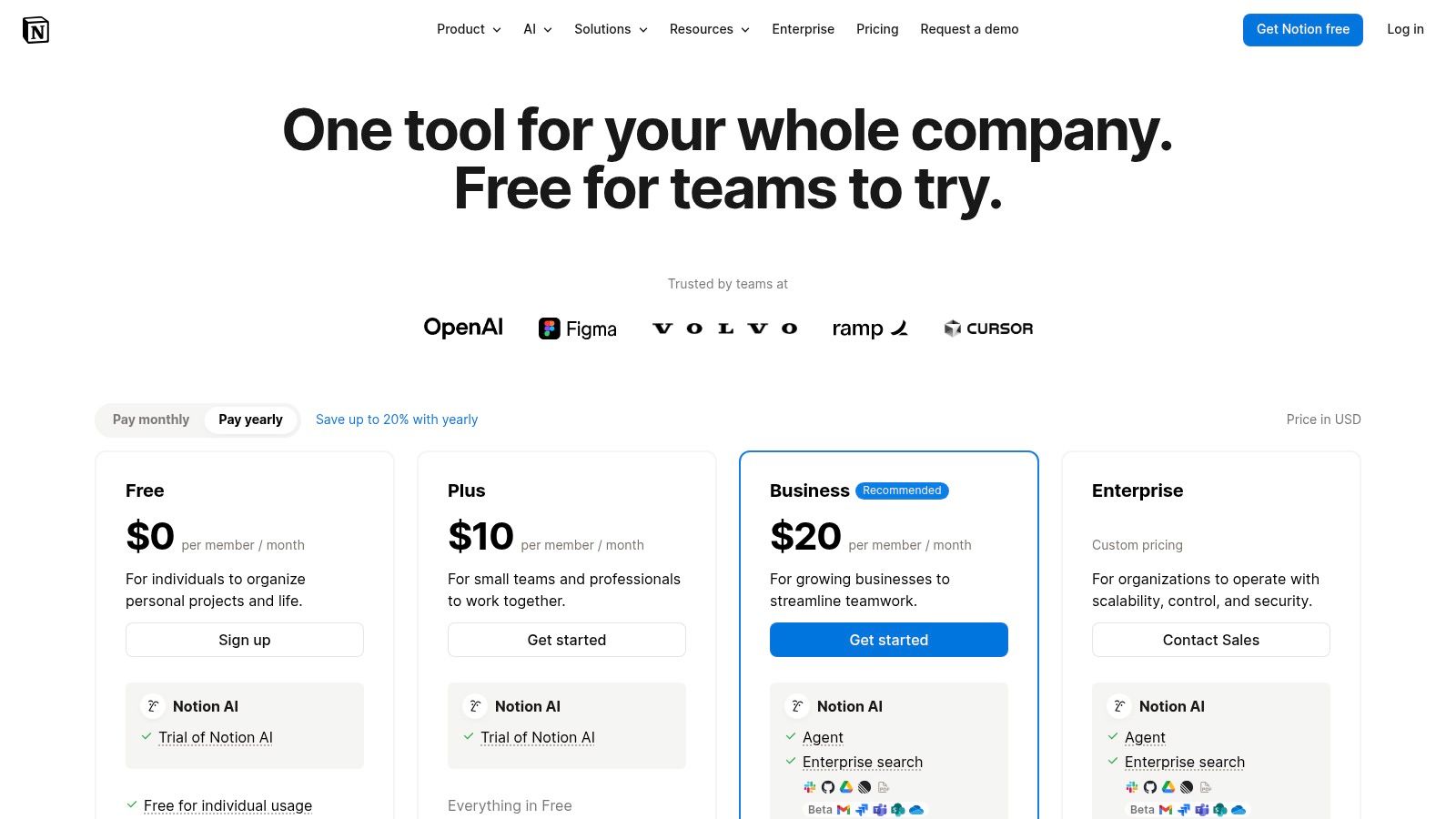
What makes Notion unique is its ability to embed AI assistance directly within the workflow where your team already operates. You can use its databases to build a sophisticated content library for case studies and pricing tables, or create a pipeline to track proposal stages. Notion AI can then be called upon to summarize research, draft initial sections based on your database entries, or rewrite paragraphs for clarity and tone, making it one of the best AI tools for proposal writing for teams that value consolidation.
Key Features & Use Cases
- Best For: Teams and freelancers who want a single, highly customizable platform to manage their entire proposal workflow, from ideation and asset management to drafting and internal reviews.
- Standout Features: Integrated AI for drafting, summarizing, and brainstorming; powerful databases for creating content libraries and sales pipelines; extensive customization and collaboration tools.
- Practical Tip: Create a master "Proposal Components" database in Notion. Store individual, pre-approved sections like your company bio, service descriptions, and testimonials. When building a new proposal, you can easily pull these components together and use Notion AI to tailor the language for the specific client.
Pros:
- Centralizes all proposal assets, templates, and approvals in one place.
- AI is seamlessly embedded in the workspace, reducing context switching.
- Highly flexible and can be adapted to almost any proposal workflow.
Cons:
- Requires a learning curve to design and implement a robust system.
- The most useful AI features and team functionalities are tied to paid plans.
Pricing: Notion offers a free personal plan. Paid team plans start with the "Plus" plan at $8 per user/month (billed annually), with the "Business" and "Enterprise" tiers offering more advanced features. Notion AI is available as an add-on for $8 per member/month.
Website: https://www.notion.com/pricing
12. Grammarly
Grammarly is an indispensable AI-powered writing assistant that serves as the final quality control checkpoint for any proposal. While not a proposal generation platform, its strength lies in polishing your final draft for clarity, tone, and professionalism. It goes beyond basic spell-checking to offer advanced suggestions on conciseness, word choice, and overall readability, ensuring your message lands with impact. For teams prioritizing error-free communication, it’s one of the best AI tools for proposal writing refinement.
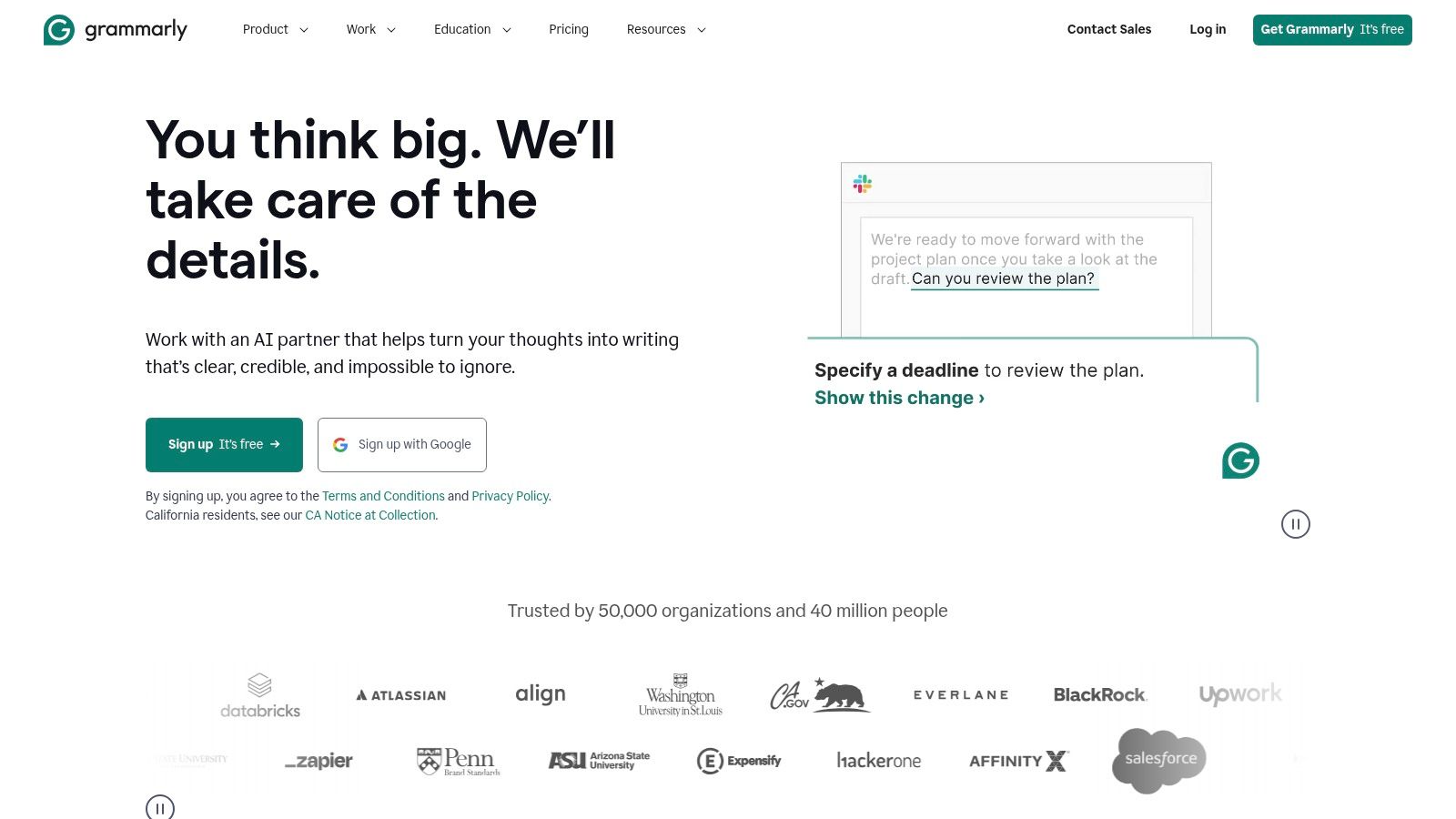
What sets Grammarly apart is its ubiquitous integration and specialized feedback. It works seamlessly across web browsers, document editors like Google Docs and Microsoft Word, and email clients, providing consistent checks wherever you write. The generative AI prompts can help you rephrase awkward sentences or expand on ideas directly within your document. Its tone detector is particularly valuable, helping you confirm your proposal sounds confident, persuasive, and professional before you hit send.
Key Features & Use Cases
- Best For: Freelancers, agencies, and sales teams who need a reliable tool to proofread and elevate the quality of their writing before submission.
- Standout Features: Advanced tone detection, clarity and conciseness suggestions, plagiarism checker, and generative AI prompts for rewriting and brainstorming.
- Practical Tip: Use the "Set goals" feature to tailor Grammarly’s feedback to your specific audience (e.g., expert) and intent (e.g., to persuade). This provides more relevant and effective suggestions for your proposal.
Pros:
- Dramatically improves the professionalism and readability of any proposal.
- Integrates across most platforms where you write, ensuring consistency.
- Simple per-seat pricing makes it accessible for individuals and teams.
Cons:
- It is a writing enhancement tool, not a full proposal management platform.
- The most powerful features require a paid subscription and an internet connection.
Pricing: Offers a free version with basic grammar and spelling checks. Premium plans start at $12 per month (billed annually) for individuals, with Business plans offering team-focused features like style guides and analytics.
Website: https://www.grammarly.com
Choosing the Right AI Tool to Win More Proposals
Navigating the landscape of AI-powered software can feel overwhelming, but the journey to finding the best AI tools for proposal writing is about identifying your most significant bottleneck. As we've explored, the solutions range from comprehensive, end-to-end platforms to specialized writing assistants, each designed to solve a different part of the proposal puzzle. Your ideal tool is the one that directly addresses your primary challenge, whether it's the speed of response, the quality of your copy, or the management of your entire sales process.
The key takeaway is to move beyond simply generating text. The true power of AI in this context lies in its ability to augment your strategy, streamline repetitive tasks, and give you back the time needed to focus on high-value activities like client relationships and project execution. A generic AI writer can help you overcome a blank page, but a purpose-built platform can transform your entire client acquisition workflow.
Your Path Forward: Matching Tools to Your Needs
To make the right choice, start by evaluating your current proposal process. Pinpoint where you lose the most time or where quality suffers. Your selection should be a strategic decision, not just a technological one.
- For Speed and Scale (Especially on Upwork): If your primary goal is to respond to a high volume of relevant job postings on platforms like Upwork without sacrificing personalization, a full-cycle automation tool is your best bet. A solution like Earlybird AI is specifically engineered for this environment, handling everything from lead discovery to crafting and sending personalized bids. This is for users who need to win the race to the client's inbox.
- For Formal Proposal Management: If your business relies on creating, sending, and tracking traditional, long-form proposals, then dedicated proposal management software is essential. Tools like PandaDoc, Qwilr, and Proposify excel here, offering features like interactive elements, e-signatures, and detailed analytics to see how clients engage with your documents.
- For Content and Copy Enhancement: If your core challenge is improving the clarity, tone, and persuasiveness of your writing, then an AI writing assistant is an invaluable addition. Jasper, Copy.ai, and Grammarly can integrate into your existing workflow, helping you refine drafts, generate compelling case study narratives, and ensure every proposal is polished and professional.
Final Considerations for Implementation
Before you commit, consider the integration aspect. How will this new tool fit into your existing stack? For Upwork freelancers and agencies, a tool that understands the platform's unique ecosystem is critical. Also, consider the learning curve. The most powerful tool is useless if your team finds it too complex to adopt. Start with the solution that offers the most immediate impact on your biggest pain point.
Ultimately, the goal is not just to write proposals faster, but to win more business. The right AI tool acts as a force multiplier, enabling you to submit higher-quality, better-targeted proposals in a fraction of the time. By strategically integrating these technologies, you can shift from a reactive, time-consuming process to a proactive, data-driven sales engine that consistently closes deals and fuels your growth.
Ready to stop manually searching for jobs and writing bids from scratch? Earlybird AI is the all-in-one platform designed to automate your entire Upwork client acquisition process. See how Earlybird AI can find your ideal clients and write winning proposals for you by visiting Earlybird AI to learn more.