← Back To Blog
A Guide to Bidding on Upwork and Winning High-Value Clients
Bidding on Upwork is all about speed, precision, and making a genuine connection. Seriously, those first two sentences of your proposal? They're everything. They decide whether a client hits "reply" or "archive." If you want to win, you have to ditch the copy-paste templates and build a strategy that gets you in front of clients fast, but with a message that proves you actually read their job post.
It’s the only way to cut through the noise in a client’s completely overloaded inbox.
The New Reality of Bidding on Upwork
Let’s be real: the old spray-and-pray method is dead. Sending out dozens of generic proposals and just hoping one sticks simply doesn't work anymore. Clients today are drowning in options, which means our approach to bidding on Upwork has to be a whole lot smarter.
The biggest challenge isn't proving you have the skills. It's just getting your proposal seen. Think of a client's inbox as a digital mountain of resumes. Only the most relevant, compelling, and timely bids ever make it to the top of the pile.
A Brutally Competitive Field
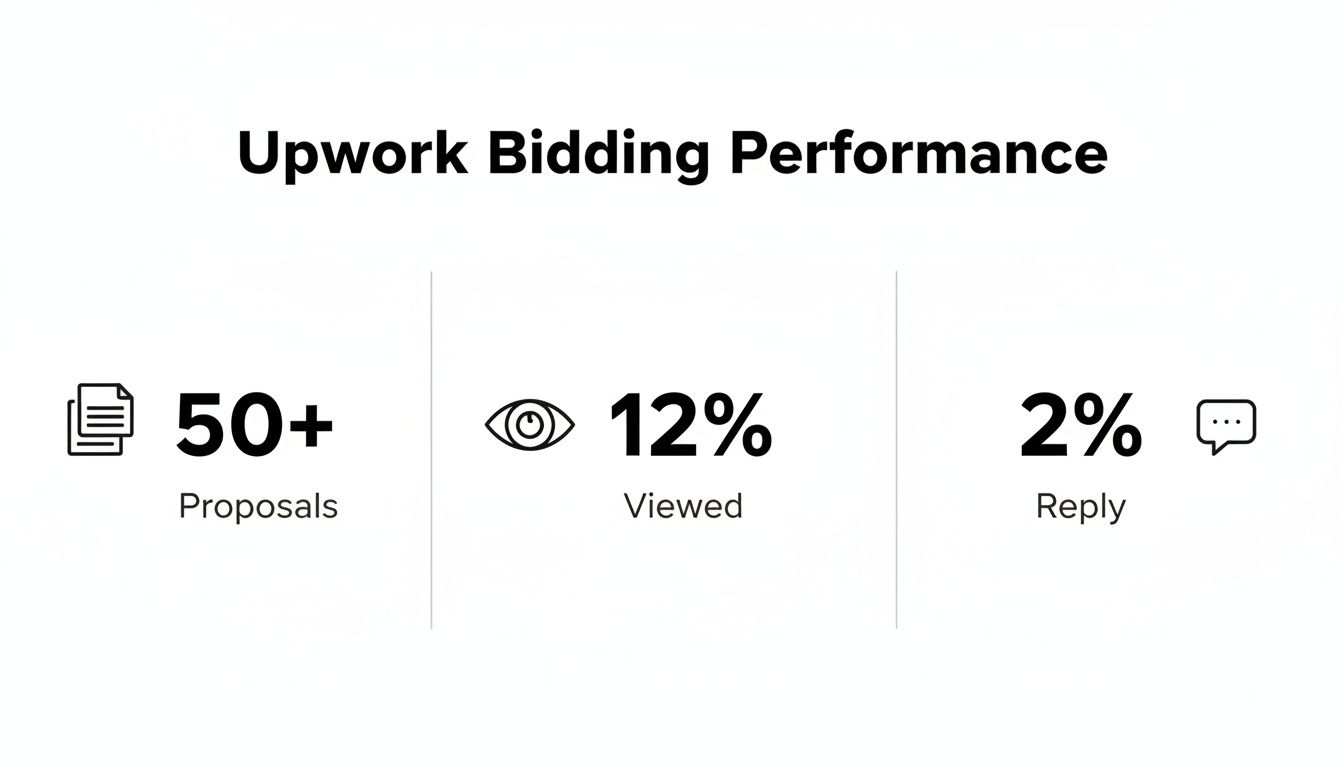
The sheer volume of competition is staggering. For any decent project, a client is likely to get 50 or more proposals. Sometimes in just a few hours. And they're certainly not reading all of them.
This flood of bids has completely changed the game. The average proposal view rate is a dismal 12%. That means nearly nine out of ten proposals you send will never even be opened. Even worse, the average reply rate—the golden ticket—hovers around a tiny 2%. You can dig deeper into these proposal metrics to see just how tough the numbers are.
This dashboard gives you a visual of the odds we're all up against.
These stats aren't meant to discourage you; they're a wake-up call. If you're just bidding and hoping for the best, you're pretty much guaranteed to get lost in the crowd.
It's Time for a New Bidding Playbook
To win in this environment, you need a completely new mindset. Stop thinking like a job applicant and start acting like a strategic partner from the very first sentence. I've found that a winning strategy really comes down to three core pillars:
- Be First (or Close to It): Getting your bid in quickly matters. A lot. Clients often review proposals as they roll in, so being one of the first gives you a massive advantage.
- Personalize, Don't Generalize: Your proposal must immediately show you understand the client's specific problem. "Hi, I'm a great writer" is a one-way ticket to the trash folder.
- Target the Right Clients: Chasing every single project is a waste of time and Connects. Focus your energy on jobs where your expertise is a perfect match. That's how you boost your win rate.
The goal isn't just to send a proposal anymore. It's to start a conversation. Your bid should feel like the beginning of a consultation, showing your value before a contract is even on the table.
By shifting to this modern approach, you stop playing by the platform's depressing averages and start getting the kind of replies that lead to fantastic, high-paying projects. The rest of this guide will show you exactly how to build and execute this strategy, step by step.
Building Your Foundation for Bidding Success
Before you even think about spending your next Connect, let’s get one thing straight: your proposals are only as good as the profile they lead back to. It’s a hard truth, but even the most perfectly crafted proposal will fall flat if it links to a weak or generic profile.
Your profile isn't just a digital resume. It’s your storefront, your sales pitch, and your credibility check, all rolled into one.

Put yourself in the client's shoes for a second. They read your compelling opening line, they're intrigued, and what's the very next thing they do? They click on your name to see if you’re the real deal. What they find there needs to seal the deal, not plant a seed of doubt.
Turning Your Profile Into a Sales Engine
Most freelancer profiles are just… there. They're forgettable lists of skills and job histories. A powerful profile, on the other hand, speaks directly to a client's problems and screams, "I am the solution you've been looking for." It shifts the focus from what you do to what you can achieve for their business.
Ready to start optimizing? Here’s how.
- Write a Benefit-Driven Headline: Your headline is prime real estate. Ditch "Expert Web Developer" and try something that sells a result, like "E-commerce Web Developer Specializing in Shopify Speed & Conversion Optimization." See the difference? The second one speaks directly to a business goal.
- Create a Client-Centric Summary: No one wants to read your entire life story. The first two sentences are all you have to grab their attention. Start with their problem. For example: "Losing sales from a slow, clunky checkout process? I help e-commerce brands boost revenue by building faster, more intuitive user experiences that customers love."
- Show, Don't Just Tell, with Your Portfolio: Your portfolio isn’t an art gallery; it’s a collection of success stories. Each entry needs to be a mini case study: outline the client's problem, explain your solution, and—most importantly—show the results. Quantify everything. Use metrics like "Increased conversion rate by 15%" or "Slashed page load time by 2 seconds."
This isn't just about tweaking a few words. It's a strategic shift that builds a rock-solid business case for why a client should hire you over the dozens of other people bidding.
Defining Your Ideal Client Profile
The second pillar of a strong foundation is knowing exactly who you’re talking to. Spraying proposals at every vaguely relevant job post is a surefire way to burn through your Connects and get zero replies. The freelancers and agencies who crush it on Upwork are laser-focused. They build a crystal-clear Ideal Client Profile (ICP).
An ICP isn't just about setting job filters. It's about deeply understanding the characteristics of the clients you do your best work for—the ones who value your skills, respect your pricing, and are a dream to collaborate with.
Defining your ICP isn't about limiting your options; it's about focusing your energy where you have the highest probability of winning. It's the strategic core of all successful bidding on Upwork.
To build your own ICP, go back and look at your best projects. What did they have in common?
Think about these factors:
- Project Type: Do you thrive on complex, multi-stage projects or are you better at knocking out quick, well-defined tasks?
- Client History: Look for clients with a high hire rate and positive reviews. Someone with a 90% or higher hire rate and a solid spending history is serious and ready to move.
- Budget Level: What do your best clients typically spend? Aim for projects in that sweet spot to filter out the low-ballers looking for the cheapest option.
- Industry Niche: Are you an expert in a specific field like SaaS, healthcare, or real estate? Specializing makes you an instant authority.
Once you have this ICP nailed down, your job feed completely changes. It goes from being a chaotic sea of random opportunities to a curated list of high-potential leads. This is how you make every Connect count, setting yourself up for real, sustainable growth.
Writing High-Converting Proposals That Get Replies
Once your profile is a polished sales asset, the real work begins. Sending a proposal is the moment you transition from a passive candidate to an active consultant. This is where you turn a simple bid into a real conversation, and honestly, it's the single most important skill for winning on Upwork.
The average proposal is a generic, self-focused plea that gets instantly archived. A winning one, though, is a client-centric sales pitch. It proves you understand their problem and are already thinking about the solution. It’s not about listing your skills; it’s about connecting your skills directly to their goals.
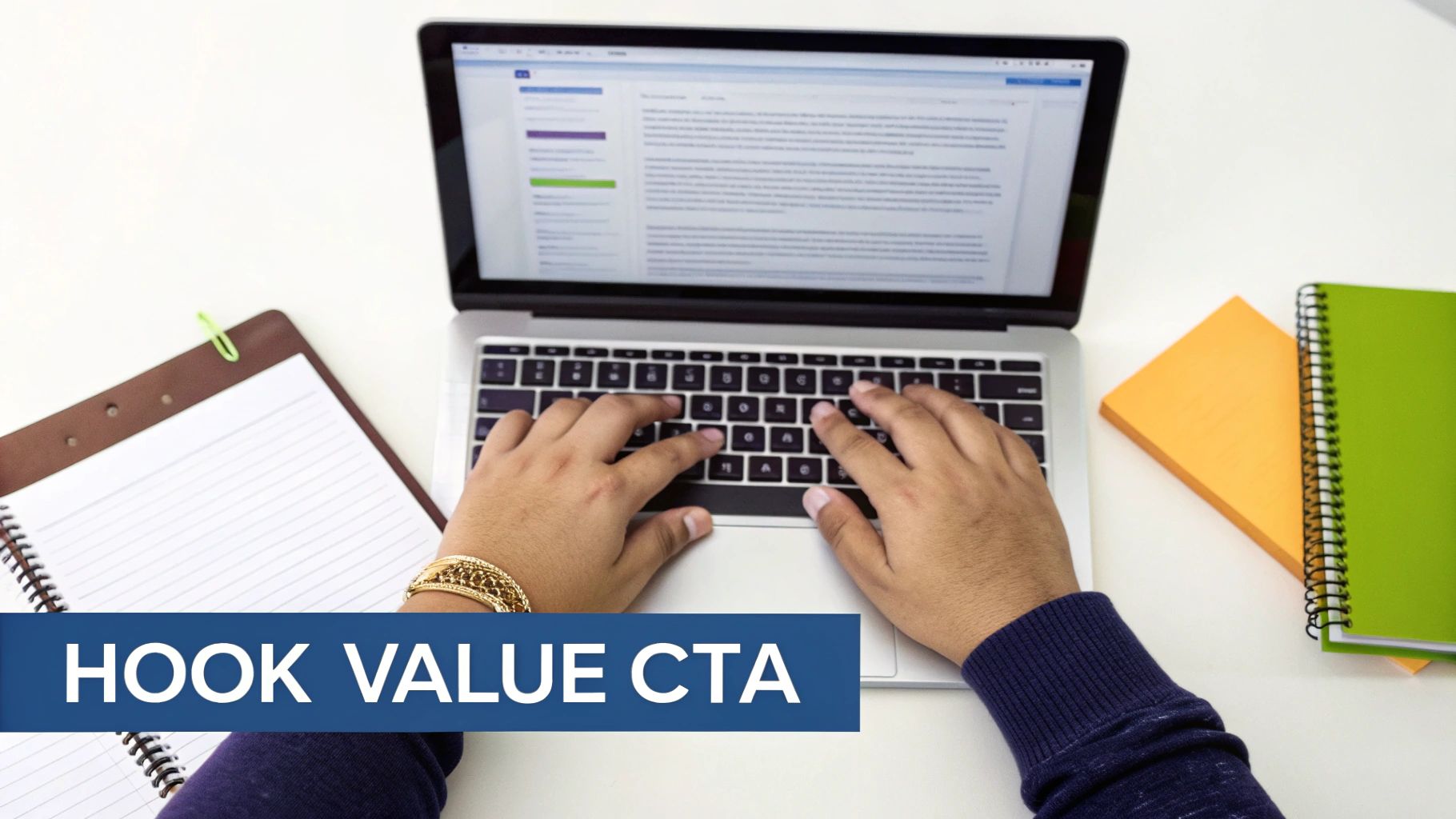
To consistently get replies, you need a simple but powerful structure. I live by what I call the ‘Hook, Value, CTA’ framework. This approach makes sure every proposal you send is sharp, relevant, and compelling.
The Anatomy of a Winning Proposal
This framework breaks your proposal into three distinct parts, each with a specific job. Mastering this flow will dramatically increase your reply rate because it aligns perfectly with what a client is looking for when they're drowning in dozens of bids.
- The Hook: Your first two sentences. Their only job is to grab the client’s attention and prove you’ve actually read their job post.
- The Value: The core of your proposal. Here, you connect your expertise directly to their problem and back it up with social proof and insightful questions.
- The CTA (Call to Action): Your closing. This is a clear, low-friction next step that makes it easy for the client to say "yes" to a conversation.
Let's dig into how to execute each part perfectly.
Crafting an Irresistible Hook
Remember, clients see the first two lines of your proposal before they even click to open it. If those lines are generic, they will scroll right past you. "Dear Sir/Madam" or "I am writing to apply for the position..." are instant deal-breakers.
Your hook absolutely must be specific to the job post. The best way I've found to do this is to reference a specific detail from their description.
Bad Hook Example (Generic):
"Hello, I am an experienced social media manager and I am very interested in your project. I have the skills you need to succeed."
Good Hook Example (Specific):
"Hi there, I saw you’re looking for a social media manager to help grow your new sustainable skincare brand's presence on TikTok. Your focus on eco-friendly packaging is a great angle we can use."
See the difference? The second example immediately shows the client you’ve not only read their post but have already started thinking strategically about their brand. This simple change moves you from "applicant" to "potential partner."
Demonstrating Your Unique Value
Once you have their attention, the body of your proposal has to deliver on that initial promise. This section isn't for listing every tool you've ever used. It's about showing the client how your specific experience solves their specific problem.
First, connect your past results to their project. Instead of just saying you have experience, give them a mini-case study.
Example of Showing Value:
"I recently helped a similar D2C brand increase their TikTok engagement by 45% in three months by creating a content series around user-generated videos. I believe a similar strategy could work wonders for your launch."
Next, ask smart, qualifying questions. Good questions show expertise and completely shift the dynamic. You are no longer just being interviewed; you are now screening them. This subtle flip in positioning is incredibly powerful.
A great proposal isn't a request for a job; it's the start of a professional consultation. It shows you're already thinking about the client's challenges and guiding them toward a solution.
For instance, instead of waiting for them to ask you everything, you might ask:
- "What is your current strategy for service discovery?"
- "What are your primary business drivers for this migration—cost savings or system stability?"
These questions prove you understand the nuances of their project and immediately position you as an expert. If you're looking for more inspiration, you can find a wealth of practical cover letter examples for Upwork to adapt to your own niche.
Ending with a Clear Call to Action
The final piece of the puzzle is your call to action. So many freelancers end their proposals with a weak, passive closing like, "I look forward to hearing from you." This puts all the work back on the client.
A strong CTA is confident and proposes a clear, easy next step. The goal is to make it effortless for them to reply. Avoid asking for a 30-minute call right away—that can feel like a big commitment. Instead, suggest a brief, low-friction interaction.
Weak CTA:
"Hope to hear from you soon."
Strong CTA:
"Does this approach align with your vision? If so, I’d be happy to answer any initial questions you have over chat."
This CTA is simple, direct, and focused on providing more value. It keeps the conversation moving forward without demanding a big time investment, making it far more likely you'll get that coveted reply.
Developing a Smart Pricing and Follow-Up Strategy
Landing the project is only half the job. To really win on Upwork, you have to price your services for real profitability and know how to follow up without being a pest. A great proposal with a weak pricing strategy is just a waste of time and Connects. And your follow-up game? That's where most freelancers drop the ball, leaving a massive opportunity wide open.
Let's walk through how to set your rates confidently and turn a client's silence into a signed contract. This two-part approach is what separates the pros from the amateurs.
Choosing the Right Pricing Model
On Upwork, you're mostly dealing with two options: hourly or fixed-price. There’s no "better" one—the right choice comes down to the project's scope and how your agency operates. Getting this right from the start is your first step toward a profitable gig.
- Hourly Rates: This is your best friend for long-term projects, ongoing maintenance, or any work where the scope might change. It gives you flexibility and makes sure you're paid for every minute, which is your best defense against the dreaded "scope creep." It’s a perfect fit for clients looking for a partner, not just someone to check off a task.
- Fixed-Price Projects: Go this route for projects with a crystal-clear scope and defined deliverables—think writing 10 blog posts or designing a single landing page. Clients love the budget predictability, and it gives you a powerful incentive to be efficient. Nail the project ahead of schedule, and your effective hourly rate skyrockets.
Many successful agencies actually use a hybrid approach. They might kick things off with a small, fixed-price discovery project to build some trust and show what they can do, then smoothly transition into a flexible hourly contract for the main event.
Calculating a Rate That Reflects Your Value
Your rate isn't just a number you pull out of thin air; it’s a strategic calculation. It has to cover your business costs, reflect your expertise, and stay competitive—all without selling yourself short. Competing on price is a race to the bottom you don't want to win. The best clients aren't looking for the cheapest option; they're looking for value.
To figure out a solid hourly rate, start with your target annual income. Add up all your business expenses (software, taxes, Upwork fees, etc.), then divide that total by the number of billable hours you can realistically work in a year. This gives you a baseline that actually keeps your business profitable. For fixed-price work, just use that hourly rate to estimate the total time needed, then add a little buffer for those unexpected curveballs.
When you state your price, own it. Ditch phrases like "I was thinking my rate could be..." and just state it clearly. Your price is a direct reflection of the results and value you bring to the table, not just the hours you clock.
The Art of the Professional Follow-Up
Here's a common mistake: send a proposal, then sit back and wait. Don't do it. Clients are juggling a dozen things at once, and a polite, professional nudge can bring your proposal right back to the top of their list. It also shows you're proactive and on top of your game.
A good follow-up isn't a desperate "Did you see my proposal?!" message. It should add value. Give it a few business days after sending your proposal, and if it's been radio silence, send a short, simple note. We cover this in much more detail in our complete guide on how to follow up with clients, which will help you master the technique.
Here's a quick, non-pushy message you can adapt:
Follow-Up Example:
"Hi [Client Name], just wanted to quickly check in on the proposal I sent over for your [Project Name] role. Did you have any initial questions I could clarify? Happy to provide more details if needed."
This is respectful, helpful, and opens the door for a conversation without applying pressure. It shows you’re organized and genuinely interested—two qualities every single client wants in a freelancer. This one simple step can dramatically increase your reply rate and turn that "maybe" into a definite "yes."
Ready to Scale? Let's Talk Smart Automation
If you're serious about growing on Upwork, you'll eventually hit a wall. That wall is manual bidding. It's the single biggest bottleneck preventing you from scaling your client base. Even with the best profile and a killer proposal template, you simply can't find and apply for enough quality jobs when you're doing it all by hand.
To truly multiply your client acquisition efforts, you need a system. And that system is smart automation.
This isn't about blasting out generic, spammy bids. Forget that. We're talking about using technology to amplify your own expertise, freeing you up to focus on what really matters: having high-value conversations and closing deals. Let the tech handle the repetitive grind.
Think of it like having a dedicated assistant who works 24/7, never sleeps, and instantly flags every single job post that fits your ideal client profile. That's what modern automation tools bring to the table.
How AI Actually Changes the Game
AI-powered platforms essentially become your always-on sales development rep. They take over the most soul-crushing parts of the bidding process, letting your team operate at a level that's physically impossible to sustain manually.
The results are pretty stark. We've seen agencies go from sending 10 proposals per day to over 50 proposals daily—all while saving up to 30 hours per week.
Even better, they're seeing reply rates jump from the typical 2% all the way up to 8-30%. That’s a 4x to 15x improvement. It’s proof that a systematic, tech-assisted approach just flat-out beats grinding it out by hand.
The real magic is that these systems learn from your direct feedback. You train the AI on what a perfect project looks like for your business. Over time, it gets smarter and refines its search to bring you only the best-fit opportunities.
Here’s a look at how this works in practice:
- Intelligent Job Matching: The AI scans the Upwork feed around the clock, using sophisticated filters that go way beyond Upwork’s native search to pinpoint jobs that perfectly match your criteria.
- Instant Proposal Drafts: As soon as a great-fit job appears, the system generates a personalized first draft. It pulls key details from the client's description and weaves them into your proposal framework.
- Lightning-Fast Submission: You get a notification with a ready-to-go draft. You just need to add your final personal touch and hit send, making you one of the first freelancers to apply—a huge advantage.
Automation isn't here to replace your expertise; it's here to amplify it. The AI handles the 80% of tedious work so you can focus on the 20% that actually closes deals: strategic personalization, client calls, and negotiating terms.
Is It Safe? Let’s Talk Account Integrity
The first question I always get is about account safety. It’s a valid concern. But modern, well-built tools are designed from the ground up to mimic human behavior, not act like a mindless bot. They operate well within Upwork's rules.
The key is that you are always in the driver's seat. The AI drafts the proposal, but you provide the final, human touch before it’s sent. This "human-in-the-loop" model ensures every proposal is high-quality and authentic while slashing your bidding time. You can learn more about how to automate Upwork proposals safely in our detailed guide.
Here’s what keeps your account safe with a quality tool:
- It Never Stores Your Password: Secure, authorized methods are used to interact with your account without ever needing your direct login credentials.
- It Mimics Human Actions: The software works at a pace and pattern that’s indistinguishable from a real person, avoiding the kind of aggressive, rapid-fire activity that can trigger red flags.
- You Have Full Control: You get the final say on everything. You review, edit, and approve every single proposal before it goes out, ensuring your brand’s voice and standards are always upheld.
Adopting this strategy means you're not just sending more proposals; you're sending better proposals, faster. It’s the strategic advantage that allows you to systematically scale your outreach, book more meetings, and finally win the high-value projects you deserve—without burning out your team in the process.
Common Questions (And Real Answers) About Upwork Bidding
Even when you have a system, bidding on Upwork can feel like a moving target. You're not alone—most agencies run into the same handful of frustrating problems. Let's break down the most common questions I hear and give you some straight answers.
Getting these details right is what separates the proposals that get opened from those that just get archived.
How Many Connects Should I Actually Use on a Bid?
Look at your Upwork Connects as your marketing budget, not just a fee. The right number to spend really boils down to the quality of the job in front of you.
For a high-value project from a client with a great hiring history and a clear budget, don't hesitate to bid the maximum. It's a power move. This puts your proposal right at the top of their list and signals that you're a serious, confident player. For smaller gigs or projects that feel a bit more speculative, a standard bid is probably all you need.
The real secret is to start tracking your 'return on Connects.' See which types of bids actually turn into conversations and contracts. Over time, you'll learn exactly which opportunities are worth going all-in on.
What if My Proposals Aren't Getting Any Views?
If you're sending proposals into the void and getting zero views, it's almost always one of two things: you're too slow, or your first two sentences are failing you.
Clients often start reviewing proposals the minute they come in. Seriously. If you’re not bidding within the first hour a job is posted, you’re likely getting buried under a mountain of other bids. Your proposal might be brilliant, but it won't matter if it's never seen.
And remember, Upwork's dashboard only shows clients the first two lines of your proposal. If you're starting with "Dear Hiring Manager, I am writing to express my interest..." you've already lost. That opener is an instant skip. You need a powerful, personalized hook that grabs their attention by referencing something specific from their post. Make them want to click.
Is It Better to Bid on Hourly or Fixed-Price Projects?
Honestly, neither is "better." The right one depends on the project's scope and how your agency works best. The most successful agencies I know have a healthy mix of both in their pipeline.
Here’s a simple way to think about it:
- Fixed-price projects are perfect for work with a crystal-clear scope and defined deliverables. They give you predictable revenue and reward you for being efficient. The big risk? Scope creep. You need an iron-clad contract to protect yourself.
- Hourly projects are your best bet for long-term work or complex jobs where the scope will probably change. They offer great flexibility and make sure you're paid for every minute you work, but you absolutely have to be diligent with your time tracking to keep the client's trust.
By chasing both, you can balance the steady cash flow from fixed-price gigs with the stable, long-term client relationships that hourly contracts often create.
How Can I Possibly Compete with Bidders Charging Half My Rate?
You don't. You stop competing on price and start competing on value. This is the single most important mental shift you can make on Upwork.
Think about it: the best clients aren't looking for the cheapest person. They're looking for the safest bet—the expert who can solve their problem without a ton of hand-holding. You win by showing you're that expert.
Your proposals and profile need to scream expertise. Pack your portfolio with relevant case studies that show tangible results. Ask smart questions in your proposal that prove you've actually thought about their business challenge. Clients will happily pay a premium for someone who sounds reliable, professional, and completely in control.
Ready to stop the manual grind and start winning more high-value clients on Upwork? Earlybird AI acts as your always-on sales team, finding ideal projects and crafting personalized proposals within minutes. Let our smart automation handle the outreach so you can focus on closing deals. Discover how Earlybird AI can scale your agency today.