
← Back To Blog
Fiverr vs Upwork vs Freelancer A Guide for Ambitious Professionals

The real difference in the Fiverr vs Upwork vs Freelancer debate boils down to a simple question: How do you want to find work? Fiverr is essentially a storefront where clients browse and buy your pre-packaged services, or "gigs." On the other hand, Upwork and Freelancer.com are more like traditional job boards where you actively bid on projects clients have posted.
Your best choice really depends on your style. Do you prefer to set up your offerings and let clients come to you, or are you better at actively pursuing opportunities and writing winning proposals?
Choosing Your Platform A Quick Comparison
Picking the right freelance marketplace can feel like a huge decision, but it's much simpler when you match the platform to your goals. Each one caters to different kinds of clients and projects, so there’s no single "best" platform—just the one that’s the best fit for what you're trying to achieve.
Think of it this way: your main objective, whether that's churning out a high volume of small tasks, landing complex long-term projects, or scaling a full-fledged agency, should guide your decision. This chart helps visualize that thought process.
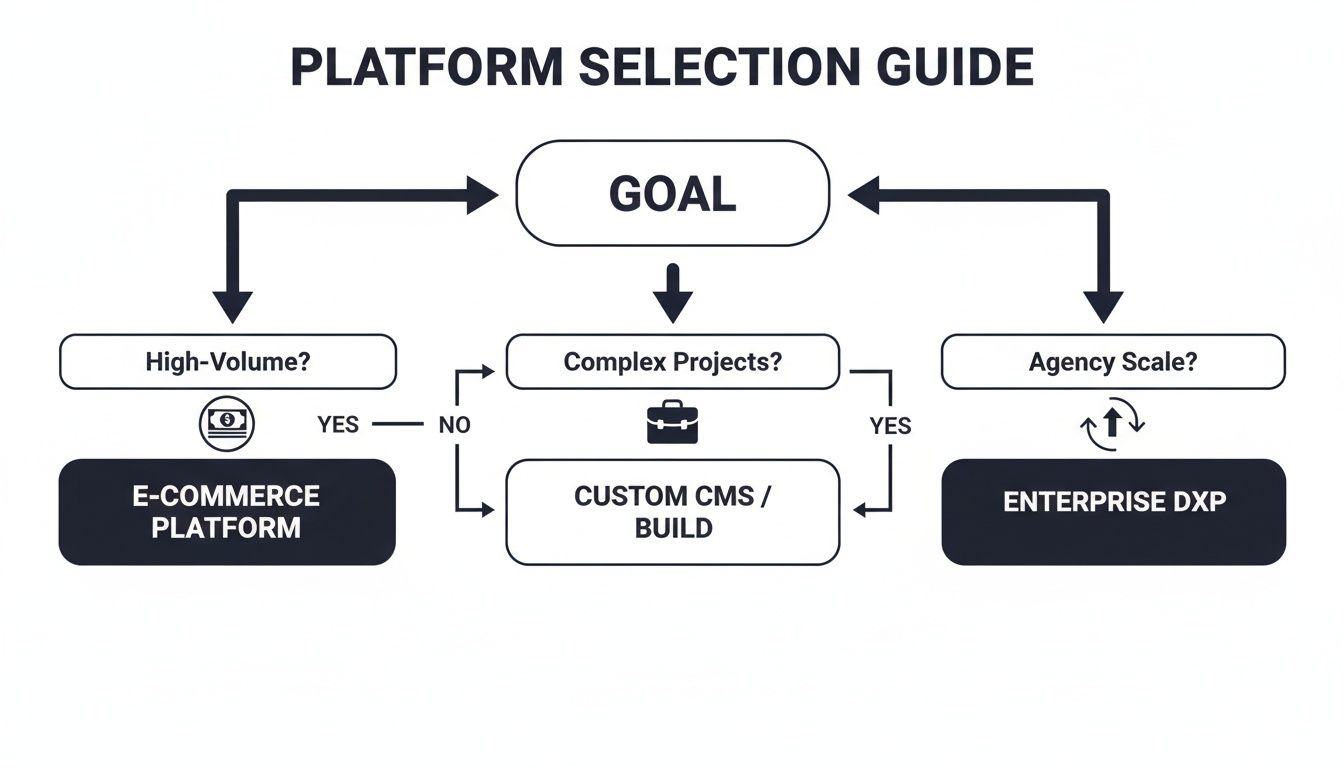
As the flowchart shows, your primary business goal—be it volume, complexity, or scale—is the most important piece of the puzzle when choosing where to build your freelance presence.
Fiverr vs Upwork vs Freelancer At a Glance
To cut through the noise, here’s a quick side-by-side look at the three platforms. This table lays out the fundamental differences you'll want to understand before you dive in and create a profile. It’s the 30,000-foot view that will set us up for the deeper analysis to come.
Many freelancers, especially those new to the platform, ask if Upwork is a reliable place to build a business. We cover that in detail in our guide exploring if Upwork is legit for serious professionals.
Here's the simplest way to think about it: On Fiverr, the client comes to you. On Upwork and Freelancer.com, you go to the client. This one distinction changes everything about your sales process and how you interact with buyers.
Let’s break down the key differences in a simple table.
This table gives you a snapshot of what to expect from each ecosystem, from the kind of clients you'll meet to how much of your earnings you'll actually take home. Now, let’s dig into the details of what these differences mean for you.
Understanding Market Share and Opportunity
When you're trying to decide between Fiverr vs Upwork vs Freelancer, market share isn't just a vanity metric. It's a direct indicator of where you'll find the best opportunities. The size of a platform is one thing, but the quality of its user base is what really dictates your odds of landing high-value clients, especially if you're an agency trying to scale.

Think of it this way: each platform’s dominance in a particular niche creates a different kind of pond to fish in. Upwork's leadership attracts a more corporate, enterprise-level crowd. On the other hand, Freelancer.com's massive user numbers create a highly competitive, fast-paced environment.
Where the Money and Clients Are
Looking at the numbers tells a pretty clear story. According to recent data, Upwork leads the pack with an 8.86% market share. That's a significant lead over Fiverr's 5.81%, solidifying its position at the top of the heap. This makes Upwork the central hub for over 18 million freelancers scattered across more than 180 countries.
For comparison, Fiverr reports at least 380,000 active freelancers, while Freelancer.com boasts a staggering 60 million registered users, a figure that highlights its immense scale. You can dig deeper into these numbers in this 2025 platform comparison report.
This data is more than just trivia; it's a strategic roadmap. A larger market share, especially when it's packed with clients who have real budgets, gives you a much bigger pool of potential projects to draw from.
For an agency, this is the most important factor. Upwork’s market leadership isn't just about size—it’s about the concentration of clients willing to pay premium rates for complex, long-term work. This is the ideal environment for building a scalable business.
The entire Upwork ecosystem is designed to support these higher-value relationships. It fosters a marketplace where genuine expertise can actually command a higher price, which isn't always the case elsewhere.
Translating User Base into Actionable Strategy
Knowing who hangs out on each platform helps you position your services much more effectively. The sheer volume on each site brings its own unique set of challenges and rewards.
- Upwork's High-Value Pool: A huge chunk of Upwork’s clients are SMBs and enterprise-level companies. This means the potential for large, recurring contracts is genuinely higher here. You're far more likely to find a client who wants a strategic partner, not just someone to complete a one-off task.
- Fiverr's Transactional Marketplace: Fiverr's model is brilliant for productized services. It attracts clients looking for a specific, pre-packaged deliverable. It's perfect for freelancers who can deliver standardized work efficiently, but it's less suited for complex, consultative agency projects where the scope isn't so neatly defined.
- Freelancer.com's Volume Game: With its enormous user base, Freelancer.com often feels like a pure numbers game. The platform is flooded with clients looking for the absolute lowest price, which frequently sparks a race-to-the-bottom bidding war that can devalue highly specialized skills.
Ultimately, the market share data draws a clear map showing where different types of clients gather. If your goal is to build a sustainable agency with high-value contracts, Upwork's market dominance and concentration of serious business clients give it a clear edge. The opportunities there aren't just more plentiful; they're often of a much higher caliber.
Comparing Platform Fees and Your Earning Potential
Let's talk about the bottom line: how much money you actually keep. Platform fees are way more than just a small percentage skimmed off the top—they directly hit your profitability and dictate your cash flow. The common comparison boils down to Fiverr's 20% versus Upwork's 10%, but that's just scratching the surface. The real financial picture includes what clients pay, how you get your money out, and any subscriptions you might need.
The story isn't just what the platform takes from you. It’s the total cost of doing business. This includes the fees your client is paying on top of your rate, which absolutely influences their budget and how much they're willing to pay you in the first place.
Breaking Down the Freelancer Fee Structures
The biggest, most glaring difference in the Fiverr vs Upwork vs Freelancer debate is the commission each platform takes from your earnings. This is the main cost you'll face, and it changes depending on the platform and your project's value.
When it comes to keeping more of your hard-earned cash, Upwork's flat 10% freelancer fee is the clear winner. It absolutely crushes Fiverr's steep 20% cut and provides more predictability than Freelancer.com's variable model. Upwork simplified its fee structure in 2023, moving away from its old 20%/10%/5% tiered system, and it was a game-changer. You can even see how they stack themselves up in their own analysis of the platform differences.
Here’s what that looks like in practice:
- Fiverr: Takes a flat 20% service fee on everything. Doesn't matter if it's a $5 gig or a $5,000 project, or if it's your first time working with a client or your tenth. That consistency is simple, but it's a brutal cut on larger jobs.
- Upwork: Now has a simple 10% flat freelancer fee for all contracts. This move made their pricing incredibly straightforward and much more appealing, especially when you put it next to Fiverr.
- Freelancer.com: Usually charges 10% for fixed-price projects and hourly work. But things get more complicated with contests, which have higher fees, and the platform constantly pushes paid upgrades to make your bid more visible.
That simple 10% fee on Upwork gives you a clear financial edge, letting you pocket more of your income right from the start.
The Hidden Costs and What Clients Really Pay
Your fee is only one side of the coin. What the client has to pay on their end can make you seem more expensive than you are. If a client is already bracing for a hefty platform fee, they're going to be less willing to approve a higher rate for you.
Let's run the numbers on a $1,000 project to see what everyone actually pays and what you take home:
On a $1,000 project, you earn $100 more on Upwork or Freelancer.com than on Fiverr. That gap adds up fast, turning into a significant amount of lost revenue over a year and making Fiverr the most expensive option for serious, high-earning freelancers.
Beyond the main project fees, you’ve got to think about withdrawal fees and optional subscriptions. Fiverr and Freelancer.com offer a bunch of ways to get your money, but each one has its own little fee that nibbles away at your final payout. Upwork, on the other hand, offers free ACH direct deposit in the U.S., which is a huge perk for managing your money efficiently.
Payment Protection and Cash Flow Speed
Getting paid reliably is everything. All three platforms have some form of escrow, where they hold the client's money until you hit your milestones. This gives you a solid safety net against getting ghosted.
But the speed at which you can actually access your cash is a different story:
- Fiverr: You have to wait 14 days for your funds to clear after a client marks an order as complete. If you’re a Top Rated Seller, that gets cut to 7 days.
- Upwork: For fixed-price gigs, the money is available after a 5-day security hold once the client signs off. For hourly work, you’re paid on a predictable weekly schedule.
- Freelancer.com: Clients release milestone payments as you complete them, so there's no mandatory waiting period after approval.
That weekly billing cycle for hourly projects on Upwork is a lifesaver. It creates the most stable and predictable cash flow, which is crucial if you're an agency or a freelancer with regular business expenses. When you combine the lower flat fee, free withdrawals, and reliable payment schedules, Upwork clearly comes out on top as the more financially sound choice for building a long-term business.
Finding the Right Workflow and Project Type
When you're trying to decide between Fiverr, Upwork, and Freelancer, the most important thing to look at isn't the fee structure or who has the most users—it’s the core workflow. How you actually land and execute projects on each platform is fundamentally different, and that single distinction will shape your entire freelance business.
This is the real heart of the matter. Understanding this difference is what will help you pick the right platform for the services you offer and the way you like to work.

Essentially, you have two models. One is a passive, product-first approach where clients come to you. The other is an active, proposal-driven system where you go to the clients. You're either building a digital storefront or a digital consultancy, and that's a crucial choice to make.
Fiverr: The Productized Service Storefront
Think of Fiverr as an e-commerce site, but for services. Your job is to package what you do into neat, pre-defined offerings called “Gigs.” Each Gig has a clear scope, a set price, and specific deliverables. Clients browse this digital marketplace, find the service package they need, and buy it off the shelf.
This is a very passive way to get clients. You put in the effort upfront—creating killer Gig descriptions, setting your pricing tiers, and optimizing everything for search—and then you wait for the orders to roll in.
- Best for Standardized Services: This setup is perfect for services that are easy to define and repeat. Think logo designs, 500-word articles, or short voiceover recordings.
- Minimal Pre-Sale Chat: Most of the time, you won’t even talk to the client until after they've already placed an order. This cuts way down on time spent on sales calls and writing proposals.
- Focus on Volume and Efficiency: To really succeed on Fiverr, you often need to be set up to handle a high volume of small-to-medium gigs quickly and efficiently.
The big idea with Fiverr is "service-as-a-product." If you can box up your skills into a tidy, easy-to-buy package, Fiverr gives you a place to sell it. It’s a much tougher fit for complex, custom projects that demand a lot of back-and-forth and discovery with the client.
Upwork and Freelancer: The Bidding Marketplace
On the other side of the fence, you have Upwork and Freelancer.com. These platforms run on a classic bidding model. Clients post a job describing what they need, and freelancers like you submit proposals to win the work. It’s an active, outbound sales process—you’re the one doing the hunting.
This means your day-to-day involves searching for good job postings, figuring out what a client really needs, and writing a compelling proposal that shows you're the right person for the job. Mastering your application is everything here, which is why having solid cover letter examples for Upwork can seriously boost your success rate.
This approach is all about selling your specific expertise and making a case for why a client should choose you for their unique project.
How the Workflows Really Stack Up
So, what’s the right call? It really comes down to your business model. If you offer a service like, "I will design three YouTube thumbnails for $50," Fiverr's productized workflow is a perfect match. But if your service is, "I will develop a comprehensive YouTube marketing strategy," then the consultative, proposal-based world of Upwork is a far better fit. Let the complexity of your work and your preferred sales style be your guide.
How Each Platform Supports Agency Scaling
For a solo freelancer, picking between Fiverr, Upwork, and Freelancer often boils down to personal taste and workflow. But for an agency looking to grow, the decision is far more strategic. Scaling isn't just about getting more projects; it's about having the right infrastructure, team tools, and access to clients who can support long-term, high-value work.
When you look at it through that lens, the three platforms show their true colors. One is clearly built with team growth in mind, while the others are fundamentally designed for the solo operator. That distinction makes all the difference when you're planning for the future.
Upwork: The Clear Leader for Agency Infrastructure
Upwork is really the only platform in this comparison with a dedicated infrastructure for agencies. Its Agency Accounts are built to be a central hub where you can manage multiple freelancers, client contracts, and all your finances under a single brand. For scaling, this is a total game-changer.
This structure lets you present a unified, professional front. Instead of having a bunch of disconnected freelancer profiles, you build a powerful agency brand right on the platform, showcasing a shared portfolio and collective earnings history.
Here’s what makes Upwork a powerhouse for agency scaling:
- Multi-User Access: As an agency owner, you can add team members, assign them specific roles, and let different people handle proposals and client communication.
- Centralized Billing: Every contract and payment runs through the main agency account. This dramatically simplifies your bookkeeping and financial reporting.
- Agency-Specific Profiles: You’re building a reputation for your team, not just for one person. This is crucial for landing bigger, more complex contracts.
- Shared Connects Pool: Your whole team pulls from a single pool of "Connects" to bid on jobs, which makes managing your business development budget way more efficient.
If you want to dive deeper into building a successful agency from the ground up, our guide on starting an SEO agency covers many of the core principles you'll need to scale effectively.
Fiverr and Freelancer: A Solo-Focused Approach
Fiverr is, by its very design, built around the individual. The "Gig" model is a solo entrepreneur's game where success is tied directly to one person's brand and service. While Fiverr has added features like "Fiverr Business" for clients, the platform just doesn't have the native tools for an agency to manage a team under one roof.
Sure, an agency could try to work around this by having its members maintain separate Fiverr profiles, but that's a clunky and disjointed approach. It creates administrative nightmares and makes it impossible to build collective brand equity or present a cohesive agency to potential clients.
Freelancer.com falls into a similar boat. While you can find a massive volume of projects, its core systems are geared toward individual bidding and head-to-head competition. You won't find sophisticated, built-in tools for agency management, team collaboration, or centralized financial oversight, making it a tough environment for any coordinated scaling effort.
The Enterprise Connection: Why It Matters for Scaling
The type of client a platform attracts is directly tied to your agency's ability to scale. Upwork's robust infrastructure has made it the go-to marketplace for larger businesses and enterprise-level clients who need reliable, scalable talent solutions. Its features are built to meet corporate needs.
For instance, Upwork’s structure is just a better fit for agencies, which you can see in the numbers: 145,000 clients spend $5,000+ annually on the platform. With dedicated options like Agency Plus plans for multi-user workflows, it clearly caters to teams. You can find more data about high-value clients and platform statistics by reviewing these insights on freelancer stats.
This direct access to high-spending clients is the fuel for agency growth. While Fiverr and Freelancer.com are great for transactional, smaller-scale projects, Upwork is where you go to find the six-figure, multi-year contracts that form the bedrock of a stable, scalable business. For agencies that are serious about growth, the choice is pretty clear.
So, Which Platform is Right for You?
Picking a winner in the Fiverr vs. Upwork vs. Freelancer showdown really boils down to your own goals. There’s no single "best" platform. The right choice is the one that fits how you work, the clients you want to attract, and where you want to take your freelance business.
Think of it this way: each platform is its own unique ecosystem. Choosing the right one from the get-go saves you a ton of headaches and puts you right where your ideal clients are already looking.

Let's break down exactly who should use each platform to make your decision crystal clear.
When to Go With Fiverr
Fiverr is your best bet if you have a service you can package and sell like a product. It’s perfect for freelancers who want to create standardized "Gigs" and let the clients come to them, rather than constantly writing proposals.
Fiverr is the right move if you:
- Specialize in productized services like logo design, writing a 500-word blog post, or recording a voiceover.
- Hate spending time on back-and-forth negotiations.
- Your business model is all about high volume and efficiency.
- You want an "e-commerce" feel where clients can browse and buy your services 24/7.
This setup is gold for anyone who has perfected a specific, repeatable task. Success on Fiverr is all about crafting irresistible Gig packages that catch a buyer's eye.
When to Go With Freelancer.com
Freelancer.com is built for the hustle—it’s where you go for a high volume of smaller, often budget-driven projects. Its massive global user base and signature contest format make for a fast-paced environment where speed and competitive pricing are the name of the game.
Freelancer.com is the place for you if you:
- Are a pro at firing off bids for a lot of different projects quickly.
- Thrive on the competitive energy of design contests and short-term gigs.
- Are comfortable in a market where clients are often looking for the best deal.
- Need to build up your portfolio fast by knocking out a bunch of smaller jobs.
While it can be a great launchpad, be aware that the intense competition can sometimes feel like a "race to the bottom" on price. It’s tough to build a premium brand here.
Here’s the key takeaway: Go where your ideal clients are. If you’re chasing enterprise-level contracts, you need to be on the platform where those companies are hiring. Don’t try to fit a square peg in a round hole by forcing a platform to work for a business model it was never built for.
When to Go With Upwork
Upwork is the undisputed leader for serious professionals and agencies chasing high-value, long-term clients. Everything about it, from its project structure to its payment protection, is designed for complex, consultative work.
Upwork is your platform if you:
- Offer custom, in-depth services that require a detailed proposal and close collaboration.
- Are scaling an agency and need tools for managing teams and client billing.
- Want to work with a roster of clients that includes everything from hot startups to Fortune 500 giants.
- Are focused on building a reputation as an expert and securing lucrative, ongoing partnerships.
For freelancers building a career and agencies looking to scale, Upwork provides the professional environment and quality of clients needed for real growth. It’s the platform where true expertise pays off.
Frequently Asked Questions
It's natural to have questions when you're trying to figure out where to stake your claim in the freelance world. Choosing between Fiverr, Upwork, and Freelancer is a big decision, so let's clear up some of the most common uncertainties.
Getting these answers right can save you a ton of time and help you build your business on the right foundation.
Can You Really Succeed on All Three Platforms at Once?
Look, while nothing is stopping you from creating a profile on all three, I’ve rarely seen it work well in practice. Juggling these platforms is like trying to learn three different languages at the same time—you'll end up being mediocre at all of them instead of fluent in one.
The smart move is to pick the one that feels right for your skills and goals, then go all-in. Learn its quirks, build a stellar reputation, and get a reliable income stream going. Only after you've truly mastered it should you even think about expanding.
The top freelancers and agencies I've seen didn't dilute their efforts. They became dominant forces on one platform first, learning its algorithm and client culture inside and out before even considering a second one.
Which Platform Has the Steepest Learning Curve?
Fiverr and Freelancer.com are generally easier to get the hang of right away. With Fiverr, your main hurdle is creating a "Gig" that grabs attention. On Freelancer.com, you can jump in and start bidding on jobs almost immediately.
Upwork, on the other hand, is a different beast. It demands more from you upfront. The clients are looking for high-value, long-term partners, so your proposals have to be sharp and persuasive. You're not just selling a service; you're building a case for yourself, and that takes time to master.
What Is the Best Platform for a Total Beginner?
If you're just starting out and need to build a portfolio from scratch, Fiverr is probably your best bet. Its "productized" service model takes a lot of the sales pressure off.
Your job is to create a great Gig and deliver excellent work when an order comes in. It's a straightforward way to get your first few projects under your belt and start collecting those all-important positive reviews.
Which Platform Is Best for an Established Agency?
For agencies looking to grow, Upwork is hands-down the best choice. It's the only one built with teams in mind, offering features like Agency Accounts, multi-user access, and streamlined billing.
This setup, plus the platform's access to enterprise-level clients, gives you the tools and the market to scale your operations effectively.
Ready to stop spending hours writing proposals and start winning more high-value clients on Upwork? Earlybird AI acts as your automated sales team, searching for ideal jobs and sending personalized proposals in minutes. Let Earlybird AI book your next client meeting.