← Back To Blog
A Modern Playbook to Get SEO Clients for Your Agency

If you're serious about getting SEO clients, you need to stop relying on random, one-off tactics. The real key is building a repeatable system—a machine that blends inbound interest with smart outbound outreach. This is how you escape the feast-or-famine cycle that plagues so many freelancers and agencies. It's about working smarter, not just harder.
Building Your Client Acquisition Engine
Putting all your eggs in one basket is a terrible business strategy. If you rely solely on referrals, cold emails, or a platform like Upwork, you're setting yourself up for a rude awakening when that channel inevitably slows down. When the well dries up, so does your income.
The only sustainable solution is to build a diversified, robust system that consistently brings in leads, nurtures them, and turns them into paying clients.
This guide is the blueprint for that engine. We're skipping the fluff and giving you the exact, actionable steps to solve the real problems holding you back—like unpredictable cash flow and the constant pressure to drop your prices.
Why a System Beats Hustle Every Time
When you shift from just "hustling" to a systematic approach, everything changes.
- You Create Predictable Revenue: Stop wondering where next month's projects are coming from. A good system builds a pipeline that delivers consistent, reliable income.
- You Escape the Race to the Bottom: Instead of being just another vendor, you position yourself as a high-value expert who solves expensive problems. This is how you start commanding premium rates.
- You Focus on What Matters: You'll spend far less time scrambling for leads and more time closing deals, delivering amazing results for clients, and actually scaling your business. If you're looking to build from the ground up, our guide on starting an SEO agency is a great place to start.
This whole process is about moving from a reactive, often desperate state to a proactive, strategic one. It’s the difference between hoping for growth and engineering it.
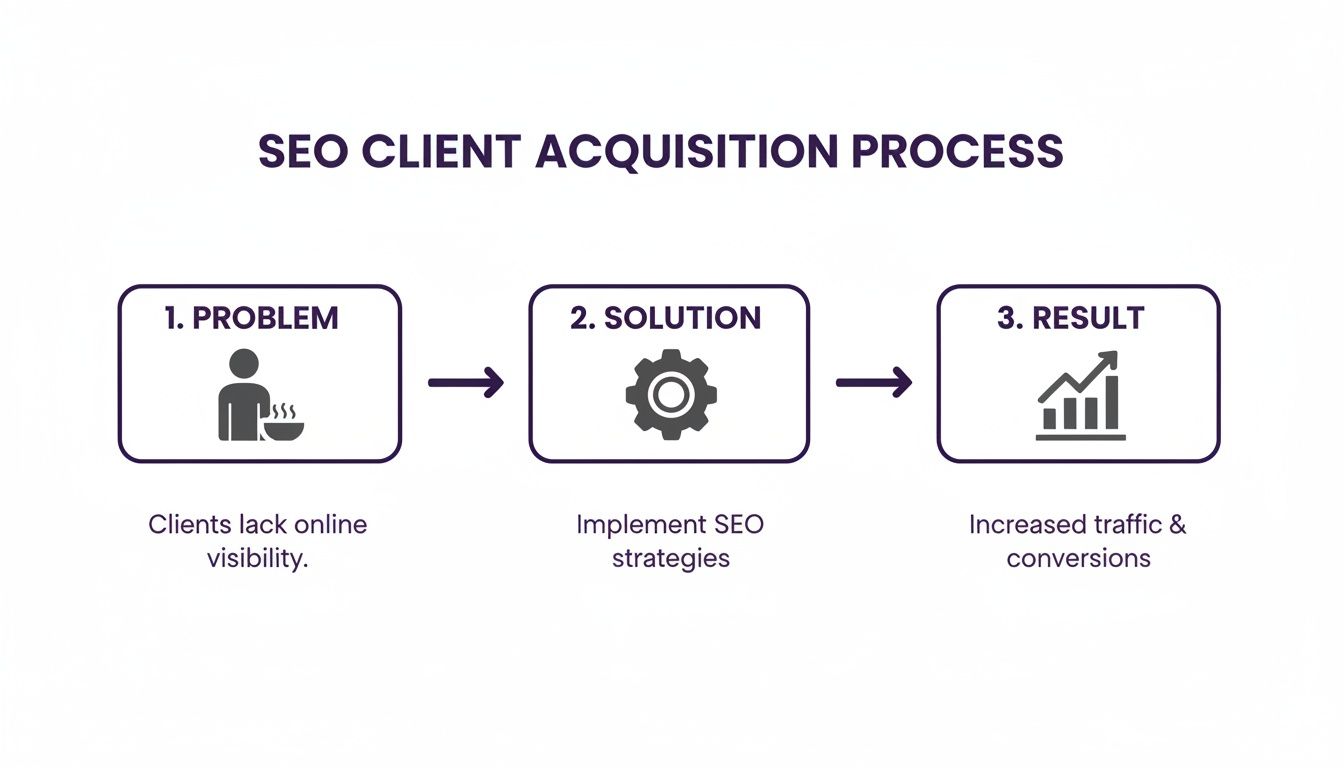
This visual really drives home the point: you're moving from inconsistency and stress to a structured model that fuels long-term, sustainable success.
The Undeniable Power of Inbound Leads
Building an engine that pulls clients to you is non-negotiable, and the data backs this up completely. Inbound leads are just flat-out better.
SEO leads close at a staggering 14.6% rate, while traditional outbound leads barely convert at 1.7%. Think about that. A lead that finds you through your own SEO efforts is nearly nine times more likely to become a paying customer. It's a game-changer.
And the ROI? SEO delivers an average return of $22 for every $1 spent, making it one of the most profitable digital channels out there.
When you focus on strategies that attract clients, you aren't just finding leads. You're connecting with prospects who already know they have a problem and are actively searching for an expert—like you—to solve it.
Finding Your Niche and Crafting a Magnetic Offer
Before you ever write a single proposal, every potential client is asking one question, whether they say it out loud or not: "Who are you for?" If your answer is "everyone," you've already lost. Trying to be a jack-of-all-trades is the fastest way to become a commodity, forced to compete on price in a race to the bottom.
The freelancers and agencies who really thrive aren't just "SEO experts." They are the SEO person for a specific type of business with a specific set of challenges. This kind of focus is what allows you to command premium rates, build real authority, and create a marketing message that actually connects with the right people.
Why Niching Down Is Your Secret Weapon
Picking a niche can feel a little scary. It feels like you're closing doors and turning away business. But in reality, you're doing the exact opposite. When you specialize, you become a magnet for your ideal clients because you get their world—you understand their customers, their pain points, and you speak their language.
Think about the difference. Instead of a generic "I do SEO," you can say, "I help B2B SaaS companies with a high customer LTV get found by enterprise-level clients through targeted content and technical SEO." One is a vague service; the other is a powerful business outcome.
Specializing isn't about limiting your opportunities; it's about amplifying your expertise. When you're the big fish in a small pond, you become the obvious choice.
Focusing on one area also lets you create repeatable systems, gather incredibly compelling case studies, and get ridiculously good at delivering results. This is the shift that takes you from being just another freelancer to an essential partner.
Identifying Your High-Value Niche
So, where do you find this magic niche? It’s usually found at the crossroads of your experience, genuine interest, and what the market is actually willing to pay for. You don't need to be a world-renowned expert in the industry, but you need to know enough to talk intelligently about their business goals.
Start by brainstorming and ask yourself a few questions:
- What's in your background? Have you already worked with clients in a certain industry? Maybe you have past experience in real estate, e-commerce, or legal services. Start there.
- Who has the money? Look for industries where the lifetime value (LTV) of a new customer is high. A new patient for a cosmetic surgeon or a new corporate client for a law firm is worth thousands, making a $5,000+ monthly SEO retainer an easy investment.
- Who needs search to survive? Some businesses are completely dependent on showing up in search results. Think about plumbers, dentists, or B2B software companies—if they're not on page one, they're invisible.
- Is there room to compete? You don't need a completely undiscovered market, but diving into a hyper-competitive space is a tough grind. Look for niches where you can realistically become a known expert without fighting a thousand other agencies.
Once you have a shortlist, go validate it. Hop on Upwork or LinkedIn and see if businesses in that niche are actively posting jobs for SEO help. Use your favorite keyword tool to see if they're searching for SEO services. You're looking for a hungry market that you're excited to serve.
Picking the right niche is crucial for building a high-margin SEO business. Here’s a quick breakdown of a few options to get you thinking.
Choosing Your High-Value SEO Niche
A comparison of potential SEO niches to help you identify the most profitable and suitable specialization for your agency.
This isn't an exhaustive list, but it highlights the trade-offs. While a niche like law firms has huge potential value, you’ll be up against some very established competition. A newer B2B tech niche might be less crowded, giving you a better chance to stand out.
From Service Provider to Problem Solver
Once you've chosen your niche, it's time to overhaul your online presence. Your website, LinkedIn, and Upwork profile need to stop being a resume and start being a client-attraction engine.
Stop listing off services like "keyword research" and "link building." Nobody truly cares about the process; they care about the result. Your ideal client, a physical therapy clinic owner, doesn't want "local SEO." They want a fully booked schedule with qualified patients from their local area.
Reframe everything around that outcome.
Your profile headline, your website's hero section, and your portfolio should all scream this one core promise. Use testimonials and case studies from your chosen niche to build instant trust and social proof. This single shift in your positioning is what changes the conversation from "How much do you charge?" to "When can you start?" It's the foundation for getting great SEO clients, consistently.
Mastering Your Lead Generation Channels
Alright, you've figured out who you want to serve and what you're offering. Now comes the fun part: actually finding those clients and starting conversations. The truth is, a solid client acquisition strategy never hinges on just one thing. It's a mix of actively going out and finding people (outbound) and creating content that brings them to you (inbound).
Think of it as hunting and farming. You need to hunt for your next meal today, but you also need to plant seeds that will feed you for years to come. To really build a sustainable business, you have to do both.

Turning Upwork Into Your Personal Lead Machine
Most freelancers treat Upwork like a lottery, scrolling through the feed hoping to stumble upon the perfect gig. The top 1% don’t do that. They treat it like a proactive tool, a machine for generating high-quality leads.
It starts with getting surgical with your job filters. Forget a generic search for "SEO." You need to use advanced search operators to find clients in your niche who have a proven track record of hiring and, more importantly, spending real money on the platform. This one step will instantly cut through 90% of the noise and low-ballers.
From there, you have to learn to read the subtext in a job post. Is the client talking about "business outcomes" and "customer acquisition," or are they just obsessed with "ranking number one"? The former signals a sophisticated buyer who understands the real value of SEO. These are the subtle clues that tell you a project is worth your time.
Cold Outreach That People Actually Want to Read
Let's be honest: cold outreach gets a bad rap because most of it is just awful. Generic, copy-pasted emails are a one-way ticket to the spam folder. If you want to get SEO clients this way, your entire approach needs to be built on real, genuine personalization.
My advice? Forget about blasting a list of 100 random contacts. Instead, hand-pick 10 companies that are a perfect fit for you. Use a tool like LinkedIn Sales Navigator to find the actual decision-maker—usually a Head of Marketing or the CEO in a smaller company. Then, do your homework.
- Find your "in." Did they just raise a funding round? Did their marketing director just publish a great article? Mention it in your first sentence. It shows you're not a robot.
- Give value first. Run a quick audit with a tool like Surfer's Audit and find one or two specific, critical things they could fix. Offer a real tip they can use, no strings attached.
- Keep it short. Your email should be easy to scan and end with a simple, low-pressure question like, "Are you the right person to chat with about this?"
This takes way more effort per email, but your reply rate will absolutely demolish what you'd get from any generic template.
The goal of cold outreach isn't to close a deal in the first email. It's to start a conversation, build a relationship, and prove your expertise from the very first interaction.
Playing the Long Game with Inbound and Referrals
While your outbound efforts are bringing in clients now, your inbound strategy is building an asset that will pay off for years. This is about creating genuinely helpful content—blog posts, detailed case studies, webinars—that solves the exact problems your ideal clients are facing.
Think about it. When a dentist stumbles upon your detailed guide, "The Ultimate Local SEO Playbook for Dental Practices," you're no longer just a random person selling a service. You're an authority. That completely changes the sales conversation.
And finally, never, ever underestimate the power of a good referral network. Make friends with web designers, copywriters, and PPC specialists who serve the same clients you do. Set up a simple, reciprocal relationship where you send business to each other. It's one of the most powerful and low-effort lead sources you can build.
Writing Proposals That Actually Win Projects
Getting a lead in the door is one thing, but your proposal is where you actually close the deal. Let’s be honest, we've all been tempted to use a generic, copy-pasted template when we're busy. But that's the fastest way to get your proposal tossed in the digital trash bin.
A winning proposal isn’t a laundry list of your skills. It's a mirror reflecting your deep understanding of the client's business pain points, followed by a clear, confident plan to make that pain go away.
Your entire goal is to reframe the conversation from "How much does this cost?" to "What is this investment worth?" A truly great proposal makes your fee feel like the most logical next step toward a massive business win, whether that's more revenue, a bigger slice of the market, or just flat-out dominating their competitors.
The Anatomy of a Winning Proposal
I can't stress this enough: every single proposal you send needs to be built on one core principle: it’s about them, not you. The client doesn't really care that you're a "technical SEO wizard." They care that you can fix the broken parts of their website that are bleeding customers and cash.
Think of your proposal as a short, compelling story.
- The Problem: Kick things off by rephrasing their main challenge in your own words. This isn't just filler; it's proof that you were actually listening and you get what's at stake.
- The Solution: Next, lay out your strategy, but always tie it back to business outcomes. Don't just say "keyword research." Instead, try "We'll uncover the high-intent keywords your ideal customers are searching for right now, so we can attract qualified buyers to your site." See the difference?
- The Investment: Present your pricing clearly. If it makes sense, offer a couple of different package options. And always, always frame it as an investment in their future growth, not a cost to their current budget.
- The Next Steps: End with a strong, clear call-to-action. Don't be vague. Tell them exactly what they need to do to move forward, like "Click here to approve the project and we'll schedule our kickoff call."
This approach turns a boring price quote into a strategic document. It immediately positions you as a partner, not just another vendor. If you're hunting for clients on Upwork, looking at some strong cover letter examples can give you some great ideas for nailing that initial project pitch.
A proposal that wins isn't the one packed with the most technical jargon. It's the one that draws a straight, undeniable line from your SEO work to the client's bank account. Show them you understand their business, and you're already halfway there.
The Art of the Follow-Up
Hitting "send" on that proposal feels great, but your job isn't done. So many potential deals wither on the vine simply because nobody followed up. A polite but persistent follow-up sequence keeps you on their radar without coming across as desperate or annoying.
A simple, well-timed cadence can work wonders.
After sending the proposal, give them some space. Wait about three business days before your first check-in. A quick, friendly email asking if they had a chance to review it and if any questions came up is perfect.
Still crickets? Wait another four to five days, then try again. This time, add a little value. Maybe you found a relevant article or a case study that reminded you of their project. This shows you're still thinking about them and reinforces your expertise.
If you still haven't heard back, one final, gentle nudge a week later is your last shot. After that, it's time to move them to your "cold" list and focus your energy elsewhere. This rhythm shows you’re a professional who is genuinely interested, not a salesperson chasing a commission.
Use Smart Automation to Scale Your Outreach
If you’re still prospecting for clients by hand, you’re putting a hard ceiling on your growth. Seriously. Manually sifting through job boards, trying to write a unique proposal for every single lead, and then remembering to follow up—it’s a full-time job on its own.
This is where you need to get smart with automation. I’m not talking about spamming people with generic, robotic messages. The goal is to use intelligent tools that act like a tireless sales assistant, finding your ideal projects and firing off personalized proposals just minutes after they go live. On a platform like Upwork, that speed is everything.

When you're one of the first applicants a client sees, your odds of getting a response skyrocket.
How Intelligent Automation Works for You
Imagine waking up and seeing qualified meetings already booked on your calendar. That's what happens when you plug the right automation into your process. Tools like Earlybird AI are built for this—they link up with your Upwork account and use machine learning to get a crystal-clear picture of your ideal client.
You start by giving the system simple feedback, and it quickly learns to spot high-value projects with uncanny accuracy. This isn't just a basic keyword filter. It's an AI that constantly refines its aim and even its messaging based on what actually gets replies. It drafts and sends proposals tailored to each job, often faster than you could finish reading the description.
This completely flips the script. You stop spending your days on tedious outreach and start focusing on strategic conversations with warm leads. If you want to dive deeper, we have a whole guide on what sales automation is and how it can reshape your business.
Technology should handle the repetitive, mind-numbing parts of lead generation. This frees you up to do what you do best: strategizing with clients, closing deals, and delivering incredible results.
The Competitive Edge of Speed and Precision
In a crowded market, being first is a massive advantage. With the SEO industry projected to hit $72.31 billion by 2025 and organic search still driving over 53% of all website traffic, the agencies that can move the fastest will win.
When you can submit proposals in under 10 minutes and reply to messages in under 5, you're playing a different game. Many freelancers and agencies using this approach have seen revenue gains significant enough to replace the need for a full-time sales rep.
And when you’re talking to potential clients, you have powerful stats in your back pocket. Mentioning that organic traffic accounts for nearly 47% of all traffic, and that the top Google spot can pull in a click-through rate of almost 40%, makes a compelling case. You can see more on these kinds of benchmarks in generative engine optimization.
This isn’t just about being fast; it’s about being fast and relevant. The best automation tools use personalization tokens pulled straight from the job description to make your proposals feel like they were written by a real person. The result is a system that helps you get SEO clients at a scale you could never achieve by hand, all while keeping that personal touch that actually closes deals.
Common Questions About Getting SEO Clients
As you dive into finding and landing new SEO clients, you're bound to run into the same questions that trip up most freelancers and agencies. It's totally normal. Let's cut through the noise and tackle the big ones—pricing, lead quality, and scaling—with some straight talk and advice I've picked up over the years.
These aren't just hypotheticals; they're the real-world roadblocks you'll face. Nailing your approach to these is what separates a struggling freelancer from a thriving, profitable business.
What Is the Best Way to Price My SEO Services?
There’s no magic bullet for pricing, but you'll generally find yourself using one of three models. The trick is knowing which one to use for which client.
- Monthly Retainers: This is the holy grail for a reason. Retainers create predictable, recurring revenue for you and give the client the long-term, strategic work they need to see real results. Think $1,500-$5,000+ per month as a common starting range.
- Project-Based Fees: Got a client who needs something with a clear finish line? This is your model. It’s perfect for one-off jobs like a comprehensive technical SEO audit, a keyword research and content strategy package, or a targeted link-building campaign.
- Hourly Rates: I typically steer clear of this for full SEO campaigns because it encourages clients to micromanage your time. However, it can be useful for consulting calls or small, one-off tasks where the scope is hard to define upfront.
Here’s the most important piece of advice I can give you: stop pricing based on your hours. Start pricing based on the value and potential ROI you're bringing to the table. See what your competitors charge, sure, but anchor your price to the actual business growth you can deliver.
How Do I Qualify SEO Leads to Avoid Wasting Time?
Learning to qualify leads effectively is your best defense against headache clients and wasted weeks. That initial discovery call isn't just a "get to know you" chat; it's your filtration system.
Your goal is to figure out if this person is serious, realistic, and has the budget to actually make something happen.
A qualified lead has a clear business problem, a realistic budget, and the authority to make a decision. Your job on the first call is to uncover whether all three of these elements are present.
Don't be afraid to ask direct, insightful questions that get past the surface-level stuff. Try these:
- "If we fast forward 12 months, what specific business goal would this SEO work have helped you achieve?"
- "What's the budget you've set aside to make this happen?"
- "From your point of view, what would a successful project with us look like?"
Pay close attention to what they say—and what they don't. Red flags include vague goals ("I just want more traffic"), no defined budget ("What do you charge?"), or completely unrealistic timelines. Politely moving on from a bad fit is one of the best business decisions you can make.
How Many Proposals Should I Send to Get Clients?
This is a classic quality-over-quantity game. The number you should be tracking isn't how many proposals you fire off, but your proposal-to-interview ratio.
Sending just 3-5 highly personalized proposals to clients you know are a great fit will always, always beat shotgunning 50 copy-pasted templates. Each proposal should scream, "I did my research, I understand your business, and I know how to solve your specific problem."
This is where smart automation can really change the game. The idea isn't just to send more proposals, but to maintain that high level of personalization at scale. A tool can handle the grunt work of finding the right jobs, letting you focus on crafting the perfect pitch for each one. It's about having more high-quality conversations, not just filling your outbox.
Stop spending your days hunting for leads and start waking up to booked meetings. Earlybird AI acts as your tireless sales team on Upwork, finding ideal projects and sending personalized proposals in minutes so you can focus on closing deals. See how Earlybird AI can automate your client acquisition.