← Back To Blog
How to Be Successful on Upwork A Modern Freelancer's Guide
If you want to succeed on Upwork, you can't just throw things at the wall and see what sticks. It's all about building a killer, client-focused profile and mastering the art of writing proposals that actually get noticed. You have to stop being a generalist and start acting like an expert who solves specific, high-value problems. Get this foundation right, and you'll be on your way to landing the best projects.
Building Your Foundation for Upwork Success

So many freelancers think Upwork is just a numbers game—the more proposals you send, the better your chances. That's a fast track to burnout. The real secret is building a powerful foundation before you ever bid on a single project. This isn't just about filling out your profile; it's about engineering a system that works for you around the clock, attracting your ideal clients while you sleep.
Let's be real: the platform is crowded. With 200,000 to 250,000 jobs posted at any given time, the opportunity is huge. But so is the competition. Data shows that a staggering 1 in 800 freelancers earns over $1,000 per month. While the number of active clients grew by 51% between 2019 and 2022, you still need a razor-sharp strategy to get a piece of that pie. You can get a deeper look into the numbers with these Upwork insights.
Define Your High-Value Niche
The single biggest mistake I see new freelancers make is trying to be everything to everyone. A profile screaming "Graphic Designer, Writer, and Social Media Manager" just confuses clients and signals you're a master of none. If you want to be successful on Upwork, you have to specialize.
Forget broad categories. Your job is to find a high-value niche where you can solve a specific, expensive problem for a very specific type of client. When you specialize, you instantly command higher rates and deal with far less competition.
- Broad: "I'm a content writer."
- Niche: "I'm a long-form SEO content writer for B2B SaaS companies in the cybersecurity space."
Think hard about who you love working with and what unique skills you have. Figuring out what problems clients are willing to pay a premium to solve is your first real step toward profitability.
Craft a Magnetic Profile That Converts
Think of your profile as your digital storefront. It’s not enough to list what you can do. It has to tell a story that grabs a potential client, speaks directly to their pain points, and positions you as the only logical solution.
Your Upwork profile is not a resume; it's a sales page. Every word should be focused on the client's needs and how you can solve their problems, build their business, or make their life easier.
Start by zeroing in on the first things a client sees.
Your Title and Overview
A client reads your profile title before anything else. It needs to communicate your value in a split second. Don't just list your job; state the outcome you deliver.
- Generic Title: "Web Developer"
- Value-Driven Title: "Shopify Expert | Fast, High-Converting E-commerce Stores"
Your overview should pick up right where the title leaves off. Use the first two sentences to hook the client by hitting on their biggest problem. Then, break down your expertise, process, and the tangible results you've gotten for others using clear bullet points. This makes your profile scannable, persuasive, and much more effective. And before you dive too deep, it's worth exploring our guide on whether Upwork is a legitimate and worthwhile platform for freelancers.
Strategic Skill Tagging
Finally, don't sleep on the skill tags. This is how Upwork's algorithm connects you with jobs. Be specific and use all the slots available. Instead of just "Writing," get granular with tags like "SEO Content Writing," "Copywriting," "Blog Writing," and "Technical Writing." The more targeted your tags, the more often you'll show up in the right client searches. This foundational work truly sets the stage for everything else.
Crafting a Portfolio That Builds Instant Trust
Your profile might get the click, but it's your portfolio that seals the deal. It's the tangible proof that you're not just a list of skills, but a genuine problem-solver. A killer portfolio removes all doubt from a potential client's mind and makes hiring you feel like a guaranteed win.
This is where a lot of freelancers get tripped up, especially when they're new to the game. They think they need a massive client roster before they can build a portfolio that wows anyone. That’s a myth. The trick isn't just showing what you've done, but strategically demonstrating what you can do for the exact clients you want to work with.
Create Projects for the Clients You Want
If your portfolio is looking a little bare, don't just sit there waiting for paid work to fill it. The fastest way to land high-value clients is to create speculative projects—or "spec work"—that speak directly to their business. This lets you showcase the precise skills they’re looking for, even if no one has paid you for that specific task yet.
Let me break it down.
- Want to be a SaaS copywriter? Don't wait. Write a killer landing page and a three-part email sequence for a made-up SaaS company in a hot niche.
- Dreaming of designing for coffee brands? Go create a full brand identity for a conceptual café. I'm talking logo, color palette, packaging mockups—the whole nine yards.
- Aiming for data visualization projects? Grab a public dataset from a site like Kaggle and build a beautiful, insightful dashboard in Tableau or Power BI. Then, write a quick analysis of what the data reveals.
Taking the initiative with projects like these does more than just show off your skills. It screams ambition. It proves to a client that you already understand their world and are actively thinking about solving their problems. That’s infinitely more persuasive than an empty portfolio or one filled with work from a totally different industry.
Frame Every Piece as a Mini Case Study
Just tossing a PDF or a JPEG into your portfolio won't cut it. You need to tell a story. Each project should be a mini-case study that paints you as a strategic partner, not just a pair of hands. This simple shift in framing helps clients instantly grasp the value you bring to the table.
A great portfolio doesn't just display your work; it explains the 'why' behind it. It should answer the client’s unspoken questions about your process, your strategic thinking, and the results you can achieve for them.
For every single project you add—whether it was for a real client or a spec piece—make sure you nail these three points:
- The Problem: Start with the "before" picture. What was the challenge? Was the client struggling with terrible conversion rates? An outdated brand? A clunky, inefficient process? Keep it brief and to the point.
- Your Solution: This is your "how." Walk them through your specific actions. What was your strategy? What key decisions did you make, and what skills did you use to get from the problem to the solution?
- The Result: Quantify everything you possibly can. Did your copy boost sign-ups by 15%? Did a website redesign lead to a 30% drop in bounce rate? For spec work, frame it as the intended result. For example, "This landing page was designed to increase free trial sign-ups by focusing on three key user pain points."
Adopting this structure turns your portfolio from a passive gallery into an active sales machine. It builds the critical trust you need to command higher rates and win much better contracts on Upwork. You’re no longer just a technician; you’re a results-driven pro.
Writing High-Impact Proposals That Actually Get Read
If your profile and portfolio are what get you in the door, your proposal is what closes the deal. This is the single most important step to finding success on Upwork, and honestly, it’s where most freelancers stumble. They get into a rhythm of treating proposals like a numbers game—blasting out dozens of generic, copy-pasted bids and just hoping one lands.
That strategy is a dead end.
A winning proposal isn't a resume. Think of it as a direct, specific response to a client's problem. It needs to show you’ve done more than just glance at their job post; it proves you understand their real business need and you're already thinking about the solution. Clients can spot a template from a mile away, and it’s an immediate signal that you haven't invested any real thought.
The Anatomy of a Winning Proposal
Your proposal has a simple job to do in just a few seconds: grab the client’s attention, establish your credibility, and convince them you're the lowest-risk, highest-reward option they have. Every single sentence should work toward that goal. Forget the long, stuffy introductions about who you are. The client doesn't care about you yet—they care about their problem.
The goal of your proposal isn't to list your skills. It's to make the client feel understood and confident that hiring you is the smartest decision they can make. Shift your focus from "Here's what I can do" to "Here's how I will solve your specific problem."
To pull this off, every proposal you send needs a clear, strategic structure. You need a powerful opening, a direct line connecting their problem to your proof, and a confident call to action that makes the next step obvious.
Crafting a Compelling Opening Hook
The first two sentences of your proposal are, without a doubt, the most important words you'll write. This is the snippet the client sees in their preview pane, and it’s what decides whether they click “Read More” or just hit “Archive.” Please, never start with "Hi, my name is..." or "I am an expert..."
Instead, lead with an observation or a pointed question that proves you've actually read and understood their project description.
- For a web design job: "I noticed your current site's loading speed is over four seconds, which is likely hurting your conversion rates. My first move would be to tackle image optimization and server response time."
- For a content writing gig: "Your goal to rank for 'sustainable pet food' is smart, but the competition is fierce. I'd suggest we focus on a long-tail keyword strategy, like 'eco-friendly dog food for sensitive stomachs,' to start capturing qualified traffic right away."
This approach immediately frames you as a strategic partner, not just another pair of hands. You're adding value before they've even hired you. For a deeper dive into how this works across different industries, checking out various cover letter examples for Upwork can give you some great ideas.
Connect Their Problem to Your Proof
Right after you’ve hooked them, you need to build a bridge between their problem and your experience. Don't just list your past jobs. That's boring and unhelpful. Instead, directly connect your accomplishments to their specific needs. A simple "You need X, and I've delivered X for clients like Y" framework works wonders.
For instance, if a client needs help with their social media engagement, you could write:
"You're looking to increase engagement on your Instagram account. Last quarter, I developed a content calendar and engagement strategy for a similar e-commerce brand that resulted in a 35% increase in comments and a 50% boost in shares."
See how much more powerful that is than saying, "I have five years of experience in social media marketing"? Specific, quantifiable results build instant trust.
To help you see how this all comes together, this flow shows how you can build the proof needed for your proposals, even if you're just starting out.
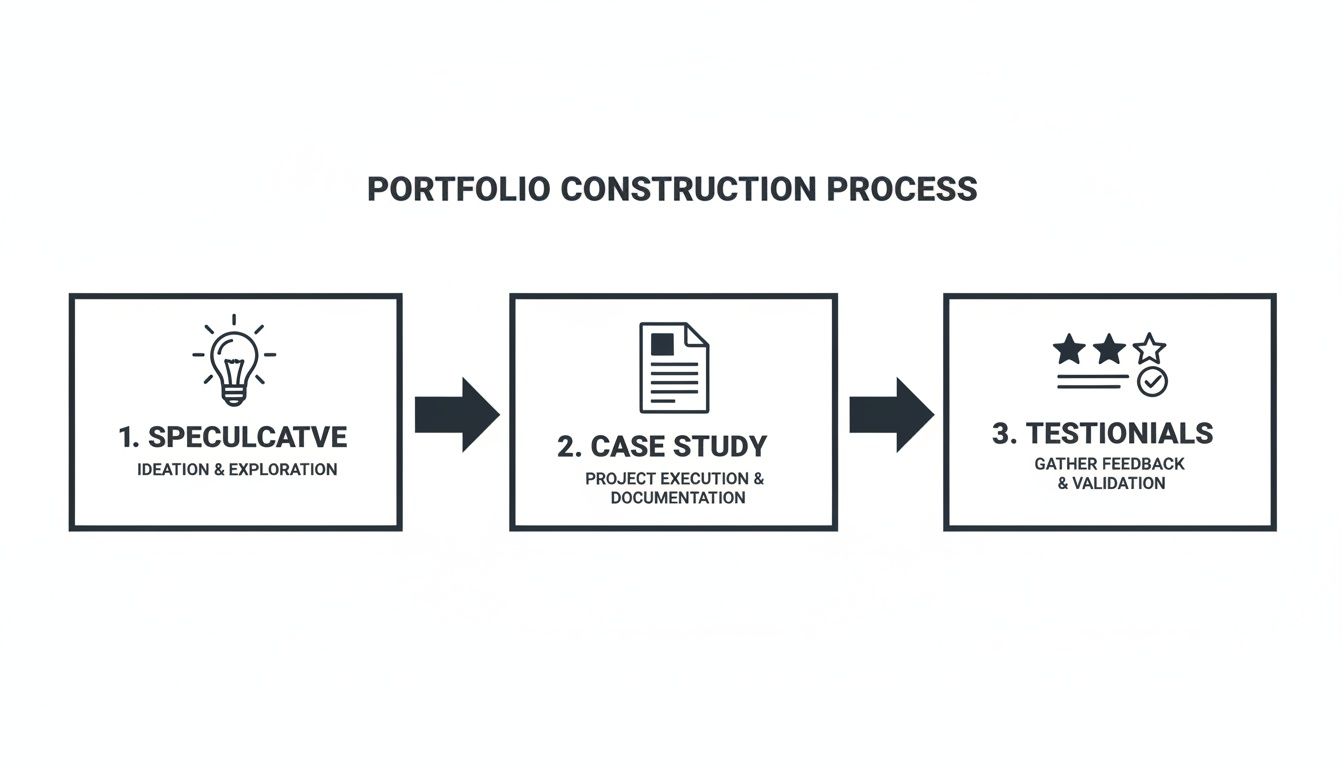
The takeaway here is that you can create compelling assets for your proposals by starting with speculative projects and turning them into powerful case studies, even before you have a long list of clients.
Gaining an Edge with Speed and Automation
Here’s a hard truth about Upwork: being one of the first freelancers to apply gives you a massive advantage. Clients often start reviewing the initial batch of proposals right away and might even hire someone before you’ve had a chance to craft your perfect bid. Speed matters. A lot.
The table below breaks down the practical differences between the old-school manual approach and a more modern, AI-assisted one.
Manual vs AI-Assisted Upwork Proposal Strategy
MetricManual BiddingAI-Assisted Bidding (e.g., Earlybird AI)Speed of SubmissionSlow; can take 15-30 minutes per proposal.Nearly instant; submits personalized bids in minutes.Proposal VolumeLimited by time; maybe 5-10 quality proposals per day.High; can submit dozens of high-quality bids daily.ConsistencyVaries based on energy and focus.Consistently high quality, 24/7.Time InvestmentHours per day spent searching and writing.Minutes per day for review and strategy.First-Mover AdvantageOften missed; proposals submitted hours after posting.Almost always one of the first applicants.
This is where automation tools like Earlybird AI completely change the dynamic. It learns your ideal project criteria, finds the best jobs for you, and submits highly personalized proposals just minutes after they're posted. This ensures your bid is sitting right at the top of the pile.
This gives you a critical first-mover advantage that’s almost impossible to achieve by hand. It frees you up to focus on strategy and client work while the system handles the heavy lifting of outreach, helping you win more jobs without spending your entire day glued to the Upwork feed.
Delivering an Exceptional Client Experience
Winning the contract feels like the finish line, but honestly, it’s just the starting gun. Real, lasting success on Upwork isn't about how many jobs you land; it's about how many clients you turn into long-term partners who can’t imagine working with anyone else.
This is where the real work of building your reputation begins. When you nail the delivery, you don’t just get a five-star review—you get a client who thinks of you first for their next project. That’s the goal.
Kicking Off Projects for a Flawless Start
The first 48 hours after a contract starts are critical. They set the tone for everything that follows. Don’t just accept the offer and disappear into the ether to work. A quick, structured kickoff shows you're a serious professional who values their time and their project.
Here’s what you need to nail in that initial kickoff:
- Confirm Timelines: Reiterate the key milestones and deadlines. This simple step ensures you and the client are perfectly aligned from day one.
- Set Communication Rules: Let them know how you'll keep them in the loop. Will it be daily check-ins on Upwork messages? A weekly summary? Setting this expectation early prevents a lot of anxiety later.
- Ask Smart Questions: No job post is ever perfect. This is your chance to dig deeper. What does success actually look like for them? Who is the end user?
A simple message can make a world of difference. Try something like, "Great to get started! I've reviewed the brief and I’m on track to deliver the first draft by Wednesday. Before I dive in, could you clarify if this piece is for a beginner or an expert audience?"
This kind of proactive communication immediately builds confidence and prevents costly misunderstandings down the road.
Mastering Communication and Proactive Updates
One of the biggest fears for clients is hiring a stranger online and then hearing radio silence. They have no idea what’s happening behind the scenes. Your job is to completely erase that anxiety with a steady rhythm of proactive updates.
Don't ever make the client chase you for an update. If a project has a one-week timeline, a quick message on day three goes a long way. "Quick update: The research is done, and I'm on track to deliver the draft by our Friday deadline." That’s it. It takes 30 seconds, but it builds immense trust.
Excellent service is more than just delivering good work. It's about creating a seamless, low-stress experience for your client. Make them feel confident, informed, and in control at every stage of the project.
This is the fastest path to earning Upwork's coveted Top Rated badge. It’s not just for show; it’s a powerful signal to new clients that you're in the top 10% of talent on the platform. To get there, you need to maintain a Job Success Score of over 90%.
More importantly, it directly impacts your bottom line. Upwork's fees drop from 20% on the first $500 with a client, down to 10%, and then just 5% for any earnings over $10,000. Exceptional service that keeps clients coming back makes every project significantly more profitable. Check out some of the other key Upwork statistics that drive freelancer success.
Handling Feedback and Scope Creep Gracefully
Feedback is part of the job. The best freelancers don't see it as criticism; they see it as collaboration. When a client requests a change, you’re just getting one step closer to what they really want.
But you also have to protect yourself from scope creep—that slow, sneaky expansion of a project beyond what you originally agreed to. When a client asks for "one more small thing," it’s tempting to just do it to be nice. But those small things add up, eating into your time and profit.
Handle these requests politely but firmly. A great response is: "I'd be happy to help with that! Since this is a bit outside our original scope, I can add a new milestone for it. Let me know if you'd like me to send that over for approval."
This approach is professional, not confrontational. It reinforces the value of your time and turns a potential problem into a new stream of revenue.
Scaling From Freelancer to Thriving Business

Real, sustainable success on Upwork happens when your income is no longer tied directly to the hours you put in. It's about a fundamental mindset shift—from a freelancer trading time for money to a business owner building a resilient, scalable system.
This is the stage where you stop working harder and start working smarter. Instead of just chasing the next gig, you're building a well-oiled machine that consistently attracts high-value work. The foundation for this isn't just ambition; it's a solid grasp of your own performance metrics. Without data, you're flying blind.
Identify and Track Your Key Metrics
You can't improve what you don't measure. If you genuinely want to scale, you have to get intimate with the numbers that define the health of your freelance practice. I'm not talking about vanity metrics like profile views; I mean the core drivers of your revenue and efficiency.
Start by consistently tracking these essentials:
- Proposal to Interview Rate: What percentage of your proposals actually gets you a conversation? A low rate—say, below 10%—is a red flag that your proposals aren't connecting.
- Interview to Hire Rate: Once you're in a call, how often do you close the deal? If this number is low, it might be time to work on your client screening or interview skills.
- Average Project Value: What's the average dollar amount for each contract you land? Purposefully driving this number up is the fastest way to boost your income without burning out.
- Client Lifetime Value (LTV): On average, how much revenue does a client bring in over their entire time with you? This metric is a powerful reminder of just how crucial repeat business and long-term relationships are.
Knowing your numbers changes the whole game. You stop chasing every job out there and start strategically targeting opportunities that will actually improve your key metrics. This creates a powerful feedback loop for growth.
Once you have a baseline for these numbers, your biggest opportunities for improvement become crystal clear. A low proposal-to-interview rate, for example, tells you to focus on writing more compelling bids, not just sending more of them. This data-backed approach is how you build a lasting career on Upwork.
Automate Your Outreach to Free Up Your Time
For most freelancers trying to grow, the biggest bottleneck is always time. There are only so many hours in the day to write proposals, answer messages, and manage projects. To break through that ceiling, you have to embrace automation.
This doesn't mean spamming clients with robotic, generic bids. It means using smart tools to handle the repetitive tasks that eat up your day—the kind of work that's essential for lead generation but doesn't need your direct, strategic brainpower.
This is where platforms like Earlybird AI can be a game-changer. They can scan for your ideal jobs and submit personalized proposals in minutes, making sure you’re one of the very first applicants. This frees you from the endless cycle of searching and bidding, giving you back hours to focus on high-value work like client strategy, business development, and delivering amazing results.
Build a Team with Multi-User Workflows
The final frontier of scaling is moving beyond what you can do alone. Building an agency on Upwork lets you take on bigger projects, serve larger clients, and multiply your revenue potential. It involves bringing other talented freelancers under your agency's umbrella.
Of course, this requires a whole new skillset: project management, quality control, and team leadership. Upwork's own agency features are built for this, giving you a central hub to manage multiple freelancer accounts and keep an eye on all ongoing projects.
Understanding the market is also key to agency success. For instance, location matters a great deal. The USA, India, and the Philippines together account for a massive 45.6% of Upwork's freelancer revenue. The United States leads with 25% of the total gross services volume, followed by India at 14% and the Philippines at 11%. Knowing this helps you position your agency and adjust your bidding strategies. If you want to dive deeper, you can discover more insights about Upwork user data.
For anyone serious about this path, a solid business plan is non-negotiable. Our guide on starting an SEO agency offers a detailed roadmap that you can adapt for any service business, covering everything from the legal setup to landing your first agency clients. By combining smart metrics, strategic automation, and team building, you can turn your freelance hustle into a truly thriving business.
Your Upwork Questions, Answered
Starting out on Upwork can feel like you're navigating a new world, and it's totally normal to have a ton of questions. As you go from setting up your profile to actually scaling a real business, some of the same concerns come up again and again. Let's tackle a few of the most common ones I hear from freelancers.
How Long Until I Start Getting Consistent Work?
This is the million-dollar question, isn't it? The honest answer is: it depends. But with a solid strategy, most freelancers can land their first few gigs within 1-3 months.
The real goal—consistent, reliable income—usually starts to take shape once you hit Top Rated status. For most people who put in the work, that happens within 3-6 months. The biggest variable is you. It all comes down to putting in focused effort every single day—sending out hyper-relevant proposals and then knocking it out of the park for every client you land. Using the right tools to get your proposals in front of clients faster can seriously cut down that timeline.
Should I Specialize or Just Be a Generalist?
Specialize. Period. It's the most reliable way to build a high-earning, long-term business on Upwork. I know it feels like you're cutting off opportunities by narrowing your focus, but trust me, being a generalist is a fast track to low pay and fighting over scraps with everyone else.
When you carve out a niche, you instantly position yourself as an expert. That authority is what lets you charge premium rates and attract clients who are serious about getting results.
Think about it: you don't go to a general practitioner for brain surgery. You find the best specialist you can. It's the exact same on Upwork. The expert who solves one specific, painful problem will always be in higher demand and can charge way more.
Stop being a generic "Writer." Start being a "B2B SaaS Content Writer for Marketing Automation Platforms." That kind of focus makes your entire profile, from your title to your portfolio, impossible for the right client to ignore.
How Do I Use My Upwork Connects Without Wasting Them?
Treat your Connects like cash, because that's what they are—your marketing budget. The biggest mistake you can make is shotgun-blasting them at every job that looks remotely okay. That's a losing game.
The key is to invest them surgically. Only apply to high-quality jobs where you know your skills are a dead-on match. Look for clients with a solid history on the platform: verified payment, a good number of hires, and positive reviews.
And what about boosting proposals? It can be a game-changer, but only use it when you're almost certain you're one of the top three candidates for the job. Boosting gets your proposal seen first, but it's a huge waste of Connects if you aren't a perfect fit.
Can I Get Banned for Using an Automation Tool?
That's a smart question to ask, and the answer really depends on the tool you're using. The good ones are built from the ground up to respect Upwork's Terms of Service. Their job is to make you more efficient, not to get you banned by spamming or doing anything shady.
A safe, reputable platform will always:
- Mimic natural human bidding patterns.
- Use clean, secure regional IPs to keep your account safe.
- Never ask for or store your password or other sensitive login details.
When you're looking at a tool, make sure they're upfront about their safety protocols. You want a smart assistant that helps you create personalized bids at scale, not a mindless spam bot.
Ready to stop spending hours hunting for jobs and start winning more high-value projects? Earlybird AI acts as your 24/7 sales team, sending AI-crafted, personalized bids just minutes after a new job is posted. Find out how our members are doubling their reply rates and landing better clients with way less effort at https://myearlybird.ai.