← Back To Blog
How to Find Web Design Clients and Build a Steady Workflow
If you want a steady stream of web design clients, you have to get crystal clear on two things first: who you want to serve and what, exactly, you’re going to do for them. This isn't just busywork; it's the foundation for your entire client acquisition strategy.
Build Your Foundation for Attracting Ideal Clients

Before you can find clients, you have to know who you’re looking for. I see so many freelancers fall into the trap of marketing to everyone. When you do that, you end up connecting with no one. The real secret is to stop being a generalist and become a specialist.
That single shift in mindset changes everything. You’re no longer just “building websites.” You’re solving specific, painful business problems for a very particular group of people. That kind of clarity is the most powerful marketing tool you’ll ever have.
Define Your Ideal Client and Niche
Picking a niche isn’t just about choosing an industry you find interesting. It’s about finding that sweet spot where your skills, your passions, and a real market need all overlap. A well-defined niche is what turns you from "a web designer" into "the go-to expert" for a specific community.
To get started, ask yourself a few honest questions:
- What industries do you actually know? Think about previous jobs, hobbies, or even family businesses. Any inside knowledge gives you a serious advantage.
- What kind of work do you love doing? Are you fired up about building e-commerce sites for sustainable brands? Or maybe you love creating sleek portfolio sites for photographers?
- Where's the money? Let's be practical. Look for industries that are growing and actually understand that a great website is an investment, not an expense.
Once you have a niche in mind, go deeper and build out an Ideal Client Persona (ICP). This is basically a detailed profile of the perfect person you want to work with. For example, instead of targeting "restaurants," you might focus on "family-owned Italian restaurants in major cities that need an online ordering system." See the difference?
Specialize Your Service Offerings
Once you know who you're serving, you need to tailor your services to solve their specific problems. A generalist offers "web design." A specialist, on the other hand, offers a targeted solution, which makes your value proposition infinitely more compelling.
The goal is to shift from being just another service provider to becoming a strategic partner. When a client sees you as an expert who genuinely understands their industry's challenges, they won't just hire you—they'll happily pay a premium for your expertise.
This focused approach is absolutely essential in today's crowded market. In the U.S. alone, you're competing with over 203,000 other web design firms. It's no surprise that nearly 30% of designers say finding clients is their single biggest challenge.
Specializing is how you cut through that noise. It also supercharges your referral engine. We know that referrals drive a staggering 80% of new business for small agencies, and you're far more likely to get them when you're known as the "dental practice website guy" instead of just "some web designer."
To illustrate, let's compare the two paths directly.
Strategic Differences Between Niche and Generalist Designers
FactorNiche SpecialistGeneralistMarketing MessageHighly targeted and specific (e.g., "Websites for Physical Therapists")Broad and generic (e.g., "Custom Web Design Services")Client AcquisitionAttracts ideal clients through authority and reputationOften relies on volume, lower-value leads, and price competitionPricing PowerCan command premium rates due to specialized expertiseFaces constant downward price pressure from competitorsProject EfficiencyDevelops faster workflows and reusable assets for the nicheEvery project is different, requiring more time for research and setupPerceived ValueSeen as a strategic partner and industry expertViewed as a commodity or a technical service provider
As you can see, the specialist has a clear advantage in building a sustainable, profitable business. This is the same focused strategy successful agencies use. For instance, designers who master SEO for their chosen niche deliver far more value, a tactic often explored when starting an SEO agency.
By building this strong foundation, you position yourself as an authority. Your marketing becomes laser-focused, your proposals hit home, and you start attracting the high-value clients you actually want to work with—instead of just chasing any project that comes your way.
Your Portfolio is Your Best Salesperson—Make It Work for You
Think of your portfolio as more than just a gallery of your past work. It's your most dedicated salesperson, working 24/7 to convince potential clients that you're the one they need to hire. I see so many designers treat their portfolio like a static art museum, but that’s a huge mistake. It needs to be an engine, actively turning curious visitors into qualified leads.
This means you have to move beyond just posting pretty screenshots. You need to build a collection of assets that tells a compelling story. Every single project you feature should answer the client's biggest unspoken question: "Can this person solve my specific problem and actually deliver a return on my investment?" When your portfolio and online profiles are laser-focused on answering that question, finding great web design clients gets a whole lot easier.
Go Beyond Pretty Pictures with Powerful Case Studies
A great portfolio doesn't just show what you did; it explains why it mattered. This is where case studies become your secret weapon. They provide the narrative and hard evidence that a simple image gallery just can't. A well-crafted case study builds immediate trust and proves you're a strategic thinker, not just a pixel-pusher.
For each project you showcase, tell a quick but powerful story. Make sure it covers:
- The Client's Problem: Kick things off by clearly outlining the challenge the client was dealing with before you came along. Was their old site bleeding visitors? Was the user experience a confusing mess? If you can, use their own words to describe the pain point.
- Your Strategic Solution: Walk them through your process. Explain the specific design choices and strategic thinking that led to your solution. This is your chance to really flex your expertise in UX, conversion optimization, or whatever your specialty is.
- The Bottom-Line Results: This is the knockout punch. You have to connect your design work to real business outcomes. Did you help them increase leads by 35%? Did the new e-commerce design boost sales by 20%? Numbers are your best friend here—they’re incredibly persuasive.
Following this simple structure shifts the conversation from your cost to your value. Suddenly, you're not just a designer for hire; you're a business partner who delivers measurable growth.
Weave in Testimonials and Social Proof
Nothing builds trust faster than a rave review from a happy client. Testimonials are the social proof that backs up all your claims and calms the nerves of a hesitant prospect. But don't just dump them all on a "Testimonials" page and call it a day. Integrate them right into your case studies.
Imagine placing a powerful quote right next to the data-driven results you delivered for that client. A testimonial that says, "Working with them was amazing, and our online bookings have doubled since the relaunch!" is infinitely more powerful than a generic "Great work!"
By placing a client's own words right next to the hard data, you create a one-two punch of emotional and logical proof. This combo is incredibly effective at cutting through a prospect's skepticism and giving them the confidence they need to reach out.
Turn Your Own Website into a Lead-Gen Machine
Let's be honest: your own portfolio website is a living, breathing demonstration of your skills. It better be fast, responsive, and, most importantly, designed to capture leads. A beautiful site that doesn't clearly tell visitors what to do next is just a digital business card—a massive missed opportunity.
First, check your call-to-action (CTA). Is it crystal clear and easy to find on every single page? Ditch the passive "Contact Us" and try something more action-oriented like "Start Your Project" or "Get a Free Proposal."
Next, make it ridiculously easy for someone to get in touch. A simple, clean contact form with as few fields as possible is non-negotiable. Every extra box they have to fill out is another chance for them to leave. Your goal is to remove every ounce of friction between a visitor thinking "this person is good" and them sending you that first message.
Make Your Upwork Profile Impossible to Ignore
For a lot of freelancers, Upwork is a critical source of new projects. But it's a crowded place, and a generic profile is a surefire way to get lost in the noise. You need to treat your Upwork profile with the same strategic care as your personal website.
Start with your bio. It needs to be a magnet for your ideal client. Instead of the typical "I am a web designer with 5 years of experience," try something targeted: "I help SaaS companies boost trial sign-ups with conversion-focused landing pages." See the difference? One is a bland statement; the other is a solution.
Finally, be ruthless about curating the portfolio pieces you show on Upwork. Don't just upload everything you've ever done. Hand-pick the projects that perfectly represent the kind of work you want more of and that will attract the high-value clients you're after. Your Upwork profile is often the very first impression you make—make it a strong one.
Where to Find High-Quality Web Design Leads
Alright, you've got a killer portfolio. Now, let's put it to work. The real secret to a steady stream of clients isn't just about having great work—it's about actively and consistently finding the right people to show it to.
Relying on one source for leads is a recipe for disaster. We've all been through the feast-or-famine cycle, and it's brutal. A multi-channel approach is your best defense. You need to be hunting for opportunities across different platforms, building real relationships, and creating systems that bring clients to you.
Master the Freelance Marketplaces (The Right Way)
Freelance marketplaces like Upwork can feel like a race to the bottom, but they're a goldmine if you know how to dig. The biggest mistake I see designers make is getting into bidding wars over cheap, low-effort projects. The trick isn't to apply for everything; it's to be ruthlessly selective.
Use Upwork's advanced filters to your advantage and stop wasting your time. Here's how:
- Filter by budget: Don't even look at projects below your minimum rate. Simple.
- Filter by client history: A client with $10k+ in spending and good reviews is serious. Someone with zero history? It's a gamble.
- Filter by client location: Targeting clients in countries with strong economies often translates to bigger budgets and more professional projects.
When you filter aggressively, you stop competing on price and start competing on value. You’ll spend less time writing proposals and more time talking to serious business owners who get it.
Go Direct and Bypass the Competition
While marketplaces have their place, nothing beats the power of targeted outreach. This is where you can hand-pick your ideal clients and connect with them directly, completely sidestepping the noise and competition.
LinkedIn is your best friend here. Don't just send a generic "I'd like to connect" request. Find a real reason to start a conversation. Let's say you build websites for dental clinics. Search for "Dental Practice Owner" in your target city. Before you reach out, actually look at their current website.
My Favorite Pro-Tip: Find one specific, nagging problem you can solve. Is their site painfully slow? Does it look broken on your phone? Is the "Book Now" button leading to a 404 page? Your opening message will be 100x more effective if you lead with a solution to a real problem they have right now.
Beyond LinkedIn, don't sleep on industry-specific directories. Think of directories for lawyers, therapists, or home-building contractors. These are often filled with businesses whose websites haven't been touched in a decade. A simple, personalized email pointing out a few critical issues and a quick note on how you can fix them is often all it takes to get a conversation started.
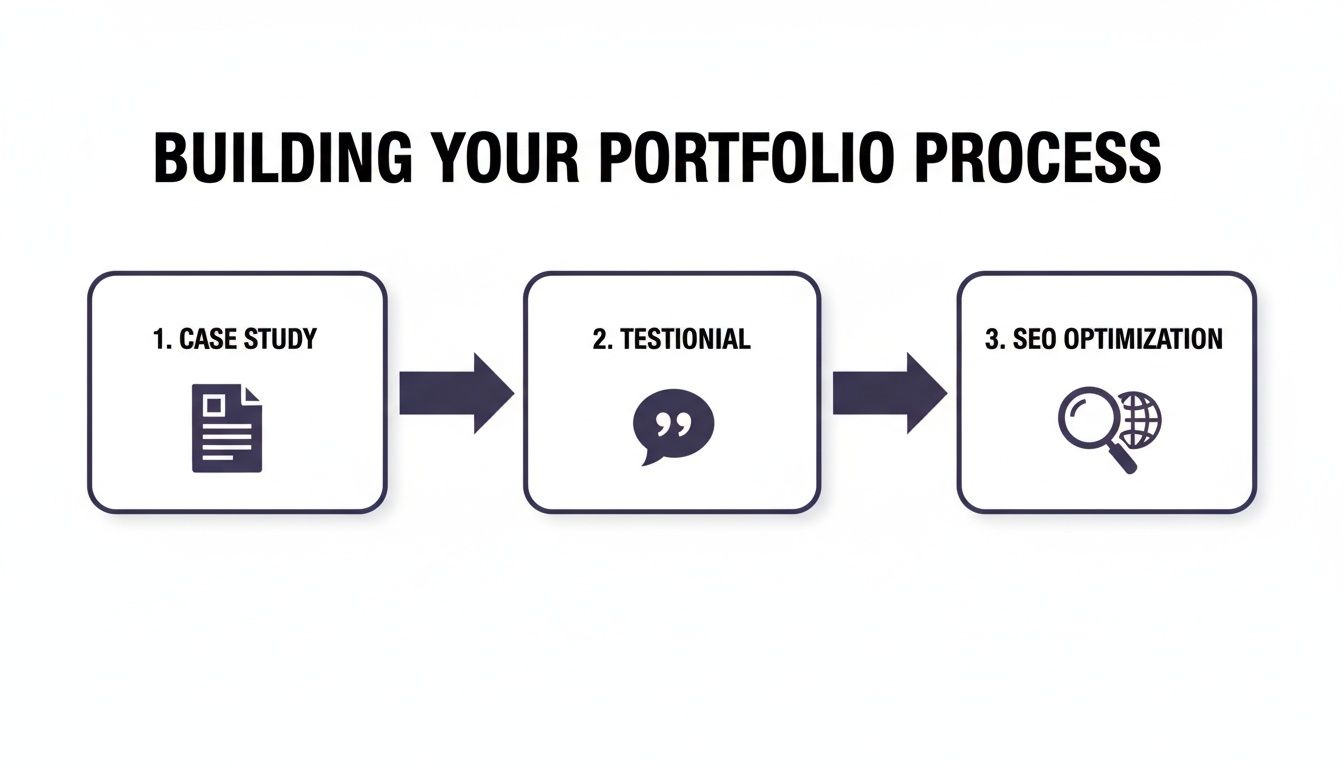
This workflow is so important because it shows that a finished project isn't the end—it's the beginning. You have to actively turn that project into social proof (testimonials) and a lead magnet (case studies) to create a sustainable pipeline.
Build a Referral Network That Works for You
Honestly, referrals are the holy grail of client acquisition. A lead that comes from a trusted source is already warmed up and ready to go, which makes your job a whole lot easier. But you can't just sit back and hope past clients send people your way. You have to actively build your network.
Think about the other professionals your ideal clients are already working with. Who's in their circle?
- Copywriters & Content Strategists: They write the words, but they need a great designer to make them look good.
- SEO Specialists & Marketers: A new marketing push or a site-wide SEO audit often uncovers the need for a full redesign.
- Photographers & Videographers: Their clients just got amazing new visuals and now need a high-end website to show them off.
- Business Coaches & Consultants: As trusted advisors, they're often the first to tell a client, "You need to fix your website."
Find these people on LinkedIn or at local industry meetups. The key is to play the long game. Don't just ask for leads. Build a genuine connection. See how you can help them first. Offer to send clients their way. When you give value without keeping score, you’ll be amazed at how much comes back to you.
Write Proposals That Actually Get a Response
Finding a lead is one thing. Turning that lead into a paying project? That's where the real work begins. Your proposal is the bridge that connects their problem to your solution, and if it's generic, that bridge will collapse.
Let's be blunt: clients can spot a copy-pasted template from a mile away. It's the fastest way to get your message archived. To actually get a reply, you have to show them you’ve done your homework and genuinely understand what they're trying to achieve.
Anatomy of a Winning Upwork Proposal
Upwork can feel like a shouting match, but a smart proposal cuts right through the noise. Most freelancers start by listing their skills. Don't do that. Clients don't care about your resume yet; they care about their problem.
A great proposal flips the script and makes it all about them. The structure is simple but incredibly effective:
- Repeat Their Goal Back to Them: Start by rephrasing their core objective. This immediately shows you've actually read and understood their brief. It’s a simple, powerful way to build instant rapport.
- Ask a Smart Question: This is your chance to shine. Pose a question that shows you're already thinking strategically. For an e-commerce project, you might ask, "Have you considered how a streamlined one-page checkout could impact your current cart abandonment rate?"
- Hint at Your Solution: Briefly touch on your approach, but always tie it back to their goal. Frame your services as the answer to their specific pain point.
- Show Relevant Proof: Don't send your whole portfolio. Link to one or two case studies that are almost mirror images of the project they're posting.
- End with a Clear Next Step: Ditch weak phrases like "I look forward to hearing from you." Be direct. "Are you available for a brief 15-minute call next week to discuss this further?" is so much stronger.
This approach instantly positions you as a consultant, not just another bidder fighting for a gig. We dive into more specific examples in our guide covering cover letter examples for Upwork.
The most effective proposals feel less like a sales pitch and more like the beginning of a collaborative partnership. By focusing on the client's problem and offering immediate value, you shift the dynamic from being a bidder to being a problem-solver.
Personalized Email Outreach That Converts
Whether you're sending a cold email or following up on a warm introduction, personalization is non-negotiable. Cold outreach has a terrible reputation for a reason, but a truly thoughtful email can still work wonders.
When you're reaching out to a cold lead, you need a real reason to be in their inbox. Maybe you saw a recent company milestone on LinkedIn, or you found a legitimate technical issue on their website, like slow load times or a broken contact form.
A simple framework for a cold email that gets opened:
- Subject: Quick Question About the [Their Company Name] Website
- Opener: Start with a specific, genuine compliment or observation about their business.
- The "Why": Briefly point out the issue you noticed and explain the negative impact it’s likely having on their business.
- The Solution: Offer a high-level idea for how to fix it. No hard selling.
- The CTA: Ask for a short, no-pressure call to explain your thoughts.
Of course, referrals are still the gold standard. They power 80% of project wins for small agencies. But with over 203,000 web design businesses in the U.S. alone, competition is stiff. It’s no surprise that 30% of freelancers say finding clients is their biggest challenge. Building a solid referral network takes time and effort. (You can dig into the numbers on the web design services industry on IBISWorld).
For a warm lead from a referral, your job is much easier. Name-drop your mutual connection in the subject line and the first sentence to establish instant credibility. Keep the email short, get straight to the point about the problem they need to solve, and move directly to scheduling a call.
Scale Your Outreach with Smart Automation

Let's be honest. Manually hunting for leads, constantly refreshing job boards, and writing every single proposal from scratch is a fast track to burnout. It's the classic freelancer trap: you spend so much time looking for work that you have no time left to actually do the work.
To build a steady, predictable pipeline of clients, you have to work smarter, not just harder.
This is where smart automation comes in. It’s not about blasting out spammy, robotic messages. It's about using technology to handle the repetitive, mind-numbing tasks so you can focus your brainpower on what really matters: building relationships and delivering incredible results for your clients.
Get Your Time Back with an AI Sales Assistant
Imagine having a personal sales assistant who works 24/7, never gets tired, and knows exactly what your ideal project looks like. That’s the reality with modern automation tools, especially those built for platforms like Upwork. This isn't just a simple script; it's a system that actually learns your preferences and acts on your behalf.
For example, a tool like Earlybird AI essentially becomes your always-on sales team. You connect your account, and it starts learning from your feedback, figuring out the precise type of web design projects you want. From there, it takes over the tedious stuff:
- Finds the Best Jobs Instantly: It scans for new projects the moment they’re posted, making sure you're one of the first to see a great opportunity.
- Drafts Personalized Proposals: Using your past proposals and client data, it can whip up highly relevant drafts in minutes, not hours.
- Sends Replies Immediately: When a client messages you, the system can send an initial reply in under five minutes, putting you at the top of their inbox.
That speed is a massive competitive advantage. On a platform where the first few quality proposals usually get the most attention, being fast is just as important as being good.
The goal of automation is to eliminate the manual grind of prospecting without losing the personal touch that closes deals. By automating the search and the first draft, you free up your mental bandwidth to add the final strategic insights that make your proposal impossible to ignore.
If you want to dig deeper into the core concepts, you can learn more about what sales automation is and how freelancers can use it to their advantage.
Use Automated Follow-Ups So No Lead Gets Left Behind
How many times have you sent a killer proposal and then completely forgotten to follow up? It happens to all of us. The client gets busy, your message slips down their inbox, and a promising lead goes cold just because of a lack of persistence.
Automated follow-up sequences are a simple, yet incredibly powerful, fix. You can set up a system to send a polite, non-pushy message if you haven't heard back after a few days. It's a small touch that can dramatically boost your response rate and shows clients you’re organized and genuinely interested. This little process ensures no opportunity falls through the cracks.
Refine Your Strategy with Real-Time Analytics
One of the biggest wins from using an automation platform is the data. You can finally stop guessing what works and start making decisions based on cold, hard numbers. A good analytics dashboard will show you:
- Which types of proposals get the most replies.
- The best time of day to send your applications.
- The keywords in job posts that lead to your highest-paying projects.
This feedback loop is what separates struggling freelancers from those who consistently find web design clients. You can see which strategies are paying off and double down on them, while ruthlessly cutting the tactics that are just wasting your time. It’s a data-driven approach that takes the emotion and guesswork out of finding work.
To really see the difference, let's put the old way and the new way side-by-side.
Manual Prospecting vs Automated Bidding on Upwork
The table below breaks down the reality of spending your days manually searching for work on Upwork versus letting an AI assistant handle the heavy lifting.
MetricManual ProcessEarlybird AI AutomationTime Investment2-4 hours per day of active searching and writing30 minutes per day for review and personalizationSpeed to Apply30-60+ minutes after a job is posted~10 minutes after a job is postedPersonalizationHigh effort, written from scratch for each leadHigh efficiency, AI-drafted then personalized by youFollow-UpInconsistent; relies on memory or manual trackingSystematic and automatic, ensuring no lead is missedStrategyBased on gut feeling and anecdotal experienceBased on real-time data and performance analytics
Ultimately, scaling your outreach with automation isn't about removing yourself from the process. It's about empowering yourself to be in more places at once, make smarter decisions, and reclaim your time for the high-value client work that actually grows your business.
Common Questions About Finding Web Design Clients
Getting your client acquisition strategy right can feel like a moving target, especially when you're just trying to grow your business. Even with a solid plan, you’re bound to hit a few snags. Let's tackle some of the most common questions and hurdles I see designers face all the time.
How Do I Find My Very First Paying Client?
Ah, the classic chicken-and-egg problem. Landing that first client feels impossible because you don't have a portfolio or testimonials to show. The fastest way to break through this is to lean on the people who already know and trust you: friends, family, and former colleagues.
So many new designers skip this step, thinking, "I don't know any business owners." You'd be surprised.
Start by just talking about what you're doing. Make an announcement on your social media profiles. Mention it in conversations. You can even send a casual email to your network.
Here’s a simple script you can adapt:
"Hey [Name], I wanted to let you know I recently launched my web design business, where I help [your niche, e.g., local service businesses] create websites that actually attract more customers. If you know anyone who might need a hand with their online presence, I'd be grateful for an introduction!"
This works because the trust is already built-in. It’s a low-pressure way to get the word out and land those first crucial projects that will become the foundation of your portfolio.
How Can I Start Attracting Higher-Paying Clients?
Want to charge premium rates? You have to act like a premium provider. This is all about shifting your positioning. Stop being a "doer" who just builds websites and become a strategic partner who solves expensive business problems.
High-paying clients aren't buying a website; they're investing in a solution. They want more revenue, better efficiency, or a stronger brand.
Here’s how to make that pivot:
- Specialize in a profitable niche. Become the go-to expert for a specific industry, like e-commerce brands or B2B SaaS companies. Deep expertise in a single area always commands higher rates.
- Talk about business results, not just pretty designs. Your case studies need to focus on metrics. Don't say, "I designed a new homepage." Instead, say, "The new homepage design led to a 40% increase in demo requests." That's a language high-value clients understand.
- Elevate your own brand. Your website, your proposals, your emails—every single touchpoint has to communicate quality and professionalism.
This isn’t an overnight fix. It’s a deliberate, conscious effort to refine your messaging and showcase work that proves you deliver a real return on investment.
What Is the Best Way to Create a Sustainable Client Pipeline?
A sustainable pipeline is the holy grail for freelancers. It’s what ends the dreaded feast-or-famine cycle and gives you a predictable income. The secret isn't finding one magic bullet; it's building a multi-channel system so you’re never relying on a single source for leads.
A truly consistent pipeline is built on three core pillars:
- Inbound Marketing: This is your long game. Creating genuinely helpful content—like blog posts, tutorials, or free guides for your niche—will eventually start attracting clients through Google. It takes time and effort, but the leads it brings are warm and already see you as an expert.
- Strategic Partnerships: Actively build a referral network. Connect with copywriters, SEO specialists, brand strategists, and business consultants who serve the same clients you do. A strong referral network can easily become your most reliable source of high-quality projects.
- Systematized Outreach: You still need to be proactive, but you can be smart about it. Use tools and automation to handle the most tedious parts of outreach, especially on platforms like Upwork. This lets you consistently bid on ideal projects without it eating up your entire day.
By balancing these three activities, you create a robust system where opportunities are always flowing in from different directions. That diversification is the key to building a stable, scalable web design business.
Stop wasting hours on manual prospecting and start landing more high-value projects. Earlybird AI acts as your always-on sales team for Upwork, finding the best jobs, drafting personalized proposals, and ensuring you're the first to reply. See how you can build a predictable client pipeline at https://myearlybird.ai.