← Back To Blog
How to Improve Sales Conversion Rate for Your Agency

If you want to close more deals, you first need to figure out why you're losing them. It's less about finding a silver-bullet solution and more about playing detective—auditing every step of your sales process, from the first "hello" to the final handshake, to find the specific leaks costing you business.
Pinpointing the Leaks in Your Sales Funnel
Before you can fix anything, you have to know what's broken. Boosting your conversion rate isn't about guesswork; it starts with a brutally honest look at where potential clients are dropping off.
Many freelancers and agencies, especially on platforms like Upwork, get caught in the trap of just sending more proposals. That’s like pouring water into a bucket riddled with holes. The smarter move? Plug the holes first.
This means you have to stop guessing and start measuring. Every interaction is a clue. Are clients viewing your profile but not responding to your proposals? Are you having great initial chats that go cold the moment you mention your price? Each stage of your funnel has its own conversion rate, and a dip at any point tells a story.
Breaking Down Your Sales Process
To find the weak spots, just map out the journey a typical client takes with you. For most service providers, it breaks down into a few key stages:
- Initial Contact to Conversation: What percentage of proposals you send actually get a reply? A low number here is a huge red flag, usually pointing to a weak proposal template or a profile that doesn't inspire confidence.
- Conversation to Meeting: Of those who reply, how many agree to a discovery call? If prospects are ghosting you after a few messages, your initial back-and-forth might be missing the mark or failing to qualify them properly.
- Meeting to Closed Deal: How many of your meetings actually turn into a signed contract? If you're getting lots of calls but few clients, the problem likely lies in your sales call itself, your pricing structure, or how you follow up.
By looking at the conversion rate between each of these stages, you can zero in on the exact moment your sales process falters. This lets you stop wasting time on things that work and focus your energy where it’ll make a real difference.
This simple diagram shows how to think about this process and spot where you’re losing people.
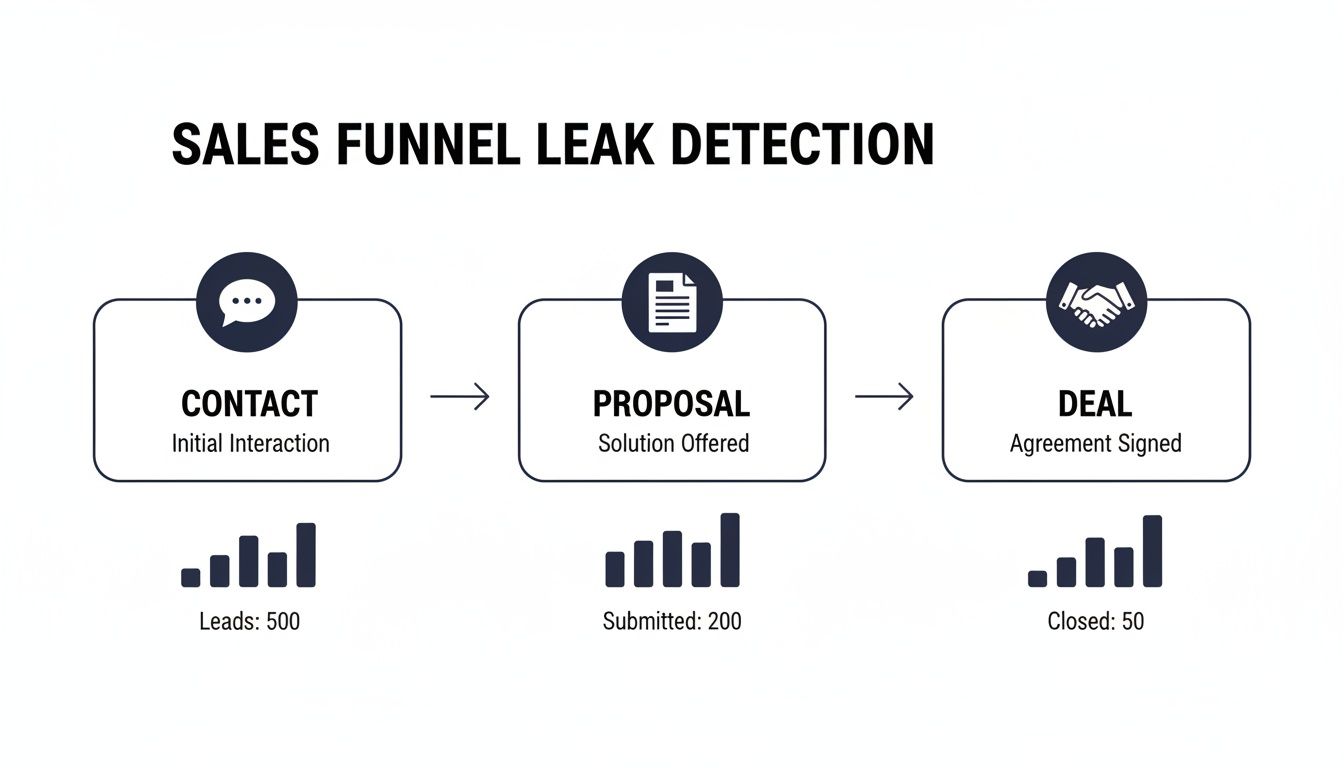
As you can see, a drop-off can happen anywhere. That's why tracking your performance across the entire journey is so critical to seeing real improvement.
Nailing Your First Impression on Upwork
On a platform like Upwork, your profile is your digital handshake, and your proposal is your elevator pitch. If either one falls flat, you lose a potential client before you even get a chance to say hello. It's easily one of the biggest leaks in any freelancer's or agency's sales funnel.

Let's face it: clients are drowning in a sea of proposals. Your one job is to stand out—fast. You have to convince them, almost instantly, that you’re the safest, most valuable choice they can make. This isn't just about tweaking a few words; it's about fundamentally rethinking your profile and how you bid on jobs.
Turn Your Profile from a Resume into a Sales Magnet
Most freelancers make the classic mistake of treating their Upwork profile like a resume. It’s a list of skills, a chronological history of jobs, and... that's about it. That's not what lands clients.
A high-converting profile isn't a resume. It’s a sales page. Its sole purpose is to speak directly to your ideal client's biggest headaches and aspirations.
To do this, you have to get out of your own head and into theirs. Instead of writing, "I'm a skilled SEO specialist," try something like, "I help SaaS companies double their organic traffic and get in front of paying customers." The first one is about you. The second is about them.
Here’s where to focus your efforts for the biggest impact:
- The Headline: This is your most valuable real estate. Don't waste it. Instead of a generic "Graphic Designer," go for something benefit-driven like, "Brand Identity Designer for Tech Startups | Creating Logos That Attract Investors."
- The Overview: The first two sentences are all a client sees before they decide to click "more." Hook them immediately. Hit on their main pain point right away to show you get it.
- The Portfolio: Stop just uploading images. Each portfolio piece should be a mini-case study. Tell a story: What was the client's problem? What was your solution? And what were the results? Be specific: "Increased landing page conversions by 25% in 60 days."
A killer profile does more than list your skills. It builds trust by proving you understand a client's world and have a track record of solving their exact problems. It pre-sells your value before they even talk to you.
If you want to see these principles in action, our guide on crafting a sample profile for Upwork breaks it down even further.
Writing Proposals That Clients Actually Want to Read
Once your profile is dialed in, it's time to tackle the proposals. Sending a generic, copy-and-paste template is the fastest way to get ignored. Clients can spot them a mile away, and it screams, "I don't really care about your project."
A winning proposal is a direct conversation with the job post. It shows you’ve not only read it but have already started thinking about their problem. The goal isn't to list every service you offer; it's to get them to reply.
Try structuring your proposals this way for a much better response rate:
- Lead with their problem. Show you understand what they need. "I see you're looking for a writer who can create blog posts that actually drive traffic, not just sit on your site..."
- Hint at your solution. Briefly explain your approach. "...my process starts with deep keyword research to find what your customers are actually searching for, ensuring every article has a purpose."
- Offer a shred of proof. Link to a relevant example. "I used this exact strategy to help a similar B2B client achieve a 40% jump in organic traffic in just three months."
- End with a question. Your call to action should be a question that's easy to answer. "What's your current monthly traffic, and what's the primary goal for the next six months?"
This simple shift changes the entire dynamic. You're no longer just another bidder asking for a job; you’re a strategic partner offering a solution.
The Unfair Advantage of Speed
Beyond the words you write, there's one factor that can completely change the game: speed. I've seen it time and time again—submitting a proposal within the first 10 minutes of a job being posted gives you a massive advantage.
You're beating the flood of competition to the client's inbox. Data from Upwork consistently shows that the first freelancers to respond capture a huge share of the work. With an active client base now at 814,000, waiting even a few hours means your proposal might get buried under 50 others.
Being first doesn't guarantee the job, but it guarantees you'll be seen. Clients are most engaged when they first post a job and review the initial wave of applicants with fresh eyes. By the time they get to proposal #51, their attention is shot. Getting in early shows you're on the ball and eager to help, giving you a powerful first-mover advantage that most freelancers completely overlook.
Winning the Conversation with Strategic Messaging
So, you got a reply. That's a huge win, but don't celebrate just yet. Getting a potential client to respond to your proposal is one thing; turning that flicker of interest into a paid project is a completely different ballgame. This is where countless promising leads go to die.
The difference between a conversation that fizzles out and one that ends with a signed contract almost always comes down to your messaging strategy. You can't just wing it.

Having a plan for how you communicate helps you build real rapport, prove your value, and gently guide the prospect to the next logical step—without ever sounding desperate or pushy.
Ask Questions That Uncover the Real Problem
Your first few messages aren't about selling; they're about diagnosing. Think of the client's job post as just the tip of the iceberg. Your real job is to figure out the massive business challenge hidden just below the surface, and you do that by asking smart, open-ended questions.
Steer clear of lazy questions like, "What are your requirements?" That's an order-taker's question. Instead, you need to dig deep to understand the why behind their project.
Let's say a client wants a new website. Don't just ask about the number of pages. Ask questions that get to their actual business goals:
- "What's the one thing you hope this new website will achieve for your business in the next six months?"
- "If we knock this out of the park, what does a successful outcome look like for you personally?"
- "Can you walk me through what frustrates you the most about your current site?"
Questions like these completely change the dynamic. Suddenly, you're not just another freelancer waiting for a task list; you're a strategic partner who’s invested in their success. For more ideas on how to frame these critical first messages, these cover letter examples for Upwork are a great starting point.
Handling Objections with Confidence
Objections are a good sign. When a client questions your price or timeline, they aren't rejecting you—they're asking for more information and need a little more reassurance. How you handle these moments is what separates the pros from the amateurs.
Whatever you do, don't get defensive. Treat every objection as a golden opportunity to drive your value home.
- When they say, "Your price is higher than others": Don't immediately jump to a discount. Reframe the conversation around the value they're getting. Try something like, "I appreciate you sharing that, and you can definitely find cheaper options. My process is different because it includes [mention a specific value-add, like in-depth customer research or post-launch A/B testing] which ensures we hit the growth targets you're aiming for. Can we talk about the ROI you're expecting?"
- When they're worried about the timeline: Show them you have a rock-solid process. You could say, "I understand the timeline is a top priority. My workflow includes weekly progress reports and a shared project board, giving you total visibility from start to finish. This is how we stay on track and avoid surprises."
The best way to handle objections is to see them coming. Once you understand the common hang-ups your ideal clients have, you can address them proactively in your messaging. You'll build trust before they even have a chance to ask.
The Art of the Professional Follow-Up
The dreaded radio silence. What do you do when a great conversation just stops? Most people either give up way too soon or send a weak, "Just checking in," which is incredibly easy to ignore. To really boost your conversion rate, you need a follow-up system that is persistent without being annoying.
Here’s a simple but incredibly effective cadence that keeps you top of mind while respecting the client's busy schedule:
- Follow-Up #1 (2-3 business days later): Add value. Never just ask for an update. Find a relevant article, share a quick thought about their industry, or offer a tiny piece of advice related to your chat. Something like, "Hi [Client Name], I was thinking about our conversation on [project goal] and stumbled on this case study about [their specific challenge]. Thought you'd find it useful. Any new developments on your end?"
- Follow-Up #2 (4-5 business days later): The direct (but polite) check-in. Now is the time for a simple prompt. "Hi [Client Name], just wanted to quickly follow up on our chat from last week. Are you still looking to move forward with the [project name]?"
- Follow-Up #3 (7 business days later): The "break-up" email. This is a brilliant, low-pressure tactic to get a final response. "Hi [Client Name], since I haven't heard back, I'll assume your priorities have shifted for now. I'm going to close out your file, but please feel free to reach out if things change down the road. Wishing you the best with the project!"
This structured approach shows you're an organized professional, not a needy freelancer. It creates a clear end to the conversation, ensuring no lead is ever lost simply because you didn't follow up enough.
Nail Your Targeting and Pricing to Win Better Clients
Let's be honest. Chasing the wrong clients or getting your pricing wrong are the two fastest ways to burn out. It doesn't matter how polished your proposals are if they're landing in front of people who can't afford you or don't see the value in what you do.
Figuring out who to talk to and what to charge is a masterclass in improving your win rate. This isn't just about picking a random number; it's a strategic move that signals your worth and attracts the right kind of business. The goal is to shift from being seen as a cost to being viewed as a critical investment.
Who Are You Really Selling To? Define Your Ideal Client
Before you can even think about pricing, you have to know who you're pricing it for. Stop spraying proposals across every job post and start focusing on high-quality leads who actually respect your expertise. The first step is to build out your Ideal Client Profile (ICP).
An ICP isn't just a vague idea. It’s a detailed, written description of the perfect client for your agency or freelance business. You need to go beyond simple demographics and dig into the real business challenges they're facing.
To start building your ICP, ask yourself these questions:
- What's their industry? Be specific. B2B SaaS, DTC e-commerce, or healthcare tech?
- What’s their company size or revenue? This is a quick way to qualify their budget without even asking.
- What specific problem are they desperate to solve? "Increase leads" is generic. "Reduce customer acquisition cost for their new enterprise software" is a problem you can solve.
- What are their buying triggers? Did they just get a round of funding? Hire a new CMO? Are they panicking because competitors are pulling ahead?
Once you have this profile, you can filter opportunities on platforms like Upwork with surgical precision. You'll stop bidding on everything that moves and start zeroing in on jobs posted by clients who are a perfect match. Your conversion rates will thank you for it.
Choose the Right Pricing Model for the Job
With a crystal-clear picture of your ideal client, you can now pick a pricing model that makes the most sense for them and for the project. The three most common models each have their place.
- Hourly: This is your go-to for projects with a fuzzy scope or those that need ongoing, flexible support. It's simple, but be warned: it can sometimes make clients watch the clock instead of focusing on the results.
- Fixed-Price: Perfect for projects with well-defined deliverables and a clear finish line. This model is powerful because it shifts the entire conversation to the outcome, not the hours you log.
- Retainers: The holy grail for long-term partnerships. Retainers are fantastic for clients who need consistent work each month. They give you predictable revenue and the client gets ongoing access to your expertise—a true win-win.
The real trick is matching the pricing model to the project’s needs and the client's mindset. A client laser-focused on a specific, one-time outcome will almost always prefer a fixed price. The one who needs a long-term strategic partner? They’re a prime candidate for a retainer.
It’s Not a Cost, It’s an Investment
How you present your price is just as important as the number itself. Never, ever just drop a number in a proposal or email without any context. You have to frame it as an investment with a clear, compelling return.
Instead of saying, "My price is $5,000," try reframing it around the value they’re getting.
For example: "The total investment for this project is $5,000. Based on our goal of increasing your demo sign-ups, we project this will generate an additional $25,000 in pipeline value for you within the first three months."
See the difference? This simple shift changes the entire dynamic. You’re no longer just an expense on a spreadsheet; you’re a growth partner. When clients can draw a straight line from their investment to a significant return, price becomes a much smaller hurdle.
Scaling Your Success with Smart Automation
Let's be honest. Manually hunting for every job post and writing every single proposal from scratch isn't a growth strategy—it's a one-way ticket to burnout. The moment you run out of hours in the day, your revenue hits a wall. To really move the needle on your conversion rate and grow your business, you have to shift from pure manual hustle to building intelligent systems.
Top performers on Upwork aren't just working harder; they're working smarter. They've found a way to amplify their efforts, and that’s where smart automation comes in. Think of it as your always-on sales assistant, tirelessly working in the background so you can focus on client conversations and closing deals.
Moving Beyond the Manual Grind
The traditional approach to finding leads on platforms like Upwork is a massive time sink. You spend hours sifting through job feeds, trying to craft the perfect custom bid, and remembering to follow up, only to discover the best jobs already have 50+ proposals.
This grind puts a hard cap on your capacity. You can only send so many high-quality proposals a day, which directly limits your earning potential. Automation is what shatters that ceiling by taking over the repetitive, time-sensitive tasks that eat up your day.
Imagine having a system that:
- Finds your ideal jobs 24/7, so you never miss a great fit, even if it’s posted at 2 a.m.
- Drafts personalized proposals using your proven templates and the client's specific requirements.
- Submits your bid within minutes of a job going live, giving you that critical first-mover advantage.
This isn't about spamming clients. It’s about using technology to execute your winning strategy faster and more consistently than you ever could on your own. This is how you build a predictable pipeline.
Using AI as Your Sales Development Rep
Tools like Earlybird AI essentially become your dedicated Sales Development Representative (SDR). Their entire purpose is to keep your pipeline full of qualified leads, freeing you up to do what you do best: talk to potential clients and deliver incredible work.
The whole process is designed to mimic and improve upon your own successful habits. By giving simple feedback on which jobs are a good match (a quick thumbs-up or thumbs-down), the AI gets smarter and hones in on the exact opportunities you want.
The goal is to automate the outreach, not the relationship. A well-designed automation strategy keeps the human touch right where it matters—in the personalized first contact—ensuring your proposal actually connects with the client's project goals.
This approach easily saves dozens of hours a week. But its real power is consistency. It never has an off day, never forgets to follow up, and never lets a perfect opportunity slip away because you were busy. If you want to dive deeper into the mechanics, our guide on what is sales automation is a great place to start.
Tracking the Metrics That Matter for Scaled Outreach
When you scale your outreach, you get a flood of new data. This data is gold. It gives you the insights you need to refine your approach and boost your conversion rates even further. You can finally stop guessing what works and start making decisions based on cold, hard facts.
To do this right, you need to track the right metrics. Your focus needs to shift from vanity numbers like "proposals sent" to the KPIs that actually reflect sales efficiency.
Here are the core metrics you should be watching:
- Proposal-to-Reply Rate: This is your most critical top-of-funnel metric. A healthy reply rate tells you that your targeting, proposal hook, and speed are all working in harmony. If this number is low, this is the first place you need to look.
- Reply-to-Meeting Rate: Of the clients who write back, how many agree to a call? This number tells you how effective your initial chat messages and qualification questions are. If you’re getting replies but no meetings, your chat game needs work.
- Meeting-to-Hire Ratio: How many sales calls does it take to land a new client? This is the ultimate bottom-of-funnel metric. It reflects the strength of your sales calls, your pricing strategy, and your ability to close.
- Average Time to Close: How many days pass between your first proposal and a signed contract? Good automation should shrink this cycle dramatically by getting you into conversations faster and keeping the momentum going.
By keeping a close eye on these numbers, you turn sales into a science. You can A/B test different proposal intros, follow-up cadences, or even types of clients and see exactly what moves the needle. This continuous feedback loop is what transforms your sales process from a daily chore into a predictable, scalable growth engine.
Got Questions? We've Got Answers
You're putting in the work, but some questions always come up when you're trying to dial in your sales process on Upwork. Let's tackle some of the most common ones I hear from freelancers and agencies all the time.

These are the real-world sticking points that can make or break your success. Think of this as a quick-reference guide to reinforce the strategies we've been talking about, giving you clear, no-fluff answers.
How Long Should I Wait Before Following Up on a Proposal?
This is all about finding that sweet spot between being persistent and being a pest. My go-to rule is to wait 2-3 business days before sending your first follow-up. This gives the client a chance to breathe and actually review what you sent without completely forgetting about you.
When you do follow up, don't just ask, "Did you see my proposal?" That's a waste of everyone's time. Instead, add some value. Share a link to a relevant case study or offer a quick thought on their project. If there's still radio silence, one final, polite check-in about 4-5 business days later is fine. After that? Let it go. Your energy is better spent on new, more engaged leads.
What's a Realistic Proposal-to-Reply Rate to Aim For?
This number can feel like a moving target because it really depends on your niche, your pricing, and how well you're targeting clients. But if you want a solid number to shoot for, aim for a reply rate of 10% or higher.
If you're consistently falling short of that 10% mark, it's a huge red flag that something in your initial approach is broken. It almost always comes down to one of three things:
- You're too slow: You aren't getting your proposal in front of the client quickly enough.
- Your proposals are generic: They read like a template and don't address the client's specific pain points.
- Your profile isn't compelling: It doesn't scream "expert" or build the instant trust needed to get a reply.
Seriously, if you focus on fixing just those three areas, you'll see a massive improvement in your reply rate.
A low reply rate is the very first leak in your sales funnel. Fixing it is the single biggest lever you can pull to improve your overall sales conversion rate, as it fills the top of your funnel with more qualified conversations.
Can Using Automation Tools Get My Account Banned?
It's a smart question to ask. The short answer is: it all depends on how you use them. Upwork’s main goal is to protect the client experience. So, yes, if you use a dumb bot to spam hundreds of low-quality, copy-paste proposals, you're asking for trouble.
But that's not what smart automation is about.
The best tools are built with safety in mind. They're designed to mimic human behavior, use clean IP addresses for your region, and never actually store your password. You're not replacing your strategy; you're just putting the repetitive parts on autopilot.
Think of it this way: automation should handle the tedious work of finding the right jobs and sending the initial bid. That frees you up to do what really matters—having high-value conversations with interested clients and actually closing deals. It’s about working smarter, not just faster.
Ready to stop the manual grind and build a predictable sales pipeline on Upwork? Earlybird AI acts as your always-on sales assistant, finding ideal jobs, crafting personalized proposals, and getting you into client conversations faster than the competition. Discover how our members are doubling their reply rates and closing more deals.