
← Back To Blog
How to Improve Sales Efficiency: Guide for Agencies
Most agency owners on Upwork don't have a sales problem. They have an efficiency problem.
They stay busy all day. They scan job posts, tweak proposals, answer messages, chase follow-ups, and jump into calls. At the end of the week, they still can't say which effort produced revenue and which effort just kept them occupied.
That was the turning point for a lot of small agencies I've watched closely. The shift happens when sales stops being treated like hustle and starts being treated like a system. On platforms like Upwork, that matters even more because there usually isn't a dedicated SDR team, a RevOps hire, or a polished outbound machine behind the scenes. There's an owner, maybe a small team, and a lot of manual work that eats margin.
If you're trying to figure out how to improve sales efficiency, the answer usually isn't “send more proposals.” It's to remove waste, tighten qualification, standardize what good looks like, and use lightweight automation where it helps.
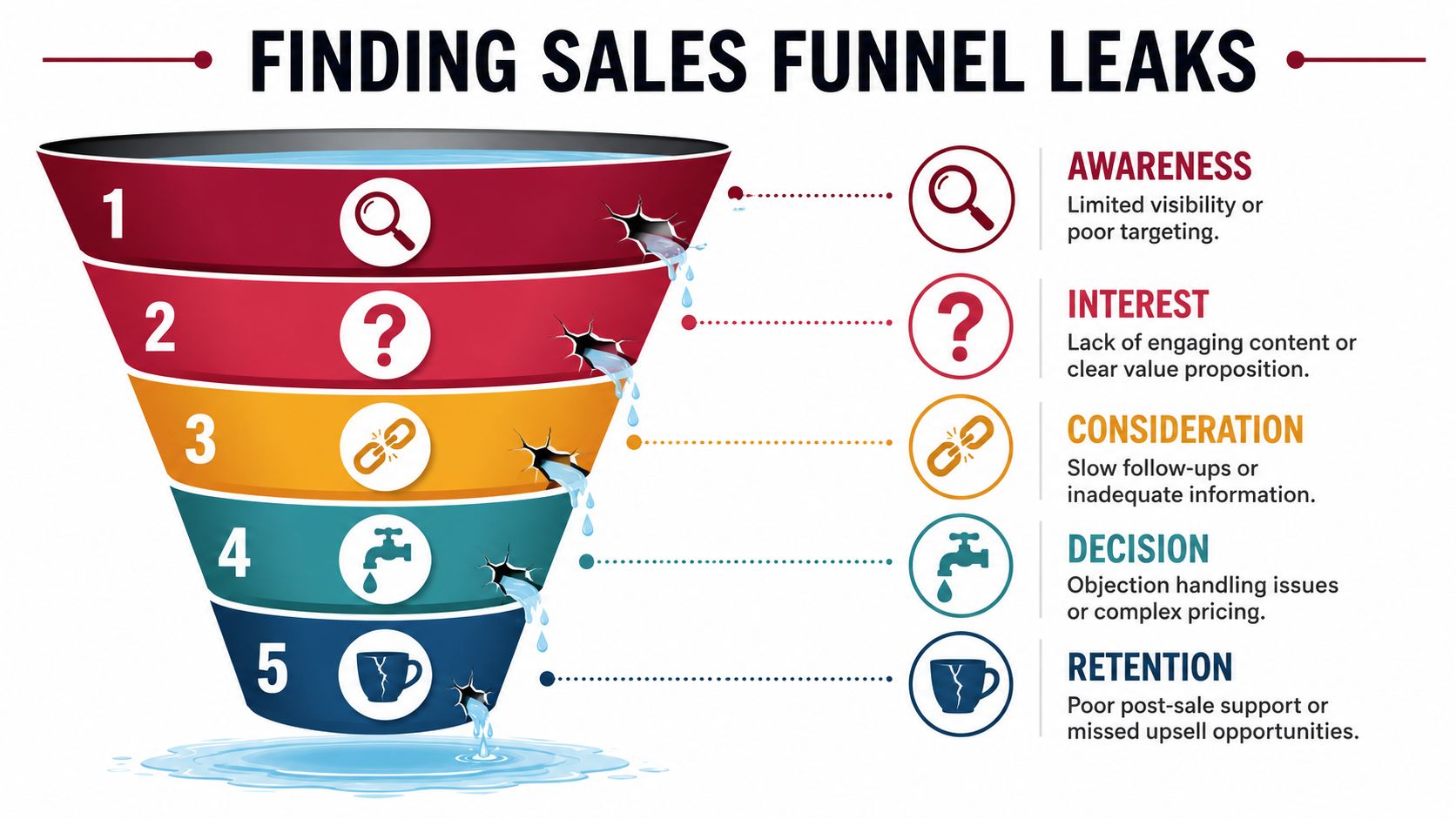
Finding the Leaks in Your Sales Funnel
The first leak usually shows up as a feeling. You're doing a lot, but the numbers don't match the effort. More proposals don't reliably lead to more calls. More calls don't reliably lead to better clients. Revenue feels uneven, and nobody can explain why.
Sales efficiency is the simplest way to force clarity. In practical terms, it asks one question: how much revenue are you generating for the cost and effort required to win it?
Start with two numbers that matter
A widely used benchmark is the ratio of revenue to sales and marketing cost. Many practitioners treat a ratio above 1.0 as the minimum sign that a team is generating more revenue than it spends. One example cited in VanillaSoft's sales efficiency guide shows $500,000 in revenue divided by $250,000 in costs = a 2.0 efficiency ratio. The same source notes that a healthy LTV:CAC ratio is 3:1 or better.
For a small agency, this does not need to be complicated. Your “sales and marketing cost” can include proposal labor, bidding support, software, founder selling time, and any paid acquisition you use to generate opportunities. Your revenue side should only include closed business that came through that sales effort.
Practical rule: If you can't tell whether your sales activity is profitable, your funnel is already leaking.
The second number is more strategic. LTV:CAC tells you whether the clients you win are worth the cost of winning them. Many Upwork sellers often misinterpret this, to their detriment. They celebrate a project win that looked cheap to acquire, then discover the client churns fast, scope creeps badly, or never grows into a strong account. Efficient sales is not just fast sales. It's profitable sales.
Diagnose the leak instead of guessing
Most agencies don't need a CRM overhaul to find the first bottleneck. A spreadsheet is enough if it tracks the right stages consistently. If your pipeline is loose, start with the basics. A good primer on sales pipeline management for small teams helps frame what should be tracked and where deals tend to stall.
Look at your funnel in simple stages:
- Lead intake: New invites, inbound messages, or job opportunities you decide to pursue.
- Qualified opportunity: Work that fits your service, budget range, and delivery model.
- Proposal sent: A real proposal with a defined offer, not a generic “we can help.”
- Conversation started: The client replies, asks questions, or books a call.
- Closed won or lost: The work is signed or clearly dead.
Now ask harder questions:
- Are you over-prospecting? If intake is high but qualified opportunities are weak, your targeting is off.
- Are you under-qualifying? If proposals go out constantly but conversations stay flat, you're sending too many low-fit bids.
- Are you slow in the middle? If clients reply but deals fade, follow-up and proposal clarity are likely the issue.
- Are you closing poor-fit clients? If revenue lands but retention is weak, your efficiency looks better on paper than it is in reality.
What busy usually hides
A lot of manual hustle masks three expensive mistakes.
- Proposal volume without filtering: Teams answer jobs they should ignore. That creates activity, not momentum.
- Founder-led selling without tracking: The owner “handles sales” from memory, which means nobody learns what works.
- Uneven offer positioning: Two similar leads get two completely different proposals, prices, and timelines.
The leak is usually not effort. It's inconsistency.
When agencies finally measure the funnel, they often find one ugly truth. The biggest waste isn't at the end. It starts near the top, where weak targeting and loose qualification force the team to carry bad opportunities through the rest of the process.
That's why the first move in how to improve sales efficiency is not buying more tools. It's making the funnel visible enough to audit.
Standardize Your Sales Process for Repeatable Wins
Once you know where time is disappearing, the next step is to stop improvising every deal.
Agencies often resist process because they think it will make sales robotic. In practice, the opposite happens. A standard process removes avoidable decisions so the team can spend more energy on real judgment, better discovery, stronger positioning, and cleaner negotiation.
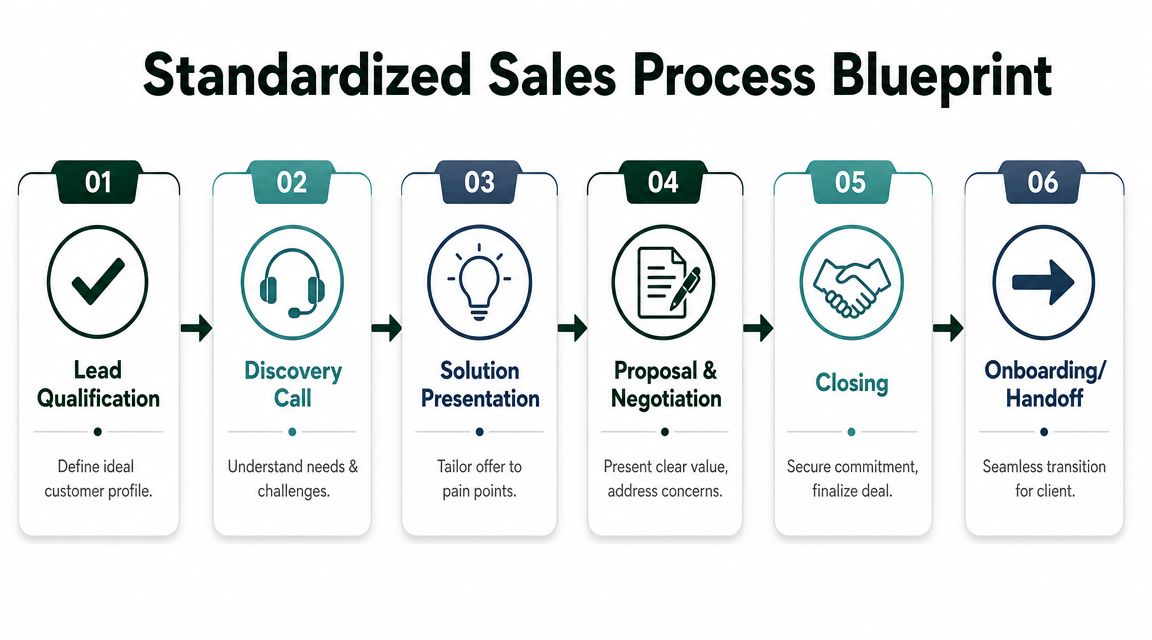
A practical way to improve sales efficiency is to standardize the sales process into measurable stages and assign KPIs such as conversion rate, average deal size, sales velocity, and win rate to each stage. JoinValley's overview of sales process optimization makes the case clearly: defined stages expose bottlenecks, improve forecasting, and make coaching less anecdotal.
Use a simple four-stage operating model
For small agencies, four stages are enough.
Prospecting
The goal here is not “find work.” The goal is find qualified work.
Prospecting should include a narrow filter: industry fit, project type, budget realism, urgency, and whether your team can produce a sharp outcome quickly. If a lead doesn't match your ideal work, it shouldn't enter the pipeline just because the brief looks interesting.
Exit criteria: the opportunity matches your service, your pricing model, and your delivery capacity.
Qualification
The process involves weak pipelines getting cleaned up. On Upwork, qualification often happens before or inside the first message exchange, not always on a formal call.
You need answers to a few practical questions:
- Problem clarity: Is the client trying to solve a real business problem or just collect ideas?
- Buying intent: Are they ready to hire or still browsing?
- Decision path: Who approves the project?
- Scope shape: Can this be turned into a clear offer?
If you skip qualification, your proposal team ends up writing custom documents for leads that were never serious.
Proposal
A good proposal is not a wall of credentials. It's a structured argument.
It should show that you understand the client's situation, define the outcome, reduce uncertainty, and make next steps obvious. Standardizing this stage does not mean using one template blindly. It means every proposal follows the same logic even when the wording changes.
Strong agencies don't pitch from scratch. They assemble from proven parts.
Exit criteria: the proposal is sent with clear scope, positioning, pricing logic, and a defined call to action.
Close
Closing is where many agencies become passive. They send the proposal, then “wait to hear back.” That isn't a closing process. That's abandonment.
Closing needs a cadence. Follow-up timing, objection handling, pricing boundaries, and handoff expectations all need to be explicit. If a client hesitates, the team should know whether to clarify scope, simplify options, or disqualify the deal.
Exit criteria: signed agreement, funded milestone, or a clear loss reason logged for later review.
What process standardization fixes
When every opportunity follows the same path, you can finally compare like with like.
That gives you an advantage in places that used to feel subjective:
- Forecasting gets cleaner because stages mean something.
- Delegation gets easier because junior team members know what “ready for proposal” means.
- Coaching gets sharper because you can isolate whether the issue is targeting, qualification, or closing.
- Pricing improves because similar work gets packaged consistently.
What doesn't work is writing a “sales SOP” nobody uses. Keep the system lightweight. One page per stage is often enough. Define the activities, define the exit criteria, and review lost deals against the process. If the same type of deal keeps slipping in the same stage, that stage needs repair.
Master High-Impact Personalization at Scale
Most Upwork proposals fail for one of two reasons. They're generic, or they're handcrafted to the point of being inefficient.
The fix is not choosing one extreme. It's building a proposal system where most of the structure is reusable and the sharpest part is personalized.
Here's the before version. It sounds professional, but it says almost nothing:
Hi, I'm an experienced agency owner with a talented team. We've worked with many clients on similar projects and would love to help. We're skilled in design, development, and marketing, and we always deliver high-quality work on time. Let's connect to discuss your project further.
That kind of proposal is easy to produce and easy to ignore. It shows no evidence that the brief was read carefully. It also forces the client to do the work of translating your experience into their situation.
Now compare it to a personalized-at-scale version:
You mentioned that your current landing page gets traffic but doesn't convert qualified leads consistently. The biggest issue in the brief isn't design polish. It's that the offer, proof, and CTA are competing for attention.
My team would approach this in two steps. First, we'd rewrite the page structure around one conversion goal. Then we'd rebuild the page so the headline, proof points, and form flow support that goal instead of distracting from it.
We've handled this kind of funnel cleanup for service businesses before, so if useful, I can outline the first-page structure I'd recommend and where I'd expect friction to drop.
The difference isn't magic. It's structure.
Build a reusable proposal library
The fastest personalized proposals usually come from a well-maintained snippet library. That library should include:
- Opening patterns: Different first paragraphs for redesigns, audits, retainer work, rescue projects, and urgent fixes.
- Proof blocks: Short examples of relevant work by service line or industry.
- Objection responses: Reusable language for timeline concerns, budget tension, or platform trust issues.
- CTA options: Different closes for warm leads, cautious leads, and high-intent leads.
Then add the human layer. Usually that means one or two sentences tied directly to the client's brief. Mention a constraint, risk, or signal they included that a generic bidder would miss.
Use the 80 and 20 split
The most efficient proposal teams treat about 80% of the proposal as a proven framework and 20% as real personalization. That keeps quality high without turning every bid into a writing project.
A useful internal check is simple:
- If the proposal could be sent to five other clients unchanged, it's too generic.
- If it takes so long to write that you can't sustain quality across the week, it's too manual.
Personalization works when it proves attention, not when it shows off effort.
On marketplaces, speed matters, but speed without relevance creates noise. The best-performing agencies usually don't write the most. They notice the right details fastest, then slot those details into a reliable proposal structure.
Leverage Automation to Reclaim Your Time
Small agencies don't usually lose deals because they lack ambition. They lose them because admin work subtly dominates the day.
Proposal drafting, project searching, inbox monitoring, follow-up reminders, handoff notes, and repetitive message cleanup all feel small in isolation. Together, they crowd out the work that secures business. That's why automation matters so much in this model. Not as a replacement for judgment, but as a way to protect it.
SPOTIO reports that reps spend only 37% of their time in actual in-person selling, and argues that reclaiming just 5 percentage points from admin work can raise output by about 12% without hiring another rep, as explained in SPOTIO's sales efficiency article. That stat comes from a traditional sales context, but the lesson maps directly to agencies. If your team can reclaim proposal prep, search time, and follow-up admin, selling quality usually improves because the human side of the process gets more attention.
What should be automated first
The first rule is simple. Automate repetition, not thinking.
For agencies selling on Upwork or similar channels, the best early candidates are:
- Opportunity discovery: Monitoring new jobs that match your service and ideal client shape.
- Draft generation: Creating first-pass proposals from a structured library of proven components.
- Message routing: Flagging replies, organizing conversations, and pushing urgent ones to a human fast.
- Follow-up cadence: Sending polite, well-timed nudges so warm opportunities don't die from neglect.
- Pipeline hygiene: Logging basic activity so the team can see where deals stall.
A helpful overview of sales automation for lean teams makes the key point: automation is most useful when it removes repetitive process steps without weakening sales judgment.
Why robotic automation fails
Bad automation creates two problems at once. It increases message volume while decreasing trust.
Clients can tell when a proposal is stitched together with no real understanding of the brief. They can also tell when follow-ups arrive on schedule but ignore what happened in the last message. That's why a lot of agency owners get skeptical. They've seen automation produce more output and worse conversations.
The right setup uses automation as an assistant. It handles monitoring, drafting, reminders, and speed. A person still controls targeting rules, offer strategy, pricing boundaries, and any high-stakes reply.
One option in this category is Earlybird AI, which connects to an Upwork account, learns preferred project types from user feedback, and automates searching, proposal drafting, and reply handling for marketplace workflows. In a small agency, that kind of tool is useful when the team already knows what a qualified opportunity looks like and wants to reduce manual bidding overhead.
Speed helps only when the handoff is clean
A lot of teams assume faster is always better. It isn't.
Fast low-fit proposals create bad conversations. Fast replies with weak context create awkward handoffs. Fast follow-up without qualification just accelerates the wrong pipeline. Automation improves sales efficiency when speed is paired with discipline.
This walkthrough shows what that looks like in practice:
The actual gain is not “more automation.” It's more human time spent where human judgment matters most. That usually means qualification, objection handling, pricing decisions, and live conversations. If automation gives those hours back, it's doing its job. If it just creates more noise upstream, it's not improving efficiency at all.
Analyze Performance and Refine Your Engine
Once automation and process are in place, the temptation is to assume the machine is working. That's how teams drift into a dangerous pattern. They respond faster, send more proposals, and still don't improve quality.
Efficiency gains from automation can be real, but they should be evaluated against process quality. Simple speed gains can be offset by poorer targeting or weak handoff discipline, and newer operating models need metrics such as speed-to-first-response, automation-assisted conversion, and time saved per opportunity, as discussed in Salesforce's guidance on increasing sales efficiency.
Review five metrics every week
You don't need a complicated dashboard. A spreadsheet or agency CRM is enough if it gets reviewed weekly. If you're building that tracking layer, this guide to the best CRM options for agencies can help you choose a setup that won't collapse under manual updates.
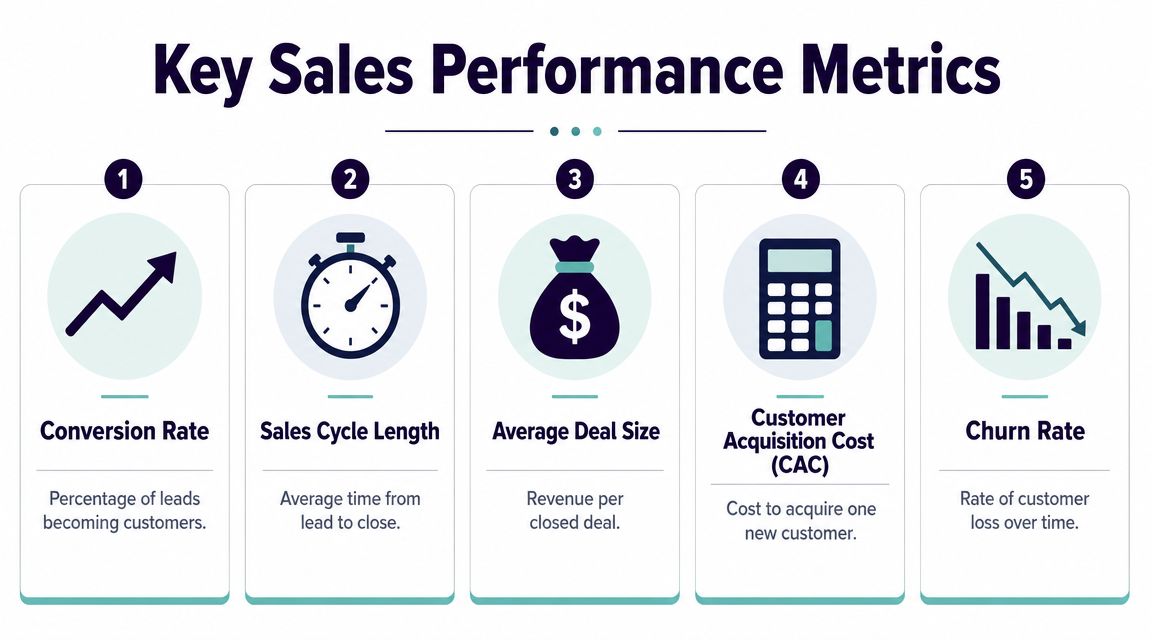
Focus on five metrics:
- Speed to first response: If this gets worse, your queue or alerts are broken. If it improves but conversions drop, your replies may be fast and shallow.
- Qualified opportunity rate: If lots of leads enter but few count as real fits, targeting needs work.
- Proposal-to-conversation rate: A falling trend usually points to weak positioning, poor personalization, or bad-fit opportunities.
- Automation-assisted conversion: Track which deals were supported by automation and whether they still turned into quality conversations and wins.
- Time saved per opportunity: If automation doesn't give time back to the team, it's just moving work around.
Know what each trend is telling you
A metric matters only if it triggers action.
Faster isn't better if your team is rushing the wrong leads into the pipeline.
If speed to first response is strong but proposal-to-conversation is weak, review your templates. If qualified opportunity rate falls, tighten filters before touching messaging. If automation-assisted conversion drops, inspect the handoff. The problem may not be the tool. It may be that the team stopped reviewing what the tool was sending.
One useful habit is to review wins and losses side by side. Compare the projects that closed quickly with the ones that dragged. You'll often find differences in fit, scope clarity, buyer intent, or proposal sharpness that were visible earlier than the team realized.
Keep the loop tight
The best sales engines improve because the feedback loop is short.
That means weekly review, not quarterly reflection. It means changing one variable at a time, not rewriting everything after a bad stretch. And it means treating automation, process, and messaging as connected parts of one system.
When agency owners ask how to improve sales efficiency over the long run, this is the part that keeps the answer from becoming shallow. Better tools help. Better process helps. Better analytics tells you whether either one is effective.
Leading Your Team Through the Change
A cleaner sales system still fails if the team treats it like extra admin.
That's the final hurdle for most agencies. The owner sees the need for discipline, but the team hears “more tracking,” “more rules,” or “more software.” Adoption breaks when people think the new process is for management visibility instead of better selling.
Make the reason obvious
Start with the problem people already feel. Slow follow-ups. Rewritten proposals. Confusing handoffs. Time lost chasing weak-fit jobs. The new system should be framed as a way to reduce that friction, not as a control layer.
For solo operators, the same principle applies. If you build a process that feels like punishment, you won't stick to it. If the system clearly saves time and reduces decision fatigue, you will.
Use a 30-day rollout
The easiest way to introduce change is one move per week.
- Week one: Define your stages and exit criteria. Stop calling every live conversation a “lead.”
- Week two: Build the proposal library. Save your best openings, proof blocks, objection responses, and closes.
- Week three: Automate one repetitive task. Search, drafting, follow-up, or activity logging are all fair targets.
- Week four: Review the weekly metrics and cut one source of waste from the process.
That sequence works because it builds from clarity to consistency to overall effectiveness. Teams usually struggle when they start with software before they know what the process should be.
Good change management is simple. Reduce friction, prove value fast, and make the next step obvious.
Train to the edge cases
A common mistake is training only the happy path. Real sales work gets messy at the edges. A client asks for a discount. A brief is vague but promising. A conversation starts strong, then goes quiet. An automated draft sounds fine but misses a critical nuance.
That's where team judgment still matters. Process should support those moments, not replace thinking. Review real examples. Show people what a qualified opportunity looks like, what a weak one looks like, and what a strong follow-up sounds like after a stalled thread.
Build the habit, not just the system
The agencies that improve fastest usually keep one discipline longer than everyone else. They review the pipeline every week. They clean up the same recurring leak. They stop tolerating vague stages and generic proposals.
Sales efficiency isn't a one-time project. It's a way of operating. Once the team sees that less waste leads to better clients, cleaner handoffs, and steadier revenue, the process stops feeling restrictive and starts feeling useful.
If you want help turning manual Upwork outreach into a more systematic sales engine, Earlybird AI is built for that workflow. It helps agencies and freelancers automate project discovery, proposal drafting, replies, and follow-up so more of the team's time goes to qualification, client conversations, and closing work.