
← Back To Blog
How to Start an Email Marketing Agency A Founder's Guide
Starting an email marketing agency really comes down to a simple formula: find your niche, package what you offer, get your tech in order, and build a reliable system for landing clients. The real magic is in tapping into a marketing channel that's not just in high demand but also delivers incredible returns—something pretty much every business needs.
Why Launching an Email Agency Is a Smart Move Now
Let's be real. It's easy to get sidetracked by the latest shiny marketing trend, but email has stuck around for a reason. It's durable, profitable, and absolutely essential for any business that's serious about growth. We're not just talking about sending out a weekly newsletter; we're talking about building a direct line to customers that drives real sales and builds loyalty.
And the market for this? It’s not just holding steady—it’s booming. We’re looking at more than 4.6 billion email users across the globe, a number that has shot up in recent years. For anyone thinking about starting an agency, that number should be a massive green light.
Better yet, email delivers an average return on investment (ROI) of $36 for every $1 spent. That’s a figure that leaves most social media and paid search campaigns in the dust. You can dig into more of these eye-opening email marketing statistics on hostinger.com.

Uncovering the Hidden Advantage for New Agencies
Impressive growth is one thing, but the real sweet spot for a new agency is the massive service gap that still exists. So many businesses know they should be doing email marketing, but they just don't have the time, the know-how, or the people to do it right.
Think about it from their perspective:
- Lean In-House Teams: Nearly half of all companies (47%) have less than a quarter of their marketing staff working on email. This creates a huge opening for a specialized agency to come in and own that function for them.
- Demand for Expertise: They aren't just looking for a button-pusher. They need someone who understands automation, can segment an audience properly, and knows how to write copy that actually converts. Those are the skills a dedicated agency brings to the table.
- Proven Profitability: The numbers don't lie. Marketing agencies that specialize in email see a staggering 42:1 return on investment. This makes it one of the most profitable service models you can build.
This isn't just about offering a service; it's about solving a core business problem. Companies need to convert leads and retain customers, and email is the most effective tool for the job. Your agency becomes the engine that powers that process.
The Modern Edge in Client Acquisition
Jumping into the agency world today gives you another massive leg up: technology. Not too long ago, getting clients meant a grueling, manual grind of cold calls and networking events. Now, you can build a predictable client-finding machine right from the start.
Tools exist today that let you automate your outreach on platforms like Upwork, sending personalized proposals to your ideal clients just minutes after they post a job. This gives you a powerful first-mover advantage, putting you way ahead of the competition without you having to spend hours every day prospecting manually.
When you pair a high-demand service with an efficient, tech-driven way to find clients, you can build a scalable and profitable email marketing agency faster than ever before.
Defining Your Niche and Crafting Your Services
If you want to start an email marketing agency and fail fast, try to be everything to everyone. Seriously. Spreading yourself thin is a surefire way to burn out, struggle with processes, and never command the rates you deserve. The agencies that truly succeed? They start by owning a specific corner of the market.
This isn't just about picking an industry like "e-commerce." Real niching goes deeper. It’s about layering an industry, a specific platform, and a type of service to carve out a unique space where you are the undeniable expert. This is how you go from being a generalist to a specialist clients are willing to pay a premium for.

Finding Your Profitable Corner
The sweet spot for your niche is where your skills, market demand, and profitability all overlap. Don't just throw a dart at a board; use real-world data to figure this out. A goldmine for this kind of research is right under your nose on platforms like Upwork.
Jump on there and search for email marketing jobs. Start looking for patterns. Are you seeing dozens of posts from Shopify stores desperate for a Klaviyo expert? Or maybe a flood of B2B tech companies that need someone to build out their lead nurturing sequences in HubSpot? This isn't guesswork—it's live data showing you exactly where businesses are spending money right now.
Here are a few examples of powerful niche combinations to get you thinking:
- Industry + Platform: E-commerce apparel brands using Klaviyo.
- Business Model + Service: Lead nurture sequences for B2B SaaS companies.
- Audience + Goal: List growth and monetization for online course creators.
When you specialize this deeply, you start to understand your client's world in a way a generalist never could. You’ll know their industry benchmarks, you’ll get their customer journey, and you’ll speak their language. That’s a massive advantage when you're trying to sell your services.
Choosing a niche isn't about limiting your opportunities; it's about focusing your efforts to attract the right opportunities. You become the obvious choice for a specific type of client, allowing you to command higher prices and deliver superior results.
Designing Your Service Menu
With your niche locked in, you can now build a service menu that speaks directly to their most pressing problems. The best approach is to create tiered offerings, giving clients a clear path to grow with you. Forget the confusing, a-la-carte list of one-off tasks. Your job is to package your expertise into clear, value-driven solutions.
Your services should solve a specific, painful problem. For an e-commerce brand, that might be clawing back revenue from abandoned carts. For a SaaS company, it could be turning more trial users into paying customers.
Core Service Offerings to Consider:
- Automation Flow Setup: This is a perfect entry-point service. You come in and build out those foundational automations every business needs: the welcome series, abandoned cart sequence, and post-purchase follow-ups. It’s a project-based offer that delivers immediate, measurable value.
- Monthly Campaign Management: This is your bread-and-butter retainer. You take over the day-to-day work of planning, creating, and sending regular email campaigns designed to drive ongoing engagement and, most importantly, revenue.
- List Hygiene and Segmentation: This is an often-overlooked but incredibly valuable service. You’ll clean up their email list to improve deliverability and then create strategic segments so they can send more targeted, effective campaigns.
The trick is to organize these into a logical progression. You could offer a one-time "Automation Kickstarter" project. Once a client sees the amazing results from that, they become the perfect candidate to upgrade to your monthly management retainer.
This creates a natural sales funnel right inside your service structure. It lets you prove your worth on a smaller scale before asking for a big commitment, which is exactly how you build the trust needed for long-term client relationships.
Structuring Your Pricing
Once you know what you’re selling, you have to figure out how to charge for it. The right pricing model not only ensures you’re profitable but also aligns your agency’s success with your client’s. Offering a few different models can also make your services more accessible to clients at different stages of their business.
Below is a breakdown of the most common pricing structures you’ll see, along with my take on where each one shines.
Comparing Email Marketing Agency Pricing Models
Choosing the right mix of these models is key. I’ve found that starting clients with a project-based fee to build trust and then transitioning them to a monthly retainer is a fantastic way to grow. It gives the client a low-risk way to test you out and gives you a clear path to building a stable, sustainable agency.
Building Your Agency's Tech Stack
Your technology is the engine that powers your agency. The right tools don't just help you get the work done—they create massive efficiencies, open the door to scale, and give you a serious competitive edge. Building your tech stack isn't about collecting a dozen different subscriptions; it's about choosing a few core platforms that play nicely together.
I like to think of the stack in three main buckets: client acquisition, project management, and the actual service delivery. When you nail these three and get them integrated, you turn your manual, day-to-day grind into a smooth, predictable, and much more profitable operation. This isn’t just about software. It’s about building an operational backbone so you can focus on big-picture strategy instead of getting lost in administrative quicksand.
Core Delivery Tools: The ESPs
The absolute heart of your service delivery is the Email Service Provider (ESP). This is the platform where you'll build, send, and analyze every campaign for your clients. Your choice here will almost always be dictated by your niche.
For instance, if you're all-in on e-commerce, Klaviyo is the undisputed champion. Its deep integration with Shopify and its powerful segmentation tools are exactly what online stores need to drive revenue.
On the other hand, if you're working with B2B clients or businesses with simpler needs, platforms like Mailchimp or Brevo (which used to be Sendinblue) are fantastic options. They're incredibly user-friendly and have solid automation features that are perfect for businesses just dipping their toes into serious email marketing. The goal isn't to know a little about every ESP. It's to become a deep expert in one or two that perfectly match the clients you want to attract.
Project Management Hubs for Sanity
Once you're juggling a few clients, multiple campaigns, and a sea of deadlines, a spreadsheet just won't cut it anymore. A real project management tool is non-negotiable if you want to stay organized and make sure nothing ever falls through the cracks.
Tools like Asana or Trello are built for this. The real magic happens when you create project templates for your recurring work, like an "Automation Flow Setup" or a "Monthly Campaign Retainer." This standardizes your entire workflow, ensuring every client receives the same high-quality, repeatable process. It also makes it a heck of a lot easier to hand off tasks when you start building a team.
- Asana: Perfect for creating detailed, step-by-step workflows with clear task dependencies and timelines.
- Trello: A more visual, Kanban-board approach that’s great for seeing the status of all your projects at a single glance.
The key is to just pick one and commit to it. A well-organized project hub becomes your agency's single source of truth for all client work, making you more efficient and far more professional.
A streamlined tech stack does more than save time—it builds client confidence. When your processes are smooth and predictable, clients see a well-run machine, which justifies the premium rates you charge.
Automating Client Acquisition
Finding clients is the lifeblood of any agency, but prospecting by hand is a soul-crushing grind. This is where automation becomes your secret weapon, especially on freelance marketplaces like Upwork. Forget spending hours sifting through job feeds and writing proposals from scratch. You can build a predictable lead-gen machine instead.
Specialized tools can monitor job feeds 24/7, pinpoint ideal projects based on your specific criteria, and send out hyper-personalized proposals just minutes after a job is posted. That speed gives you an incredible first-mover advantage, putting your proposal at the top of a client's inbox before most of your competitors even know the job exists. To really grasp the power of this, it's worth learning what is sales automation and how it can completely flip your client acquisition process on its head.
A Sample Workflow in Action
So, how does this all come together in the real world? Let's walk through a new client project.
- Acquisition (Automation Tool): Your Upwork automation tool spots a new gig from a Shopify store looking for a Klaviyo expert. It instantly fires off a tailored proposal that highlights your e-commerce wins.
- Onboarding (Asana): The client signs on the dotted line. You immediately kick off your "New Client Onboarding" template in Asana, which automatically populates tasks for the contract, asset collection, and scheduling the kickoff call.
- Delivery (Klaviyo): Following the checklist in Asana, you get to work building out the client's welcome series and abandoned cart flows directly inside their Klaviyo account.
- Reporting (Klaviyo & Asana): At month's end, you pull the performance data from Klaviyo's analytics dashboard. A recurring task in your Asana template then reminds you to compile that data into a simple, value-focused report that shows the client their clear ROI.
Your Go-to-Market Plan for Client Acquisition
An agency without clients is just an expensive hobby. You’ve defined your niche and sorted out your tech, so now it's time to build a repeatable system for bringing in business. It’s tempting to throw spaghetti at the wall and try a dozen different strategies at once, but the fastest way to get paying clients is to master one channel first. Then, you can expand.
For a new agency, that one channel should be Upwork.
Why? Because it’s a direct pipeline to people who are actively looking for the exact services you sell. Forget cold calling or trying to network your way into a project. On Upwork, the demand is already there. You just have to be smart about capturing it. The secret isn't grinding away for hours writing proposals by hand—it's using the right tools to get there first.
Mastering Upwork with Speed and Precision
On a platform like Upwork, speed is your single biggest advantage. Clients are often in a hurry to hire and usually engage with the first few quality proposals that land in their inbox. If you use automation, you can submit a personalized, well-crafted proposal within minutes of a job being posted. This puts you right at the front of the line before your competition even logs on.
This isn't about spamming generic templates. It’s about building a system that does the heavy lifting for you.
- Identifies the perfect jobs based on your keywords, budget filters, and the client's hiring history.
- Generates a tailored proposal using a predefined structure that pulls in key details from the job post.
- Submits it almost instantly, giving you that critical first-mover advantage.
This workflow is all about connecting the dots between acquiring, managing, and delivering client work with an integrated tech stack.
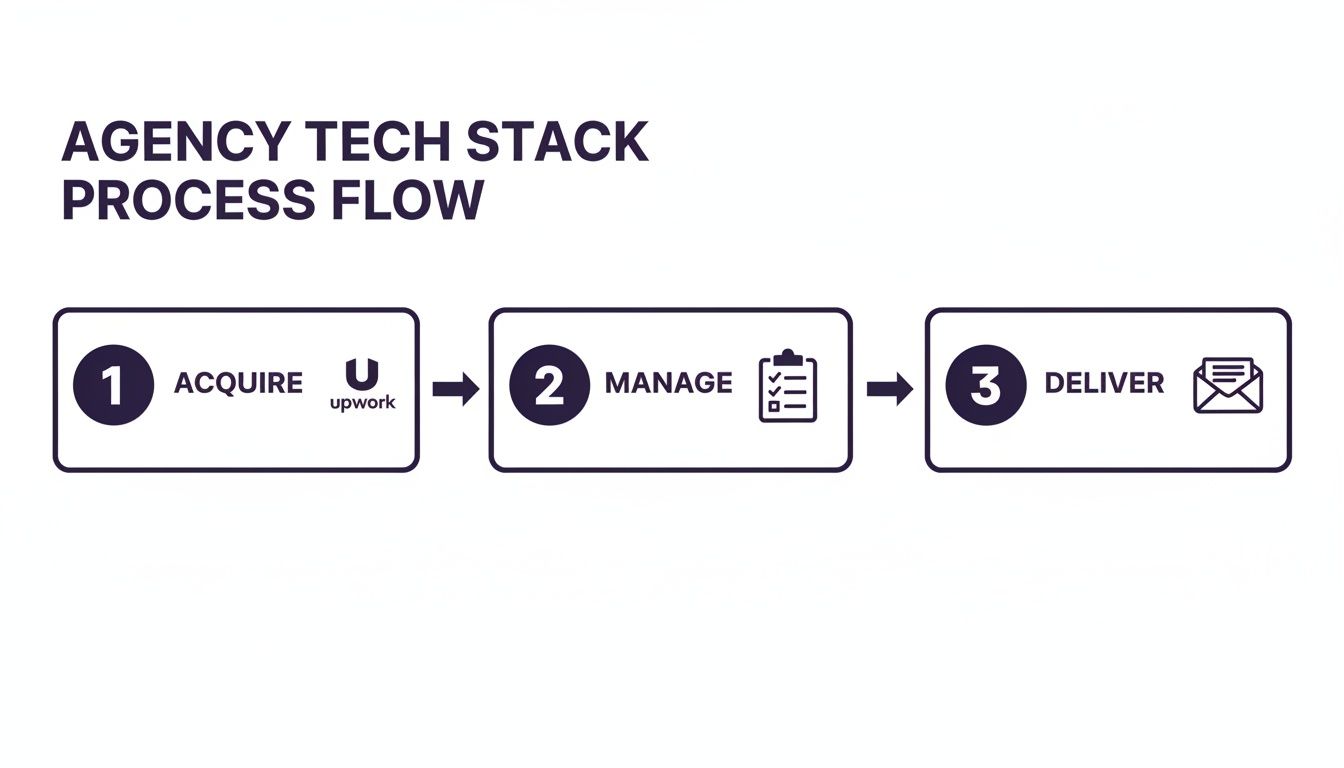
When you nail your acquisition machine on Upwork, it feeds directly into a streamlined delivery system, making your entire agency more efficient and profitable from day one.
Crafting an Upwork Proposal That Actually Gets a Response
Your proposal has one job: get the client to reply. It's not the place to just list your skills. It’s about showing you understand their problem and have a clear, credible plan to solve it. A proposal that focuses on the client’s desired outcome will always beat one that just talks about your experience.
I've found a simple structure that works wonders:
- Acknowledge Their Goal: Start by restating their main objective in your own words. This shows you actually read the post.
- Outline Your Approach: Briefly map out the steps you’ll take to get them from A to B.
- Provide Social Proof: Mention a similar result you achieved for another client. Be specific if you can.
- Ask a Question: End with a smart question about their business or project to make it easy for them to reply.
This simple framework shifts the conversation from "Here's what I do" to "Here's how I can help you." If you're looking for real-world examples, check out these powerful cover letter examples for Upwork that put this principle into practice.
Beyond Upwork: Expanding Your Reach
Once you have a steady stream of leads coming from Upwork, you can start layering in other client acquisition channels. But don't try to master them all at once. Pick one and fold it into your existing process.
- Strategic Cold Email: Use your niche to build a highly targeted list of potential clients. Keep your emails short, personal, and focused on a single pain point you can solve. Referencing something specific about their current email marketing is a great way to start a conversation.
- LinkedIn Authority Building: Instead of spamming DMs, use LinkedIn to share what you know. Post content that helps your ideal clients solve small email marketing problems. This positions you as the go-to expert, so when they’re ready to hire an agency, you’re the first person they think of.
The best client acquisition strategies are built on providing value before you ever ask for the sale. Whether it’s a hyper-relevant Upwork proposal or an insightful LinkedIn post, your goal is to prove your expertise from the very first touchpoint.
This is especially true when you focus on high-impact services like email automation. Think about it: automated emails are a secret weapon, generating 4x more revenue than standard campaigns and driving 37% of all email sales—even though they only make up 2% of total sends. Brands are catching on and ramping up their use of automation, which means agencies that master these workflows are set up for massive success.
Leading Sales Calls That Actually Convert
Getting a potential client on a call is a big win, but now you have to close the deal. The key is to shut up and listen. Let them do most of the talking. Your job is to listen, diagnose their real problem, and then present your service as the obvious solution.
I structure my sales calls like this:
- Discovery (70% of the call): Ask open-ended questions. "What have you tried so far?" "What does success look like in six months?" "What's holding you back?"
- Diagnosis (15% of the call): Summarize what you heard. "So, if I'm understanding correctly, the main issue is..." This makes the client feel heard.
- Prescription (15% of the call): Present your specific service package as the perfect remedy for their diagnosis.
By the end of the call, the client should feel completely understood and confident that you have a plan. The final step is sending over a simple service agreement that clearly outlines the scope, deliverables, timeline, and payment terms. Make it easy for them to say "yes" and get started.
Delivering Results and Scaling Your Operations
Getting the client to sign is just the starting line. Now the real race begins. Your focus has to pivot immediately from landing clients to keeping them, and that all comes down to delivery. Amazing results are what transform a one-off project into a long-term retainer, and it's what generates the word-of-mouth referrals that will actually build your agency.
It all starts with a seamless onboarding experience. A messy, chaotic kickoff plants a seed of doubt right away, but a tight, structured process shows them they made the right choice. Your first move should be to create and use a standardized onboarding checklist for every single client. This ensures you get all the assets, logins, and brand guides you need on day one, saving you from those frustrating back-and-forth emails down the line. It's a simple step, but it screams professionalism.

Proving Your Value Through Reporting
Once the campaigns are live, your job is to constantly prove your worth. So many new agencies fall into the trap of sending over cluttered dashboards packed with vanity metrics like open rates. While those numbers are interesting to us as marketers, business owners care about one thing: return on investment.
Your reports need to be clean, simple, and laser-focused on the numbers that hit their bottom line.
- Revenue Attributed to Email: This is the big one. Show them the money you're making them.
- Conversion Rate: What percentage of people are actually taking the action that matters?
- List Growth: How are you growing their most valuable marketing asset?
Keep it short and visual. A crisp one-page summary highlighting these KPIs, followed by a quick analysis of what worked, what didn't, and your plan for next month, is infinitely more powerful than a data dump. This turns reporting from a tedious chore into your best client retention tool.
Your goal with reporting isn’t just to show data; it’s to tell a story of progress and value. Frame your results around their business goals, and you'll never have to justify your fee again.
Knowing When to Hire and How to Delegate
As the work piles up, you’ll hit a crossroads: hire help or put a cap on your growth. That moment usually comes when you realize you're spending more time on admin and basic tasks than you are on high-level strategy for your clients. That's the alarm bell telling you it's time to bring someone on.
Your first hire doesn't have to be a full-time employee. More often than not, a skilled freelance email specialist or a sharp virtual assistant is the perfect next step. Before you even post a job, though, you have to get your processes out of your head and onto paper.
Create simple Standard Operating Procedures (SOPs) for your most common tasks—things like setting up a new campaign, pulling monthly reports, or running your client onboarding sequence. These documents become your agency's playbook, making sure the work is done right every time, no matter who's doing it. This kind of foundational work is critical for any service business, a lesson many founders learn when starting an SEO agency or a similar venture.
Turning Wins Into Your Best Sales Tool
With a solid delivery system in place and the beginnings of a team, the final piece is to create a feedback loop that fuels your growth. Every single successful campaign is a potential case study just waiting to happen.
Don't wait months to ask for a testimonial. The moment you deliver a fantastic report showing a huge revenue win is the perfect time to ask for feedback while they're thrilled with your work.
- Collect the Hard Numbers: "We grew their abandoned cart revenue by 45% in 60 days."
- Get a Great Quote: Ask for a specific line or two about what it’s like working with you.
- Package it All Up: Combine the data and the testimonial into a clean, simple one-page PDF.
These case studies become absolute gold in your sales process. They offer the social proof new prospects are desperately looking for, turning your early successes into a magnet for your next, even bigger, client. This is the engine of scalable growth that will take you from a solo freelancer to a thriving agency.
Common Questions I Hear from New Agency Founders
Starting an agency is a rollercoaster. One minute you're on a high, the next you're stuck on a problem that feels impossible.I hear the same questions over and over from founders who are just getting started. It’s always the practical, day-to-day stuff that trips people up. Let's cut through the noise and get you some straight answers.
What's the Real Cost to Start an Email Marketing Agency?
Honestly, you can get an email marketing agency off the ground for less than you'd think. It's one of the leanest business models out there because you don't need a fancy office or a warehouse full of products. Your main costs are digital.
- Business Registration: Setting up your LLC or sole proprietorship will probably run you somewhere between $100 and $500. This really just depends on where you live.
- Core Software: You obviously need an Email Service Provider (ESP). A starter plan on something like Mailchimp or Klaviyo is usually in the $20 to $50 a month range. For project management, you can easily start with the free versions of Asana or Trello.
- Website & Domain: A domain name and basic hosting are pretty cheap. Budget around $150 a year to look professional.
- Client Acquisition Tools: This is where you can be smart with your money. Instead of hiring a salesperson, which is a huge expense, investing in a tool to automate your Upwork outreach can be a game-changer. It’s one of the highest-leverage investments you can make early on.
Bottom line? You can realistically get your doors open for well under $1,000. The biggest variable is just how aggressively you want to invest in tools to find those first few clients.
Do I Have to Be a Designer or a Coder?
Nope. Absolutely not.
Look, knowing a bit of HTML and CSS is a nice-to-have for fancy custom templates, but it's not the main event. Modern ESPs have incredible drag-and-drop builders that let you create beautiful, professional emails without writing a single line of code.
Your real value—the reason clients will pay you—comes from three other skills:
- Strategy: Can you see the big picture? Can you map out a customer journey and build automated flows that make sense?
- Copywriting: Can you write a subject line that gets opened and email copy that gets clicked?
- Data Analysis: Can you look at a campaign report, understand what worked (and what didn't), and explain how to improve it?
Master those three, and you'll be golden. If a client ever needs some super-complex, custom-coded email, you can just hire a freelancer for that one-off project.
The single biggest mistake I see is a failure to niche down. New founders try to be the 'full-service email agency' for 'any business.' You end up being a master of none, and it's impossible to stand out, build efficient systems, or charge premium rates.
How Can I Prove My Value if I Don't Have a Portfolio?
This is the classic chicken-and-egg problem. You need clients to build a portfolio, but you need a portfolio to get clients. The way out is to stop trying to sell big, scary retainers right away.
Lead with strategy and give them a low-risk "first taste" of what you can do.
Offer to tackle one small, high-impact project. A fantastic entry point is setting up a single, crucial automation, like an abandoned cart sequence for an e-commerce store. You could even get creative and tie a small part of your fee to the revenue it generates. This shows you have skin in the game.
Another great move is to offer a paid "strategy audit." For a few hundred bucks, you'll do a deep dive into their current email marketing, point out what’s broken, and deliver a roadmap for fixing it. You provide a ton of value upfront, prove you know your stuff, and make it a no-brainer for them to hire you for the full project.
Ready to build a predictable client acquisition machine for your new agency? Earlybird AI acts as your always-on sales team for Upwork, automatically finding ideal clients and sending personalized proposals in minutes. Stop grinding and start closing. Learn more about Earlybird AI.