
← Back To Blog
Best Pipeline Tracking Software 2026 for Agencies
Upwork messages. Referral intros. Website forms. A sales inbox that nobody fully owns. A spreadsheet with color coding that made sense three months ago and now feels like archaeology.
That's where a lot of agencies get stuck. The work is coming in from too many directions, too quickly, and nobody can answer simple questions with confidence. Which opportunities are active? Which bidder sent the first touch? Which proposal deserves follow-up today? What's likely to close this month versus next month? When leads come from a mix of marketplaces, email, Slack handoffs, and automated outreach, memory becomes the operating system. That never scales.
Spreadsheets usually fail in the same way. They look fine when volume is low, then turn into a lagging record of what already happened. Automated lead generation makes that worse because activity starts before a human rep even sees the opportunity. If your agency is responding fast on Upwork, the gap between “lead exists” and “deal entered CRM” can swallow the most important part of the sales story.
From Scattered Leads to a Streamlined Sales Machine
Most agency owners recognize the pattern. A project lands on Upwork. Someone replies fast. A prospect also emails through the site. Another lead comes through a referral and gets dropped into Slack with “can someone take this?” attached. By Friday, the team has activity everywhere and visibility nowhere.
The immediate cost is missed follow-up. The bigger cost is bad judgment. Leaders start forecasting from instinct because the pipeline itself can't be trusted. Deals sit in the wrong stage. Conversations live in inboxes. Nobody knows whether the problem is lead quality, response speed, proposal quality, or weak follow-through.
That's why pipeline tracking software matters. It isn't just another dashboard. It becomes the operating layer that tells the team what exists, where each deal sits, and what has to happen next. If you're tightening your process from first touch to close, AONMeetings' guide to lead funnels is useful context because lead capture and pipeline management break down when they're treated as separate systems.
The demand for these systems is rising for a reason. The global sales pipeline management software market is projected to grow from $6.803 billion in 2025 to $14.05 billion by 2035 at a 7.52% CAGR, which reflects how central these tools have become in modern sales operations, according to Market Research Future's sales pipeline management software outlook.
Why spreadsheets break under agency volume
A spreadsheet can list deals. It can't reliably capture real sales motion when multiple people and systems touch the same opportunity.
Three problems show up fast:
- Ownership gets blurry: One bidder sends the proposal, an account lead takes the call, and delivery reviews scope. Nobody owns field hygiene.
- Timing disappears: You know a lead replied, but not whether it replied two minutes after outreach or two days later.
- Forecasting turns into opinion: Revenue estimates depend on whoever updated the sheet last.
A proper system fixes that by treating every opportunity as a moving record, not a static row. Agencies that want a practical blueprint for the transition can start with a structured approach to building a sales pipeline.
Practical rule: If your team needs to ask “where are we with this one?” more than once, your pipeline isn't a system yet.
What Is Pipeline Tracking Software Really
Pipeline tracking software is best understood as air traffic control for sales. Every opportunity is a flight in motion. Some have just entered your airspace. Some are circling because the prospect went quiet. Some are cleared to land. Without a control tower, you don't have a sales process. You have moving objects and rising risk.
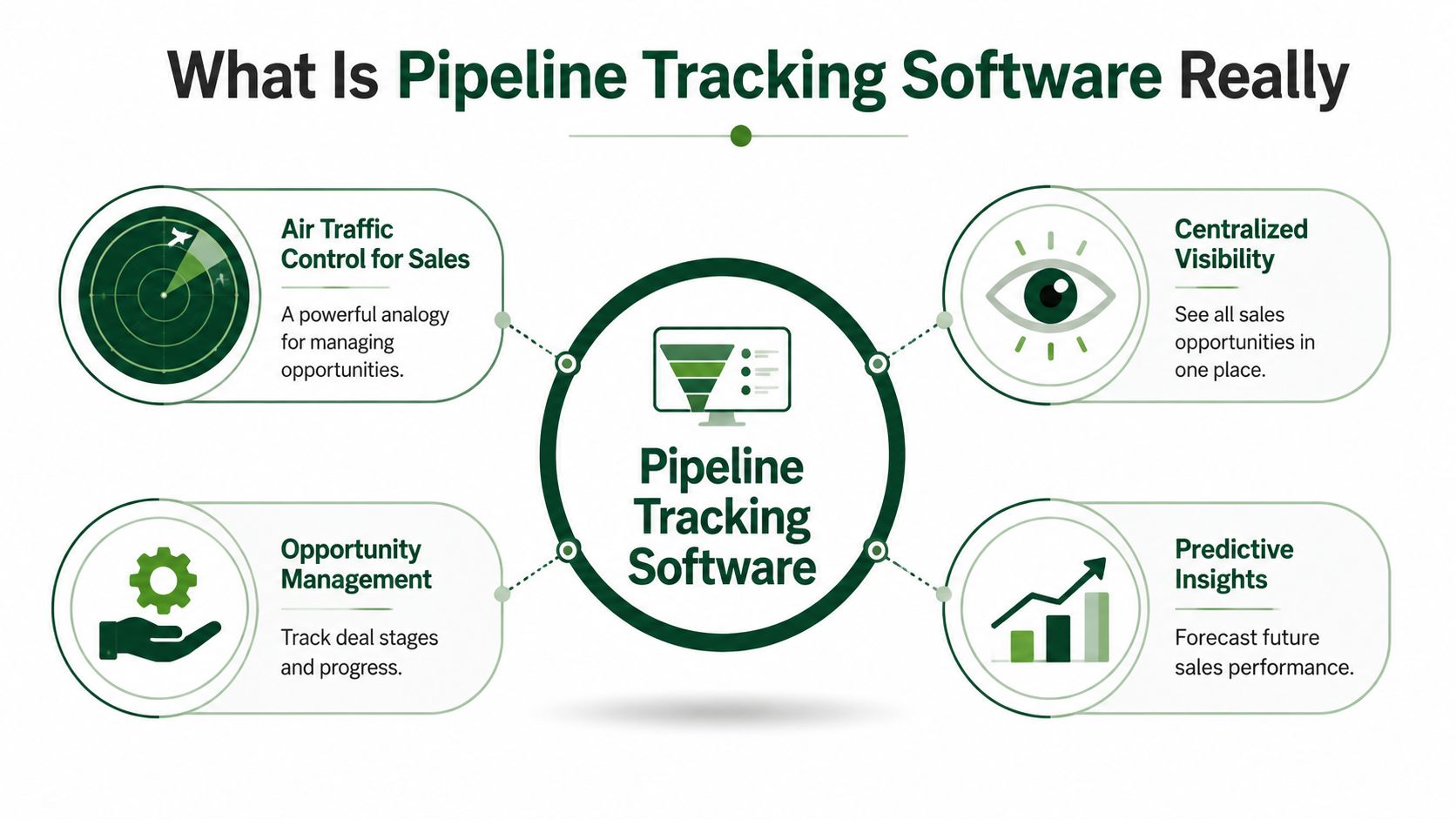
Pipeline tracking software gives you one visual source of truth for each deal. It records where an opportunity entered the system, what stage it's in now, who touched it last, and what should happen next. For agencies, that matters because sales rarely follow a clean B2B script. One lead wants a quick estimate. Another wants a discovery call. A third starts with a direct request for a proposal.
The stages only work when they mean something
Most pipelines use a version of five familiar stages: prospecting, qualification, proposal, negotiation, and closing. On paper, that sounds basic. In practice, the value comes from making those labels operational.
A healthy pipeline answers questions like these:
- Prospecting: Has the lead entered the system from Upwork, email, referral, or another source?
- Qualification: Do we have enough information to know this project fits our services, budget, and delivery model?
- Proposal: Has scope, pricing, or a specific response been sent?
- Negotiation: Is the client discussing changes, approvals, or commercial terms?
- Closing: Did the deal convert, stall, or get lost?
If a stage can't answer a real business question, it's decoration.
A lot of agencies also need a stage model that reflects spend efficiency, not just close rates. That's why it helps to look at adjacent thinking like SourceLoop's piece on optimizing spend for pipeline, especially if your lead sources include both owned channels and marketplaces.
What the software actually does day to day
The good systems don't just display columns. They connect activity to progression.
That usually includes:
- Visual tracking of deal flow: You can see stalled work immediately instead of discovering it in a meeting.
- Activity capture: Calls, emails, messages, notes, and timestamps live with the deal.
- Assignment and accountability: The next owner is visible.
- Forecast support: Leaders can estimate future revenue based on live opportunities rather than disconnected notes.
Pipeline tracking software should reduce interpretation. If two managers look at the same deal and reach different conclusions about its status, the pipeline is underdefined.
For a foundational breakdown of how this differs from generic CRM usage, this overview of sales pipeline management is a strong companion read.
Core Features and Their Tangible Benefits
Most software evaluations go wrong because teams compare feature lists instead of operating outcomes. Agencies don't buy pipeline tracking software because a kanban board looks tidy. They buy it because they need fewer blind spots, faster response loops, and more reliable revenue planning.
Visibility that removes status-chasing
Visual deal stages are the feature everyone notices first. Their real benefit isn't aesthetics. It's decision speed. When the pipeline is current, account leads don't need to hunt through inboxes or ask bidders for updates. They can see what's waiting on scope, what's gone quiet, and what needs escalation.
That alone changes weekly operations. Status meetings get shorter because the system already answers basic questions. Managers spend more time coaching and less time collecting fragments.
Automation that protects momentum
The second feature that matters is workflow automation. This includes reminders, stage-change triggers, task assignment, and alerts when a deal lingers too long without movement.
That matters because sales slippage often looks small at first. A proposal sits untouched. A follow-up doesn't happen. A buyer who was warm last week cools off. Automation gives the team a backstop. It won't replace judgment, but it will stop preventable inaction.
AI-powered pipeline tracking tools can increase sales win rates by 15–20% by helping teams track critical daily and weekly metrics, according to Bigin's guide to sales pipeline tracking.
Reporting that earns trust from leadership
Agencies also need integrated reporting. Not vanity charts. Real operational reporting that shows stage conversion, deal age, pipeline value, and owner-level activity.
When reporting is weak, forecasting becomes political. Sales says the month looks good. Finance doesn't believe the number. Delivery gets surprised by uneven project starts. Better reporting creates a shared view of reality.
A practical stack often combines:
- Deal-stage tracking for daily execution
- Activity logs for rep or bidder accountability
- Pipeline dashboards for weekly leadership review
- CRM sync for one customer record across pre-sale and post-sale work
For agencies comparing tools that sit closer to the CRM layer, this guide to the best CRM for agencies helps frame where pipeline-specific software fits.
The best feature is the one your team will actually maintain. A sophisticated scoring engine is worthless if reps still keep the real notes in Slack.
What doesn't work
A few features get oversold.
Custom fields don't help if nobody agrees how to use them. AI summaries don't fix a broken stage model. A beautiful dashboard won't rescue a process where lead ownership changes three times in a week. Software amplifies process quality. It doesn't invent it.
That's why the buying question shouldn't be “Which platform has the most features?” It should be “Which platform makes it hardest for our team to lose track of a real opportunity?”
Adapting Your Pipeline for Upwork and Automation
Traditional pipeline design assumes a person sees a lead, decides what to do, then manually creates and updates the record. That assumption breaks fast in an automated agency workflow.
On Upwork, activity starts before anyone opens the CRM. A proposal goes out quickly. A reply can come back minutes later. Follow-up may continue across short bursts of messaging before the opportunity is formally qualified. If the pipeline only starts when a human logs the lead, the most valuable part of the interaction is already missing.

A common challenge is integrating tracking with autonomous bidders without violating platform policies, as most guides assume a human-led process and ignore that automated tools submit proposals and reply in minutes, creating untracked micro-interactions, as noted in ZoomInfo's overview of sales pipeline management software tools.
The black box problem
For agencies, the failure point usually sits between first touch and qualified conversation.
That gap creates a black box:
- The source exists, but not the context: You know the lead came from Upwork, but not which trigger or workflow initiated the response.
- The prospect replied, but chronology is muddy: Was the response immediate? Was there a second touch? Did someone else step in?
- The deal enters late: By the time it appears in the pipeline, the early engagement signals are gone.
If you can't see those moments, attribution gets sloppy. You end up crediting the closer while ignoring the system that generated the conversation.
A pipeline model that matches automated lead flow
Agencies running high-volume lead generation need a pipeline that starts earlier than a standard CRM pipeline. That usually means adding pre-qualification stages that capture automated activity without pretending the deal is sales-ready.
A practical structure looks like this:
Automated first touch
The system records that outreach happened and logs the source, time, and account owner.Client replied
The lead hasn't been qualified yet, but there's confirmed engagement.Human review
A person checks fit, urgency, budget clues, and service alignment.Qualified opportunity
The deal enters the main pipeline only after basic commercial fit is confirmed.Proposal or scoped response
The team sends a customized next step rather than treating every reply as equal.
This model keeps the top of the funnel honest. It also stops teams from inflating the main pipeline with every inbound message.
Don't force automated lead flow into a human-first pipeline. Build stage logic that reflects how the lead actually moves.
What to track for automated channels
Once you adapt the stage model, the next job is deciding which fields matter. Most agencies need fewer fields than they think, but those fields have to capture speed and context.
Track these consistently:
- Lead source: Upwork, referral, inbound email, website, or partner intro
- Origin timestamp: When the opportunity first appeared
- First response timestamp: When the first outreach or reply happened
- Assigned owner: Bidder, sales lead, or account manager
- Engagement type: Proposal sent, message thread, discovery request, direct scope ask
- Qualification result: Fit, no fit, nurture, or unclear
- Next action: Follow-up, call scheduling, scope review, or close-lost reason
The key trade-off is simplicity versus fidelity. If you demand perfect logging of every micro-event, the team will abandon the process. If you track too little, you can't learn which lead paths convert. The right answer is a lightweight event trail at the top, then richer detail once the lead qualifies.
How to Choose the Right Software for Your Agency
Agencies shouldn't buy pipeline tracking software the way a SaaS sales team would. The workflow is different. Lead sources are messier. Ownership changes hands more often. Marketplace leads behave differently from inbound demos or outbound account-based sales.
Start with fit, not brand recognition
A popular tool can still be wrong for your agency if it assumes a linear rep-led process. The first test is whether the software can model your real motion without awkward workarounds.
Look for:
- Custom stage design: You need flexibility for marketplace leads, referrals, direct inbound, and retained sales.
- Strong integrations: Email, Slack, calendar tools, and your CRM need to stay connected.
- Usable activity history: Teams must be able to see what happened without opening five tabs.
- Multi-user controls: Agencies often have several bidders, salespeople, and managers touching one account.
Security and control matter more than most teams expect
Agencies handle pricing conversations, client details, proposals, and internal notes across distributed teams. That means security can't be an afterthought.
Enterprise-grade platforms typically enforce AES-256 encryption, role-based permissions, audit logs, and compliance certifications including GDPR and SOC 2 Type II, according to monday.com's review of sales pipeline software requirements. In practice, even smaller agencies benefit from those controls because they reduce accidental access, messy edits, and silent field changes.
That same source notes that real-time synchronization under low latency matters for forecast fidelity. Operationally, the lesson is simple. If updates arrive slowly, managers make decisions from stale stage data.
The short list should survive real workflow testing
Don't decide from a demo. Recreate three common situations inside the trial environment or sandbox:
- A fast Upwork reply that needs assignment, qualification, and follow-up
- A referral lead that skips early stages and goes straight to scoping
- A stalled proposal that should trigger reminders and escalation
If the software handles those cleanly, it's worth deeper evaluation. If your team starts saying “we'd just track that manually,” move on.
A good agency tool doesn't force everyone into the same lane. It gives each role enough structure to stay aligned without slowing the work down.
Implementation Onboarding and Best Practices
Most implementations lapse into disuse. The software gets purchased, a pipeline is imported, and everyone keeps managing real opportunities from inboxes and chat threads. The system becomes a reporting graveyard instead of an operating tool.
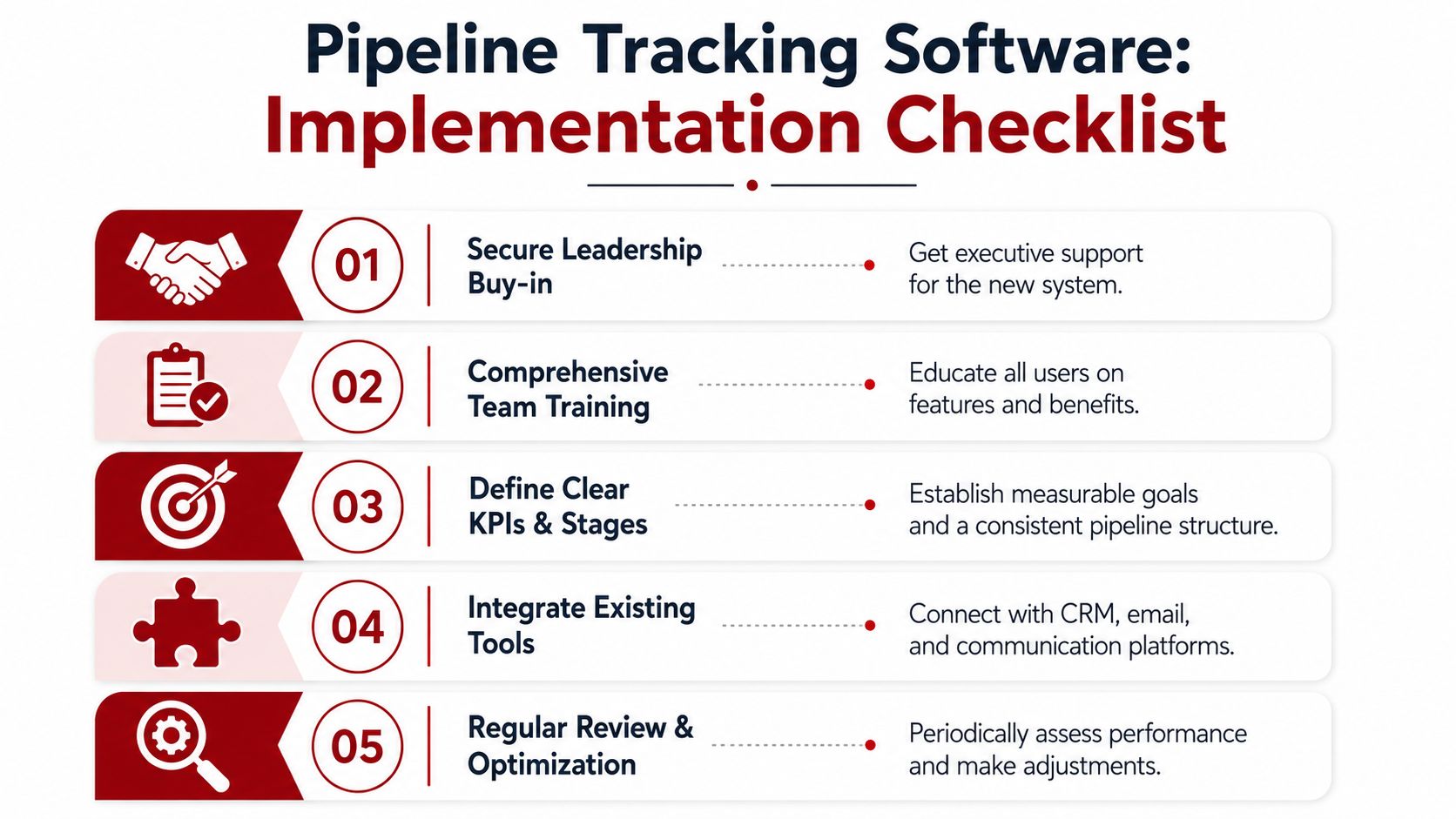
The fix is discipline at the stage level. Effective pipeline tracking requires defining clear, measurable exit criteria for each of the five standard sales pipeline stages, prospecting, qualification, proposal, negotiation, and closing, according to Spekit's guidance on sales pipeline management tools.
Define stage exits before importing anything
A stage isn't a label. It's a rule.
Examples of useful exit criteria:
- Prospecting ends when a lead source is identified and an owner is assigned.
- Qualification ends when service fit and next-step viability are confirmed.
- Proposal ends when the prospect has received pricing, scope, or a specific response.
- Negotiation ends when the client accepts, declines, or goes inactive under a defined rule.
- Closing ends when the opportunity is marked won or lost with a reason.
Without rules like that, teams move deals based on optimism.
Roll out habits, not just software access
Training should focus on moments of use. Show people what to do when a reply arrives, when ownership changes, when a deal stalls, and when a close-lost reason needs to be logged. Abstract platform tours rarely stick.
A clean onboarding sequence usually includes:
- Agree on stage definitions
- Map ownership by role
- Connect inboxes, calendars, and CRM records
- Test alerts and follow-up triggers
- Review live deals weekly for the first month
Keep the pipeline lean enough to live
Teams often overbuild. They add too many fields, too many stages, and too many edge-case rules. Then updates slow down and the data degrades.
A better approach is to launch with the minimum structure needed for accuracy, then refine after seeing real usage. If a field doesn't help qualification, forecasting, or follow-up, it probably doesn't belong in the first version.
The first implementation goal isn't elegance. It's trust. If the team doesn't trust the pipeline by week two, adoption will collapse.
Key KPIs to Measure Pipeline Health and Success
Pipeline tracking software becomes valuable when it tells you what to fix. That requires a small set of KPIs that reflect flow, quality, and forecast reliability.
The metrics that actually matter
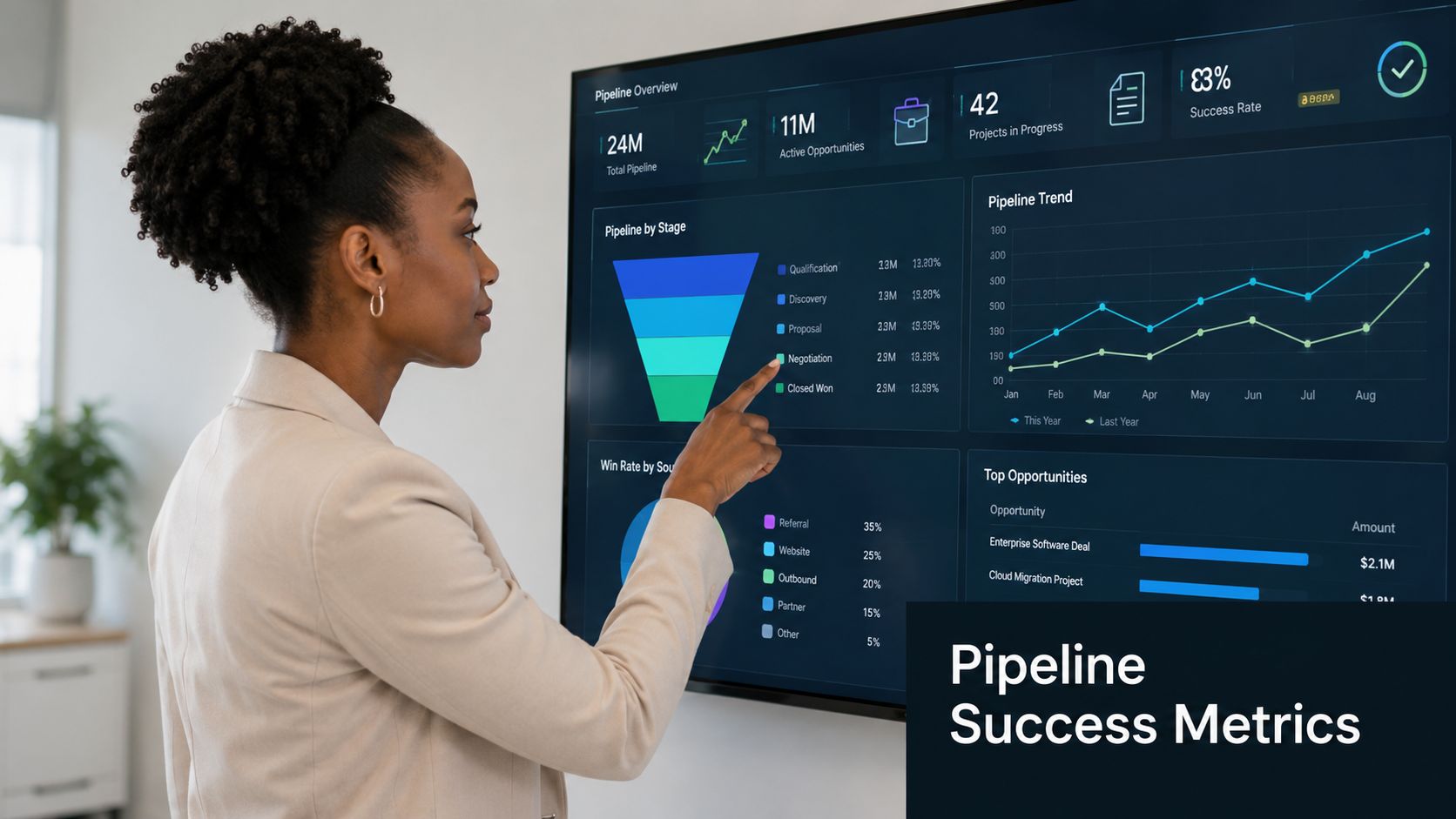
For most agencies, these are the core numbers to watch:
Stage conversion rates
These show where deals stall. If many opportunities reach proposal but few move forward, the issue may be scoping, pricing, or proposal quality.Sales velocity
This measures how quickly deals move from first engagement to close. A slowing velocity usually points to a bottleneck, not just a slow market.Time in stage
This is one of the best operational warning signals. A deal that sits too long often needs action or reclassification.Total pipeline value
This helps leadership assess likely future revenue, but only if stage hygiene is strong.
If your team also struggles with lead definitions at the top of funnel, a simple primer on what is a marketing qualified lead can help align marketing and sales language before those leads enter the pipeline.
Use KPIs to trigger action
Metrics shouldn't just sit on a dashboard. They should create intervention rules.
Advanced pipeline software improves forecast accuracy by 15–25% by aggregating multi-source data and automatically flagging when a deal exceeds the median time-in-stage, reducing stagnation by up to 30%, according to Upcell's glossary entry on pipeline tracking.
That matters because the most useful KPI systems don't just describe the pipeline. They interrupt bad patterns.
A practical agency review rhythm looks like this:
- Daily: new qualified opportunities, urgent follow-ups, stalled replies
- Weekly: stage conversion, time-in-stage exceptions, owner workload
- Monthly: forecast confidence, source quality, win-loss patterns
When those reviews are consistent, you stop treating every sales problem as a mystery. You can see whether the issue starts with low-quality intake, weak proposal conversion, slow follow-up, or overloaded owners.
If your agency wants an always-on way to capture, respond to, and organize Upwork opportunities before they disappear into inbox chaos, Earlybird AI is built for that workflow. It helps teams automate proposal and message handling on Upwork while giving agency leaders the visibility they need to run a cleaner, more accountable pipeline.