
← Back To Blog
How to Build a Sales Pipeline to Win on Upwork in 2026

If you’re just reacting to job posts and sending proposals into the void, you're not running a business—you're playing the lottery. Building a proper sales pipeline is about creating a structured, visual map of your entire sales process, from the first point of contact all the way to a closed deal.
This isn't just about getting organized. It's about building a predictable engine for generating revenue. You'll move from scattered, reactive efforts to a system that consistently brings in the right kind of work by identifying your ideal clients, finding them, qualifying them, and tracking every single interaction.
The Blueprint for Your Upwork Sales Pipeline
For freelancers and agencies on a battlefield like Upwork, the line between thriving and just getting by is a systematic sales process. Firing off random bids is a recipe for burnout and a rollercoaster of income. A well-designed sales pipeline, however, turns that chaos into a clear, repeatable path to landing high-value clients.
Think of it as a fundamental shift in your mindset. You stop being a simple job applicant and start operating like a sophisticated business owner. Instead of just reacting to whatever the marketplace throws at you today, you're proactively managing your opportunities. This isn’t about some generic sales theory; it's a battle-tested framework for winning on Upwork.
Why a Pipeline Is Your Unfair Advantage
Having a real sales pipeline gives you something most freelancers lack: clarity and control. It’s a visual snapshot of every potential deal, showing you exactly where each prospect is in your process. That visibility is everything when it comes to making smart decisions and putting your energy where it will actually pay off.
Instead of guessing where your next client is coming from, you can look at your pipeline and forecast revenue with surprising accuracy. What this really means is you can:
- Spot the Bottlenecks: Instantly see where deals are getting stuck. Are your proposals getting ghosted? Are discovery calls not converting? A pipeline shines a spotlight on these leaks so you can fix them.
- Work Smarter, Not Harder: When you have defined stages, you stop wasting time on leads that are a bad fit. You can focus your best efforts on prospects that match your ideal client profile.
- Create Predictable Income: A steady flow of leads moving through your pipeline smooths out the feast-or-famine cycle. This is the key to scaling your business without losing your mind.
- Personalize at Scale: Seeing a prospect’s entire journey allows you to tailor every email and proposal. That level of personalization is what gets replies and dramatically boosts your win rate.
A well-managed pipeline isn't just a to-do list; it’s a client acquisition machine. It makes sure you're not just busy, but genuinely productive, focusing only on the activities that lead directly to more revenue.
Ultimately, learning how to build a sales pipeline is the single most important investment you can make in your freelance or agency business. It’s the foundation for sustainable growth, especially if you're trying to scale. For a deeper look at this, check out our guide on how top agencies on Upwork structure their growth. This is how you stop chasing work and start building a business that attracts it.
Defining Your Pipeline Stages From First Contact to Closed Deal
If your approach to winning work feels more like a lottery than a business process, it's time to build a real sales pipeline. A good pipeline takes the guesswork out of freelancing, giving you a clear path from a raw job post all the way to a signed contract. It’s about creating a system that turns scattered bids into a predictable stream of revenue.
Think of it as transforming chaos into a clear, repeatable process that actually grows your income.
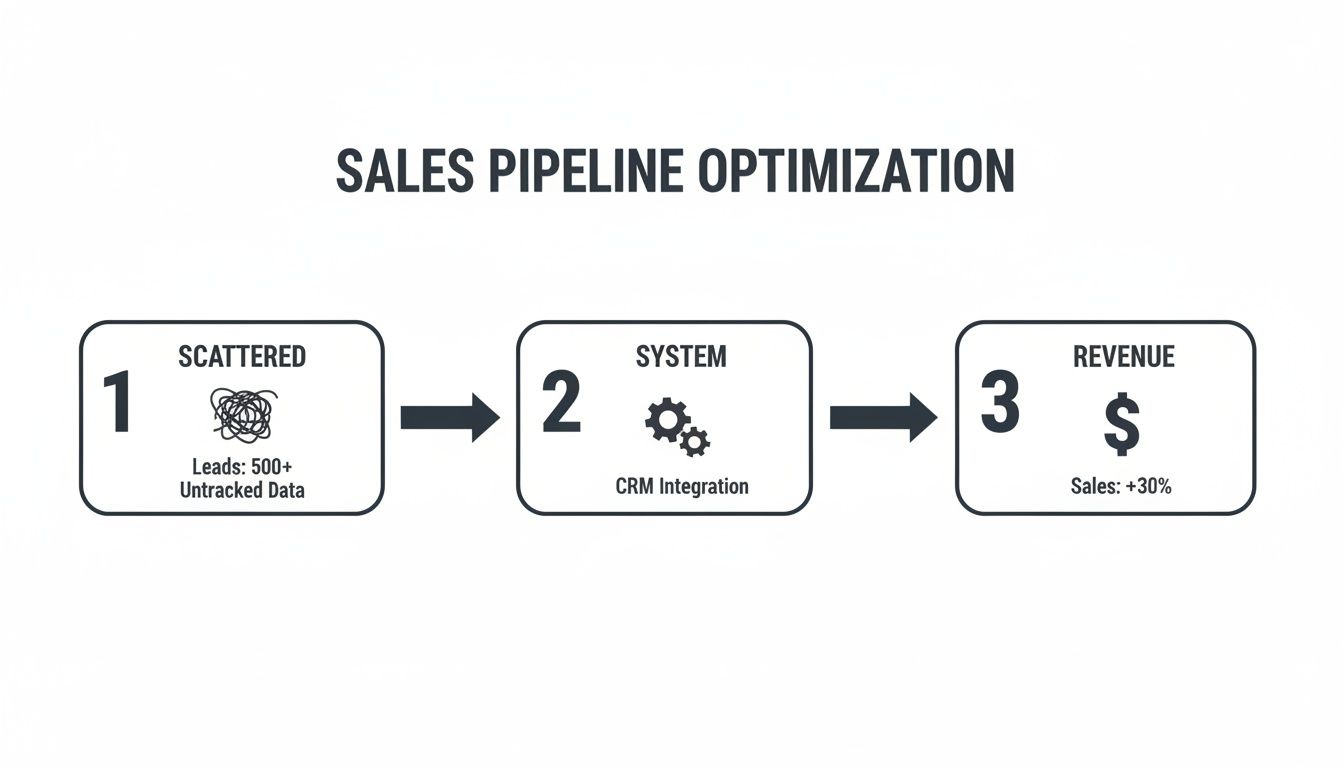
The secret isn't just having stages; it's having meaningful ones. Vague labels like "In Progress" or "Follow-Up" are useless. They don't tell you what to do next or how close you are to a win.
Instead, every stage needs strict entry and exit criteria. These are the ground rules that dictate when a lead is ready to move forward. This discipline is what makes your pipeline work.
Crafting Your Core Pipeline Stages
For most of us on Upwork, a pipeline with 5 to 7 stages is the sweet spot. It's detailed enough to be useful but not so complex that you spend more time managing your CRM than you do selling.
Here’s a practical set of stages I’ve seen work time and time again for freelancers and agencies.
New Leads: This is the very top of your funnel. It's where every potential job post you find on Upwork lands first. At this point, you haven't vetted anything. The goal is simply to capture opportunities as they appear before they get buried. A lead only moves out of this stage once you've actually taken a moment to review it.
Qualified: A lead gets promoted to this stage only after you've decided it’s a genuine contender. Does the project match your expertise? Is the client's budget realistic? Does their review history look solid? This is your critical filtering step, where you separate the high-potential leads from the noise.
A deal should never jump ahead without meeting the specific criteria for the stage it's in. This is the single most important habit for making your pipeline a reliable forecasting tool instead of just a messy to-do list.
- Contacted/Proposal Sent: Once you’ve qualified a lead, it’s time to act. A deal moves here only after you've sent a truly personalized proposal. Firing off a generic template doesn't count. This stage tracks your real, high-effort outreach.
From Initial Contact to a Closed Deal
The next few stages are all about the back-and-forth conversation. This is where deals are won or lost, and where your communication and follow-up really shine. You're moving from chasing the client to having them actively consider you for the job.
Engaged/Replied
This one is a huge milestone. The moment a client responds to your proposal, the lead moves here. A reply, any reply, signals real interest and instantly elevates this opportunity above all the others. Your only job now is to respond promptly and steer the conversation toward a discovery call.
Meeting Scheduled
After some positive messages, the goal is to get a meeting on the calendar. As soon as a specific date and time are booked, the deal enters this stage. It’s a powerful buying signal—the client is now willing to invest their own time to talk to you. Get ready to nail that call.
Won/Lost
Every opportunity ends up here. The distinction is critical.
- Won: A deal is only "Won" when the contract is officially active on Upwork. A verbal "you've got the job" is nice, but it's not a done deal until that "Offer Accepted" notification comes through.
- Lost: A deal is "Lost" if the client hires someone else, cancels the job, or simply ghosts you after a reasonable number of follow-ups. Don't be afraid to mark deals as lost; it keeps your pipeline clean and your focus on active opportunities.
Nailing down these stages is the first, most crucial step toward taking full control of your sales process. It gives you the clarity you need to spot bottlenecks, predict your future income, and put your energy where it will make the biggest impact.
Fueling Your Pipeline With High-Quality Upwork Leads
Let's be honest, a sales pipeline without good leads is just a pretty diagram. You can have the most perfectly organized stages, but if you're feeding it low-quality opportunities, you’ll just get a clear view of your deals going nowhere. On a platform like Upwork, this "garbage in, garbage out" principle is everything.
The real game-changer isn't just bidding on more jobs; it's about being incredibly picky about which job posts even earn a spot in your "New Leads" stage. Success on Upwork means ditching the passive habit of waiting for invites and actively hunting down the right clients with speed and precision.
How to Spot a High-Value Client on Upwork
Before you spend a single Connect or write a word of a proposal, you need to put on your detective hat. A few minutes spent vetting a client's profile can save you dozens of hours chasing dead-end projects.
Here’s the checklist I run through to spot a client worth my time:
- Verified Payment Method: This one’s a deal-breaker. No verification, no proposal. It’s the most basic sign that a client is serious.
- Detailed Job Description: I immediately skip vague, one-sentence posts. A client who can’t spend 10 minutes outlining their needs probably doesn't have a clear budget or vision for the project.
- A Sensible Hire Rate: A client with 50 open jobs and a 10% hire rate is just window shopping. I look for a hire rate of 30% or higher—this tells me they actually pull the trigger when they find the right fit.
- Positive Review History: Read what other freelancers say. Do they communicate well? Are they fair? Past behavior is the best predictor of your future experience with them.
- High Average Hourly Rate Paid: This number is a goldmine. It reveals their budget expectations. If their average is $15/hour and my agency's rate is $100/hour, we're not a match. It’s that simple.
Think of this screening process as your pipeline's bouncer. By only letting quality prospects through the door, you're setting yourself up for a much higher win rate from the very beginning.
The Myth of Passive Lead Generation
Relying on client invites is comfortable, but it's not a strategy for predictable growth. It puts the Upwork algorithm in the driver's seat of your business, which is a place you never want to be. The most successful agencies are masters of proactive outreach.
The data backs this up. Warm leads, like referrals, have a massive 25.56% conversion rate, completely overshadowing cold outreach's 9.38%. On Upwork, invites and repeat business are your warm leads. But you can't build a business on them alone.
Proactive bidding is your engine for top-of-funnel growth. By being fast and highly targeted, you can blow past the dismal 1-3% awareness-to-lead rates common in many B2B sales funnels. You can dig into more benchmarks in this 2025 sales call conversion report.
The most successful Upwork agencies don't wait for opportunities to find them. They hunt them down with speed and precision, using smart filters and automation to find the perfect jobs seconds after they're posted.
This is where smart automation changes the entire dynamic. Instead of manually refreshing the job feed all day, tools can scan thousands of posts and instantly flag the ones that match your ideal client profile. You get a curated feed of high-potential gigs, letting you be one of the first to submit a sharp, personalized proposal.
This blend of speed and targeting is what keeps your pipeline full and your revenue predictable. If you're ready to build this kind of system, we break it down further in our guide to Upwork agency lead generation.
We Need to Talk About Speed and Automation

When you're trying to win work on a platform like Upwork, speed isn't just a nice-to-have. It’s everything. I’ve seen countless top-tier freelancers and agencies lose out on perfect projects for one simple reason: they were too slow.
Having a well-organized sales pipeline is a great start, but it means nothing if your leads go cold waiting for you to get in touch. Think about it from the client's perspective. They have an urgent problem and are ready to hire now. The first handful of quality proposals they see don't just get read—they set the standard for everyone else.
Why Being First Matters More Than You Think
The numbers don't lie. Responding to a lead within just one hour can lead to a 53% conversion rate. Wait a full day, and that plummets to a mere 17%. On top of that, sales cycles have stretched by 32% since 2021 as buyers have become more cautious, and B2B win rates have dropped to an average of 21%. You can dig into more of this data in a 2025 sales pipeline report from Salesso.
This is the harsh reality of trying to prospect manually on Upwork. You can't be glued to your screen 24/7, waiting for the perfect job to pop up. This is where automation stops being a luxury and becomes an absolute necessity.
Automation isn't about replacing your personality with a robot. It’s about eliminating the delays that prevent a client from ever seeing your personality in the first place.
It’s how you get your perfectly crafted proposal into their hands the moment their intent to hire is at its absolute peak.
Using Automation to Get Ahead on Upwork
The right automation tools let you consistently claim that "first-to-apply" advantage. These systems handle the repetitive, time-sensitive work that burns us out, so we can spend our time on what really matters—talking to clients and closing deals.
Here's a practical look at how this works:
- Automated Job Scanning: Instead of endlessly refreshing the Upwork feed, a smart tool monitors it for you. You set your filters—budget, client rating, specific keywords—and it finds the jobs that are a perfect fit, instantly.
- AI-Assisted Proposals: Good automation doesn't mean spamming generic templates. The best tools today use AI to read the job post, pinpoint the client's core needs, and then help you draft a personalized opening line that proves you actually read it. You can get a high-quality, relevant bid out in minutes, not hours.
- Instant Replies: The race isn’t over once you apply. When a client messages you, the clock starts ticking again. An automated reply can immediately acknowledge their message, letting them know you're on it and will be in touch shortly. It’s a small touch that makes you look incredibly responsive.
Turning Automation Into Real Business Growth
Putting these systems in place isn't just about moving faster for the sake of it. It’s about seeing real, measurable improvements in your business. Your sales pipeline transforms from a simple tracking sheet into a powerful client-winning machine.
Here are the results you should expect:
- Shorter Sales Cycles: When you cut down the time between a job posting and your first interaction, the entire sales process speeds up. You get into more conversations, faster, which leads to quicker decisions.
- Higher Reply Rates: Being one of the first applicants with a genuinely relevant message drastically boosts your chances of getting a reply. You're catching the client when they're most engaged.
- Increased Pipeline Velocity: Automation is the antidote to a stagnant pipeline. It keeps deals from getting stuck in the early stages and ensures a steady flow of opportunities moving toward "Won."
This is the engine that will power a modern sales pipeline, especially on a competitive platform like Upwork. It gives you the speed you need to not just compete, but to actually win. If you want to go deeper, we cover all the essentials in our guide to the fundamentals of sales automation.
Tracking and Optimizing Your Pipeline for Maximum Revenue

Let’s be clear: a sales pipeline isn't something you build once and then admire from a distance. It's a living system. If you treat it like a static to-do list, you'll never get the predictable income you're after. The real power comes from learning to read the story your data is telling you.
This is about getting past feel-good numbers, like how many proposals you fired off this week. We need to focus on the metrics that actually drive decisions. Your pipeline should become a diagnostic tool, shining a spotlight on where your sales process is working and, more importantly, where it's leaking cash.
Core Metrics Every Upwork Seller Must Track
To get real, actionable insights, you have to track the conversion rate from one stage to the next. This is how you find the bottlenecks holding you back. For Upwork sellers and agency owners, these are the numbers that matter most:
- Lead-to-Proposal Rate: What percentage of job posts you flag as a 'New Lead' actually end up receiving a proposal from you? A low number might mean your lead sourcing is too broad, or you're just not fast enough to act on good opportunities.
- Proposal-to-Reply Rate: Out of all the proposals you send, how many get any kind of response? This is a huge one. It's a direct reflection of how well your proposals grab a client's attention.
- Reply-to-Interview Rate: How many of those initial conversations actually turn into a scheduled call? If clients are ghosting you after the first message, your opening lines might not be compelling enough to earn their time.
- Overall Win Rate: At the end of the day, what percentage of qualified leads become closed deals? This is your bottom-line metric, but it’s completely dependent on how well you perform at every previous stage.
Calculating these rates shows you exactly where things are breaking down. For example, if you send 100 proposals and only get 5 replies, that 5% reply rate is a massive red flag. The problem isn't your work ethic; it's your proposal quality or targeting.
Interpreting the Data and Finding Your Bottlenecks
Once you have your numbers, you need to give them some context. The path from a lead to a closed deal is often a game of attrition. Across B2B sales, overall conversion rates hang around a stark 2-5%. Digging deeper, you might see leads convert to "marketing qualified" at 20-25%, then to "sales qualified" at 12-18%, with final opportunities closing at a rate of only 6-9%. You can explore more benchmarks in this 2025 B2B sales conversion report.
Don't let those numbers discourage you; use them as a measuring stick. If your proposal-to-reply rate is way below the industry average, you know exactly what to fix first. This is what data-driven decision-making really looks like.
Your pipeline data doesn't just show you what happened; it tells you why it happened. A high proposal volume with a low reply rate isn't a volume problem—it's a quality problem that needs immediate attention.
This single insight is a game-changer. It stops the guesswork. Instead of blindly sending more proposals into the void, you can start making targeted fixes—refining your opening hooks, personalizing your approach, or showcasing more relevant portfolio pieces.
A/B Testing Your Way to a Higher Win Rate
With a bottleneck clearly identified, you can start optimizing with A/B testing. The idea is simple: change one variable at a time and measure the impact on your key metrics. It’s the scientific method applied to your sales process.
Here are a few simple A/B tests you can start running immediately:
- Test Different Proposal Openers: For one batch of proposals, start with a direct question about the project. For the next, open by highlighting a specific, impressive result from your portfolio. Track which approach gets more replies.
- Experiment with Your Call to Action (CTA): In your initial messages, try asking for a "brief 15-minute chat" in some, and "a call to discuss the project details" in others. You'd be surprised how a small wording change can affect how many meetings you book.
- Refine Your Qualification Rules: Are you winning a lot of low-budget jobs but constantly losing the high-value ones? Try tightening your qualification criteria. Only bid on projects over a specific budget for a month and see how it affects your win rate and average deal size.
By consistently tracking your metrics, analyzing what they mean, and running small, controlled tests, you’ll transform your pipeline from a simple organizational tool into a powerful engine for real, sustainable growth.
Common Sticking Points When Building an Upwork Sales Pipeline
Even with a solid plan, taking that first step to build out a sales pipeline for Upwork can feel a bit overwhelming. Let's walk through some of the most common questions and roadblocks I see freelancers and agencies run into. Getting these right from the start will save you a ton of headaches down the road.
Where on Earth Do I Even Begin?
It all starts with one thing: your client. Before you even glance at a CRM or map out a single stage, you have to get crystal clear on who you're actually selling to. This is, without a doubt, the most critical piece of the puzzle.
Ask yourself some tough questions:
- What's the one service I offer that's most profitable and that I genuinely enjoy?
- What project budget makes me feel confident, not stressed?
- Which industries or business types do I consistently get the best results for?
- What are the non-negotiable red flags that scream "bad client" for me?
The answers to these questions form your Ideal Client Profile (ICP). Think of this as the bouncer for your pipeline. Every single lead you consider gets measured against this profile. Without it, you’ll inevitably clog your pipeline with low-quality prospects that waste your time and kill your momentum.
How Many Stages Should This Thing Have?
There's no single right answer, but for anyone focused on Upwork, a 5-to-7 stage pipeline is the sweet spot. It's detailed enough to give you a clear picture of what's happening without becoming a nightmare to keep updated.
A solid framework to start with looks something like this:
- New Leads
- Qualified
- Proposal Sent
- Engaged/Replied
- Meeting Booked
- Won
- Lost
The goal here is clarity, not complexity. Each stage should represent a real, meaningful step forward in your sales process. It’s tempting to over-engineer this from the start, but trust me, it's better to begin with a simple structure. You can always add or tweak stages later as you learn more about what works for you.
The whole point of a pipeline is to give you an at-a-glance snapshot of your sales health. If updating it feels like a full-time job, it’s too complicated. Focus only on the major milestones that move a prospect toward becoming a paying client.
What’s the Most Important Number to Watch?
While your final win rate is what pays the bills, the single most important metric for actually improving your process is your conversion rate between each stage. This is what shows you exactly where your pipeline is "leaking" and where deals are falling apart.
For example, have you ever sent out 100 proposals only to get a couple of replies? That’s not bad luck; it’s a data point. It tells you that your proposal messaging or your initial targeting is off. Or maybe you get plenty of replies, but nobody agrees to a call. That’s a sign your initial back-and-forth isn’t creating enough value to earn 30 minutes of their time.
Tracking these stage-by-stage conversions lets you diagnose problems with surgical precision. You stop guessing what’s wrong and start making targeted fixes that have a real impact on your income.
Do I Really Need a CRM for This?
Technically, no. You could start with a spreadsheet, creating columns for your stages and manually dragging names across the board. If you're just starting out and handling only a few leads, this can work to get the basic concept down.
But let's be honest—that manual system will fall apart the second you start to gain any real traction. You’ll lose track of conversations, forget to follow up, and have no way to analyze what’s actually working. A dedicated Customer Relationship Management (CRM) tool, even a free one, is one of the best investments you can make.
Modern CRMs put everything in one place, automate your reminders, and give you the analytics you need to spot those bottlenecks we just talked about. For an Upwork business, the real power comes when you connect your pipeline to tools that automate the most tedious parts of the job, creating a smooth journey from finding the perfect lead to closing the deal.
If you're serious about building a high-velocity sales pipeline on Upwork, you need more than just a CRM—you need an engine. Earlybird AI acts as your always-on sales team, automatically finding your ideal clients, crafting personalized proposals, and managing follow-ups to get you the first reply and the first meeting. Stop chasing leads and start building a predictable revenue machine. Learn more about how Earlybird AI can transform your Upwork business.