← Back To Blog
A Guide to Building and Scaling Agencies on Upwork
For a long time, Upwork was seen as a stage for solo acts—a place where individual freelancers could shine. But that stage has grown into a full-blown production house. Agencies on Upwork are now a major force, changing the game entirely. The platform isn't just a simple job board anymore; it's a bustling marketplace where coordinated teams offer clients comprehensive, managed solutions.
Why Upwork Is a Goldmine for Modern Agencies
That old view of Upwork as just a gig platform? It’s completely outdated. A massive shift has taken place, driven by what clients need and what freelancers want to achieve. Clients, especially small and mid-sized businesses, are tired of juggling multiple contractors. They'd much rather have a single, reliable point of contact for complex projects, whether it's building a website from scratch or running a year-long marketing campaign.
At the same time, top freelancers figured out they could accomplish more together. Instead of fighting over smaller, one-off tasks, they started forming lean, specialized agencies. This allowed them to bid on and win larger, more complex contracts that were simply out of reach for a single person. It was the perfect storm, turning Upwork into a thriving ecosystem for team-based work.
The Power of a Deep Talent Pool
What really kicked this transformation into high gear is the sheer size and diversity of Upwork's talent network. The platform's global reach is a huge draw for agencies. With over 18 million registered freelancers from more than 180 countries, the talent pool is immense. This depth has pushed many serious clients to prefer managed teams over solo specialists, especially for complex jobs.
Take development, for instance. Web, mobile, and software development now make up about 34% of all work on the platform. That kind of work is a natural fit for agencies that can assemble a full squad of designers, developers, and project managers.
This blend of a massive talent supply and strong client demand creates the perfect environment for agencies to build a scalable business.
A Marketplace Primed for Agency Success
The client side of the equation is just as powerful. Upwork's client base is packed with small and mid-sized businesses, and they're looking for exactly what agile agencies provide. They often need a partner to take over an entire function, like their digital marketing or ongoing software maintenance, all under one contract.
For agency owners, this means the platform is no longer just about winning isolated projects. It is increasingly about building repeatable, team-based delivery models that can plug directly into clients’ workflows and handle larger scopes of work.
This evolution is a huge opportunity. Agencies that get it can position themselves as strategic partners, not just vendors. Upwork gives you all the tools you need to make it happen:
- Direct Access: You can connect with hundreds of thousands of active clients who are actively looking for solutions.
- Scalability: Need to staff up for a big project? You can assemble a team on-demand from a global talent pool.
- Credibility: A strong agency profile lets you show off your team's collective expertise and highlight successful projects.
By putting these pieces together, a modern agency can turn Upwork into a primary engine for real, long-term growth. If you're still on the fence about the platform's potential, you might find our deep dive into whether Upwork is a legitimate and valuable channel for your business helpful.
Understanding Agency vs. Freelancer Accounts
First things first, let's get clear on the fundamental difference between going it alone as a freelancer on Upwork and running an agency. It’s a crucial distinction.
Think of a freelancer profile as a solo artist's portfolio. It’s all about one person: their skills, their work history, their reputation. It’s a direct line between the client and the individual talent.
An agency account? That’s more like a record label or a creative studio. It’s not about one person; it’s a unified brand representing a whole roster of talent. This setup allows you to showcase the collective power of your team, offer a much wider range of services, and confidently tackle the kind of big, complex projects that a single freelancer just couldn't manage.
This diagram helps visualize where agencies sit within the whole Upwork ecosystem. You can see they act as a key intermediary, organizing talent to serve clients.
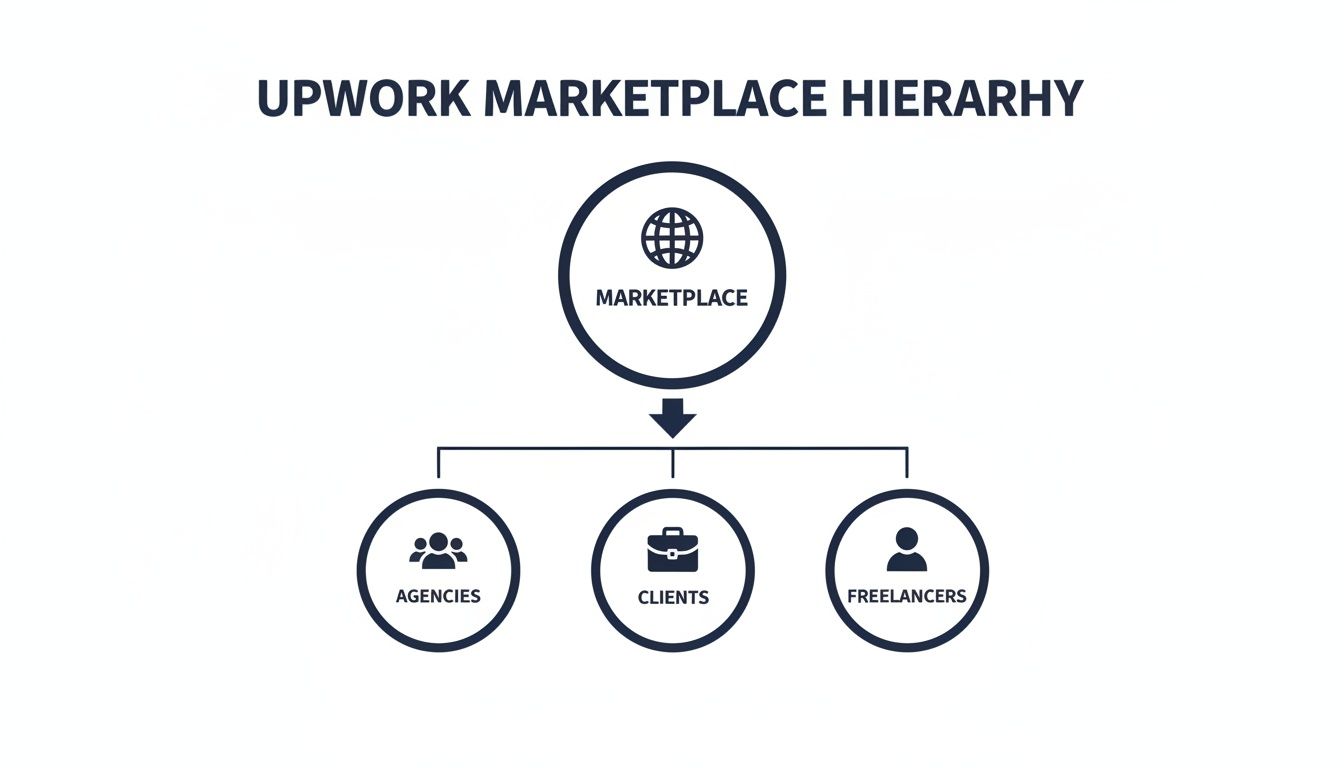
This unique position is what gives agencies on Upwork a serious advantage when it comes to scaling their business.
To really get to grips with this, let’s compare the two side-by-side.
Agency Account vs. Freelancer Profile: A Quick Comparison
This table breaks down the core operational differences you'll encounter day-to-day. It’s not just a branding choice; it changes how you find work, manage your reputation, and get paid.
As you can see, running an agency adds a layer of management and shared responsibility, but it also unlocks the potential for much greater scale and earning power.
How Profile Structure Shapes Your Brand
The most obvious difference hits you right on the profile page. A freelancer's profile is all about them—their name, their photo, their personal work history. Every review and every skill is tied directly to that one person. It’s perfect for building a strong personal brand.
Agency profiles, on the other hand, are two-tiered. You get a main agency page that serves as your company's storefront, complete with its own overview, portfolio, and list of services. Then, nested under that agency umbrella, you have the individual profiles of your team members.
This gives you a powerful one-two punch:
- The Agency Brand: Your main profile tells clients what your team is capable of and showcases your collective track record.
- The Member Expertise: The individual profiles show clients who will be doing the work, building trust by putting a face to the name.
Reputation Is a Team Sport
On Upwork, your reputation is your currency, and it’s all measured by the Job Success Score (JSS). This is where things get really different for agencies.
A freelancer has one JSS, tied directly to their personal performance. It's simple and clean. For an agency, the JSS is a composite score—a weighted average of the scores of every single member.
This means one superstar can help lift the whole team's score, but just one underperforming member can drag everyone down. As an agency owner, this forces you to be ruthless about quality control and team management.
Your agency's reputation becomes a shared responsibility. The success or failure of one contract reflects on the entire team, making consistent, high-quality delivery absolutely non-negotiable if you want to keep that JSS high and attract premium clients.
The Nuts and Bolts: Connects and Payments
Even the day-to-day operations work differently. As a freelancer, you buy your own Connects (Upwork’s virtual tokens for bidding on jobs) and your earnings land directly in your account.
Agencies pool their resources. The agency owner buys a bank of Connects, and any authorized team member can dip into that shared pool to bid on jobs. This centralizes your outreach and makes it easier to manage your bidding budget.
Payments follow the same logic. When a client pays for an agency contract, the money doesn’t go to the freelancer who did the work. It goes into the central agency balance. From there, it's up to the agency owner to handle payroll and distribute the funds to the team members based on your internal agreements. It gives you full financial control, but it also adds a layer of administrative work you have to be ready for.
How to Build a Client-Winning Agency Profile
Think of your Upwork agency profile as your digital storefront. If it’s poorly put together, it's like a shop with a dusty, uninviting window—clients will just walk on by. But a great one? That’s a magnet for high-value contracts, instantly showing off your team's expertise and professionalism.
This isn't just about filling in boxes on a form. It's about telling a compelling story that positions your agency as the only logical solution to a client's problem. Every single part of your profile, from the overview to the portfolio, has to work together to convince a client to trust your team with their project.
The real goal is to create a profile that doesn’t just list what you do, but actively sells the value you bring. That means being thoughtful and strategic about every section to make sure your message is clear, consistent, and impossible to ignore.

Crafting a Compelling Agency Overview
The agency overview is your first, and maybe only, shot. A potential client is reading it, and you have just a few seconds to grab their attention and make them want to know more. Drop the generic corporate speak and talk directly to their problems.
Start by getting laser-focused on who you help and what you fix. Are you the marketing agency that helps SaaS startups land their first 1,000 users? Or are you the development team that builds custom e-commerce sites for retail brands? Get specific.
That kind of clarity instantly builds a connection. It shows you get their world and have the specialized skills they need, making you a much better choice than a generalist agency that claims to do everything for everyone.
A winning overview isn't a list of your services; it's a narrative about your client's success. Frame your capabilities around the results you deliver, turning features into tangible benefits that resonate with your target audience.
It’s basically a cover letter for your whole agency. Just like you’d tailor a proposal for a specific job, your overview should feel like it was written directly for your ideal client. If you want to see how to nail this client-focused language, checking out some top-tier cover letter examples for Upwork can give you some great ideas.
Curating a Portfolio That Showcases Teamwork
For agencies on Upwork, a portfolio serves a totally different purpose than it does for an individual freelancer. It shouldn't be a random dump of past work. Your portfolio needs to scream, "We are an amazing team that can tackle complex projects together."
Every piece in your portfolio should tell a story of collaboration. Make a point to feature projects that required several different skills from your agency members.
- Detail the Challenge: Start with a quick summary of the client's initial problem.
- Explain Your Process: Walk them through how the team worked together. Who was on strategy, who handled design, who coded, and who kept it all on track?
- Showcase the Result: This is the money shot. Hit them with clear metrics, like a 30% increase in conversions or a 50% reduction in page load time.
Following this structure proves you’re not just a group of freelancers sharing a logo, but a well-oiled machine ready to execute on big ideas. It highlights your agency's true value: managed, end-to-end project delivery.
Defining Your Service Offerings with Clarity
Upwork’s "Project Catalog" feature is a gift—use it. This is where you can create pre-packaged services that solve common client problems. It takes the guesswork out of the equation for the client and makes your sales process a whole lot smoother.
Try structuring your services in tiers—think "Basic," "Standard," and "Premium"—to appeal to clients with different budgets and needs. For each package, you need to be crystal clear about:
- Scope of Work: What's included? Just as important, what isn't?
- Deliverables: What tangible things will the client actually get?
- Timeline: How long will this take, roughly?
- Price: A fixed, no-surprises price for the package.
When you "productize" your services like this, you make it incredibly easy for clients to hire you. They see exactly what they're getting and how much it costs, which builds trust and gets you to a "yes" much faster. Your profile goes from being a passive resume to an active, 24/7 sales tool.
Building Your Agency Sales Engine on Upwork
A polished agency profile is just the starting line. The real game-changer for agencies on Upwork is turning the platform from a place you find random gigs into a predictable, scalable sales machine. So many agencies get trapped in a reactive loop, scrolling through job feeds and shooting off proposals whenever they find a spare moment. That's a recipe for inconsistency and leaving a lot of money on the table.
The top-tier agencies treat Upwork as a primary sales channel, complete with a structured workflow and an obsession with efficiency. They don’t just wait for good jobs to appear; they build a system to find and win them, day in and day out. This means getting past founder-led sales and creating a repeatable process anyone on the team can run with.
The objective is to build a system that pinpoints the right projects, crafts proposals that actually get read, and lands client interviews without wasting time or energy. This is where smart tools and strategic automation come into play, letting you operate at a scale that’s impossible to match manually.
Designing a Modern Sales Workflow
A successful Upwork sales engine isn’t a chaotic scramble. It’s a series of clear, well-defined stages that guide a potential project from discovery to a signed contract.
A rock-solid workflow usually looks something like this:
- Targeted Lead Sourcing: Using laser-focused filters and keywords to dig up high-value projects that are a perfect match for your agency’s expertise.
- Rapid Proposal Crafting: Creating templates and systems that allow you to quickly personalize proposals that highlight your team's collective horsepower.
- Immediate Follow-Up: Replying to client messages within minutes. This keeps the conversation hot and ensures you stay top-of-mind.
- Performance Analysis: Tracking key metrics like proposal win rates and interview conversion rates to constantly fine-tune your strategy.
This systematic approach means you’re spending your time (and Connects) on the opportunities you’re actually likely to win. It replaces guesswork with a data-backed strategy.
The Rise of the AI-Enabled Agency
The ground is shifting under our feet on Upwork, thanks to automation and AI. Agency life has already moved from ad-hoc gigs to systematized, team-based delivery. Now, a new breed of "AI-enabled" freelancers is entering the scene. New research shows that 31% of skilled freelancers already see themselves this way, building their services around a partnership between human talent and AI tools. Another 36% expect to join them within five years. You can dive deeper into this trend in the latest research on the future of freelancing.
For agencies, this trend raises the stakes dramatically. The gap is widening between teams stuck in manual sales mode and those using automation to get near-instant response times and make data-driven bids.
For an agency, speed is the ultimate competitive advantage. Being one of the first qualified applicants in a client's inbox dramatically increases your chances of getting an interview. Automation is the key to achieving that speed consistently.
This is exactly where a tool like Earlybird AI becomes an essential part of your sales engine. Think of it as a 24/7 sales associate that never sleeps. It scans the job feed for you, flags perfect-fit projects, and uses AI to draft and send highly personalized proposals just minutes after a job gets posted.
This screenshot shows how an automation platform gives you a central command center for all your outreach.
By automating the most tedious, time-sucking parts of prospecting, you free up your team to focus on what humans do best: building relationships, strategizing, and closing deals.
From Manual Prospecting to Automated Outreach
The day-to-day difference is night and day. Without automation, a team member could burn hours every day just sifting through jobs, leading to burnout and missed opportunities. With an intelligent automation platform, that whole process hums along in the background.
Your team's role shifts from manual labor to strategic oversight. You’re no longer just bidding on jobs; you’re managing a sales system. This frees up your senior talent—the experts who should be talking to clients and delivering work—to get out of the prospecting weeds. They only need to step in when a genuinely interested client replies, ready for a high-level conversation.
This isn’t just about saving time; it’s about fundamentally changing your agency's capacity to grow. By automating the top of your sales funnel, you can chase more opportunities, book more meetings, and ultimately win more high-value contracts. This is how you turn your Upwork presence into a powerful and predictable revenue stream.
Scaling Your Agency with Smart Automation
Sooner or later, every successful agency founder hits a wall. You can't be the lead salesperson, the project manager, and the visionary all at once. If your agency's growth is still entirely dependent on your personal hustle, it's time to build a real engine for growth.
This is where you stop relying on manual effort and start building a system. Smart automation tools, like Earlybird AI, are designed for this exact transition. Think of it less as a simple tool and more as the central nervous system for your sales pipeline on Upwork. It provides the infrastructure you need to scale—things like analytics to actually see what's working, access for multiple team members, and the ability to test different outreach strategies simultaneously.
The whole point is to build a machine that finds, qualifies, and engages potential clients consistently. This frees up your best people to do what they do best: talk to qualified leads, build relationships, and close deals.

From Guesswork to Data-Driven Bidding
One of the biggest traps growing agencies fall into is the "spray and pray" method of sending proposals. You're just tossing Connects into the void, hoping something sticks, with zero insight into why you win or lose. It's a frustrating and expensive way to operate.
This is where automation flips the script by bringing hard data into the picture. By tracking a few key metrics, you can stop guessing and start making surgical adjustments to your bidding strategy.
Here are the numbers you absolutely need to be watching:
- Proposal View Rate: Are clients even opening your proposals? This is your first hurdle.
- Reply Rate: Of the clients who read your proposal, how many are actually responding?
- Interview Rate: How many of those conversations are turning into a real meeting or call?
- Win Rate: Of all the interviews you land, what percentage turns into a new contract?
These metrics tell a story. For instance, a low view rate probably means the first two lines of your proposal are failing to grab attention. A high view rate but a terrible reply rate? That could point to a problem with your pricing, your portfolio, or the core solution you're offering. This data lets you diagnose the real problem instead of just changing things at random.
Replacing an SDR with Intelligent Systems
As an agency grows, the idea of hiring a Sales Development Representative (SDR) to handle prospecting often comes up. But this is a huge commitment. Between salary, benefits, and training, a full-time SDR can easily run an agency over $50,000 per year, and there’s no guarantee they’ll perform.
Intelligent automation offers a powerful alternative. A compliant, well-designed tool can effectively replicate—and often outperform—the core functions of an SDR for a fraction of the cost, operating 24/7 without needing a single day off.
This isn’t about blasting out generic, spammy templates. Modern automation is about achieving personalization at scale. By using AI to analyze a client’s job post, these systems can write incredibly relevant, human-sounding proposals that hit on the client’s specific pain points. If this idea is new to you, our guide on what sales automation is and how it drives growth is a great place to start.
It's a way to mimic the thoughtful, targeted outreach of a great salesperson but with the speed and persistence of a machine. You end up being one of the first qualified proposals a client sees, which massively increases your odds of getting that first interview.
Building a Scalable and Compliant Growth Engine
The end goal here is a system that brings in leads with minimal day-to-day meddling from you. A truly mature automated sales engine can handle the entire top of the funnel, from spotting the perfect job post all the way to getting that initial discovery call booked on your calendar.
This kind of system is built on a few core principles:
- Continuous Learning: The platform gets smarter over time. It learns from your wins and losses to better identify ideal clients and refine its proposal writing.
- Multi-User Workflow: It's built for teams. Multiple bidders can work within the same system, all following a unified strategy that keeps your brand messaging consistent.
- Account Safety: It’s designed for compliance. By mimicking real human behavior and using secure, modern connection methods, it protects your agency’s most valuable asset—its reputation.
When you put these pieces together, you're no longer limited by how many hours you can personally sink into finding new work. Instead, your agency's growth is fueled by a reliable, data-driven system that delivers a predictable stream of opportunities day in and day out.
Got Questions About Running an Upwork Agency?
Even when you have a solid plan, the day-to-day reality of running an agency on Upwork throws a lot of curveballs. Knowing how to handle the little details is often what separates the agencies that scale smoothly from those that hit one roadblock after another.
Think of this section as your practical field guide. We’ll get into the nitty-gritty of how your agency’s reputation is actually calculated, what happens to your old freelancer profile, and how to keep your team from burning through your shared resources. Let's get you operating with confidence.
How Does the Agency Job Success Score Work?
This is probably the most common point of confusion for new agency owners. Unlike an individual freelancer's score, an agency's Job Success Score (JSS) is a collective number. It’s essentially a weighted average of the scores from every single one of your agency members.
But it’s not a simple average. Upwork's algorithm is smart; it gives more weight to contracts with higher earnings and projects that were completed more recently. This means a $10,000 project that just wrapped up with a 5-star review will boost your agency JSS way more than a small, $100 gig from six months ago.
The takeaway? To keep that agency JSS high, every team member needs to be obsessed with client satisfaction. I recommend keeping a close eye on individual scores. It helps you spot anyone who might need a bit of coaching before their performance starts to pull down the entire team’s reputation.
Can I Turn My Freelancer Profile into an Agency?
Absolutely. Upwork has a straightforward process for this, specifically designed to help successful freelancers grow into a full-fledged business. You can convert your existing profile directly into an agency owner account, and you won't lose a shred of your hard-earned history.
When you make that switch, your personal work history, JSS, and portfolio all get neatly bundled into your new member profile within the agency structure. It’s a huge advantage because it gives your brand-new agency instant credibility right out of the gate.
To get started, just head over to your account settings and look for the option to create an agency. Once you've set up the main agency page, you can start inviting other freelancers to join your roster. Just like that, you've gone from a solo act to a team.
What's the Best Way to Manage Agency Connects?
Wasting Connects is like burning cash. Since every proposal sent by any team member dips into the same central pool, you need a system to avoid chaos and waste.
A smart management strategy really boils down to three key steps:
- Create Strict Bidding Rules: Get crystal clear on what a perfect project looks like for your agency. This makes sure your team only spends Connects on jobs you actually have a high chance of winning.
- Appoint a Gatekeeper: Have one person—an agency manager or a lead bidder—approve all proposals before they go out. This simple step adds a crucial layer of quality control and strategic oversight.
- Track Your Proposal ROI: Use your analytics to see how many proposals it takes to land an interview. If you're burning through Connects and hearing crickets, it’s a massive red flag that your targeting or proposal strategy needs a serious rethink.
Is It Safe to Use Automation Tools on Upwork?
Using automation is perfectly safe, but with one huge caveat: you have to choose a tool that was built from the ground up with compliance and account safety in mind. The good platforms go to great lengths to protect your account.
They do this by mimicking natural human behavior, using clean IP addresses specific to your region, and connecting to your account through secure methods that don't involve storing your password. The real danger comes from those cheap, clunky bots that just spam generic proposals—that's the fastest way to get your account flagged.
Good automation isn’t about spam; it’s about achieving personalization at scale. It’s a tool that helps you craft highly relevant proposals based on the actual details in a job post. Used the right way, it gives you a powerful—and safe—competitive edge, helping you win more business without ever putting your account at risk.
Ready to stop wasting time on manual prospecting and start winning more high-value clients? Earlybird AI is your 24/7 sales engine, finding perfect-fit jobs and sending personalized proposals in minutes. Discover how Earlybird AI can automate your agency's growth on Upwork today.