
← Back To Blog
Build a Portfolio in Upwork That Wins High-Value Clients
Your Upwork profile is so much more than a simple gallery of your past projects. Think of it as your best salesperson, working around the clock to land you jobs while you sleep. A powerful portfolio in Upwork instantly answers the two questions every potential client has: "Can you actually do the work?" and "Have you done something like this before?"
When you nail the answers to those two questions, you build immediate trust and pull ahead of the pack.
Why Your Upwork Portfolio Is Your Ultimate Sales Tool
You’ve been there. You spend time crafting the perfect proposal, pouring over every word to make sure it hits the mark. You click send... and then you wait. But what's really happening on the other side? Before a client ever thinks about hitting "reply," they're clicking over to your profile to see your work.
This is your moment of truth.
Your portfolio is the single most compelling piece of evidence you have to turn a curious client into a paying one. It shifts the entire conversation away from just your hourly rate. A fantastic portfolio shows your skills in action, proving you're worth your asking price and showcasing the real value you bring to the table—all before you’ve even had a conversation. It’s what separates the serious professionals from all the other bidders.
Getting Inside a Client's Head
When a client lands on your profile, they’re on a mission. They have a problem that needs solving, and they’re scanning for proof that you’re the right person to solve it. They aren't just looking for pretty pictures; they're hunting for concrete evidence.
Their thought process looks something like this:
- Is this relevant? Does this freelancer's past work look anything like the project I need help with?
- What's the quality like? Is the work polished and professional, or does it feel amateur?
- Where are the results? Can they show me that their work actually achieved something tangible for a business?
Clients are making these snap judgments on a platform that is absolutely massive. With a huge number of registered users and a constantly growing base of active freelancers, the competition is fierce. You’re vying for attention against more than 3 million active freelancers. A generic, half-finished, or empty portfolio just won't cut it. You can explore more about Upwork's growth statistics to get a real sense of the scale here.
Your portfolio is often your only chance to make a lasting impression. It's your visual resume, a collection of case studies, and your best sales pitch—all rolled into one. Don't treat it like an optional extra; treat it like the core of your Upwork strategy.
Building a Foundation for a Portfolio That Actually Wins Clients
Before you even think about uploading your first project, you need a plan. A great Upwork portfolio isn't just a random dump of everything you've ever done. It’s a curated gallery, strategically designed to attract the exact clients and projects you want.
Think of it this way: if you have a specific heart issue, you don’t go to a general doctor. You find a cardiologist. Your portfolio needs to position you as that specialist, making it a no-brainer for clients with a specific problem to hire you.
Define Your Target, Then Curate Your Work
First things first, get crystal clear on who you're trying to attract. Are you going after tech startups that need a slick new UI? Or maybe established e-commerce brands that need killer product photography? The more specific you are, the better.
Once you know who you’re talking to, go through your past work and select only the pieces that speak directly to their needs and goals.
If your past work doesn't quite fit the bill, don't panic. Create the work you need. It's a fact that freelancers who publish a portfolio get hired nine times more often than those who don't. So, build a mock project, redesign a well-known app, or even offer a small project to a local nonprofit. The whole point is to create proof that you can solve your ideal client's problems.
This is the critical moment where your portfolio shines. It’s the bridge between a client reading your proposal and deciding to send you a contract.
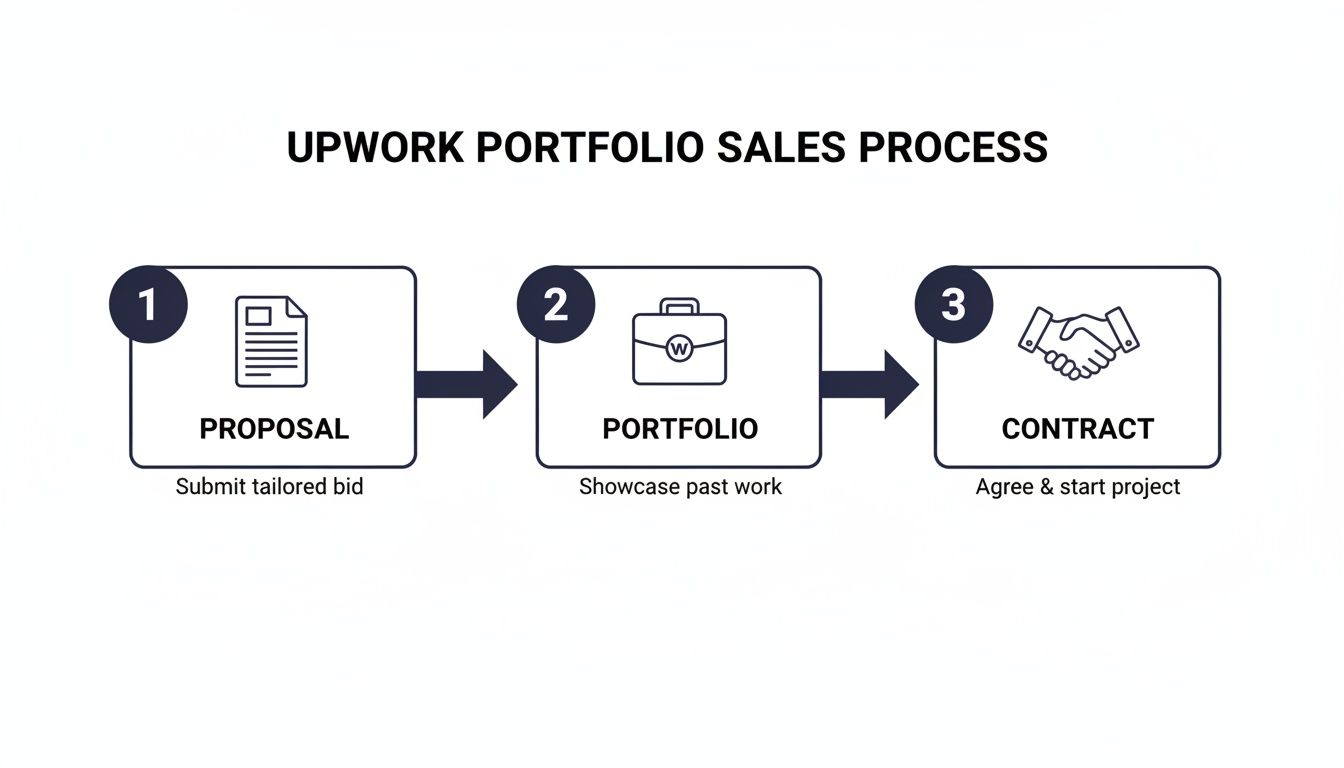
After a client likes your proposal, their very next step is almost always to check out your portfolio. They're looking for validation that you can back up what you say.
Organize Your Work for Maximum Impact
How you organize your portfolio is just as important as what you put in it. You can't expect a potential client to dig through a dozen irrelevant projects to find the one that matters to them. You have to make it easy.
Try grouping your portfolio items logically to guide the client.
Here are a few ways this works well:
- By Skill: This is straightforward. Create sections like "UI/UX Design," "Content Strategy," or "WordPress Development."
- By Industry: If you have a niche, lean into it. Group your work by "Healthcare SaaS," "Hospitality Marketing," or "Financial Technology."
- By Outcome: This one is powerful. Frame your projects around the results you delivered. Think categories like "Lead Generation Campaigns" or "E-commerce Conversion Optimization."
This kind of strategic organization helps clients find what they’re looking for in seconds. If you want to see how this all comes together, check out our guide with some sample profiles for Upwork.
Your portfolio should do more than just show off your work. It should take a potential client on a journey that ends with them thinking, "This is the exact person I need." Every single project you include should reinforce that feeling.
Crafting Portfolio Case Studies That Convert

This is where you separate yourself from the pack. A gallery of images is a start, but a portfolio filled with compelling case studies is what will actually get you hired. It’s the difference between showing a client a picture of a finished product and walking them through exactly how you built it, proving you’re the real deal.
A great case study tells the story behind your work. It positions you as a strategic thinker who solves business problems, not just someone who completes tasks. When done right, your portfolio in Upwork becomes your most powerful sales tool, guiding clients from a passive "nice work" to an urgent "I need to hire you."
From Problem to Solution: Telling the Right Story
Every project you’ve completed has a story behind it. The most effective ones follow a simple but powerful arc: they start with the client’s problem, walk through your unique solution, and finish with a tangible, impressive result.
Think beyond just showing the final website design. Instead, set the stage by explaining the client's initial challenge. Maybe their old site had a staggering 70% bounce rate, or mobile users were abandoning their carts because the checkout was broken. This immediately grounds your work in a real-world business need.
Once you’ve established the problem, detail your specific contributions. Did you run user research sessions? Did you re-architect the backend? Get specific about the actions you took to turn things around. This is your moment to showcase your skills in a practical context that clients can easily understand.
Showcasing Results That Matter
The final, and most crucial, part of your case study is the payoff: the results. This is where you connect your work to real business outcomes. Without this, your case study is just a project summary. With it, it's undeniable proof of your value.
At the end of the day, what really moves the needle for a client is results. We’re talking hard numbers.
- A developer could show how they boosted site speed by 50%, leading to a direct drop in user bounce rates.
- A marketer might highlight a campaign that delivered 300% growth in qualified leads to the sales team.
- A content writer can point to a blog post that now ranks on page one of Google, driving thousands of new organic visitors.
By framing your work with a clear "before" and "after," you aren't just showing what you did—you're demonstrating a return on investment. You're proving that hiring you is a smart business decision, not an expense. This mindset is what lets you command higher rates and attract serious clients.
This focus on provable impact is what separates top-tier freelancers. It’s why average rates for many roles are so heavily influenced by the proof in their portfolios. And with a 70% YoY growth in demand for AI skills, according to recent freelancing stats on Upwork, showing how you use new tools to get results is more critical than ever—especially since 84% of freelancers are eager to adopt them.
Bring Your Story to Life With Visuals
Don't just tell the client what you did—show them. Strong visuals make your case studies far more engaging and your results much more tangible. Look for opportunities to use visuals throughout your entire case study, not just as a single header image.
A strong portfolio is your first step toward earning glowing reviews. For a deeper dive on that topic, check out our guide on client feedback on Upwork.
Here are a few ways to visually enhance your case studies:
- Before-and-after screenshots: These are incredibly persuasive for any redesign project, whether it’s a website, app UI, or even a presentation deck.
- Short video walkthroughs: Record a quick 30-60 second screen share where you walk through the solution. You can explain design choices or demo a key feature in action.
- Graphs and charts: If you have performance data like traffic growth or conversion rates, turn it into a simple chart. It makes your results look more official and feel much more impactful.
Advanced Strategies to Maximize Portfolio Visibility
Having a fantastic portfolio is one thing, but getting the right clients to actually see it is how you win projects. It's not enough to just upload your work and hope for the best. To maximize visibility for your portfolio in Upwork, you have to be strategic about how you tag, categorize, and even update your projects.
The name of the game is showing up in as many relevant client searches as you can. You have to get inside a client's head and ask: what words would they use to find someone with my skills? This is where your tagging strategy becomes your secret weapon.
Master Skill Tags and Categories
Upwork's search algorithm uses skill tags and project categories to connect freelancers with jobs. This is your chance to guide it. Don't just list your main skill and call it a day. Think about all the related and secondary skills a client might be searching for.
For instance, a graphic designer shouldn't stop at "Logo Design." You’ll get way more traction by adding tags like:
- Brand Identity
- Visual Branding
- Marketing Collateral Design
- Social Media Graphics
Casting a wider net like this helps your portfolio pop up in a much broader range of searches. Honestly, you should treat the skills section on every single portfolio item as a mini SEO opportunity. It's your most direct way to tell Upwork’s system what you do, drastically improving your chances of getting found.
On a platform as competitive as Upwork, your portfolio isn't just a nice-to-have—it's your biggest advantage. Visibility is everything, and the algorithm rewards active profiles with strong, well-tagged portfolios. Making your work easy to find is just as important as the work itself.
This focus on visibility is critical when you're competing against a backdrop of over 25,000 jobs posted daily and 3 million active freelancers. Getting seen is the first, and most important, step. It's why seasoned pros stick with the platform; they've learned that a visible, polished portfolio is a magnet for high-quality opportunities. You can read more on a freelancer's take on Upwork's value to see how this plays out in the real world.
Create Specialized Portfolio Items
Don't hesitate to build out specialized portfolio pieces for high-value niches, even if they aren't your bread and butter. If you see a sudden spike in demand for a specific skill, create a dedicated case study around it. This immediately shows potential clients you have direct, relevant experience.
A generalist web developer, for example, could create a specific project titled "Custom Shopify Theme for E-commerce Growth." This immediately positions them as an expert for clients in that booming sector, rather than just another developer.
For agencies, this approach is a game-changer. You can build a portfolio that showcases your team's combined power. Create entries for integrated projects—maybe a campaign that involved your designer, copywriter, and developer working in concert. This demonstrates a level of coordination and capability that solo freelancers simply can't offer. If you're looking to streamline this process for your team, exploring options for Upwork profile automation can free up a ton of time.
Refresh and Leverage Social Proof
A stale portfolio is a dead portfolio. Make it a habit to regularly update your collection with your latest and greatest work. This does two things: it shows clients you're in-demand, and it signals to the Upwork algorithm that you're an active, engaged freelancer.
Better yet, weave client testimonials directly into your case studies. Nothing speaks louder than social proof. A simple quote from a happy client saying, "Her work increased our conversions by 30%," is incredibly powerful. It provides instant validation for your skills and builds trust, turning your portfolio from a simple gallery into a client-converting machine.
Polishing Your Portfolio: Common Mistakes and How to Fix Them

Even the best freelancers can have a few weak spots in their portfolio in Upwork. These are the kinds of small, easy-to-miss details that can unknowingly sabotage your chances before a client even sends a message. You might not even realize they’re there.
The good news? These are almost always simple fixes. Let's run a quick audit on your portfolio to spot these common tripwires and turn them into strengths.
The "Pretty Picture, No Story" Project
A visually stunning project thumbnail paired with a generic, one-sentence description is a common mistake. Or worse, no description at all. A great image will stop the scroll, but it's the story behind it that actually sells your skills and convinces a client you know what you're doing.
Your fix is to go back through every single portfolio item and give it the case study treatment. Use that problem-solution-result framework we talked about. What was the client struggling with? What specific steps did you take? And what was the concrete, measurable outcome you delivered? That’s what clients care about.
Displaying Outdated or Irrelevant Work
Think about it—is that project from three years ago truly representative of the expert you are today? Showing old work, or projects that don't align with the jobs you want now, can send the wrong signal to the high-value clients you're trying to attract.
Remember, freelancers who publish a relevant, high-quality portfolio on Upwork get hired nine times more often than those who don’t. Don't let old projects keep you out of that top tier.
You need to be ruthless here. Go through your portfolio and archive anything that isn't your absolute best, most recent work. If you're pivoting to a new niche, your portfolio needs to reflect that. Don't have a relevant project? Go create one! A strong sample project is far more effective than an old, irrelevant one.
The Accidental NDA Violation
This is a big one, and it can instantly kill a potential client's trust. In the excitement of showing off a project you're proud of, it's surprisingly easy to accidentally share confidential information or work you’re bound by an NDA not to show.
Always, always get explicit, written permission from a client before you add their project to your public portfolio. If they say no or you can't get in touch, you still have options:
- Anonymize it: Use a photo editor to blur or remove logos, brand names, and any other sensitive data. Change the client's name to something generic like "Fintech Startup" or "E-commerce Retailer."
- Focus on the process: Write a case study that details the project goals, your strategy, and your methodology without actually showing the final deliverable.
- Create a "lookalike" project: Build a brand-new sample project that demonstrates the exact same skills and process but uses none of the original client's assets or information.
Taking the time to audit your portfolio for these common slip-ups is one of the highest-impact things you can do for your freelance business. A polished, strategic portfolio in Upwork is your most powerful tool for building trust and winning better, higher-paying clients.
Your Top Upwork Portfolio Questions, Answered
Even with the best guide, you're bound to run into some tricky situations when building out your Upwork portfolio. It happens. Let's walk through some of the most common questions freelancers wrestle with and get you some clear, practical answers.
"How Can I Build a Portfolio With No Experience?"
Ah, the classic catch-22. You need work to build a portfolio, but you need a portfolio to land the work. My advice? Stop waiting for a client to give you a project. Create your own.
Seriously, self-directed projects can be even more compelling than client work because they show off your raw ambition and the exact skills you want to be hired for.
Here are a few ways to get started:
- Invent a dream project. Are you a writer? Create a three-part blog series for an imaginary brand in your ideal niche. A UX designer? Mock up a mobile app concept for a company you admire.
- Redesign something that exists. Find a popular website or app you feel could be better. Then, build a case study that breaks down your proposed changes and explains the "why" behind your design choices.
- Offer your skills to a non-profit. Local charities are often short on resources. You get a real-world project to feature, they get professional help, and you get to support a good cause. It's a win-win-win.
The goal is to have something tangible that proves you can do the job. Remember, one study showed that freelancers with a portfolio get hired nine times more often than those without one. A single, strong sample project beats an empty gallery every time.
"What's the Best Way to Showcase Work Under an NDA?"
Handling projects covered by a Non-Disclosure Agreement is a delicate balance. You want to show off your great work, but violating an NDA is a fast way to burn your reputation. You can absolutely still use this experience, but you have to be smart about it.
First, always ask the client for permission to feature their project. If they say yes, fantastic—get that approval in writing. If they say no or you can't reach them, you have to shift your focus to complete anonymization.
Protecting your client's confidentiality is non-negotiable. It proves your professionalism and builds immediate trust with potential clients. The way you handle sensitive information in your portfolio speaks volumes about how you'll treat their business.
To make a project anonymous, you need to scrub every identifying detail. Blur out logos, change specific company names to general descriptions (e.g., "a FinTech company" or "a B2B SaaS startup"), and remove any proprietary data or numbers.
From there, you frame it as a case study. Focus on your process, your methodology, and the high-level outcomes. A result like "increased user engagement by 20%" is powerful without revealing any confidential secrets.
"How Many Projects Should I Actually Include?"
This is one area where quality blows quantity out of the water. A portfolio with three to five fantastic, relevant case studies will do more for you than one with 20 mediocre or unrelated projects.
Clients are busy. They aren't going to sift through your entire work history. They need to see, in a glance, that you are the right person to solve their specific problem.
Think of your portfolio in Upwork as a curated gallery, not a storage locker. Every piece should be a strategic choice that reinforces your expertise in the niche you're targeting. I recommend reviewing your portfolio every few months. Archive older, less impressive projects to make space for your latest and greatest work.
Building a killer portfolio is a great start, but what if you could put the whole client acquisition process on autopilot? Earlybird AI acts like your personal 24/7 sales agent. It connects to your Upwork account to find your ideal jobs, writes personalized proposals that get noticed, and even helps manage client replies. It's all about getting you in front of clients first so you can spend less time searching and more time working. Learn more and see how it works.