

← Back To Blog
Proposal Writing Topics: 8 Sections That Win Upwork Clients
A client posts a job on Upwork. Within an hour, 30 proposals are sitting in the inbox. The client reads the first two lines of each and closes most of them. "I am an experienced developer with five years in the field" dies right there, before anyone reaches your portfolio, your price, or your plan.
You usually don't lose these on skill. You lose because the bid reads like a résumé, not a response to this post. Agencies running several bidders feel it fastest: volume goes up, replies stay flat, and nobody can say which paragraph is at fault.
Winning bids are assembled from blocks that each do one job, not from a single inspirational paragraph.
These proposal writing topics are the eight blocks I audit first when reply rate stalls: the hook, the scope, the proof, the pricing, the discovery questions, the modular library, the follow-up, and the analytics. Each one below shows a structure that earns a reply, a concrete example, and the mistake that gets the bid closed.
1. Client-Centric Opening Hook Proposals

Clients decide in the first two lines whether you read the post. A client-centric hook restates their problem, goal, or phrasing before you mention your background. Your years of experience are assumed. Their checkout, their tone, or their deadline is not.
Say a store owner needs a checkout migration because mobile buyers drop off at shipping. Open with that, not your stack. "You need the checkout moved off the old plugin without breaking Apple Pay or tax calculation. I migrated a similar flow for a home-goods store and kept the existing payment tokens." Then go straight to proof.
A copywriter can mirror a tone line the same way. If the post says the brand should sound "direct, not corporate," say how the first landing-page draft would use short headlines and one proof line above the fold. Two sentences, then stop.
Practical rule: Pull one specific phrase from the job post into line one, and don't talk about yourself until line three.
Build a small hook library by category, with three openings each for development, design, SEO, and content, and rotate them so repeat clients don't see a clone. Tag the hook type on every send. If you can't point to a noun from their brief, you didn't read it, and a warmer greeting won't fix that.
2. Scope-and-Deliverables Breakdown Proposals
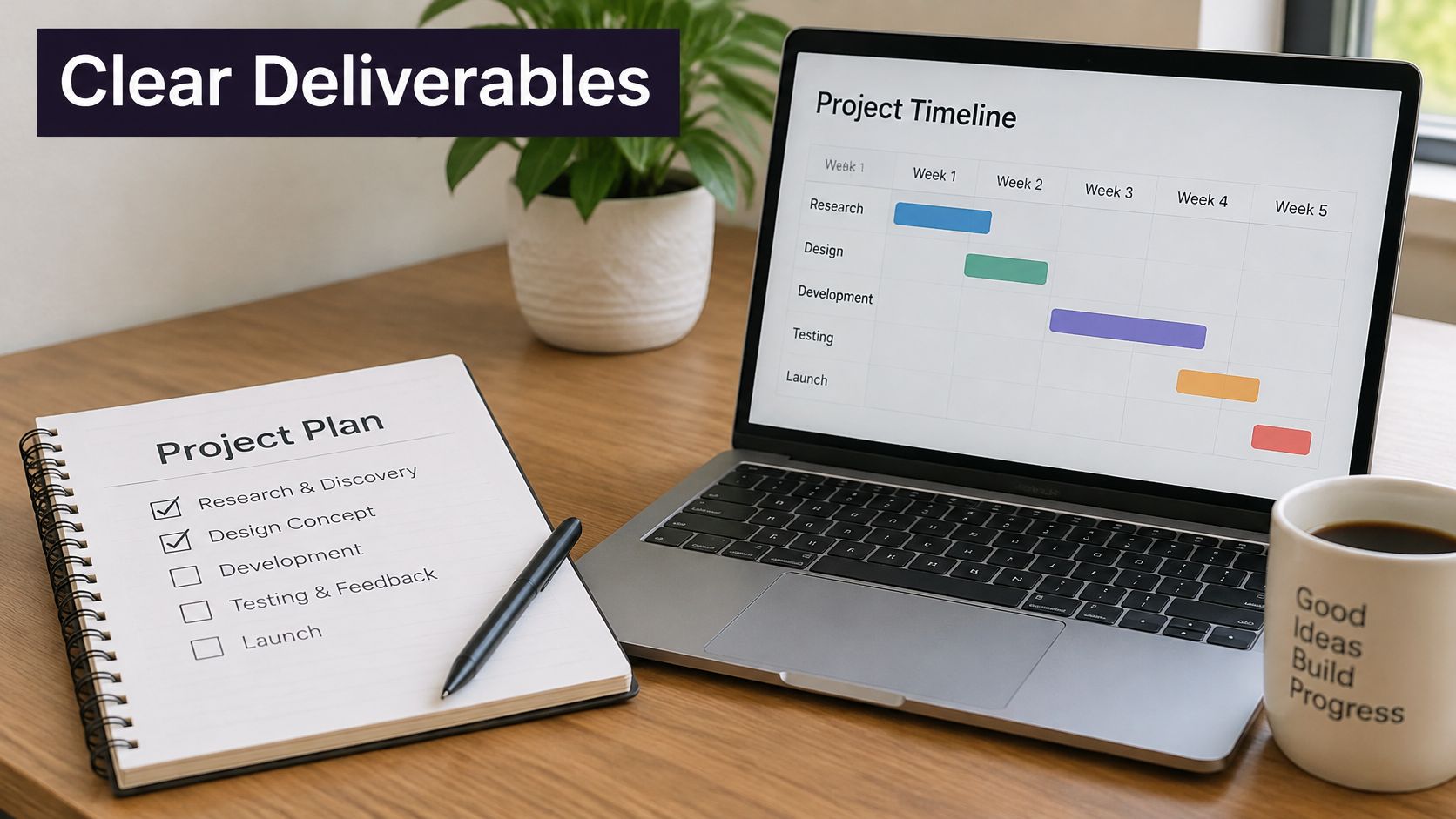
A price without outputs is a guess the client has to interpret. A scope block says what you will produce, in what order, and what you need from them. That is how two bids become comparable instead of two vague promises.
An SEO freelancer can put three phases on three lines: a technical audit with a prioritized fix list, on-page recommendations for the main templates, and a 60-day content calendar. Each line names the file the client receives and the review before the next phase. A UI designer does the same with wireframes, two rounds of high-fidelity revisions, and a handoff set of components, specs, and exported assets.
Make the scope scannable
Clients compare bids on a phone between calls. If the scope takes a minute to parse, they move on.
- One output per line: "Homepage wireframe in Figma," not "design support as needed."
- Revision count in the line: "Two rounds on the high-fidelity screens." Unlimited revisions sound generous and destroy the margin.
- Client inputs named: Access, brand files, and a feedback deadline. Missed feedback moves the calendar.
- Exclusions in one sentence: Workshops, copy, or ads sit outside this bid.
For a boundary your team can reuse before anyone prices the work, start with a clear project scope definition.
A scope someone can scan in under a minute is easier to approve than a polished paragraph they have to decode.
"I'll handle your SEO" feels flexible and creates disputes. A short list feels smaller and still wins the interview, because the client can see week one.
3. Portfolio-Led Proof Proposals
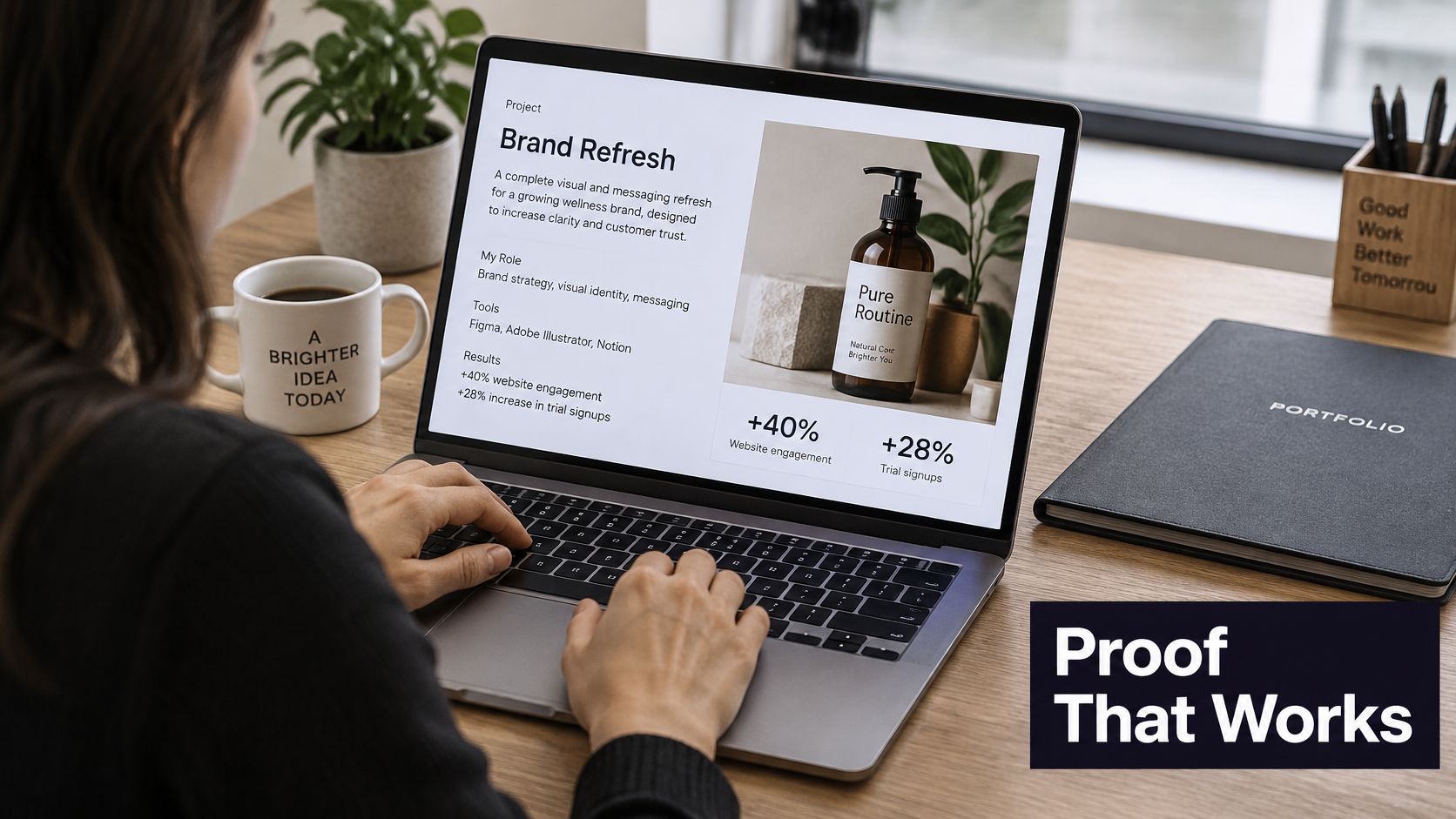
"Experienced and reliable" is free, so clients skip it. A short case with a result is harder to dismiss and easier to trust. Use the same shape every time: challenge, action, result.
A developer might write: "A catalog site was taking several seconds to load on mobile. I deferred third-party scripts and compressed the hero images. Load time dropped under two seconds on the templates that drive add-to-cart." A content writer might write: "A B2B software blog had posts and no pipeline. I rebuilt six articles around questions sales already heard, and organic sessions rose over six months."
Pick the example closest to this client's industry or failure mode. A fintech checkout story will not help a restaurant booking tool. Anonymize the name unless you have permission, and only cite numbers you can defend if they ask.
Thomson Reuters' 2023 summary of the QorusDocs Proposal Management Benchmark reported that existing-client RFPs averaged a 62% win rate, while the median new-business win rate fell from about 45% to 40%. A new logo doesn't have that history, so the case has to do the job a past relationship would have done. Put it in the first third of the bid, not after your tools list.
Keep the sample easy to open
If the work sample is a PDF, send a clean file. I attach samples with free PDF merging without watermarks so page one isn't stamped with a trial banner. Refresh the two examples you lean on once a quarter. A dead metric from years ago reads as neglect, even when the craft was good.
4. Value-Based Pricing Justification Proposals
Price is a business decision for the client and a margin decision for you. Tie the number to the outcome, then make the commercial terms match the story you just told.
Upwork's instructions for submitting a proposal require an hourly rate, including any suggested scheduled increases, or a fixed-price bid, plus a choice of payment by project or by milestone. If you promise three deliverables and bill one lump sum, there is no checkpoint. If you bill hourly and never say what drives the hours, the client assumes the total will drift.
Tiers when the budget is blank
A marketing freelancer facing an unclear budget can offer three packages. The first is a landing page and one ad set with a single reporting cycle. The second adds two assets and a mid-campaign read. The third adds another cycle and a creative refresh. Each tier states what is excluded, including media spend and page development.
A developer on a fixed fee can write one plain sentence: the fee covers integration, staging tests, and one fix window in the two weeks after launch. New endpoints after sign-off are a change request.
Anchor the number to their goal, such as a launch date or a broken checkout, not to your internal day rate. Offer two or three options only when the post doesn't name a budget. One option is cleaner when they did. Hourly is safer when discovery is thin. Fixed is safer when you have shipped this build enough times to know the edges. Don't switch formats halfway through the thread, and track which price points get a reply.

5. Discovery-Question Proposals
Two or three questions at the end do more than another paragraph of enthusiasm. They show you're already making decisions, and they give the client an easy reply that isn't "thanks, we'll review."
Rank them. An SEO specialist might ask which keyword clusters tie to revenue, whether analytics is installed and trusted, and who signs off on titles. A developer might ask which hosting setup is essential and which integrations are must-haves versus later. Each question should be answerable in a sentence or two.
Questions tied to a real decision
The useful questions are ones the client must answer before anyone can start, whether they hire you or not. Hosting, access, the success metric, the approver. "Tell me about your business" is homework, and strangers don't get homework.
Pair the questions with a next step in the same breath. "If those three answers are straightforward, a 20-minute call this week is enough to lock phase one." Agency teams selling into a buying group should also identify the right contacts in target accounts before they spend that call with someone who can't approve the milestone.
Stop at three. Five questions looks like a form. Zero questions looks like a blast. And don't ask for something already sitting in the job post. That undoes the hook you opened with.
6. Modular Template Library Proposals
Speed without modules means every bidder invents a new voice. Modules without edits means the client can smell the template. You want tested blocks, assembled per job, with one sentence that could only belong to this post.
Set up separate module sets for web development, UX, and technical SEO. Give each set three hook options and two proof blocks. A solo freelancer can keep scope lists by service and rewrite only the opening. Build modules for the slow parts: proof, scope, exclusions, and the close. Leave the first line mostly custom.
Upwork's Connects guidance prices Connects at $0.15 each, sold in bundles, and the number required can vary with project size, scope, and market demand. New freelancers can earn 18 free Connects after submitting three or more proposals. Volume is an acquisition-cost choice, not a virtue. A shared library lets you answer fast on posts that fit and skip the rest, instead of rewriting from zero and bidding everything.
Retire the weak block
Store the current modules in one shared doc so two bidders don't send last quarter's proof. Once a month, drop the block with the worst reply rate. If you can't find a custom sentence, usually the first line or a risk in their stack, don't send the bid. Teams that want the folder already laid out can adapt these agency proposal templates and swap in their own cases.
7. Post-Proposal Follow-Up Message Sequences
Plenty of hires happen after the proposal, inside the message thread. A sequence is three short notes with a job each, not three copies of the pitch.
Reply while the thread is warm, ideally within a few hours of working time. Note one answers their question and offers a time. It does not restate the bid. Note two, about two days later if they go quiet, adds something useful: a cropped screenshot, a one-page outline, or a closer sample. Note three, near the end of the week, asks whether the project is still active, then stops.
Say they reply, "Can you share something similar?" Answer the same afternoon with two links and one line on which sample matches their stack. Two days later, send the outline of week one. If they stay silent, one polite check is enough.
- Stop at three: More than that trains the team to chase dead posts.
- Don't repeat the price: They already have it.
- Keep one sender: The bidder who wrote the proposal should send the notes.
- Automate the reminder, not the voice: Timing can be scheduled. The words should still sound like that person.
The same restraint shows up off the platform in guidance on how to follow up on quotes. On Upwork the window is shorter. A practical three-note pattern is spelled out in this piece on how to follow up with clients.
8. Analytics-Driven Proposal Optimization
Guessing which opening "feels stronger" wastes a month of Connects. Change one variable, name the metric before you send, and read the result by job type.
A team can run two openings across a batch of web-development proposals and keep the one that earns more replies. An agency can compare fixed-price and hourly formats on each service line and keep the format with the higher interview rate. Don't change the hook and the price in the same week. You won't know which one moved.
The Stargazy RFP Analysis Report found that time on buyer and market research correlated with win rate at r = +0.20, while time on the RFP document correlated at r = +0.08, and total person-days showed no relationship (r = −0.00). It also found no statistically significant win-rate difference between teams using general-purpose AI assistants and those that did not (p = 0.493). More writing hours, and a generic AI draft, are not the lever. Knowing the buyer's constraint is.
What to read each week
- Reply rate by hook type: Split it from the bidder's opinion of the line.
- Interview rate by price format: Fixed versus hourly, per service.
- Segment: Job category and budget band. A hook that works on larger builds can fail on small tasks.
- One change at a time: Otherwise the weekly review is a story, not a test.
A simple dashboard is enough if you only watch those four cuts. This walkthrough shows a clean way to review proposal trends without drowning in fields.
If extra writing time isn't moving shortlist rate, stop polishing paragraphs. Fix who you bid on, and which block you keep.
Assemble Your Proposal System and Start Testing
Don't rebuild all eight blocks in one sitting. Pick three this week. I recommend the hook, one proof block, and a three-note follow-up. Those three decide whether anyone answers. Scope and pricing matter next, once people are replying.
For the next 30 days, tag every proposal with the hook type, the proof example, and whether a follow-up went out. Review reply rate once a week by service line. Kill the opening that sounds clever and gets ignored. Keep the one that restates the client's problem in their words.
Consistency compounds faster than a heroic Friday rewrite. If two bidders on the same account send different scopes for the same service, the client experience is random and your numbers are too. Put the winning blocks in the shared library. Still require that one custom sentence, or the library will drift back into a mail merge.
Speed belongs in the same system as the writing. Earlybird AI submits personalized proposals within about 10 minutes of a job posting, replies to client messages in under 5 minutes, and follows up until a call is booked. In one tracked period it sent 4,587 proposals that returned a 14.8% reply rate and 202 projects. You can book a demo and watch the full loop of finding jobs, sending proposals, and booking calls live on your own Upwork account.
Treat the eight proposal writing topics as a checklist, not a manifesto. This week, rewrite ten openers so each one borrows a phrase from the post. Swap one tired case for a current challenge-action-result. Load the three follow-up notes so they go out without a scramble. At day 30, keep the block that earned replies and retire the one that only felt thorough.
Earlybird AI connects to your Upwork account, learns which projects fit from simple feedback, and drafts a personalized proposal for each job instead of a reused template. That is the same loop this article covered, from the opening hook through follow-up and weekly analytics, without your team rewriting every bid from a blank page. Visit Earlybird AI to see the workflow on your own account.


