
← Back To Blog
Project Scope Definition: The Complete Guide for 2026
You already know the feeling. The client sends a short brief, you give a clean quote, work starts, and then the messages change. “Can we also add a login area?” “Can you make the homepage more premium?” “While you're in there, can you fix the blog too?” By the time everyone argues about what was “included,” the project has drifted, the budget feels tight, and the relationship is worse than it needed to be.
That mess usually starts long before the first task. It starts when project scope definition never gets written down in a way both sides can point to later. In proper project management, scope is the baseline that names the objectives, deliverables, tasks, constraints, deadlines, and what's explicitly excluded, and PMI treats it as the project's work content and products, not a casual planning note. project scope definition and baseline guidance matter because they give you one reference point for every later conversation.
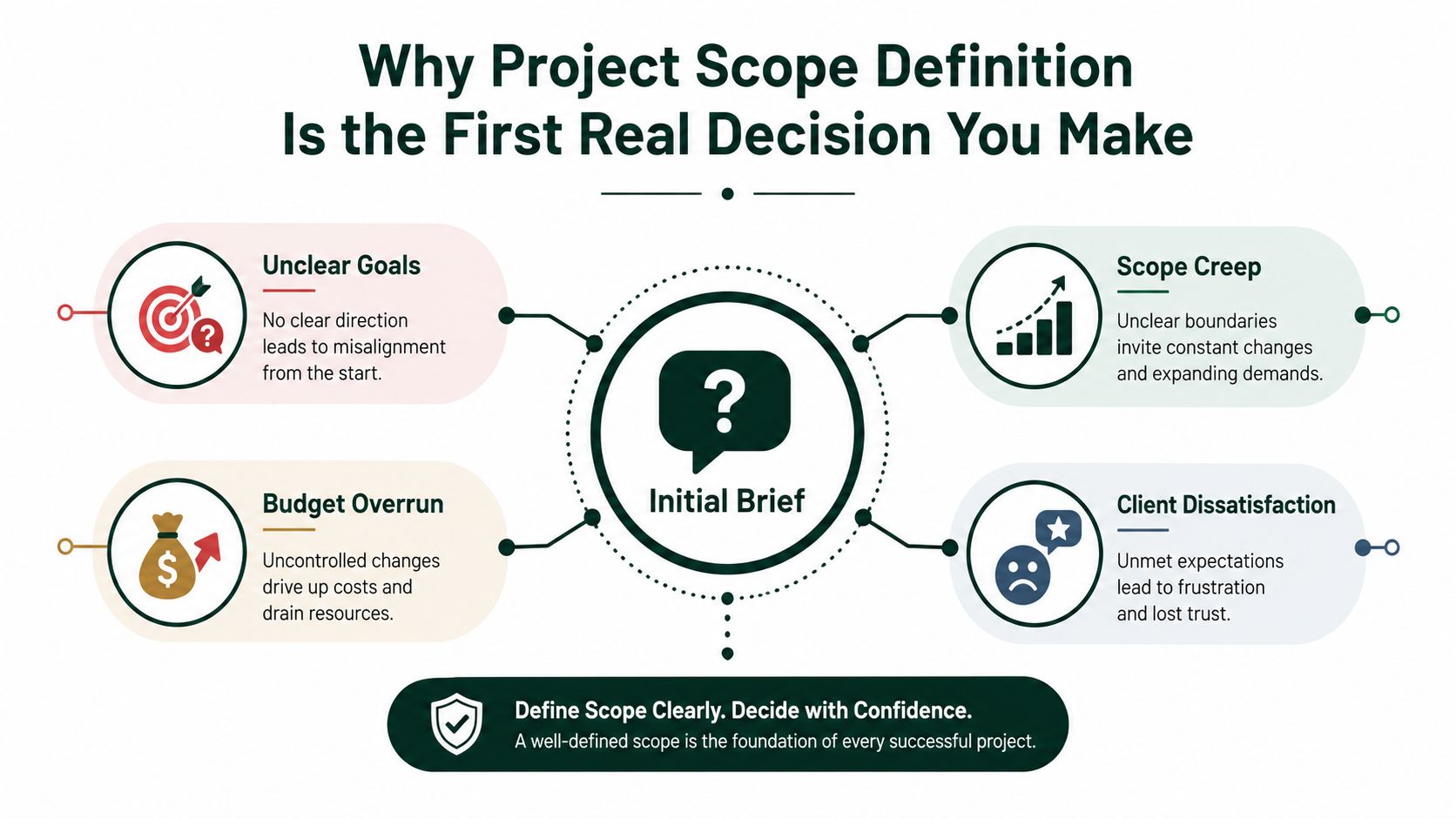
Why Project Scope Definition Is the First Real Decision You Make
A freelancer often treats pricing as the first decision. The first decision is deciding what the work includes, because price only means something after the boundaries are clear. If a client says “build a site,” but nobody writes down whether that means five pages, eight pages, copywriting, forms, or revisions, a dispute is waiting to happen.
A simple freelance example makes the risk obvious. One client may expect a basic brochure site, while the freelancer assumes the brief includes content loading, mobile tweaks, and two revision rounds. Both people can be acting in good faith and still end up arguing later because the agreement never named the work.
The moment a project goes sideways
That pattern shows up constantly on Upwork and in agency work. A developer delivers the site they believed had been approved, the client says a key feature is missing, and both sides are sure the other side “knew.” The problem is usually not skill or effort, it is that scope lived in chat threads instead of a shared document.
A strong project scope definition fixes that by creating a written baseline. It separates approved work from change requests before execution begins, so the team can decide whether a new ask belongs inside the current agreement or needs a formal change. Project-management guidance treats that baseline as the control point for alignment and verification, not a side note. scope management guidance from PMI frames this same idea as a structured control function.
Practical rule: if you cannot point to the line that says “this is included” and the line that says “this is excluded,” you do not have scope yet.
Why the written boundary protects both sides
Scope is also a protection tool. It protects the client from getting something vague, and it protects the freelancer from being asked to absorb hidden work. That is why project-management writing keeps coming back to scope as the reference point for deliverables, deadlines, and acceptance. Atlassian's project scope guidance says the same thing plainly, scope is the boundary of the work, and vague boundaries create risk.
For a small agency, that written boundary keeps the timeline honest. If a client wants design, copy, SEO setup, launch support, and AI-assisted content automation, those are not one blurry request. They are separate commitments that need to be named, priced, and checked against the agreement. Spend an hour clarifying them before work starts, and you can avoid many hours of revising, renegotiating, and apologizing later.
The Core Components Every Scope Definition Must Include
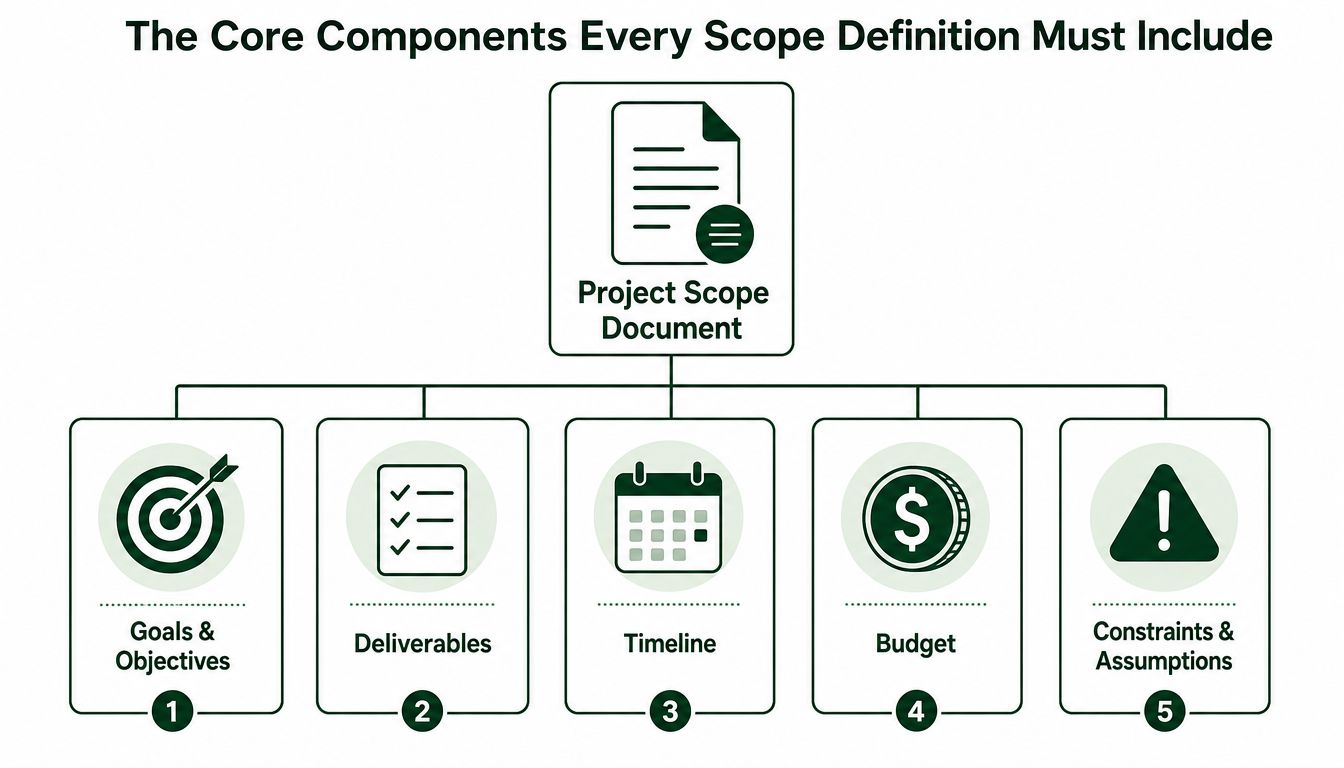
A scope document does not need polished language. It needs the right pieces in the right order. A useful way to picture it is a set of labeled drawers. If one drawer is empty, someone will eventually slide an extra expectation into that gap and treat it as agreed.
For a freelancer on Upwork, that gap is where trouble starts. The client says “just a few revisions,” the agency hears “minor edits,” and the contract suddenly has to answer what counts as minor, what counts as extra, and who approves the change. Scope definition keeps those conversations from drifting into guesswork.
The checklist that keeps the document honest
Strong scope definitions usually bring together goals, deliverables, milestones, constraints, assumptions, exclusions, and acceptance criteria. That structure turns a broad request into something a team can build, review, and sign off with less confusion.
Here is the easiest way to read each part:
- Goals and objectives: the business reason the project exists. If the client cannot explain the problem they want solved, the rest of the scope tends to wobble.
- Deliverables: the visible outputs. A website, a landing page, a content calendar, a set of wireframes.
- Milestones: the checkpoints that show progress. They help you avoid the “everything is almost done” problem that stretches projects for weeks.
- Constraints: the limits you are working inside, such as a fixed platform, a hard deadline, or an approved brand guide.
- Assumptions: the things you believe are true for planning purposes.
- Exclusions: the work that is not part of the deal.
- Acceptance criteria: the conditions that tell both sides when the work is done.
A junior freelancer often stops at deliverables. That is where proposals get thin. A client on Upwork may ask for “a website,” but the work can include copy edits, image sourcing, form setup, responsive checks, and handoff notes for the next person who touches the project. The scope document has to name those pieces, or someone will assume they were included.
Why exclusions matter more than people expect
Many people write what they will do and skip what they will not do. That is how a client later claims a missing feature was implied. If you say you will design a homepage, about page, services page, and contact page, the client may still assume basic SEO setup, mobile QA, or contact-form integration is included unless you state otherwise.
Rule of thumb: inclusions describe the promise, exclusions prevent argument.
A useful comparison is a restaurant menu. The menu tells you what can be ordered, and it also keeps the kitchen from being asked to invent dishes on the spot. A project scope statement does the same thing for project work, whether you are running a small agency retainer or shaping a single freelance contract. It also helps when you need to compare proposals and legal agreements, because the scope language should match what the client signs.
AI-assisted work makes the exclusions even more important. If a proposal says the team will use automation to draft content outlines, that does not automatically include final copy approval, fact-checking, or model tuning after launch. Those boundaries have to be written down, or the automation becomes invisible labor inside the scope.
Product Scope and Project Scope Are Not the Same Thing
Many beginners blur these together, then wonder why the brief still feels slippery. The clean distinction is simple. Product scope is what the deliverable must be, while project scope is the work needed to produce it. Wrike's project scope explanation separates them clearly, and that distinction is worth keeping in your head whenever you price client work.
One website, two different scopes
Take a client who wants a marketing website. The product scope might say the site needs a contact form, a blog, fast load times, and on-page SEO basics. That describes the thing being built.
The project scope says what you're doing to make that happen. You'll gather requirements, design layouts, write or revise copy, build the pages, test the form, check mobile views, and hand over the finished site. That describes the work.
A client often talks in product language, while you have to deliver in project language. If they ask for “a blog,” they may mean a blog template, a CMS setup, category pages, and initial content migration. If you only heard the feature, you'll underquote the work.
Why contracts and proposals need both layers
If you want a clean deal structure, compare proposals and legal agreements before you send anything for signature. A helpful reference is compare proposals and legal agreements, because it shows why the promise and the legal commitment are not the same thing. Your proposal should describe the work in enough detail that the contract can lock it down without ambiguity.
Use this split when you estimate:
- Product scope: what the client will receive.
- Project scope: what you must do to deliver it.
That one habit makes pricing much more defensible. It also helps you spot hidden work before you quote.
How to Build a Scope Definition Step by Step
The easiest scope document starts with the client's problem, not with a list of services. If the problem is unclear, every later line will be too. Start with one sentence that names the pain, then turn that pain into something you can verify.
Build the document in a clean sequence
Use this order:
- Write the problem statement. Say what the client is trying to fix or achieve, in plain language.
- Convert it into goals. Make the outcome measurable in practical terms, even if you keep it qualitative.
- List deliverables. Name each output the client expects to receive.
- Add milestones. Tie the work to phases or dates so progress is visible.
- Record constraints and assumptions. Note what must stay true for the plan to work.
- Write exclusions. Name what the project does not cover.
- Set acceptance criteria. Define what “done” means.
If you're collecting requirements before you draft the scope, a lightweight intake process helps a lot. A useful internal reference is requirement gathering methods, because the quality of your questions directly affects the quality of your scope.
For complex work, translate the scope into a work breakdown structure and a formal change-control flow. Adobe's project scope guidance notes that a WBS reduces ambiguity by breaking deliverables into smaller work packages, and that a change-control gate prevents uncontrolled expansion as requirements evolve. Adobe's scope definition best practices support that method.
A short example helps. If the deliverable is a website redesign, the WBS might split it into discovery, wireframes, design, development, testing, and launch. Then any new request, like adding a membership area, goes through the change gate instead of slipping into the original fee.
Real Scope Definition Examples You Can Adapt Today
A good scope document reads like something a normal client could approve without a translator. The point isn't to sound formal, it's to remove guesses. The clearest way to do that is to show the same structure on two common freelance jobs.
Example one a five page marketing site
Project name: Freelance marketing website build
Problem statement: The client needs a simple site that presents the business clearly and gives prospects a place to make contact.
Deliverables: five pages, homepage, about, services, blog, and contact. The build includes basic responsive layout and a working contact form.
Milestones: wireframe approval, design approval, development handoff, final review, launch.
Exclusions: branding refresh, ongoing SEO campaign, copywriting beyond light edits, and future page additions.
Acceptance criteria: the site matches approved layouts, the contact form submits correctly, and the client signs off on the final version.
That version is tight. A looser version would say “small website, a few pages, some revisions, and whatever else is needed.” That wording invites drift immediately.
Example two a content agency SEO program
Project name: three month SEO support engagement
Problem statement: The client wants consistent search-focused content support for a defined set of topics.
Deliverables: keyword research summary, content plan, written drafts, one round of revisions, and monthly reporting.
Milestones: topic approval, draft delivery, revision approval, publication handoff, monthly review.
Exclusions: technical site rebuild, paid ads, and full design work.
Acceptance criteria: each draft meets the agreed topic brief, revisions stay within the defined round, and final deliverables are delivered in the requested format.
A formal scope statement often includes the project name, charter, owner, sponsors, stakeholders, problem statement, goals and objectives, requirements, deliverables, non-goals, milestones, and cost estimates. Open Text BC's scope planning chapter lays out those baseline contents clearly.
If you want a contract-ready structure for app work, see proposal for an app. It's useful as a format reference when you're turning a client brief into an actual engagement.
Scope Creep and the Two Pitfalls Nobody Warns You About
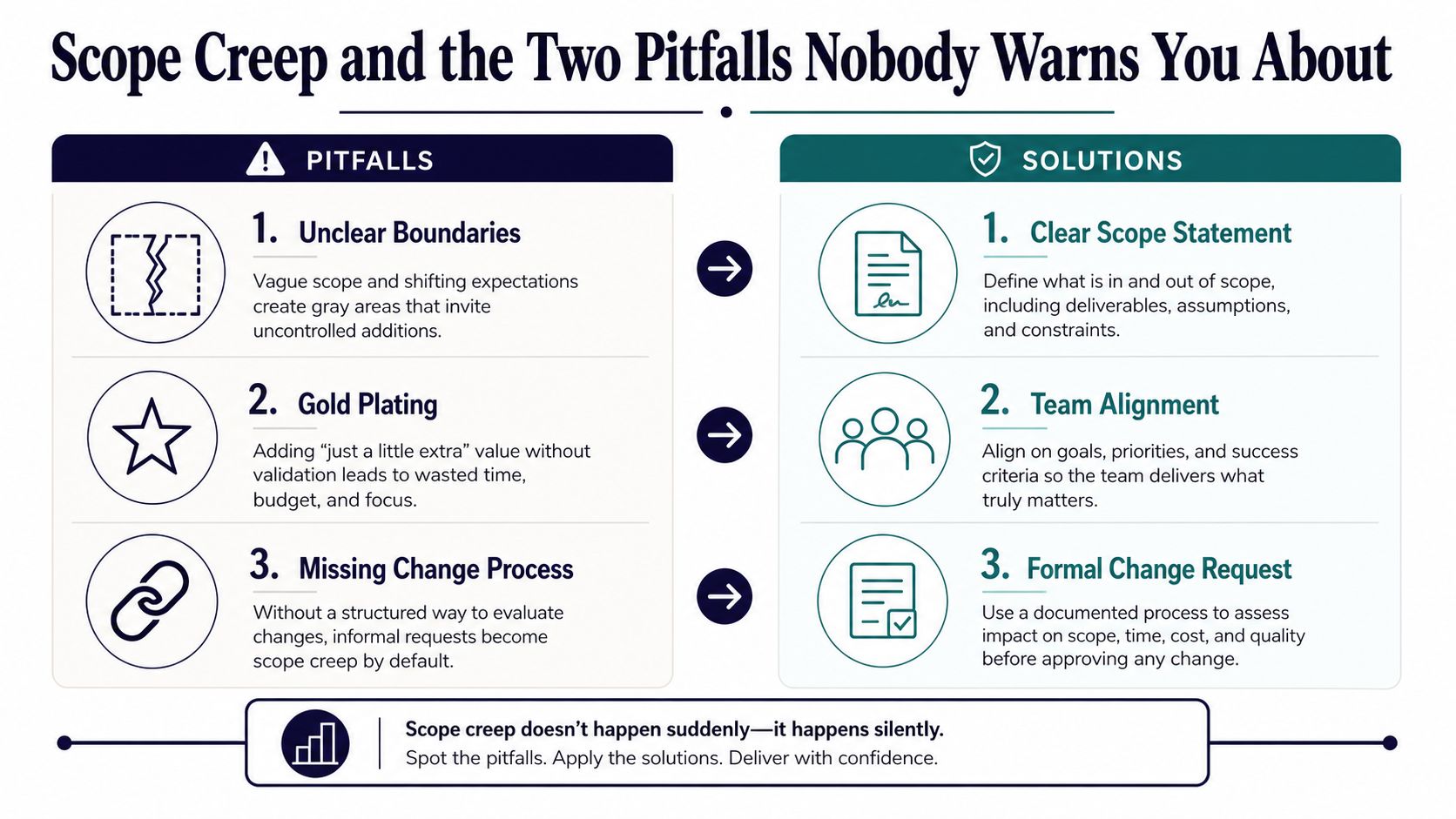
A project usually drifts for a simple reason. Someone thought the request was open-ended, someone else assumed a detail was implied, and the work kept growing one small favor at a time. That is scope creep in practice, and it shows up often in freelance and agency work, especially when the agreement lives in chat threads and proposal comments instead of a clear scope statement.
The three failure modes
A logo designer agrees to “one more” revision because the client sounds uncertain. A developer adds an admin panel because it seems useful. A writer hears “two blog posts” and prepares two long-form pieces, while the client expected shorter articles. None of those mistakes begin with bad intent. They begin with a boundary that was never specific enough for both sides to read the same way.
The first pitfall is fuzzy scope. The second is silent assumptions. The third is scope expansion after work has already started, which is where a small request becomes a larger obligation. A junior freelancer on Upwork can feel this most sharply, because a message like “can you also handle the landing page?” sounds minor until it changes the whole fee structure and timeline.
Scope creep is also where formal project management and day-to-day contracting meet. PMI-style language around boundaries, work breakdown, and change control sounds academic until you are writing a proposal, then it becomes practical very quickly. If the client cannot tell where the work ends, the work will keep moving.
The defenses that actually hold up
You do not control scope by hoping everyone stays reasonable. You control it by making the boundary easy to see and hard to reinterpret.
- Clear exclusions: state what will not be done, not only what will be done.
- Formal change requests: any new request gets reviewed before approval.
- Written confirmation: repeat verbal requests back to the client in writing.
- Team alignment: everyone doing the work should use the same scope language.
- Contract clarity: if the scope lives only in conversation, it will drift.
A scope document only helps when people use it at the moment the request changes. If the client asks for a new page, a new automation step, or an extra revision, the team should know whether that request belongs inside the current statement of work or belongs in a separate agreement. For a practical breakdown of that boundary, see master service agreement vs statement of work.
That is the core lesson. Scope creep does not usually start with one huge demand, it starts with one unclear sentence and a team that treats ambiguity as harmless. If the agreement is vague, the project keeps paying for it later.
Writing Scope Into Upwork Proposals and Client Contracts
On Upwork, vague promises are cheap and expensive at the same time. They win attention quickly, then cost you later when the contract becomes a memory test. Good proposals don't need to be long, they need to be precise enough that the client can see what's included without guessing.
How to write it inside the proposal
Keep the proposal short, but include four things: the problem you understand, the main deliverables, the boundary, and the approval point. For example, you can say, “I'll design the five requested pages, set up the contact form, and include one revision round after first review. Copywriting, new page types, and post-launch SEO work would be separate.” That sentence does a lot of work because it names the scope and the edge of the scope.
For contracts, mirror the same language. Put the deliverables in the agreement, state what's out of scope, and define what counts as acceptance. If you're unsure how to structure the legal side of the relationship, a practical reference is Contract setup guide for freelancers. It helps you separate the working agreement from the working assumptions.
Keeping scope consistent across multiple bidders
Agencies running several Upwork profiles need internal consistency more than flair. Shared scope templates help, but only if someone reviews them before they go out. A simple review step catches the quiet problems, like a proposal that promises “ongoing support” when the delivery team only priced launch work.
AI-assisted outreach belongs inside this system, not outside it. If automation drafts proposals or replies to client messages, the team still has to define which actions are authorized, which replies are templated, and which requests need human review. That boundary matters more now that AI is mainstream in knowledge work, with 78% of organizations reporting AI use in at least one business function in 2024, up from 55% the year before. Galorath's project scope note connects that shift to scope boundaries around automation.
If you're setting up your contract structure for repeat work, master service agreement vs statement of work is a helpful internal reference for keeping the legal layer and the project layer separate.
Scope Definition in Agile Projects and a Final Checklist
Agile doesn't remove scope, it changes how often you revisit it. You still need a product vision, release scope, and non-goals, even if the detailed backlog changes every sprint. The boundary just gets refined in cycles instead of frozen forever.
For teams that want to pair scope with client follow-up and pipeline discipline, getting started with Micro CRM is a useful reference point for keeping conversations, approvals, and next steps organized.
The simplest rule is this, scope is the promise, and the backlog is the path. Keep the promise clear, then let the path evolve under review. If you want a fast notebook version, use this checklist before any client work begins:
- Name the problem.
- List the deliverables.
- Mark the milestones.
- Write the exclusions.
- Define done.
That's enough to protect most freelance and agency engagements from the usual chaos. When the next client says “just a small extra thing,” you'll have a document, not a memory, to point to.
If you want fewer vague briefs and cleaner client approvals, Earlybird AI can help you capture requirements, shape tighter scopes, and turn early conversations into clear project documents before scope creep starts.