← Back To Blog
10 Requirement Gathering Methods to Win Better Projects
You win a promising project on Upwork. The client sounds organized, the budget works, and the brief looks clean enough to start. Two weeks later, the brief has changed three times, feedback comes from people you never met, and “one small addition” has turned into unpaid work.
That spiral usually starts before delivery, before design, and before the first line of code. It starts in discovery. Poor requirement gathering turns good projects into messy ones, and messy ones usually cost the freelancer or agency more than the client. Margin disappears first. Trust disappears next.
The upside is just as real. Strong requirement gathering methods help you qualify better projects, spot red flags early, price with more confidence, and give clients a process they can rely on. That matters on Upwork because buyers compare not just skills, but clarity. The provider who asks better questions often looks more senior before any work starts.
This isn't about adding ceremony to small projects. It's about using the right method for the job. Some projects need a fast interview. Some need a prototype. Some need document analysis because the client already buried actual requirements in Slack threads, old briefs, and contracts. Used well, these methods help freelancers and agencies win better projects and keep them profitable.
1. Interviews and One-on-One Conversations
Interviews are still the fastest way to get past vague briefs. A client might post “need a dashboard,” but a direct conversation reveals whether they need internal reporting, investor-facing metrics, or a sales tool for account managers. Those are different projects, priced differently, with different success criteria.
This method matters because individual conversations uncover both functional requirements and non-functional requirements, and they work best when you use open-ended questions and active listening, as noted in this requirements gathering process guide. For freelancers, that often means asking about workflow, approvals, deadlines, and what “done” means in the client's business.

How to run better discovery calls
A good interview isn't a casual chat. It needs structure. I prefer a short sequence that starts broad, gets specific, and ends with constraints.
- Start with the business trigger: Ask what changed internally that made this project urgent now.
- Map the workflow: Ask who uses the deliverable, who approves it, and where work usually gets stuck.
- Probe with examples: “Can you show me the current version?” beats abstract discussion almost every time.
- Confirm constraints early: Budget, timeline, tools, compliance, and handoff expectations should come up before a proposal is finalized.
Practical rule: If the client can describe the solution but can't describe the problem, keep digging.
Interviews also help with qualification. If you work from repeatable lead criteria, a framework like qualifying sales leads effectively makes these calls far more useful. You're not just collecting requirements. You're deciding whether this is a client you should take on at all.
2. Surveys and Questionnaires
Surveys work when you need input from multiple people without scheduling six separate calls. That makes them useful for agency projects, internal product requests, and Upwork engagements where several stakeholders all influence the decision but don't all have meeting time.
They're also useful when the client team is distributed. Some remote-friendly requirement gathering methods are missing from standard playbooks, even though hybrid stakeholder groups often resist traditional workshops or long interviews. In those situations, a short questionnaire can collect enough structured input to expose disagreements before they become revision rounds.
Where surveys help most
Use surveys when you need breadth, not depth. They won't replace a strong discovery call, but they will show patterns fast.
A few practical uses:
- Pre-kickoff alignment: Send a short form to the client team before the first working session.
- Feature ranking: Ask stakeholders to prioritize must-haves, nice-to-haves, and blockers.
- Process mapping: Collect answers on current tools, handoff points, and reporting needs.
- Post-project mining: Ask past clients why they hired you, what nearly stopped them, and what made the engagement smooth.
Keep surveys short enough that people finish them. Typeform and SurveyMonkey are both fine choices for this. For small projects, five to ten focused questions usually beats a long form full of optional fields.
Short surveys reveal where people disagree. Interviews reveal why.
The main trade-off is depth. A stakeholder might tick “security is important” on a form, but that doesn't tell you whether they need audit logs, role-based access, SSO, or vendor review paperwork. Use surveys to gather a baseline, then follow up where answers conflict or stay too broad.
3. Focus Groups
Focus groups are useful when requirements are shaped by shared discussion, not just individual opinions. This comes up often in branding, product strategy, internal tools, and customer-facing workflow changes. One person's requirement can sound firm in an interview, then change once the rest of the team reacts to it.
The group dynamic is the point. You're listening for friction, agreement, and the language stakeholders use when they challenge each other. That tells you a lot about hidden priorities.

What a good focus group reveals
A small agency might run a focus group with three client-side stakeholders from sales, operations, and support before building a reporting dashboard. Sales asks for speed. Operations asks for accuracy. Support asks for better filtering and history. None of those are wrong, but they shape different decisions.
What works:
- Mixed representation: Include people with different roles, not five versions of the same stakeholder.
- Strong moderation: One person needs to keep the session moving and stop dominant voices from taking over.
- Clear prompts: Show a workflow, mockup, or sample output to anchor the discussion.
- Tight scope: One session should solve one decision area, not the whole project.
What doesn't work is using focus groups as a substitute for decision-making. They generate insight, not final approvals. If no one in the room has authority, you'll get good discussion and weak outcomes.
For freelancers, a lightweight version works well. Bring a client, one operational stakeholder, and one end user into the same call. You'll surface contradictions in thirty minutes that would otherwise take three weeks of async feedback to uncover.
4. Observational Studies and User Research
People often describe their work as they think it happens, not as it happens. Observation closes that gap. If you watch a user complete a task, you'll usually find workarounds, skipped steps, and pain points that never show up in interviews.
This is one of the most practical requirement gathering methods for process-heavy projects. It's especially useful for admin dashboards, CRMs, internal tools, and anything replacing spreadsheets or manual review work.
Watch the real task, not the ideal one
If a client says their team “just updates the sheet and sends a report,” ask to watch that happen. You may discover they copy data between four tabs, look up missing values in email, export a PDF for a manager, then paste highlights into Slack. That's the actual requirement set.
A few ways freelancers can apply this on Upwork:
- Shadow a workflow live: Watch the client share screen while completing the current process.
- Review proposal handling: If you sell services, study how buyers scan profiles, portfolios, and opening messages.
- Track task friction: Note where users hesitate, recheck, or ask someone else for help.
- Pair observation with follow-up questions: Ask why a workaround exists after the task is done, not during it.
Observation also matters in remote settings. Some standard guides underplay adaptive methods like shadowing and document-based analysis, even though remote teams often need alternatives to workshop-heavy discovery. When stakeholders are busy or non-technical, watching the current workflow can be easier than asking them to explain it cleanly.
This method takes more time than a survey, but it prevents expensive assumptions. If the project depends on how people work in practice, not how they describe it, observation is worth the effort.
5. Stakeholder Workshops and Collaborative Sessions
Workshops are the fastest way to align multiple stakeholders when the project has moving parts. They work best when the problem isn't “we have no ideas,” but “we have too many opinions and no shared structure.”
That's why they remain one of the strongest requirement gathering methods for agencies. A well-run workshop can define scope boundaries, priority features, approval flow, and success criteria in one session. A badly run workshop becomes a rambling meeting that produces notes and no decisions.
How to make a workshop useful
Preparation decides whether the workshop works. Send the agenda, context, and decisions needed before the call. If participants arrive cold, the first half gets wasted on background.
A workshop should usually produce:
- A shared problem statement: What the project is solving and for whom.
- Prioritized requirements: Which items are core, deferred, or conditional.
- Decision ownership: Who approves what after the session.
- Open questions: Which points still need follow-up evidence.
Here's a useful explainer to pair with your own facilitation process:
The trade-off is availability. Busy client teams don't always want a long collaborative session, especially across time zones. In those cases, shrink the format. A ninety-minute workshop with pre-read material is often better than trying to force a half-day session nobody wants to attend.
Workshops work when participants know why they're there and what decision must leave the room with them.
6. Contextual Inquiry and Ethnographic Research
Contextual inquiry goes deeper than basic observation. Instead of watching a single task, you study the environment around the work. That includes team habits, approval culture, tool switching, informal communication, and the little constraints that never make it into a brief.
This method sounds heavy, but a lightweight version is practical even for freelancers. Spend part of a day inside the client's real workflow. Join the planning call. Watch where requests come from. See how they review deliverables. You'll understand the project far better than you would from a polished kickoff deck.
Where this method pays off
Use contextual inquiry when the project sits inside a larger system. Good examples include:
- internal operations tools
- content production workflows
- agency handoff systems
- vendor onboarding processes
- compliance-sensitive delivery environments
The biggest advantage is that it surfaces implied requirements. A design team may ask for “faster review cycles,” but what they really need is better version control, clearer approval roles, and auditability. Those are different requirements, and some of them are non-functional.
The gap between functional requests and behavioral constraints is still widely overlooked. Teams often capture what the system should do but miss how it needs to perform under real-world conditions like latency, scalability, and security. If you serve regulated industries or enterprise teams, this method helps expose those hidden constraints earlier.
The downside is effort. Contextual inquiry takes more coordination and trust than a quick call. Don't use it on every project. Use it when the workflow itself is the problem, or when a client says, “Our process is messy and we're not sure why.”
7. Analytics and Data Analysis
Sometimes the requirements are already sitting in your data. Freelancers and agencies often overlook this because analytics feels more like sales ops than discovery, but historical performance tells you which projects fit your process and which ones drain it.
That makes analytics one of the most underused requirement gathering methods on platforms like Upwork. Before accepting a pattern as “just how clients are,” look at the numbers you already own in your dashboard, CRM, proposal archive, and messaging history.
What to analyze before you scope
Track patterns such as response speed, proposal acceptance by service type, revision load by client segment, and margin by project structure. You're not only learning what sells. You're learning which requirements produce clean execution.
This is also where automation helps. A stronger AI for revenue operations workflow can surface patterns across won projects, lost opportunities, and follow-up timing so you can qualify work more intelligently.
The market is also moving toward more formal requirements tooling. The requirements management software market is projected to grow from USD 2.64 billion in 2026 to USD 5 billion by 2035 at a 6.6% CAGR, according to Wise Guy Reports' requirements management software market projection. For small teams, that doesn't mean buying enterprise software on day one. It does mean clients increasingly expect traceability, structured change handling, and cleaner documentation.
The common mistake
Don't confuse correlation with a requirement. If shorter projects close faster, that doesn't automatically mean clients prefer smaller scopes. It may mean your proposal process explains short scopes better. Data gives you clues. You still need judgment.
8. Competitive Analysis and Market Research
Competitive analysis helps you understand what buyers already expect before they ever speak to you. On Upwork, that means reviewing how strong competitors position offers, frame outcomes, show process, and reduce buyer risk.
This isn't about copying their profile wording. It's about spotting expectation patterns. If top providers in your category all mention onboarding, reporting cadence, and revision policy, clients have probably learned to look for those things.
Research the market you actually sell into
Start with a tight comparison set. Review a handful of top profiles in your category, recent job posts, client feedback language, and portfolio formats. Then compare that against your own positioning.
A good market scan usually reveals:
- Baseline expectations: What buyers assume is included.
- Messaging gaps: Which pains clients mention that providers barely address.
- Differentiation opportunities: What you can package more clearly than everyone else.
- Requirement language: The exact phrases clients use when describing urgency, risk, and desired outcomes.
For agencies, segmentation makes this much sharper. If you split prospects by service type, company maturity, or budget behavior, you'll gather better requirements from the start. That's where target market segmentation for outbound growth becomes useful. Better segments lead to better questions, better proposals, and better-fit projects.
One caution. Competitive analysis can bias you toward visible features and away from deeper constraints. A competitor may advertise “fast turnaround,” but that doesn't tell you what review process, staffing model, or scope control makes it sustainable. Use market research to understand expectations, then validate the actual requirements directly with clients.
9. Prototyping and Iterative Feedback
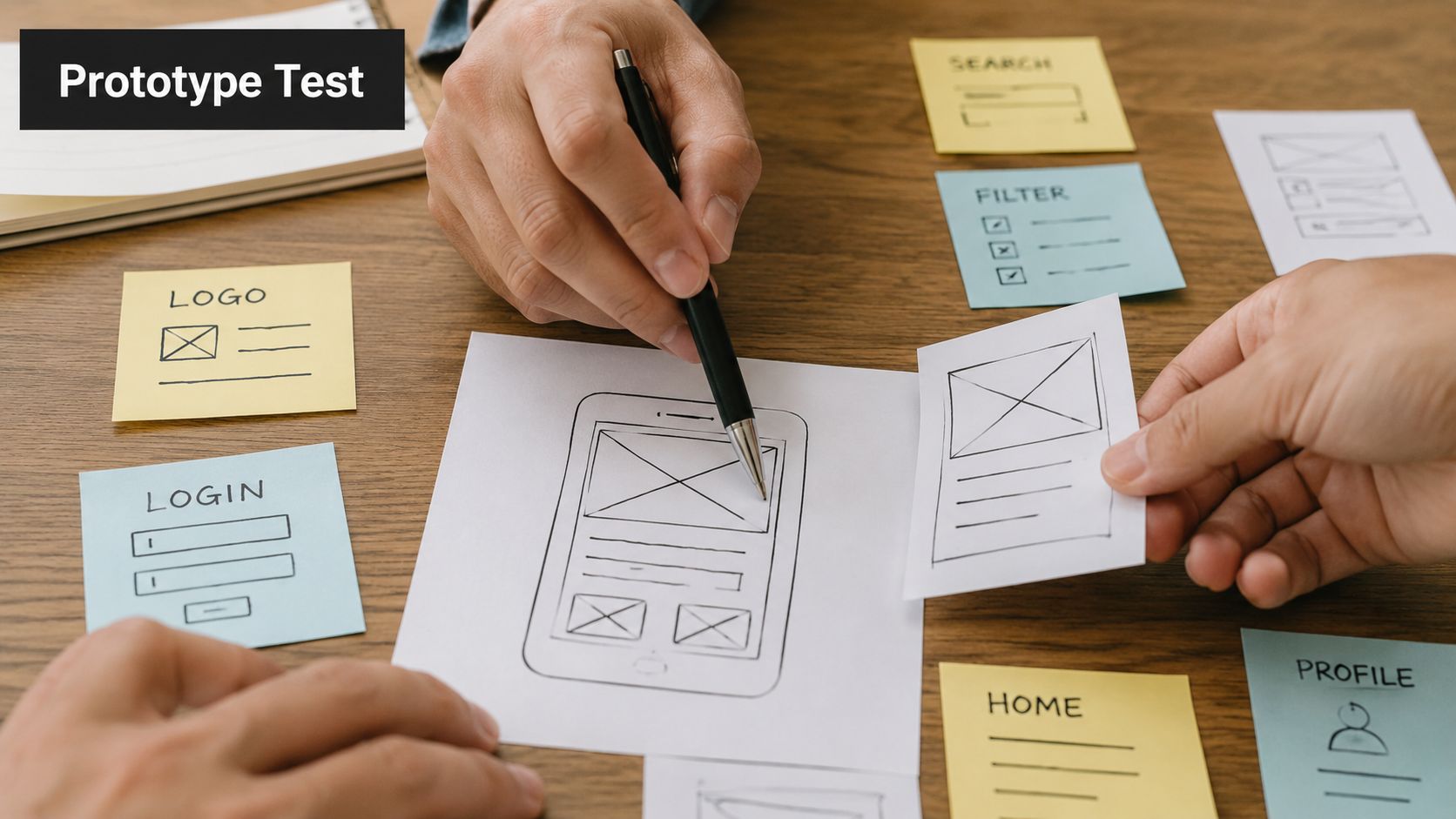
Some clients can't articulate what they want until they can react to something concrete. That's where prototypes earn their keep. A wireframe, sample dashboard, content outline, or draft automation flow gives the client something to approve, reject, or refine.
This is especially useful when the client uses broad language like “modern,” “simple,” or “more premium.” Those words aren't requirements. They're placeholders. Prototypes turn placeholders into decisions.
Keep prototypes cheap and disposable
A prototype should be fast enough to change. If you spend too long polishing it, both you and the client become emotionally attached to a draft that was only meant to test direction.
Good prototype practice looks like this:
- Use low-fidelity first: Figma wireframes, Notion outlines, or sample flows are enough.
- Test one big question at a time: Layout, workflow, messaging, or content structure.
- Observe reaction, not just comments: Where the client hesitates often matters more than what they say first.
- Document decisions immediately: Approved elements should move into the scope doc right away.
This method also supports requirement validation. Validation is the mandatory final stage where stakeholders confirm that documented and prioritized requirements meet their needs, as explained in Modern Requirements' guidance on requirements gathering techniques. Prototypes make that validation easier because people can assess something visible instead of debating abstractions.
For freelancers, prototypes also sell the engagement. A thoughtful sample can show seniority fast, as long as you don't slip into doing unpaid production work before the contract is defined.
10. Document Analysis and Requirements Mining
Many projects already contain the requirements. They're just scattered across briefs, contracts, old proposals, kickoff notes, support tickets, Slack threads, and email chains. Document analysis is the discipline of extracting those requirements before they turn into missed assumptions.
This method is ideal when a client says, “We've talked about this internally for months.” That usually means the answers exist somewhere, but no one has consolidated them. Small teams can create a real advantage here because they often move faster than larger vendors at turning messy documentation into a usable scope.
What to mine from existing documents
Look for repeated requests, approval patterns, recurring objections, and contradictions between documents. A proposal might promise one thing while the contract limits something else. An email thread might reveal a hidden stakeholder. A support log might expose edge cases nobody mentioned in kickoff.
It also helps to start where the process should start. Identifying and engaging all stakeholders first is a foundational step in requirement gathering, as described in Spec Innovations' overview of methods to gather requirements. Document analysis often tells you who those stakeholders are.
Another reason this method matters is project risk. The 2004 CHAOS Report found that only 34% of software projects met all original requirements, and poor requirement elicitation made projects three times more likely to fail, with global losses estimated above $100 billion annually, as summarized in this requirement gathering methods reference. That's old data, but the lesson still holds. Sloppy intake is expensive.
If a client has a large paper trail, read it before you ask them to repeat it in another meeting.
Document analysis won't replace live conversation. It makes those conversations sharper. You walk in already aware of gaps, contradictions, and unstated assumptions, which is exactly where the best questions come from.
Turn Requirements into Revenue
Choosing the right requirement gathering methods changes more than project documentation. It changes who you work with, how you scope, how often scope expands, and how much confidence the client has in your process. For freelancers and agencies on Upwork, that isn't a side benefit. It's part of sales.
The best practitioners don't use one method every time. They combine them based on the job. A one-off website refresh might only need an interview, a short document review, and a prototype. A larger internal tool might need workshops, observation, analytics, and a validation round before the work is safely scoped. The method follows the risk.
Bad requirement gathering still wrecks projects. PMI reported in 2020 that inaccurate requirement gathering was the primary cause of project failure in 37% of surveyed organizations globally, based on research covering over 2,000 project managers across 15 major markets, according to Jama Software's summary of the PMI finding. If you've ever watched a decent project go sideways through changing expectations, you've seen that problem up close.
What works in practice is straightforward. Identify stakeholders early. Ask better questions than the brief invites. Validate assumptions before production starts. Capture non-functional constraints, not just visible features. Keep a record of what was agreed and what changed. None of that is glamorous, but it's the difference between a smooth project and a slow-motion rescue job.
For smaller teams, this is also how you gain advantage. Requirement gathering creates reusable patterns. You learn which client profiles give clear input, which industries hide complexity in compliance and approvals, and which project structures consistently create margin pressure. Over time, your discovery process becomes a filter. You stop chasing every available job and start pursuing the jobs that fit your strengths.
That's where automation becomes useful. Earlybird AI learns from your successful projects, especially the ones with clear requirements, strong client fit, and healthy outcomes, then helps find and bid on similar opportunities on Upwork. Instead of spending your time digging through low-fit postings, you can put more energy into the part that improves results. Discovery, qualification, and delivery.
Better requirement gathering methods don't just prevent chaos. They help you win better projects, define them more clearly, and deliver work that leads to repeat business. Done consistently, that turns process discipline into revenue.
If you want an always-on system that helps you find better-fit Upwork opportunities, draft personalized proposals fast, reply to clients quickly, and learn from the projects you want more of, Earlybird AI is built for that workflow. It gives freelancers and agencies more time to qualify, scope, and deliver strong projects instead of manually chasing every lead.