
← Back To Blog
AI for Revenue Operations: An Agency's Guide to Growth
Most agencies on Upwork don't have a lead generation problem. They have a workflow problem.
The day usually looks the same. Someone checks the job feed between client calls. Another person saves a few posts to revisit later. Proposals go out in bursts, usually after the best jobs have already attracted a pile of competitors. Follow-ups happen when someone remembers. Message replies sit too long because delivery work comes first. Then the team wonders why revenue feels inconsistent even when the service is strong.
That cycle burns time and hides the bottleneck. You aren't losing only on proposal quality. You're losing on speed, consistency, and handoff discipline. Large sales teams solve that with revenue operations. Small agencies usually try to solve it with hustle.
That's where AI for Revenue Operations becomes useful. Not as enterprise jargon. Not as a dashboard project. As a practical operating system for finding the right work, responding faster, and keeping your pipeline moving while you're busy doing client work.
For solo freelancers and small agencies, that shift matters even more than it does for bigger firms. You don't need another tool that creates more admin. You need a setup that reduces manual bidding, shortens response time, and keeps opportunities from slipping through the cracks.
Introduction From Manual Grind to Automated Growth
A small agency owner I know had a familiar problem. The team did strong delivery work, clients stayed, referrals came in occasionally, but new business still depended on someone manually checking Upwork several times a day. If that person got pulled into meetings, proposals slowed down. If they got tired later in the day, follow-ups disappeared. Revenue looked lumpy because the pipeline was lumpy.
That's the trap. Most freelancers and agencies think they're running sales when they're really just reacting to incoming listings. Search, read, decide, write, send, repeat. It feels productive because you're always doing something. It doesn't scale because every step depends on human attention.
The better model is operational. Treat your client acquisition like a system, not a side task. That means defining what a good lead looks like, routing work quickly, responding while intent is high, and tracking where deals stall.
The agencies that win consistently on marketplaces usually aren't writing dramatically better proposals. They're responding faster, filtering better, and following through more reliably.
AI changes the equation because it can handle the repetitive parts without dropping the ball. It can watch for the right jobs, structure first drafts, keep outreach moving, and surface signals you'd miss in a busy week. For a lean team, that's the difference between chasing work and building a repeatable sales engine.
What Is AI for Revenue Operations for an Agency
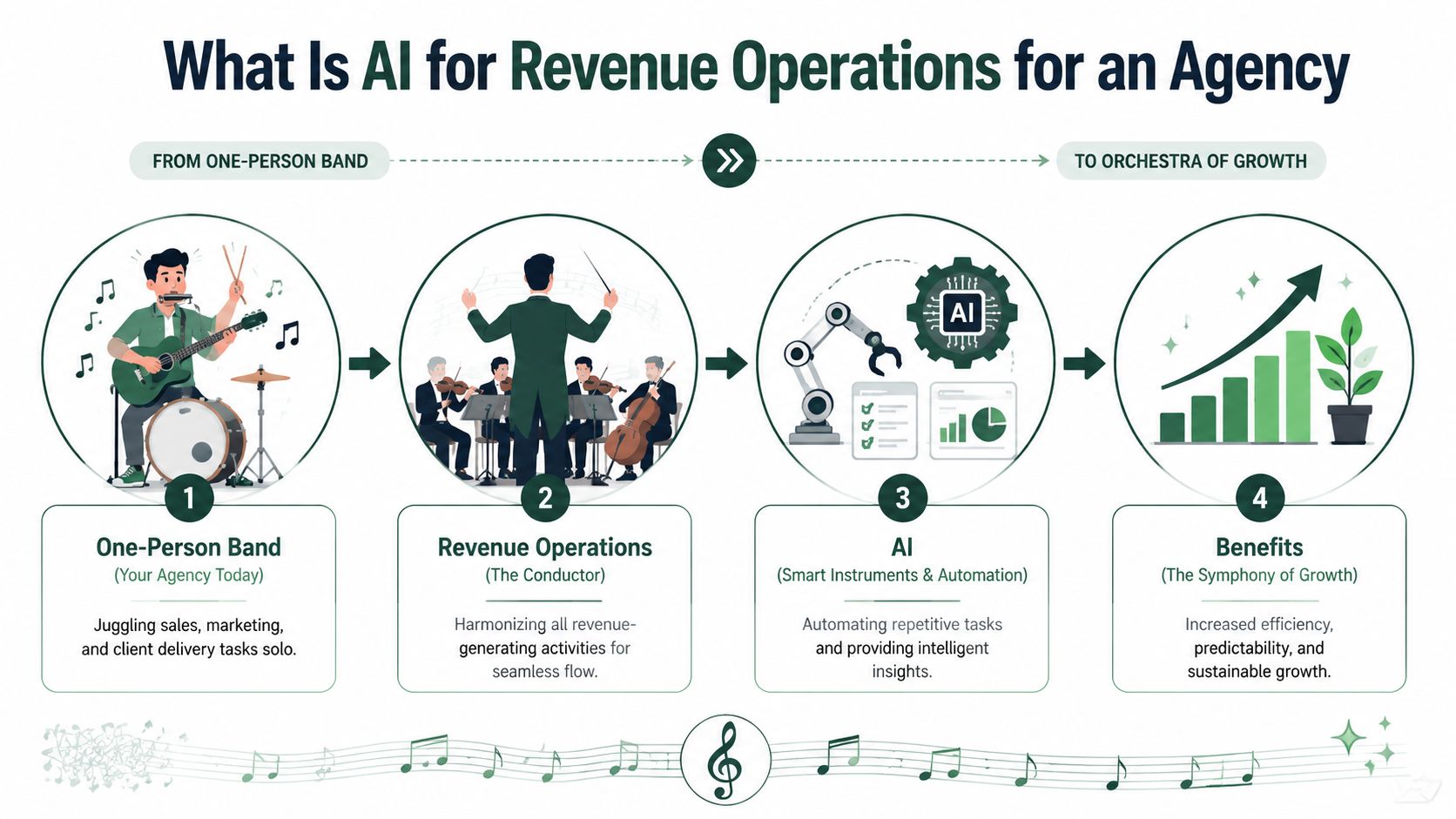
For a small agency, revenue operations isn't a department. It's the discipline of making sales, marketing, client communication, and handoffs work together so revenue doesn't depend on memory or luck.
A lot of small teams operate like a one-person band. One person finds jobs, another writes proposals, someone else jumps in when a client replies, and delivery starts with half the context missing. Work gets done, but the motion is noisy. RevOps fixes that by making each step feed the next one.
The agency version of RevOps
In practice, RevOps for an agency means a few simple things:
- Lead selection is consistent. You know which jobs fit your pricing, niche, and delivery model.
- Proposal work follows a process. Good opportunities don't sit untouched because the team is busy.
- Replies move fast. Prospects get answers before they lose interest or hire someone else.
- Data feeds decisions. You can tell whether the problem is targeting, positioning, proposal quality, or follow-up discipline.
AI sits on top of that process as the execution layer. It doesn't replace judgment. It handles the repetitive work that usually prevents good judgment from being applied consistently.
Why this matters now
The broader category is no longer niche. The RevOps market was estimated at USD 4.39 billion in 2024 and is projected to reach USD 16.98 billion by 2033, implying a 16.6% CAGR, with North America as the largest market in 2024 and Asia Pacific as the fastest-growing region, according to Grand View Research's RevOps market analysis. For small agencies, that matters because the tools and operating models once reserved for larger sales teams are becoming standard infrastructure.
That doesn't mean you need an enterprise stack. It means the principle has become clear. Agencies grow faster when revenue work is coordinated instead of improvised.
What AI is actually doing
When people hear AI for revenue operations, they often think of forecasting dashboards. That's too narrow for a marketplace-based agency.
The useful version looks more like this:
- Screening incoming opportunities against your ideal client profile
- Drafting individualized responses from structured knowledge about your offers
- Keeping communication active after the first touch
- Flagging patterns in what gets replies and what gets ignored
Practical rule: If AI only produces suggestions but doesn't help move the next step forward, it won't change your revenue rhythm.
The goal isn't to sound advanced. The goal is to create a quieter, more reliable funnel. Fewer missed jobs. Faster proposal output. Better handoffs. More time spent on calls and delivery instead of repetitive admin.
Concrete AI Use Cases on Platforms Like Upwork
On Upwork, the sales cycle is compressed. Good jobs get attention quickly, and slow teams lose before quality even enters the conversation. That makes AI especially useful in the parts of the workflow where speed and consistency matter most.

Lead sourcing that gets sharper over time
Manual lead sourcing breaks down in two ways. First, people miss good jobs because they aren't watching constantly. Second, they waste time reading poor-fit jobs that were never worth bidding on.
AI is useful here because it can apply the same filters every time. Not just category filters, but pattern filters. Budget language, urgency signals, scope clarity, niche fit, client history, and the types of problems your agency solves well. Over time, that creates a cleaner opportunity queue than a team can maintain by hand.
For freelancers, that means fewer random bids. For agencies, it means your bidders stop acting like separate operators with different standards.
Proposal drafting that still sounds specific
Many teams approach this with skepticism, and fairly so. Generic proposal spam is easy to spot.
The right use case isn't "write everything automatically and hope for the best." It's using AI to assemble the raw material fast, then shaping it around the client's actual need. A strong system pulls from your case examples, niche language, service boundaries, and proof points, then tailors the structure to the listing.
That's the same basic idea covered in this guide to automating Upwork proposals. The practical win isn't just speed. It's maintaining relevance at scale without forcing a human to start from a blank page every time.
Fast response changes the game
BCG notes that companies have cut RFP turnaround times by up to 20% when applying agentic AI to deal-execution workflows, in its analysis of AI in RevOps execution workflows. On Upwork, the direct translation is simple. Faster proposal execution helps you enter the conversation while a project is still fresh and before competition thickens.
That doesn't guarantee a win. It does improve your position. Clients often review early candidates first, and early momentum affects the rest of the thread.
Message handling and follow-up discipline
Most agencies focus too much on the first proposal and not enough on the conversation that follows. That's a mistake.
Once a prospect replies, speed matters again. So does continuity. AI can help classify the message, suggest the next action, surface prior context, and keep follow-ups from disappearing when the team gets busy. That removes one of the most common leaks in a small agency pipeline: good leads that die in the gap between interest and scheduled call.
If your inbox is where opportunities go to stall, your sales problem isn't top-of-funnel. It's operational follow-through.
Analytics that point to the real issue
The final use case is diagnosis. Teams often assume they need "better proposals" when the actual problem is poor targeting or slow response. AI-supported analytics can help isolate where the funnel is weak.
Look for patterns like:
- Reply quality by job type. Some categories may generate conversation but low close intent.
- Proposal timing. Jobs approached earlier may convert differently than jobs approached later.
- Client-fit signals. Certain posting behaviors may correlate with smoother sales conversations.
- Handoff friction. Some replies may die because information isn't carried cleanly from bidder to closer.
Used well, AI doesn't just help you do more outreach. It helps you stop doing the wrong outreach.
Calculating the ROI of Automated Revenue Operations
Most agency owners evaluate automation the wrong way. They ask whether it saves time. That matters, but it's not the main financial question.
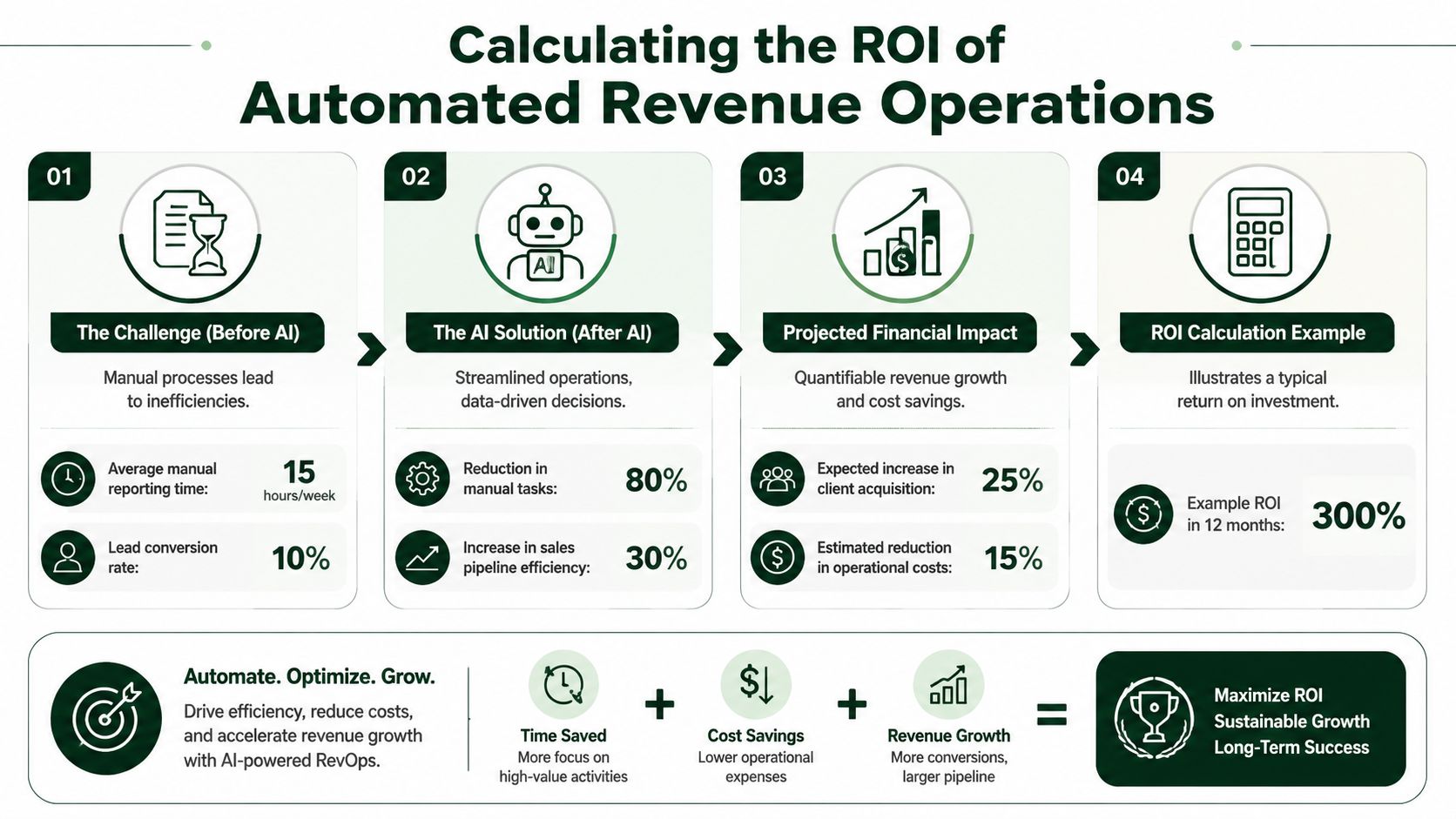
The better question is this: what does manual revenue work cost you in lost opportunities, delayed follow-up, and inconsistent throughput?
ROI starts with replacement value
If one person on your team spends a meaningful part of the week searching, drafting, sending, and following up, that labor has a replacement value. Even if you don't hire a full-time SDR, you're still paying for the work through founder time, account manager time, or a freelancer handling bids.
The first return from AI RevOps is workload transfer. The tool takes over repetitive work, and your team moves to tasks humans handle better: qualification calls, objection handling, pricing discussions, and delivery.
A broader business case exists beyond small agencies. A 2025 MIT Sloan study found that companies with extensive AI adoption experienced a 9.5% increase in sales growth over five years, and Tech Mahindra reported a 27% increase in revenue per advertiser for a client after applying generative AI in a RevOps context, as summarized in Inventive AI's review of AI tools for revenue operations. Those are not Upwork-specific numbers, but they reinforce the core point. Revenue operations automation can affect both growth and execution quality.
For agency owners trying to frame the investment, this overview of what sales automation means in practice is useful because it shifts the lens from software cost to workflow economics.
Opportunity cost is usually bigger
A missed proposal on a good-fit job has a cost. So does a reply sent too late. So does a lead that goes cold because nobody followed up.
Most small teams underestimate this because missed opportunities don't show up in the P&L. They show up as empty calendar slots next month. That's why the strongest ROI often comes from recovering deals that would have died in the gaps.
Here's the way I look at it:
- If your proposal volume is low, automation increases coverage.
- If your response times are slow, automation protects intent while it's still active.
- If your follow-up is inconsistent, automation prevents avoidable drop-off.
- If your team is overloaded, automation keeps the pipeline moving during delivery-heavy weeks.
This walkthrough adds useful context for anyone assessing the business case through a process lens.
What good ROI evaluation looks like
Don't reduce the decision to software price. Measure the impact in operational terms:
- Revenue continuity. Is the pipeline more stable from week to week?
- Sales capacity. Can the team pursue more qualified opportunities without adding headcount?
- Founder relief. Has the owner stopped being the fail-safe for every lead?
- Speed to conversation. Are prospects moving from posting to reply to call with less friction?
A tool pays for itself when it reliably moves one of those levers in a way your team can feel in the pipeline, not just in a timesheet.
Your Implementation Roadmap Data Tooling and Workflows
Most AI RevOps projects fail for a simple reason. Teams buy automation before they define the operating logic behind it.
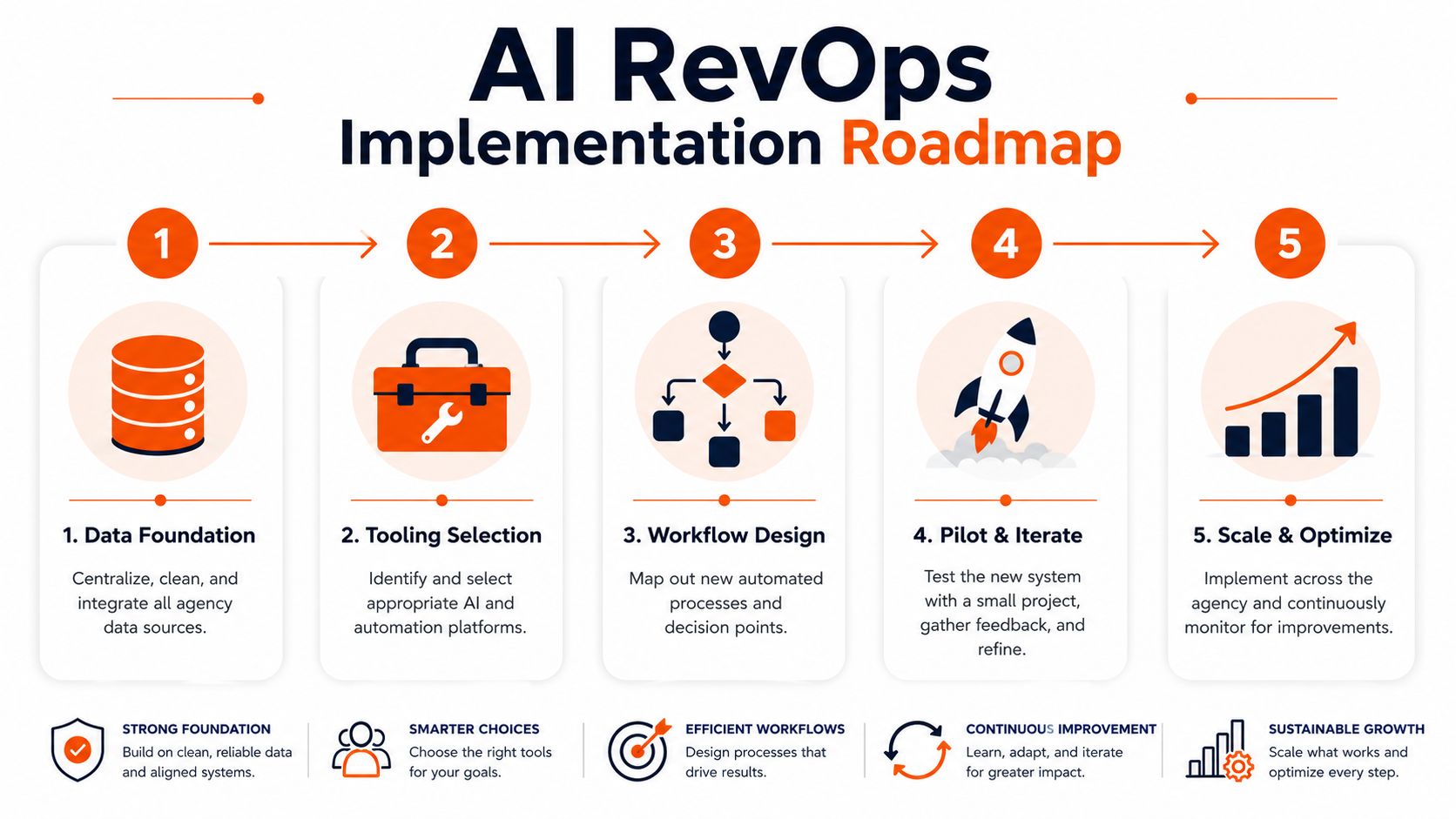
If you want AI for revenue operations to work in a small agency, build it in sequence. Start with judgment, then systems, then automation. Not the other way around.
Step one define what good looks like
Before any tool touches your workflow, document your ideal project profile.
That means more than niche and budget. Include signals like scope clarity, expected timeline, communication style, red flags, preferred industries, and which projects usually become long-term retainers. If your team can't explain why one job is worth pursuing and another isn't, the automation won't be smart. It will just be fast.
A practical way to start is with binary feedback. Good fit or bad fit. Strong lead or weak lead. Useful pattern or noise. Over time, this gives the system the operating context it needs.
Step two choose tools that can see and act
A lot of teams stack disconnected tools and call it automation. One app watches leads. Another drafts text. Another logs activity. None of them carry context well, and the team ends up doing the glue work manually.
Celigo's discussion of AI agents and RevOps makes the core point clearly. AI value in RevOps depends on unified workflow and telemetry layers. In plain language, the system needs enough connected context to spot an opportunity and help execute the next action in a closed loop.
For agencies, that means your setup should do three things:
- Capture signals across the pipeline. Job fit, proposal activity, message replies, and handoff status should not live in separate silos.
- Normalize the data. The same types of opportunities should be tagged and evaluated consistently.
- Trigger actions from signals. Detection without execution creates more dashboards, not more revenue.
If you're also organizing client and pipeline data outside the marketplace itself, this roundup of the best CRM options for agencies helps clarify what should live in your core system versus what should remain in execution tools.
Step three design the workflow before you automate it
Map the actual flow from job posted to call booked.
Not the idealized version. The actual one. Who reviews fit? When does a draft get created? Who checks tone? What happens when a client asks a technical question? When does delivery get looped in? Where do leads sit too long?
Write those steps down and trim them. If a workflow has too many pauses or approvals, AI won't fix the bottleneck. It will hit the bottleneck faster.
Strong automation follows a clean process. Weak automation exposes a messy one.
Step four run a narrow pilot
Don't automate everything in week one. Pick a bounded use case with visible friction.
Good starting points include:
- Proposal triage for one service line
- First-draft generation for a specific niche
- Message response support during business hours
- Follow-up automation after initial client reply
Run the pilot long enough to see patterns. You'll learn quickly where prompts are weak, where handoffs break, and where human review still matters.
Step five track the right KPIs
Many agencies track proposal count because it's easy. That metric doesn't tell you much by itself.
Track movement through the funnel instead:
- Reply rate
- Call-booked rate
- Time from posting to proposal
- Time from first reply to scheduled conversation
- Close patterns by project type
- Reasons deals stall or disappear
These metrics help you separate volume from effectiveness. A smaller number of tightly matched proposals can outperform broad outreach if the workflow is sharp and response times are strong.
What usually doesn't work
The failures are predictable.
Some teams automate generic outreach without refining targeting. Others install point tools that don't share context. Many skip process design and assume the software will create discipline for them. It won't.
For lean agencies, the winning path is usually simpler than expected:
- Define fit clearly.
- Connect the workflow.
- Automate repetitive execution.
- Review outcomes weekly.
- Tighten the system continuously.
That's enough to build a real revenue engine without turning your agency into a software project.
Navigating Risks Compliance and Change Management
The two biggest objections to AI in RevOps are valid. First, people worry about account safety and platform compliance. Second, they worry that automation will make outreach feel robotic.
Both concerns matter. Neither is a reason to stay manual.
Compliance starts with tool behavior
If a platform-based sales motion is part of your business, compliance has to be part of tool selection. That means looking closely at how the tool operates, how it handles account access, and whether its automation patterns resemble normal user behavior.
A flashy feature list doesn't matter if the underlying setup creates avoidable risk. For small agencies, this is essential. One compromised account or one bad automation habit can disrupt the whole pipeline.
The practical test is simple. Choose systems built for the platform you're using, not generic automation layers forced onto a marketplace workflow.
Personalization still needs standards
Bad AI output usually isn't an AI problem. It's an input problem or a review problem.
If your offer is vague, your positioning is weak, and your examples are generic, the automation will reproduce that weakness at scale. If your source material is sharp, AI can help you respond faster without sounding templated.
Use guardrails:
- Define approved offer language
- Set rules for tone and scope
- Maintain reusable proof points
- Review edge-case proposals manually
That keeps the system useful while protecting quality.
Lean teams get the fastest win when they automate tasks that remove manual coordination work, not when they chase the most sophisticated-sounding AI feature.
That pattern lines up with Dust's take on AI agents in revenue operations, which argues that the best first use case for smaller teams is often the one that removes the most manual work.
Change management for a small team
The internal shift matters too. When agencies adopt AI for revenue operations, people often assume they're replacing judgment. The better framing is role elevation.
Your team should spend less time hunting, copying, formatting, and reminding. They should spend more time qualifying demand, running calls, tightening positioning, and improving close rates.
If you're leading the change, set expectations early:
- Automation owns repetitive execution
- Humans own strategy and exceptions
- Weekly review beats constant micromanagement
- Feedback improves the system faster than opinions do
That approach keeps the team focused on better decisions instead of defending old habits.
Conclusion Your Future as a Scalable Agency
Small agencies don't need enterprise bureaucracy. They do need operational discipline.
That's why AI for revenue operations matters. It takes the parts of business development that break under pressure, lead screening, proposal drafting, response speed, follow-up consistency, and turns them into a system your team can rely on. The result isn't just less admin. It's a more stable pipeline and a cleaner path from opportunity to signed client.
The agencies that scale on Upwork and similar platforms usually make one important shift. They stop treating sales as a batch of manual tasks and start treating it as an engine that needs structure, feedback, and execution speed.
If you're still winning work through effort alone, you can probably keep going for a while. But effort-only growth is fragile. A stronger model is available now, and it's accessible to teams far smaller than the enterprise vendors usually talk about.
The upside is simple. More proposals sent on time. More conversations started while buyer intent is high. Less founder involvement in repetitive sales work. More room to focus on delivery and growth.
If you want that kind of always-on pipeline without building the system from scratch, Earlybird AI is built for exactly this workflow on Upwork. It helps freelancers and agencies find the right jobs, generate personalized proposals, reply quickly, and keep follow-ups moving so your team can spend less time grinding through outreach and more time closing and delivering great work.