
← Back To Blog
Master Target Market Segmentation for Upwork Success
You log into Upwork, search your category, open a promising job, and see the same pattern again. Thin brief. Low budget. Dozens of proposals already in. You write something decent anyway, swap a few lines, hit send, and move to the next one.
After enough rounds, the work starts to feel less like business development and more like slot-machine pulling. You're reacting to whatever appears in the feed. You're competing on speed when you should be competing on fit. And because the work is generic, your proposal becomes generic too.
That's where target market segmentation changes the game.
Done right, it stops you from chasing “clients” as one giant category. It forces you to separate rushed founders from procurement-heavy teams, repeat hirers from first-timers, clear briefs from chaotic ones, and strategic buyers from bargain hunters. That's the difference between sending more proposals and sending proposals that belong in that client's inbox.
The payoff for relevance isn't theoretical. Segmented campaigns can generate a 760% increase in revenue compared to non-segmented ones, according to Campaign Monitor's summary of the benchmark. On Upwork, the same principle applies. Targeted outreach beats volume when the platform rewards fit, timing, and trust.
Moving Beyond the Upwork Grind
The freelancers who stay stuck on Upwork usually aren't less skilled. They're just operating with a weak filtering system.
A common pattern looks like this: a web agency applies to ecommerce builds, SaaS landing pages, B2B redesigns, healthcare content work, and random “urgent” fixes in the same afternoon. The service might be related, but the buyers aren't. Their expectations, review habits, speed of decision-making, and willingness to pay all differ. When those jobs get treated as interchangeable, proposal quality drops.
What the grind actually costs
The obvious cost is time. The less obvious cost is positioning.
If your proposal process starts with “Can we win this?” instead of “Should we even target this client type?”, you end up shaping your whole pipeline around noise. That usually leads to three bad outcomes:
- Low-value conversations that drain attention but rarely become stable accounts
- Weak messaging because one pitch tries to speak to too many buyer types
- Unpredictable workload because random wins don't create a repeatable niche
Practical rule: If your proposal template can fit almost every Upwork posting in your category, it's probably too broad to convert the clients you actually want.
Segmentation fixes that by narrowing your field before you write a word. Instead of “I help businesses with content” or “we build websites,” you start with a defined slice of the market. Maybe it's funded SaaS teams hiring for ongoing SEO content. Maybe it's service firms replacing an outdated WordPress site. Maybe it's ecommerce brands that have hired before and post detailed scopes.
The shift from reactive to selective
Once you segment the market, Upwork stops looking like a chaotic list of jobs and starts behaving like a series of micro-markets. Each one has its own signals.
That shift matters because good client hunting isn't about being visible everywhere. It's about being highly relevant in the places where your service, proof, and process line up naturally. The strongest agencies on Upwork don't just write better proposals. They reject more jobs, faster.
And that's how you leave the grind. Not by working harder inside the same messy system, but by replacing randomness with a selection model.
The Four Pillars of Market Segmentation
The cleanest way to understand target market segmentation is through four lenses. Effective segmentation uses four distinct types: demographic, geographic, psychographic, and behavioral, as outlined by Lotame's explanation of the four segmentation types.
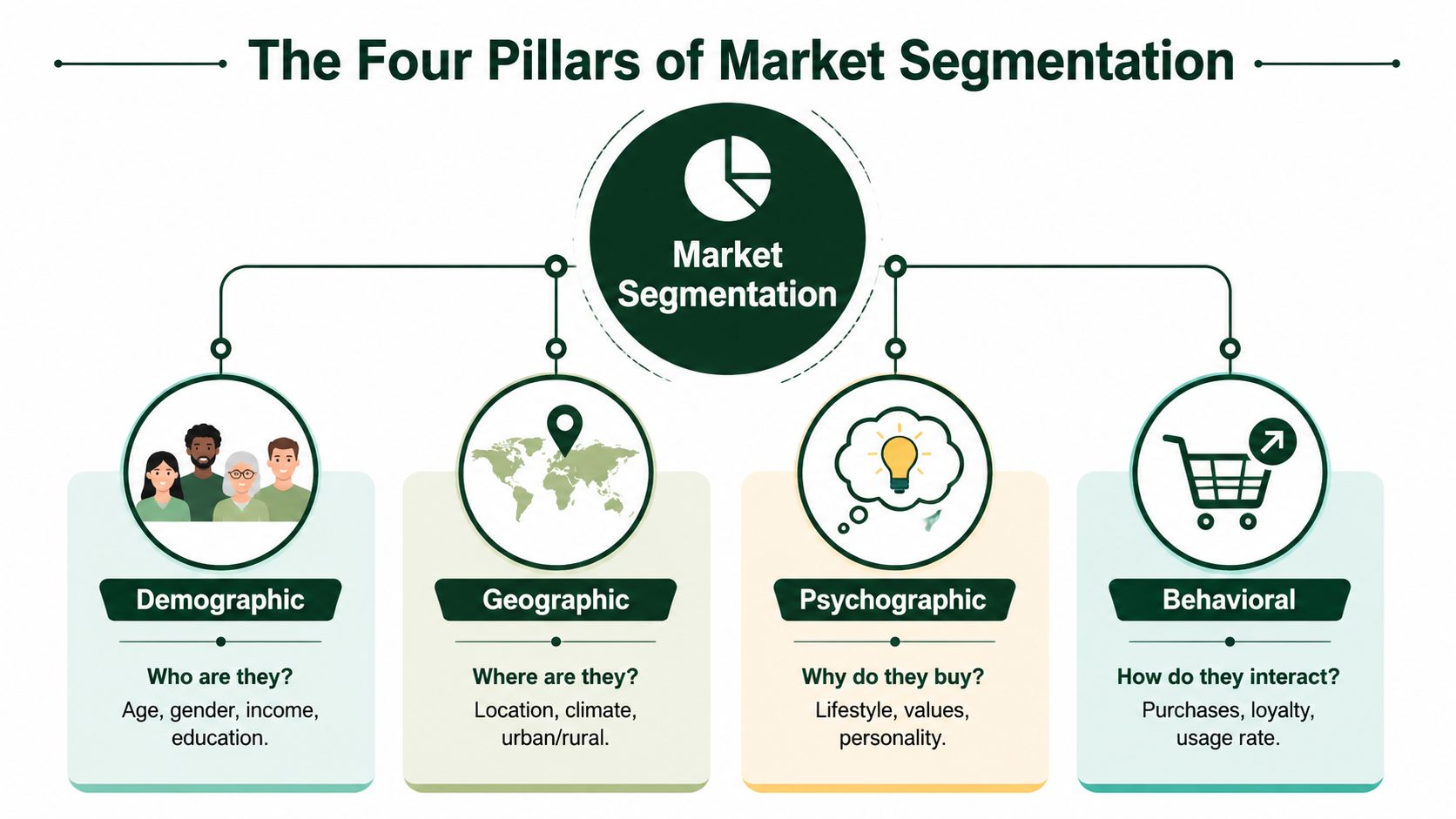
On Upwork, these pillars don't look exactly like textbook examples. They show up through client profiles, hiring patterns, job post language, and the way buyers behave once they engage.
Demographic and geographic signals
In consumer marketing, demographic data often means age or income. On Upwork, it's more useful to think in business terms.
- Demographic clues often map to company type, team maturity, budget posture, or decision-maker role
- Geographic clues show where the client operates, what market they sell into, and sometimes what timezone or communication rhythm they expect
- Combined use helps you spot practical constraints, like whether a client needs overlap hours, native-market nuance, or local industry familiarity
A founder hiring alone behaves differently from a marketing manager inside a larger team. A US-based legal client usually expects a different tone than a fast-moving startup in another region. Geography isn't just location. It often hints at compliance pressure, language preferences, and what “professional” looks like to that buyer.
Psychographic and behavioral signals
Most Upwork sellers commonly miss the mark. They look at what the client is, but not how the client thinks.
Psychographic segmentation gets at motivation. Is the client risk-averse? Speed-obsessed? Brand-sensitive? Are they trying to impress a board, launch before a deadline, or clean up after a bad freelancer experience? You won't find that in a dropdown field. You infer it from wording, urgency, project framing, and the kind of proof they ask for.
Behavioral segmentation is even more useful on a marketplace.
- Hiring frequency tells you whether they're building through freelancers or just testing the platform
- Feedback history reveals if they manage contractors well or create friction
- Proposal style cues show whether they reward customized thinking or simple price shopping
- Response habits hint at how organized they are once a conversation starts
A client's brief tells you what they say they need. Their history tells you how they actually buy.
The best segmentation work combines all four pillars, but not equally. On Upwork, demographic and geographic clues help you filter. Psychographic and behavioral clues help you win.
Defining Your Ideal Client on Upwork
The most useful move in Upwork prospecting is to stop reading job posts as isolated opportunities. Read them as evidence about the business behind the post.
That's where the STP model becomes practical. The modern framework shifted marketing from mass messaging to a more disciplined system, and in B2B settings it adds firmographics to the picture. As this STP overview explains, a viable target market is defined through factors like size, growth, and compatibility. On Upwork, that means asking whether this client type matches the kind of work you want to deliver repeatedly, not just whether the current project looks acceptable.
Read the business, not just the brief
A “need a copywriter for landing page” post can come from completely different buyers:
- An early-stage founder who needs speed, loose collaboration, and someone who can shape strategy
- A marketing lead who already knows the funnel and wants execution without hand-holding
- An agency account manager who needs a dependable subcontractor and clean communication
- An enterprise team that values process, documentation, approvals, and low operational risk
Same service. Different client segments.
That distinction changes how you respond. A founder may care about momentum and flexible thinking. A mature team may care more about reliability, revision structure, and stakeholder alignment. If your proposal treats those buyers the same, you erase your own advantage.
Where firmographic clues appear on Upwork
You won't get a polished company profile every time, but the signals are there if you know where to look:
- Job post wording can suggest internal maturity. Tight scope often means experienced buying. Vague urgency often means uncertainty.
- Hiring history can reveal whether the client works with freelancers regularly.
- Role framing can suggest team structure. “Report to Head of Growth” says something different from “Need someone to help my business.”
- Project stack can hint at industry and operating model. References to HubSpot, Shopify, Figma, compliance docs, or sprint cycles are useful clues.
Your own profile has to support this filtering. If your Upwork presence still tries to speak to everyone, the segmenting work breaks down before outreach starts. Tightening your positioning through a focused Upwork profile optimization process makes the right clients easier to convert because your profile confirms the story your proposal starts.
A simple compatibility screen
Before applying, run each prospect through a short screen:
Business fit
Is this the kind of company you want more of, or just a job you could technically do?Working style fit
Does the brief suggest clarity, respect for specialists, and realistic expectations?Proof fit
Can you show relevant examples without stretching the connection?Retention fit
If this project goes well, is there a realistic path to repeat work?
If a post fails most of that screen, skip it. Segmentation only works when it leads to exclusion.
How to Create and Validate Your Segments
Most freelancers build segments backwards. They start with a niche label, then try to force every lead into it. Better segmentation starts with evidence from your own work.
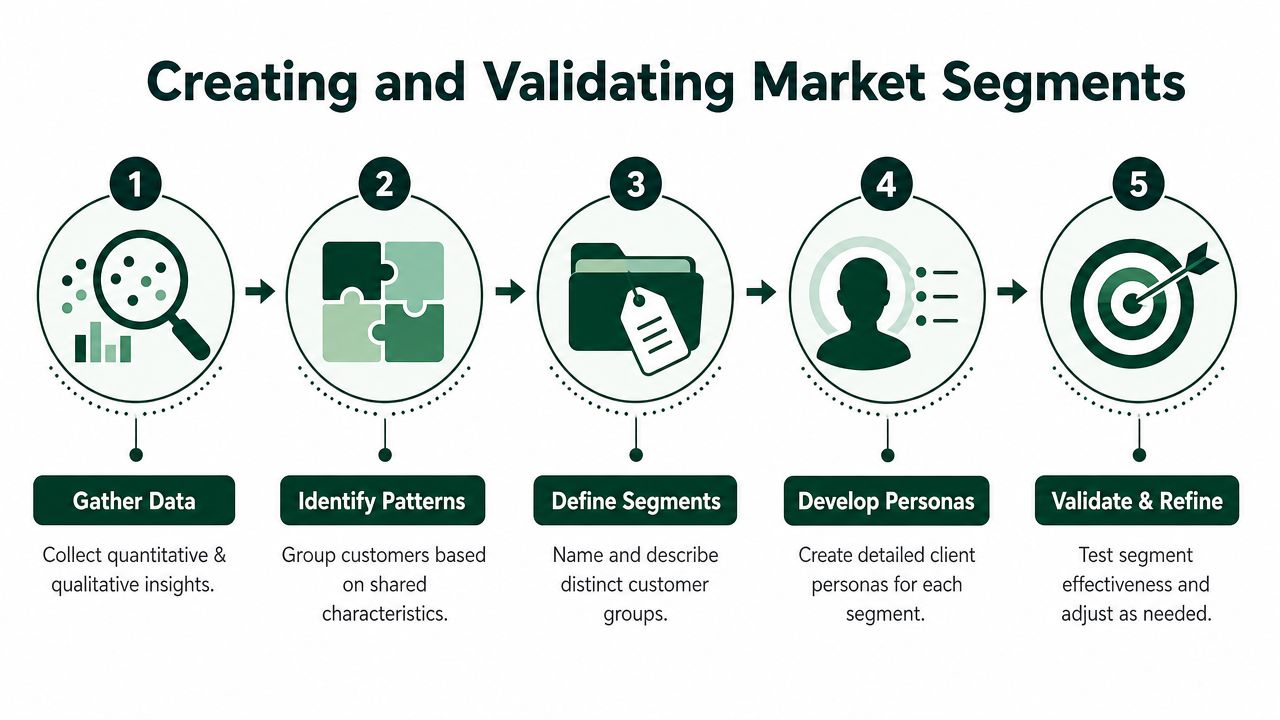
A reliable model combines numbers with actual client language. Effective segments are built on a mix of quantitative and qualitative insights, with the strongest strategies prioritizing primary data from your own client interactions, as described in SurveyMonkey's market segmentation guide.
Start with your own deal history
Look at the projects that felt commercially strong, not just creatively satisfying. That usually means clients who paid fairly, communicated well, and created second-order value through repeat work, referrals, or cleaner delivery.
Review your recent work and note patterns like:
- Client type such as SaaS, ecommerce, agencies, coaches, local service firms
- Buyer role such as founder, marketing manager, operations lead
- Project shape such as one-off sprint, retainer, audit, rebuild, production support
- Buying signals such as detailed brief, fast replies, realistic deadlines, clear success criteria
Then add the qualitative layer. Pull phrases from kickoff calls, proposal replies, chat threads, and five-star feedback. That language tells you what the client valued. Sometimes it was speed. Sometimes strategic thinking. Sometimes “you made this easy.”
Here's a useful walkthrough before you formalize anything:
Turn observations into segment hypotheses
Once you see patterns, name them as hypotheses, not truths.
For example:
- Growth-stage SaaS content teams
- Founder-led service businesses needing conversion-focused websites
- Agencies looking for white-label production support
- Repeat Upwork buyers who value process over the cheapest rate
That wording matters. A segment should describe a cluster with shared needs and shared buying behavior. It shouldn't just describe an industry.
Field note: If you can't explain why a group buys, not just what group they belong to, the segment is too thin to guide outreach.
Validate before you scale
Many agencies often skip the hard part. They create nice personas in a doc, then never test whether the segment behaves differently in practice.
Use small experiments instead:
Run a focused search window
Spend a set period applying only to one segment type.Change proposal language by segment
Lead with speed for urgency-driven buyers. Lead with process for risk-sensitive buyers.Track conversation quality
Don't judge only by replies. Look at whether the right buyers engage with the right framing.Refine your lead qualification rules
If a segment attracts too much noise, tighten the filter. This is the same discipline used in stronger sales lead qualification systems.
A segment is valid when it helps you make better decisions repeatedly. It should tell you who to pursue, what to say, what proof to show, and which jobs to ignore without regret.
Turning Segments into Actionable Client Personas
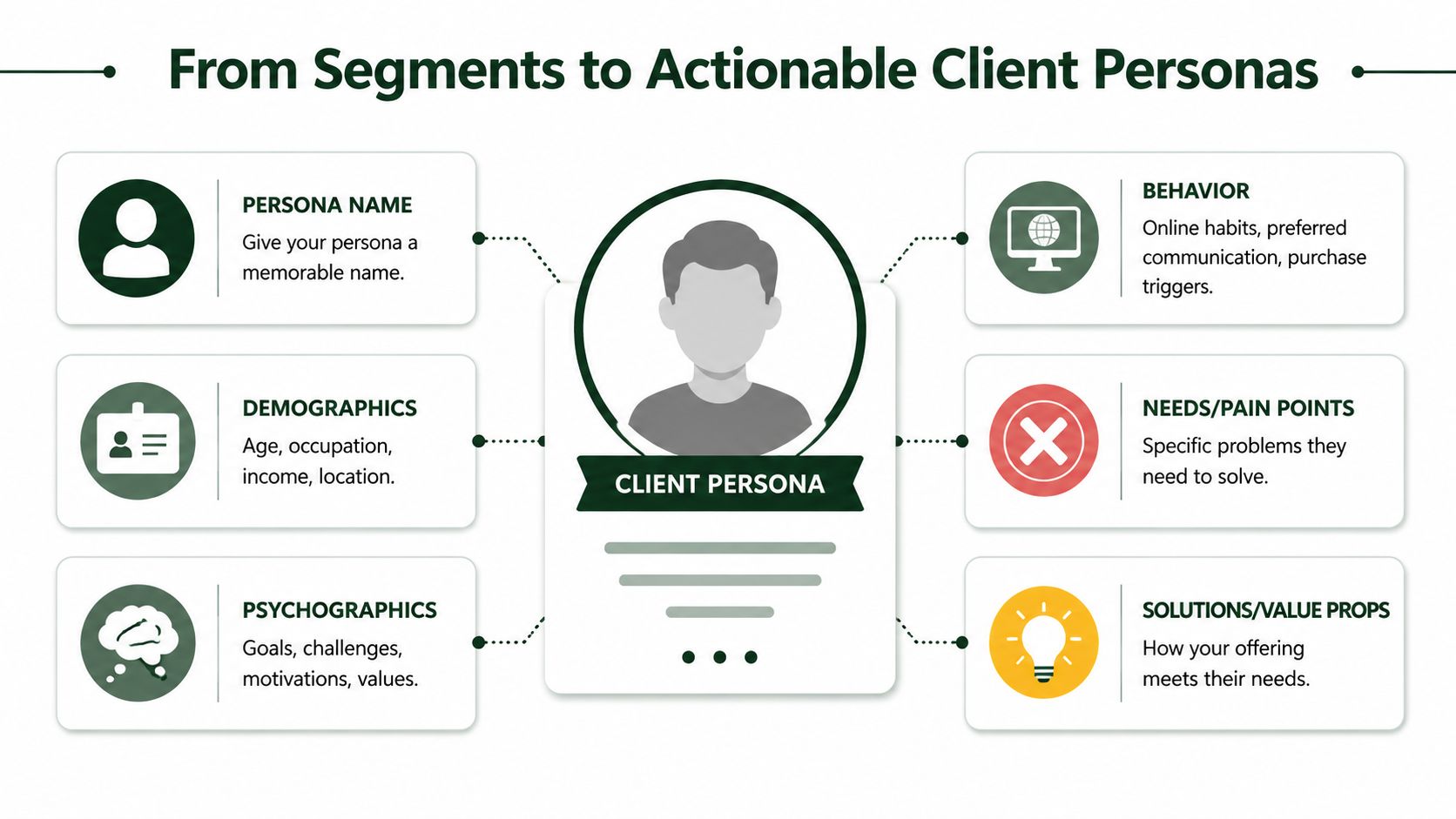
Segments help you sort the market. Personas help you write like you understand the buyer.
That distinction matters because many freelancers stop at labels. They say they target “SaaS founders” or “agencies,” but their proposal still reads like a generic service pitch. A working persona gives you a sharper lens. It turns a segment into someone with pressures, habits, and objections.
Two buyers who need very different proposals
Take a web or content agency on Upwork. Two clients may post similar jobs, but the winning pitch changes completely depending on the persona.
Startup Steve is founder-led, impatient, and trying to ship. He wants someone who can see gaps, move fast, and avoid bloated process. He doesn't want a long credential dump. He wants confidence, speed, and a clear next step.
Corporate Carla manages a team and has internal stakeholders. She isn't buying raw talent alone. She's buying reliability. She wants someone who can follow scope, communicate clearly, document progress, and reduce surprises.
Both might hire for SEO content, design, or development. But their real buying criteria aren't the same.
A practical persona template for Upwork
Build each persona with fields that directly affect outreach:
Role and team context
Who posts the job, and who else influences approval?Primary business goal
What outcome are they trying to create through this hire?Main pain on Upwork
Are they tired of poor communication, weak quality, slow execution, or unreliable freelancers?Decision style
Do they choose quickly, compare carefully, or escalate internally?Preferred communication tone
Brief and direct, consultative, highly structured, or collaborative?What a winning proposal looks like
Short and decisive, detail-heavy, proof-led, or process-led?
Good personas don't sound clever. They make proposal choices easier.
How the persona changes the pitch
For Startup Steve, your opening might focus on momentum. You'd point to similar fast-turnaround work, identify the likely bottleneck, and suggest a simple action plan.
For Corporate Carla, the same service might be framed around accountability. You'd show that you understand handoffs, review cycles, and stakeholder visibility. The proposal gets calmer, more structured, and less promotional.
That's the core value of personas. They don't just help with tone. They help you decide which proof to include, which risks to address first, and how much complexity the buyer wants to see.
Operationalizing Segments with Outreach Automation
Automation magnifies whatever logic you feed into it. If the logic is sloppy, you don't scale results. You scale mistakes.
That's why target market segmentation matters even more when outreach becomes automated. A manual bidder can sometimes compensate for bad filtering by using judgment on the fly. An automated system can't rely on instinct. It needs clear rules about which jobs fit, which buyer signals matter, and what kind of message belongs to each segment.

Broad automation creates noise
Many Upwork sellers get into trouble. They confuse targeting with segmentation and build systems that chase any posting containing a keyword. That creates irrelevant touches, weak proposals, and account-level risk because the behavior stops looking selective.
The failure pattern is documented beyond Upwork. A 2025 study found that 65% of failed automated outreach campaigns resulted from broad, low-specificity segments that produced irrelevant touches and violated platform safety norms, according to Circana's report on marketing automation.
The lesson is simple. Automation without high-fidelity segmentation isn't aggressive growth. It's low-quality activity.
What strong automation rules look like
A usable automated outreach system needs rules such as:
- Client fit rules that screen for the right industries, team types, or buyer patterns
- Exclusion rules that block low-signal postings, vague briefs, or poor-fit client histories
- Message rules that match proposal angle to segment-specific pain points
- Safety rules that keep activity selective and human-like rather than spraying generic outreach
That's why teams that want to automate Upwork proposals successfully need segmentation first. The segment becomes the brain behind the workflow. It tells the system when to act, when to skip, and what kind of relevance to deliver.
Automation works best when it behaves like your best human operator, not your most desperate salesperson.
Hyper-targeting beats volume
Upwork is not a broad ad network. It's a live marketplace with reputation signals, job context, timing pressure, and visible buyer history. That means the winning automation strategy isn't “apply to more.” It's “apply with much tighter relevance.”
The strongest setups treat each segment as its own bidding environment. One segment might need concise, high-speed proposals for founder-led buyers. Another might need more structured messaging for teams that care about process and handoff discipline. Once those differences are encoded, automation becomes useful instead of risky.
That's the key upgrade. Segmentation turns outreach from mechanical activity into selective execution.
From Freelancer to Strategic Business Owner
The jump from freelancer to operator usually starts with one decision. Stop treating the market as one giant pool of possible clients.
When you use target market segmentation properly, you stop bidding like a generalist and start building a pipeline like a business owner. You see distinct buyer groups inside Upwork. You define the ones that fit your strengths. You validate them against actual response and delivery quality. Then you turn those patterns into personas and outreach rules.
That changes more than your proposal copy. It changes what work enters your pipeline, how predictable your sales process feels, and how often you end up in conversations that were never a good fit in the first place.
Freelancers chase available work. Strategic owners build systems for winning the right work.
If you're serious about replacing manual proposal grinding with a cleaner, more scalable process, Earlybird AI helps turn your ideal client signals into automated Upwork outreach that stays personalized, selective, and easier to manage across a solo account or agency team.