← Back To Blog
Upwork Profile Optimization: A 2026 Playbook
A lot of freelancers hit the same wall on Upwork. They have solid skills, decent work samples, and rates that aren't wildly off. But their profile stays quiet, invites barely show up, and every new lead depends on manually chasing jobs.
That usually isn't a talent problem. It's a positioning problem.
Most underperforming profiles read like résumés. They list software, past roles, and broad capabilities, then hope clients will connect the dots. Clients don't. They scan fast, compare faster, and choose the profile that feels safest and most relevant in seconds. That's why upwork profile optimization matters so much. You're not polishing a bio. You're building a page that has to win attention, earn trust, and trigger action.
The strongest profiles aren't static either. They don't get rewritten once and left alone for a year. They get adjusted based on what attracts views, what earns invites, and what converts into calls and contracts. That's the difference between a profile that looks complete and one that consistently pulls work in.
Your Upwork Profile Is a Sales Tool Not a Resume
A résumé explains what you've done. An Upwork profile has to do something harder. It has to persuade a stranger to contact you before they've ever spoken to you.
That changes how every line should be written.
When I review weak profiles, the same pattern shows up. The freelancer says things like "motivated professional," "hardworking specialist," or "experienced in multiple areas." None of that helps a client make a hiring decision. It sounds fine. It sells nothing.
A sales profile does three things immediately:
- It identifies a buyer problem. Not your background. Their problem.
- It shows relevant fit. Not everything you can do. The part they need now.
- It reduces hiring risk. Clear offer, clear proof, clear next step.
What a resume style profile sounds like
A resume style overview usually opens with biography. It talks about years of experience, education, broad services, and personal work ethic. The client has to work hard to figure out whether you're right for their specific project.
That friction kills momentum.
A sales driven profile opens with relevance. If you build Shopify stores for skincare brands, say that. If you write SEO content for B2B SaaS teams, lead with that. If you manage paid search for local service businesses, make it obvious in the first lines.
Your profile isn't there to impress every buyer. It's there to feel like the obvious fit for the right one.
What changes when you treat it like a sales asset
Once you stop thinking like a job seeker, your decisions get sharper.
You stop listing random secondary skills that muddy your positioning. You stop opening with "Hi, my name is..." You stop uploading portfolio pieces that have nothing to do with the work you want next. And you stop assuming profile optimization is a one-time task.
Instead, you start asking better questions:
- What kind of client should instantly feel understood here?
- What part of my profile gets seen first, and does it create curiosity?
- What proof makes me easier to trust than the generic alternatives?
- What should I change if views come in but invites don't?
That's the playbook. Not decoration. Conversion.
Building Your Profile Foundation for Trust and Visibility
Before you tweak wording, tighten keywords, or test new positioning, you need the basics locked down. Profiles with shaky foundations don't perform consistently, even when the freelancer behind them is good.

The first pass is simple. Make the profile look complete, current, and trustworthy to both clients and the marketplace itself. The missing pieces are usually small, but they send a bad signal when they pile up.
Complete the profile like it matters, because it does
A half-finished profile tells clients one of two things. Either you don't pay attention to detail, or you aren't active enough to care.
Neither helps you get hired.
I treat profile completeness as a trust layer. That includes the sections many freelancers skip because they think clients won't scroll that far. Fill out your overview, employment history, education, skills, portfolio, certifications if relevant, testimonials if you have them, and any additional experience that supports your positioning.
A strong foundation usually looks like this:
- Photo is professional. Clear face, clean background, no distractions.
- Title is specific. It says what you do for a defined type of client or problem.
- Overview is client-facing. It explains outcomes and process, not autobiography.
- Skills are relevant. They support the niche you're trying to own.
- Portfolio is curated. It shows the work you want more of.
- Profile details are current. Old tools, old niches, and stale samples create doubt.
Protect your Job Success Score
This is the one metric I tell established freelancers to take seriously from day one. A 2026 analysis of 92 Upwork profiles found that Job Success Score was the dominant ranking factor, estimated at 25 to 30 percent weight, and that top-ranked profiles averaged JSS above 90 percent, while bottom-ranked profiles were below 70 percent.
That gap isn't cosmetic. It affects visibility.
If your JSS is already strong, protect it. Don't chase every contract. Take projects you can deliver well, manage expectations early, and avoid mismatched scope. A profile can be beautifully written and still struggle if the performance signals behind it are weak.
Practical rule: A bad-fit contract is often more expensive than a quiet week.
Use your photo like a trust signal
Your photo doesn't need to be fancy. It does need to feel professional and current.
Clients often make snap judgments from tiny visual cues. A blurry image, cropped group photo, vacation shot, or heavy filter creates uncertainty before your words get a chance to work. A simple headshot with good lighting and direct eye contact usually performs better than anything overly styled.
The same principle applies to consistency. If your title says enterprise consultant and your photo looks casual to the point of careless, the profile sends mixed signals. Clients notice that even if they don't say it out loud.
Stay active enough to look alive
Stale profiles tend to feel abandoned. Recent work history, fresh portfolio items, and occasional profile updates all reinforce that you're active and available.
This doesn't mean constantly rewriting everything. It means treating the profile like a storefront. If you finished strong work recently, add it. If your niche changed, reflect it. If your best tools or offers are buried, move them up.
A clean foundation won't make a weak offer irresistible. But without it, every advanced optimization tactic gets harder to convert.
Crafting Your Title and Overview to Win Clicks
Clients often decide whether to open your profile before they ever see the full thing. They see a preview first, and that preview has one job. Earn the click or the invite.

A YouTube analysis of Upwork profile previews notes that clients can send invites from previews alone, with 20 to 30 percent of top freelancer traffic originating there, and that an Upwork 2025 algorithm update prioritized preview relevance by 15 percent, boosting specialized preview profiles' visibility by 2.5x in niche searches.
That means your title and opening lines carry more weight than many freelancers realize.
Write a title that narrows the field
Generic titles attract generic attention. Usually the worst kind.
"Web Developer" is too broad. "Graphic Designer" is too broad. "Marketing Expert" says almost nothing. A stronger title helps the right buyer self-select fast.
Try these shifts:
- Too broad
Graphic Designer - Better
Brand Identity Designer for SaaS and Tech Startups - Too broad
Content Writer - Better
B2B SaaS SEO Writer for Product Led and Demand Gen Teams - Too broad
Virtual Assistant - Better
Executive Assistant for Founders Managing Sales and Client Ops
The title should do more than name a profession. It should position a service.
Fix the first lines of your overview
Most freelancers waste the opening with pleasantries or self-introductions. That space should answer the buyer's silent question: can this person solve the thing I need solved?
A weak opening:
- Hi, I'm a dedicated freelancer with experience in many areas and a passion for helping clients succeed.
A stronger opening:
- I help ecommerce brands turn product pages, launch emails, and lifecycle flows into clearer buying journeys that convert.
The second version gives the client something tangible to react to. It's specific. It points to a type of buyer and a type of outcome.
Use this structure for the first few lines:
- Who you help
- What you do
- What kind of outcome or relief they can expect
If you want a few profile models to compare against your own positioning, review these sample Upwork profile approaches and notice how the strongest ones sound focused from the first line.
Make the rest of the overview easy to scan
Most clients don't read linearly. They skim for fit.
So write your overview in short blocks. Use spacing. Use selective bullets if needed. Build it so someone scanning for twenty seconds can still understand your offer.
A practical layout works well:
- Opening hook focused on the client problem
- Core services listed plainly
- Relevant proof or experience stated briefly
- Process so the client knows how you work
- Call to action with a low-friction next step
Here's a useful visual walkthrough of how profile presentation affects perception:
What works better than cleverness
Clever copy usually loses to clear copy on Upwork.
Clients aren't looking for a brand slogan. They're looking for evidence that you understand their project, their industry, or the problem behind the project brief. Strong overviews often sound plain. That's fine. Plain and relevant wins.
If your title gets the click, your first two lines need to earn the next ten seconds.
One more trade-off matters here. The narrower your title and opening, the fewer irrelevant clicks you'll get. Some freelancers resist that because they want to look flexible. But broad positioning often lowers quality. Better to attract fewer, better-fit views than a wider set of poor-fit ones.
Mastering Keywords and Skills for Discoverability
A polished profile still won't help if the right clients never see it. Discoverability on Upwork comes from alignment. Your language has to match the words buyers use when they search.
That means guessing is a bad strategy.
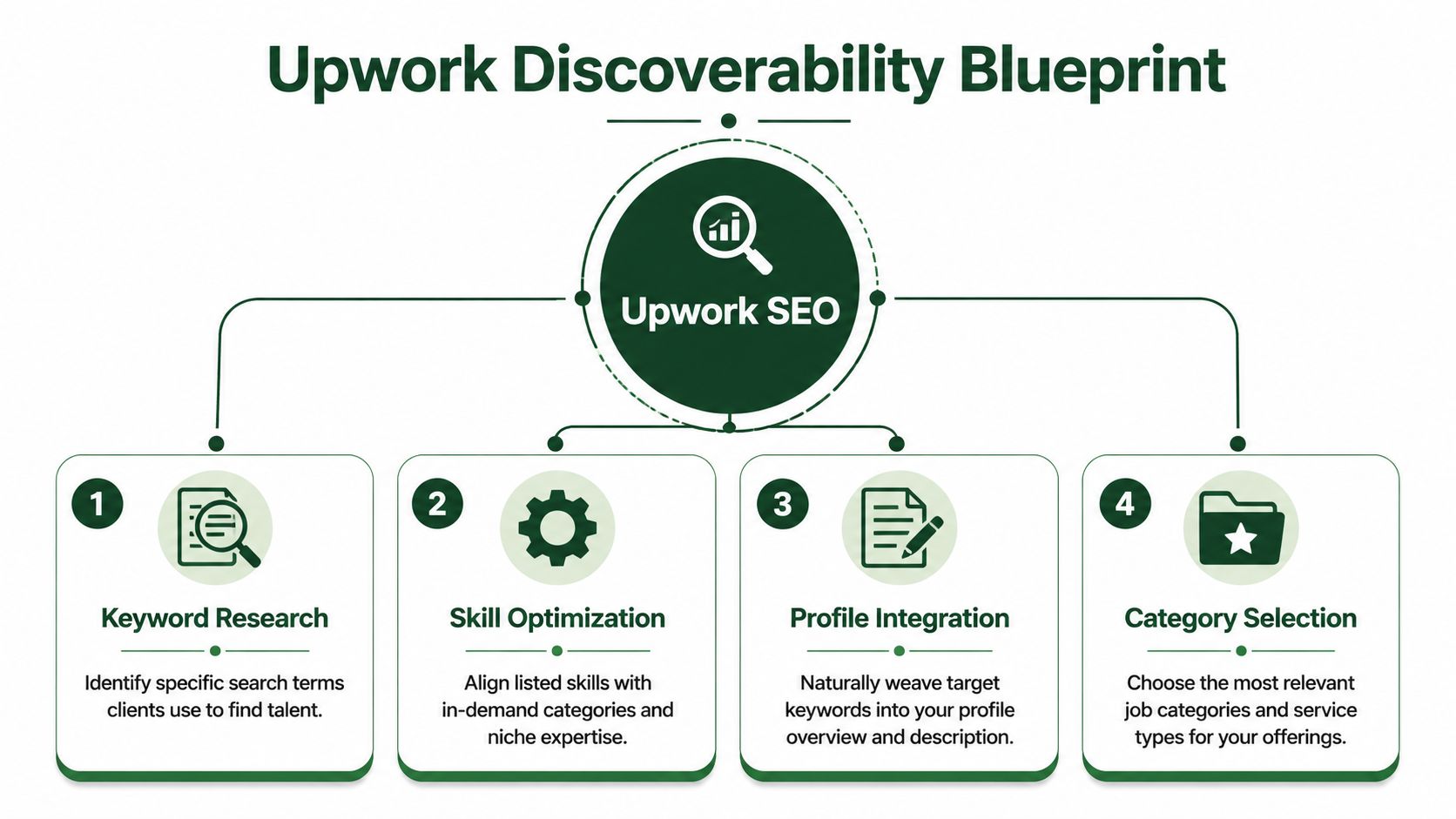
The simplest way to do keyword research on Upwork is to reverse-engineer the market. Search your target service, review the wording in job posts and top profiles, and look for repeated phrases. Then use those phrases naturally in the places that matter most.
Start with buyer language, not your own labels
Freelancers often describe themselves one way while clients search another way.
For example, you may think of yourself as a "copywriter." A client may search for "email copywriter for ecommerce," "Klaviyo expert," or "landing page writer for SaaS." Those are different discovery paths. If your profile only uses the broad label, you'll miss relevance.
I usually gather terms from three places:
- Search results on Upwork
- Recent job posts in the target niche
- Profiles already attracting the kind of work I want
Once you see repeated terms, sort them into groups. Core service. Industry. Platform or tool. Deliverable type. Those combinations usually create the best profile language.
Use all available skill slots strategically
This is one of the clearest tactical opportunities in current upwork profile optimization. In 2026, Upwork expanded the skills limit from 15 to 20, and top profiles used every slot with niche-specific terms, increasing search matches by an estimated 30 percent because each tag creates another possible client query match.
Don't waste those slots on vague terms if more precise ones exist.
A weak skill list might include:
- Writing
- Marketing
- Design
- SEO
A stronger list is closer to what buyers search:
- Technical SEO
- On-Page SEO
- SEO Content Writing
- Blog Writing
- Content Strategy
- Shopify SEO
- Surfer SEO
- Ahrefs
- Internal Linking
- SEO Audit
Place keywords where they reinforce your positioning
Keywords matter, but stuffing them everywhere makes the profile sound robotic. Placement matters more than density.
Focus on these areas:
- Title
Put the clearest service phrase here. - First lines of the overview
This supports both preview relevance and immediate clarity. - Portfolio item titles and descriptions
Many freelancers miss this. Portfolio text helps clients connect your proof to their search intent. - Skills list
This is the fastest place to broaden match coverage without bloating the overview.
Specialized profiles are often the cleaner move
Generalist profiles struggle because they try to rank for too many unrelated things. If you offer multiple services that serve different buyers, split them where the platform allows it.
A web professional who does both Webflow development and conversion copywriting shouldn't mash both into one muddled identity if the work attracts different client searches. Distinct specialized profiles create cleaner relevance, cleaner previews, and better expectations.
Field note: The best keyword strategy isn't "add more terms." It's "make your profile read like the exact answer to a narrow search."
The skill list should reflect demand, not ego
A common mistake is listing every tool you've touched. That dilutes positioning.
If you want to be hired for paid media strategy, don't spend precious skill slots on old design software or unrelated admin tasks just because you can do them. Skills are not a biography. They're search signals.
I also recommend auditing skill tags against your actual portfolio. If the profile claims "conversion rate optimization" but your samples only show generic web design, the profile creates tension. Relevance works best when title, overview, skills, and proof all point in the same direction.
Showcasing Your Expertise with a Killer Portfolio
A lot of portfolios fail for one reason. They show output without explaining value.
The client sees a landing page, logo, dashboard, article, or ad creative. It might look polished. But they still don't know what problem it solved, why your approach mattered, or whether you can do the same for them.
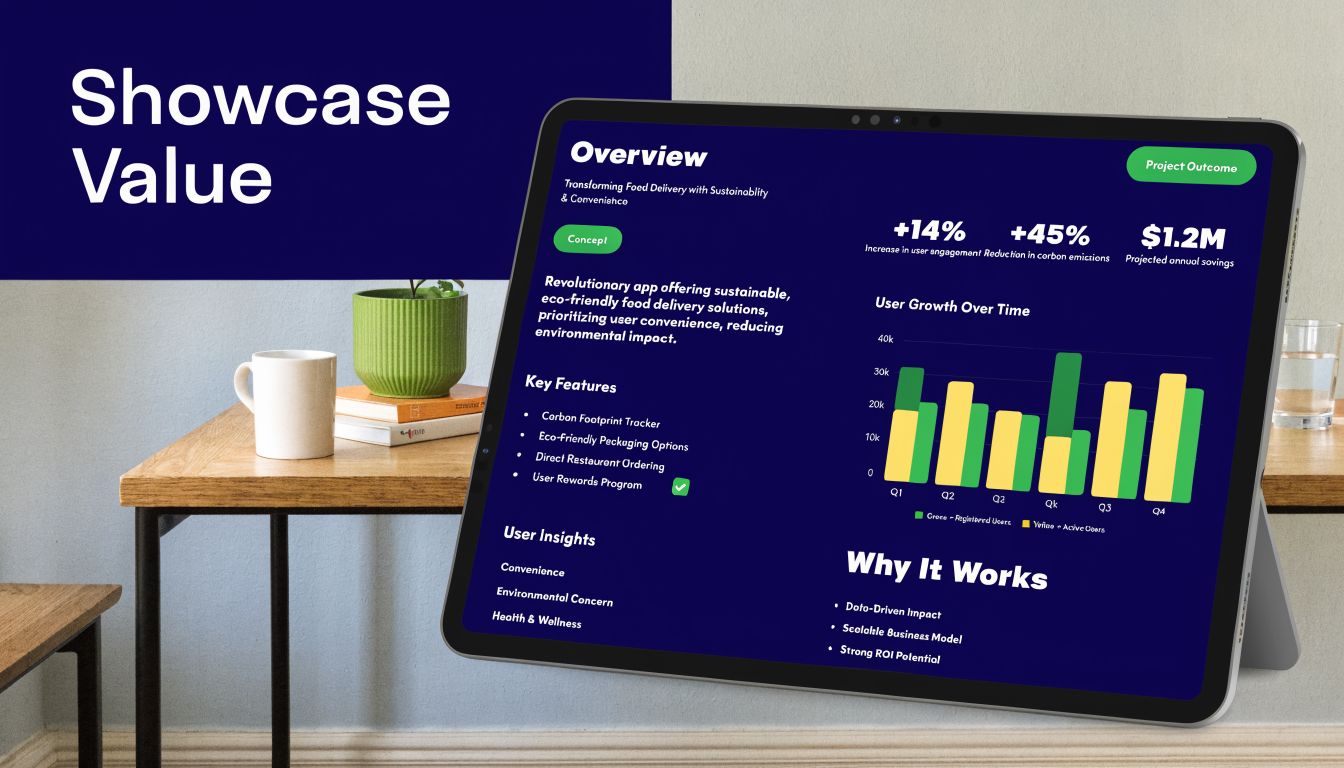
That's why I treat each portfolio item like a mini case story, not a gallery upload.
Use problem, process, result
This framework keeps portfolio descriptions grounded and persuasive.
A weak portfolio caption says:
- Designed homepage for client in wellness space.
A stronger one sounds more like this:
- The client needed a homepage that could explain a new wellness subscription clearly and reduce confusion around pricing tiers. I reworked the information hierarchy, simplified the offer structure, and built a cleaner mobile-first layout. The final page made the signup path easier to understand and gave the client a reusable direction for future product pages.
Notice what's different. The second version gives the buyer context. It shows judgment, not just execution.
Pick work that supports the profile you want now
Freelancers often upload whatever they have, especially early on. That creates a scattered portfolio.
If you want higher-value ecommerce email work, feature email strategy and lifecycle examples. If you want brand identity projects, don't lead with social media graphics. If you want technical SEO retainers, make sure your portfolio reflects audits, content structures, or implementation examples rather than unrelated marketing tasks.
That curation matters more than volume.
A focused portfolio usually benefits from:
- Fewer but tighter samples that support one buying decision
- Clear titles that mirror the service being sold
- Descriptions with context so the client understands your role
- Visual order that puts the strongest and most relevant work first
If you're rebuilding your samples, this guide on creating a stronger Upwork portfolio strategy is a useful reference point for deciding what belongs and what should be removed.
Tell the client what to notice
Clients don't always know how to evaluate specialist work, especially in technical or strategic categories.
If you're a developer, point out the business logic or UX constraint you solved. If you're a writer, explain the audience, intent, and structure behind the piece. If you're in paid media, explain the testing logic, creative angle, or account cleanup work. Guide their attention.
A portfolio item should answer this question fast: why does this sample make hiring you feel safer?
One strong example beats five vague ones
I once reviewed a designer's profile with plenty of visual work but almost no explanation. The pieces looked good, but they all blended together. After rewriting the item titles and adding concise descriptions that framed the problem and the design choices, the portfolio felt more premium without changing the actual work.
That's the overlooked part. Better framing improves the perceived value of the same project.
Don't use portfolio space to archive your history. Use it to pre-sell your next engagement.
From Optimized to Automated An Iterative Growth Loop
Most freelancers still handle profile optimization like a cleanup task. They rewrite the title, tighten the overview, swap in better samples, and call it done. That mindset leaves money on the table because profile performance changes with market demand, buyer behavior, niche shifts, and the kinds of projects you're targeting.
A profile that converts well this quarter might underperform later if your offer becomes too broad, your samples go stale, or your pricing signals stop matching the buyers you're attracting.
Optimization works best when it's tied to behavior
The useful question isn't "does my profile look better now?" It's "did the right client behavior improve?"
Watch what happens after a profile change. Are you getting more relevant views? Better invites? Fewer low-fit messages? More conversations that match your preferred contract size or service type?
That's how real optimization works. You change one meaningful variable, observe the response, and decide whether the market is validating the shift.
Pricing is part of positioning
A lot of freelancers think pricing sits outside profile strategy. It doesn't.
Clients read your rate as a signal. If the profile language, portfolio quality, and niche positioning suggest specialist expertise, but the rate signals bargain labor, the profile creates doubt. On the other hand, if the rate is ambitious but the proof is generic, the buyer hesitates for the opposite reason.
That doesn't mean there is one perfect number. It means pricing has to match the story your profile tells. Positioning, proof, responsiveness, and rate all work together.
Subtle behavior matters too:
- Fast replies make you look operationally reliable
- Consistent niche language reduces confusion
- Fresh samples imply active, current practice
- Clear service boundaries filter out messy projects
Build a repeatable testing loop
You don't need an elaborate system to do this well. You need a simple operating rhythm.
Try a loop like this:
- Choose one bottleneck
Low views, low invites, weak-fit leads, or poor proposal conversion. - Adjust one profile element
Title, first lines of the overview, lead portfolio item, skills, or positioning. - Observe downstream behavior
Watch whether lead quality changes, not just raw activity. - Keep, refine, or revert
If the new version attracts better conversations, keep iterating in that direction.
Tooling becomes particularly useful. Platforms that track profile-related signals and proposal outcomes can help you make smaller, cleaner decisions instead of rewriting everything on instinct. For teams that want a more systematic workflow, Upwork profile automation options can connect profile improvement with outreach, testing, and response management. Earlybird AI is one example. It connects to an Upwork account, helps with analytics and profile optimization, and feeds performance signals back into a more continuous process instead of a one-off rewrite.
The profile should inform outreach, and outreach should inform the profile
This is the loop many freelancers miss.
If your proposals get responses for one type of project but your profile still presents you more broadly, tighten the profile around that demand. If your outreach shows buyers care about one tool, one industry, or one deliverable more than you expected, make that more visible in the profile. If your messages attract the wrong contract type, your positioning is probably too loose.
The best profiles aren't written in isolation. They're shaped by live buyer feedback.
Once you work this way, upwork profile optimization stops being cosmetic. It becomes part of your sales system.
Upwork Profile Optimization FAQs
How often should I update my Upwork profile
Update it when something meaningful changes. New proof, a tighter niche, stronger service language, better samples, or a shift in target client type all justify a refresh.
Minor tweaks can happen regularly. Full rewrites usually aren't needed unless your positioning has drifted.
Is it better to be a generalist or use specialized profiles
Specialization usually makes it easier for clients to understand why you're relevant. If you offer distinct services to distinct buyers, separate positioning is cleaner than forcing everything into one identity.
Generalist language often sounds flexible to the freelancer and vague to the client.
I have a new profile and no JSS yet. What should I focus on first
Focus on clarity, relevance, and proof. Make the title specific, write an overview around one clear service, fill out the profile completely, and add samples that match the jobs you want.
Then be selective with the first contracts you accept. Early fit matters because your delivery history becomes part of the trust layer that supports future visibility.
Should I keep changing my title if invites are slow
Only if you know why invites are slow. A title change helps when the current one is broad, generic, or mismatched to buyer search intent. It won't solve weak proof, poor fit, or an unclear portfolio on its own.
Change one meaningful thing at a time so you can tell what improved.
What's the simplest ongoing system to maintain a strong profile
Use a cycle. Review profile performance, proposal outcomes, and buyer conversations together. Then update the profile based on what the market is responding to, not what sounds impressive on paper.
That feedback loop is where most freelancers level up. Agencies do too. The teams that treat the profile as a living sales asset usually make better decisions across positioning, pricing, portfolio curation, and outreach.
If you want help turning your Upwork profile into a system instead of a static page, Earlybird AI is built for that workflow. It connects profile optimization, analytics, and automated outreach so you can test changes, track what drives invites, and keep improving based on real client response rather than guesswork.