
← Back To Blog
Master Service Agreement vs Statement of Work: A Guide

You've probably hit this point already. A client hires you on Upwork for one website update, then asks for landing page copy, then email sequences, then a quick audit, then another sprint next month. The work keeps coming, which is good. The contract process keeps resetting, which isn't.
That's where many freelancers and small agencies get stuck. They win the relationship, then lose time to paperwork. Every new project turns into another round of negotiating payment language, IP ownership, confidentiality, timelines, revision terms, and what happens if the work changes halfway through.
The fix isn't more legal complexity. It's better structure. Discussions around master service agreement vs statement of work frequently aim to determine the appropriate document. The more useful question is this: how do you use both documents to make repeat client work faster, cleaner, and safer?
The Never-Ending Contract Cycle You Need to Break
A familiar scenario looks like this. You close a client for a one-off design project. The project goes well, so they ask for more. Now you're handling monthly ad creative, occasional site changes, and campaign support. But each new request triggers the same routine. New scope. New pricing. New edits to legal language. New approval delay.
That process creates friction in exactly the part of your business that should feel easiest. Repeat work should move faster than first-time work. Instead, many freelancers end up rebuilding the deal every time the client says, “Can you also help with this?”
Why the loop hurts growth
For solo freelancers, this slows cash flow and burns admin time. For agencies, it creates handoff problems between sales, delivery, and whoever's chasing signatures. In the Upwork context, where speed often helps you win and expand accounts, that delay matters.
A better setup separates relationship rules from project details. The first document handles the long-term legal terms. The second handles the specific assignment in front of you. If you're serious about optimizing legal contract workflows, that split is one of the first upgrades worth making.
The client shouldn't have to renegotiate confidentiality and IP terms every time they ask for a new deliverable.
What changes when you structure it right
Once you stop treating every new task like a fresh legal event, the relationship becomes easier to scale.
- Repeat work moves faster: You approve a new project with a focused scope document instead of redoing the entire contract.
- Your terms stay consistent: Payment rules, ownership, and dispute language don't drift from project to project.
- Clients get a smoother experience: They see a professional operating system, not ad hoc paperwork.
- Your team stays aligned: Sales can close. Delivery can start. Finance can bill from the same framework.
That's the practical value behind the MSA and the SOW. One keeps the relationship stable. The other keeps the project clear.
What Is a Master Service Agreement (MSA)
A Master Service Agreement, or MSA, is the contract that governs the relationship itself. It's the standing rulebook you put in place when you expect ongoing work, recurring projects, or a client relationship that won't end after one invoice.
As Aline explains, a Master Service Agreement establishes the overarching legal framework for a long-term business relationship, covering broad terms such as payment terms, intellectual property rights, confidentiality, and dispute resolution that apply to the entire relationship, while a Statement of Work is a project-specific addendum that outlines the specific scope, deliverables, timelines, and pricing for a single engagement (Aline's explanation of MSA vs SOW).
Think of the MSA as the permanent rules
If you freelance on Upwork, this matters most when a client starts acting less like a one-time buyer and more like an account. That usually happens after the first successful engagement. They trust you, they want faster turnaround, and they don't want to rehash legal terms every time they send a Loom video with a new request.
An MSA usually handles issues like:
- Payment mechanics: invoicing timing, late payment rules, and general billing expectations
- Intellectual property: who owns work product and when ownership transfers
- Confidentiality: what each side must protect
- Dispute process: what happens if the relationship goes wrong
- Liability framework: how risk is allocated between both parties
If you want a broader primer on service contracts before drafting one, it can help to explore contract management with BoloSign, especially if you're translating legal language into a workflow your team can effectively use.
What an MSA is not
An MSA is not your project plan. It doesn't say, “Design three landing pages by Friday” or “Deliver two ad concepts and one revised video script.” If you stuff that level of detail into the MSA, you create a bloated document that's annoying to update and easy to break.
Practical rule: Put stable terms in the MSA. Put changing work in the SOW.
That separation matters because the MSA should stay durable. It's there so you can take on the next project without reopening every legal issue from scratch.
When an MSA makes sense
Use an MSA when the client relationship has any of these traits:
- Multiple likely projects: design retainers, dev sprints, campaign support, SEO work
- Cross-functional work: the same client may buy copy, strategy, implementation, and reporting
- Longer time horizon: you expect the relationship to continue rather than close after one job
- Operational handoffs: several people on either side need one consistent contract foundation
For a growing freelancer or agency, the MSA isn't legal decoration. It's infrastructure.
What Is a Statement of Work (SOW)
A Statement of Work, or SOW, is the project-level document. It tells both sides what is being done right now, what the deliverables are, how long the work should take, and what gets paid.
If the MSA is the rulebook for the relationship, the SOW is the job ticket. It converts a general working relationship into actual billable work.
Athena Legal notes that the duration and lifespan of an MSA are designed for long-term relationships, often lasting for the entire life of the business relationship, whereas an SOW is typically valid only for the duration of a specific project or engagement and expires once that project is complete (Athena Legal on the duration of MSAs and SOWs).
What belongs inside the SOW
This is where specificity matters. A good SOW removes ambiguity before the work starts.
It should answer questions like:
- What exactly is being delivered
- What's out of scope
- When milestones are due
- Who provides inputs, approvals, or access
- How acceptance works
- What the client is paying for this project
For Upwork freelancers, the SOW often protects you from the casual message that says, “Can we squeeze in just one more thing?” If that extra task isn't in the SOW, you have a clean basis to price it separately or issue a change order.
Why vague SOWs cause trouble
A loose SOW creates operational confusion first, then billing conflict after. The client thinks “website copy” includes messaging strategy, three rounds of revisions, upload support, and stakeholder workshops. You thought it meant copy only.
That's why disciplined requirement gathering matters before you draft scope. If your projects often drift because the client's needs weren't pinned down early, these requirement gathering methods are worth reviewing before you send the next SOW.
A useful way to draft it
When writing an SOW, define the work in layers:
- Project summary: one short paragraph on what the engagement is for.
- Deliverables: name the outputs in plain language.
- Timeline: state dates, dependencies, and approval windows.
- Responsibilities: note what you need from the client.
- Commercial terms: connect fees to milestones or completion points.
A strong SOW doesn't try to sound legal. It tries to make misunderstanding difficult.
The Core Differences MSA vs SOW
The simplest way to understand master service agreement vs statement of work is this: one document governs the relationship, and the other activates a specific piece of work under that relationship.
Early in the client lifecycle, that distinction can feel academic. Once you're managing repeat projects, revision requests, team handoffs, and billing, it becomes operational.
Here's a quick comparison.
CriteriaMaster Service AgreementStatement of WorkPrimary purposeGoverns the long-term business relationshipDefines one specific project or engagementScopeBroad terms like IP, confidentiality, payment structure, and dispute processNarrow details like deliverables, milestones, timeline, and feesDurationLong-term or renewableEnds when the project endsHierarchyParent agreementChild document under the parent agreementChange frequencyInfrequentUpdated for each new projectBest useOngoing client relationshipIndividual assignment, sprint, or deliverable set
A visual can make the hierarchy easier to grasp.

Governance versus execution
The MSA sits at the governance layer. The SOW sits at the execution layer.
Legitt AI describes this clearly: in enterprise contract governance, the Master Service Agreement functions as the overarching parent legal framework that pre-defines critical risk-mitigation clauses such as liability caps (typically 100-150% of annual fees), intellectual property ownership transfer, and dispute resolution mechanisms, whereas the Statement of Work is a subordinate, execution-level document that strictly defines tactical variables such as specific deliverables, acceptance criteria, resource allocation, and precise timelines without altering the underlying legal framework (Legitt AI on MSA and SOW roles).
Relationship rules belong in the MSA. Project instructions belong in the SOW.
In practice, that means your MSA might say who owns source files after payment clears. The SOW would say whether this particular project includes Figma files, coded pages, ad variations, or reporting dashboards.
What each document answers
The MSA answers questions like:
- How do we handle risk
- Who owns the work
- What are the general payment terms
- How do we handle disputes
- What confidentiality obligations apply
The SOW answers a different set:
- What is being built or delivered
- When is each milestone due
- What does approval look like
- Who is doing what
- What does this project cost
That split matters because clients often blur the two. They'll send a “contract” that mixes legal boilerplate, project notes, Slack assumptions, and fee terms into one long document. It can work for a tiny one-off project. It usually becomes messy once the relationship grows.
This walkthrough adds another perspective before you draft your own contract stack.
Why hierarchy matters
If the MSA and SOW conflict, the MSA typically controls the broader relationship terms while the SOW governs the project specifics within that framework. That's why the hierarchy has to be explicit.
A common failure point is trying to sneak legal changes into an SOW. For example, a client uses a new SOW to alter IP terms or liability treatment without updating the MSA. That creates confusion fast. The cleaner approach is simple. Keep legal architecture in the MSA. Keep assignment details in the SOW.
How Agencies and Freelancers Should Use MSAs and SOWs
Freelancers often ask whether they really need both documents. The practical answer is: not always, but often sooner than they think.
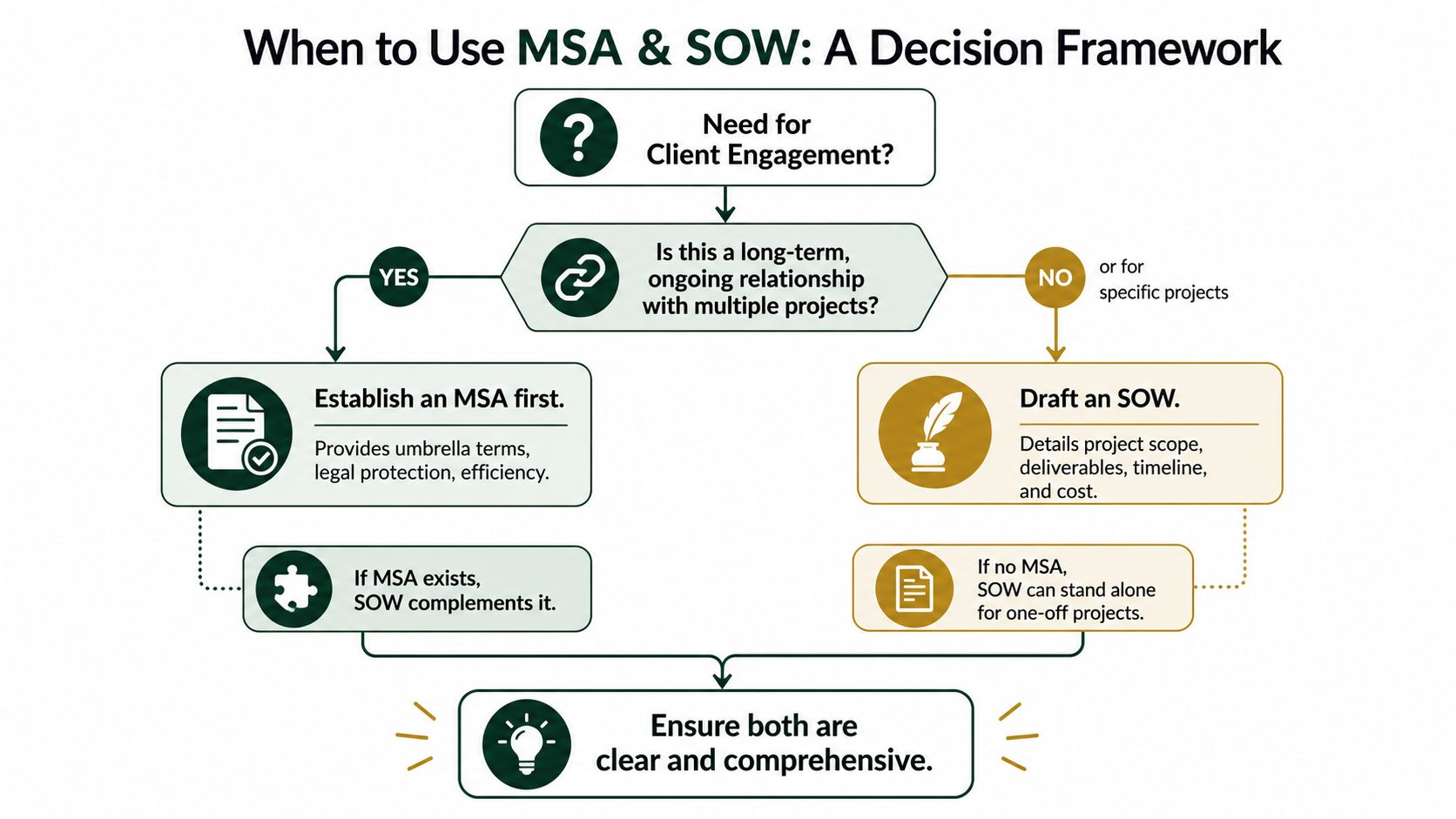
If you're doing a small one-time project with no obvious follow-on work, a standalone SOW or the platform's standard terms may be enough. If the client is likely to return, refer other teams internally, or expand the engagement after the first win, an MSA becomes a scaling tool rather than a legal extra.
Use cases that make sense
Here's the practical framework I'd use for Upwork and agency work:
- One-off fixed project: A detailed SOW can be enough if the relationship is narrow and short.
- Trial project with expansion potential: Start thinking about an MSA as soon as the client signals more work is coming.
- Monthly retainer or repeated sprint work: Put the MSA in place, then launch each sprint or workstream under its own SOW.
- Agency with multiple team members: Use the MSA to standardize the legal terms so account managers and delivery leads aren't improvising on every deal.
For agencies, this is also a communication issue. If your internal team doesn't know what was promised, scope slips. Clear documents support better client communication best practices because everyone is working from the same written baseline.
Why the paired model works better
There's a speed benefit to separating the documents. Thomson Reuters reports that organizations utilizing a combined MSA+SOW architecture achieve a 40-60% reduction in average contract negotiation time compared to those drafting standalone contracts for every project (Thomson Reuters on MSA efficiency).
That result makes intuitive sense in service businesses. Once the hard legal issues are settled once, you can move future projects forward by negotiating only the scope, timeline, and commercial details that changed.
If a client trusts you enough to keep buying, they usually want less paperwork, not repeated paperwork.
What works and what doesn't
What works:
- One MSA per ongoing client relationship
- A new SOW for each discrete project or phase
- A clear approval process for scope changes
- Consistent document naming and version control
What doesn't work:
- Stuffing every possible future project into one giant SOW
- Using a vague SOW and hoping Slack messages fill the gaps
- Letting legal terms drift from one project document to another
- Treating repeat work like repeated first-time work
That's the business case. Better contract structure doesn't just reduce risk. It removes drag from growth.
Common Pitfalls and Costly Contract Mistakes
Many small agencies skip the MSA because it feels faster. In the short term, it often is. In the long term, that shortcut can expose the business exactly when the client relationship becomes valuable.

The false speed of standalone SOWs
HyperStart notes that 42% of small agencies in major markets like the US and UK operate without an MSA, citing speed, but this leads to ambiguous IP ownership and unbounded liability when disputes arise, as the SOW alone lacks the MSA's dispute resolution and confidentiality scaffolding (HyperStart on operating without an MSA).
That trade-off shows up constantly in creative and technical services. The project starts quickly, but nobody fully addressed who owns drafts, whether background IP stays with the freelancer, what happens if the client delays approvals, or how disputes get handled. Those issues don't matter until they suddenly matter a lot.
Scope creep is usually a document problem
A lot of freelancers talk about scope creep like it's a personality issue. Sometimes it is. More often, it starts as a drafting issue.
Here's where people go wrong:
- Undefined deliverables: “Brand package” can mean wildly different things to different buyers.
- No out-of-scope list: if you don't exclude, clients often assume inclusion.
- Missing acceptance criteria: you can't tell when work is done if “done” was never defined.
- No change request path: every new ask becomes an awkward negotiation.
If you already send formal proposals before contract drafting, tightening the format for a proposal letter can reduce downstream contract confusion because the scope starts cleaner.
A vague SOW invites unpaid work. A clear SOW gives both sides a fair boundary.
The mistakes that cost the most
The most expensive contract mistakes usually aren't dramatic. They're quiet.
- Mixing legal and project terms carelessly: the more one document tries to do everything, the easier it is to contradict itself.
- Reusing old SOW templates without updating assumptions: timelines, deliverables, and responsibilities drift.
- Ignoring client dependencies: if the client must provide access or approvals, write that into the scope.
- Using the SOW to change core legal terms: that's how disputes start over precedence and enforceability.
The goal isn't to make your contracts longer. It's to make them harder to misunderstand.
Your Essential MSA and SOW Checklist
If you're reviewing a client document or building your own template stack, use a checklist instead of relying on memory. You don't need a perfect legal masterpiece. You need coverage of the issues that most often affect delivery, payment, ownership, and scope.

What to confirm in the MSA
Check that the MSA includes:
- Parties and relationship scope: who is contracting, and what broad service categories are covered
- Term and termination: when the agreement starts, how it ends, and what survives termination
- General payment terms: invoice timing, payment windows, and what happens on late payment
- Confidentiality obligations: what information must be protected and by whom
- Intellectual property ownership: who owns work product, pre-existing materials, and transferred rights
- Liability and indemnification: how risk is allocated if something goes wrong
- Governing law and dispute resolution: where and how disputes get resolved
If you regularly review incoming client paper, a detailed checklist can help you secure better business deals without missing the clauses that affect your bargaining power later.
What to confirm in the SOW
The SOW should be far more concrete. Look for:
- Project title and summary: enough context to identify the exact engagement
- Detailed scope of work: what's included, excluded, and assumed
- Deliverables and milestones: named outputs, dates, and review points
- Budget and payment schedule: fees tied to milestones, time periods, or final delivery
- Acceptance criteria: how the client approves work and when approval is deemed complete
- Roles and responsibilities: what you do, what the client must provide, and who signs off
- Change request process: how new requests are documented, priced, and approved
The final test
Read both documents together and ask one question: if a disagreement happens, can a neutral third party tell what was promised, what was excluded, who owns the work, and when payment is due?
If the answer is fuzzy, keep editing.
Earlybird AI helps Upwork freelancers and agencies turn client acquisition into a repeatable system. It automates proposal drafting, outreach timing, and follow-up while giving teams the speed needed to win better-fit projects faster. If you want your sales process to scale as cleanly as your contracts should, take a look at Earlybird AI.