← Back To Blog
Format for a Proposal Letter: A Simple Template to Win Clients
If your proposals are met with silence, the problem probably isn't your skills—it's how you're presenting them. A solid format for a proposal letter does more than just list your services; it builds a bridge from the client’s problem straight to your solution. Without that structure, you’re just shouting into a crowded inbox.
Why Your Proposal Format Is Costing You Clients

On competitive platforms like Upwork, a weak proposal is the fastest way to get archived. It’s not just about looking professional. A smart format is a strategic tool that gets you noticed, builds immediate trust, and actually shortens the time it takes to land the job.
The biggest mistake I see freelancers and agencies make is leading with a long list of their credentials. This self-centered approach almost always fails. Why? Because clients are laser-focused on their problems. Your proposal has to instantly show you get it and you have a plan. Shifting your mindset from "here's who I am" to "here's how I'll fix your problem" will completely change your results.
The Power of a Client-Centric Structure
A proposal that actually converts isn't a resume; it’s a business case. It’s your chance to persuade the client that hiring you is the best possible investment. In fact, a disorganized structure is a huge reason why over 50% of bids are dismissed without a second thought. This isn't just a minor detail—it's a critical flaw.
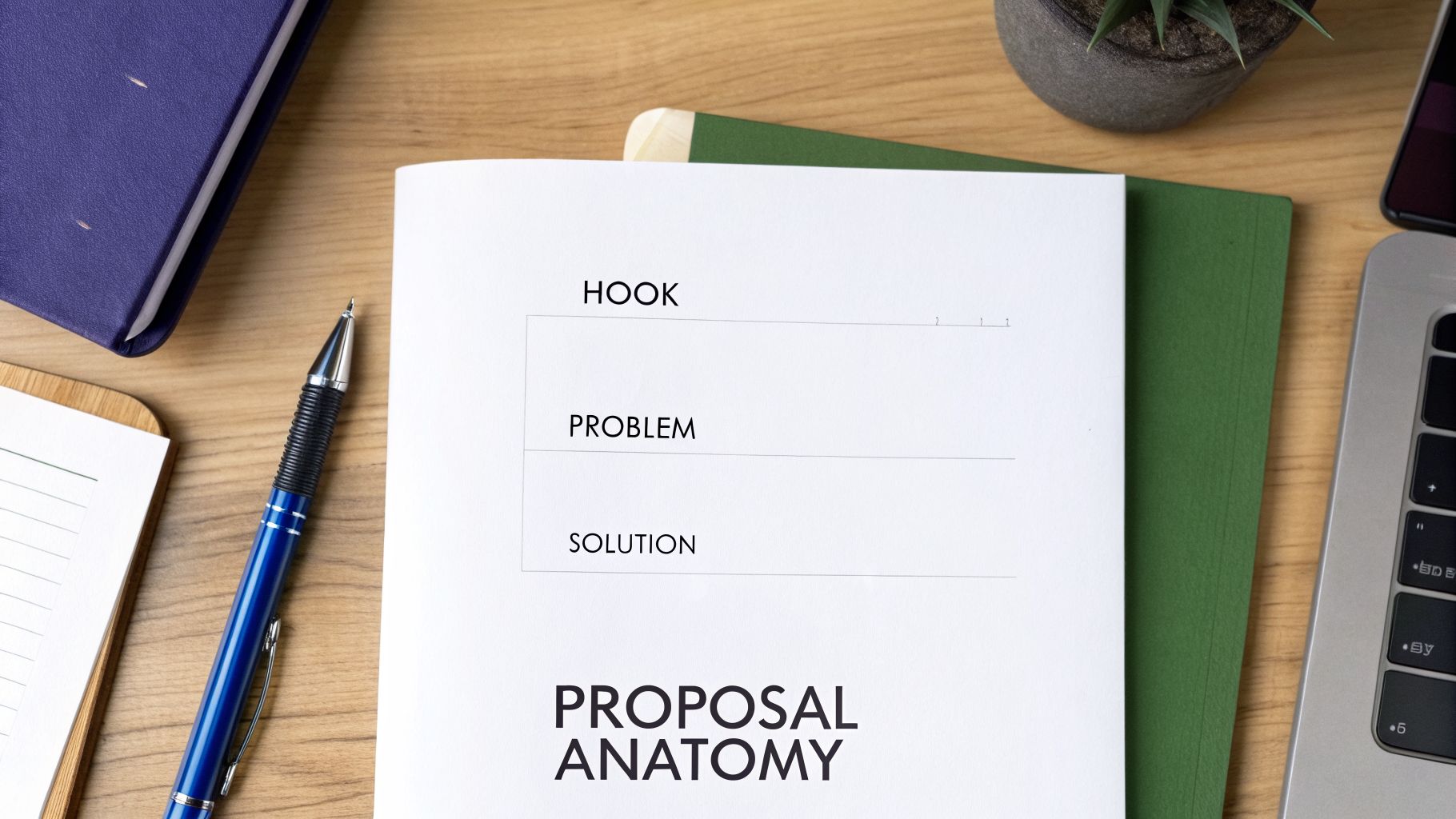
A winning format boils down to four simple, powerful parts:
- The Hook: Start by directly acknowledging the client's specific need to grab their attention.
- The Problem: Show you've done your homework by clearly describing their pain point.
- The Solution: Explain exactly how your service solves that specific problem.
- The Call to Action: Give them a clear, simple next step to make replying effortless.
Once you master this client-first structure, you stop competing on price and start competing on value. Your proposal goes from being just another bid to a strategic document that makes you the obvious expert.
This guide will show you exactly how to build and use this framework. If you’re active on specific freelance sites, it's also worth knowing the platform's quirks. For instance, you might find our guide on submitting a proposal on Upwork a helpful companion to these strategies.
The Anatomy of a High-Converting Proposal Letter
After writing and reading thousands of proposals over the years, I can tell you one thing with absolute certainty: a great proposal is a story, not a brochure. It's not just a list of your skills and prices. It’s a carefully crafted argument that walks a potential client from "I have a problem" to "You are the solution."
Think of it like a business case. A book proposal, for example, has to convince a publisher that the book is a worthwhile investment long before a single chapter is finalized. Your proposal needs to do the same thing—prove that hiring you is a smart, strategic move for their business right now.
Let's break down the format for a proposal letter that actually works. Getting this structure right is the first step to leaving your competition in the dust.
Your Opening: Hook Them in the First Two Sentences
Your first two sentences are everything. Seriously. If you don't grab your reader's attention immediately, the rest of your beautifully crafted proposal won't even get a glance. They'll just click over to the next one.
The easiest way to nail the opening is to prove you actually read and understood their request. Ditch the generic "Dear Sir or Madam" and forget starting with your name and credentials. Instead, jump right into their world by referencing a specific detail from their project description or a pain point you've identified.
Here’s an opening that lands:
"I saw you're looking to reduce customer churn for your SaaS platform, and your goal to decrease it by 15% in Q3 caught my eye. I recently helped a similar B2B software company achieve a 20% reduction in just two months by implementing a targeted email onboarding sequence."
This works wonders because it instantly signals relevance and teases a successful result. It tells the client you're not just another mass applicant; you’re a specialist who gets their specific goal.
Show You Understand Their Problem
Once you have their attention, your next move is to build a connection by showing genuine empathy. This is where you demonstrate that you don't just see the surface-level task—you understand the deeper business problem. Don't just repeat their job description back to them; expand on it. Articulate the challenges and frustrations they're facing, maybe even better than they did.
This is your chance to show you've done your homework. It repositions you from a simple task-doer to a strategic partner they can trust. When you can accurately frame their challenge, you're not just selling a service; you're building credibility.
Try to touch on these points:
- State the core issue you've identified.
- Discuss the consequences of not solving it (e.g., lost revenue, brand erosion, wasted time).
- Connect it back to their goals to show you're focused on the same outcome.
For many clients, especially on busy platforms, finding someone who truly gets it is a huge relief. If you want to see this in action, we break it down even further in our guide with a high-converting Upwork proposal sample.
Introduce Your Solution
Now, it's time to position yourself as the answer to their problem. This is where you connect the dots between their pain and your services. But the key here is to be incredibly specific. Vague promises and generic service descriptions are proposal killers.
Don't just say, "I offer SEO services." Instead, explain how your SEO expertise will directly solve their specific problem. Show them the path from A to B.
Don't just focus on the what of your service; focus on the why. Why does it matter to this client, right now? How does your approach solve their problem more effectively than anyone else's?
For instance, if a client needs more leads, avoid saying you'll run a Google Ads campaign. Get specific. Say you will "create a targeted Google Ads campaign focusing on long-tail keywords for high-intent buyers. This will drive qualified traffic directly to your landing page and lower your overall cost-per-acquisition." That level of detail shows you aren't just guessing—you have a plan.
Automating Success with the Right Proposal Format
Having a winning proposal format is a fantastic start. But let's be honest—manually personalizing every single one is a massive time-drain. It’s the classic freelancer’s paradox: you’re so buried in writing proposals that you have no time left for the actual client work you're trying to land.
That’s where smart automation, guided by your solid structure, completely changes the game.
The secret isn’t to blast out generic, robotic bids. It's about using your proven format for a proposal letter as a high-performance engine. You can use tools to take that framework—your killer hook, insightful problem summary, and brilliant solution—and apply it consistently at a scale you could never hope to match by hand.
This approach turns proposal writing from a necessary evil into a predictable, lead-generating system. You start sending rapid, personalized submissions that always hit the mark, giving you a serious edge over the competition.
Moving Beyond Manual Drudgery
Just think about all the little steps you take to customize a single proposal. You hunt down the client's name, pinpoint a specific pain point from their job description, and dig through your files to attach the right case study. An automation platform can handle all of that in seconds.
By building a strong template from the high-converting format we've been discussing, you’re essentially telling the technology what to do. It takes care of the repetitive, tedious parts for you.
Suddenly, you're free to focus on what actually matters: talking to interested leads, refining your strategy, and closing deals. It’s the definition of working smarter, not harder. You can see exactly how to automate your Upwork proposals to get a feel for how this works in practice.
The effect on your sales cycle is immediate. Instead of spending hours writing and waiting days for a reply, you can have a perfectly tailored proposal in a client's inbox within minutes of them posting a job. That speed and precision are exactly what shortens the distance from prospect to paying client.
Why Proposal Software is Exploding in Popularity
This shift toward automated efficiency isn't just a small trend—it's a massive market realignment. The value of a great proposal format is directly reflected in the explosive growth of the Proposal Management Software Market.
This industry was valued at $3.26 billion USD in 2026 and is projected to skyrocket to $9.19 billion USD by 2034. That’s a compound annual growth rate of 12.2%, proving that more and more businesses are catching on to the need for structured, scalable systems.
Agencies and freelancers who adopt software to standardize their formats are already seeing incredible results. In North America, the biggest market, businesses report a 59.6% jump in efficiency when responding to large volumes of RFPs.
The data points to a clear conclusion: using technology to manage and deploy your proposal format is quickly becoming a requirement for staying competitive. You can read the full research on the proposal software market to get a deeper look at where the industry is headed. When you automate your format, you aren't just saving time—you're aligning your business with a proven strategy for serious growth.
Real-World Proposal Examples That Actually Work
Knowing the theory is great, but let's be honest—seeing a real proposal in action is what truly clicks. The "best" proposal format isn't a one-size-fits-all template. It completely depends on where you're sending it and who's reading it.
A pitch for a quick gig on a freelance site needs to be punchy and direct, while a six-figure agency project demands a much deeper, more strategic document. I'll walk you through two very different scenarios I see all the time and give you some templates you can steal and adapt.
The Upwork Pitch: Get Noticed, Get Hired
On platforms like Upwork, you're not just competing on skill; you're competing against the scroll. Clients are drowning in proposals. You have about five seconds to prove you've actually read their post and aren't just another copy-paste applicant.
This means you need to get straight to the point. No fluff, no long-winded intros about your life story. Show them you understand their problem and have a plan.
Here’s a framework I’ve used to land countless freelance jobs:
Subject: Re: Your need for a Shopify SEO Expert to increase organic traffic
Hi [Client Name],
I just saw your post about looking for an SEO expert to grow organic traffic for your new Shopify store. Getting qualified buyers to your site without constantly paying for ads is a smart goal, and it’s exactly what I help my e-commerce clients do.
For a recent clothing brand I worked with, I built a content and keyword strategy that boosted their non-branded organic traffic by 45% in just three months. I believe we can get similar results for you by focusing on a few key areas:
- A deep technical audit to find and fix any backend issues that might be holding your site back from Google.
- Smart keyword research to uncover the high-intent search terms your actual customers are typing in.
- Strategic on-page optimization for your most important product and category pages to climb the rankings.
I've attached a one-page summary of that project. I'm available to start as early as next week.
Would you be open to a quick 15-minute call sometime this week to talk through your goals?
Best,
[Your Name]
Why this pitch lands jobs: It opens by mirroring the client's own words, which instantly builds rapport. It then hits them with a compelling, specific number (45% in three months) to prove you're not just talking a big game. The bullet points aren't just a list of services; they're a mini-plan, showing you've already started thinking about their project. The call to action is simple and low-pressure.
The Full-Scale Agency Proposal
When you’re an agency pitching a larger, more complex project, the game changes. The client is making a serious investment, and they need to feel confident that you’re the right partner to guide them. A quick email won't cut it.
This is where a polished, comprehensive proposal document (usually a PDF) comes in. It’s less about a quick hook and more about building a case. It’s your chance to demonstrate strategic thinking and prove you understand their business on a deeper level.
A winning agency proposal has a logical flow that walks the client from their problem to your solution.
- Cover Page: Don’t skip this. A professional cover page with your logo, the client's name, and a clear project title makes you look polished from the first glance.
- The Executive Summary: This is arguably the most important page. It's a one-page snapshot of the entire proposal—the problem, your proposed solution, and the expected outcome or ROI. It's written for the CEO or decision-maker who might not read anything else.
- Our Understanding of Your Challenge: Go beyond just repeating their problems. Show you understand the impact of those problems on their business. This proves you were listening.
- The Proposed Solution & Our Methodology: This is the heart of your proposal. Detail your plan. What specific strategies will you use? Why is your approach the best one for them? This is where you flex your expertise.
- Scope of Work & Deliverables: Get incredibly specific here to avoid scope creep down the line. Instead of saying "social media management," say "12 unique posts per month for Instagram and Facebook, including custom graphics, copywriting, and monthly performance reports." Leave no room for ambiguity.
- Project Timeline: Clients love seeing a timeline. It makes the project feel real and manageable. A visual chart showing key phases, milestones, and deadlines shows you’re organized and have a clear path forward.
- Investment & Pricing Options: Always break down your pricing. Even better, offer two or three packages (e.g., Basic, Pro, Enterprise). This gives the client a sense of control and can actually nudge them toward a higher-priced option.
- About Your Team & Relevant Case Studies: Keep the "About Us" section brief. Focus more on social proof. Show them relevant examples of how you've solved similar problems for other clients.
- Next Steps: End with a clear, direct call to action. Tell them exactly what they need to do to move forward, whether it's signing the proposal, scheduling a kickoff call, or submitting the initial payment.
Creating a document like this takes time, but it immediately separates you from competitors who just send a price list. It shows you’re not just a vendor; you’re a strategic partner invested in their success.
Common Proposal Mistakes and How to Avoid Them
Even if you have the perfect structure, a few common slip-ups can send your proposal straight to the trash. I've seen it happen time and again. Knowing what these pitfalls are is the first step to making sure your hard work actually gets a response.
A well-structured proposal isn't just about looking professional; it genuinely performs better across the board.
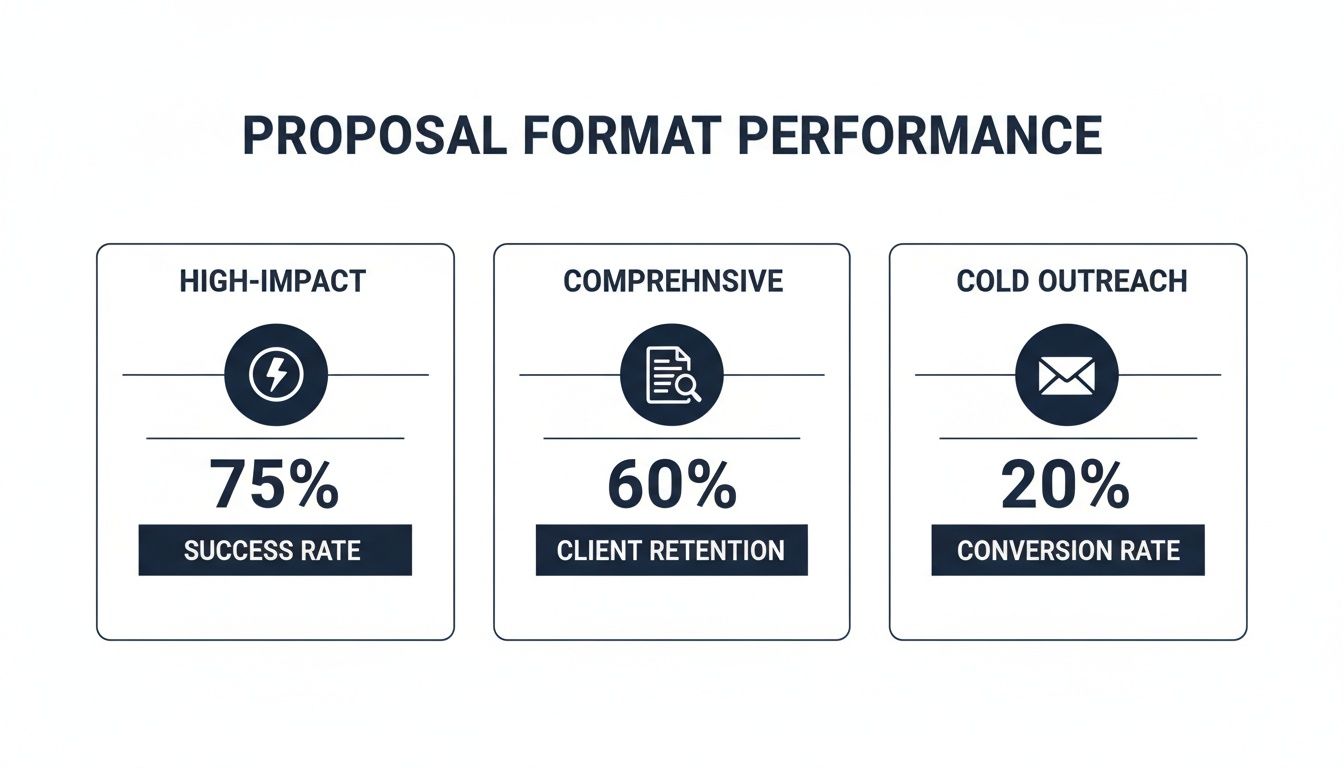
The data here is clear. Adapting your format—whether it's a quick, high-impact pitch or a detailed project plan—has a direct line to your success rate. Now, let’s dig into the classic mistakes that trip people up.
Focusing on Yourself Instead of the Client
This is, without a doubt, the most common mistake I see. People lead with their credentials, their company history, or a long list of skills. Honestly, the client doesn't care about your resume at this stage. They care about their own problem.
- What most people write: "I am a skilled web developer with over ten years of experience building custom WordPress sites for a variety of clients."
- What you should write: "You need a new website that not only looks modern but also converts visitors into customers. I'll build a custom WordPress site with a clear conversion funnel to help you achieve that goal."
See the difference? The second example immediately connects with the client's needs and their desired outcome. It’s a conversation-starter, not a monologue.
Using One-Size-Fits-All Language
Clients can smell a copy-pasted template from a mile away. When your proposal is filled with vague platitudes and doesn't mention any specifics from their project description, it screams "I didn't really read your request."
A proposal isn't a broadcast; it's a conversation. If it feels like it could have been sent to anyone, it will be ignored by everyone.
Personalization is your secret weapon. Simply using the client's name and referencing a specific goal they mentioned shows you’re paying attention. It proves you're genuinely interested in their project, not just any project.
Presenting Vague Pricing and Timelines
Nothing makes a potential client more nervous than fuzzy numbers. A single, unexplained price tag feels like a gamble. The same goes for a proposal that lacks a clear timeline—it feels like a project with no end in sight.
Break down your pricing. Show the client what they're paying for. Provide a simple, realistic timeline with a few key milestones. This transparency doesn’t just build trust; it makes you look like a seasoned professional who knows how to manage a project.
The industry data backs this up. The Proposal Management Software Technology Market saw a 15.1% CAGR from 2022-2029, largely because businesses need these structured, transparent formats. In fact, well-formatted proposals with clear pricing and timelines have been shown to increase approval rates by 35% in competitive bids. If you're curious, you can explore more insights from the proposal management software market to see how these trends are shaping the industry.
Common Proposal Questions, Answered
Even with the best templates, a few tricky questions always seem to pop up in the real world. Let’s tackle some of the most common ones I hear from freelancers and agencies.
How Long Should a Proposal Actually Be?
This is the classic "it depends" answer, but here's a more practical breakdown. The context of the job is everything.
If you're bidding on a project on a fast-moving platform like Upwork, you have to be quick and concise. The client is likely reading dozens of these, so keep it tight. I aim for around 150-250 words—just enough to show you've read the brief and have a solid plan, but short enough to be scanned in less than a minute.
For a larger, complex project you're pitching as an agency, you’ll need a much more detailed document. These proposals often run between 8-15 pages and include everything from an executive summary and case studies to a detailed scope of work and tiered pricing.
What's the Fastest Way to Personalize a Proposal?
The single quickest way to make your proposal stand out is to grab one specific detail from the client’s request and lead with it. It instantly proves you’re not just copy-pasting. Look for a unique goal, a piece of software they mentioned, or a specific challenge they’re facing.
Instead of the generic, "I'm a great writer," try this: "I saw you need blog posts that drive email sign-ups for your fintech brand. That's a direct-response approach I specialize in." See the difference? That simple shift from generic to specific makes you instantly more credible.
How Should I Follow Up If I Don't Hear Back?
Yes, you should follow up! The silence can be deafening, but don't assume the worst. People get busy.
Wait about 3-5 business days and then send a polite, brief email. The key is to avoid the needy, "Just checking in on my proposal" line. Instead, add a little extra value.
Try something like: "Just wanted to quickly follow up on the proposal I sent over. I was thinking more about your goal and stumbled on this article about [relevant topic] that you might find interesting. Happy to chat if any questions have come up on your end."
This approach keeps you top of mind in a helpful, not a pushy, way.
Ready to stop worrying about proposals and start winning more clients? Earlybird AI can become your always-on sales assistant for Upwork. It finds the perfect projects for you, crafts a personalized proposal using a proven format, and sends it out in minutes. You get to be first in line, every time. Learn how Earlybird can automate your success.