← Back To Blog
Submitting a Proposal on Upwork That Actually Wins Jobs
Sending a proposal on Upwork can feel like a high-stakes game. You’ve got just a few sentences to convince a potential client you’re the solution to their problem. The real challenge? Cutting through the noise to prove you actually understand what they need and that you’re the best person to deliver it.
To win, you have to move away from generic, copy-paste applications and start crafting targeted, value-driven messages that practically demand a reply.
Why Most Upwork Proposals Fail (And How Yours Will Win)
If it feels like your proposals are just disappearing into a black hole, you're not alone. So many freelancers burn through their precious Connects and get nothing back, leaving them convinced the platform is just too saturated.
But here’s the truth: it’s not just crowded, it’s filled with low-effort proposals that are surprisingly easy to beat.
The competition is definitely real. When you submit a proposal, you’re often going up against 20 to 50 other freelancers for that one job. With client reply rates sitting somewhere between a slim 8% and 30%, it's obvious most bids get archived without a second glance. Winning the actual contract is even harder, with success rates sometimes as low as 1 in 20. You can find more insights about Upwork bidding mastery to see how these numbers play out in the real world.
Don't let that discourage you. It’s actually a massive opportunity. Most proposals fail for the same predictable reasons: they're generic, they're all about the freelancer, and they completely fail to address the client's problem in the first two sentences.
The Snowball Effect of Your First Wins
On Upwork, momentum is everything. Once you land those first few projects, a powerful "snowball effect" kicks in. Every piece of positive feedback acts as social proof, making your profile more credible and visible.
Clients hate risk. A profile with a proven track record is always going to be more appealing than a brand-new one. This initial traction makes every subsequent win a little bit easier. Your Job Success Score (JSS) climbs, you earn badges like "Top Rated," and soon enough, clients start sending you direct invitations. The initial grind slowly gives way to a steady flow of better, higher-paying work.
Stop Guessing and Start Measuring
To break out of the ignored-proposal cycle, you have to stop guessing what works and start measuring it. The top earners on Upwork aren't just lucky; they treat their proposals like a sales funnel and track their performance. This is the single biggest change you can make to your strategy.
By tracking a few simple metrics, you can pinpoint exactly where your process is breaking down. Are clients not even opening your proposals? Or are they opening them but not replying? Each issue has a completely different fix.
Below is a table summarizing the metrics that can transform your approach from guesswork into a predictable system.
Key Metrics for Upwork Proposal Success
This table outlines the essential performance indicators every freelancer should track to measure and improve their proposal effectiveness.
MetricWhat It MeasuresTarget BenchmarkView RateHow many of your proposals are actually opened by clients.50% or higherResponse RateThe percentage of viewed proposals that get a reply.20% or higherInterview RateHow many of your responses lead to an interview or call.50% or higherWin RateThe final percentage of proposals that turn into a hired contract.10-20% of proposals
Tracking these numbers turns a frustrating, expensive process into a puzzle you can actually solve. If your View Rate is low, your proposal's first two lines or your profile headline need work. If your Response Rate is the problem, the body of your proposal isn't connecting.
This data-driven approach allows you to systematically test and tweak each part of your strategy, ensuring every Connect you spend is an investment in a system that consistently lands clients.
How to Read a Job Post Like a Detective

The real secret to writing a killer proposal isn't about your writing chops; it's about your research. Before you even think about typing a single word, you need to put on your detective hat. Most freelancers give the job description a quick scan and fire off a generic template. But the winning clues are hiding in plain sight, just waiting for someone to notice.
This little bit of upfront analysis is what separates a proposal that gets ignored from one that gets an immediate reply. When you're submitting a proposal on Upwork, this initial time investment ensures you’re not just another name in a long list—you’re the exact problem-solver the client was hoping to find.
Decoding the Job Description
First things first, you have to read between the lines of the job post itself. This is your primary piece of evidence. Look past the obvious requirements and search for specific language, hidden pain points, and what the client really wants to achieve.
- Listen for the Tone: Does the client sound frustrated ("I've been struggling with this for weeks!") or are they excited ("We're launching a groundbreaking new product!")? Matching their energy in your proposal is a simple trick that builds instant connection.
- Spot the Keywords: If they mention a specific tool, software, or methodology, that’s not just a casual suggestion—it's a dealbreaker. Mentioning your direct experience with that exact tool in your first sentence is a fantastic way to hook them.
- Find the "Why" Behind the "What": Don't just read "I need a new logo." Ask yourself why. Are they rebranding to target a new market? Is this for a new service launch? Figuring out the business goal lets you position yourself as a strategic partner, not just another freelancer waiting for instructions.
This deeper read lets you stop talking about your skills and start talking about their needs.
Investigating the Client's History
The job post is just chapter one. The client's profile and hiring history provide the backstory that almost everyone else skips. This is where you find out what they truly value in a freelancer.
Here's one of my favorite tricks: scroll through the feedback other freelancers have left for the client. They often mention the client by their first name. Starting your proposal with "Hi [Client's Name]" instead of "To Whom It May Concern" is a tiny detail that makes a huge difference.
Beyond finding their name, you can uncover their hiring habits.
- Average Hourly Rate Paid: Check their past jobs. What have they actually paid other freelancers? If their budget says "$20-$50/hr" but you see they've never gone above $25/hr, you know that bidding on the high end is probably a waste of your Connects.
- Feedback They've Left: This is a goldmine. Do they constantly praise people for "great communication" or "delivering ahead of schedule"? Those are their core values. Make sure you highlight your own commitment to clear communication and reliability.
- Project History: Do they typically hire for quick one-off tasks or long-term projects? This tells you whether they're looking for a quick fix or a lasting partnership, so you can frame your proposal to match.
By piecing these clues together, you build a complete picture of your potential client. You learn their name, what they can realistically afford, their communication style, and what makes them happy. This detective work is how you write a proposal that feels like it was crafted just for them—because, in a way, it was.
Writing a Proposal That Gets an Immediate Reply

Alright, you've done your homework on the client. Now it's time to cash in on that intel and write a proposal that a client simply can't ignore. The real goal isn't just to get your proposal read—it's to get a reply. To make that happen, your proposal needs to stop feeling like a job application and start feeling like the beginning of a solution.
This is where most freelancers stumble. They open with, "Hi, I'm John, a web developer with 10 years of experience." Frankly, the client doesn't care about you yet. They care about their own problems. A winning proposal flips the script entirely. It leads with their world, not yours.
This client-first approach is the bedrock of a successful proposal. It proves you didn’t just skim the job post; you actually thought about what they need to succeed.
Crafting a Powerful Hook
You get maybe two seconds to grab a client's attention. Seriously. Upwork's dashboard only shows the first couple of lines of your proposal, making those first words your most valuable real estate. If your opening is generic, you're getting archived. Period.
Instead of introducing yourself, dive straight into their pain point or their biggest goal. This immediately signals that you get it and positions you as a problem-solver, not just another applicant.
Think along these lines for your opening hook:
- Acknowledge the Problem: "It sounds like your current sales funnel is generating leads, but the conversion rate is falling short—which is likely costing you significant revenue each month."
- Affirm the Goal: "Building a user-friendly mobile app for your new subscription service is a fantastic goal. Getting the UI/UX right from the start will be absolutely critical for long-term user retention."
- Share a Relevant Insight: "I noticed you're looking for a writer familiar with the SaaS world. Having worked with B2B tech clients before, I know the real challenge is often translating complex features into crystal-clear benefits for the end-user."
These hooks work because they're all about the client. They show empathy and understanding, which is infinitely more compelling than a résumé summary.
Explaining Your Solution Concisely
Once you’ve got them hooked, your next move is to briefly outline how you'll solve their problem. This isn't the time for a massive, multi-page project plan. Think of it as a confident, high-level overview of your strategy.
Your mission here is to build credibility and show you have a process. Keep it short, sweet, and focused on the outcome.
For example, a social media manager might write something like this:
"My approach would start with a quick audit of your current channels to find some low-hanging fruit. From there, I'd build out a content calendar focused on two core themes I know resonate with your target audience, using a mix of video and carousel posts to really drive up engagement."
It’s not bogged down in technical jargon, but it clearly demonstrates a plan of action. It tells the client you have a strategy in mind, which is far more reassuring than just saying, "I can manage your social media."
Backing It Up with Hyper-Relevant Proof
Now you can bring in your experience, but you have to frame it perfectly. Don't just list your skills or past jobs. You need to connect your experience directly to the client's project with what I call hyper-relevant proof.
Generic proof is a lazy list of past projects. Hyper-relevant proof is a specific, hand-picked example that mirrors the client's current needs.
- Weak: "I have a lot of experience with SEO."
- Strong: "I recently helped an e-commerce brand in your niche increase their organic traffic by 40% in just three months. We did it by overhauling their product descriptions and building targeted backlinks. I've attached that specific case study for you to review."
See the difference? That level of specificity is what builds real trust. When submitting a proposal on Upwork, always choose one or two killer portfolio pieces over a generic link to your entire collection.
Asking Questions That Start a Conversation
The final piece of the puzzle is your call to action. Most freelancers end with a passive and forgettable, "I look forward to hearing from you." A much smarter move is to ask a thoughtful question that practically begs for a response.
A great question shows you're already thinking strategically about the project and kicks off a real conversation. For more ideas on this, check out these powerful cover letter examples for Upwork that master the art of the compelling closing.
Here are a few questions that get replies:
- "Before I start mocking up some initial concepts, do you have any existing brand guidelines I should be aware of?"
- "What's the number one metric you'll be using to measure the success of this campaign? Is it lead generation, brand awareness, or something else entirely?"
- "You mentioned needing this wrapped up by the end of the month—are there any key stakeholder review dates I should factor into that timeline?"
These questions can't be answered with a simple "yes" or "no." They open the door for a genuine discussion, making it incredibly easy for the client to hit "reply" and start the dialogue that leads to a contract.
Bidding and Answering Screening Questions Like a Pro
Your cover letter gets you in the door, but it’s the rest of your proposal that closes the deal. Freelancers often treat the bid, screening questions, and portfolio attachments as afterthoughts, rushing through them just to hit "submit." This is a huge mistake.
These elements are your chance to prove you’ve actually read the job post, understand the client's needs, and are the perfect person to solve their problem. A client sees your entire package—your rate, your answers, and your work samples. Getting these details right is what separates a good proposal from an irresistible one.
Set Your Rate with Confidence
Figuring out what to bid can be nerve-wracking. Go too high, and you might scare the client away. Go too low, and you look inexperienced and attract clients who don't value quality. The goal is to bid with confidence, basing your number on research and the real value you bring to the table.
Before you type in a number, take a moment to be a detective. Check the client’s hiring history on their profile. What have they typically paid for similar work? This gives you a fantastic starting point.
Ultimately, your bid should be a blend of three key factors:
- The market rate for your skills and experience level.
- The client’s budget, both what they've stated and what their history suggests.
- The value you deliver. What’s the tangible business outcome they get from hiring you?
When you put down your price, you're not just guessing. You're making a calculated statement about the impact your work will have.
Don't just state your price—justify it. You can subtly connect your rate to the value you deliver right in your cover letter. Something like, "My proposed rate includes a full strategy brief and two rounds of revisions to ensure we get this exactly right for your audience."
Screening Questions Are Your Golden Ticket
Let’s be honest, most freelancers see those pre-set screening questions as a chore. They dash off a one-sentence answer and move on. This is precisely why treating them seriously gives you a massive advantage.
Think of these questions as a mini-interview. They’re a direct invitation from the client to show off your expertise and prove you’re a strategic thinker, not just another applicant.
For instance, a client asks: "What is your experience with social media marketing?"
- A weak answer: "I have 5 years of experience managing social media for various clients." (Generic and uninspired).
- A strong answer: "I've spent the last five years specializing in social media for B2B tech companies. For one SaaS client, I grew their LinkedIn engagement by 150% in six months by focusing their content on customer pain points instead of product features. Is there a particular platform you’re hoping to improve?"
See the difference? The second answer is specific, packs a punch with a real number, and opens a conversation by asking a smart question. It screams "expert."
Curate Your Portfolio for Maximum Impact
Your portfolio is your proof. But dumping your entire life’s work on a client is overwhelming and ineffective. They're busy people. They don’t want to wade through ten projects to find one that’s relevant. Your job is to make it incredibly easy for them to say "yes."
How? By providing hyper-relevant examples.
Don't just attach your best work; attach the work that looks the most like what the client is asking for. If they need an e-commerce product description, sending them that amazing white paper you wrote on blockchain is a waste of their time. Send them your best e-commerce work, even if you think the white paper is more impressive.
Relevance always wins. It instantly shows the client you can do their job, not just a job. This targeted approach ties your entire proposal together, sending a clear, powerful message: you're the right person for them.
Turning Your Proposal Data into More Wins
The most successful freelancers on Upwork aren't just winging it. They treat their proposals like a sales pipeline, not a lottery. They know their numbers inside and out, which lets them get a way better return on their Connects and stop wasting time on bids that are going nowhere.
This is the real secret: shifting from a "spray and pray" mentality to a data-driven strategy. It's how you stop blaming the platform and start figuring out what clients actually want to see. This is what separates struggling freelancers from those building a reliable, growing business.
Your Most Important Proposal Metrics
If you want to get better, you have to know where you stand. Without tracking a few key numbers, you're just guessing about what's working and what's not. The three metrics that matter most are your response rate, interview rate, and win rate.
These numbers tell the story of your proposal's journey. According to industry benchmarks, freelancers in a specific niche should aim for a response rate of 20-40%. Out of those responses, a healthy interview rate is around 10-25%. This should ultimately lead to an overall win rate of 3-10%, with roughly 15-30% of your interviews turning into a paid gig. You can get a full breakdown by exploring more on Upwork analytics and tracking your ROI.
A low response rate probably means your first two sentences aren't compelling. A poor interview rate suggests the body of your proposal isn't sealing the deal. And a low win rate? That could point to issues with your interview skills or even your pricing.
The Power of A/B Testing Your Proposals
Once you know your baseline numbers, you can start improving them with A/B testing. It sounds technical, but it’s really just trying one approach, measuring the results, then trying a different one to see if it performs better.
You don't need any fancy tools for this. A simple spreadsheet is more than enough to start gathering some incredibly valuable data.
Here are a few simple things you can test right away:
- Your Opener: For the next 10 proposals, open by directly addressing the client's biggest pain point. For the 10 after that, try leading with a surprising statistic about their industry.
- Your Pricing: Play around with your rates. For five projects, bid exactly what you think the job is worth. For the next five, try bidding 15% higher to see if it positions you as a more premium, expert choice.
- Your Call to Action: Test different ways to end your proposal. In one batch, ask a specific question about their timeline. In the next, ask about the biggest challenge they're facing with the project. See which one gets more clients talking.
This infographic really breaks down the core pieces of your bid that are perfect for this kind of testing.
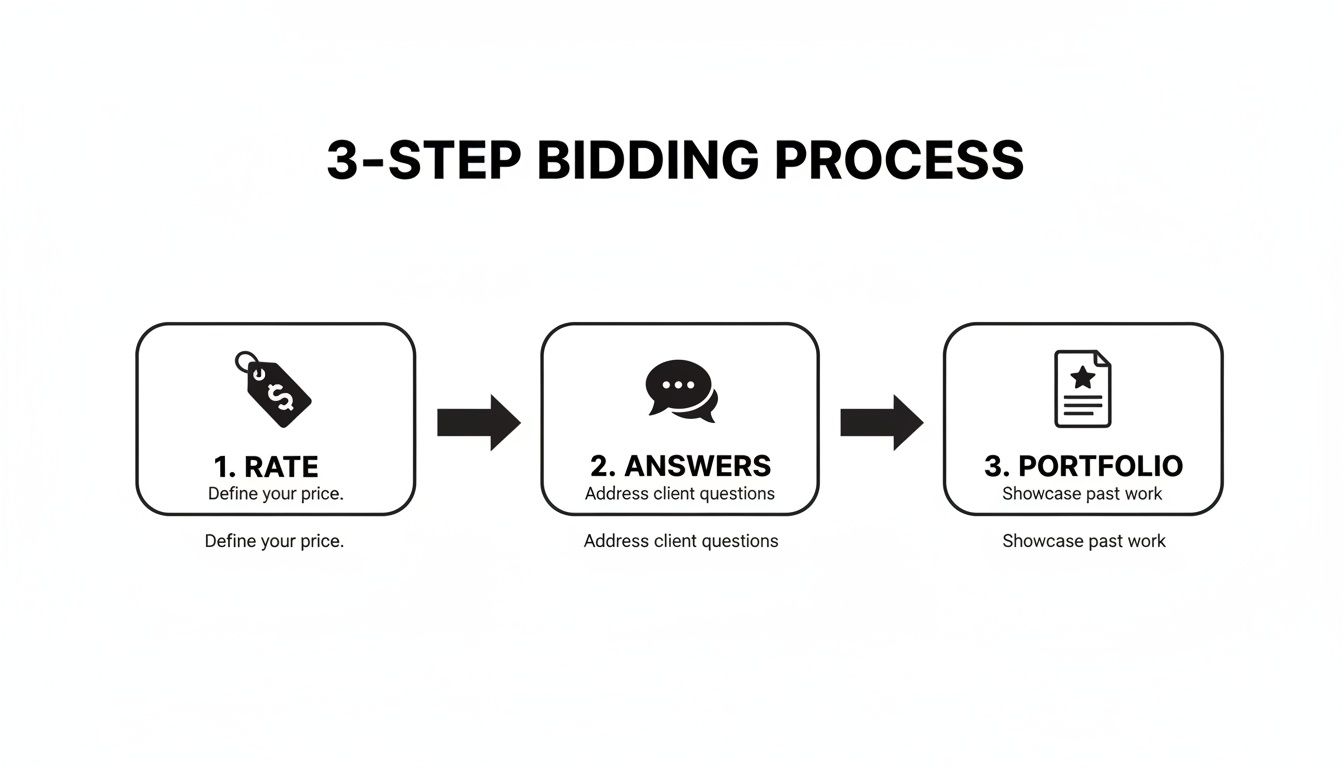
This simple flow—rate, answers, portfolio—is exactly where a client is judging you. It's also where a little bit of testing can make a huge difference.
Timing is Everything
One of the most powerful data points you can track is timing. How fresh a job post is has a massive impact on whether your proposal ever gets read. It's a simple fact: your odds of success skyrocket when you apply to jobs that have fewer than five proposals.
Once a job post has more than 10 proposals or has been live for over an hour, your chances of getting a reply drop dramatically. The client's inbox is already full, and your amazing proposal might never even get a fair look.
This isn't to say you should never apply to older jobs, especially if one seems like a perfect match. But as a general strategy, prioritizing fresh job posts gives you a massive competitive advantage. Setting up job alerts and being quick to respond is one of the easiest ways to boost your response rate. For anyone looking to make this even more efficient, check out our guide on what is sales automation to see how technology can give you an edge.
When you start thinking this way, you're no longer just a freelancer—you're a business owner. You'll make smarter decisions, stop wasting Connects, and systematically increase your income.
Common Proposal Mistakes That Get You Archived
It's a tough pill to swallow, but even the best freelancers get their proposals sent straight to the archive folder. It usually comes down to simple, avoidable mistakes. Understanding what not to do is just as important as knowing what to do, especially when the competition is this fierce.
And it is fierce. With over 855,000 active clients on Upwork in 2024, every proposal you send is a high-stakes pitch. Most projects attract 20-50 proposals, and the average reply rate is a slim 8-30%. With those odds, one little slip-up can be the difference between landing a conversation and getting completely ignored. You can dive deeper into the competitive landscape in the latest Upwork statistics.
Let's break down the unforced errors that kill your chances.
The Template Trap
This is, without a doubt, the most common and damaging mistake: sending a generic, copy-paste template. Clients can spot these a mile away. The moment they read "Dear Hiring Manager, I am a skilled professional with X years of experience," their eyes glaze over. You sound exactly like the last ten applicants.
This approach screams that you didn't even bother to read their job post. A client needs to feel like you understand their specific problem, not that you're just another resume in a digital pile. This low-effort strategy is the fastest way to get archived.
Making It All About You
Here's another deal-breaker: a proposal that's all "me, me, me." Too many freelancers treat their proposal like a résumé, just listing skills, tools, and past jobs. While your experience is obviously important, the client is way more interested in their own project.
Your proposal isn't about you; it's about them. Think of it as a sales document, one that shows exactly how you can solve their problem and make their life easier.
So, instead of saying, "I'm proficient in SEO," frame it for their benefit. Try something like, "My SEO expertise will help you rank higher on Google, which means driving more organic traffic directly to your new product page." See the difference?
Ignoring the Details
Finally, nothing signals "careless" more than failing to follow simple instructions. If a job post asks you to start your proposal with a specific word or to answer a direct question, you absolutely have to do it.
Ignoring these small details tells a client one of two things: either you have poor attention to detail, or you just didn't care enough to read their post thoroughly. This is often a simple test they use to weed out the spammers and bots. Passing it proves you're diligent and you respect their time—two qualities every single client is looking for.
Your Upwork Proposal Questions, Answered
Submitting proposals on Upwork can feel like a bit of an art form. You've got questions, and I've got answers based on years of navigating the platform. Let's clear up some of the most common hurdles freelancers face.
How Long Should an Upwork Proposal Be?
Forget word count and focus on impact. I've found the sweet spot is usually around 100-200 words.
Think of it this way: you need enough space to prove you've actually read the job post and understand the client's problem. But it absolutely has to be short enough for a busy client to scan in under a minute. Your first two sentences are your entire hook—if they don't grab attention, the rest of your proposal doesn't stand a chance.
Should I Bother Applying to Jobs With Tons of Proposals?
Honestly, your best shot is always with jobs that have fewer than 10 proposals. It’s simple math.
That said, don't automatically rule out a crowded field if the project is a perfect match for your unique skills. Before you spend your Connects, check if the client is already interviewing. If they are, it means they're actively looking for the right person. A sharp, highly specific proposal from an expert like you could be exactly what they need to see. Use your gut here—don't just throw Connects at every long shot.
If you're still questioning the platform's potential, we've broken down the pros and cons in our guide on whether Upwork is legit.
Is Boosting My Proposal a Good Idea?
Boosting can give you an edge, but only if your proposal is already top-notch. It’s not a magic wand for a lazy, generic bid.
Think of it as paying for a premium parking spot right at the front. It gets you seen faster, but it doesn't make your car any better. I only recommend boosting for high-value projects where you are genuinely one of the best possible candidates. Boosting a weak proposal is just a surefire way to burn through your Connects with nothing to show for it.
Ready to stop wasting Connects and start winning more clients? Earlybird AI acts as your always-on sales team, automatically finding your ideal jobs and submitting personalized proposals within minutes. Let automation handle the outreach so you can focus on what you do best. Discover how Earlybird AI can transform your Upwork success today.