
← Back To Blog
Sales Team Productivity: How to Measure and Improve It
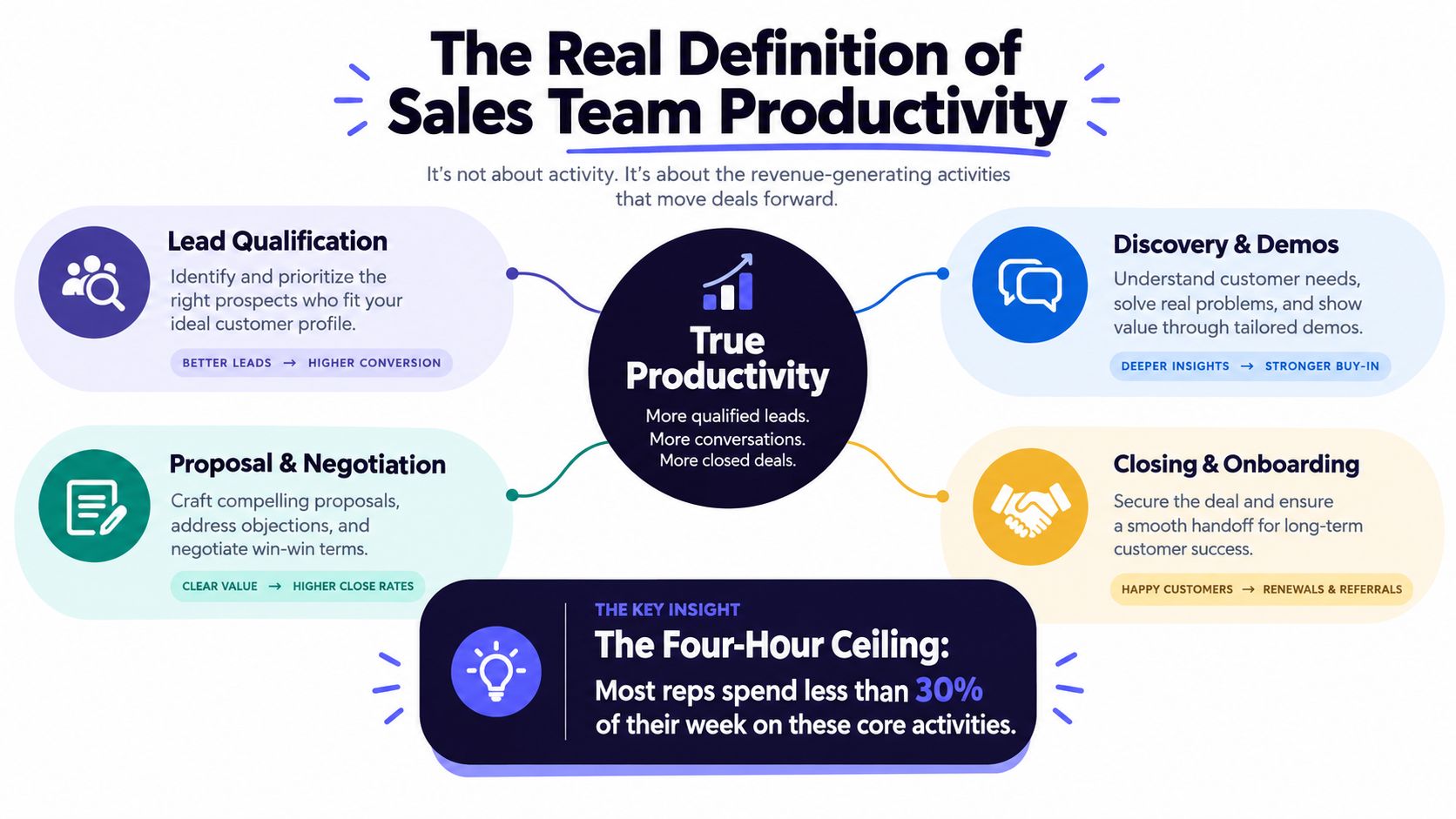
Sales reps spend only 28% of their working week selling, according to Salesforce's 2023 sales research. In a 40-hour week, that's just 11.2 hours for prospect conversations, discovery, proposals, negotiation, and closing. The remaining time disappears into deal administration, data entry, internal work, and tool switching.
That changes how sales team productivity should be managed. The main problem usually isn't a lack of motivation or another coaching session. It's a sales system that forces capable reps to spend too much time away from buyers. The practical fix is to redesign workflows and incentives first, then use coaching and technology to reinforce the new operating model.
The Real Definition of Sales Team Productivity
Sales team productivity is the amount of revenue-generating work a team completes with the time and resources available. It isn't the number of calls logged, emails sent, or tasks marked complete. Those activities matter only when they create qualified conversations, advance real opportunities, and produce profitable customers.
Salesforce also reported that sales teams use an average of 10 tools to close deals, while nearly 70% of reps feel overwhelmed by the number of tools. That combination creates a structural ceiling. A rep can look busy all day and still have too little uninterrupted time for lead qualification, discovery, proposals, negotiation, closing, and onboarding.
Start with the operating model
I use a five-step audit loop when rebuilding an underperforming sales function:
- Measure: Capture selling time, administrative time, stage conversion, response speed, and deal movement.
- Diagnose: Find the bottleneck affecting the greatest number of opportunities.
- Redesign: Remove unnecessary steps, clarify ownership, and simplify the tool path.
- Train: Coach reps and managers on the new process using real opportunities.
- Re-measure: Check whether behavior and outcomes changed before adding another initiative.
Most productivity programs stall because leaders begin at step four. They coach harder while the CRM still requires duplicate entry, lead ownership remains unclear, and compensation rewards the wrong behavior. Coaching can improve execution, but it can't permanently compensate for a broken workflow.
Practical rule: Fix the system that shapes behavior before asking people to work harder inside it.
Activity counts are especially misleading when lead quality varies, deal sizes differ, or one rep inherits a clean territory while another spends the week repairing stale opportunities. A high call count can hide poor qualification. A low email count can reflect strong account selection. The useful question is whether each hour produces progress at the right stage.
Before changing anything, an agency owner should answer three questions:
- Where does rep time go today? Separate customer-facing work from administration, meetings, research, and internal coordination.
- Where does pipeline value disappear? Compare stage-by-stage conversion and time in stage, rather than relying only on final revenue.
- What behavior does compensation reward? Check whether the plan values profitable new business, retention, expansion, speed, or merely visible activity.
Those answers create a baseline. Without one, a new tool, quota, or coaching program becomes another opinion layered onto an unmeasured process.
KPIs and Benchmarks That Actually Move the Needle
A useful KPI system has layers. Leadership needs a view of commercial outcomes and operating health. Reps need a short scoreboard that tells them what to do next. Mixing every available metric into one dashboard creates noise, not control.
Gartner's sales productivity framework separates measurement into three practical tiers. Tier one covers revenue per period, profitability, and customer or revenue retention. Tier two includes lagging indicators such as deal count, win rate, and average deal size. Tier three uses leading indicators such as lead response time, interaction quality, and sales cycle time.
Build the dashboard around yield
For service businesses, stage-level yield is more useful than a single revenue-per-rep number. Track how many leads become qualified opportunities, how many qualified opportunities reach proposal, and how many proposals become closed-won deals. Then add time in each stage and compare performance by inbound, outbound, marketplace, deal size, and rep tenure.
Forrester's sales productivity benchmark recommends measuring relative productivity by funnel stage, including time spent on highly productive activities and yield at each stage. That approach identifies whether prospecting, qualification, proposal conversion, or closing is causing the loss.
| Tier | KPI | Formula | Example Benchmark |
|---|---|---|---|
| Tier 1 | Revenue per rep | Revenue ÷ quota-carrying reps | Establish an internal baseline |
| Tier 1 | Retention | Retained revenue ÷ starting revenue | Compare by segment and cohort |
| Tier 2 | Win rate | Closed-won deals ÷ qualified opportunities | Track by motion and stage |
| Tier 2 | Average deal size | Closed-won value ÷ closed-won deals | Compare by offer and segment |
| Tier 3 | Lead response time | Time from lead creation to first response | Use an agreed service-level target |
| Tier 3 | Stage yield | Opportunities entering next stage ÷ opportunities entering current stage | Locate the largest conversion leak |
Don't import a benchmark from a larger SaaS company and apply it unchanged to an agency selling services between $3,000 and $50,000. Deal complexity, buying committees, proposal effort, marketplace competition, and delivery capacity all change the expected pattern. Use external benchmarks to ask better questions, then calibrate targets against your own historical cohorts.
Run a one-week audit
On Monday, export the previous quarter's opportunity data. By the end of the week, you should have:
- Stage conversion: Count entries and exits for every stage.
- Time in stage: Identify opportunities that remain open without a verified next step.
- Response speed: Separate inbound leads answered quickly from leads left unattended.
- Activity-to-meeting ratio: Compare outreach volume with qualified meetings, not raw replies.
- Tenure cohorts: Review quota attainment and conversion for new, ramping, and established reps.
- Loss reasons: Group losses by qualification, timing, budget, competition, and execution.
- Follow-up gaps: Audit whether opportunities received the necessary sequence of contacts.
For practical context on slow-response leakage, review this resource on recuperación de leads con Lynkro.io. Keep the leadership view focused on outcomes and bottlenecks, while the rep view shows today's priority, overdue commitments, and the next action for every active deal. Teams can also compare dashboard structures through these sales performance dashboard examples.
Auditing Workflows and Cutting Admin Drag
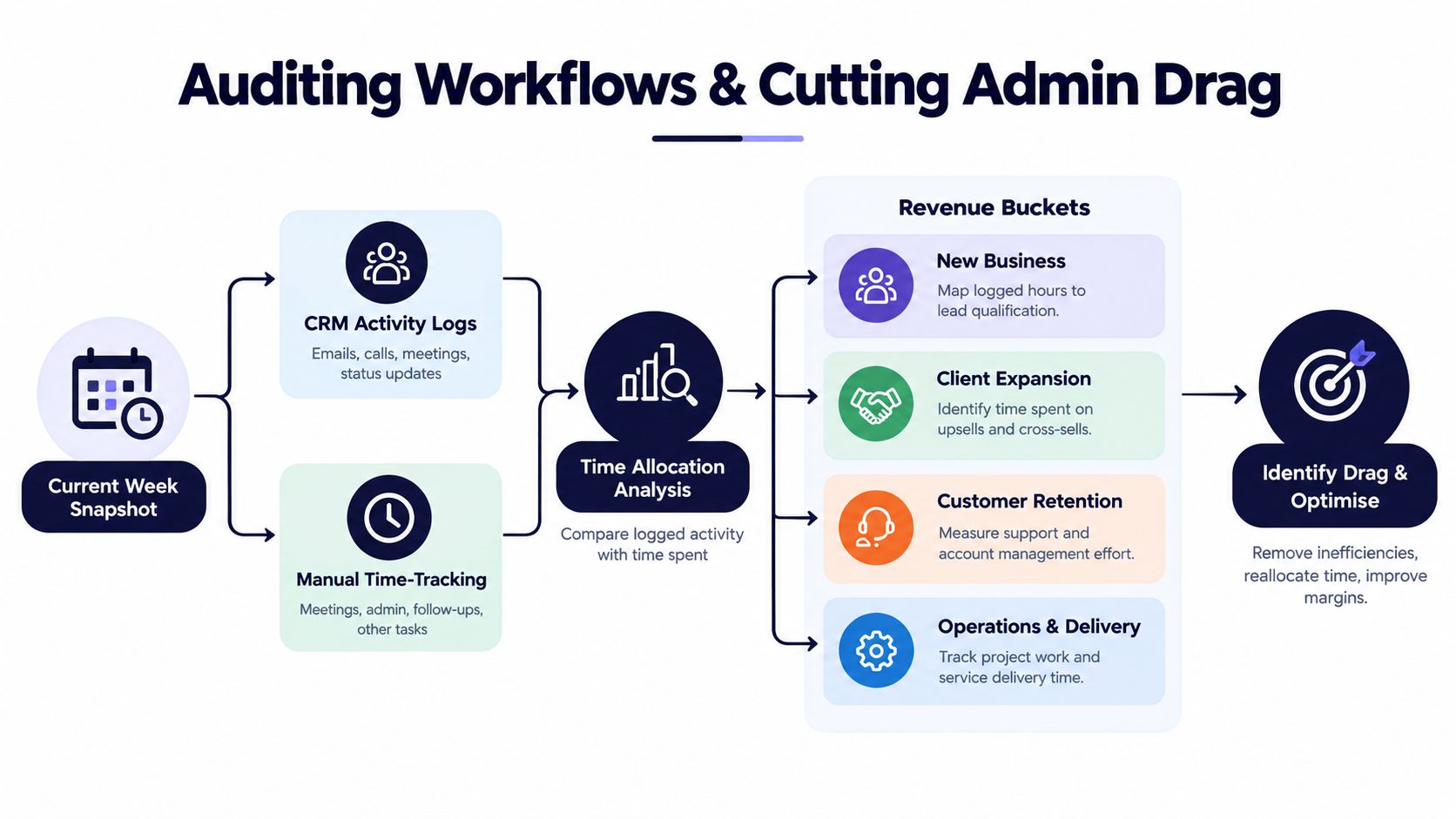
The fastest productivity gains often come from observing the work nobody sees in the revenue report. Ask reps to record their activities in broad blocks for a week, then reconcile those entries with CRM logs, calendar data, and task history. The goal isn't surveillance. It's to expose the gap between the process leaders think they designed and the process reps follow.
Accenture and CSO Insights reported that only 36% of the average sales workweek was spent selling, down from 41% five years earlier. The same research found that 59% of global sales executives felt they had too many sales tools and too much disaggregated customer data, while 55% said their tools were an obstacle to selling, as summarized by Everstage's sales productivity benchmark analysis.
Map time against the deal motion
Use four revenue buckets as the audit frame:
- Prospecting and qualification: List building, first responses, screening, and routing.
- Discovery and demos: Preparation, calls, demonstrations, and stakeholder coordination.
- Proposal and negotiation: Scoping, pricing, revisions, approvals, and legal or procurement work.
- Closing and follow-up: Decision management, contract completion, onboarding coordination, and expansion conversations.
A six-rep agency might discover that every proposal requires a rep to copy information from a form into the CRM, recreate a scope document, request approval in chat, and manually set follow-up tasks. Consolidating the CRM, dialer, proposal workflow, and task automation can remove repeated entry. Stage changes should create the correct next task automatically, populate standard fields, and alert the next owner when a handoff is due.
The redesign should also define a handoff contract. The person qualifying a lead owns the record until required information is complete. The closer accepts the opportunity only after the qualification fields, buyer context, commercial scope, and next meeting are present. That prevents the common failure where two people assume the other person owns follow-up.
Don't start with the easiest admin task. Start with the friction that touches every deal.
Before changing tools, document the current path in sales pipeline management. Then remove duplicate fields, retire unused alerts, create templates for recurring proposals, and reserve human judgment for decisions that affect fit, pricing, or trust.
This short visual walkthrough can help managers frame the audit conversation:
A workflow improvement is successful when reps can explain what changed, complete the common path without workarounds, and spend more time in buyer conversations. A new integration that adds another dashboard or exception queue hasn't solved the problem. It has moved the admin burden.
Automation, Templates, and Outreach Systems
Automation should remove waiting, copying, and repetitive drafting. It shouldn't remove qualification or turn every prospect into an identical sequence. The right design preserves human judgment at the moments where context changes the outcome.
Start with the highest-friction handoffs. A form submission can enrich the record, assign an owner, apply a lead score, and start an appropriate nurture path. A high-intent lead can trigger a fast-response SLA and a task for the assigned rep. A marketplace opportunity can enter a filtered queue, where a proposal template provides structure while the rep decides whether the project fits.
Independent speed-to-lead data makes this priority clear. One 2026 benchmark reports a 42-hour median B2B response time, with only about 7% of teams responding within five minutes. It also reports conversion of roughly 21% for five-minute responders compared with 2.3% for teams waiting a day, as documented by AloWare's lead response time benchmarks.
Create a template vault
A useful vault has separate assets for cold outbound, inbound follow-up, discovery preparation, proposal responses, and re-engagement. Each template should contain editable context fields, proof points that match the buyer, a clear next step, and a short explanation of when not to use it.
The rep should be able to personalize a relevant template quickly, not rewrite the message from an empty screen. Review templates weekly using reply quality and qualified meetings, not opens alone. Test one variable at a time, such as the subject line, call to action, offer framing, or follow-up interval.
The same principle applies to marketplace bidding. Proposal templates can handle recurring structure, while routing rules identify matching work and human review protects quality. For inbound teams, lead scoring and timers make ownership visible. Neither approach works if the CRM contains incomplete fields or if reps don't trust the scoring logic.
A useful overview of balancing automation with human judgment is this human-led sales automation approach. The point isn't to automate every touch. It's to automate the delay between intent and action while keeping the message commercially relevant.
| Template Variant | Reply Rate | Meetings Booked | Avg. Send Time |
|---|---|---|---|
| Baseline message | Record current result | Record current result | Record current result |
| Problem-led version | Compare against baseline | Compare against baseline | Track preparation time |
| Proof-led version | Compare against baseline | Compare against baseline | Track preparation time |
| Short follow-up | Compare against baseline | Compare against baseline | Track preparation time |
For teams working across Upwork and other channels, sales outreach automation can be evaluated using the same controls. Measure speed, relevance, qualified response, meeting creation, and downstream win rate. A faster send that attracts poor-fit work isn't a productivity win.
Coaching, Incentives, and Multi-User Operations
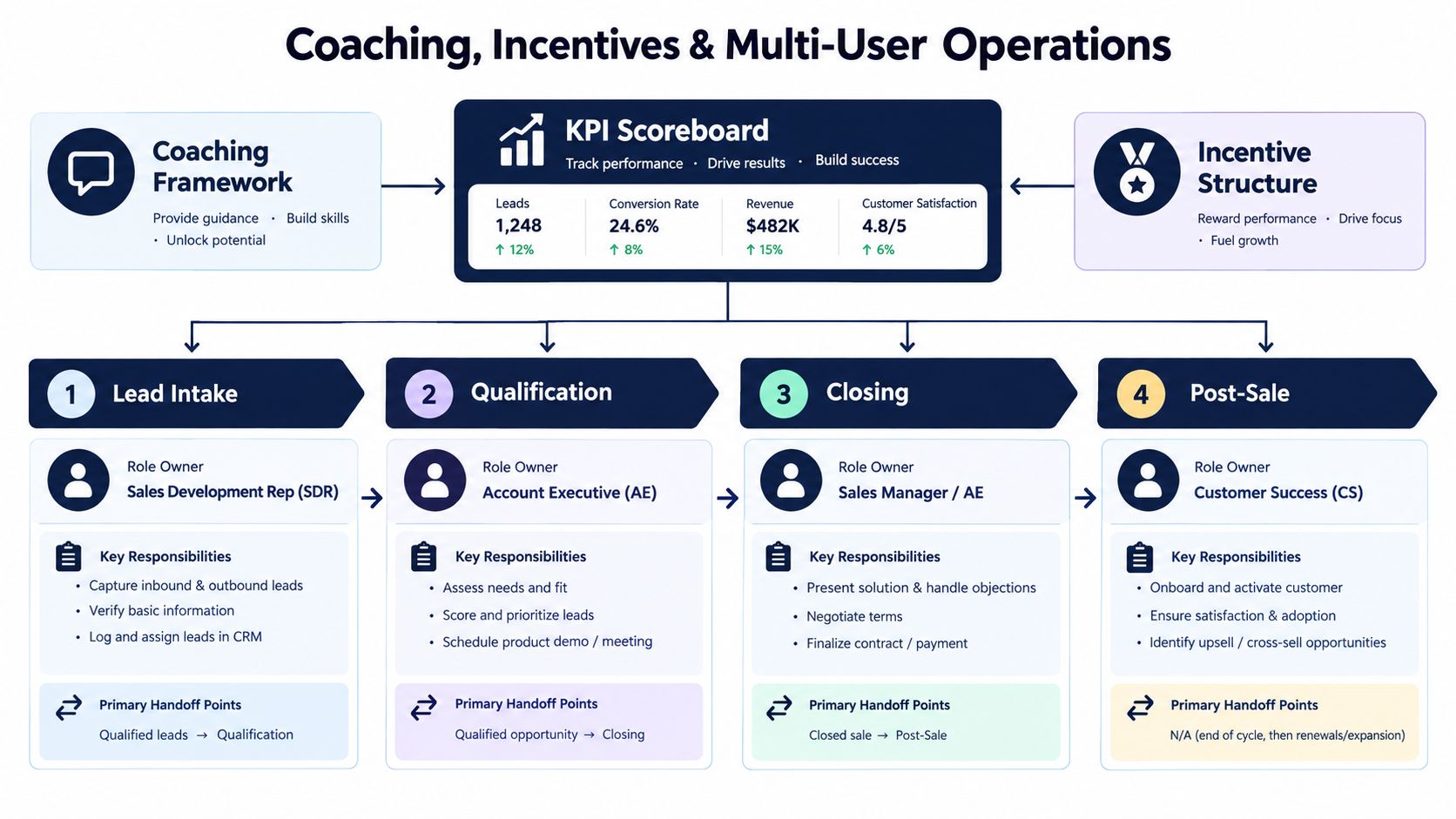
Coaching becomes effective when it reinforces the operating model rather than acting as a separate motivational program. Managers should coach the same stage yields, response behaviors, qualification standards, and follow-up commitments that appear on the scorecard.
Assign ownership before adding headcount
Multi-user operations need explicit ownership:
- Lead intake: Owns capture, enrichment, deduplication, and routing.
- Qualification: Confirms fit, need, timing, stakeholders, and commercial potential.
- Closing: Owns discovery depth, proposal quality, negotiation, and forecast accuracy.
- Post-sale: Owns onboarding, retention signals, expansion identification, and feedback.
Each handoff needs an acceptance condition. If the closer receives a lead without a verified business problem or next step, the workflow has transferred a record, not an opportunity.
Run a weekly pipeline review from a one-page scorecard. Include activity ratios, stage conversion, deal velocity, forecast confidence, overdue next steps, and notable risks. The manager should select a small number of deals for inspection, ask what evidence supports the current stage, and agree on the next buyer action. A status meeting asks for updates. A coaching review improves decisions.
Design compensation around desired behavior
Compensation changes behavior because it changes the economic value of effort. A 2011 Journal of Marketing Research finding, reflected in a University of Texas-hosted paper preview, reported that a commission plan increased sales force productivity by approximately 24% compared with a bonus plan.
That result doesn't mean commission is automatically right for every team. A heavily variable plan can increase urgency while raising churn risk. A base-plus-bonus model can support ramp and retention but may reduce the ceiling for exceptional performance. Team overlays can encourage collaboration and reduce free-rider behavior, but they can also blur individual accountability.
A practical structure might combine a stable base with individual commission, an accelerator above 100% of quota, a targeted SPIFF for new-logo or expansion deals, and non-cash recognition for behaviors such as clean handoffs, strong qualification, or useful peer coaching. Publish the rules before the period begins. Define treatment for discounts, split credit, cancellations, renewals, and shared opportunities.
Coach the moment, not the calendar
Weekly one-to-ones should use call recordings, live opportunities, and one observable skill. Lost-deal teardowns should focus on the point where the opportunity became unrecoverable, not on assigning blame. Monthly drills can rotate through discovery, objection handling, proposal framing, negotiation, and close planning.
Track ramp at week 4, week 8, and week 12 using leading indicators and quality checks. Don't judge a new rep only by closed revenue before the pipeline has had time to mature. Look for stronger qualification, faster follow-up, accurate CRM notes, improved stage movement, and increasing independence in deal decisions.
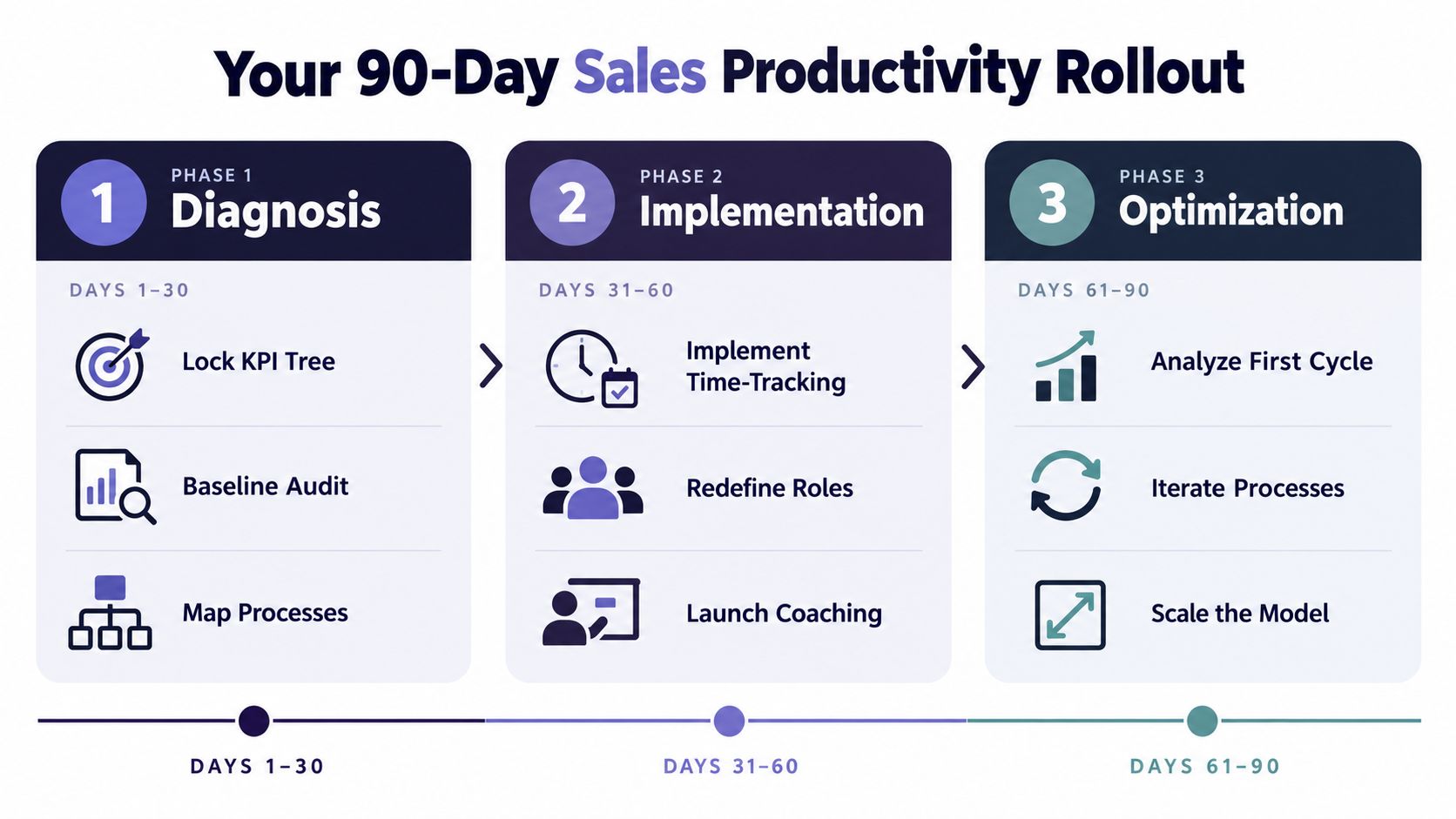
Your 90-Day Sales Productivity Rollout
A productivity overhaul fails when leadership tries to change compensation, routing, templates, dashboards, coaching, and tools in the same week. Sequence the work so each phase produces evidence for the next one.
Days 1 to 30 focus on diagnosis
Lock the KPI tree first. Define the outcome metrics, stage-level indicators, and leading behaviors that managers and reps will use. Baseline response time, stage conversion, time in stage, activity-to-meeting ratio, ramp velocity, and administrative load.
Map every workflow from lead creation to post-sale handoff. Interview reps about workarounds, inspect CRM records, and identify the three highest-cost bottlenecks by reach and commercial impact. Don't automate a process until you know which steps are necessary and which exist only because the system is incomplete.
Run controlled diagnostic tests rather than broad changes. For example, compare a fast-response queue with the existing routing process, or test whether better profile positioning improves the quality of marketplace opportunities. Record the hypothesis, owner, start date, success metric, and decision rule.
Days 31 to 60 focus on redesign
Build the template vault around the messages reps already send. Turn on lead enrichment and routing where the data supports it. Add timers and escalation paths so a hot prospect can't sit unowned. Finalize role contracts for intake, qualification, closing, and post-sale work.
Managers need training on the new pipeline scorecard before they enforce it. Reps need examples of acceptable notes, stage-entry criteria, proposal standards, and handoff information. If compensation is changing, show the calculation logic with realistic scenarios and give the team a clear transition policy.
Watch speed-to-lead, stage conversion, activity-to-meeting ratio, and ramp velocity during this phase. A dashboard should show trend lines, owner, current value, baseline, and next intervention. Leadership needs enough detail to remove blockers, not enough detail to micromanage every call.
Days 61 to 90 focus on activation
Run the first complete coaching cycle. Launch two controlled experiments weekly, such as a response-time test, a multi-touch follow-up sequence, or a profile optimization variant. Keep the testing disciplined. Change one meaningful variable, preserve a comparison group where possible, and judge success by qualified pipeline and revenue progression rather than superficial activity.
Retire templates, alerts, and automations that don't move the selected metrics. Keep the process simple enough that a new rep can understand it during onboarding. Document the final operating model, including stage definitions, ownership, meeting cadence, compensation rules, exception handling, and dashboard definitions.
Three failure modes deserve special attention:
- Over-automation: Teams automate before mapping the workflow and create faster confusion.
- Compensation distrust: Leaders change the plan before reps understand or trust the measurement.
- Optional coaching: Managers treat the review cadence as extra work, so old habits return.
Earlybird AI fits one specific workflow option for agencies that sell through Upwork. It can search for matching projects, draft and submit personalized proposals, reply to client messages, follow up, and support call booking, while providing analytics, profile optimization, and multi-user workflows. Evaluate it like any other system, against response speed, qualified replies, booked calls, and closed business.
If your team loses selling time to slow routing, repetitive proposals, scattered follow-up, or multi-user Upwork coordination, Earlybird AI can automate matching, proposals, replies, follow-ups, and call booking within that workflow. Visit the platform to assess whether its analytics and agency workflows fit your 90-day sales productivity plan.