← Back To Blog
The Top 12 Best Software for Advertising Agency Growth in 2026

Running a successful advertising agency is less about individual heroics and more about the systems that power your team. The right software for an advertising agency can automate tedious tasks, provide critical insights, and free up your most valuable resource: your team's creativity. Your technology is the engine of your growth, from winning new business to delivering stunning client reports.
But with thousands of tools available, how do you build a stack that delivers profitability and efficiency without creating a monster of subscriptions? This guide cuts through the noise. We have assembled a curated list of essential tools covering key agency functions, from project management and CRM to creative automation and media buying.
Inside, you will find an honest look at what each platform does best, where it falls short, and who it's truly for. We provide screenshots, direct links, and practical insights to help you make informed decisions. We'll explore platforms that help with everything from new business automation, like Earlybird AI for Upwork, to comprehensive campaign management with tools like HubSpot and Teamwork.com. Our goal is to help you build a more streamlined, scalable, and profitable agency by choosing the technology that fits your specific needs.
1. Earlybird AI
For advertising agencies looking to build a consistent and scalable client pipeline from Upwork, Earlybird AI serves as a powerful, always-on sales automation engine. It moves far beyond simple job searching, handling the entire lead generation cycle from initial outreach to a booked meeting. The platform connects to your agency's Upwork account, learns your ideal project criteria through simple feedback, and then automatically submits personalized proposals, often within 10 minutes of a job being posted.
What distinguishes Earlybird as premier software for advertising agencies is its end-to-end automation. It doesn't just send proposals; it manages client replies, follows up on conversations, and shares your calendar to book calls. This frees your team from the manual, time-consuming work of prospecting, allowing them to focus on closing deals and delivering for clients. Features are built specifically for agency workflows, including multi-user support, real-time analytics dashboards, and profile optimization tools. Every account is also paired with a dedicated 1:1 Success Agent to ensure rapid onboarding and strategy alignment. With case studies showing doubled pipelines in weeks and one agency hitting $1M ARR in under 90 days, its impact is measurable.
Key Strengths & Use Cases
- Full-Cycle Sales Automation: Automates job discovery, proposal submission, message replies, follow-ups, and meeting scheduling. It's an ideal replacement or augmentation for a human Sales Development Representative (SDR) focused on Upwork.
- Rapid Response Advantage: By submitting proposals in minutes and replying to messages almost instantly, it secures a top spot in the client's inbox, significantly boosting reply rates (typically 12%+).
- Agency-Focused and Scalable: Supports multiple users under one agency, provides deep analytics on performance, and is built on secure AWS infrastructure that mimics human behavior to maintain account safety.
Limitations
- Premium Investment: Pricing is not public and is positioned as a higher-ticket solution. Agencies should book a demo to confirm the ROI aligns with their budget and growth goals.
- Requires Initial Guidance: The AI's effectiveness depends on the quality of your Upwork profile and the initial training you provide by rating jobs. Consistent oversight is needed at the start to fine-tune its performance.
While there is no public pricing, many users report that the cost is covered by landing just one new client. If your agency is serious about making Upwork a primary channel for new business, Earlybird AI provides the technology and support to achieve that at scale. You can explore a related list of essential tools and find more context on the role of automation in our guide to software for a digital marketing agency.
Website: myearlybird.ai
2. HubSpot Marketing Hub
HubSpot Marketing Hub acts as an all-in-one platform where advertising agencies can manage client campaigns from lead capture to final reporting. It centralizes critical marketing functions, allowing an agency to run email campaigns, build landing pages, manage ad integrations, and track client pipelines within a single system. This makes it a strong choice when you need campaign automation directly connected to a robust CRM.
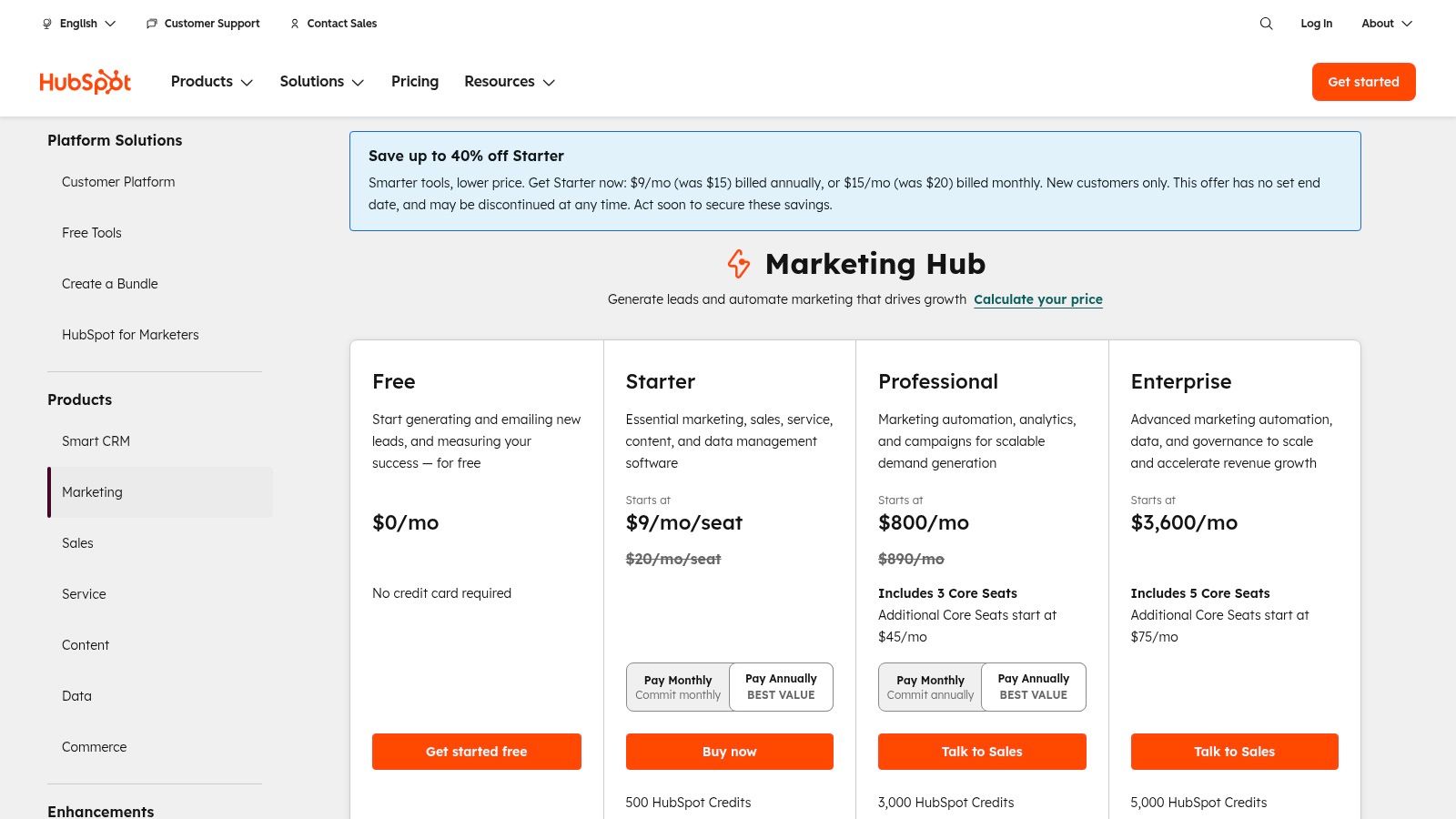
The platform stands out by integrating its marketing automation tools directly with CRM data. For instance, an agency can create a lead-capture form on a client's landing page, and the submitted information automatically creates a contact record. This contact can then be segmented for targeted ads on Google, Meta, or LinkedIn using HubSpot's native ad integrations. For agencies that need to provide clients with a transparent view of their growth efforts, HubSpot’s permission settings and team features facilitate direct collaboration. Finding the right CRM is a key decision, and you can explore more options to determine the best CRM for agencies to support your specific client service model.
Key Features & Considerations
- Pros: The platform is backed by a mature ecosystem with extensive free training (HubSpot Academy) and a large partner marketplace for integrations. It scales effectively from small agency teams to larger enterprise needs. Bundling the Marketing Hub with the Sales or Service Hub can also reduce the total cost of ownership if you require those functions.
- Cons: The pricing structure, which is based on both marketing contact tiers and paid user seats, can become complex and lead to unexpected costs at renewal. Setting up advanced features like custom objects and attribution reporting requires a significant time investment and technical know-how.
Website: https://www.hubspot.com/pricing/marketing
3. Sprout Social
Sprout Social is an agency-focused social media management tool designed for publishing, engagement, listening, and reporting across multiple client accounts. It centralizes social media workflows by offering a unified inbox for all networks, a shared content calendar, and client-ready analytics. This makes it a go-to solution for agencies that need to manage several brand presences efficiently while maintaining brand safety through approval workflows.
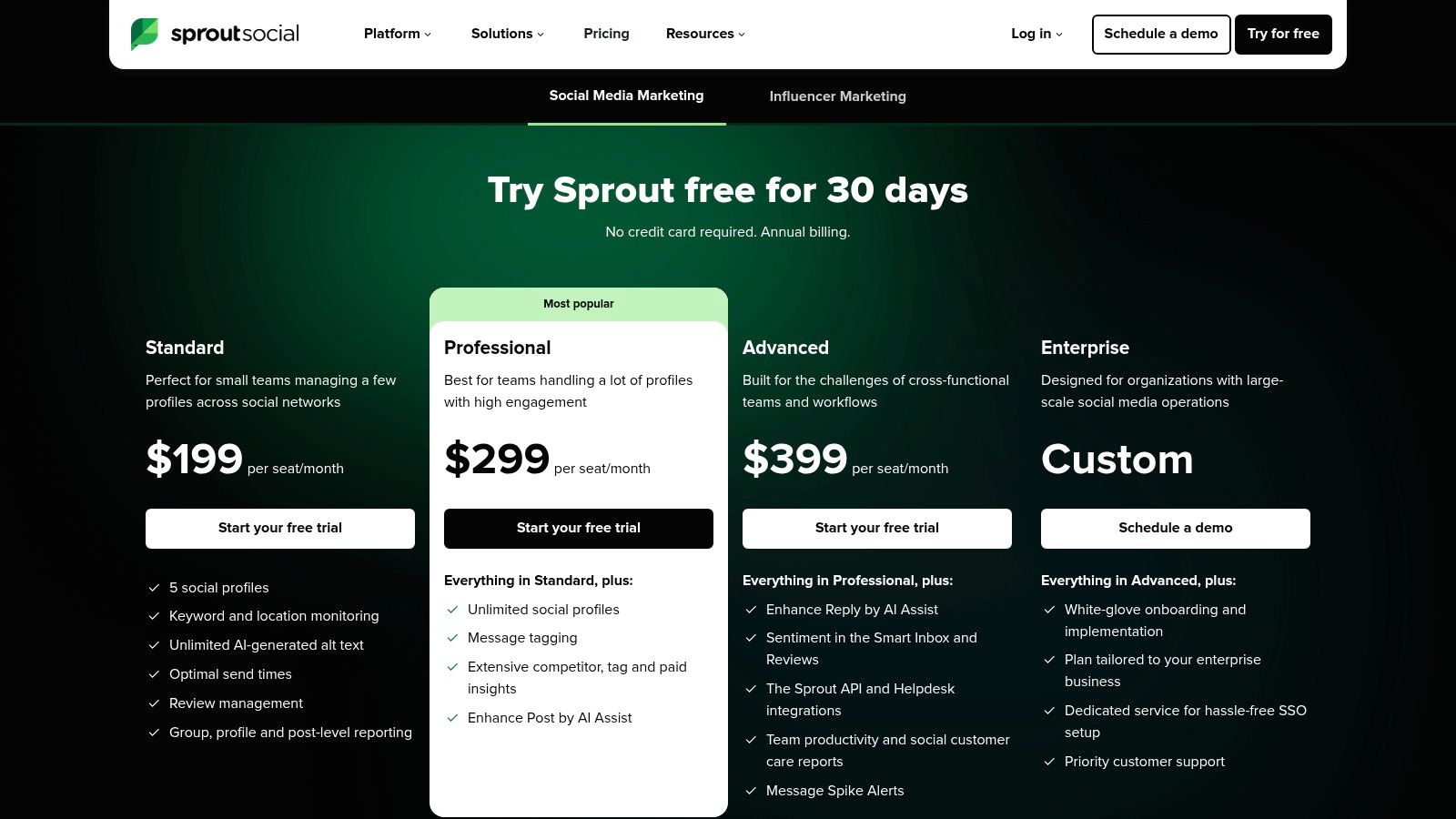
The platform’s strength lies in its reporting capabilities and agency-specific features. Agencies can use the Unified Smart Inbox to engage with comments and messages across all client profiles from one place. The scheduling tools include an asset library and approval queues, ensuring content is vetted before going live. For agencies needing to prove the value of their social media efforts, Sprout’s presentation-ready reports can be automatically generated and sent to clients, offering a clear view of performance. This level of organization makes it a strong piece of software for an advertising agency managing complex social media campaigns.
Key Features & Considerations
- Pros: The platform offers straightforward, seat-based pricing to test its full functionality. Its reporting depth is a major advantage, providing stakeholder-friendly exports that clearly communicate campaign results.
- Cons: The per-user pricing model can become expensive for larger or growing agency teams, requiring careful budget planning. Advanced social listening and influencer identification tools are restricted to the more expensive tiers, limiting access for agencies on the standard plan.
Website: https://sproutsocial.com/pricing/
4. Teamwork.com
Teamwork.com is a project and team management platform built specifically with client service businesses, like advertising agencies, in mind. It directly connects project tasks to core financial metrics such as time tracking, budgets, and invoicing. This allows an agency to maintain a clear line of sight on project profitability and resource allocation, moving beyond simple task management to provide a full picture of operational health.
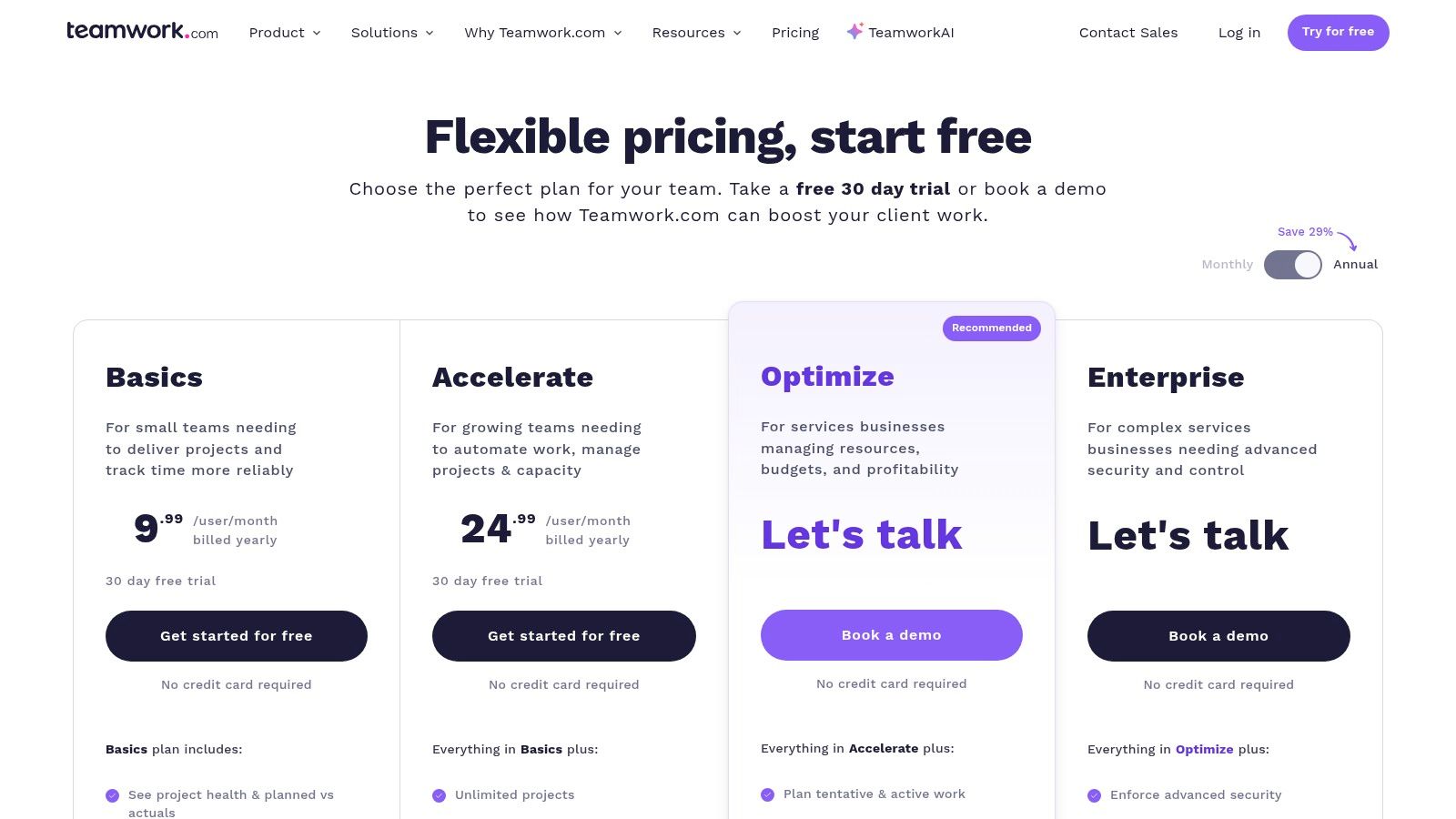
The platform’s strength lies in its focus on billable work. Agencies can create project templates for recurring campaigns or creative deliverables, ensuring process consistency. A standout feature is the client user functionality, which provides branded portals where clients can review progress, approve assets, and communicate with the team. This controlled transparency helps build trust without giving clients access to internal conversations. For agencies looking to improve their financial operations, understanding the fundamentals of how marketing agencies make money is crucial for setting up this kind of software for success.
Key Features & Considerations
- Pros: Being purpose-built for agencies means its features are directly relevant to managing billable work and client relationships. The granular permission controls are excellent for collaborating with clients and freelancers while protecting sensitive internal information. Strong integrations with tools like Slack and Google Drive keep workflows connected.
- Cons: Accessing the most valuable profitability and resource management reports requires subscribing to the higher-priced tiers. The platform's depth and extensive feature set can create a steeper learning curve for team members who are not project managers, potentially slowing down initial adoption.
Website: https://www.teamwork.com/pricing/
5. AgencyAnalytics
AgencyAnalytics is a reporting and client-portal platform designed specifically to address the reporting bottlenecks that plague many advertising agencies. It connects with over 80 marketing integrations, allowing teams to pull data from sources like Google Ads, Meta, and GA4 into a single, cohesive view. This makes it an ideal piece of software for advertising agency teams that spend hours each month manually compiling PPC, SEO, and social media reports for clients.
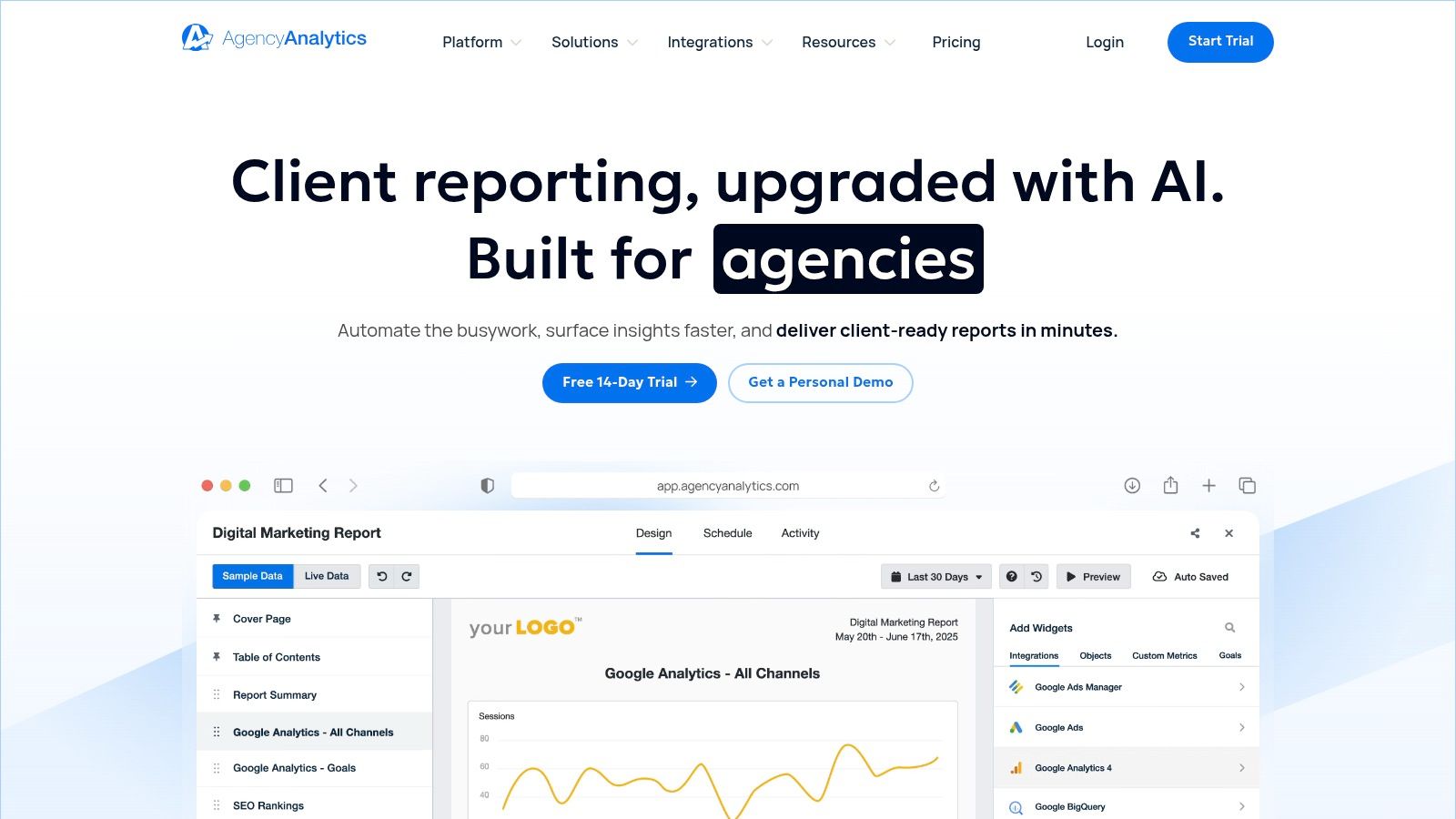
The platform’s strength lies in its agency-centric workflows and white-labeling capabilities. An agency can create a fully branded client portal with custom dashboards, logos, and color schemes, giving clients a professional, self-service way to check campaign progress. Automated report scheduling further reduces administrative overhead by sending out PDF reports on a daily, weekly, or monthly basis without manual intervention. For agencies needing to prove ROI clearly and consistently, AgencyAnalytics provides a direct and efficient solution that consolidates performance metrics and simplifies client communication.
Key Features & Considerations
- Pros: The setup is remarkably fast, significantly reducing the time required to generate and send reports. It offers agency-specific features like staff and client role controls, plus unlimited dashboards on higher-tier plans, which supports growing client rosters.
- Cons: While it excels at aggregating data, teams needing deep custom data blending or complex analysis may still find a dedicated business intelligence tool necessary. Certain valuable features and add-ons, such as the SEO rank tracker and database connectors, are billed separately, which can increase the total cost.
Website: https://agencyanalytics.com/
6. TapClicks
TapClicks is a marketing operations and reporting platform designed for agencies managing numerous clients across a wide array of data sources. It centralizes performance data into unified dashboards, client portals, and automated reports, helping agencies scale their reporting without the heavy manual lift. This makes it an ideal software for advertising agency teams that need to consolidate analytics from platforms like Google Ads, Meta, and various SEO tools into a single, cohesive view.
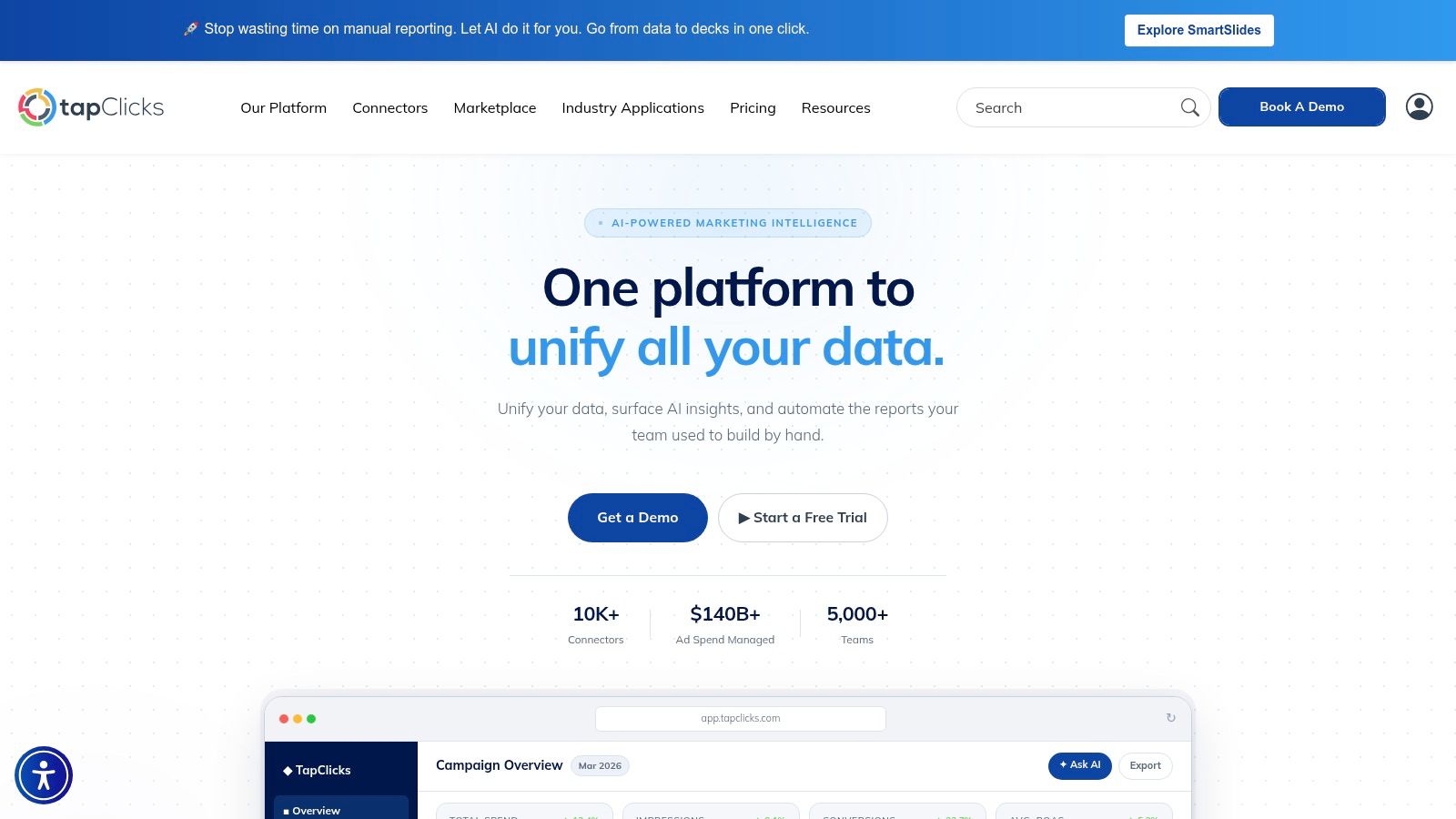
The platform’s strength lies in its extensive library of over 250 managed API connections, which ensures data from disparate marketing channels is pulled consistently and accurately. Agencies can create fully white-labeled dashboards that reflect their own branding, giving clients a professional and seamless experience. With features like automated report scheduling and a dedicated Report Studio, account managers can move away from building presentations in spreadsheets and slides, instead delivering real-time insights through secure client portals. The ability to centralize and enrich data with its TapData services also allows for deeper, more customized analysis beyond standard platform metrics.
Key Features & Considerations
- Pros: TapClicks excels at scaling reporting operations across a large client roster and supports deep agency branding on all client-facing assets. The automation significantly reduces the time spent on manual data gathering and report creation.
- Cons: Pricing is not publicly listed and typically requires a custom quote, which can be a barrier for smaller agencies needing transparent costs. The platform is more robust than simple reporting tools, meaning it can present a steeper learning curve and may be overly complex for teams with basic needs.
Website: https://www.tapclicks.com/
7. Adverity
Adverity is an enterprise-level data integration platform designed for advertising agencies that need to consolidate complex marketing data at scale. It acts as a powerful ETL/ELT (Extract, Transform, Load) engine, pulling information from over 600 advertising, analytics, and commerce sources into a unified data warehouse. This makes it an essential piece of software for advertising agency teams responsible for managing and standardizing performance reporting across dozens or hundreds of client accounts.
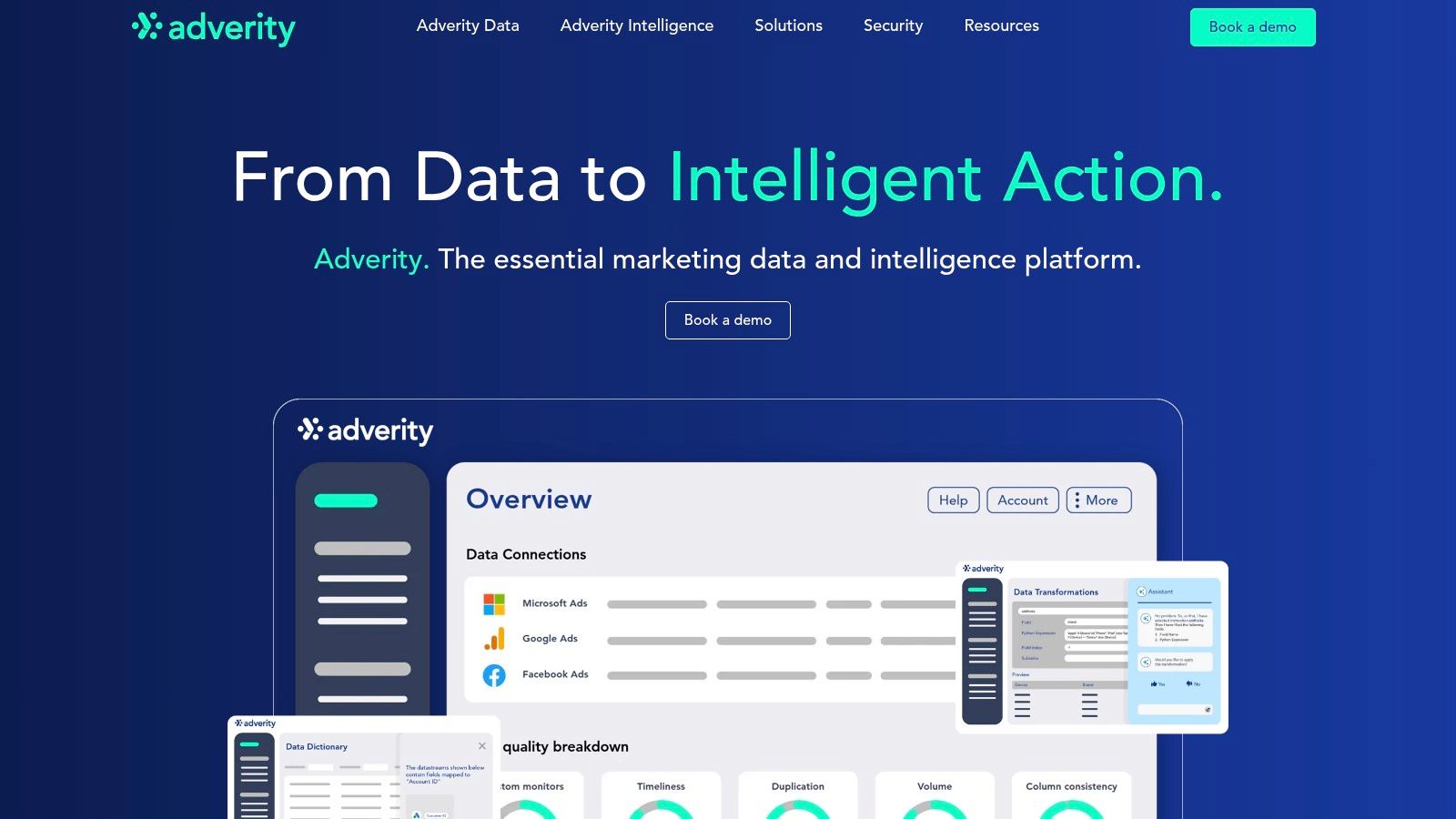
The platform’s strength lies in its ability to automate the entire data pipeline, from ingestion to transformation and loading into a destination like BigQuery, Redshift, or Snowflake. Instead of manually downloading CSVs from multiple ad platforms, an agency can set up automated connectors that normalize disparate metrics (e.g., aligning "clicks" from Google Ads with "link clicks" from Meta). This allows for the creation of a single source of truth for all client campaign data, which can then be fed into external business intelligence tools like Looker Studio or Power BI for custom dashboard creation. Adverity is best suited for agencies that are building a centralized data practice to deliver advanced analytics and insights.
Key Features & Considerations
- Pros: The extensive library of pre-built connectors is robust and well-maintained, significantly reducing the engineering overhead required to build and manage custom API integrations. Its data governance and transformation capabilities are ideal for creating a centralized data spine that serves the entire agency.
- Cons: Pricing is entirely custom and geared toward the mid-market and enterprise segments, making it less accessible for smaller agencies. The platform requires significant data maturity and dedicated technical resources for initial setup and ongoing management, as it does not include its own front-end visualization layer.
Website: https://www.adverity.com/
8. StackAdapt
StackAdapt is a self-serve programmatic demand-side platform (DSP) that allows advertising agencies to plan, execute, and manage data-driven campaigns across multiple channels. It consolidates buying for display, native, video, connected TV (CTV), audio, and in-game advertising into one interface, eliminating the need to manage several disparate platforms. This makes it an ideal piece of software for an advertising agency looking to scale its programmatic offerings without the operational complexity of enterprise-level DSPs.
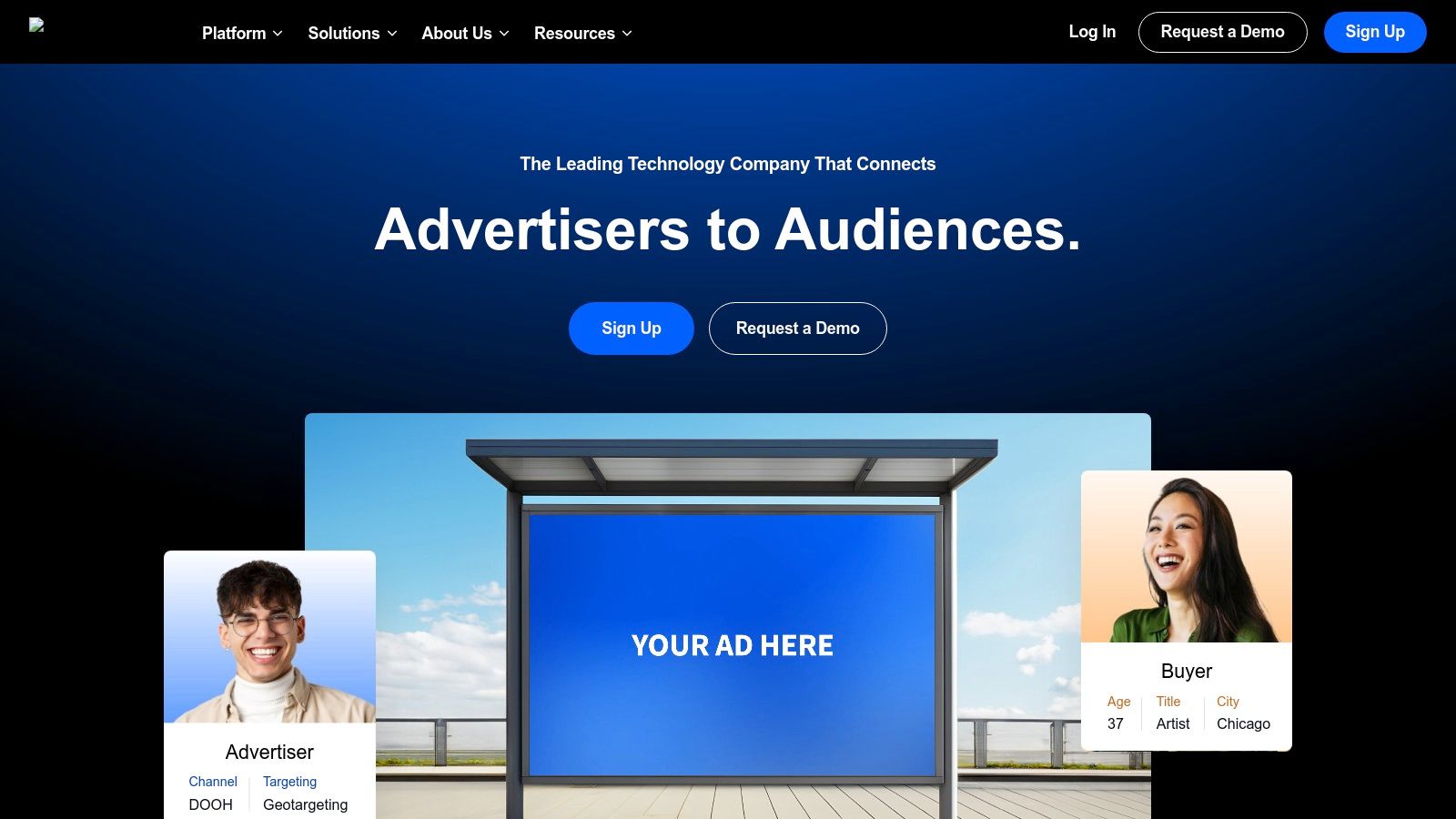
The platform is recognized for its intuitive user experience and strong agency support, which includes extensive educational resources through StackAdapt Academy. Agencies can activate campaigns using a mix of audience, contextual, and geo-targeting options, with AI-powered algorithms working to optimize performance toward campaign goals. It also includes a creative studio to help build dynamic ad formats, giving agencies the tools to produce engaging assets directly within the platform. For teams that need to run sophisticated, omnichannel digital ad campaigns, StackAdapt provides a powerful yet accessible solution.
Key Features & Considerations
- Pros: The agency-friendly interface and comprehensive onboarding resources lower the barrier to entry for programmatic advertising. Its broad channel coverage, including emerging formats like in-game and digital out-of-home (DOOH), allows agencies to offer clients a complete media mix from a single tool.
- Cons: Pricing is based on media spend (CPM/CPC/CPE) rather than a flat SaaS fee, so costs are directly tied to campaign budgets. Accessing advanced measurement features like incrementality studies may require working with external partners, adding another layer of coordination and cost.
Website: https://www.stackadapt.com/
9. Basis (Basis Technologies) — Basis Platform
Basis Platform is an omnichannel demand-side platform (DSP) and media workflow automation tool designed to consolidate the entire ad campaign lifecycle. It centralizes everything from media planning and cross-channel activation to performance measurement and billing reconciliation. This makes it an ideal software for advertising agency teams looking to collapse operational steps and automate the non-buying tasks that consume significant resources, such as trafficking and reporting.

The platform’s main strength is its ability to unify disparate media buying and operational functions into a single interface. An agency can plan a multi-channel campaign, activate programmatic, search, and social ads, and then generate a single invoice that reconciles all vendor costs automatically. This end-to-end workflow automation directly addresses the common agency challenge of managing multiple point solutions for different channels. The integrated dashboards and collaboration portal also provide teams with a unified view of campaign progress and documentation, simplifying approvals and communication.
Key Features & Considerations
- Pros: The operational automation significantly reduces time spent on manual trafficking, quality assurance, and billing tasks. It offers a single environment for coordinating complex media buys and managing multiple vendor relationships, improving efficiency.
- Cons: As an enterprise-leaning platform, onboarding requires a substantial commitment to process change and training. The custom pricing model may not be accessible for agencies with very small or unpredictable media budgets.
Website: https://basis.com/
10. Skai (formerly Kenshoo)
Skai operates as an enterprise-grade, omnichannel advertising platform tailored for performance-focused agencies managing large-scale campaigns. It provides a unified system for planning, executing, and optimizing retail media, search, and social advertising. Agencies use Skai to manage complex, cross-channel strategies, making it a valuable piece of software for an advertising agency dealing with significant ad spend across multiple publishers.
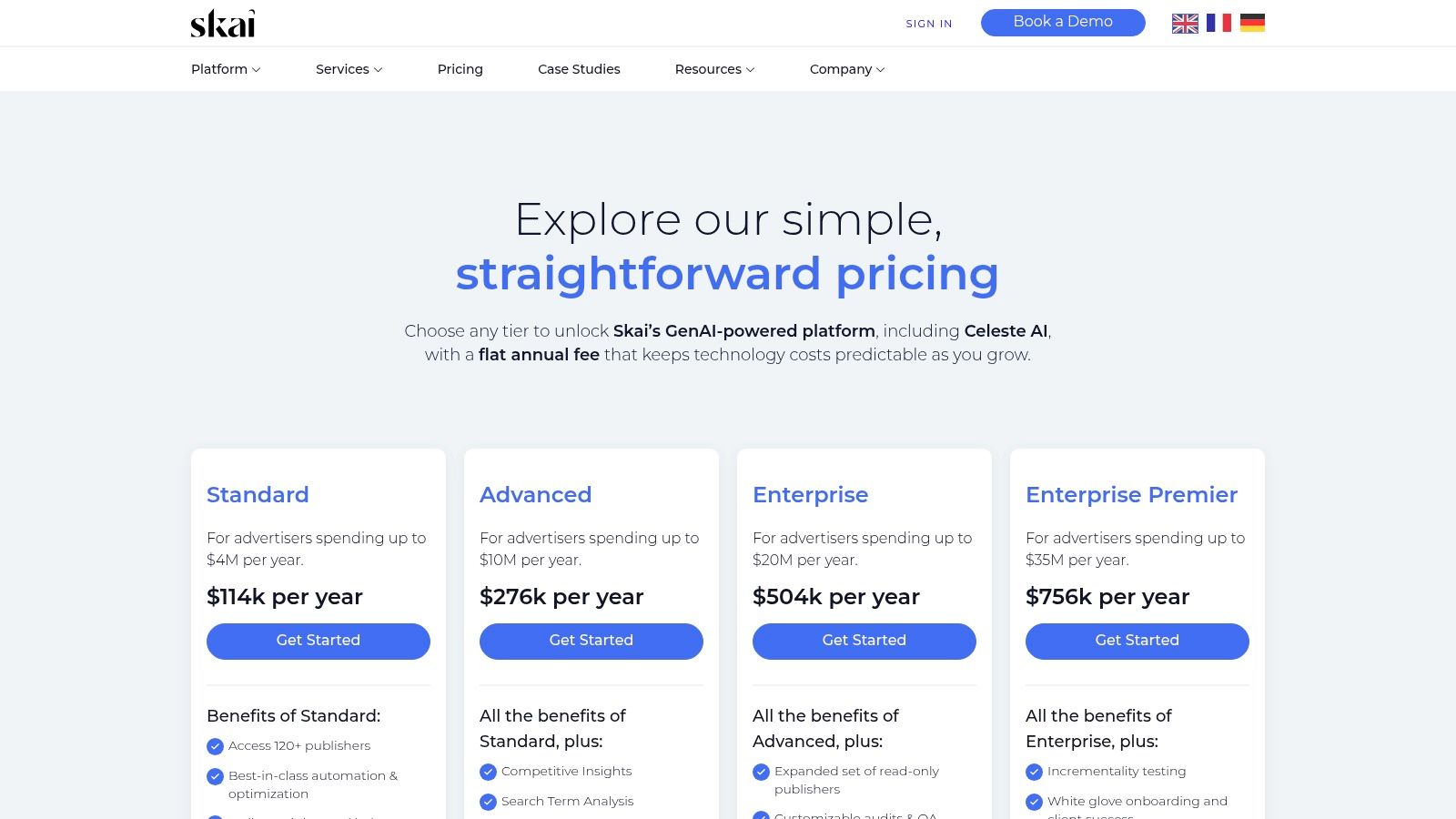
The platform’s strength lies in its deep integrations with over 120 publishers, including major retail media networks, which allows for centralized budget pacing and performance analysis. For agencies needing to automate workflows, its generative AI agent, Celeste AI, helps with commerce media tasks, while its core automation tools handle bid management and creative optimization. The ability to conduct incrementality testing on upper-tier plans also gives agencies a powerful tool to prove the direct value of their media buys to clients.
Key Features & Considerations
- Pros: Skai offers published tiered annual pricing, which provides transparency for agencies planning their technology stack costs. Its robust, combined capabilities for retail media, search, and social campaigns within a single user interface reduce the need for multiple point solutions.
- Cons: The platform’s annual flat fees are substantial, making it most suitable for agencies managing clients with higher advertising budgets. To realize its full value, an agency must commit to adopting Skai’s cross-channel workflows end-to-end, which can require a significant operational shift.
Website: https://skai.io/pricing/
11. Celtra
Celtra is a creative automation and management platform designed to help advertising agencies produce on-brand, multi-format ads at scale. It connects creative production directly to media activation, allowing teams to build, iterate, and deploy campaigns much faster. The system is built around modular templates, making it an ideal piece of software for an advertising agency that manages complex, multi-market campaigns requiring hundreds of creative variations.
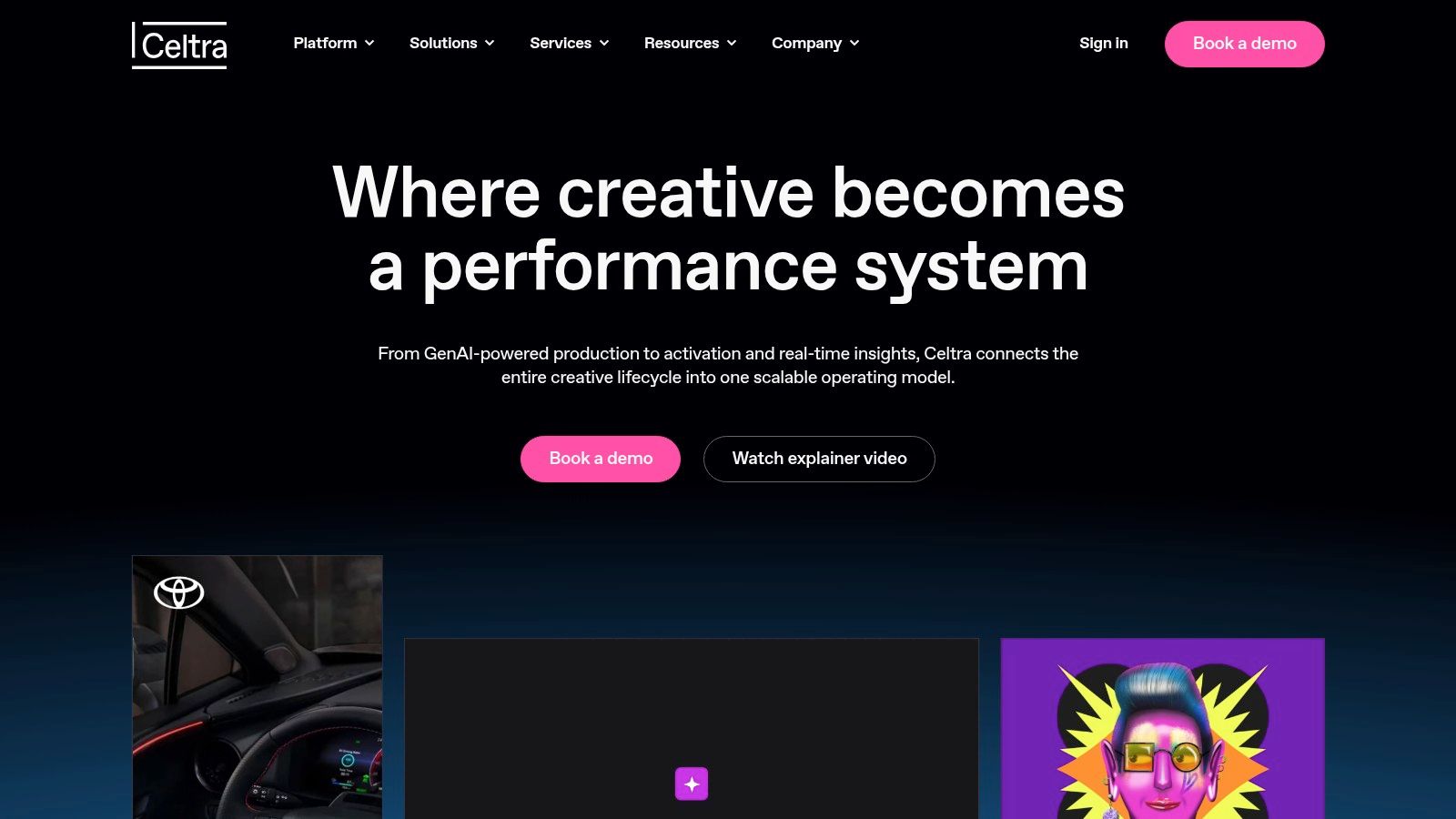
The platform’s strength lies in its ability to separate content from design, letting designers build flexible templates while copywriters or marketers populate them with dynamic content. For example, an agency can create a single video template and automatically generate dozens of localized versions for different regions, each with unique pricing, messaging, and calls to action. With built-in approval workflows and AI-assisted performance insights like the "Celtra Score," it brings creative and media teams together within one system to optimize ads based on real-world data.
Key Features & Considerations
- Pros: Celtra drastically reduces creative versioning time, a major benefit for global brands and their agency partners. Its strong enterprise adoption means it integrates well with established ad tech stacks and media buying platforms. The modular approach ensures brand consistency across a high volume of assets.
- Cons: Pricing is custom and typically geared toward enterprise-level budgets, which may be prohibitive for smaller agencies. To get the best return on investment, an agency must standardize its creative operations processes around the tool, which requires significant internal change management and training.
Website: https://celtra.com/
12. Smartly (formerly Smartly.io)
Smartly is a specialized platform for paid social and retail media, built for advertising agencies managing large-scale, multi-brand campaigns. It connects creative production directly with media buying and automation, allowing teams to create dynamic, feed-based ads and optimize them with rule-based workflows. This makes it a go-to software for advertising agency teams who need to deliver personalized social campaigns without manual overhead.
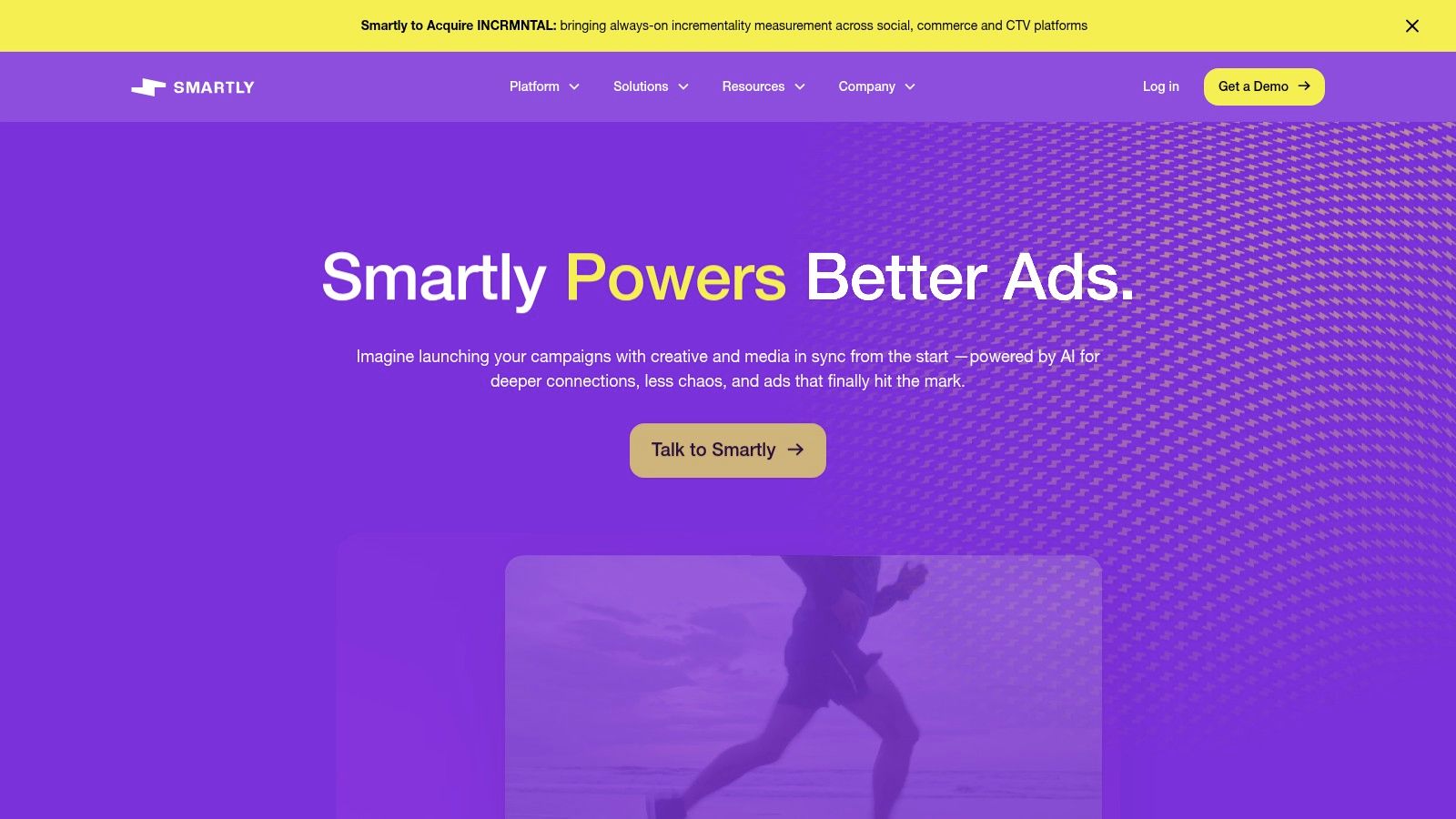
The platform’s strength lies in its ability to unify creative and media buying functions that are often siloed. For example, an agency can use Smartly’s dynamic creative templates to pull product information from a client’s catalog feed, automatically generating thousands of ad variations. These can then be tested and managed across platforms like Meta, Pinterest, and TikTok using a single interface. Its close partnerships with major social platforms often grant agencies early access to new ad formats and features, providing a competitive edge for their clients.
Key Features & Considerations
- Pros: Consolidates creative and media workflows, saving significant time on campaign production and management for social advertising at scale. Its agency certification and enablement programs help teams master the platform quickly. Strong partnerships ensure access to the latest ad tech features.
- Cons: The pricing model is not public and is often based on a percentage of ad spend with a monthly minimum, making it better suited for agencies with substantial social budgets. The platform has a specific focus on paid social and retail media, so it isn't an all-in-one solution for every marketing channel.
Website: https://www.smartly.io/
Building Your Agency's Ultimate Tech Stack
Selecting the right software for your advertising agency is a foundational decision that will echo through every part of your operation. It affects your team’s daily workflow, your ability to deliver exceptional client results, and ultimately, your agency's profitability. As we've explored, the market is filled with options, from specialized creative platforms like Celtra and Smartly to comprehensive campaign management systems like Skai and Basis Platform. The challenge isn't finding a tool; it's finding the right combination of tools that work together to form a cohesive operating system for your business.
The most effective approach is to avoid a "collect them all" mentality. Instead, start by conducting an honest internal audit. Pinpoint the single biggest bottleneck that is currently holding your agency back.
- Is it client acquisition? If your pipeline is dry and you're struggling to find qualified leads, a tool focused on business development is your top priority.
- Is it project chaos? If deadlines are slipping and profitability is a mystery, a robust project management system like Teamwork.com is essential.
- Is it reporting overload? If your team spends days manually pulling data for client reports, a dedicated analytics dashboard like AgencyAnalytics or TapClicks can provide an immediate return on investment.
Focus your initial investment on solving that primary pain point. This targeted strategy ensures you get a quick win and demonstrate the value of new software to your team, making future adoption much easier.
A Practical Implementation Strategy
Once you've identified your priority, the next step is choosing a core platform. For many agencies, the journey begins with either a CRM like HubSpot to manage relationships or a project management tool to organize the work itself. For those targeting specific platforms, a solution like Earlybird AI for Upwork can fundamentally change the sales process by automating lead discovery and proposal generation, freeing up your team for more strategic work.
When you select that first key piece of software for your advertising agency, consider its integration capabilities. The goal is to build a connected ecosystem, not a collection of isolated data silos. A project management tool that syncs with your financial software, or an ad management platform that feeds data directly into your reporting dashboard, creates an environment where information flows freely. This automation eliminates redundant data entry, reduces human error, and provides a single source of truth for your agency's performance.
From there, you can build outwards. After solving your biggest issue, identify the next most pressing challenge and find a tool that integrates with your existing stack. This incremental, problem-focused approach ensures every piece of software you add has a clear purpose and contributes directly to a more efficient, profitable, and scalable agency. The ultimate tech stack isn't about having the most expensive or feature-rich tools. It's about having an intelligent, interconnected system that empowers your team to do what they do best: create brilliant advertising that drives real growth for your clients.
Ready to fix your client acquisition bottleneck and fill your pipeline with high-quality leads from the world's largest freelance marketplace? Earlybird AI is the essential piece of software for any advertising agency looking to dominate Upwork by automating lead discovery and getting you in front of ideal clients first. Stop wasting time manually searching for jobs and start winning more business today with Earlybird AI.