
← Back To Blog
Start: A Practical Guide to start social media agency
Before you even think about landing your first client, you need to get your own house in order. Seriously. The temptation to just dive in and start prospecting is huge, but without a solid plan, you're setting yourself up for a world of pain.
This foundational blueprint—who you serve, what you sell, and how you charge for it—is completely non-negotiable. It’s what separates the agencies that thrive from those that burn out.
Defining Your Agency's Foundation

Resist the urge to jump straight into client hunting. Building a real, sustainable business starts with getting these fundamentals right. A clear foundation brings focus to your marketing, attracts the right clients, and makes it way easier to scale later on.
The truth is, the most successful agencies don't try to be everything to everyone. They build a reputation by specializing, creating clear offers, and using a pricing structure that actually supports their growth. Let's dig into the three pillars that will hold up your new agency.
Carve Out Your Profitable Niche
This is probably the single most important decision you'll make. A niche isn't just an industry; it's the specific corner of the market where you can become the undisputed go-to expert.
Generalist agencies get lost in the noise. They're constantly competing on price and struggling to prove their value. Specialists, on the other hand, can charge premium rates because they bring proven, specific expertise to the table.
Don't just think "restaurants" or "real estate." Get specific.
- Instead of all e-commerce stores, you could focus on Shopify brands in the sustainable fashion space.
- Instead of all local businesses, you could specialize in marketing for high-end dental practices or boutique fitness studios.
Here are a few ways to think about niching down:
- Industry-Specific: B2B SaaS, home service contractors (plumbers, HVAC), or legal firms.
- Platform-Specific: You could become the absolute master of TikTok marketing for DTC brands or LinkedIn lead generation for consultants.
- Service-Specific: Maybe your agency only does paid social advertising (Facebook & Instagram Ads), or maybe you stick to organic community management and content.
If you have a genuine interest or past experience in a certain area, lean into it. That's your unfair advantage. You'll speak the client's language, understand their pain points, and deliver results that actually move the needle for them. While this is crucial for social media, the same idea holds true if you're starting an SEO agency, where specialization is just as critical.
Build Irresistible Service Packages
Once you know who you're serving, you need to define what you're selling. The worst thing you can do is present a potential client with a massive, confusing menu of one-off services. It's overwhelming.
Instead, bundle your services into clear, tiered packages. This approach solves specific client problems and naturally guides them to the right solution.
A simple three-tiered structure is a great place to start. Here’s a look at how you might structure your offerings to make the sales process smoother for both you and your future clients.
Core Service Packages for a New SMMA
This packaged approach simplifies your sales conversations and makes it crystal clear what a client gets at each price point. No confusion, just value.
Clarify the Pricing Puzzle
Pricing can feel like a guessing game, but it doesn't have to be. Your goal is to find a model that gives you predictable revenue while delivering obvious value to your clients.
For most new agencies, the monthly retainer is the gold standard. Clients pay you a flat fee every month for a set scope of work. It’s perfect for ongoing social media management and gives you the stable cash flow you need to grow.
Other options include:
- Project-based fees: Great for one-off jobs like a product launch campaign or a social media audit.
- Performance-based models: You might take a percentage of ad spend or a bonus for hitting certain goals. This can be very profitable, but it's best to wait until you have a solid track record.
The demand for these services is exploding. The global social media ad market is on track to blow past $276 billion, and with businesses seeing an average ROI of $5.20 for every $1 spent, they are more than willing to pay for expert help. This isn't a shrinking pie; with the right foundation, there's more than enough opportunity to build a seriously profitable agency.
Building Your Client Acquisition Machine

Let's be real: amazing service packages don't pay the bills. Without clients, your new agency is just a well-documented business plan. The key to moving from a hobby to a thriving business is building a predictable, repeatable system for finding and closing new clients.
You need a machine that constantly feeds you opportunities, even while you're busy delivering fantastic work for your current partners. This isn't about one-off wins; it's about creating a consistent flow of leads that turns into booked meetings and signed contracts. That's the engine that will drive your growth.
Use Upwork as Your Launchpad
When you're just starting, your personal network might be thin and your marketing budget even thinner. This is where a platform like Upwork becomes your best friend. Instead of spending weeks trying to find leads, you can tap into a live marketplace where clients are actively searching for exactly what you sell.
Don't think of it as a place for cheap, one-off gigs. High-value clients are on Upwork every day, looking for long-term agency partners they can trust. Your mission is to craft a profile that makes it impossible for them to ignore you.
- Be hyper-specific in your headline. Ditch "Social Media Manager." Instead, try "TikTok Ad Strategist for D2C Fashion Brands."
- Talk results, not tasks. Nobody cares that you can "post on Instagram." They care that you "help sustainable e-commerce brands scale their revenue through targeted Meta ad campaigns that deliver a 3x ROAS."
- Show, don't just tell. Build out 2-3 detailed case studies. Break down a client's problem, your strategy, how you executed it, and—most importantly—the measurable results you delivered.
Top-rated agencies on the platform know that a killer profile is directly tied to getting invited to the best jobs. According to Upwork's own data, agencies with detailed profiles, compelling case studies, and specialized skills can see up to 50% more invites to high-value projects. It’s worth spending time getting this right, and Upwork has a great guide on creating a powerful freelancer profile that breaks it all down.
The Unfair Advantage of Speed
On a competitive marketplace like Upwork, speed is everything. The first handful of proposals are the ones that get the most attention. If you’re the tenth or twentieth applicant, your brilliant pitch might never even get seen.
The truth is, clients are often in a hurry. They're looking to solve a problem now, and they'll almost always review the first qualified applicants who show up. Being first isn't a small edge; it's often the deciding factor.
The numbers back this up. Proposals sent within the first hour of a job posting have a staggering 65% higher view rate. You can’t manually refresh the job feed 24/7 and write custom proposals in minutes. It's just not humanly possible. This is where you need to bring in the robots.
Automate Your Outreach to Scale Effortlessly
What if you had a sales rep working for you around the clock? One that found the perfect projects, drafted a compelling, personalized proposal, and sent it just minutes after the job was posted. That's exactly what sales automation can do for you.
Tools like Earlybird AI are designed for this. You essentially train an AI on your ideal client and project criteria, and it handles the tedious grind of prospecting and bidding.
Here’s what that looks like in practice:
- You're always first in line. The system can fire off a proposal in as little as 10 minutes, putting you at the very top of the client’s list.
- You get personalization at scale. It doesn't send generic templates. The AI crafts a unique proposal for every job, pulling key details from the client’s description to show you actually read it.
- You wake up to booked meetings. By automating the initial outreach, your calendar starts filling up with discovery calls. You can finally stop prospecting and start closing.
This isn't about spamming. It's about using technology to execute a perfect outreach strategy with superhuman speed and consistency. By setting up this kind of system, you build that client acquisition machine we talked about—one that frees you up to focus on what you're actually good at: getting incredible results for your clients.
To see how this works in more detail, take a look at this guide on what is sales automation and how it can completely change your agency's trajectory.
Designing Bulletproof Systems and Workflows
If you're constantly putting out fires, you're not growing. To build a social media agency that can actually scale, you need an operational backbone—solid, repeatable systems that work every single time. Without them, each new client just adds another layer of chaos.
These systems aren't just about keeping things tidy. They’re about delivering a consistent, professional experience that makes clients feel secure from day one. Good systems cut down on mistakes, eliminate bottlenecks, and pull you out of the day-to-day grind so you can focus on steering the ship.
Engineering a Seamless Client Onboarding Experience
The first 90 days make or break a client relationship. A clunky, confusing onboarding process plants seeds of doubt and sets a terrible tone. But a smooth, professional kickoff? That builds immediate trust and makes them feel brilliant for hiring you.
Your goal is to make the client feel guided and confident at every step. This process needs to be so buttoned-up that you could hand it to a brand-new hire, and they could run it without a hitch. This isn't just a nice-to-have; it's a core business function.
A solid onboarding workflow usually moves through a few key phases:
- Contract & Invoice: The moment they say "yes," get the contract out the door. Use a tool like DocuSign or PandaDoc to make it official, and follow up immediately with the first invoice. It shows you’re a pro and gets the admin stuff handled quickly.
- Welcome Packet: This is your first real chance to impress. Send a beautifully branded PDF or a link to a client portal. It should include a warm welcome, introduce their main point of contact, and clearly outline communication expectations (like response times and meeting schedules).
- Intake Questionnaire: This is where you dig in. Create a detailed form to pull all the essential info you need: brand guidelines, target audience profiles, social media logins, access to existing brand assets, and even examples of content they love (and hate).
- Kickoff Call: Get everyone on a formal call. Use this time to walk through their questionnaire answers, align on goals for the first 30-60 days, and lock down the content approval process. This call ensures everyone is on the same page before a single post is created.
A standardized onboarding isn't just about making a good first impression. It's about fundamentally improving client retention and operational efficiency from the very beginning.
In fact, agencies with dialed-in onboarding processes see a 30% reduction in client churn in the first three months and a 25% jump in project efficiency. These workflows are a direct line to long-term client satisfaction. For more on this, check out these insights on improving the client onboarding process from Forbes.
Mastering Content Creation and Approval
This is where so many new agencies fall apart. Without a system, content creation quickly devolves into a chaotic mess of endless email chains, missed feedback, and frantic last-minute approvals. It’s a recipe for frustrating your team and your client.
A bulletproof content workflow stops the chaos before it starts. It defines every single step, from a rough idea to a published post, making sure everything is high-quality and on-brand.
Your workflow should look something like this:
- Content Calendar Planning: Use a shared space—it could be a simple Google Sheet or a more robust tool like Asana or Later—to map out content themes, post ideas, and formats for the month ahead.
- Creation & Internal Review: Your team gets to work creating the copy and visuals. But before the client ever sees it, a second pair of eyes on your team gives it a once-over. This internal check is crucial for catching typos and ensuring it aligns with the strategy.
- Client Submission for Approval: Present the content in a way that’s dead simple to review. Ditch the email attachments. Use a platform that lets clients leave comments directly on the mockups.
- Feedback & Revisions: The client gives their notes, you make the edits, and you send it back for the final green light.
- Scheduling: Once it’s fully approved, the content gets loaded into the scheduler and is ready to go live.
This structured process gets rid of the guesswork and makes clients feel like they're part of a smooth, collaborative partnership, not a frantic fire drill.
Assembling Your Agency Tech Stack
Let’s be honest: you can’t build a real agency on a foundation of spreadsheets and sticky notes. At some point, that system collapses. The right technology is what separates a frantic, overworked freelancer from a scalable, professional agency. It automates the tedious, soul-crushing tasks so you can pour your energy into what actually matters: client strategy and building relationships.
Think of your tech stack as the central nervous system for your entire client workflow. It should make every step—from that initial onboarding call to creating killer content and reporting on the wins—smoother and more efficient.
This is a simple but powerful way to visualize how your systems should support the client journey.
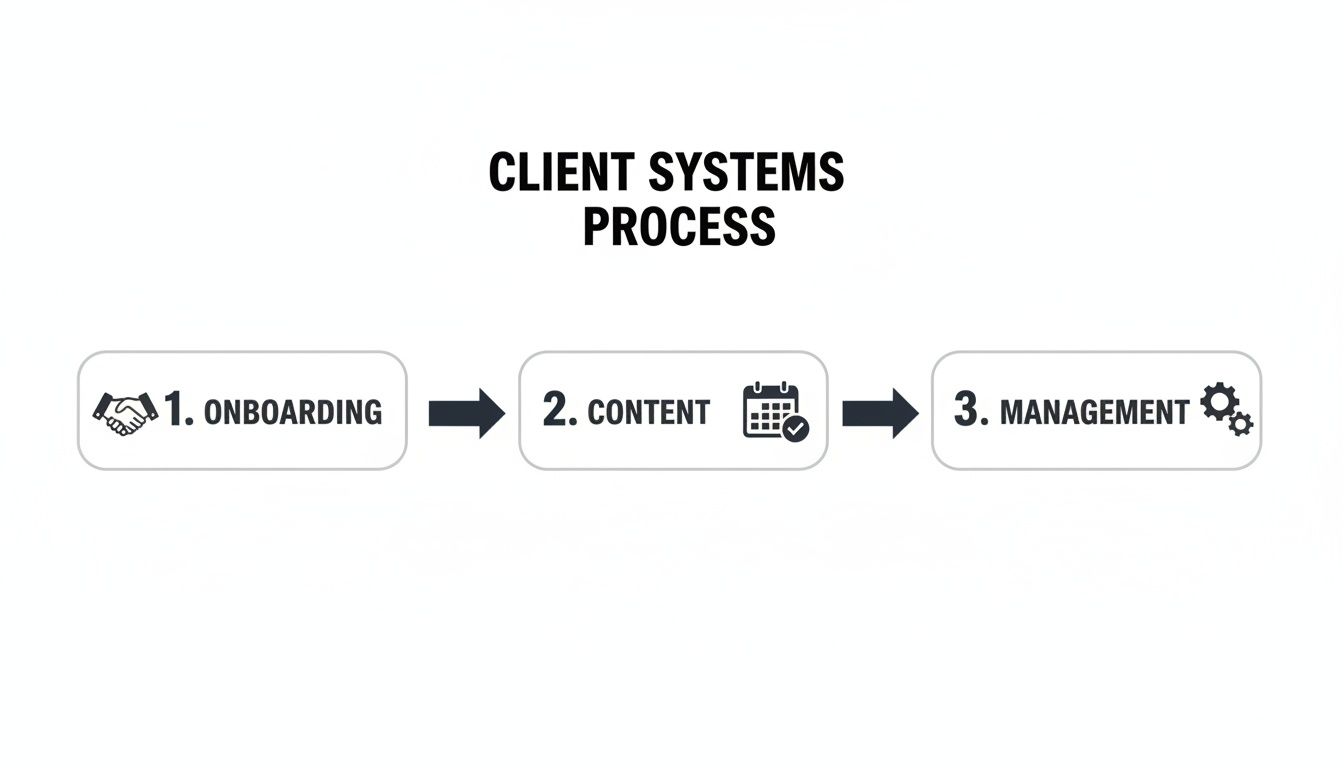
You move clients from a structured onboarding into a repeatable content machine, and then into a seamless management and reporting rhythm. This is how you deliver a consistently professional experience, every single time.
The Four Pillars of Your Agency Stack
You don't need to sign up for a dozen expensive subscriptions right out of the gate. When you're just starting, focus on nailing these four key areas. A smart investment here will pay for itself almost immediately through saved time and better client results.
Social Media Management & Scheduling: This is your command center. Instead of logging in and out of a half-dozen platforms every day, a good scheduler lets you plan, approve, and publish everything from one dashboard. I always recommend new agency owners start with something like Buffer or Later. They're incredibly user-friendly and will save you countless hours.
Content Creation: Unless you're secretly a graphic design prodigy, you need help creating professional-looking visuals without the headache. Canva is the undisputed king here. Its massive template library and drag-and-drop editor are a lifesaver. Once you have more demanding clients (or a designer on staff), you can graduate to the Adobe Creative Suite for total creative control.
Project Management: Juggling tasks for one client is easy. For three? Or five? It gets messy, fast. A project management tool is non-negotiable for tracking deadlines, organizing client feedback, and assigning tasks. A visual, Kanban-style tool like Trello is perfect for getting started. If you need more horsepower for complex projects, Asana is a fantastic next step.
Client Reporting: Clients stick around when they can see the value you're delivering. You have to prove your worth with data. Reporting tools transform raw numbers into clean, easy-to-digest reports. You can absolutely get by with the powerful (and free) Google Data Studio. Later on, upgrading to a paid tool like DashThis can seriously wow clients with beautiful, automated reports.
Your Tech Stack: Bootstrapped vs. Growth Mode
Your budget will obviously be a huge factor in your initial tool choices. The great news is you can build a highly effective, professional-grade stack without breaking the bank. You can—and should—upgrade as your revenue grows.
I see so many new agency owners make this mistake: they over-invest in complex, enterprise-level software before they even have the client roster to justify it. Start lean. Master your core tools. Only upgrade when you feel a real, painful need for more features.
To make this tangible, here’s a look at how your tech stack might evolve.
Essential vs. Growth Tech Stack Comparison
This table breaks down the lean, cost-effective tools you need to get your first clients versus the more advanced platforms that help you scale to 10+ clients and beyond.
Starting with the "Essential" column gives you everything you need to look polished and deliver fantastic results. As your agency grows, investing in the "Growth" tools will unlock deeper analytics, better team collaboration features, and more powerful automation. That's how you build the operational backbone for the next phase of your agency's journey.
Getting Your Legal and Financial House in Order
It’s easy to get swept up in the fun stuff—mapping out killer content strategies, designing beautiful creative, and dreaming about landing that first big client. But let’s talk about the less glamorous side of things for a minute, because getting this part wrong can sink your agency before you even set sail.
Ignoring the legal and financial nuts and bolts is a rookie mistake. Getting these fundamentals dialed in from day one isn't just about compliance; it's about building a real, professional business that protects you and is built to last.
Choose the Right Business Structure
One of the first big decisions you'll make is how to legally structure your agency. This might sound like boring paperwork, but it has huge implications for your taxes, personal liability, and even how seriously potential clients take you.
For most people starting out, it really comes down to two main paths:
- Sole Proprietorship: This is the default. If you just start working with clients, you're a sole proprietor. It's simple, but there's a massive downside: there's no legal separation between you and your business. If something goes wrong and your agency gets sued, your personal assets—your car, your house, your savings—could be on the line.
- Limited Liability Company (LLC): This is the move I almost always recommend. Forming an LLC creates a separate legal entity, putting a protective wall between your business and personal assets. If the business runs into trouble, generally only the business's assets are at risk. It also just looks more professional when you're sending out proposals.
The simplicity of a sole proprietorship is tempting, but the peace of mind an LLC provides is worth every penny of the small setup fee. Think of it as your business's first insurance policy.
Draft a Rock-Solid Client Contract
I'm going to say this in no uncertain terms: never start work without a signed contract. A verbal agreement or a handshake deal is just asking for trouble. It's the fast track to scope creep, late payments, and endless misunderstandings. Your contract is your single most important tool for managing expectations.
According to the Small Business Administration, the most common legal blunder for new service businesses is operating without a formal agreement. This isn't just a small oversight; it's a major source of conflict, with some estimates suggesting 40% of these disputes lead to a financial hit. You can dig into more of these small business facts from the SBA if you're curious.
At a minimum, your contract needs to nail down:
- Scope of Work: Be painfully specific about what you’re delivering and, just as importantly, what’s not included.
- Payment Terms: Outline your rates, when you get paid, and what happens if a payment is late.
- Term and Termination: How long does the agreement last? What’s the process if either of you needs to end it early?
- Ownership of Work: State clearly who owns the creative assets and social media accounts once the project is over.
A strong contract isn't about mistrust; it's about clarity. It creates a professional framework that allows you to build a healthy, long-lasting client relationship based on mutual understanding and respect.
Manage Your Finances Like a Pro
Finally, you have to get a handle on your money from the get-go. Mixing your personal and business finances is a classic mistake that turns tax season into a complete nightmare and makes it impossible to know if you're actually profitable.
You don't need a finance degree, just some good habits. Start here:
- Open a Dedicated Business Bank Account: This is non-negotiable. All business income goes in, and all business expenses come out. Simple.
- Use Accounting Software: Get set up with a tool like QuickBooks or FreshBooks. It makes invoicing, tracking expenses, and seeing your financial health incredibly straightforward.
- Set Aside Money for Taxes: Remember, you're the boss now, which means no one is withholding taxes for you. A safe bet is to immediately transfer 25-30% of every single payment you receive into a separate savings account just for taxes. Don't touch it.
Got Questions? Let's Get Them Answered
Even with the best roadmap in hand, jumping into the agency world is going to stir up some questions. That's not just normal; it's a sign you're thinking through the right things. The path to a successful agency is paved with countless decisions, and getting clear, straightforward answers can make all the difference.
Let's tackle some of the most common hurdles and "what-ifs" that pop up when you're just getting started. Think of this as your personal FAQ for navigating the early days with a bit more confidence.
How Much Money Do I Really Need to Start?
This is the big one, isn't it? The good news is, the answer is probably a lot less than you think. You can realistically get your social media agency off the ground with just a few hundred dollars. We're not dealing with brick-and-mortar overhead here; your main costs are digital.
Here’s what a lean startup budget actually looks like:
- LLC Formation: This will run you anywhere from $50 to $500, depending on your state and whether you DIY it or use a service.
- Essential Software: So many of the tools you need—like Canva, Trello, and Buffer—have amazing free plans. A pro-level scheduler might set you back $20-$50 a month when you're ready.
- Website & Domain: A domain name is about $15 per year. You can spin up a great-looking, professional one-page site with a tool like Carrd for as little as $19 per year.
Honestly, your biggest investment at the start is your own time. The hours you'll spend honing your skills, packaging your services, and hunting down those first few clients are where the real value is.
The beauty of a service business like this is the incredibly low overhead. You don't need a business loan; you need a laptop, decent Wi-Fi, and the hustle to get results for your clients. You can hit profitability way faster than you might imagine.
Should I Specialize or Be a Jack-of-all-Trades?
It's tempting to want to offer everything to everyone. It feels safer, right? Broader net, more fish. But in the agency world, that's a trap. Being a generalist forces you to compete on price. Specializing lets you compete on value.
Put yourself in the client's shoes. If you own a chain of boutique fitness studios, are you going to hire the "social media manager for all businesses" or the agency that specializes in "social media growth for boutique fitness brands"? The specialist gets it. They know your audience, they talk your talk, and they already have results you care about.
This isn't just a hunch. Industry data consistently shows that specialized agencies command retainers up to 40% higher than their generalist peers. Picking a niche streamlines your entire operation, makes you an undeniable authority, and attracts clients who are happy to pay a premium for real expertise. You can dig into more of these social media marketing insights from Sprout Social.
Okay, But How Do I Land My First Clients?
Getting that first paying client is a huge moment. It's the ultimate validation that your idea has legs. It can feel like a monumental task when you have zero portfolio to show, but there are proven ways to get it done.
Freelance platforms are your launchpad. Seriously, don't sleep on a platform like Upwork. High-quality clients are on there every single day, actively looking for the exact skills you have.
- Nail Your Profile: Don't just list what you do. Craft a headline and bio that scream "expert" in your specific niche.
- Create Your Own Proof: No clients yet? No problem. Pick a brand you love and build out a sample social media strategy for them. Turn it into a slick PDF case study. Boom, you have a work sample.
- Write Proposals That Actually Get Read: Personalization is everything. Show them you've read their post and understand their specific problem. For a deep dive, check out our guide on writing effective cover letter examples for Upwork.
Your first few clients are all about building momentum and getting those golden testimonials. Go above and beyond, deliver fantastic results, and turn that success into the social proof you'll use to land the next client, and the one after that.
When Is the Right Time to Hire Someone?
Making the leap from a one-person show to a team leader is a big deal. Too many agency owners wait until they're completely burned out, trapped working in the business instead of on the business.
Here’s the signal: the right time to hire is just before you feel like you’re drowning.
When you find yourself turning down good projects because you just don't have the hours in the day, it's time. When you're spending more time on admin and busywork than on strategy and sales, it's time.
Your first hire doesn't have to be a full-time, salaried employee. Start small. Bring on a freelance content creator for 10 hours a week. Hire a virtual assistant to handle scheduling and reporting. This lets you delegate the repetitive stuff, freeing you up to focus on client relationships and growth, all without taking on a huge financial commitment. It’s a smarter, more sustainable way to scale.
Ready to stop chasing leads and start closing deals? Earlybird AI is your always-on sales team for Upwork. It finds the perfect projects, crafts personalized proposals, and gets you in front of clients in minutes—not hours. Let automation fill your calendar so you can focus on building your agency. Learn how Earlybird AI can transform your client acquisition.