
← Back To Blog
Set a Winning Upwork Hourly Rate in 2026
When you first land on Upwork, one of the first things that hits you is the wild range of hourly rates. You’ll see one freelancer charging $15/hour for a task, and another charging $150/hour for what looks like the same thing. So, what should your rate be?
That's the million-dollar question, isn't it? The truth is, your Upwork hourly rate is a strategic choice, not just a number you pull out of thin air. It’s the very first signal you send to potential clients about your expertise, your confidence, and the quality of work you deliver.
Thinking Beyond the Dollar Sign

Let's be real—setting that initial rate can feel like a total shot in the dark. It's tempting to look at the low end of the market and think, "I'll just charge a little less to get my foot in the door." But this is almost always a mistake.
Your rate is so much more than a price tag. Think of it as a client filter. A low rate tends to attract clients who are shopping for the cheapest option, which often leads to micromanagement, scope creep, and a general lack of respect for your skills. A confident, well-reasoned rate, however, communicates professionalism and attracts clients who are looking for a genuine partner to help solve their problems.
The Value vs. Price Mindset
Trying to be the cheapest freelancer on the platform is a race you'll never win. There will always be someone willing to work for less, and it's a quick path to burnout and feeling completely undervalued. The top freelancers on Upwork figured this out a long time ago: they don't compete on price. They compete on value.
This means you have to change the conversation from "How much will this cost?" to "What's the return on this investment?"
Your rate isn't just about the time you spend on a task—it's about the problems you solve. A client will gladly pay a premium for a freelancer who can increase their sales by 30%, not just someone who can check items off a to-do list.
Making this mental shift is the key to building a sustainable, long-term career. It forces you to get crystal clear on the tangible results you can deliver for a business. You're not just a "social media manager"; you're a "brand-builder who grows engaged communities and drives website traffic." See the difference?
Here’s how to start putting that into practice:
- Focus on Outcomes: Always connect your skills back to a client's core goals, whether that's generating more leads, saving them time, or boosting their revenue.
- Showcase Your Expertise: Your profile, portfolio, and proposals are your stage. Use them to prove you're an expert who delivers real, measurable results.
- Target Quality Clients: A premium rate works for you, filtering out the bargain hunters and bringing in serious clients who are ready to invest in quality.
When you stop thinking about the hourly rate and start focusing on the value you create, you're not just bidding on jobs anymore. You're building a business.
Benchmarking Your Rate in the Upwork Marketplace
Setting your Upwork hourly rate can feel like plucking a number from thin air. It’s a common mistake, but one that can leave a lot of money on the table. Before you can price your work with real confidence, you have to do a little homework and see what the market actually looks like.
Think of it like pricing a house. You wouldn’t just guess; you’d look at what similar homes in the neighborhood are selling for. On Upwork, that means digging into the going rates for your specific skills, industry, and experience level. This isn't about copying others—it’s about gathering the intel you need to set a rate that’s both competitive and ambitious.
Decoding Rates Across Popular Categories
On Upwork, some skills are simply hotter than others. Basic supply and demand are always at play. A generalist offering common services will face a ton of competition, which naturally pushes rates down. But if you’re a specialist in a field that businesses are desperate to hire for, you’re in a much stronger position to command a premium.
Take software development, for example. The platform has become a major destination for specialized tech talent, and the rates prove it. An analysis from Clockify found that software developers on average pull in $55 per hour. Compare that to programmers at around $38 per hour and web developers at $22.50 per hour.
What does that tell you? Specialization is your ticket to higher earnings. This is especially true in fast-growing fields.
- AI and Machine Learning: Experts here are in a league of their own. Demand is through the roof, and rates often hit $80-$200+ per hour. These skills directly fuel business growth, so clients are willing to pay top dollar.
- Project Management: A great project manager is worth their weight in gold, keeping projects on track and on budget. Depending on the project's size and complexity, rates usually fall between $30 to $75 per hour.
- Creative and Design: This is a broad category with a wide range of rates. A general graphic designer might start out around $25 per hour, but a seasoned UX/UI designer with a killer portfolio can easily command $75 per hour or more.
The Impact of Geography on Your Rate
Let’s be real: where you live matters. Even on a global platform like Upwork, clients often have regional budgets in mind, and freelancers from different countries have different costs of living. This creates a pretty clear gap in average rates around the world.
The same research that looked at developer pay also highlights this geographic divide. Freelancers in North America have the highest average global rate at $56 per hour.
That’s a sharp contrast to other parts of the world. For instance, the average rate for freelancers in the Asia Pacific region is $20 per hour, while in Central America, it’s around $18 per hour.
This doesn't mean you're at a disadvantage if you're outside of North America. It just means you have to be smarter about communicating your value. A world-class portfolio, glowing testimonials, and a focus on high-impact skills can help you smash through those regional price ceilings. If you want a deeper dive into maximizing your income, check out our guide on how to make money on Upwork.
Ultimately, all this research isn't so you can just copy someone else's rate. It’s about arming yourself with the right information. Use these numbers as your baseline, then adjust based on your unique skills, years of experience, and the real results you get for your clients. That’s how you start building a truly profitable freelance career on Upwork.
Figuring Out Your Real Take-Home Pay
That hourly rate you set on your Upwork profile? It's just the starting line, not the finish. Many freelancers get a nasty surprise when they see the actual amount that lands in their bank account. The rate you advertise and the money you actually pocket can be two very different numbers.
It's not a hidden trick; it's just the business side of freelancing that often gets overlooked in the beginning. To build a genuinely profitable business, you have to look past the sticker price. You need to understand every little thing that chips away at your earnings before you get paid. Only then can you set a rate that actually supports you and your financial goals.
The biggest slice taken from your earnings is, of course, Upwork's service fee. This isn't just a flat tax. It’s a dynamic percentage designed to reward you for building long-term relationships with clients, and smart freelancers use this to their advantage.
Think of it like a loyalty program that works in your favor. The more you earn from a single client, the smaller the platform's cut becomes, which directly boosts your take-home pay over time.
This entire system is built to encourage freelancers to find and nurture lasting partnerships rather than just bouncing from one small gig to the next. Let's dig into how it actually works.
Understanding Upwork's Sliding Fee Structure
The platform's fees are tiered based on your lifetime billings with each specific client. This is a crucial detail to remember—the fee reduction is client-by-client, not based on your total earnings across the entire platform.
- 20% Fee: This is what you'll pay on the first $500 you bill any new client. It’s the highest tier and has the biggest impact on your earnings from short-term or one-off projects.
- 10% Fee: As soon as you cross the $500 threshold with that same client, the fee on all future payments drops to 10%. This is a huge jump and where the majority of your long-term project earnings will fall.
- 5% Fee: For your best, highest-value clients, the fee drops to just 5% once you've billed them more than $10,000. This tier is a massive reward for landing and keeping major, enterprise-level clients.
If you want to get really granular with how this impacts your bottom line, check out our guide on how much Upwork takes from freelancers. Getting a firm grip on this is non-negotiable for good financial planning.
The infographic below shows just how much things like your location and specialty can affect your starting rate.
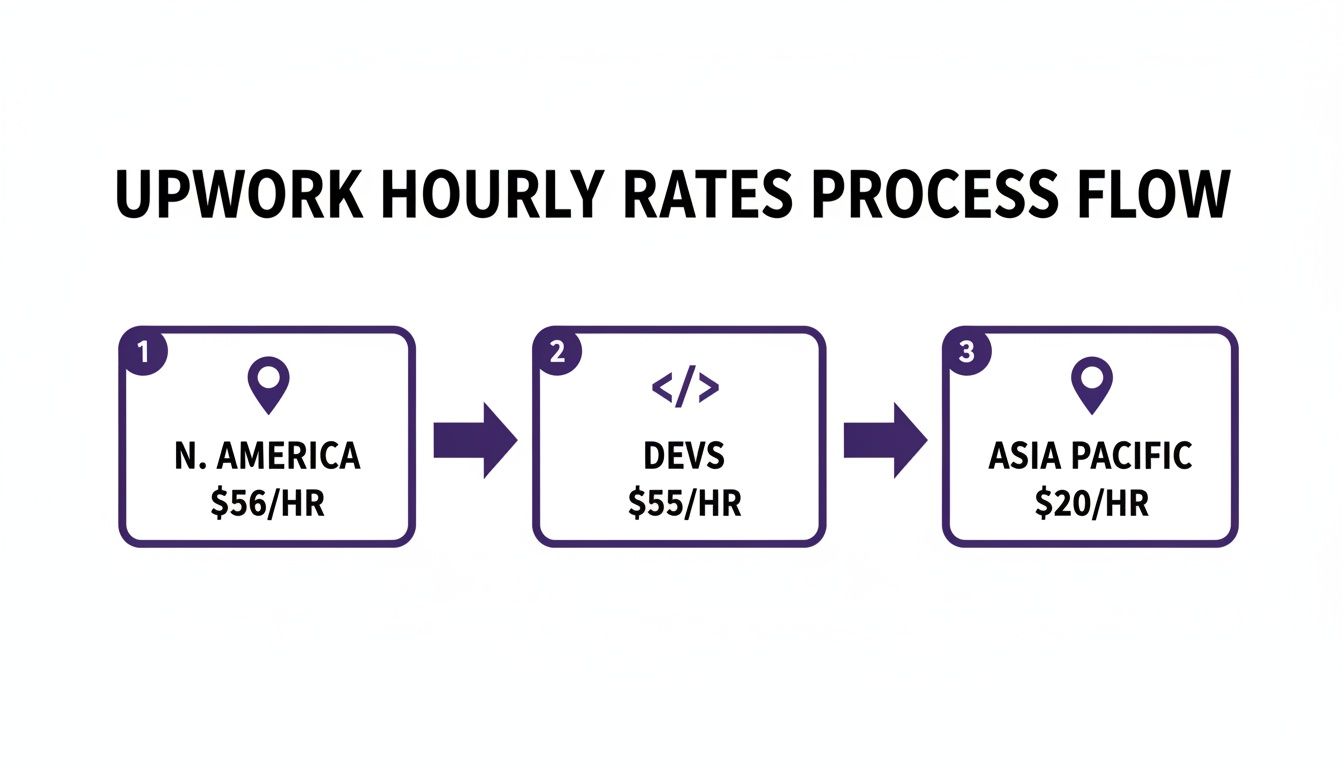
As you can see, a developer in North America can often command a much higher rate than a freelancer with similar skills in the Asia Pacific region. It’s a powerful reminder that both geography and skill set play a huge role in your earning potential.
Calculating Your Effective Hourly Rate
Platform fees are just one piece of the puzzle. The other piece is all the "hidden" time you spend on non-billable tasks. This is the real work of running a business—the hours you put in that never appear on a client's invoice. This includes time spent on:
- Hunting for new projects
- Crafting and submitting proposals
- Answering messages from potential clients
- Handling your own admin and finances
This work is absolutely essential, but it's unpaid. To find your effective hourly rate—what you actually make per hour you work—you need to do some simple math.
Let's imagine you billed a client for 20 hours at $50/hour, for a total of $1,000. Since this is a long-term client, the fee is 10% ($100), leaving you with $900. But you also spent 5 unpaid hours that week writing proposals and managing your account. Your total time investment is now 25 hours.
Formula: (Net Earnings) / (Billable Hours + Non-Billable Hours) = Effective Hourly Rate
Example: $900 / (20 + 5 hours) = $36 per hour
All of a sudden, that nice $50/hour rate is effectively $36/hour. That’s the number that truly reflects your profitability. Once you understand this calculation, you can set your listed Upwork hourly rate high enough to ensure your real take-home pay covers both your time and your expertise.
How to Strategically Set and Raise Your Rate
Your Upwork hourly rate isn't something you set once and forget about. The best freelancers treat it as a living number—a direct reflection of their growing expertise and the value they bring to the table. Nailing your pricing is a journey, one that starts with getting your foot in the door and ends with you confidently charging what you're truly worth.
This section is your playbook. We’ll cover how to price yourself at every stage, from landing those first critical reviews to establishing yourself as a go-to expert who commands premium fees.
Starting Out The Smart Way
When you’re just starting on Upwork, your main goal is simple: build momentum. That means getting those first few 5-star reviews under your belt and filling your portfolio with proof of your skills. In this early phase, your rate needs to be competitive enough to catch a client's eye and win some initial projects.
But competitive doesn't mean cheap. In fact, pricing yourself too low can backfire, signaling a lack of confidence and attracting difficult, low-budget clients. Your best bet is to aim for the lower end of the established professional range for your skills. This shows you're serious and ready to deliver quality work.
Your profile is your number one sales tool. Even as a newcomer, you have to frame the value you offer. Focus your profile summary on what you can do for the client, not just a list of your skills.
Forget the myth that Upwork is a race to the bottom. Data shows that real professionals can command solid rates. For example, business consultants on the platform average around $63 per hour, while HR consultants average $52. Even entry-level IT consultants start near $21. For a deeper dive, you can explore a full breakdown of professional rates on Upwork.
The Art of Justifying Your Price
As you collect positive reviews and build a solid track record, your rate should start to climb. But a higher price tag demands a stronger justification. You can't just change the number on your profile and hope for the best; you have to show clients why you’re worth the investment. This is where your profile, portfolio, and proposal writing come into play.
- Profile Summary: Your summary should mature. It needs to go from "I can do X" to "I help businesses achieve Y by doing Z." Frame everything in terms of client outcomes and the return on their investment.
- Portfolio Power: A screenshot isn't enough. Turn your portfolio items into mini-case studies. Briefly explain the client's problem, outline your solution, and highlight the measurable results you delivered.
- Proposal Language: Shift your proposals from task-focused to strategy-focused. Lead with how you'll solve the client's core problem, building their confidence in your expertise before you even talk numbers.
This strategic shift is what separates a $25/hour freelancer from a $75/hour consultant. In the world of web and mobile development, for instance, a WordPress specialist might charge $40, while a senior full-stack engineer who can architect complex systems commands upwards of $150. The difference lies in their proven ability to solve bigger, more valuable problems.
When and How to Raise Your Rate
Knowing when to raise your rate is just as important as knowing how. It shouldn't be a random guess. Instead, look for clear signals from the market that tell you it's time to charge more.
Key moments to consider a rate increase:
- After 3-5 Successful Projects: Once you have a string of 5-star reviews and a few great portfolio pieces, you have tangible proof of your value. That's your green light to bump up your price.
- When Your Win Rate Is Too High: Are clients accepting almost every proposal you send? That's a classic sign you're underpriced. You have room to increase your rate without scaring off good clients.
- Every Six Months: As a general rule, take a hard look at your pricing twice a year. Your skills improve, your experience deepens, and your rate should grow right along with them.
When you decide to raise your rate, test it out first. Instead of changing your public profile rate overnight, try bidding on a few new projects at a 15-20% higher rate. If you're still winning jobs, you know the market will bear the new price. You can then confidently update your profile for all new clients. For your existing long-term clients, give them a heads-up and explain that your new rate reflects your improved skills and the ongoing value you deliver.
Moving Beyond Hourly to Project-Based Pricing

While getting your Upwork hourly rate right is a huge step, it has one major drawback: you’re always trading time for money. There are only so many hours in a day, which puts a hard cap on how much you can earn. If you want to truly grow your freelance business, you have to learn how to change the conversation from hours to outcomes.
This is where project-based pricing comes into play. Instead of selling your time, you start selling a result. This completely unchains your income from the clock, letting you earn based on your expertise—especially when you know how to deliver great results efficiently.
Shifting from Hours to Outcomes
The most successful freelancers on Upwork aren’t just selling hours; they're selling solutions. Think about it. When a client hires you for a fixed-price project, they aren't buying 10 hours of your design time. They're buying a finished website that will attract customers, a marketing campaign that will drive sales, or a solved business problem that was costing them money.
This shift in perspective is a game-changer. It changes the entire dynamic with a client. The discussion stops being about "How long will this take?" and becomes "What will this do for my business?" This allows you to set your price based on the actual value you deliver, not the minutes it takes you to do the work.
By focusing on the end result, you anchor your price to the client's return on investment. If you can create a sales funnel that generates an extra $10,000 a month for a client, a $3,000 fixed price for the project seems like an absolute bargain, even if it only took you 15 hours to build.
Leaning into this value-first mindset is how you unlock seriously higher earnings. You get to price projects based on their impact, which often leads to an effective hourly rate that blows away what you could have charged for straight time-and-materials work.
How to Scope and Price Fixed-Price Projects
The biggest boogeyman in fixed-price work is "scope creep"—that slow, painful process where a project’s requirements start to balloon well beyond what you originally agreed to. The key to avoiding it is defining the project with surgical precision before you even think about sending a proposal.
Key steps for successful project scoping:
- Define Clear Deliverables: Be brutally honest about what's included and, just as importantly, what isn't. A "Brand Identity Kit" might include a logo and color palette, but it doesn't include a 20-page brand style guide unless you say it does.
- Set Firm Boundaries: Clearly state the number of revisions you'll provide. For instance, "This price includes two rounds of revisions on the initial concepts." Any more than that gets billed separately. No exceptions.
- Establish Milestones: For anything but the smallest jobs, break the project into milestone payments. This is great for your cash flow and makes sure you and the client are on the same page every step of the way.
Once the scope is locked down, you can price it for profit. A good starting point is to estimate your hours, multiply by your target hourly rate, and then add a risk buffer—usually 15-30%—to cover client communication, unforeseen snags, and admin time. This buffer is what protects your profit margin. For a deeper dive on putting together killer proposals, check out our guide on bidding on Upwork.
Packaging Your Services for Predictable Income
Ready for an even more advanced move? Start packaging your work into repeatable, product-like services. This streamlines your entire sales process and gives you a much more predictable income stream. Instead of starting from scratch with every lead, you can point them to a menu of pre-defined packages.
Examples of Packaged Services:
- For a Writer: A "Monthly SEO Blog Package" that includes four 1,000-word articles, keyword research, and meta descriptions for a set monthly fee.
- For a Designer: A "Startup Brand Identity Kit" with a logo, business card template, and social media assets for a single fixed price.
- For a Developer: A "WordPress Website Tune-Up" that includes a speed audit, plugin updates, and a security scan for a one-time fee.
These packages make it dead simple for clients to see what they’re getting and how much it costs. It instantly positions you as a specialist with a proven system, which builds trust and lets you scale your business far beyond the limits of a simple Upwork hourly rate.
Your Upwork Rate Questions Answered
Setting your Upwork rate can feel like you're throwing darts in the dark. How much is too much? How little is too little? It's a question every single freelancer struggles with.
We've covered the core strategies, so now let's get into the nitty-gritty. This is where we tackle those nagging, everyday questions about pricing your work. Consider this the FAQ section built from years of experience on the platform.
How Often Should I Raise My Upwork Rate?
This is the big one, isn't it? The good news is you don't have to guess. The platform gives you clear signals when it's time to bump up your price. This isn't about picking a random date on the calendar; it's about reacting to your own success.
As a general guideline, take a hard look at your rate after every 3-5 successful projects that land you a 5-star review. Those glowing reviews are your proof. They are the evidence you need to justify a higher price. At a minimum, you should be reviewing your rate every six months—your skills aren't standing still, so your pricing shouldn't either.
Here's the clearest sign you're underpriced: you win almost every proposal you send. If clients are saying "yes" instantly without any back-and-forth, that’s a massive red flag. It means you have plenty of room to charge more.
When you're ready to make the move, be confident but smart about it.
- Test the Waters: Start by bidding on new jobs with a 10-20% increase. This lets you feel out the market's response without torpedoing your chances.
- Update Your Justification: Don’t just change the number on your profile. Refresh your overview to spotlight new skills, recent testimonials, and portfolio pieces that make your new rate an obvious choice.
- Inform Existing Clients: For your long-term partners, give them a heads-up. Frame it as a natural adjustment that reflects your growing expertise and the increasing value you bring to their projects.
Raising your rate isn't just about demanding more money. It’s about confidently showing you’re worth it.
What if a Client Says My Rate Is Too High?
Hearing "your rate is too high" can feel like a punch to the gut. The key is not to panic and immediately slash your price. A premium rate is a filter; it's meant to weed out clients hunting for a bargain and attract those who are serious about quality. How you handle this objection says everything about the confidence you have in your own work.
Instead of getting defensive, steer the conversation back to value. A calm, collected reply can shift the focus from cost to results.
Here’s a script you can use:
"I appreciate you sharing that. My rate reflects my background in [Your Specific Skill], which allows me to deliver [Specific Outcome] efficiently and avoid common pitfalls. Many clients find this approach saves them time and money in the long run by minimizing revisions and ensuring a high-quality result from the start."
This response doesn't apologize. It justifies. It connects your price directly to a better outcome for the client. If their budget is truly maxed out, you still have moves to make that don't involve simply dropping your rate.
- Adjust the Scope: See if you can deliver a smaller piece of the project to fit their budget. For instance, "To stay within your budget, we could focus on just the homepage design this month and then plan for the interior pages in the next phase."
- Suggest a Trial Project: If you get a good vibe from the client and see long-term potential, propose a small, fixed-price trial. It’s a low-risk way for you to prove your value and make them comfortable with your full hourly rate on bigger projects down the line.
Just remember, a client whose only concern is finding the absolute lowest price is rarely a great partner. Standing firm on your rate helps you find the ones who will respect your expertise.
Should I Use a Fixed-Price or Hourly Rate?
There's no single "best" option here. The real question is, which is better for this specific project? Your choice should come down to the clarity of the project scope and how you work best.
Hourly rates are your best friend for projects where the scope is a bit fuzzy, the work is ongoing, or you know things are likely to change. This is perfect for situations like:
- Long-term consulting and support retainers.
- Complex software projects using an agile approach.
- Any job where the client says the magic words: "I'm not totally sure what I need yet."
Hourly billing protects you from the dreaded scope creep. It ensures you’re paid for every single minute you put in, including all those extra meetings and unexpected revisions.
Fixed-price contracts are the way to go when a project has a rock-solid, clearly defined outcome and timeline. This is tailor-made for tasks such as:
- "Write one 1,500-word SEO-optimized article."
- "Design a standard three-panel brochure."
- "Set up a basic Google Ads campaign with five ad groups."
When you're efficient, a fixed-price project can rocket your effective hourly rate into the stratosphere. You’re getting paid for the result, not the hours logged. If you can knock out a $500 project in five hours of focused work, you just earned an effective rate of $100/hour. That's the reward for your expertise.
Can I Have Different Rates for Different Jobs?
Yes, you absolutely can—and you absolutely should. Thinking you're locked into the single rate displayed on your profile is a rookie mistake. Smart freelancers treat that public rate as a starting point, not a non-negotiable law.
You should be adjusting your bid for every single proposal based on a few key factors:
- Project Complexity: A simple, almost mindless data entry task shouldn't command the same rate as a complex strategic plan that taps into your deepest knowledge.
- Skills Required: If a job requires a rare or high-demand skill in your arsenal, that's your cue to charge a premium.
- Client Budget: Pay attention to the budget a client posts. If it's way above your usual rate, that's a direct signal that they have a healthy respect for the work and you can, and should, bid higher.
This kind of flexibility keeps you competitive across a wide range of jobs. You can take on smaller, easier gigs to fill your schedule while making sure you're compensated properly for your most valuable and impactful work. It's the ultimate way to maximize your earnings on Upwork.
Feeling overwhelmed by the constant hunt for high-value clients? Earlybird AI acts as your personal sales team, finding the perfect jobs and crafting personalized proposals within minutes. Stop wasting time scrolling and start winning the projects that match your true worth. Get started with Earlybird AI today and let automation build your pipeline while you focus on delivering amazing work.