← Back To Blog
6 Upwork Message to Client Sample Templates to Win More Jobs in 2026
In the crowded Upwork marketplace, a generic proposal is a losing strategy. The difference between a thriving freelance business and a stagnant one often comes down to a few carefully crafted sentences. Your initial message isn't just a formality; it's your first, and sometimes only, chance to stand out, build trust, and prove you understand the client's problem better than anyone else. A well-written Upwork message to client sample can be the key that unlocks higher-value projects and long-term partnerships, moving you from being just another bidder to a top contender.
This guide moves beyond generic advice. We provide a categorized collection of real, customizable message samples designed for every critical stage of the client interaction process. From the initial proposal and strategic follow-ups to clarifying scope and negotiating terms, each example is built to get a response. We will break down the psychology behind why each sample works, offering deep strategic analysis and actionable takeaways you can implement immediately. Whether you're sending your first pitch or trying to re-engage a past client, these templates will help you craft messages that don't just get replies, but get you hired.
1. Initial Proposal Introduction Message
This is the crucial first impression you make after a client views your proposal. It's not just a follow-up; it's your chance to transform your proposal from a static document into a dynamic conversation starter. The goal is to immediately demonstrate you’ve read and understood their needs, pulling a key detail from their job post to prove you aren't just spamming applications. This personal touch signals genuine interest and expertise, making you stand out from generic, templated bids.
A strong initial message confirms your expertise and gently guides the client toward the next logical step, whether that's a quick chat, sharing more details, or clarifying a specific point. This message acts as a bridge, leading the client directly from your proposal to your inbox.
Example: Tech Startup Needing a React Developer
Client Job Post Snippet: "...seeking a senior React developer to help us refactor our legacy codebase, improve state management with Redux Toolkit, and optimize our CI/CD pipeline..."
Winning Message Sample:
"Hi [Client Name], thanks for reviewing my proposal. I saw you're looking to refactor your legacy codebase and optimize state management with Redux Toolkit. I recently completed a similar project for a FinTech app where we cut component load times by 40%.
I've attached a brief case study on that project. Would you be open to a quick 15-minute call next week to discuss your current CI/CD pipeline and project goals?"
Strategic Breakdown
- Mirrors Specific Language: The message directly references "refactor legacy codebase" and "Redux Toolkit," proving the freelancer read the job description carefully. This is a powerful trust signal.
- Provides Relevant Proof: Instead of just claiming expertise, it offers a specific, quantifiable result ("cut component load times by 40%") from a similar project. This makes the claim credible and impactful.
- Low-Friction Call to Action (CTA): The CTA is specific and easy to accept. "A quick 15-minute call" feels far less intimidating than a vague "let's connect," increasing the likelihood of a positive response.
Actionable Takeaways
- Reference 1-2 Key Requirements: Pinpoint the most critical needs mentioned in the job post. This shows you understand the client’s main pain point.
- Keep it Mobile-Friendly: Aim for under 100 words. Many clients check Upwork on their phones, so a concise message is more likely to be read in full.
- Propose a Clear Next Step: Don't leave the conversation open-ended. Suggest a specific action, like a brief call or reviewing a portfolio piece relevant to their project. This is a core component of effective communication and is detailed further in our guide on cover letter examples for Upwork.
2. Follow-Up Message After No Response (3-5 Days)
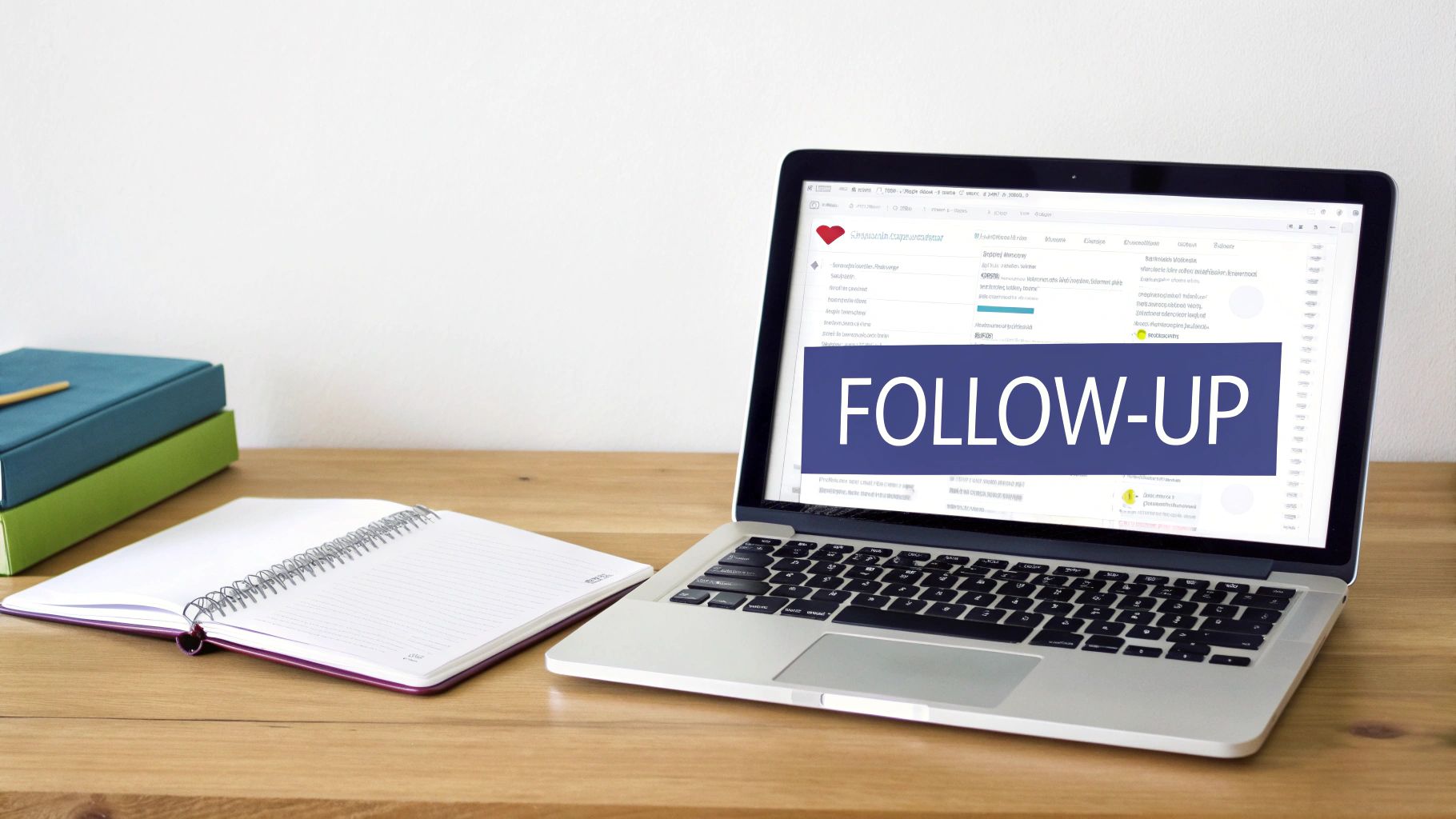
This message is your strategic second chance to re-engage a client who has viewed your proposal but hasn't replied after a few days. The key is to add new, genuine value, not just to "check in." A well-crafted follow-up shifts the dynamic from chasing to advising, positioning you as a proactive expert who is already thinking about the client's success. This approach respectfully reminds them of your application without sounding desperate or pushy.
By offering a relevant insight, a helpful resource, or a new idea related to their project, you demonstrate continued interest and expertise. This gesture can be the catalyst that moves your proposal to the top of their list, proving you’re a partner, not just another bidder.
Example: SaaS Company Needing Content Marketing Strategy
Client Job Post Snippet: "...looking for a content marketing strategist to help us increase organic traffic and generate more MQLs for our B2B SaaS platform. We need a comprehensive strategy for our blog and social channels..."
Winning Message Sample:
"Hi [Client Name], I hope you're having a productive week. As I was thinking more about your goal to increase MQLs, I came across a new industry report on B2B SaaS content funnels that I thought you'd find valuable.
The data on using interactive content for lead qualification on page 12 is particularly relevant to your goals. It highlights a strategy that helped a similar company boost conversions by 25%. I'm confident we could adapt this for your platform. No need to reply, just thought it might be helpful!"
Strategic Breakdown
- Leads with New Value: The message immediately offers a valuable resource (an industry report) directly tied to the client's primary goal ("increase MQLs"). This is far more effective than the generic "just following up."
- Demonstrates Proactive Expertise: By pointing to a specific page and strategy, the freelancer shows they are actively thinking about the client's problem. It frames them as a strategic consultant.
- Removes Pressure with a "No-Reply-Needed" CTA: The closing line, "No need to reply," is a confident, low-pressure tactic. It makes the message feel genuinely helpful, encouraging the client to review the resource and reconsider the proposal without feeling cornered.
Actionable Takeaways
- Avoid "Just Checking In": Always lead your follow-up with a new piece of value. This could be a relevant article, a quick insight, a case study, or a mini-audit of their current assets.
- Time It Right: Send this message 3-5 business days after your initial proposal. This timing is persistent without being annoying, giving the client ample time to review other candidates.
- Leverage Automation Tools: Manually tracking every proposal is inefficient. Using smart tools can help you automate these value-driven touchpoints at the perfect time. You can read about how this works in our guide on what sales automation is. This is an excellent
upwork message to client samplefor re-engagement.
3. Question-Based Discovery Message
This approach flips the traditional proposal on its head. Instead of leading with your qualifications, you lead with strategic questions that demonstrate your expertise. This message positions you as a consultant or a strategic partner, not just a service provider. It shows you are already thinking critically about the client's business goals and potential challenges, moving the conversation beyond a simple transaction to a collaborative discovery process.

By asking insightful questions, you uncover hidden requirements and frame the project in terms of business outcomes. This type of Upwork message to client sample is powerful because it makes the client stop and think, immediately elevating your status from a bidder to a valuable expert who can help them solve their core problem, not just complete a task.
Example: SaaS Company Needing a UI/UX Redesign
Client Job Post Snippet: "...we need a talented UI/UX designer to redesign our user dashboard. The current design feels outdated, and we want to improve the overall user experience..."
Winning Message Sample:
"Hi [Client Name], thank you for the invitation to submit a proposal for your dashboard redesign. The project sounds like a great opportunity to enhance user engagement.
Before I put together a detailed plan, I have two quick questions to ensure my proposal is aligned with your business goals:
- What is the primary business metric you're hoping to improve with this redesign (e.g., user retention, task completion rate, or reducing support tickets)?
- Could you share a key piece of user feedback you've received about the current dashboard's friction points?
Your answers will help me focus my approach on solving the right problems from the start."
Strategic Breakdown
- Shifts the Frame: The message immediately moves from "what I can do" to "what are we trying to achieve?" This consultant-like approach builds authority and trust.
- Focuses on Business Outcomes: Asking about "business metrics" and "user feedback" shows the freelancer understands that design isn't just about aesthetics; it's about solving real business problems and improving results.
- Implies a Process: The questions hint at a structured, thoughtful process. It tells the client that this freelancer doesn't just jump into designing but starts with strategy and data, which is highly reassuring.
Actionable Takeaways
- Ask Open-Ended Questions: Avoid simple yes/no questions. Frame them to require a thoughtful response about goals, challenges, or success metrics.
- Limit to 2-3 Questions: Don't overwhelm the client with a lengthy questionnaire. A couple of highly targeted, strategic questions are far more effective.
- Ensure Questions Add Value: Your questions should reveal information not already in the job post. This shows you're thinking beyond the brief and are genuinely invested in understanding their needs.
4. Social Proof & Case Study Reference Message
This message type shifts the focus from what you say you can do to what you have proven you can do. Instead of simply listing skills, you lead with tangible results, case studies, or testimonials from past projects. This approach immediately de-risks the hiring decision for the client by demonstrating your value through evidence, not just claims. It’s a powerful way to build credibility and show you understand business outcomes, not just task completion.
By referencing specific, quantifiable achievements, you connect your expertise directly to the client’s potential success. This is a crucial "upwork message to client sample" because it answers the client's unspoken question: "Can this person actually deliver the results I need?" A well-placed piece of social proof can make your proposal feel like a safer, more reliable choice compared to others.

Example: SaaS Company Needing a PPC Specialist
Client Job Post Snippet: "...we need a Google Ads expert to audit our current campaigns, reduce wasted ad spend, and improve our overall lead quality. Our target CPA is under $50..."
Winning Message Sample:
"Hi [Client Name], thanks for the invitation. Your goal of reducing wasted ad spend and hitting a sub-$50 CPA caught my eye.
For a B2B SaaS client in a similar niche, I recently restructured their account and cut ad spend waste by 28% in just 60 days, bringing their CPA down from $75 to $48. I've attached a one-page report detailing the process.
Are you free for a brief call on Thursday to discuss your current campaign structure?"
Strategic Breakdown
- Aligns Proof with Goals: The message directly ties the case study result ("cut ad spend waste by 28%") to the client's stated pain point. It also specifically addresses their target CPA of under $50.
- Quantifies and Time-Bounds Results: "28% in just 60 days" is far more compelling than "improved campaign performance." Specific numbers and a clear timeframe make the achievement feel concrete and believable.
- Reduces Client Effort: Attaching a "one-page report" is a smart move. It provides deep-dive proof without forcing the client to navigate away to a full portfolio, making it easy for them to see your value instantly.
Actionable Takeaways
- Create a Results Library: Keep a document of your best stats, testimonials, and mini-case studies. Organize them by client industry or project type so you can quickly pull the most relevant proof for any new proposal.
- Mirror the Client’s Metrics: If a client mentions wanting more organic traffic, share a result about traffic growth. If they mention leads, use your best lead generation stat. Direct alignment is key.
- Make Proof Accessible: Don't just say "see my portfolio." Link directly to the relevant case study or attach a concise PDF. The fewer clicks it takes for a client to see your proof, the better.
5. Problem-Agitate-Solve (PAS) Format Message
This persuasive framework is a powerful tool for converting clients who may be hesitant or comparison-shopping. The Problem-Agitate-Solve (PAS) model works by first identifying a client’s core pain point, then amplifying the negative impact of that problem (agitate), and finally presenting your service as the clear and specific remedy. This approach demonstrates deep empathy and positions you as a strategic problem-solver, not just a service provider.
Using this format in an Upwork message to a client sample can be incredibly effective because it cuts through the noise. It shows you've done your research, understand their business challenges on a deeper level, and can deliver a tangible solution that directly addresses their biggest concerns.
Example: E-commerce Store with Low Conversion Rates
Client Job Post Snippet: "...looking for a web designer to refresh our Shopify store. We get decent traffic but our sales are flat. We need a modern look that helps convert more visitors into customers..."
Winning Message Sample:
"Hi [Client Name], I saw you're looking to refresh your Shopify store to improve sales.
Problem: Your current site is likely converting around the industry average of 1.5%, which is a solid start but leaves a lot of potential revenue untapped.
Agitate: This means for every 1,000 visitors, 985 are leaving without making a purchase, costing you sales every single day.
Solve: I specialize in conversion-focused redesigns for Shopify. My process focuses on optimizing the user journey to typically lift conversion rates by 2.5% to 3.5% within 60 days.
Would you be open to a quick call to discuss how we can apply this process to your store?"
Strategic Breakdown
- Starts with Empathy: The message opens by identifying a specific Problem using an educated guess based on industry data ("1.5% conversion rate"). This shows you understand their world.
- Creates Urgency: The Agitate step reframes the problem in terms of real loss ("985 are leaving," "costing you sales"). This makes the pain point more acute and motivates the client to act.
- Presents a Clear Solution: The Solve step isn't just a generic promise. It offers a specific outcome ("lift conversion rates by 2.5% to 3.5% within 60 days") and highlights a unique process, making your offer concrete and trustworthy.
Actionable Takeaways
- Research Industry Pain Points: Before writing, spend five minutes researching common challenges in the client's industry. This allows you to state a problem with confidence, even if it's not explicitly mentioned in the job post.
- Quantify Everything: Use numbers in all three stages. Quantifying the problem, the agitation, and the solution makes your message far more persuasive than vague statements.
- Keep Agitation Brief but Potent: The goal is to create urgency, not fear. One or two impactful sentences are all you need to highlight the negative consequences of inaction.
6. Call-to-Action Optimization Message
After you've established interest, the single most important part of your message is the call-to-action (CTA). A vague or high-friction CTA like "let me know if you want to chat" puts the burden on the client and often kills momentum. An optimized CTA, however, is a clear, specific, and low-commitment next step that makes it incredibly easy for the client to say "yes" and move the conversation forward.
The goal is to remove all friction and decision fatigue. Instead of asking for a major commitment, you propose a small, manageable action, such as a 15-minute call or answering a single pivotal question. This keeps the process moving without overwhelming a busy client, making this type of upwork message to client sample a powerful tool for conversion.
Example: Agency Proposing a Full-Scale SEO Strategy
Client Job Post Snippet: "...looking for a comprehensive SEO audit and long-term strategy to increase organic traffic and lead generation for our e-commerce site..."
Winning Message Sample:
"Hi [Client Name], based on your project brief, it's clear you need a strategy that covers technical SEO, content, and link building. I have a few initial ideas for quick wins that could boost your traffic in Q3.
To make sure my full proposal is perfectly aligned, I have one quick question: Is your primary goal to increase overall traffic volume or to drive conversions for a specific product category? Knowing this will help me tailor the strategy. Would you be open to a 15-minute call this Thursday or Friday to discuss?"
Strategic Breakdown
- Presents a Clear, Simple Choice: The message offers two clear paths: answer a simple question via message or book a brief call. This gives the client control and makes responding feel effortless.
- Frames the CTA with Client Benefit: The request is framed around their needs ("to make sure my full proposal is perfectly aligned"). This shows the freelancer is focused on delivering value, not just closing a deal.
- Reduces Decision Fatigue: By suggesting specific days ("Thursday or Friday"), it eliminates the back-and-forth of scheduling. A calendar link could make this even more seamless.
Actionable Takeaways
- Offer Two Specific Options: Suggest two specific time slots or days. This is far more effective than an open-ended "let me know what works for you."
- Use a Single, Focused CTA: Don’t ask the client to review your portfolio, answer three questions, and book a call. Pick one low-friction action to guide them toward.
- Make it About Them: Frame your request around how it will help you better understand their needs or deliver a more accurate proposal. For more insights on framing your value, see our guide on how to properly structure an agency.
6 Upwork Client Message Samples Comparison
Message TypeComplexity 🔄Resources ⚡Expected Outcomes ⭐📊Ideal Use Cases 💡Key Advantages ⭐Initial Proposal Introduction MessageLow–Medium 🔄: short personalization to project detailsLow ⚡: brief research + template; automatable⭐📊 Higher reply rates and differentiation; moderate conversion lift💡 New proposals with clear briefs on competitive platforms⭐ Quick credibility, scalable, A/B testableFollow-Up Message After No Response (3-5 Days)Medium 🔄: craft value-add and timing strategyMedium ⚡: relevant resource or case + automation⭐📊 Increases visibility and reply likelihood; lifts conversion💡 Use when initial outreach receives no reply⭐ Resurfaces profile, adds value without pressureQuestion-Based Discovery MessageMedium–High 🔄: needs industry knowledge to craft 2–3 questionsMedium ⚡: research time and consultative prep⭐📊 Drives engagement and qualification; may slow immediate conversion💡 Best for consultative, complex, or high-touch projects⭐ Builds rapport, qualifies fit, differentiates from sellersSocial Proof & Case Study Reference MessageLow–Medium 🔄: select highly relevant proof and metricsMedium–High ⚡: curated portfolio and measurable case studies⭐📊 Reduces hiring risk; enables premium pricing and higher conversion💡 Ideal for risk-averse or higher-budget prospects⭐ Trust-building, self-qualification, strong credibilityProblem-Agitate-Solve (PAS) Format MessageMedium–High 🔄: research pain points and craft persuasive copyMedium ⚡: research + copywriting and testing⭐📊 Highly persuasive when accurate; increases conversions if well-targeted💡 Good for hesitant/comparison-shopping clients⭐ Emotional resonance, clear remedy, scalable templatesCall-to-Action Optimization MessageLow 🔄: focused, time-bound ask with clear optionsLow–Medium ⚡: calendar link + timezone handling⭐📊 Higher meeting acceptance; shorter sales cycles💡 Use to move conversations to calls or demos quickly⭐ Low-friction next step, measurable, reduces scheduling friction
Turn Samples into Success: Automating Your Winning Messages
Navigating the competitive Upwork marketplace requires more than just skill; it demands strategic communication at every touchpoint. Throughout this guide, we've dissected the anatomy of effective client messages, moving beyond generic templates to provide a playbook of strategic samples. We've explored everything from the critical first proposal to the delicate art of the follow-up, the precision of scope clarification, and the finesse of re-engagement.
The core lesson is that a successful message is never just a block of text. It's a carefully constructed tool designed to build trust, demonstrate expertise, and guide the client toward a specific action. Each upwork message to client sample we analyzed serves a unique purpose, whether it's using the Problem-Agitate-Solve framework to create urgency or leveraging social proof to eliminate doubt. Mastering these nuances transforms your proposals from simple bids into compelling business cases.
From Manual Effort to Automated Excellence
Having a library of proven message templates is a significant first step, but the real challenge lies in execution. Manually personalizing and sending dozens of proposals daily is a recipe for burnout and missed opportunities. The time you spend tailoring each message is time you aren't spending on billable client work. This manual bottleneck is precisely where top-tier freelancers and agencies gain a decisive edge through intelligent automation.
The ultimate goal is to fuse the personalization of a handcrafted message with the speed and scale of technology. Instead of simply copying and pasting, the next evolution is to build a system that can:
- Instantly identify relevant jobs the moment they are posted.
- Intelligently select the best message framework based on the project description.
- Dynamically insert the most relevant case studies and portfolio pieces.
- Deploy your proven follow-up sequences without you lifting a finger.
This systematic approach ensures you are consistently the first and most relevant applicant in a client's inbox. It allows you to focus your energy on high-value conversations with clients who are already warmed up and engaged, rather than on the repetitive task of initial outreach. By treating your Upwork messaging not as a daily chore but as a scalable sales system, you unlock predictable growth and reclaim your most valuable asset: your time. The winning formula is clear: combine proven messaging strategies with smart automation to dominate your niche.
Ready to turn these expert samples into an automated client acquisition machine? Earlybird AI takes the strategic principles from this guide and puts them on autopilot, submitting hyper-personalized proposals in minutes. Stop manually searching and typing, and start waking up to a pipeline full of qualified leads. Discover how Earlybird AI can transform your Upwork strategy today.