
← Back To Blog
Upwork vs Fiverr The Ultimate Agency Growth Guide
When you're weighing Upwork vs Fiverr, the right choice for your agency really boils down to your business model. If you're chasing high-value, long-term contracts and complex projects with a lot of moving parts, Upwork is almost always the better bet. On the other hand, Fiverr is king for freelancers and agencies that have mastered turning their services into standardized, quick-turnaround products.
Upwork vs Fiverr: The Quick Verdict for Agencies
Picking a freelance platform isn't just a minor operational choice; it's a strategic decision that will shape your client pipeline, the kinds of projects you land, and how you scale. The core difference between Upwork and Fiverr isn't just about the user interface—it's about their entire philosophy.
Think of Upwork as a dynamic talent marketplace where you actively hunt for opportunities and bid on jobs. Fiverr is more like an e-commerce storefront where clients browse and buy your pre-packaged services, or "Gigs."
This fundamental divide influences everything, from the clients you attract to your potential for building lasting business relationships. Agencies geared toward custom solutions and strategic partnerships will feel much more at home with Upwork’s framework.
Upwork vs Fiverr at a Glance
To make sense of it all quickly, let's break down the core philosophies and ideal use cases for each platform. This table gives you a high-level view of where each one shines.
AttributeUpworkFiverrCore ModelA professional marketplace where clients post jobs and freelancers submit detailed proposals.An e-commerce catalog where freelancers list "Gigs" (pre-defined services) for clients to purchase.Ideal AgencyBuilt for agencies that thrive on complex, high-value, long-term projects and strategic client partnerships.Perfect for agencies or solo freelancers offering standardized, productized services with fast delivery.Typical ProjectsMonthly retainers, custom software development, end-to-end marketing campaigns, and in-depth consulting.A single logo design, one-off blog posts, voiceovers, or quick video edits.Client InteractionRequires proactive bidding and proposal-driven outreach to win jobs.Mostly reactive, fulfilling orders after a client finds and purchases a Gig.
As you can see, the platforms are built for fundamentally different types of work. Your agency's service delivery model will naturally align better with one over the other.

Upwork’s positioning is clear from the get-go. With messaging like "How work should work" and logos from trusted enterprise clients, it immediately signals a focus on professional, high-stakes engagements.
This is a key differentiator in the Upwork vs Fiverr debate. That professional branding naturally attracts clients with bigger budgets, more complex problems, and a desire to build long-term working relationships.
Exploring the Core Platform Philosophies
To really get to the heart of the Upwork vs. Fiverr debate, you have to look past the logos and dashboards. These platforms aren't just two sides of the same coin; they were built from the ground up on fundamentally different ideas about how freelance work gets done. This core distinction is what shapes everything from the clients you'll meet to how you manage projects and grow your agency.
Upwork is, at its core, a professional talent marketplace. Think of it like a high-end headhunting firm. Clients post detailed job descriptions for specific needs, and freelancers or agencies pitch them with custom proposals. This entire process naturally attracts more complex, high-stakes projects where real skill and a tailored solution are non-negotiable.
Fiverr, on the other hand, operates like an e-commerce store for professional services. As a freelancer, you package your skills into fixed-price “Gigs,” and clients browse and buy them just like they would a product on Amazon. The model is all about speed and simplicity, making it a go-to for standardized, clearly defined tasks.

Upwork: The Bid-to-Win Model
Everything on Upwork revolves around its proposal-based system. It’s a “bid-to-win” environment where you’re in the driver's seat, actively hunting for opportunities that are a perfect fit for what your agency does best. This structure demands dialogue and negotiation before any work actually starts.
Because a client has to put in the effort to write a detailed job post and then sift through proposals, they’re usually more invested. They're often looking for a strategic partner, not just a pair of hands to complete a task. This dynamic naturally leads to bigger projects with bigger budgets.
This model is defined by:
- Active Outreach: You can't just sit back and wait. Success means constantly searching for and applying to relevant job postings.
- Custom Proposals: Every proposal is your chance to prove you understand the client's pain point and can offer a unique solution, building credibility from day one.
- Relationship-Focused: The platform is built to encourage long-term work. Its fee structure and features are geared toward fostering lasting client relationships, not one-off gigs.
This is where Upwork's sheer size gives it a massive edge. It connects millions of businesses with freelancers across 180 countries, creating a deep well of high-quality opportunities you just won't find elsewhere.
Fiverr: The Buy-a-Service Model
Fiverr’s entire philosophy is built on making transactions painless. It effectively turns your professional services into products on a shelf. Your main job as a seller is to craft compelling, well-defined Gigs that clients can discover and purchase with a click.
This "buy-a-service" approach strips away most of the back-and-forth. Clients arrive knowing what they want and expect a pre-packaged deliverable, making the whole thing feel more like retail than a professional engagement.
This completely flips the dynamic. You become reactive, waiting for orders to roll in based on how well your Gig is optimized for search and how appealing it looks. While that’s incredibly efficient for high-volume, repeatable services, it makes landing nuanced, evolving projects a real challenge. For many agencies, this transactional nature brings up questions about reliability, leading them to ask is Upwork legit and perhaps a better fit for serious professional work.
Ultimately, deciding between Upwork vs. Fiverr comes down to your agency’s game plan. If you want to be a strategic partner solving complex problems for high-value clients, Upwork’s marketplace model is designed for you. If your strength is in delivering standardized services efficiently and at scale, Fiverr’s e-commerce setup provides a more direct route to customers.
How Fee Structures Impact Your Bottom Line
When you're weighing Upwork vs Fiverr, the fee structure isn't just a number on a spreadsheet—it's a window into each platform's entire philosophy. How they take their cut directly shapes your pricing, your profitability, and even the kind of client relationships you end up building. The differences here are stark, and they have huge implications for your agency's bottom line.
Fiverr’s approach is dead simple: a flat 20% commission on every single transaction. Whether it's a $5 gig or a $5,000 project, that number stays the same. The predictability is nice, especially for one-off jobs and productized services where you want to know exactly what you’ll pocket.
But that simplicity has a downside for agencies playing the long game. That 20% fee never budges, no matter how much work you do for a client. There’s no built-in reward for fostering repeat business, which can seriously eat into the profits you should be making from a great client partnership.
Upwork's Sliding Fee Scale: A Strategic Advantage
Upwork plays a different game, one that’s designed to reward loyalty and bigger projects. Its sliding fee scale is a massive advantage for agencies focused on building a roster of high-value, long-term clients.
Here’s how it works, based on your lifetime billings with a single client:
- 20% on the first $500 you bill them.
- 10% on lifetime billings between $500.01 and $10,000.
- A mere 5% on any lifetime billings over $10,000.
This structure completely changes the financial picture. Sure, the initial 20% stings, but it drops fast, making long-term engagements incredibly profitable. Let's run the numbers: a $20,000 project on Fiverr would cost you a flat $4,000 in fees. On Upwork, that same project would only cost you $1,550, leaving an extra $2,450 in your bank account.
For a growing agency, this isn't just a small perk—it's a strategic incentive. Upwork’s model actively encourages you to find, nurture, and retain high-value clients, aligning their success with your own.
The Hidden Costs and Upfront Investments
Beyond the main service fees, there are other costs to be aware of. On Fiverr, clients pay an additional service fee of 5.5% on their order. This can sometimes make your higher-priced Gigs feel a bit more expensive to buyers who are watching their budgets closely.
Upwork, on the other hand, has "Connects," which are essentially a virtual currency you spend to submit proposals. You get a few free Connects each month, but if you're serious about bidding on good projects, you’ll almost certainly need to buy more. Think of it as a small investment to play—it helps filter out casual applicants and rewards freelancers who are strategic about which jobs they go after.
These different models really show what each platform is about. Fiverr's revenue is almost entirely commission-based. Upwork has a more diverse ecosystem with multiple revenue streams, including things like their Freelancer Plus subscription and ad monetization. It shows they're building a platform for professionals, a fact you can see as you learn more about their business model.
So, when you look at Upwork vs Fiverr on fees alone, the right choice really boils down to your business goals. Fiverr offers straightforward, transactional simplicity that’s perfect for high-volume, low-touch services. But for agencies aiming to build a book of high-paying, long-term clients, Upwork's sliding scale offers a clear and much more profitable path to growth. It's built to make your best client relationships your most lucrative ones.
Comparing Client Quality and Project Scope
Forget the fees and platform features for a moment. For any agency trying to grow, the real make-or-break factor in the Upwork vs Fiverr debate comes down to the work itself. What kinds of clients will you meet, and what sort of projects can you realistically land? The very way each platform is built channels a specific type of client and project through its doors.
Upwork’s whole system is built around proposals. This forces clients to pause and actually think through their needs—to write a detailed brief, define what success looks like, and set expectations. That simple step acts as a powerful filter, weeding out casual browsers and attracting more serious businesses looking for a strategic partner for complex, higher-budget projects.
Fiverr, on the other hand, is designed for speed. Its e-commerce style is perfect for clients who know exactly what they want and need it done now. It's incredibly efficient for simple tasks, but this often means the projects are smaller, one-off jobs without much strategic depth.

Upwork: The Home of Enterprise and Retainers
Think about the high-value contracts that agencies live on. They’re rarely simple, one-click purchases. They start with a conversation, a discovery process, and a custom strategy—all things that Upwork’s hiring process is designed to handle.
For agencies, Upwork is fertile ground for projects like:
- Full-Service Digital Marketing Retainers: A client looking for an agency to run their entire digital show—SEO, PPC, social media, content—on a monthly contract.
- Enterprise Software Development: Building a custom CRM or a complex mobile app requires intense collaboration and a serious budget, making it a natural fit for Upwork's milestone-based structure.
- Long-Term Content Programs: Businesses often need an agency to develop and execute a content strategy for the next six to twelve months, involving dozens of articles and case studies.
The platform gives you the room to prove your agency's value right in the proposal. Nailing that first impression is everything. For a masterclass on articulating your value, check out these cover letter examples for Upwork to see how it's done.
Fiverr: The Hub for Productized Services
Fiverr shines where you can turn a service into a standardized, repeatable product. Its "Gig" model is built for offerings with a clear scope, a fixed price, and a predictable deliverable. This is where you go for a high volume of quick-turnaround work.
Typical Fiverr Gigs are very specific:
- A single logo design with two revision rounds.
- A 30-second voiceover for an Instagram ad.
- Proofreading a 1,000-word blog post.
- Designing three social media graphics for a promotion.
While many freelancers build fantastic careers on Fiverr, its core design isn't really set up for the sprawling, six-figure contracts that fuel major agency growth. The whole model nudges clients to think about buying tasks, not building partnerships.
Here’s the bottom line: Upwork is where businesses go to hire a team or find a strategic partner. Fiverr is where they go to buy a specific, finished product. That one distinction colors every single interaction on each platform.
This difference in client mindset is backed up by the data. A huge chunk of Upwork's client base is concentrated in high-value markets like North America, with the United States, India, and the Philippines leading the charge. This creates a competitive but incredibly lucrative environment for agencies that know how to position themselves correctly.
Which Platform Is Built for Agency Scalability?
When your goal shifts from landing one-off freelance gigs to building a real, scalable agency, the whole Upwork vs Fiverr debate gets a lot simpler. For any agency owner serious about growth, the platform's core infrastructure is what really matters. While you can find opportunities on both, only one is truly designed to help an agency expand from the ground up.
Upwork was clearly built with scalability in mind. Its entire feature set feels designed for teams, giving you the tools you need to manage a growing list of clients and internal staff all under one roof. This isn’t some tacked-on feature; it’s baked into the platform’s DNA.
Fiverr, on the other hand, feels different. It has introduced things to help teams, but they often come across as additions bolted onto its core productized-service model, not a truly integrated system for running an agency.
Upwork's Dedicated Agency Infrastructure
The single biggest advantage for a growing team on Upwork is the dedicated Agency account. This feature alone makes it the superior choice for scaling. It's not just a fancy label; it’s a powerful management system that brings all your critical operations into one place.
With an Agency account, you can:
- Manage Multiple Profiles: Bring your team members under a single agency banner. This lets them bid on jobs and work on projects, all while building your agency’s collective reputation.
- Centralize Billing and Reporting: Forget chasing down invoices from multiple freelancers. All contracts and payments flow through one central account, which makes managing your finances and tracking revenue a breeze.
- Collaborate on Proposals: Your team can pool their expertise to find and win the best projects, sharing insights and resources to boost your proposal win rate.
This structure allows you to present a unified, professional front. Clients see they’re hiring a coordinated team, not just a random individual, which builds trust and opens the door to much larger, more complex projects.
Fiverr's Approach to Teamwork
Fiverr has tried to catch up with offerings like Fiverr Pro and Fiverr Studios, which allow freelancers to work together. A "Studio" lets multiple freelancers bundle their Gigs into one comprehensive package, which is a neat idea. But at the end of the day, it’s still stuck within the platform's reactive, e-commerce-style framework.
The real sticking point is that Fiverr’s model is built around selling pre-defined "Gigs." It just doesn't have the robust project management, centralized billing, or team management infrastructure an actual agency needs to scale efficiently. It feels more suited for one-off collaborative projects than for managing a full-fledged agency’s entire client portfolio.
The Role of Automation in Scaling
This is where the comparison becomes completely one-sided. Scaling an agency isn't just about hiring more people; it's about building a predictable way to get new clients in the door. Upwork's active marketplace, with its constant flood of high-quality project posts, is the perfect environment for automation to thrive.
Because Upwork is a "bid-to-win" platform, you can go out and find opportunities. Automation tools can scan this massive job feed 24/7, pinpoint projects that perfectly match your agency’s ideal client profile, and fire off highly personalized proposals in a flash.
This kind of automated outreach allows an agency to:
- Maintain a Consistent Pipeline: You can say goodbye to the feast-or-famine cycle by constantly bidding on the best new opportunities.
- Scale Outreach Efforts: It’s like having a sales team that never sleeps, letting you manage multiple funnels at once without the headcount.
- Improve Speed-to-Lead: You’re often one of the first to apply to a new job, which is a massive advantage in getting noticed by top-tier clients.
You simply can’t build this kind of systematic client acquisition machine on Fiverr. Its reactive, Gig-based model forces you to polish your listings and then sit back and wait for buyers to find you. There’s no comparable process to automate, making it much harder to build a predictable, scalable pipeline.
For a closer look at building these foundational systems, our guide on starting an SEO agency is a great resource. Ultimately, in the Upwork vs Fiverr discussion, Upwork's natural fit with automation is a game-changer for any agency focused on serious growth.
Making the Final Call: Upwork vs. Fiverr for Your Agency
Picking between Upwork and Fiverr isn't just a tactical choice; it's a strategic one that needs to align with your business model and where you want to be in a few years. There’s no single "best" platform. The right answer really depends on what you're selling and how you plan to scale.
It all boils down to one core question: are you building a business on high-volume, standardized services, or are you chasing high-value, strategic partnerships?
Once you answer that, the path becomes much clearer. If your agency is a well-oiled machine cranking out repeatable tasks with maximum efficiency, Fiverr's "e-commerce for services" model is your most direct route to a transactional customer base. But if you're aiming to land six-figure contracts and build an agency on long-term client relationships, Upwork is, without a doubt, the better playground.
This decision tree breaks down the two main paths for scaling on these platforms. It's a simple visual that shows how your end goal should steer your choice from the very beginning.
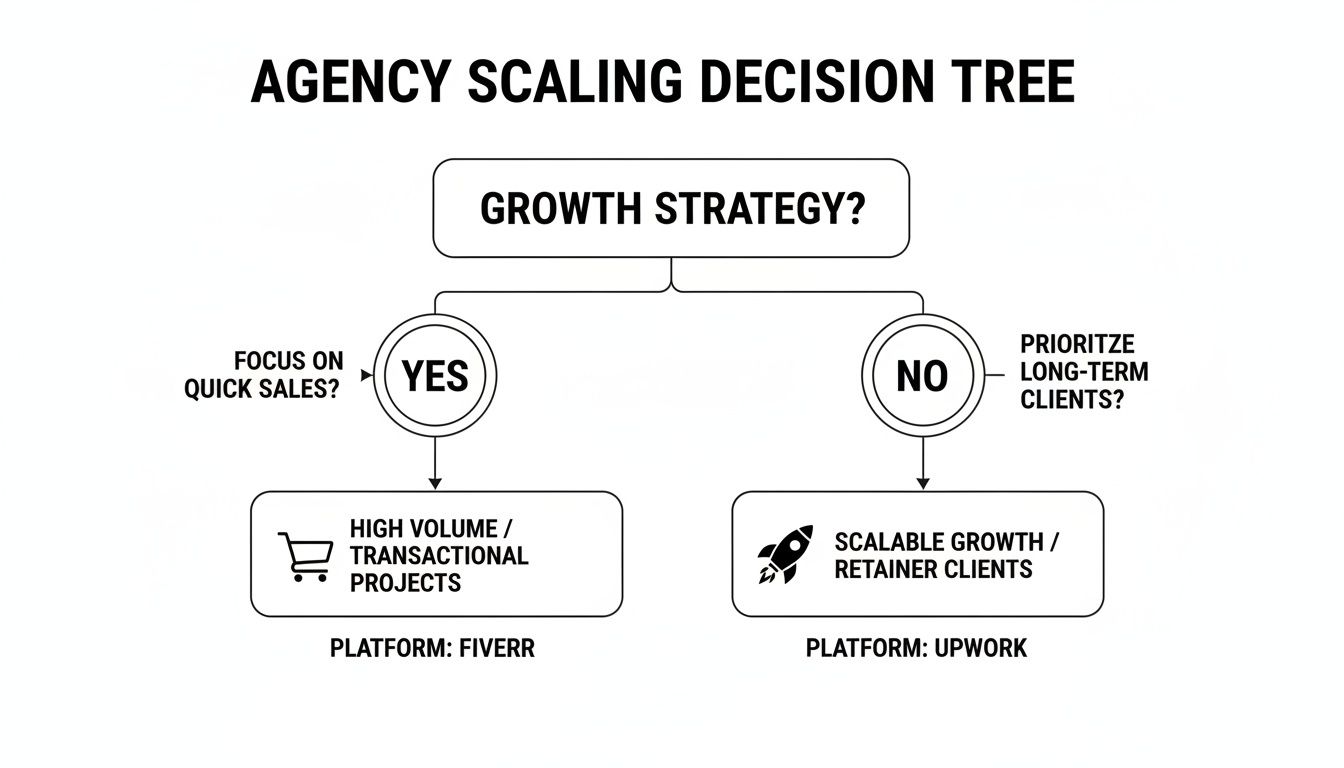
As you can see, there's a clear fork in the road. Fiverr is all about getting a high volume of quick sales, while Upwork is built for scalable, long-term growth.
Scenarios to Help You Decide
Let's ground this in some real-world situations. Thinking through these specific scenarios will show you how your service type naturally fits one platform better than the other.
- You're a solo freelancer selling a productized service. Think logo design, short video edits, or single blog posts. In this case, choose Fiverr. Its Gig-based model is perfectly designed to attract clients who know exactly what they want and just need a one-time deliverable. You set up your shop, optimize your listing, and process orders as they come in.
- You're a growing agency hunting for long-term, six-figure contracts. We're talking about monthly marketing retainers, custom software builds, or in-depth consulting projects. Here, you should choose Upwork. The entire platform is built around a proposal system designed for winning complex, high-stakes work. Everything from the client quality to features like Agency Accounts is there to support strategic, high-value partnerships.
When it comes right down to it, for any agency that's serious about building a systematic and repeatable client acquisition engine, Upwork is the clear winner. The sheer volume of quality projects posted every day creates the ideal environment for building a predictable pipeline of great clients.
The Final Verdict on Scalability
So, what’s the bottom line? Your choice hangs on your ambition and your business model. Fiverr is a fantastic tool for getting cash flow from standardized services. It’s a direct and effective way for freelancers and agencies focused on transactional sales to get to market.
But for agencies aiming for serious, scalable growth, the answer is just as clear. Upwork’s infrastructure, client base, and marketplace dynamics provide the foundation you need to grow. Its whole ecosystem doesn't just support the pursuit of bigger, more complex contracts—it actively rewards it, making it the only logical choice for ambitious growth.
Frequently Asked Questions
When you're deciding between Upwork and Fiverr, a handful of practical questions always seem to come up. Getting those answered is the key to picking the platform that actually fits your business model, not just the one that's most popular. Let's dig into some of the most common questions freelancers and agencies have in the Upwork vs Fiverr debate.
Can I Use Both Upwork and Fiverr Successfully?
Technically, yes, but it's like trying to be a master at both chess and checkers at the same time. The strategies required to win on each platform are fundamentally different.
Upwork is all about proactive outreach. You need to get good at writing compelling proposals and building relationships. On the other hand, success on Fiverr comes down to optimizing your "Gigs" to attract buyers and then managing the incoming orders. It's a much more reactive process.
For agencies chasing high-value, long-term clients, splitting your focus is a bad idea. Your time and energy are finite. Mastering Upwork's ecosystem will almost always deliver a better return than being mediocre on both platforms.
Is Upwork Harder to Get Started On Than Fiverr?
Yes, there's definitely a steeper learning curve with Upwork. To get your first job, you need a sharp-looking profile, a solid portfolio, and the ability to write a proposal that doesn't sound like everyone else's. Fiverr can feel easier right out of the gate—you just set up a Gig and wait.
But don't let that initial simplicity fool you. Getting noticed on Fiverr is a battle. The platform is incredibly saturated. Upwork's model rewards smart, consistent effort, meaning if you nail your client acquisition strategy, you can find quality work much faster.
Which Platform Has Better Payment Protection?
Both platforms do a good job of making sure you get paid, but they handle it differently.
Upwork's Escrow system is the gold standard, especially for the large, multi-stage projects agencies often handle. The client has to fund a milestone before you even start the work. This offers incredible security and peace of mind when there are big budgets on the line.
Fiverr's system is also safe—it secures the full payment when an order is placed and releases it to you once the work is approved. It works perfectly well for smaller, defined tasks. But for complex, six-figure agency contracts, nothing beats the financial safety of Upwork's Escrow.
Why Is Upwork Better for Client Acquisition Automation?
This one comes down to the core design of each platform. Upwork is a living, breathing marketplace with thousands of new jobs popping up every single day. This creates a constant stream of opportunities just waiting to be tapped.
This dynamic environment is perfect for automation. Specialized tools can watch this job feed 24/7, pinpoint the ideal projects for your agency, and send out highly personalized proposals in an instant. It gives you a massive advantage in speed and scale.
Fiverr is built like an e-commerce store. Clients come to you to browse pre-packaged services. There's no real "job feed" to tap into, which means there’s no proactive outreach process to automate. This makes Upwork the clear winner for any agency serious about building a predictable, scalable client pipeline.
Ready to stop manually searching for clients and start automating your agency's growth on Upwork? Earlybird AI acts as your always-on sales team, finding ideal projects and sending personalized proposals in minutes. See how Earlybird works.