
← Back To Blog
What Is Sales Velocity? Unlock Client Growth

Sales velocity is the rate at which your pipeline generates revenue, calculated as SV = (N × D × W) / L. If you move a win rate from 20% to 30% while keeping a 10-day cycle and $50,000 average deal value constant, velocity rises from $100,000/month to $150,000/month, a 50% increase.
That matters on Upwork because most agencies don't have a lead problem. They have a consistency problem. One month the team is slammed with delivery work, the next month nobody's sure where the next good-fit client is coming from. Sales velocity is the speedometer for your sales pipeline. It tells you how quickly your business turns qualified opportunities into revenue, and it gives you a cleaner operating metric than profile views, invite counts, or raw proposal volume.
The End of the Upwork Feast or Famine Cycle
A typical Upwork agency knows this rhythm well. Work piles up, everyone stops selling, and proposal activity drops. Then a project wraps, revenue gets thin, and the team scrambles to bid on anything that looks remotely close to the agency's service mix.
That cycle feels normal on Upwork, but it isn't a law of nature. It's usually the result of running client acquisition as a burst of activity instead of a managed system. Agencies that break out of it stop asking, "How do we get more jobs this week?" and start asking, "How fast does our pipeline turn into signed contracts?"
The real issue isn't luck
On Upwork, randomness hides weak process. One bidder writes custom proposals all morning. Another replies late to client questions. A third sends lots of proposals but targets poor-fit jobs. You can stay busy doing all of that and still have no predictable revenue engine.
A healthier approach starts with a defined pipeline. If your stages are blurry, your revenue will be too. A practical place to start is this guide to building a sales pipeline for service businesses. Upwork may look different from outbound sales, but the core discipline is the same. Define stages, qualify hard, measure conversion, and track time between steps.
Practical rule: If you can't explain where an Upwork lead sits right now and what needs to happen next, you don't have a pipeline. You have activity.
What sales velocity changes on Upwork
Sales velocity gives Upwork agencies a way to translate platform activity into business reality. Instead of celebrating more invites or more profile views, you focus on the inputs that drive revenue.
For freelancers, that means treating proposals as part of a real sales process. For agencies, it means treating each bidder, account manager, and closer as part of one revenue system. Once you track velocity, feast or famine stops being a mystery. It becomes a set of levers you can improve.
Understanding the Sales Velocity Formula
Sales velocity measures how much revenue your pipeline produces over a given period. The formula is SV = (N × D × W) / L, where N is qualified opportunities, D is average deal value, W is win rate, and L is sales cycle length. For an Upwork agency, that formula matters because it turns platform activity into an operating metric you can manage.
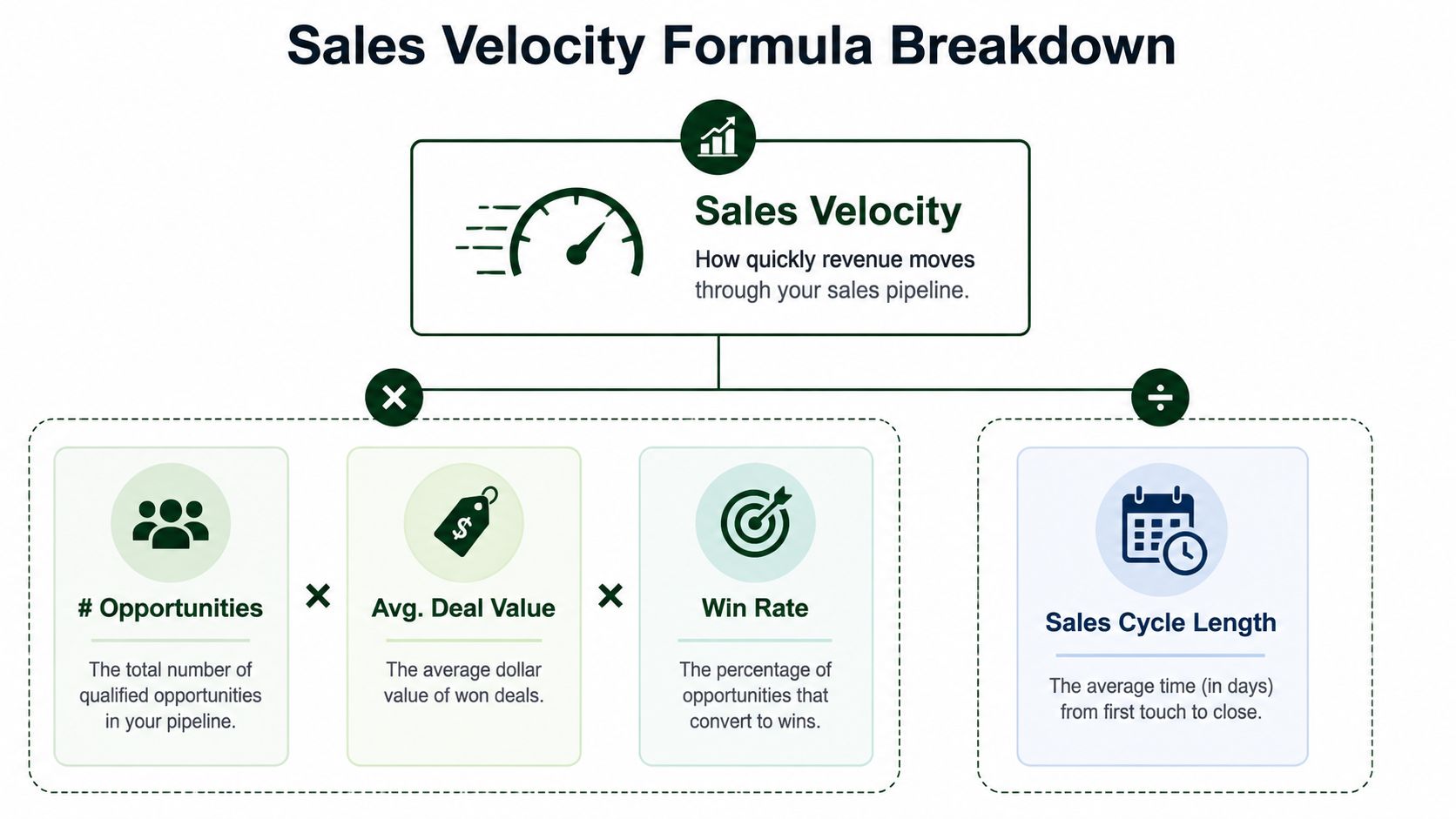
The formula itself is simple. The hard part is defining each input in a way that matches how Upwork deals move.
What each variable means on Upwork
Qualified opportunities (N) are the leads that deserve a place in your pipeline. On Upwork, that usually means jobs or invites that fit your service, budget floor, timeline, and delivery model, then progressed into a real sales step such as a submitted proposal, an active client conversation, or a booked call. If your team counts every job viewed or every low-fit invite, velocity becomes inflated and useless.
Average deal value (D) should come from recent closed business, based on the mix of work you sell. If your agency wins audits, fixed-fee builds, and monthly retainers, use a sample that reflects that mix instead of anchoring to your largest contract. Teams often need tighter sales pipeline management processes for service businesses before this number becomes reliable, because weak stage definitions usually lead to messy deal records.
Win rate (W) is won deals divided by qualified opportunities. That sounds obvious, but Upwork agencies often distort it by using total proposals sent as the denominator. That approach hides whether targeting is weak or qualification is too loose.
The denominator deserves more discipline
Sales cycle length (L) is the time from first meaningful contact to signed contract. On Upwork, that often starts with the first proposal or first client message and ends when the client hires and activates the contract.
This variable gets ignored because it feels less visible than proposals or close rate. In practice, cycle length is where many agencies lose speed. A good proposal can still stall if replies sit overnight, pricing gets introduced late, multiple teammates handle the same lead inconsistently, or a discovery call ends without a clear next step.
That is why consistent definitions matter more than perfect math.
If one account manager starts the clock at proposal submission and another starts at first reply, your trend line stops being useful. The same problem shows up when one closer counts a vague client chat as a qualified opportunity and another does not. Sales velocity only helps if your team uses the same rules every month.
One more point matters for agencies with multiple offers. Track velocity by service line, client size, or project type whenever possible. A quick-turn landing page project and a retained growth engagement move through Upwork at different speeds, and one blended number can hide both strong performance and slow leaks.
Why Sales Velocity Matters for Upwork Agencies
Most Upwork agencies track what the platform makes visible. Views. Clicks. Invites. Proposal counts. Message volume. Those numbers feel useful because they're easy to access, but they don't tell you whether the business is becoming more predictable.
Sales velocity does.

Vanity metrics don't forecast revenue
A spike in profile views can mean stronger positioning. It can also mean nothing. An increase in invites can be positive, but if those invites are poor fit, low budget, or stalled in chat, they won't help you staff the team or plan delivery capacity.
Velocity is different because it ties pipeline movement to revenue generation. That's why agency owners who want cleaner forecasting need a system that connects lead flow, conversion, deal size, and cycle time. If you're focused on Upwork agency lead generation, velocity tells you whether your lead gen machine is producing business outcomes or just more platform motion.
It diagnoses the actual bottleneck
The strongest reason to track sales velocity isn't reporting. It's diagnosis.
If opportunities are high but revenue feels slow, your win rate or cycle length is probably weak. If you close often but growth still feels capped, your average deal value may be too low. If your close rate is fine but the team keeps having dry spells, you may not be feeding enough qualified opportunities into the pipeline in the first place.
That makes velocity a management metric, not just a dashboard metric.
A good Upwork agency doesn't just ask, "How many proposals did we send?" It asks, "Which part of the machine is slowing revenue down?"
It improves decision-making
Once you see velocity clearly, better decisions get easier.
You can decide whether the team needs tighter qualification or faster follow-up. You can see whether account managers should push toward larger scopes. You can determine whether your agency should specialize more narrowly, raise minimum project size, or split bidders by niche.
Without velocity, those decisions are driven by anecdotes. With velocity, they're tied to the mechanics of how the agency wins work.
Actionable Tactics to Increase Your Sales Velocity
A familiar Upwork pattern looks like this. The team sends a high volume of proposals, replies to a few invites, jumps on calls, and still ends the month with uneven revenue. The problem usually is not effort. It is that effort is spread across the wrong velocity levers.

The practical fix is to improve one variable at a time inside the Upwork funnel. On this platform, small gains stack fast because buyer intent changes quickly, response windows are short, and weak-fit opportunities consume the same bidder time as strong ones.
Increase qualified opportunities
The first lever is N, the number of qualified opportunities. For an Upwork agency, that means creating more real chances to close, not inflating activity with low-fit proposals.
Use a stricter screen before anyone writes a proposal:
- Filter for service fit: Match the job to a defined offer, not to a broad capability list.
- Set a budget floor: Protect bidder time from jobs that cannot support your delivery model.
- Check client signals: Review hire history, responsiveness, and whether the scope is clear enough to price.
- Split searches by offer type: Keep web projects, retainers, audits, and support work in separate workflows.
This usually reduces proposal count. That is often a good trade-off. Agencies that treat every posting as pipeline create busy dashboards and slow revenue.
Raise average deal value without hurting close rates
The second lever is D, average deal value. On Upwork, deal size often stays low because agencies anchor too tightly to the client's initial post. Strong teams price around the outcome, the risk, and the delivery structure.
Three practical ways to do that:
- Expand the scope only where it improves the result: Add the missing research, QA, strategy, or implementation support that makes the project successful.
- Offer clear packages: Give the client a defined option set instead of a vague list of possible tasks.
- Target better buyers: Clients with repeat platform spend, funded companies, and teams replacing an existing vendor often accept larger scopes faster.
There is a real trade-off here. Pushing deal size too aggressively can slow the cycle or lower the win rate. The goal is not to force every project upward. The goal is to stop winning work that is too small to matter.
Improve win rate through tighter qualification
The third lever is W, your win rate. This factor often causes many Upwork agencies to lose speed without noticing it. They stay in conversations that were never likely to close.
Better qualification fixes that.
Ask direct questions in chat before the call. Confirm who approves the project. Check whether the timeline is real. Ask what the client has already tried. If answers stay vague, treat that as useful information, not as a cue to keep chasing.
A fast disqualification protects velocity. So does a sharper sales conversation. Each call should end with a defined next step, a decision owner, and a timing commitment. If those are missing, the opportunity is weaker than it looks.
After you've tightened qualification, use this walkthrough for process context:
Shorten sales cycle length
The fourth lever is L, sales cycle length. For many Upwork agencies, this is the fastest variable to improve because the delays are operational, not strategic.
Cycle time usually drags for a few predictable reasons:
- Slow first response: The client has already focused on other freelancers by the time your reply lands.
- Weak discovery: The conversation ends without a clear scope, timeline, or owner.
- Late pricing discussion: Budget mismatch surfaces after time has already been spent.
- Proposal bottlenecks: Internal review or drafting slows follow-up while buyer intent cools.
The fix is straightforward. Reply quickly. Set a concrete goal for each interaction. Put pricing boundaries on the table early. Send follow-ups that move the decision forward, not generic check-ins.
Do not cut cycle length by rushing buyers. Cut it by removing dead time between steps. On Upwork, that difference matters because momentum fades fast and the best-fit clients often hire before a slow agency finishes its internal process.
Common Pitfalls When Measuring Sales Velocity
A familiar Upwork mistake looks like this. An agency thinks pipeline speed is improving because proposal volume is up and replies are coming in faster. Then the month closes, win rate slips, average contract value drops, and the team realizes they measured motion, not sales velocity.
Sales velocity helps only when the inputs mean the same thing every week. On Upwork, that breaks down fast because deal data lives across job posts, direct messages, call notes, freelancer inboxes, and half-maintained spreadsheets. The formula is simple. The operating discipline behind it is not.

Bad definitions create bad decisions
The first failure point is inconsistent definitions. If one person counts every submitted proposal as an opportunity, while another counts only jobs with a real buyer conversation, the metric becomes useless for management decisions.
As noted earlier, standard sales velocity guidance from monday.com and HubSpot points to the same discipline: measure qualified opportunities, keep deal value grounded in recent closed-won business, and use one consistent date range long enough to smooth out short-term swings. For Upwork agencies, that matters because project mix changes quickly. A month heavy with one-off builds should not distort how you evaluate a retainer-focused pipeline.
Use rules your team can follow without interpretation:
- Opportunity: Count only jobs that reached active selling, such as a meaningful reply, discovery call, or scoped discussion.
- Deal value: Use the same closed-won sample each reporting period so pricing changes are visible instead of random.
- Cycle start: Pick one starting event, first meaningful client response or first discovery call, and keep it fixed.
- Win rate denominator: Base it on qualified opportunities, not raw proposals sent.
Small definition problems create expensive decisions. A bad denominator can make your agency look more efficient while actual close performance is getting worse.
Speed can hide quality problems
Faster activity is not automatically better performance. On Upwork, agencies often create this problem with templates, rushed qualification, or automations that increase outreach volume without improving fit.
Zendesk makes the right point in its article on sales velocity and pipeline quality. Automation can reduce delays, but weak lead quality and poor pipeline hygiene still drag results down. That trade-off is sharper on Upwork because low-fit opportunities consume real bandwidth. Every weak conversation your team chases delays follow-up on better buyers.
I usually see this in agencies that celebrate response speed while ignoring conversation quality. They reply in minutes, book more calls, and still slow revenue because too many of those calls should have been disqualified earlier.
Measure the quality cost of speed. If proposal count rises but close rate and average contract value fall, the system is producing more work, not more revenue.
Short windows create false signals
Upwork pipelines are uneven by nature. One strong week with two solid contracts can make velocity spike. A quiet stretch can make it look like the process broke.
That is why the measurement window matters. Quarterly review periods usually give a clearer read than weekly snapshots, especially for agencies selling larger projects or retainers. Short views are still useful for operational checks, but they should not drive strategic changes on their own.
Segmentation matters too. Quick-turn fixed-price work and multi-month service agreements move at different speeds and close for different reasons. If you combine them into one number, the result is tidy but misleading.
A single headline metric is fine for a dashboard. Improvement decisions need a segmented view of how your actual Upwork pipeline behaves.
Your Upwork Velocity Action Plan
Sales velocity becomes powerful when you stop treating it like a concept and start using it like an operating tool. For Upwork agencies, that means measuring the pipeline you run, not the one you wish you had.
Start with a baseline
Pull your recent Upwork pipeline and calculate a baseline using one clear definition for each variable. Keep it simple. Count only qualified opportunities. Use recent closed-won deals for average deal value. Measure win rate from qualified opportunities, and track cycle length from first meaningful contact to contract start.
Don't overbuild this on day one. A clean baseline beats a complex dashboard full of exceptions.
Find the one constraint
Once the number is on paper, diagnose the weakest lever. Don't try to improve all four at once.
Use a simple sequence:
- Check cycle length first: Delays often hide in response time, proposal turnaround, and weak follow-up.
- Review win quality next: If conversations stall, your qualification may be too loose.
- Look at deal size last: If you're closing consistently but growth feels capped, your offer structure may be underselling the value.
Change one behavior and track it
Pick one tactic and run it long enough to produce a meaningful signal. That might mean tightening your qualification checklist, standardizing call next steps, or restructuring how you scope proposals for higher-value engagements.
What matters is consistency. Sales velocity rewards agencies that operate with repeatable rules. Upwork doesn't have to feel random when your pipeline is measured, segmented, and managed like a real growth system.
If you want help turning Upwork outreach into a faster, more consistent pipeline, Earlybird AI is built for that workflow. It automates job discovery, proposal drafting, client replies, follow-up, and analytics so your team can reduce response lag, stay organized across multiple accounts, and focus more attention on qualified opportunities instead of manual bidding.