← Back To Blog
Discover what skills do you offer clients upwork to win high-value jobs

When a potential client on Upwork asks, "So, what skills do you offer?" it's a trick question. They aren't actually looking for a laundry list of your technical abilities.
What they're really asking is, "What specific business problem can you solve for me right now?" Understanding this difference is what separates the freelancers who struggle to land jobs from the ones who are consistently booked.
Translating Your Skills into Client Solutions
The single biggest mistake I see freelancers make is answering that question literally. They fall back on a resume-style list: "I do graphic design, SEO, and content writing." While that might be true, it puts all the work on the client. You're forcing them to figure out how your skills fit into their business, and frankly, they don't have the time for that.
Top earners on the platform get this. They never just list skills. They frame their abilities as tangible, money-making or time-saving outcomes. This shift in how you talk about yourself is the bedrock of a successful Upwork career.
Reframe Skills as Solutions
Stop thinking, "What can I do?" and start asking, "What problem do I solve?" This simple change moves you from being a commodity (just another 'writer' or 'designer') to a strategic partner who delivers real value.
Here's what that looks like in action:
Instead of: "I'm a graphic designer."
Try: "I create scroll-stopping brand visuals that boost click-through rates for social media ads."
Instead of: "I know SEO."
Try: "I find untapped keywords and optimize your site to attract high-intent organic traffic that actually converts into leads."
See the difference? This approach immediately tells the client you understand their end goal. You’re not just focused on the craft; you’re focused on their return on investment.
The most successful people on Upwork don't sell skills or hours. They sell results. A client isn't buying "Python programming"—they're buying an automated script that saves their team 10 hours of manual data entry every single week.
The Psychology of a Job Post
Think about it: every single job post on Upwork is born from a pain point. A client is stuck. They might be bleeding money on ads, drowning in manual tasks, or completely failing to connect with their audience.
Your job isn't to show off your toolbox. It's to prove you know exactly how to use your tools to make that pain go away.
Once you learn to read between the lines of a job description and identify the real problem, you can tailor your entire profile and every proposal to speak directly to that need. This is how you start commanding higher rates, attracting far better clients, and building a business that lasts. It's the ultimate answer to "what skills do you offer clients upwork" without ever just listing them.
Auditing Your Skills for Maximum Profitability
Okay, theory is great, but let's get practical. You've started thinking about solutions instead of just skills—now it’s time to figure out which of your skills will actually make you money on Upwork.
Here’s a hard truth I learned early on: the skill you love doing the most isn't always the one clients will pay top dollar for. To build a profitable freelance business, you have to get strategic and audit what you bring to the table.
Start by playing detective. Go find the top-earning freelancers in your space—the ones charging rates that make you a little jealous. Dissect their profiles. What specific skills are they highlighting in their titles and overviews? They aren't just listing generic abilities; they're showcasing specialized, high-value expertise that clients are clearly willing to fund.
Categorize Your Skill Inventory
As you start spotting these in-demand skills, it’s time to organize your own. Don't just make a random list. You're building a strategic service menu. I find it helpful to think of my skills in three tiers:
- Core Skills: These are your headliners—the high-value services you're a true expert in. You can confidently deliver amazing results every time. For a writer, a core skill isn't "writing"; it's something specific like "B2B SaaS Content Strategy."
- Secondary Skills: Think of these as your supporting cast. They complement your core skills and make your main offer even more valuable. For that same writer, secondary skills could be "On-Page SEO" or "Interviewing Subject Matter Experts."
- Emerging Skills: This is where you keep an eye on the future. These are skills you're currently learning or see gaining traction in the market, like "AI Content Optimization" or "Video Scriptwriting." Tracking these keeps you from becoming obsolete.
This tiered approach helps you present yourself as a focused specialist with a well-rounded toolkit, not just a generalist who does a bit of everything.
Uncover What High-Budget Clients Want
Your next move is to go straight to the source: high-budget job postings. Use Upwork’s search filters to zero in on jobs with budgets of $1,000 or more in your field. Read these job descriptions very carefully. What keywords and phrases keep popping up?
This is where you make the critical mindset shift from your raw skill to the client's end goal.
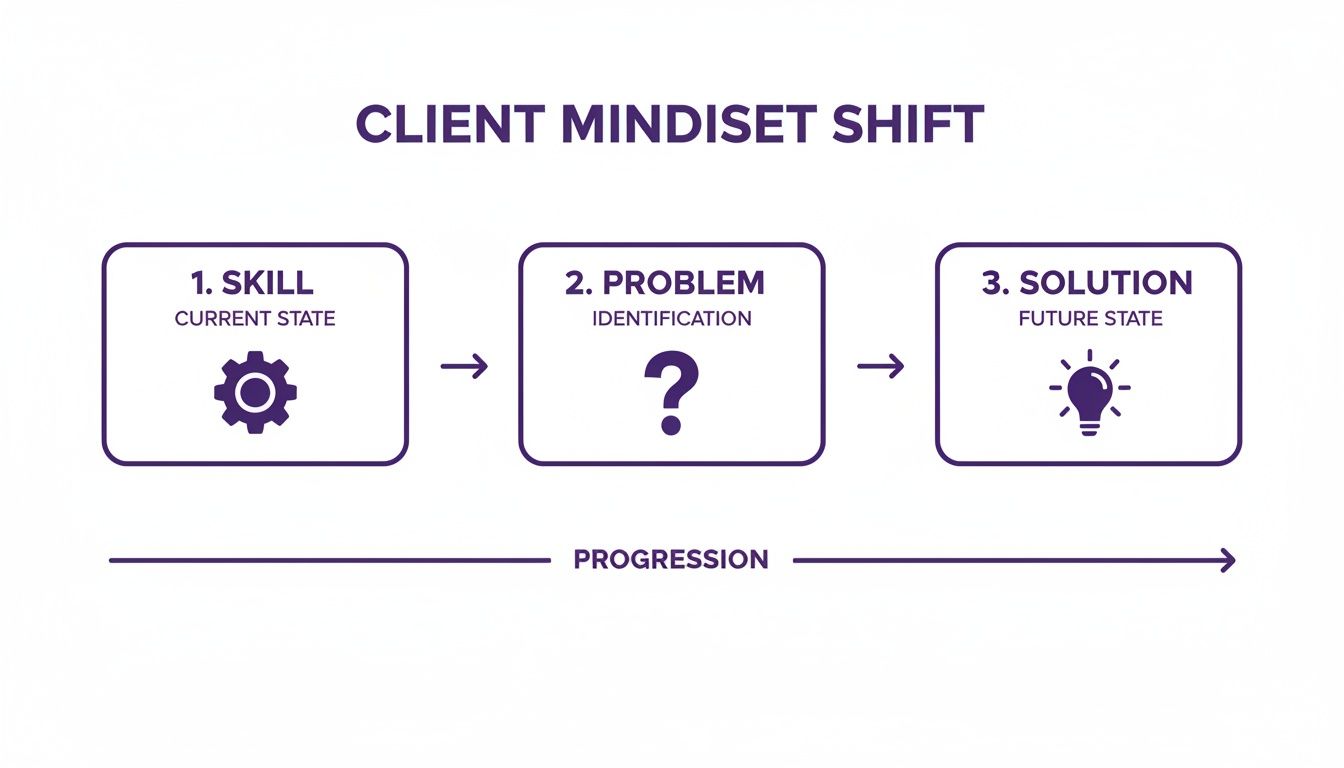
As the diagram shows, your skill is just the starting point. The real money is made when you connect that skill to a specific client problem and offer a clear solution. When clients post these high-value jobs, they aren't just listing skills; they're describing a business pain point.
By analyzing these posts, you're getting direct insight into the market's most pressing—and profitable—problems. If you see "data visualization for investor reports" appearing consistently in high-budget analytics jobs, that's a clear signal to prioritize and feature that skill prominently in your profile.
How to Weave Your Top Skills into Your Upwork Profile
Think of your Upwork profile as your best salesperson, working for you 24/7. When a potential client lands on your page, they aren't just looking for a list of your abilities. They're searching for someone who can solve their specific, nagging problem. Your profile needs to scream, "I'm the one who can fix that for you."
Every single section—your title, your overview, even your portfolio—is a chance to grab the attention of a great client. It's prime real estate. Let's make sure you're using it to showcase your most profitable skills long before you even submit a proposal.

Go from a Generic Title to a Client-Grabbing Headline
Your profile title is the very first thing a client sees. It’s your digital handshake. Too many freelancers just put "Python Developer" or "Graphic Designer," which immediately makes them look like thousands of others.
Instead, your title should declare your specialty and the value you bring to the table.
- A simple "Python Developer" becomes "Python Developer for Data Automation in SaaS Companies."
- "Content Writer" turns into the much more specific "SEO Content Writer for B2B Tech & Finance."
That small tweak does two powerful things. First, it acts as a filter, attracting clients who need exactly what you do. Second, it instantly positions you as a specialist, not a generalist—and specialists solve expensive problems and command higher rates.
Write a Client-Focused Overview
This is where I see most freelancers get it wrong. They write their overview all about themselves: their background, their personal journey, their passions. Honestly, a client's main concern is their own journey, not yours.
Your overview is your pitch. It should be framed entirely around your client’s world and their problems.
Start by hitting on a pain point they likely have. Then, you can introduce your skills as the clear solution to that pain. Use short paragraphs and bullet points to highlight the tangible results you help them achieve.
Your overview should immediately answer a client's silent questions: "Do you get my business? Can you fix my specific issue? What results can I actually expect from hiring you?" Always focus on the benefits you provide, not just the features of your service.
For instance, don't just say you offer "copywriting." Instead, explain that you write "email sequences that nurture cold leads into sales" or "website copy that clarifies your brand's message and boosts conversions." Every skill you list should be tied to a bottom-line business result. You can see great examples of this in action in our guide to creating a standout sample profile for Upwork.
Turn Your Portfolio into Solid Proof
Your portfolio is your chance to stop telling clients what you can do and start showing them. Please don't just upload a file with a generic title like "Website Mockup." Each portfolio piece should be a mini-case study that proves your value.
Frame every project with a simple, powerful story:
- The Problem: What was the client struggling with? (e.g., "A new e-commerce store was struggling to build an email list from zero.")
- The Solution: What skills did you use to fix it? (e.g., "I designed and wrote a 5-part welcome email sequence paired with a compelling lead magnet to capture visitor information.")
- The Result: What was the outcome? Use numbers! (e.g., "The campaign generated over 1,500 new subscribers in its first 30 days and maintained a 35% open rate.")
This approach gives clients concrete proof that you deliver results. It makes it incredibly easy for them to picture you doing the same for their business, which is the most effective way to show them exactly what skills you bring to the table.
Framing Your Skills in High-Converting Proposals
The biggest mistake I see freelancers make on Upwork? They talk all about themselves. The reality is, a winning proposal isn't a resume—it’s a direct response to a client's problem. And I'd say 90% of freelancers get this wrong.
The secret is to stop listing your skills and start showing how those skills solve the client’s specific issue. Your profile might get you noticed, but the proposal is where you prove you understand their pain and have the exact remedy.

It all comes down to breaking down what the client actually wants before you even think about mentioning your qualifications.
Mirror the Client's Goal Before Pitching Your Solution
The most powerful proposals I've ever written—and the ones I see get hired—start by reflecting the client's goal back to them. It's a simple act of paraphrasing that instantly shows you’re paying attention. It builds trust right away and makes you stand out from the flood of generic bids.
Instead of opening with, "I am an expert SEO with ten years of experience," try something that feels like you're already on their team. For instance: "Ranking for 'eco-friendly packaging' is a great goal, especially in such a competitive market. To pull it off, you'll need a very targeted content and backlink strategy."
See the difference? Only after you’ve shown you get the big picture should you introduce your skills as the tools to get the job done. You’ve shifted the entire conversation from "Here's what I do" to "Here's how I'll get you what you want."
Here’s what that looks like in practice:
- Weak approach: "My skills include technical SEO, content strategy, and link building."
- Strong approach: "To start ranking for 'eco-friendly packaging,' my technical SEO skills can address the site speed issues I found. From there, my content strategy expertise will help us build a topic cluster that cements your authority."
This small shift in framing changes everything. You’re no longer just another bidder; you’re a strategic partner.
Apply Your Skills at Scale with Proposal Tools
I know what you're thinking. Crafting a truly personalized proposal for every single job sounds exhausting, especially when the best jobs get swamped with applications in the first hour. This is where you can get a serious edge.
Tools like Earlybird AI let you systematize this client-first approach. You can build smart templates that automatically identify and weave a client's keywords from their job post directly into your proposal framework. This means even your fast bids are highly targeted.
The goal isn't just to be first; it's to be first and best. By using automation smartly, you can submit a thoughtful, personalized proposal moments after a job is posted, massively boosting your odds of getting a reply.
You’re not just sending more proposals; you’re sending smarter proposals, and you're doing it faster than the competition. To learn more about perfecting your pitch, check out our guide on how to write an Upwork proposal that clients can't ignore.
Testing a New Skill's Market Demand on Upwork
Before you sink months into learning a new skill, you have to know if clients will actually pay for it. The fear of spending all that time on something nobody wants is real, but you can sidestep that problem with a few quick validation tests right inside Upwork.
Instead of just guessing, let's use some real data. By running a couple of simple checks, you can get a feel for client interest, typical budgets, and the quality of available projects—all before you commit to a steep learning curve.
The 10-Minute Job Feed Test
This is my go-to method for a quick reality check on any new skill I'm considering. It’s a fast way to see what's happening on the platform right now.
First, head over to the Upwork job feed. In the search bar, type in some specific keywords for the skill you're testing. Don't be vague. Instead of just "AI," try something more targeted like "AI chatbot development" or "Midjourney image creation."
Now, you're looking for three things: volume, budget, and quality.
- Volume: Are you seeing dozens of jobs posted daily, or just a trickle of a few per week?
- Budget: Are clients offering solid budgets of $500+, or are most of the jobs stuck under $100?
- Quality: Read the actual job descriptions. Do they look like they’re from serious businesses with clear goals, or are they just low-effort posts from tire-kickers?
A healthy market has a steady stream of high-quality, well-funded work. This quick search will tell you pretty clearly whether a skill is worth digging into further.
Create a 'Micro-Offer' with a Specialized Profile
If the job feed test shows promise, the next move is to test client interest more directly. You don't have to blow up your entire freelance business to do this; Upwork’s specialized profiles are the perfect tool for the job.
Set up a new, dedicated profile that focuses only on the skill you're testing. For instance, if you're a writer looking into "B2B SaaS case studies," you'd create a profile with that exact title. Write a short overview that speaks directly to the needs of SaaS marketers and maybe even mock up a sample or two for your portfolio.
Think of this specialized profile as a test balloon. You're not committing to a new career—you're just putting up a small, targeted sign to see who stops to look.
If you start getting invites or messages specifically for that profile, you have a powerful signal that there’s real market demand.
Analyze Your Proposal and Invite Data
Finally, the data from your own proposals is a goldmine. Start paying close attention to what happens after you send a proposal. Are you getting more views and interviews when you mention "video editing" versus "graphic design"?
This is where a tool that gives you deeper insights can really pay off. For example, using an Upwork job finder tool can help you track which skills you pitch most often and, more importantly, which ones actually start conversations.
When you notice that proposals mentioning a specific skill get a 20% higher view rate, that’s the market telling you exactly what to focus on. This data-first approach makes sure you're putting your energy where you’ll get the biggest results.
Answering Your Top Questions About Upwork Skills
Once you start digging into how to position yourself on Upwork, a few common questions always seem to pop up. Let's tackle some of the ones I hear most often from freelancers trying to get their skills in front of the right clients.
How Many Skills Should I Actually List on My Profile?
I see this all the time: freelancers stuffing their profiles with every skill they've ever picked up. Resist that temptation. When it comes to your Upwork profile, quality absolutely demolishes quantity.
Instead of a laundry list of 20+ skills, focus on the 5-7 core skills where you have serious expertise. These are the things you do best and can back up with a strong portfolio. You can then add a few related, secondary skills to round things out. This approach immediately frames you as a specialist who solves a particular type of problem, not a generalist who dabbles in everything. Trust me, the best clients are always looking for an expert.
Should I List Soft Skills Like "Communication"?
Here's the thing about soft skills: listing them as tags like "Communication" or "Problem-Solving" is a waste of valuable profile space. It's weak and offers zero proof. Clients just assume you have these basic professional skills, so you need to show them, not just tell them.
Here’s how you can demonstrate them effectively:
- Great Communication: This comes through naturally in a well-written, error-free profile overview. It shines in the personalized, thoughtful proposals you send.
- Problem-Solving: Don't just claim it. Frame your portfolio pieces as mini case studies. Explain the challenge, how you tackled it, and the specific, positive outcome you delivered for your client.
Actions provide the concrete evidence that a simple skill tag never can.
What if My Main Skill Is in a Super Crowded Market?
If your primary skill feels like you're just a small fish in a massive, crowded ocean, the answer is to specialize. Carve out your own niche. This is how you stop competing with thousands of other freelancers and start standing out to a select few high-value clients.
By niching down, you aren't limiting your opportunities—you're focusing them. You attract clients who are specifically looking for your unique expertise and are willing to pay a premium for it.
Think about it this way:
- Instead of being a general "Graphic Designer," you could become a "Logo and Brand Identity Designer for Tech Startups."
- Rather than a generic "Writer," you could position yourself as a "Long-Form Blog Writer for B2B SaaS Companies."
Taking this targeted approach makes your profile incredibly compelling. You're no longer just another option; you become the obvious choice for a specific type of client, which drastically cuts down your competition and lets you charge what you're worth.
Stop drowning in manual bidding and start winning more high-value clients. Earlybird AI acts as your 24/7 sales team on Upwork, sending personalized proposals in minutes and keeping you first in line for the best jobs. Discover how Earlybird AI can automate your growth.