← Back To Blog
How to Write Proposal Upwork: how to write proposal upwork that wins jobs
If you want to learn how to write a proposal on Upwork that actually wins jobs, you need to think less like an applicant and more like a problem-solver. Your proposal isn't just a cover letter; it's a strategic document designed to show a client you understand their world and have the exact skills to make their problem disappear.
The Blueprint for a High-Converting Upwork Proposal

Before you even start typing, remember this: clients don't read proposals, they scan them. They're looking for quick signals that you're competent, you've read their brief, and you're not just blasting out a generic template to every job on the feed. Your mission is to make it incredibly easy for them to see you're the right choice.
Think of your proposal as a direct sales pitch. You've got about three seconds to grab their attention, a few more to build trust, and then a final moment to guide them toward a conversation. This means shifting your focus from simply listing your skills to framing your expertise as the perfect solution to their specific problem.
The Psychology Behind a Winning Bid
A great proposal gets inside the client's head. It quickly and quietly answers the two questions every client is asking: "Do you actually understand my problem?" and "Can I trust you to fix it?"
To do that, you need a solid framework. This isn't about a rigid, copy-paste template but a flexible blueprint that helps you hit all the right notes, every single time. It's the structure that lets you build that critical trust in just a few short paragraphs.
A winning proposal is the one that speaks the buyer's language. It's the one that creates empathy and shows a clear 'before and after' story of how you can help.
Core Components for Success
Every single one of my high-converting proposals contains four essential elements. They work in tandem to build a case for hiring you, and mastering this flow is the fastest way to boost your reply rate.
Below is a quick-reference table that breaks down the essential parts of a proposal and why each one matters.
Core Components of a High-Converting Proposal
Think of these components as the building blocks of your argument. When you assemble them correctly, the result is a proposal that feels less like a cold application and more like the start of a productive partnership.
This isn't just theory; it's a proven method. Industry analysis shows that structured proposals with a clear call to action consistently get more client replies. By following a methodical approach instead of just winging it, you stack the odds in your favor. If you're looking for more guidance, there are excellent resources on proposal templates that get responses that confirm this strategy works.
Crafting an Opening That Demands a Response
Think of your Upwork proposal's first two sentences as prime real estate. This is your one shot to stand out. Most clients are drowning in proposals that all start the same way: "Hi, my name is..." or "I am the perfect fit for your job." They're generic, they're boring, and they get you archived instantly.
Your opening has one job: to prove you're different. You need to make the client stop scrolling and actually read. You don't do this by bragging about your skills; you do it by showing you’ve already put real thought into their problem.
The secret is to make the opening about them, not you. A powerful hook shows you’ve done your homework and are already thinking like a partner, not just another bidder.
Ditch the Clichés and Start a Conversation
Generic openers are a dead end because they’re completely self-centered. A client doesn't care who you are until they're confident you can solve their problem. So, instead of a formal introduction, jump right into their pain point.
Let's say a client is looking for a "social media manager." The average freelancer will list their years of experience. A pro, on the other hand, digs a little deeper. Maybe you mention a specific detail from their company website or a missed opportunity you spotted on their Instagram feed. You're no longer just applying; you're consulting.
The best opening line is one that makes the client think, "Finally, someone who gets it." It immediately changes the entire dynamic.
Real-World Examples of Powerful Openers
Let's see this in action. A generic opener is easy to write, but it's just as easy for a client to ignore. A specific, client-focused hook is impossible to overlook. For a deeper dive, check out these exceptional cover letter examples for Upwork that nail this approach.
Here’s a simple side-by-side comparison.
- Weak Opening: "I have read your job description and I am confident I can help you with your SEO needs."
- Strong Opening: "I noticed your e-commerce site is stuck on page two for 'organic dog treats,' while your top competitor owns the featured snippet. I have a three-step plan to start closing that gap in the first 90 days."
See the difference? The second example doesn’t just claim expertise—it proves it by offering immediate, specific insight. It shows you're already on the case.
Mastering the First Impression
In just a few seconds, your opening needs to accomplish three things:
- Prove You Read the Post: Reference a specific detail from their project description. Bonus points if you can find the client's name in their review history and use it.
- Acknowledge Their Core Problem: Briefly summarize their main challenge or goal to show you understand what truly matters to them.
- Hint at a Solution: Tease your approach. Suggest a concrete outcome or a unique angle you'd bring to the project.
Focusing on these three elements turns your proposal from just another application into a magnet for the client's attention. It shows you’re a thoughtful professional who invests time upfront—a crucial step in learning how to write a proposal on Upwork that doesn't just get views, but starts conversations.
Connecting Your Skills to Their Bottom Line

Okay, you’ve hooked them with a strong opening. Now comes the part where most freelancers drop the ball. They pivot straight into a laundry list of their skills—"SEO," "content writing," "graphic design"—and completely miss the point.
Here's the truth: clients don't actually care about your skills in a vacuum. They care about what those skills can do for them. They have a business problem—stagnant sales, low customer engagement, wasted time—and they're looking for someone to make that problem disappear. Your job is to draw a direct line from your expertise to their success.
Think of yourself as a detective. Read the job description, then read it again. What's the real reason they're hiring? A client asking for "a few blog posts" is probably struggling to get new leads. Someone who wants a "website refresh" is likely frustrated with a low conversion rate. Your proposal needs to speak to that hidden pain point, not just the task itself.
Translating Skills into Business Value
Once you have a good idea of their core objective, you can frame your experience in a way that resonates. Don't just list what you did in past projects; explain the results you generated. This is a subtle but powerful shift that turns your proposal from a bland resume into a strategic business case.
Let's look at a simple before-and-after.
- Instead of this: "I have five years of experience with Google Ads."
- Try this: "For a similar e-commerce client, I was able to cut their cost-per-acquisition by 18% while increasing their return on ad spend. I'm confident I can find similar opportunities to optimize your campaigns."
See the difference? The second version shows you think like a business partner. You understand that your work isn't just about managing ads; it's about delivering tangible, bottom-line results. This is what separates a forgettable proposal from one that a client has to respond to.
The most convincing proposals don't sell services; they sell a future state. They paint a clear picture of what the client's business will look like after they hire you.
Weaving in Proof and Mini Case Studies
Big claims need solid proof. This is where you bring in your portfolio, but not in the way most people do. Don't just dump a link to your entire portfolio and make the client do the work of finding something relevant. That’s lazy.
Instead, hand-pick one or two perfectly matched examples and present them as mini case studies right inside your proposal. Tell a quick story of success.
Here’s an example of a mini case study:
"Your goal of boosting organic traffic really clicks with a project I did for another B2B software company. They were also struggling to get traction in search results. I developed a content strategy around specific long-tail keywords, and we managed to grow their organic traffic by 45% in just six months. I can share a quick report showing that growth curve if you're interested."
This is so much more effective than a simple link. It gives context, shows your thought process, and provides concrete evidence that you can solve their specific problem. This value-first approach borrows from proven B2B sales tactics, where demonstrating deep understanding of a client's challenges is everything. You can actually learn a lot by studying the principles behind tools that do this at scale, as detailed in this guide on what is sales automation, and apply those same concepts manually to your proposals.
Using AI as Your Proposal Co-Pilot
Let's be real: AI tools are changing the game for freelancers, and that includes how we tackle Upwork proposals. The trick is to think of AI as your co-pilot, not the autopilot. It's an incredible assistant for getting things done faster, but it can't fake the human connection that actually lands you the job.
The biggest win with AI? Pure speed. Instead of battling a blank screen, you can have a tool whip up a first draft based on the client's job post. This gives you a solid starting point, freeing you up to focus on what matters—digging into the client's business and making your proposal impossible to ignore.
The Smart Way to Use Proposal AI
Look, the goal isn't to have a robot write and send proposals on your behalf. That’s a fast track to getting ignored. Instead, you want to use it to sharpen your process. Think of it as a brainstorming buddy that helps you find the right words faster, so you can spend your brainpower on the strategy that seals the deal.
Here’s how I put these tools to work without sounding like a machine:
- Brainstorming Hooks: I'll drop the job description into an AI tool and ask for a few different opening lines. It’s a great way to spot angles I might have missed on my own.
- Polishing My Language: Ever write a paragraph that just feels... clunky? I’ll paste it in and ask the AI to tighten it up or make it sound more professional. It’s like having an editor on call.
- Spotting Gaps: Once I have a draft, I'll ask the AI to cross-reference it with the original job post. Sometimes it catches a small question or requirement I completely overlooked.
This whole approach keeps me in the driver's seat. I'm making all the critical decisions, but my co-pilot is handling the busywork. The result? I can apply to more of the right jobs without my proposal quality taking a nosedive.
Avoiding the Pitfalls of Generic AI Copy
The number one risk of using AI is ending up with a proposal that sounds like it was written by a robot—because it was. Clients are getting incredibly good at sniffing out generic, copy-paste bids. They’re the ones that feel totally impersonal and could have been sent for any project under the sun.
An AI-generated proposal is a starting point, not a final product. The human touch—your unique insights, personality, and genuine interest in the client's problem—is what turns a generic draft into a winning bid.
Even Upwork is leaning into this with its own AI, Uma. They found its Proposal Writing feature boosted the number of bids freelancers sent by 2.5%. This tells us that AI is great at helping people get over that initial hurdle of just starting. You can dig into more stats about Upwork’s AI-driven platform to see how these tools are being used.
The lesson here is simple: let the AI get you started, but always, always inject your own expertise and personality before you even think about hitting "submit." That's the part the machine can't replicate.
Common Proposal Mistakes That Cost You Jobs
Ever wonder why your Upwork proposals get ignored, even when you know you’re the perfect fit for the job? I've been there. The truth is, it's rarely about your skills. It's almost always about small, avoidable mistakes in the proposal itself.
These common blunders send your bid straight to the client’s trash folder. Let's walk through the most frequent ones so you can dodge them and start landing more interviews.
The Copy-Paste Catastrophe
This is, without a doubt, the number one proposal killer. Clients can spot a generic, copy-pasted template from a mile away. It immediately tells them you didn't bother to read their brief and are just spamming every job post you see.
Think of it this way: your proposal is a sales pitch, not a form letter. While having a base structure is smart, the first two paragraphs must be 100% custom. Reference the client’s company, their specific problem, and use the language they used in their post. Show them you're paying attention.
Making It All About "I, Me, My"
Another classic mistake is what I call the "I-centric" proposal. This is where freelancers just list their own credentials: "I have 5 years of experience..." or "I am an expert in..."
Here’s the thing: the client doesn't care about you yet. They care about their problem. Your job is to connect your skills to their needs.
Flip the script. Instead of leading with your resume, lead with their solution.
- Don't say: "I am a skilled graphic designer with a strong portfolio."
- Do say: "Your brand's current logo feels a bit dated. I can create a modern design that will connect with your target audience and give your brand a fresh, professional look."
See the difference? One is an application; the other is a solution.
The infographic below breaks down how to keep that human, client-focused touch, even if you're using tools to help speed up the writing process.
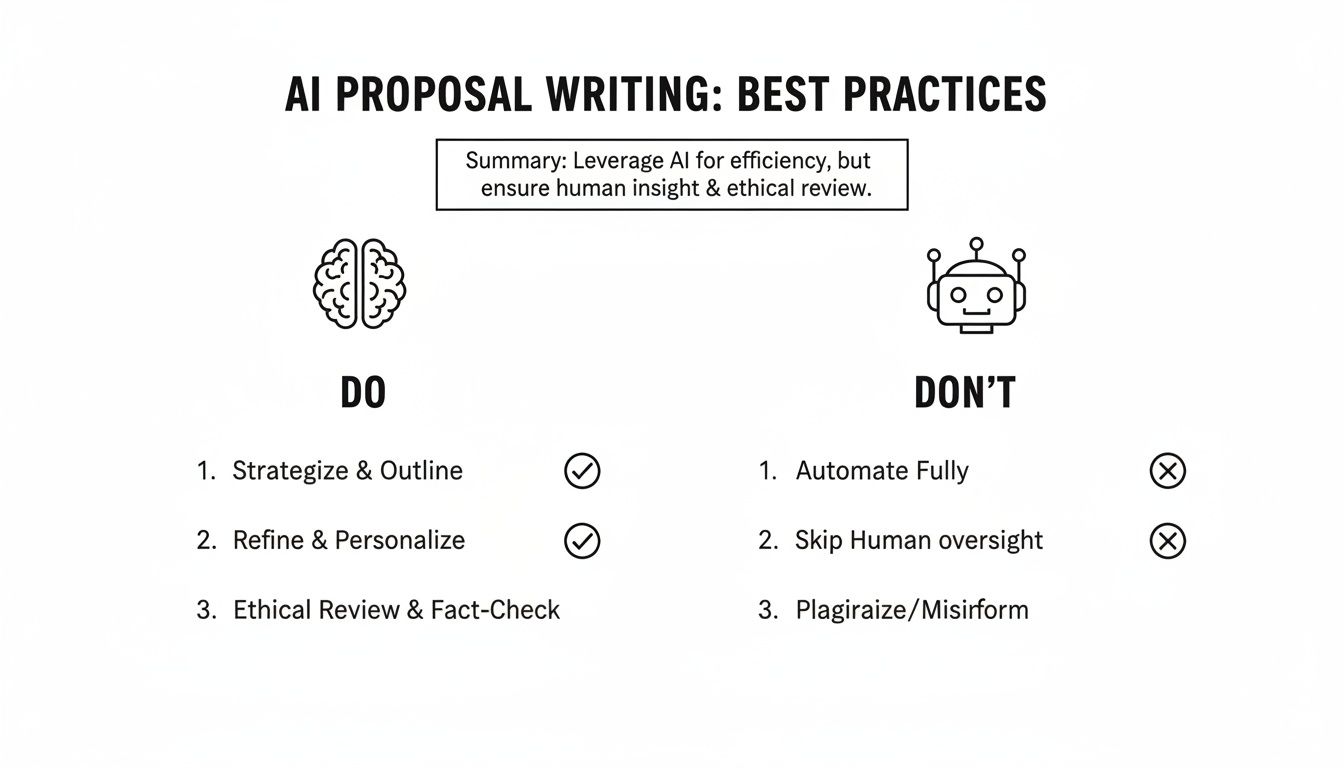
The best proposals always start with a human strategy, focusing on empathy and problem-solving, not just automated text.
To make this crystal clear, here’s a quick comparison of the most common proposal pitfalls and what you should be doing instead.
Proposal Pitfalls vs. Winning Alternatives
Thinking in terms of "alternatives" rather than just "don'ts" is a powerful way to reframe your entire approach.
Forgetting to Read the Fine Print
Some clients are clever. They’ll hide a small instruction or a specific question deep in the job description to filter out the spammers. You might see things like, "Start your proposal with the word 'banana' to show you've read this."
Ignoring these is an instant disqualification. It’s a dead giveaway that you didn't read the brief. Always scan the entire job post for these little tests. Nailing them is the easiest win you'll get.
The Weak and Wimpy Finish
Finally, so many proposals fizzle out at the end. They close with something passive and hopeful, like "I look forward to hearing from you." This puts all the responsibility back on the client.
You need to end with a confident, clear call to action (CTA). Guide them to the next step and make it easy for them to say yes.
Here's a simple, effective CTA: "I've already got a few ideas for your content strategy. Are you free for a quick 10-minute chat tomorrow to see if we're a good fit?"
This kind of proactive closing doesn't just ask for a job—it starts a conversation. And that's exactly what you want.
Answering Your Top Questions About Upwork Proposals
Even with the best strategy, you're bound to run into questions when you're in the trenches, firing off proposals. Let's clear up some of the most common sticking points so you can bid with confidence.
How Long Should My Upwork Proposal Be?
There’s no magic word count, but I’ve found the sweet spot is usually between 100 and 200 words. The goal is impact, not a novel.
Your first two sentences are make-or-break. They absolutely have to hook the client by directly addressing their core problem. This instantly proves you've read their post and aren't just spamming them. A short, sharp, and hyper-relevant proposal will win out over a long, rambling one every single time. Clients are scanning for value, so make it incredibly easy for them to see it.
Should I Include My Portfolio in Every Proposal?
Absolutely, but you have to be smart about it. The biggest mistake freelancers make is dropping a generic link to their entire portfolio and hoping the client will do the heavy lifting. That just creates more work for them and screams "I didn't bother to customize this."
Instead, hand-pick two or three of your best pieces that are directly relevant to their project. Frame each one with a quick, punchy sentence explaining why you chose it.
- For example: "Here’s a case study showing how I helped another SaaS client reduce churn by 15% using the exact email marketing strategy I have in mind for you."
This simple tweak provides immediate proof of your skills and shows you’ve actually thought about their specific situation.
By curating your examples, you transform your portfolio from a passive gallery into an active sales tool. It's a small step that makes a huge difference in how clients perceive your expertise.
What Should I Do If a Job Post Is Vague?
Vague job posts are actually a golden opportunity. Most freelancers will either take a wild guess at what the client wants or just skip the job entirely. This is your chance to stand out.
Use your proposal to ask smart, clarifying questions. This immediately positions you as a strategic partner, not just a task-doer waiting for orders. You could ask something like, "To make sure the final designs really hit the mark, could you clarify if the main audience for this landing page is new customers or existing users?" This shows you're already thinking about their business goals.
Navigating these client interactions is a lot easier when you trust the platform you're on. For more on that, our guide on if Upwork is a legitimate platform can offer some helpful perspective.
Is It Okay to Use a Proposal Template?
Using a base template or a proven framework is a great way to work efficiently. But—and this is a big but—you can't just copy and paste it without serious customization. Think of your template as a skeleton, not the finished product.
The first 2-3 sentences must be 100% unique and written specifically for that job. The body of your proposal should also pull in the client's own language and specific needs from their post. Your template is really just a checklist to make sure you hit all the key points: the personalized hook, the problem-solution bridge, and a clear call to action. The content itself needs to be fresh every time.
Ready to stop writing proposals and start winning clients? Earlybird AI acts as your always-on sales team, automatically finding your ideal projects and sending personalized bids within minutes. Let our AI handle the outreach so you can focus on what you do best—delivering great work.
Discover how Earlybird AI can double your reply rate at https://myearlybird.ai