
← Back To Blog
The Essential Guide to Advertising Agency Software
If you're trying to run a modern ad agency using just spreadsheets and email, you’re not just making things hard on yourself—you're actively capping your own growth. It's like trying to build a skyscraper with a hammer and some loose nails. The chaos is predictable, efficiency is a pipe dream, and your ability to scale is severely limited. Advertising agency software is what brings order to that chaos, acting as the central nervous system for your entire operation.
Why Your Agency Can No Longer Ignore Specialized Software
In this industry, speed and accuracy are everything. Relying on outdated manual processes isn't just a quaint way of working; it's a direct threat to your agency's bottom line. Think about it: disjointed task lists, never-ending email chains for simple approvals, and client info scattered across a dozen different folders. It all creates friction that slows projects down, burns out your team, and eats into your profit margins.
This isn't just about being inefficient. This kind of operational drag is what stops you from scaling. You end up turning away good business simply because you don’t have the internal bandwidth to handle it. The right software isn't a luxury anymore—it's the fundamental engine for growth. By bringing everything under one roof, these platforms allow agencies to manage more clients with the same team, deliver better work, and finally scale with confidence.
From Disjointed Tasks to a Unified Workflow
Picture the daily grind at your agency. Without a central system, it's like an orchestra where every musician is playing a different song. Your project manager has their spreadsheet, your designer uses a separate to-do list, and your account exec lives in their inbox. They're all functional on their own, but together, it's just noise.
Advertising agency software is the conductor that gets everyone in sync. It weaves all those individual tasks and conversations into a single, cohesive workflow.
- Client Onboarding: Instead of a flurry of back-and-forth emails, you have a standardized intake form and automated welcome sequences.
- Project Execution: A central hub for tasks means everyone knows exactly what they need to do and when, eliminating confusion.
- Creative Approvals: The nightmare of "final_final_v3.psd" is over. A single platform for feedback and revisions keeps everyone on the same page.
- Reporting: Forget spending hours cobbling together data. Real-time dashboards give you instant performance insights.
The Growing Market Underscores the Need
This isn't just an internal observation; it's a global trend. The market for advertising agency software is exploding, projected to reach USD 2.65 billion by 2025 and keep climbing. In major markets like North America and the Asia Pacific, where ad spending is through the roof, this software has become non-negotiable. It’s the backbone of modern agency collaboration, with benchmarks showing it can cut down workflow bottlenecks by a staggering 40%. You can dig into more of the numbers behind this market surge on datainsightsmarket.com.
The core benefit is simple: a well-implemented software stack transforms administrative hours into billable hours. It automates the mundane so your talented team can focus on what they do best—creating brilliant campaigns that drive client results. This is how you build a more profitable and resilient agency.
The Building Blocks of Your Agency's Tech Stack
Trying to piece together the right software for your agency can feel like building a complex machine with no instructions. It's easy to get overwhelmed. A better way to think about it is like building a high-performance car—every single part has a specific job to do, and they all need to work together to get you moving forward.
The foundation of this whole operation, the very chassis of your car, is your Project Management software. This is the core framework that holds everything together. It organizes every task, timeline, and deliverable, making sure your campaigns stay on the rails from kickoff all the way to the finish line.
It’s the connective tissue between your people, their work, and each other. Without a solid project management system in place, your agency is running on a wobbly frame. You might be moving, sure, but it’s chaotic, inefficient, and bound to fall apart when things get intense.
Navigating Your Client Relationships
If project management is the chassis, then your Customer Relationship Management (CRM) software is the navigation system. This tool does so much more than just store names and numbers; it maps out the entire journey you have with every single client. It shows you where you’ve been, where you are now, and helps you chart the best course toward a long-term, happy partnership.
A good CRM tracks every interaction—from the first sales call to the project renewal discussion. This gives your team a 360-degree view of a client's history, their unique needs, and even how they prefer to communicate. This centralized intelligence is gold. When an account manager knows the client voiced budget concerns three months ago, they can craft their next proposal with that in mind, turning a simple service into a real strategic partnership.
For a deeper look at how these different tools fit into the bigger picture, you might find our guide on software for a digital marketing agency helpful.
This next diagram really drives home how having a central software system creates the foundation you need to grow through smarter workflows and better decisions.
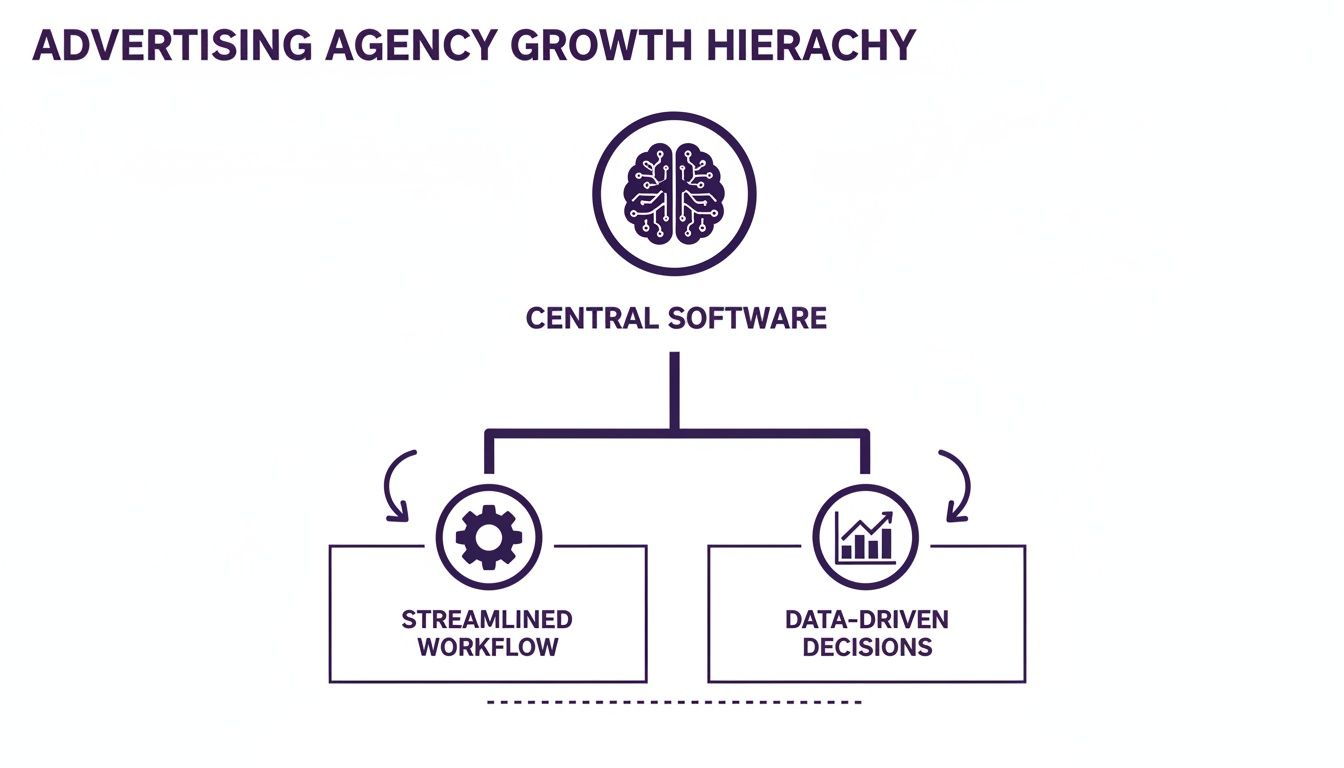
As you can see, a centralized system acts as the "brain" of the operation. It's what allows for both efficient day-to-day work and the kind of data-backed strategy that leads to sustainable growth.
Powering New Business and Performance
Next up is the engine: your Proposal Automation software. This is what gives your agency the raw power to win new business and convert prospects into clients. Let’s be honest, creating custom proposals from scratch is a massive time-sink that grinds your sales cycle to a halt. Automation changes the game.
With these tools, your team can:
- Create polished proposals in minutes, not hours, using templates and pre-approved content.
- Maintain brand consistency across every single document you send out.
- Get real-time alerts to see exactly when a prospect opens, reads, and signs your proposal.
Think of proposal software as your agency's V8 engine. It gives you the horsepower to dramatically speed up client acquisition, freeing your team to focus on building relationships and closing deals instead of getting bogged down in admin work.
Of course, once the engine is roaring, you need a way to see how you're doing. That’s where Analytics and Reporting tools come in. These are your dashboard gauges—the speedometer, fuel level, and warning lights that give you a constant read on campaign performance. The best tools pull data from all your different channels into one clear dashboard, so you can see at a glance what’s working and what needs a tune-up.
Finally, no car runs without gas. Your Billing and Invoicing software is the fuel system, making sure you get paid on time and accurately for all your hard work. Modern tools can automate invoicing, send out payment reminders, and even sync with your project management software to track billable hours down to the minute. This is absolutely critical for maintaining healthy cash flow—the true lifeblood of any agency.
When all these building blocks are working in harmony, you don't just have a collection of software. You have a well-oiled machine built for speed, reliability, and growth.
How to Choose the Right Software for Your Agency
Picking the right software for your advertising agency is a high-stakes decision. I've seen it firsthand: the wrong choice can burn through your budget, frustrate your team, and grind your entire operation to a halt. To sidestep this costly mistake, you need a practical game plan that puts your agency's real-world needs front and center, not just the flashy features on a sales page.
This whole process starts with an honest look in the mirror. Before you even think about browsing software websites, talk to your team. Where are the real bottlenecks? Are creative approvals a constant back-and-forth nightmare? Are your project managers spending more time chasing down updates than actually managing work?
Pinpointing these specific issues gives you a clear problem to solve. Suddenly, your search isn't a vague exploration—it’s a targeted mission.
Define Your Core Needs and Future Goals
Once you have your list of pain points, the next step is to translate them into a list of non-negotiable features. Be realistic and even a little ruthless here. If messy client communication is your single biggest headache, then a robust CRM needs to be at the very top of your list. Our guide on the best CRM for agencies can be a great starting point for that.
But here’s the thing: you can't just solve for today. The software that works perfectly for your five-person team might completely buckle under the pressure of a 15-person agency juggling twice the number of clients.
As you evaluate your options, think about scalability and consider these questions:
- Per-User Costs: Will the pricing model get out of hand as your team grows? You want a plan that still feels like a good deal when you add more people.
- Feature Tiers: Are the most important functions locked away in an expensive "enterprise" plan? Make sure the features you need now, and in the near future, are actually within reach.
- Performance: Can the platform handle more users, more projects, and a ton more data without slowing to a crawl? Look for reviews or ask the sales team for case studies from agencies your size or slightly larger.
All-In-One Suite vs. Best-Of-Breed Stack
One of the biggest forks in the road is deciding whether to go with a single, unified platform or to build your own custom stack from specialized tools. There's no single right answer; each path has its pros and cons, and the best choice really depends on your agency's workflow and technical appetite.
An all-in-one suite offers a beautiful simplicity. You get one vendor to deal with, one bill to pay, and a guarantee that every part of the system talks to every other part. This is often a fantastic choice for smaller agencies or teams that want to get up and running fast without becoming IT experts.
A best-of-breed stack, on the other hand, is all about picking the absolute best tool for every individual job—the undisputed champ of project management, the most powerful analytics tool, the slickest proposal software. This approach delivers incredible functionality and flexibility but means you're juggling multiple subscriptions and are responsible for making sure all the different pieces play nicely together.
A hybrid model is often the sweet spot. Start with a solid all-in-one platform that handles 80% of your daily grind. Then, add one or two best-of-breed tools to solve your most critical, specialized problems. This gives you a great balance of simplicity and power.
The market trends show just how critical this decision is. With the marketing agencies market forecasted to hit an incredible USD 571.53 billion by 2030, the pressure to run a tight ship is immense. More than 60% of agency revenue now comes from digital services, and for full-service shops, that segment is growing at nearly 12% annually. You can see a full breakdown of digital advertising agency market trends to understand how fast things are moving. The right software is essential to managing that growth without dropping the ball.
At the end of the day, choosing the right advertising agency software isn't just a tech decision—it's a business decision. Focus on solving the problems you actually have, plan for the agency you want to become, and make a strategic choice between integrated simplicity and specialized power. A deliberate approach here will pay you back over and over in efficiency, profit, and a much happier team.
Automating Client Acquisition to Fuel Your Growth
Most of the advertising agency software we talk about is designed to help you manage the work you already have. But what about the single biggest challenge for any agency? Keeping a steady stream of new projects flowing in. A specialized category of software is built to do just that, acting like an around-the-clock business development scout to fill your pipeline.

Here's a good way to think about it. Your project management software is the finely tuned race car, and your CRM is the expert pit crew. They're both critical for winning. But client acquisition tools are what get you into the race in the first place, ensuring you always have great opportunities to compete for.
This isn’t about firing your sales team. It's about taking the most draining, repetitive parts of their job—the endless searching and cold outreach—off their plate. This frees them up to do what humans do best: building real relationships and closing deals.
How Client Acquisition Automation Works
Imagine a system that’s constantly scanning for your ideal client, day and night. That’s exactly what these tools do. Platforms like Earlybird AI, for example, plug directly into freelance marketplaces like Upwork to act as an intelligent filter and a first responder for new job posts.
The whole process is surprisingly straightforward:
- Define Your Perfect Project: You start by teaching the system what you're looking for. Through simple yes/no feedback, it quickly learns the types of projects that match your agency's skills, budget, and sweet spot.
- Monitor Everything, 24/7: The software keeps an eye on the platform around the clock. The second a job is posted that fits your criteria, it gets flagged. No more hitting "refresh" all day.
- Draft a Smart Proposal: Using AI, the system instantly crafts a personalized proposal. It analyzes the job description and weaves in key details to create an intro that feels anything but generic.
- Submit Instantly: The proposal goes out almost immediately, putting your agency right at the top of the client’s inbox. In the world of online marketplaces, that speed is a massive competitive advantage.
This entire sequence can unfold in less than 10 minutes—a tiny fraction of the time it would take a human. It's a powerful example of sales automation, a strategy top agencies are using to get ahead. To get a deeper look at the concept, you can check out our guide on what sales automation is and how it works.
Bridging the Gap in Your Tech Stack
What makes this kind of automation so valuable is how it connects to the rest of your agency's software. It’s not just another isolated tool; it's the missing link between the huge pool of potential clients and your internal workflow.
This technology creates a powerful handoff. It doesn't just find a lead; it finds a lead, engages them, secures their interest, and then neatly delivers that warm, qualified opportunity directly into your CRM.
This seamless handoff eliminates the dreaded manual data entry. Client names, project scope, conversation history—it all gets piped directly into your core systems. Your project and account managers get the full story from the very beginning, allowing them to hit the ground running without any friction.
The result is a beautifully connected workflow:
- Lead Generation: An automation tool like Earlybird AI finds and lands a new project.
- Data Transfer: All client and project details are automatically pushed to your CRM (like HubSpot) and your project management tool (like Asana).
- Project Kickoff: Your team can dive right in with all the context they need, instantly.
By plugging this crucial gap at the top of your sales funnel, you're not just adding another piece of advertising agency software. You’re building a complete, automated engine for real, sustainable growth.
Turning Your Software Investment Into Real ROI
Let's be honest—buying a new piece of advertising agency software is the easy part. The real work, and where you'll find the actual value, is convincing your team to actually use it. Without a smart adoption plan, even the most impressive platform will just become another line item bleeding your P&L dry.

Turning that software subscription into a measurable return on investment (ROI) isn't about flipping a switch. It’s about carefully weaving the new tool into your agency's daily rhythm until it’s a core part of how you operate, not just another login nobody can remember.
Champion Change From the Inside Out
I've seen it a hundred times: agency leaders think a top-down memo is enough to get a team on board. It never is. Real, lasting change comes from influence, not just authority. The smoothest rollouts always start by finding and empowering your internal "champions."
These aren't necessarily managers. It could be a project coordinator who’s genuinely excited about better workflows, or a designer who sees how a new proofing tool will end their version-control headaches.
Once you identify them, these champions become your on-the-ground advocates. They will:
- Build real buzz and field casual questions from colleagues in a way a manager can't.
- Show, not just tell, how the software solves the little daily frustrations everyone complains about.
- Give you unfiltered feedback on what’s actually working (and what’s not) during the transition.
When you give these folks a real sense of ownership, you spark a wave of grassroots support that’s far more powerful than any executive mandate. This peer-to-peer buy-in is what turns skepticism into curiosity and, eventually, into genuine enthusiasm.
Make It Stick With Smarter Training
Please, do not subject your team to a generic, one-size-fits-all training day. It's a recipe for glazed-over eyes and wasted time. Your people are busy, and they only care about one thing: "How does this make my job easier?"
The key is role-specific training. A designer doesn’t need a tutorial on the billing module, and an account manager can skip the deep dive into creative asset libraries.
Break your training into short, punchy sessions that speak directly to each department's pain points. Show your PMs exactly how the new tool frees them from chasing status updates. Walk your creative team through the feature that finally kills those "final_final_v3.psd" nightmares.
A successful software implementation isn’t an IT project; it’s a people project. When you prove to each person how the tool makes their individual job easier, faster, or more effective, buy-in becomes a natural outcome, not an uphill battle.
This people-first approach is why the market for these tools is booming. The digital marketing software space—the engine room of the modern agency—is projected to climb to USD 121.71 billion by 2026. A huge part of that is AI, which is responsible for +3.5% of the growth impact by automating tedious work and optimizing campaigns. Think about how specialized platforms can now automate Upwork proposals in under 10 minutes, leading to double-digit reply rates and huge revenue bumps. It's all about replacing grunt work with smart automation. You can dig deeper into the market trajectory of digital marketing tools on mordorintelligence.com.
Measure What Actually Matters
To prove your software is delivering a real return, you have to look past vanity metrics. "Did everyone log in today?" is not a KPI. The real goal is to measure the software's tangible impact on your agency's financial health and operational efficiency.
Start tracking the metrics that tell the real story:
- Improved Profit Margins: Are your project-level profits increasing because you're finishing work with fewer billable hours?
- Reduced Admin Time: How many hours a week are you saving on soul-crushing tasks like manual reporting, chasing down approvals, or mind-numbing data entry?
- Faster Project Turnaround: Is the clock from project kickoff to final delivery getting shorter? This is how you increase your agency's capacity.
- Increased Client Satisfaction: Use simple client surveys (like NPS) to see if they're noticing better communication, more transparency, and faster delivery.
When you focus on these business outcomes, you draw a straight line from your software expense to your bottom line. This data doesn't just justify the cost—it shows you exactly where to double down to get even better results.
Your Top Questions About Agency Software, Answered
Making the leap to dedicated advertising agency software brings up a lot of questions. I hear them all the time from agency leaders worried about the cost, the learning curve, and whether the payoff is really worth it. It’s a big step! Let's clear the air and tackle those common concerns head-on so you can move forward with confidence.
How Do I Know If My Agency Is Ready for Dedicated Software?
You’re ready when the chaos starts costing you. It’s not about how many people you have on staff; it’s about how much complexity you’re juggling. If you're constantly chasing down files, missing deadlines because tasks slipped through the cracks, or have no real idea which projects are actually profitable, you’ve waited long enough.
Here’s the real tipping point: when your team spends more time figuring out what to work on than actually doing the work. You've hit a wall. Even a small, scrappy team will see a huge return from a central system that brings order to the madness. The whole point is to get your people back to doing what they do best—creative, strategic work—instead of drowning in admin.
Should I Choose an All-in-One Suite or Build a Custom Stack?
This is the classic "all-in-one vs. best-of-breed" debate, and honestly, there's no single right answer. It comes down to your agency's specific needs and how comfortable you are with technology.
An all-in-one suite is all about simplicity. You get one vendor, one bill, and integrations that are guaranteed to work right out of the box. It’s a fantastic choice for agencies that want to get up and running quickly without a ton of technical fuss. The trade-off is that some features might feel a bit compromised—a jack-of-all-trades, master of none.
On the other hand, a custom 'best-of-breed' stack lets you hand-pick the absolute best tool for each job—the strongest project manager, the most powerful CRM, the most insightful analytics platform. This approach gives you incredible power and flexibility, but it also means managing multiple subscriptions and making sure they all talk to each other. A good way to start is by finding your single biggest pain point and solving it with the best tool you can find.
How Do Client Acquisition Tools Fit In?
This is a great question because it gets right to the heart of how an agency actually grows. Most agency software is focused on the 'delivery' side of the business—it helps you manage work for clients you already have. Client acquisition tools sit at the very top of the funnel, handling the 'acquisition' part.
For instance, an automation tool like Earlybird AI finds and lands a new client for you on a platform like Upwork. The moment that project is won, all the critical details—the client's info, project scope, initial conversations—get pushed directly into your CRM (like HubSpot) and your project management tool (like Asana).
This creates a seamless handoff from your sales efforts to your project team. It completely closes the gap between finding a lead and kicking off the work, which means no more manual data entry and no more project managers starting a new job with zero context.
What's the Biggest Mistake Agencies Make When Adopting New Software?
By far, the biggest mistake is focusing on the tool instead of the team. I’ve seen so many agencies invest in powerful advertising agency software only to have it fall flat because nobody uses it properly. This happens when leadership fails to show each person how the new system will make their specific, day-to-day job less frustrating.
A successful rollout isn't an IT project; it's a change management project. It’s about people. To get it right, you need to think a few steps ahead:
- Build Excitement: Don't just announce a new tool. Talk about the real problems it solves—"Remember how we lost those files? This prevents that."
- Train by Role: A one-size-fits-all demo is useless. Show designers the new proofing workflow. Show account managers the automated reporting. Make it relevant to them.
- Explain the "Why": Communicate the benefits for everyone, not just the C-suite. How does this give a creative more time to design? How does it help a PM avoid weekend work?
If you don't invest the time and energy into getting your team on board, even the most expensive software on the market will fail to deliver a return. The people using the tool are what make it work, and making them feel heard and empowered is the secret to a successful software investment.
Ready to automate the most critical part of your agency's workflow—client acquisition? Earlybird AI acts as your always-on sales team, finding ideal projects on Upwork and sending personalized proposals in minutes. Stop spending hours on manual bidding and start focusing on closing deals and delighting clients.
Discover how Earlybird AI can fill your pipeline by visiting the official site.