
← Back To Blog
AI Job Matching Explained: How It Works and Where It Fails
You're searching Upwork for SEO writing projects, but the results feel strangely repetitive. A posting titled Content Strategist for SaaS Onboarding never appears, even though it asks for the customer research, search intent analysis, and conversion copy you already deliver.
AI job matching promises to spot that connection. The useful question isn't just whether it finds relevant work, though. It's whether it ranks suitable opportunities, respects your constraints, and gives qualified people a fair chance to be seen.
What AI Job Matching Is and Where It Came From
A keyword search works like a card catalogue that recognizes the label you type. A good recruiter remembers what you've really done and suggests work you wouldn't have thought to search for.
AI job matching attempts something closer to the recruiter's approach. It reads information about people and jobs, then orders possible pairings by likely fit rather than shared words alone.
AI job matching is the use of AI to interpret worker and job information, then rank potential pairings against relevant skills, requirements, and preferences.

From search boxes to recruitment workflows
Digital job boards made vacancies searchable before AI matching became common. Employers and jobseekers could find each other, but they often had to guess which wording the other side used.
By January 2023, private recruiters, public and private employment services, online job boards, and digital work platforms were already using AI across job-description generation, sourcing, CV analysis, chatbots, interview scheduling, and shortlisting, according to the OECD's report on artificial intelligence and labour-market matching. The report identifies potential benefits including lower administrative costs, a better jobseeker experience, and improved matching quality, alongside barriers involving organizational readiness, technical reliability, bias, privacy, transparency, and explainability.
That wider role matters. A system can influence how employers describe work, which abilities count as evidence, and who reaches a shortlist before anyone speaks.
For a useful companion perspective, Underdog.io's discussion of human judgment in tech recruitment helps frame where professional discretion belongs alongside automated recommendations. A capable model still needs people who can question its assumptions, correct its inputs, and take responsibility for consequential decisions.
The Signals Matchers Read and How Much Each Counts
A matcher never sees your whole career, only the signals it can extract. Missing evidence can look like missing ability, while a neatly completed profile can appear stronger than the work behind it.
Inputs are evidence, not universal weights
There's no universal formula assigning every signal the same importance. Treat the hierarchy below as an illustration, not a specification for every platform.

- Declared skills. Skills listed on a profile or CV provide a strong early filter for overlap. They're self-reported, however, and a long list can exaggerate genuine competence.
- Extracted skills. Project descriptions and work history let a matcher infer capabilities, including related wording such as customer acquisition and growth marketing. Skills you never describe remain invisible.
- Job titles. Previous role labels help retrieve broadly related opportunities, but precision suffers because companies use titles differently. A marketing coordinator might perform analytical work that another employer assigns to a specialist.
- Work history. Sectors, tenure, responsibilities, and project types provide evidence of depth and transferable experience. A poorly designed ranker can interpret career gaps or an unconventional path as weakness rather than context.
- Portfolio and past outcomes. Samples, completed projects, and repeat clients can offer the strongest direct evidence for design and development work. Private repositories, image-heavy PDFs, and disconnected links are harder to interpret reliably.
- Budget and rate fit. Pay ranges or hourly rates can remove projects far outside your commercial limits. A rigid comparison may also reject fairly priced work when scope, milestones, or expected hours are unclear.
- Availability and location. Working hours, time zones, and eligibility help remove scheduling mismatches. Location becomes problematic when a system uses it to infer quality rather than assess a genuine working requirement.
- Behavioral signals. Reply speed, invitation responses, and completion rates can adjust rankings as activity accumulates. Without safeguards, the system rewards constant availability instead of thoughtful work.
Why skills deserve explicit evidence
The OECD's 2025 skills-first report, citing LinkedIn analysis from 2023, reports that identifying candidates through relevant and overlapping skills produced more than nine times as many eligible candidates as relying on job titles alone. That's a wider eligible pool, not proof that every additional person is qualified.
A title such as marketing coordinator can hide data analysis, project management, and client communication. Screening still needs to establish whether those capabilities meet the actual brief.
State your skills explicitly, connect them to named projects, and update availability and rates when they change.
How a Two-Stage Engine Ranks Jobs
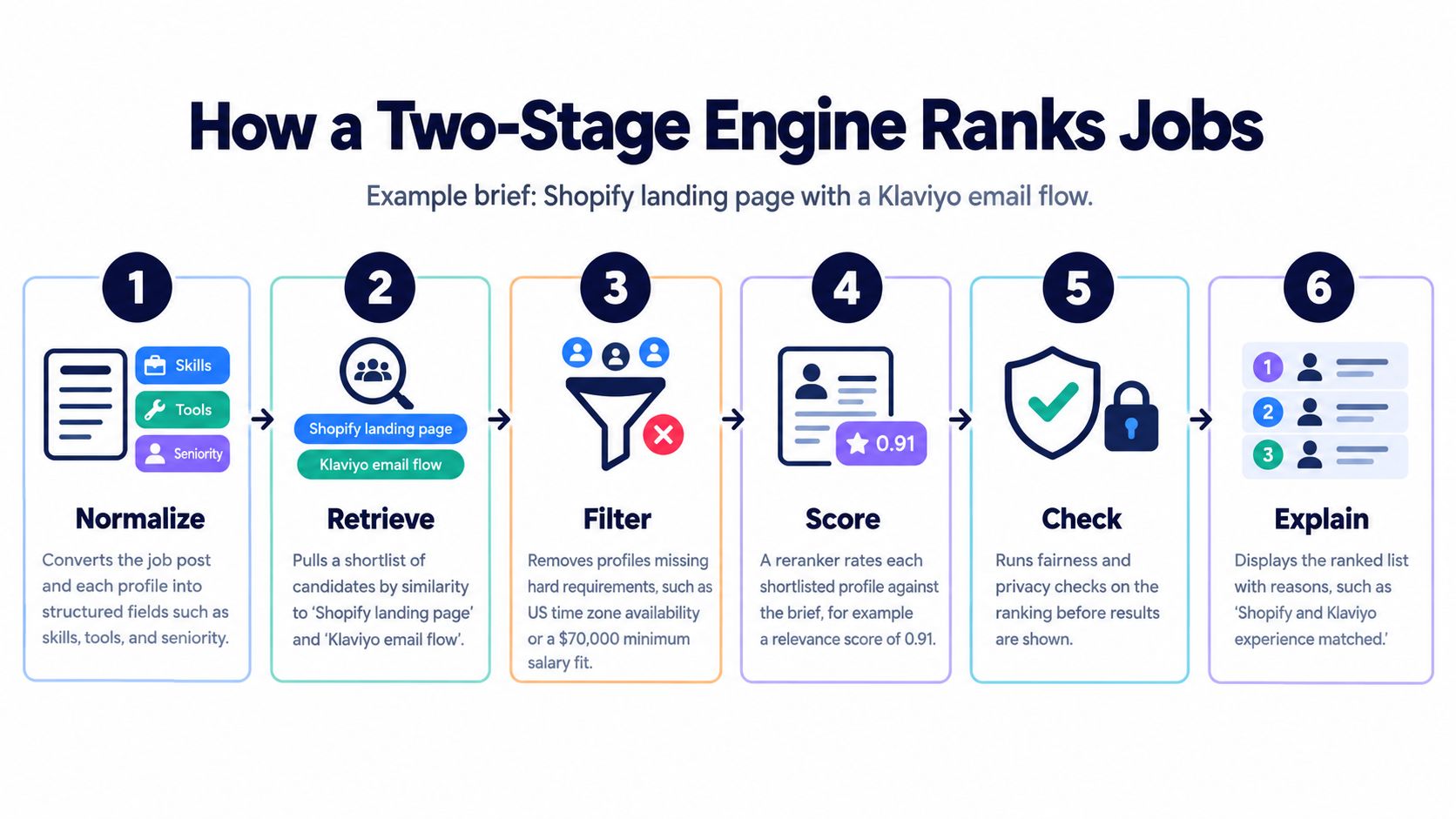
Say a client needs a Shopify landing page with a Klaviyo email flow. A useful matcher must distinguish a designer who creates attractive page mockups from someone who can also implement the storefront and configure the email sequence.
The heavy comparison shouldn't run against every available profile. A two-stage engine first retrieves plausible options cheaply, then examines that smaller set more carefully.
Follow a brief through the pipeline
- Normalize the text. Convert the job post and profiles into comparable fields such as tools, deliverables, seniority, and project type. This prevents a polished paragraph and a terse skills list from being treated as entirely different kinds of evidence.
- Extract skills and constraints. Identify Shopify implementation, Klaviyo automation, budget, deadlines, and required working-hour overlap. Separate essentials from preferences so a missing optional tool doesn't become an automatic rejection.
- Create embeddings. Represent passages as mathematical coordinates that capture meaning. In a resume–job matching evaluation available through the National College of Ireland repository, Sentence-BERT exceeded a TF-IDF baseline on ranking accuracy and human-judged semantic relevance, supporting contextual matching beyond literal token overlap.
- Retrieve a broad candidate set. Use a sparse retrieval method such as BM25 to find plausible profiles inexpensively. The aim is recall: don't lose a suitable freelancer before detailed comparison begins.
- Rerank the retrieved set. Combine embedding similarity with a cross-encoder, which reads the brief and profile together, or explicit rules for skills, seniority, budget, availability, and project type. A Shopify specialist without Klaviyo evidence should receive a different explanation from someone who meets both requirements but can't meet the deadline.
- Display results and collect feedback. Show the ranked matches with reasons, then record accepts, skips, and replies. A skip needs context because an unsuitable deadline shouldn't teach the system that Shopify work itself is unwanted.
Test the ranking, not just the prediction
For an Upwork-style marketplace, keep freelancer identities separate across training and test sets. Otherwise, a model may appear capable because it recognizes profiles it has already encountered.
Use an evaluation checklist that includes:
- nDCG@K and MRR. Check whether useful results appear near the top and how soon the first relevant result appears.
- Precision@K and Recall@K. Measure how much of the visible list is relevant and how much relevant work the engine retrieves.
- Latency and human judgments. Confirm that results arrive promptly and that people reviewing the actual briefs agree with the ordering.
Here, K means the chosen cutoff in the ranked list. None of these measures alone establishes that a recommendation will become a successful contract.
Where AI Matching Runs From Job Boards to Freelance Marketplaces
Say a designer receives ten apparently relevant briefs in one morning, but only three meet her rate floor. The ranking looks impressive until she checks whether the work is commercially viable.
The same matching technique behaves differently depending on who uses it and what they count as success.
Different platforms reward different actions
Job boards and professional networks pair roles with profiles and activity histories. When operators optimize clicks and applications, they risk promoting attention-grabbing vacancies rather than suitable ones. A career changer may need deliberate searches outside their previous title; AI job-hunting tips for career changers from HiredBySkill provide useful context for that task.
Freelance marketplaces compare client briefs with portfolios, rates, and win history. Proposal wins and client replies are useful outcomes, but chasing them without quality controls can encourage hurried, low-value applications. An Upwork job finder workflow should therefore start with service boundaries, not just a list of attractive keywords.
Staffing agencies and applicant tracking systems rank applicants for a specific requisition. Shortlist and interview rates help measure progress, but recruiters can reproduce historical preferences if they label familiar career paths as the best examples.
Agency bidding automation scans saved searches, filters for niche fit, and drafts proposals for team members. Reply rates and booked calls matter, yet overlapping account responsibilities can produce duplicate outreach or promises the delivery team can't fulfill.
Internal talent marketplaces connect employees with projects or temporary assignments. Staffing speed is useful, but managers may repeatedly select familiar people, leaving employees outside established networks with little chance to demonstrate adjacent skills.
Set constraints before judging recommendations
A recommendation is only usable when the person receiving it can act on it. For an agency, that includes delivery capacity, ownership of the lead, and whether the proposed work fits the team's service model.
Before enabling a workflow, define:
- Commercial boundaries. Specify the rate floor, acceptable project scope, and excluded client requirements.
- Delivery boundaries. Record tool expertise, available capacity, and required working-hour overlap.
- Ownership boundaries. Assign responsibility for reviewing, sending, and responding so teammates don't contact the same lead independently.
The practical rule is straightforward: a matcher is only as useful as the constraints you set and maintain.
Benefits and Limits Worth Weighing
Faster isn't the same as better. A system that clears a queue quickly can still create more work for whoever must review unsuitable recommendations or repair weak outreach.
Pair each advantage with its cost
- Quicker first-pass screening reduces repetitive reading, but it can rush borderline candidates out of consideration before someone examines their evidence.
- Wider skills-based reach can reveal adjacent opportunities, but new profiles with thin histories face a cold-start problem. The system has little evidence to distinguish unfamiliar talent from weak fit.
- Consistent criteria make decisions easier to compare, but consistency can also repeat an unsuitable historical preference.
- Lower administrative load frees attention for client conversations, yet activity-based signals can encourage unnecessary applications and constant checking.
A 2025 two-wave survey of 213 online platform workers in China found that algorithmic recommending and rewarding could reduce perceived workload when workers attributed the system's actions to supportive organizational commitment, while restricting and evaluating, especially under low transparency, were associated with greater workload.
That distinction is useful for agency operations. Recommendations can support a bidder's judgment, while unexplained quotas, penalties, and ranking changes can leave the same person feeling monitored rather than helped.
Adoption isn't evidence of effectiveness
In iHire's 2025 employer survey, 25.9% of employers reported using AI in recruitment, compared with 14.7% in 2024 and 4.9% in 2023. Rising adoption makes careful evaluation more important, not less.
To establish whether a matcher beats manual search, compare similar work under similar conditions. Keep the service line, commercial limits, and review standards consistent, and record review effort alongside downstream outcomes.
Balance test: A matcher helps when you can understand why a job surfaced, correct the interpretation, and still decide for yourself.
A longer recommendation list isn't automatically a productivity gain. If your team spends its saved search time rejecting irrelevant briefs, you've moved the work rather than removed it.
Fairness, Privacy and the 2027 Rules to Check
A matcher can rank jobs accurately and still distribute opportunity unfairly. Relevance answers one question: does this posting fit this profile. Fairness answers a different one: who gets seen, shortlisted, and hired when the model does the sorting. A system works like a recruiter who forwards only candidates resembling last year's hires. The shortlist looks reasonable on paper, yet equally capable people with unusual career paths never reach it.
The survey of fairness in algorithmic hiring identifies representation, exposure, selection outcomes, and user-side effects as distinct fairness dimensions, and notes that conventional debiasing can fail to remove gender-related information from resumes. Deleting an explicit demographic field leaves proxies behind. Hobbies, addresses, and writing style can carry the same signal.

Ask for controls at each decision point
- Limit unnecessary inputs. Remove demographic fields and proxy features that don't serve a legitimate matching requirement.
- Audit exposure. Check which qualified groups appear in recommendations and where they appear, where collecting or using group information is legally permissible.
- Compare progression. Examine group-specific shortlist and selection rates, using comparable eligibility criteria rather than treating every applicant as interchangeable.
- Weight visible positions. A candidate near the top receives a different opportunity from one buried below the results people actually browse.
- Review borderline exclusions. Give a named reviewer a clear escalation rule, the underlying evidence, and authority to override the result.
Run this audit at each stage separately. A model's retrieval step can expose jobs evenly while its reranking step concentrates the top positions on one profile type, and proposal generation can add a third skew on top. Track coverage, concentration or Gini measures, and subgroup gaps alongside nDCG@K so a strong overall relevance score doesn't conceal a narrow distribution of opportunity.
The multidisciplinary survey published by ACM recommends tracking wage differences among people hired through algorithmic systems as an additional fairness measure. Equal access to interviews says nothing about whether the hired groups end up with comparable pay.
Make privacy and compliance operational
Store only the fields needed for ranking, set a retention window for each, and identify who can access them. Let users view, correct, and delete extracted skills, and keep a record of which profile information each client or agency received.
The European Commission's employment AI guidance identifies many systems that analyze CVs, rank candidates, or recommend suitable job postings as high-risk. Classification deserves attention before deployment, not after a complaint arrives.
Under the European Commission's AI regulatory framework, strict obligations for high-risk systems, including risk assessment, documentation, transparency, human oversight, and resilience requirements, phase in on a set timetable. Confirm the applicable dates in the current official text before making deployment decisions, since the schedule has been under revision.
A useful compliance file connects the system's purpose, input fields, evaluation records, review responsibilities, and correction process. A generic statement that the model is unbiased substitutes nothing for that record.
Measuring a Matcher Across the Hiring Funnel
A single hire-rate figure hides where a matcher fails. Suitable jobs might receive weak proposals, strong proposals might go unseen, or promising conversations might stall when scope and price become clear.
Upwork's proposal analytics track proposals sent, client views, interviews or responses, and hires, while proposal insights update hourly and can show opened, shortlisted, and answered proposals. Those distinctions let you diagnose the process rather than judge everything by its final outcome.
Give every stage its own warning sign
- Submission. Track proposals or applications sent each week and attach a brief quality assessment. Rising volume alongside weaker fit notes suggests the sending workflow is outrunning review.
- Visibility. Track client or recruiter views relative to submissions. A decline after a profile or template change calls for inspecting presentation and targeting before increasing volume.
- Shortlist. Track shortlist progression separately from opens wherever those fields are available. A weak shortlist rate compared with comparable niche peers can indicate that visible evidence doesn't support the initial match.
- Response. Track replies and interview invitations, then distinguish substantive conversations from polite refusals. Replies that never become calls may reveal unclear scope, poor qualification, or a mismatch in expectations.
- Contract. Track hires and closed contracts by service and client type. Wins concentrated in a narrow category may reveal a profitable niche, but they can also signal excessive dependence.
Use consistent denominators. Views divided by submissions answers a different question from replies divided by views, and mixing those rates makes changes difficult to interpret.
For practical reporting setup, an Upwork data analytics workflow can help organize the measurements around decisions rather than disconnected dashboard totals.
Keep a weekly review routine
- Sample surfaced matches. Review a manageable selection each week, including rejected opportunities rather than only successful sends.
- Record the decision reason. Use concrete labels such as missing implementation experience, unclear budget, unsuitable deadline, or strong portfolio evidence.
- Cap daily sends. Choose a limit your team can review without losing proposal quality or duplicating outreach.
- Escalate borderline rejections. Route uncertain exclusions to a human reviewer before treating them as negative training feedback.
Keep the job brief, profile version, proposal, and outcome together. Otherwise, you may attribute an improvement to matching when the actual change was better writing.
A visibility drop calls for a different fix from a contract drop. Repair the stage where qualified opportunities stop progressing, rather than applying more automation to the entire funnel.
Run a Small Pilot Before Automating Your Bids
Adopt a matcher only when you can see why a job surfaced, set its constraints, export your data, and override its ranking.
Start with a proposed four-week pilot focused on one service line, such as Shopify implementation rather than every ecommerce service your agency offers. Before the first week, create a blind review exercise using around thirty surfaced jobs: assess the briefs without seeing their scores, then compare those decisions with your independently assembled shortlist.
Define the test before enabling sends
Log every disagreement in the same notes you'll use for weekly reviews. Distinguish a missing requirement from an overly strict preference, and don't count an unexplained rejection as proof that either the person or the model was right.
Repeat the funnel routine each week, keeping review standards stable. Expand automation only when the results and review effort support doing so; the human still makes the final call about suitability and delivery commitments.
For freelancers and agencies using Earlybird AI, our onboarding starts by connecting your Upwork account, after which a dedicated coach helps set up your profile, filters, and targeting. You mark a few real jobs you would apply to or skip so we can learn your niche, while our real-time analytics tracks performance from views to replies to booked calls in one place.
A controlled Upwork bidding automation pilot should make disagreements visible, not merely accelerate sending.
Put these questions to any vendor
- Inputs. Which signals does the system read, infer, and prioritize?
- Fairness testing. How does it compare exposure and progression across groups?
- Personal data. What does it store, who receives it, and how long is it retained?
- Corrections. How can users repair misread transferable skills?
- Documentation. What records support applicable EU obligations?
Earlybird AI offers niche-based Upwork job discovery, personalized proposals, automated client replies, and call booking from your own account. Visit Earlybird AI to explore the workflow and discuss a focused pilot that measures qualified conversations, not just bidding volume.


