
← Back To Blog
Client Engagement Metrics: Your Guide to Upwork Success
You're probably doing a lot on Upwork already. You send proposals, tweak your profile, answer messages when you can, and try to stay visible enough to keep work flowing. Then a frustrating pattern shows up. You stay busy, but the pipeline still feels unpredictable.
That usually means you're measuring effort instead of engagement.
On Upwork, revenue doesn't come from activity alone. It comes from the moments where a client moves toward you: they read, reply, ask a follow-up, book a call, hire you again, or leave strong feedback that makes the next sale easier. Those moments can be tracked. Once you track them, you stop guessing which parts of your process are working.
Beyond Busy Work The Case for Engagement Metrics
A lot of freelancers mistake motion for progress. They send proposal after proposal, maybe even improve their profile headline, and still feel like jobs disappear into a black hole. From the outside, it looks disciplined. Inside the business, it's chaos.
I've seen this with solo freelancers and agency teams alike. One bidder says the market is slow. Another says clients are cheap. A third says Upwork is hit or miss. Sometimes those things are partly true. More often, the actual problem is simpler: nobody is tracking where client interest starts dropping.
Busy doesn't equal traction
If you send many proposals and get very few replies, the issue might be targeting. If clients reply but interviews don't turn into hires, the issue might be positioning. If interviews go well but repeat work never materializes, the issue is probably delivery or post-project communication.
Those are different problems. Treating them like one big “lead gen problem” wastes time.
Practical rule: If you can't point to the exact stage where client interest falls off, you can't fix your sales process with confidence.
That matters even more now because client expectations aren't loose or forgiving. 73% of customers expect better personalization as technology advances, 65% expect companies to adapt quickly to their needs and preferences, and 61% say most companies still treat them like numbers rather than individuals according to this customer engagement data roundup. The same source says more than half abandon a purchase if their questions aren't answered fast, and it includes a projection that by 2025, 85% of customer interactions will be handled without a human agent through AI, automation, and self-service.
On Upwork, those expectations show up in practical ways. A generic proposal gets ignored. A slow reply loses the conversation. A weak follow-up lets a warm lead cool off.
What changes when you track the right signals
Once you start using client engagement metrics, the platform gets clearer. You stop asking, “Am I working hard enough?” and start asking better questions:
- Are the right clients replying
- How fast are we responding once interest appears
- Which interviews convert into contracts
- Which clients come back with more work
- Which projects strengthen future sales instead of just filling this week
That's the shift. Metrics don't make Upwork less competitive. They make your decisions less emotional.
What Are Client Engagement Metrics Anyway
A client replies to your proposal, asks one smart question, then disappears for six days. Another client sends a shorter message, books a quick interview, hires within 24 hours, and comes back two weeks later with phase two. Both leads engaged. Only one moved the business forward.
That distinction is the point.
Client engagement metrics measure how prospects and clients behave from first contact to repeat work on Upwork. They show whether interest is progressing, stalling, or turning into revenue. On this platform, that means tracking signals across proposals, messages, interviews, contracts, delivery, feedback, and rehires.
Good tracking changes how you judge performance. A profile can get attention and still produce weak opportunities. A proposal can win replies and still attract low-value clients. Engagement metrics help separate activity from buying intent.
What these metrics are meant to do
On Upwork, engagement metrics are useful when they help you make a specific decision. They should tell you whether to change your targeting, tighten your proposal opener, reply faster, improve interview handling, or put more effort into retention after delivery.
That is why I treat them as operating metrics, not vanity reporting. If a number does not influence how the team bids, follows up, or manages delivery, it does not belong on the main dashboard.
A simple way to sort them:
- Vanity metrics show visibility or surface-level activity, such as profile views or impressions without clear downstream impact.
- Actionable metrics connect to a next step, such as reply rate, time to first response, interview-to-hire rate, repeat client rate, or post-project follow-through.
Upwork compresses the sales cycle. Small delays and weak handoffs thus show up fast. The freelancers and agencies that keep winning are usually not guessing. They are watching where momentum drops and fixing that step.
Engagement is not just client happiness
A client can sound pleased on a call and still never hire. A project can finish with a five-star review and still produce no second contract. Satisfaction matters, but it is only one part of engagement.
On Upwork, useful engagement measurement usually spans three categories. First, behavior. Did the client reply, keep the conversation going, attend the interview, respond during delivery, and return later? Second, outcomes. Did the conversation become a contract, a larger scope, a second job, or a referral? Third, sentiment. What did the public review say, what showed up in private feedback, and did the relationship become easier or harder after the first milestone?
That broader view also protects you from optimizing for the wrong thing.
The wrong metric can make you optimize for attention when you should be optimizing for trust.
If more profile traffic brings in more low-fit invites, the extra visibility is not helping. If proposals get replies but clients disappear after the interview, the issue is not top-of-funnel volume. If contracts close but your Job Success Score on Upwork weakens over time, the problem sits in delivery quality, expectation setting, or client fit.
Tools can help here. Upwork gives you parts of the picture inside messages, contracts, and work history. Earlybird AI helps agencies and freelancers organize those signals faster so proposal activity, response behavior, and hiring outcomes are easier to compare. But the principle stays the same either way. Track the points in the relationship where a client makes a meaningful move, then use those signals to improve how you sell and how you deliver.
The 5 Core Metrics Every Upwork Freelancer Should Track
A freelancer can send solid proposals all week and still end Friday with no new revenue. On Upwork, activity is not the same as progress. The numbers that matter are the ones tied to client movement: reply, interview, hire, expansion, and satisfaction after delivery.
Most freelancers and small agencies do not need a heavy reporting stack. They need a short scorecard they can review every week and act on fast. These five metrics cover the client lifecycle that drives revenue on the platform.
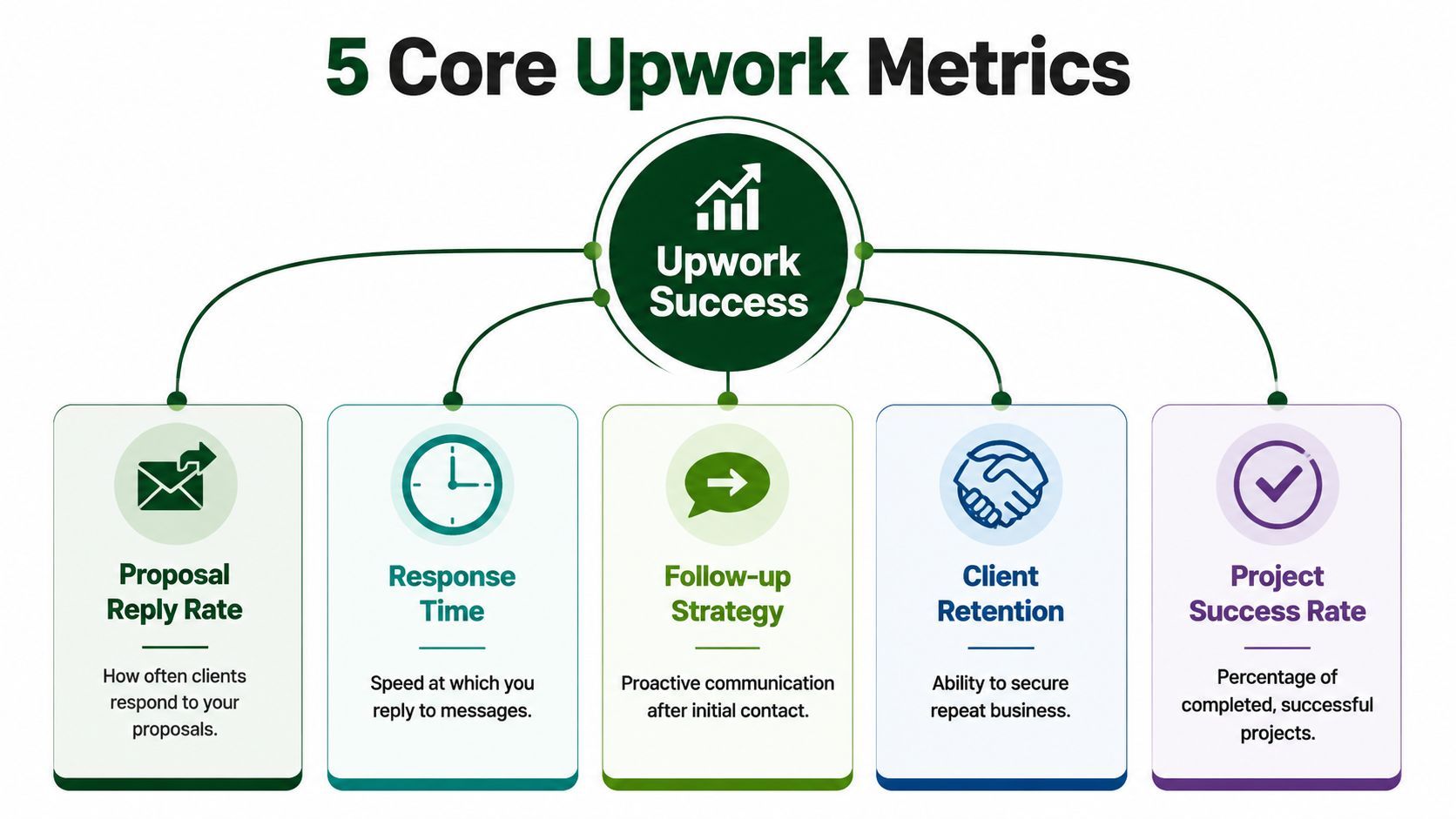
Proposal reply rate
This is the first number to fix if lead flow feels weak.
Simple formula: replies received ÷ proposals sent
Track real client responses only. Ignore automated notices, archived jobs, and anything that did not open a conversation. On Upwork, this metric reflects two things at once: whether you picked the right jobs and whether your first few lines gave the client a reason to answer.
For agencies, break it down by service line, bidder, and job type. A general reply rate can hide a lot. One bidder may perform well on retained roles but poorly on fixed-price projects. One niche may attract plenty of replies but low-budget clients. That trade-off matters because a high reply rate is useless if it comes from low-fit work.
Response time
Once a prospect replies, speed matters.
Simple formula: total time to respond across client messages ÷ number of client messages received
Measure this during active sales conversations, not across every message in every contract. The first response after client interest is the one that shapes momentum. Upwork buyers often contact several freelancers within a short window, and slow follow-up gives faster competitors an easy opening.
I usually treat this as an operations metric, not just a communication metric. If response time is slow, the issue is often staffing, unclear inbox ownership, or no system for after-hours coverage. It also supports account health over time, alongside your Upwork Job Success Score guide.
Follow-up rate
A lot of good opportunities stall here.
Simple formula: opportunities with a documented follow-up ÷ opportunities that required follow-up
Track follow-up after a proposal reply, after an interview, after sending a scope, and after a successful project that could expand into more work. Neglecting this often leads many freelancers to lose revenue without realizing it. They assume silence means no interest, when in practice the client got busy, hired internally, or forgot to respond.
A strong follow-up rate does not mean sending generic nudges every day. It means having a clear next step, a deadline, and a reason to reconnect.
Interview-to-hire rate
This metric shows whether conversations turn into contracts.
Simple formula: contracts won ÷ interviews or serious sales conversations
If reply rate is healthy but interview-to-hire is weak, the problem usually sits in qualification, pricing communication, proof of past work, or how the interview is handled. On Upwork, that often means the proposal did its job but the live sales conversation did not.
For agencies, this is one of the most useful split metrics in the whole funnel. It helps separate who is good at starting conversations from who is good at closing them. Those are different skills, and the fix is different too.
Client satisfaction score
This is the metric that protects future revenue, not just current revenue.
You can track it through a small set of Upwork-specific signals:
- Job Success Score trend
- Public client feedback
- Private sentiment from messages and calls
- Repeat engagement behavior, such as contract extensions, added milestones, rehires, and direct invites
Satisfaction on Upwork is more than a review at the end of a job. It affects whether clients come back, whether they trust you with larger scopes, and whether your profile converts well in future sales cycles. Repeat contracts are the practical version of retention on the platform. If clients praise the work but never return, the relationship may have been pleasant without being commercially strong.
For that reason, I do not read satisfaction as a single rating. I read it as a pattern across delivery quality, ease of communication, and whether the client chooses to keep buying.
Building Your Client Engagement Dashboard
A metric you don't review consistently won't change behavior. That's why the dashboard matters. It gives you one place to see whether your Upwork pipeline is improving or drifting.
Start simple if you're solo
A spreadsheet is enough in the beginning. Create one row per opportunity and track the stages that matter to your business. For most freelancers, that means job link, date found, proposal sent, client replied, response time, interview booked, hired, contract value range, and follow-up status.
The key is consistency, not complexity.
Use clear labels for why a lead was won or lost. Over time, your notes become more valuable than the raw count because they explain the pattern behind the numbers.
Use native data where it helps
Upwork's own stats pages can give you useful visibility, especially around profile and proposal activity. Native reporting isn't a full sales dashboard, but it's still useful as a validation layer.
What matters is merging platform signals with your own records. If your spreadsheet says a bidder is performing well but the actual quality of clients is declining, your dashboard should reveal that contradiction.
A dashboard should reduce interpretation time. If it takes too long to understand, you won't use it when decisions need to be made.
Build a single source of truth
Scattered information often causes many teams to slip. Proposal data lives in one place. Messages sit in another. Notes from calls stay in Slack or someone's head. Then nobody can tell which service line produces the strongest conversations.
A better setup pulls your workflow into one view and lets you compare trends over time. If you're thinking through reporting structure, this breakdown of SEO agency reporting is useful because the same reporting discipline applies to Upwork sales operations.
For agencies, the dashboard should answer a few operational questions every week:
- Which bidder is generating the highest-quality replies
- Which service category turns interviews into contracts
- Where response delays are hurting momentum
- Which clients are most likely to expand into repeat work
Look for trends, not isolated events. One bad week means very little. A recurring drop in reply quality means something needs attention.
How to Improve Your Key Engagement Metrics
Improvement starts when each weak metric gets matched to a specific operational fix. General advice won't move the numbers. Small process changes usually do.

Raise proposal reply rate
Low reply rate usually comes from one of three issues: poor targeting, generic openings, or weak proof. Most freelancers try to fix this by writing longer proposals. That often makes things worse.
A better approach is to tighten the first few lines. Refer to the client's actual problem, mention one relevant outcome you can deliver, and remove anything that sounds copied from a template. You don't need to sound impressive. You need to sound specific.
What works:
- Mirror the buying context by referencing the exact task, bottleneck, or deliverable the client mentioned
- Lead with fit instead of biography
- Use proof selectively with one relevant example, not a portfolio dump
- Disqualify weak-fit jobs so your denominator improves, not just your message
What doesn't work:
- Long introductions about your background
- Laundry-list service menus inside the proposal
- Empty urgency that pushes for a call before trust exists
Cut response time without sounding robotic
Fast replies matter, but speed without relevance doesn't help. If a client asks a thoughtful question and gets a vague instant response, you've still lost ground.
For teams handling larger proposal volume, tools can help here. Earlybird AI connects to an Upwork account, learns which projects fit through simple feedback, searches for jobs, drafts personalized proposals, and replies to client messages automatically. In practice, that gives agencies a way to reduce lag on first-touch conversations while keeping the outreach tied to actual project fit.
The goal isn't to automate personality. It's to prevent delays that kill momentum.
Improve follow-up rate with a real system
Most freelancers don't need better persuasion here. They need a follow-up routine.
Create categories for open conversations:
- waiting after proposal reply
- waiting after interview
- waiting after scope or pricing
- waiting after completed project
Then define the next action for each. Follow-ups should move the conversation forward, not just ask whether the client has updates.
For example:
- After a quiet interview send a tighter recap with the proposed next step
- After sending scope answer likely objections before they surface
- After delivery suggest the next logical phase of work
A useful reference for message quality and timing is this guide on how to increase client engagement.
Here's a practical walkthrough worth watching before you rebuild your process:
Lift interview-to-hire rate
When this metric is low, the instinct is to lower price. Usually that's the wrong move.
Instead, review your sales conversations for friction:
- Qualification problems where you're taking calls with buyers who aren't serious
- Unclear scope framing where the client doesn't understand what they're buying
- Weak diagnosis where you pitch services before showing you understand the problem
- No close structure where the call ends without a defined next step
This metric improves when the call has a job to do. Clarify goals, constraints, ownership, and timeline. Then offer a recommendation that feels specific, not rehearsed.
Strengthen client satisfaction so it compounds
Good feedback is downstream of expectation management. The freelancer who delivers decent work without proactive communication can still lose future opportunities if the client feels uncertain throughout the project.
To improve satisfaction:
- Set communication rules early so clients know when updates will arrive
- Define “done” clearly before starting
- Show progress visibly instead of disappearing until delivery
- Close with a next-step recommendation so the relationship doesn't end at handoff
Clients remember two things most clearly: whether working with you felt easy, and whether the result matched what they thought they were buying.
That's why satisfaction is not just delivery quality. It's engagement quality across the entire project.
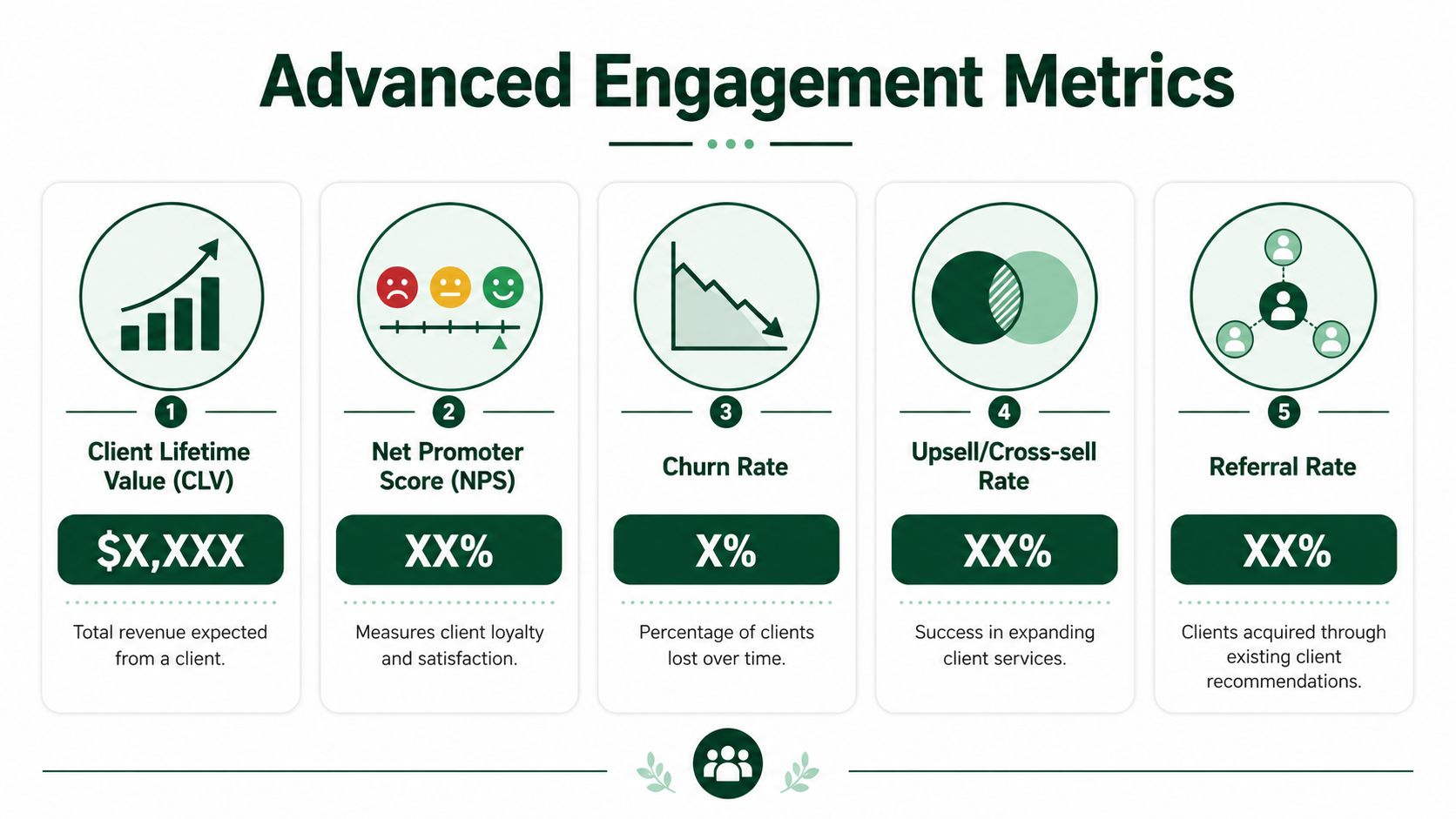
Beyond the Basics with Advanced Engagement Metrics
Once the core metrics are stable, the next question changes. It's no longer “How do I get more replies?” It becomes “Which work creates the healthiest business?”
That's where advanced client engagement metrics start to matter.
Choose metrics by business stage
One mistake I see in agencies is building a dashboard that looks impressive but answers nothing. That happens when teams copy generic KPI lists instead of tying metrics to the actual business model.
That's a known problem in engagement measurement. Reputable guidance stresses that client engagement metrics are not a universal dashboard and should be tied to business goals, data setup, and the right mix of behavioral, sentiment, outcome, and channel-specific measures, as discussed in Twilio's guide to measuring customer engagement.
For Upwork sellers, the right advanced metric depends on stage:
- New freelancers need to understand which proposal types create real conversations
- Established freelancers need to understand which clients return
- Agencies need to understand which services and team members produce durable profit
The advanced view that actually helps
A few advanced measures are especially useful on Upwork.
Client lifetime value tells you which client relationships are worth protecting and expanding. Some clients hire once and vanish. Others become long-term accounts across multiple projects.
Time to conversion shows how long it takes to move from first proposal to contract. That helps you compare short-cycle services against consultative projects that take longer to close.
Engagement by job category reveals where your positioning is strongest. A team might get plenty of replies in one niche but better retention in another. Those are not the same signal.
Upsell and expansion patterns matter for agencies. If certain project types consistently lead to milestone extensions or related services, that should influence how you pitch and package your offers.
Referral tendency is another strategic signal. Some clients don't just buy. They introduce you to others. That's a different kind of account value than a one-off contract.
Advanced metrics should help you choose where to focus. If they only make the dashboard bigger, they're noise.
From Metrics to Meaningful Freelance Growth
The point of tracking client engagement metrics isn't to become obsessed with dashboards. It's to stop running your Upwork business on hunches.
When you know your reply rate, you can judge proposal quality accurately. When you know your response time, you can see whether delay is costing you conversations. When you track interview-to-hire rate and repeat work, you can tell whether your sales and delivery systems are building a business or just creating short bursts of income.
That creates a simple operating loop:
- Measure what clients do
- Analyze where momentum improves or breaks
- Act on the weak point
- Repeat until the process gets tighter
Freelancers who skip this loop usually stay reactive. They blame the market when replies slow down. They chase volume when qualification is the actual issue. They celebrate busy weeks that don't lead to stable revenue.
The stronger move is calmer and more disciplined. Track fewer metrics. Review them often. Use them to make decisions about targeting, messaging, follow-up, delivery, and account management.
That's how Upwork starts feeling less random.
If you want a more structured way to turn Upwork activity into a repeatable sales process, Earlybird AI is built for that workflow. It helps automate proposal search, personalized outreach, message replies, follow-ups, and analytics so freelancers and agencies can spend less time managing pipeline chaos and more time closing strong-fit clients.