
← Back To Blog
SEO Agency Reporting: 2026 Playbook for Client Retention
Reporting week is where a lot of SEO agencies subtly lose margin.
You know the routine. Someone exports data from GA4. Someone else pulls rankings from Ahrefs or Semrush. A strategist opens Google Search Console in another tab to explain why clicks moved differently than sessions. Then the account manager turns a pile of screenshots into a report the client can understand. By the time it goes out, the team is exhausted, the story is muddy, and the client still asks the same question: “What did SEO do for the business?”
That problem gets worse as an agency grows. More clients means more tool switching, more chances for mismatched date ranges, and more pressure to make every report feel custom without rebuilding it from scratch. The challenge isn't a reporting problem. It's a systems problem.
Good seo agency reporting fixes that. It gives clients a clear view of outcomes, gives your team a repeatable operating model, and turns reporting from a monthly chore into part of retention. In a market that keeps getting more crowded, that matters. The global SEO services market is valued at $108.28 billion in 2026 and is projected to reach $203.83 billion by 2030, while the number of SEO consultants in the US grew 18.0% in the last year, according to IBISWorld market data on SEO consultants and services growth.
The agencies that win don't just rank pages. They explain progress better, tie work to business goals faster, and run a tighter client communication loop than everyone else.
Beyond the Monthly Scramble An Introduction
Most agency reporting breaks down in the same place. The data exists, but the reporting process lives in people's heads.
One strategist knows how to explain brand versus non-brand traffic. Another remembers which conversions matter for a local service client. The founder reviews reports at the last minute because nobody trusts the numbers until they've been checked manually. That system can survive a few clients. It doesn't survive scale.
What works is a playbook. Not a prettier PDF. Not a dashboard with more widgets. A playbook.
That playbook has five parts:
- Pick KPIs that map to the client's business model
- Centralize the data so the team isn't stitching reports together by hand
- Design reports that explain movement, not just display it
- Automate delivery and workflow handoffs
- Present results in a way that builds confidence, even when performance is uneven
Practical rule: If a client can read your report without you and still understand what changed, why it changed, and what happens next, your reporting system is working.
A strong reporting process also protects the agency internally. It shortens training time for account managers, reduces founder review bottlenecks, and keeps delivery quality consistent across accounts. It also forces hard conversations early. If the client wants revenue but the team is optimizing for low-intent traffic, good reporting exposes the mismatch before it becomes a retention issue.
The rest of this guide is the operating model that makes seo agency reporting scalable. It's not theoretical. It's the structure agencies use when they want reports to support delivery, sales, and client management instead of draining time from all three.
The Foundation Aligning SEO KPIs with Client Goals
The biggest reporting mistake agencies make is simple. They report what is easy to pull, not what the client cares about.
A client rarely wakes up wanting more impressions or a higher average position. They want more booked calls, qualified leads, online sales, store visits, or pipeline influence. If you don't translate that into the right SEO KPIs at the start, every monthly review becomes a debate about whether the campaign is “working.”
Successful SEO agency reporting usually focuses on 3 to 10 key metrics, with organic traffic, keyword rankings, and conversions as the main anchors. ROI measurement still varies widely. Over 45% of marketers use sales as their primary ROI metric, while over 30% rely on lead generation numbers, according to Databox research on SEO reporting metrics and ROI tracking.

Start with the commercial outcome
Before you build a dashboard, pin down the business result.
For a local service business, that might be form fills, booked consultations, or calls from organic landing pages. For an ecommerce brand, it may be transactions, revenue tied to organic sessions, and category page performance. For a B2B company, it might be qualified leads, demo requests, or CRM-stage progression from organic acquisition.
The KPI stack should reflect that hierarchy.
- Primary KPIs: Conversions, sales, qualified leads, revenue indicators
- Secondary KPIs: Organic traffic, rankings for high-intent keywords, CTR on important pages
- Tertiary KPIs: Backlinks, referring domains, technical health indicators, supporting visibility trends
This isn't about hiding data. It's about putting the right data in the right order.
Build a reporting contract early
The cleanest reporting relationships start with what I think of as a reporting contract. Not legal language. Operational language.
That contract answers a few questions up front:
- What counts as success: Define whether the client is buying growth in leads, sales, visibility, or a mix.
- Which conversions matter: Separate primary actions from softer engagement events.
- Which keyword sets matter most: Focus on commercial pages and high-intent queries, not every tracked term.
- What gets reported monthly: Decide what always appears, what appears only when relevant, and what stays in the appendix.
Without this, teams over-report. They stuff in every metric because they're trying to prove value through volume. That usually backfires. More numbers create more room for distraction.
The best client reports feel selective, not sparse. They show restraint because the agency knows what matters.
Customize by client type
A local roofing company and a national ecommerce brand should not get the same report with different logos.
For local SEO, the report should lean into service-area landing pages, local intent queries, calls, form submissions, and page-level conversion paths. Rankings matter, but rankings only matter when they support local lead flow.
For ecommerce, the report should put more weight on category and product page visibility, organic sessions to money pages, CTR by query cluster, and conversion movement tied to specific landing pages. In those accounts, a blog can drive value, but it shouldn't dominate the narrative unless it contributes to revenue-producing journeys.
For B2B lead generation, the strongest setup is often a blended view. Show organic visibility and traffic growth, but tie it back to demo pages, solution pages, and content that influences lead creation or sales conversations.
Keep the KPI count disciplined
Most agencies don't need more metrics. They need better filters.
Use a small number of leading indicators and a smaller number of business outcomes. That's what keeps monthly meetings focused. A report with too many charts tells the client you haven't made enough editorial decisions.
A practical framework looks like this:
- One business outcome section
- One acquisition section
- One demand capture section
- One supporting SEO health section
If a metric doesn't help explain one of those four, it probably doesn't belong in the core report.
That restraint is what makes the rest of the reporting system possible.
Building Your Centralized Data Engine
Once KPIs are set, the next job is operational. You need one place where the numbers come together consistently.
Many agencies remain stuck in the middle. They know what they want to report, but the data still lives across GA4, Google Search Console, Ahrefs, Semrush, call tracking software, CRM fields, and scattered spreadsheets. That setup creates delay, confusion, and rework.
Expert agencies solve it by building a centralized data system. According to TapClicks guidance on SEO reporting workflows and centralized templates, a master template can handle approximately 80% of reporting scenarios when paired with automation and cross-platform validation.
Choose the hub, not just the tools
Your hub can be Looker Studio, a dedicated reporting platform, or another internal reporting environment. The specific stack matters less than the rule behind it. Every recurring report should pull from the same controlled system, not from fresh exports each month.
That hub should combine:
- Search performance data from Google Search Console
- Website behavior and conversion data from GA4
- Ranking and competitor visibility data from Ahrefs or Semrush
- Optional client-specific inputs such as CRM outcomes, call tracking, or lead quality notes
If your team is still rebuilding report logic inside slides or spreadsheets every month, the reporting system isn't mature yet.
If you're reviewing stack options, this guide to best SEO software for agencies is a useful place to compare what belongs in the workflow.
Standardize the data rules
The hidden work in seo agency reporting isn't connecting tools. It's making sure the numbers mean the same thing every time they appear.
Three issues cause most client-facing reporting errors:
- Date mismatches: One platform uses month-to-date while another uses the last full month.
- Definition mismatches: The team mixes users, sessions, clicks, and conversions as if they're interchangeable.
- Scope mismatches: A report includes branded and non-branded demand in one place, then isolates non-branded visibility somewhere else.
A centralized engine needs written rules. Keep them simple and shared.
For example:
- Use the same reporting window across every connected source.
- Label every conversion clearly.
- Separate exploratory metrics from decision metrics.
- Document any platform limitations before the report goes out.
Validate before the client sees it
No single platform should be trusted blindly. Search Console, GA4, and ranking tools often tell different parts of the story. That's normal. The fix isn't chasing perfect alignment. The fix is cross-checking important movements before they make it into the narrative.
A healthy review workflow looks like this:
- Check trend direction first: Are the major KPIs moving up, down, or flat?
- Verify suspicious spikes: Compare across source platforms before calling out a win or a problem.
- Look at page-level context: A traffic gain on one page can explain why keyword movement matters more than sitewide averages.
- Flag data caveats internally: If tracking changed, annotate it before the client asks.
Clean reporting isn't about making every tool agree. It's about making sure the agency understands why they don't.
Build refresh and review into the process
Automation only helps if the team trusts the output. That means two layers have to exist at the same time. Automated refresh. Human review.
Set fixed refresh schedules inside your reporting hub. Then create a brief approval path before reports are sent. Usually that means an analyst or strategist checks the data, and an account lead checks the story.
The agencies that do this well don't automate thought. They automate retrieval, formatting, and distribution so the team can spend its time on interpretation.
That is the main point of a centralized data engine. It doesn't just save time. It creates a single source of truth the whole team can work from without second-guessing every chart.
Designing Repeatable Dashboards and Client Reports
A dashboard shows data. A report explains it.
That distinction matters because clients rarely leave a meeting saying, “Thanks for the widgets.” They stay when the agency helps them understand what changed, what created the change, and what the team is doing next.
The strongest seo agency reporting systems separate live visibility from monthly narrative. The dashboard exists for on-demand access. The monthly report exists to interpret movement and set direction.
Build the dashboard for monitoring
A client dashboard should be restrained. If it's overloaded, nobody uses it except your internal team.
A useful live dashboard usually includes:
- Core business outcomes: Leads, sales, or primary conversions from organic search
- Acquisition trends: Organic traffic movement, landing page contribution, channel comparisons where helpful
- Demand capture signals: Rankings for priority keyword groups, CTR, and page performance
- Health indicators: Technical notes, backlink trends, or visibility support metrics when relevant
Keep the dashboard interactive but not fragile. If the client can change filters so easily that they misread the story, you've made it too flexible.
For agencies that want more control over templates, distribution, and client-facing views, it's worth reviewing SEO reporting software for agencies before you lock in the reporting stack.
Write the monthly report like a strategist
The monthly report should have a backbone. I prefer five parts because they force discipline.
Executive summary
Most agencies underperform in this regard. They open with charts when they should open with judgment.
Start with a short summary that answers:
- What improved
- What slipped
- Why it happened
- What the team is doing next
A strong summary sounds like this:
Organic lead quality improved because commercial landing pages attracted more qualified visits, while blog traffic was stable. Rankings moved positively for service-intent terms, but CTR fell on two priority pages, so next month's work will focus on title testing and page refinements.
That kind of opening creates confidence because it sounds like a human operator, not a data export.
Performance versus goals
This is the accountability section. Show movement against the KPIs agreed at the start of the relationship.
If the client cares about leads, lead movement belongs near the top. If the client cares about sales, make sales or revenue indicators the headline. Supporting SEO metrics should sit underneath, not in front.
Explain what the team did
Clients don't want a task dump, but they do want to see the work behind the results.
This section should briefly cover completed activity such as on-page optimization, technical fixes, internal linking, content updates, local SEO work, or link acquisition. Don't turn this into a production log. Curate it.
A simple rule helps. Only include completed work that explains past movement or sets up future movement.
Pair rankings with real engagement
One of the most useful shifts in modern reporting is treating rankings as incomplete without CTR and page-level behavior. Funnel Boost Media's reporting guidance makes this point clearly. Better reporting pairs keyword ranking data with CTR so agencies can see what earns engagement, not just visibility.
That changes how you tell the story.
Instead of saying a page “improved in rankings,” say that the page gained visibility for high-intent queries, CTR held or declined, and the implication is either stronger message-market fit or a need to improve titles and descriptions. That gives the client a business explanation, not just an SEO update.
Client-facing advice: Rankings are a signal. Clicks and conversions tell you whether the signal is becoming business value.
End with recommendations, not observations
The last section is where many reports go flat. They stop at analysis and never convert it into a plan.
A good close includes:
- What's working and should continue
- What needs attention right now
- What the agency will do next month
That forward-looking plan matters because it reframes reporting as active management. The client should never finish reading and wonder what happens now.
A few examples of strong “next steps” language:
- Expand optimization on pages already gaining qualified organic traffic
- Improve low-CTR pages that already rank for commercial terms
- Consolidate overlapping content that splits intent across multiple URLs
- Push technical fixes that unblock crawling or user experience on important templates
That final section is what turns a report into a retention tool. It shows the agency isn't just documenting the month. It's steering the next one.
Automating Reporting and Integrating Workflows
Most agencies automate the easy part. They schedule the report email and call it a system.
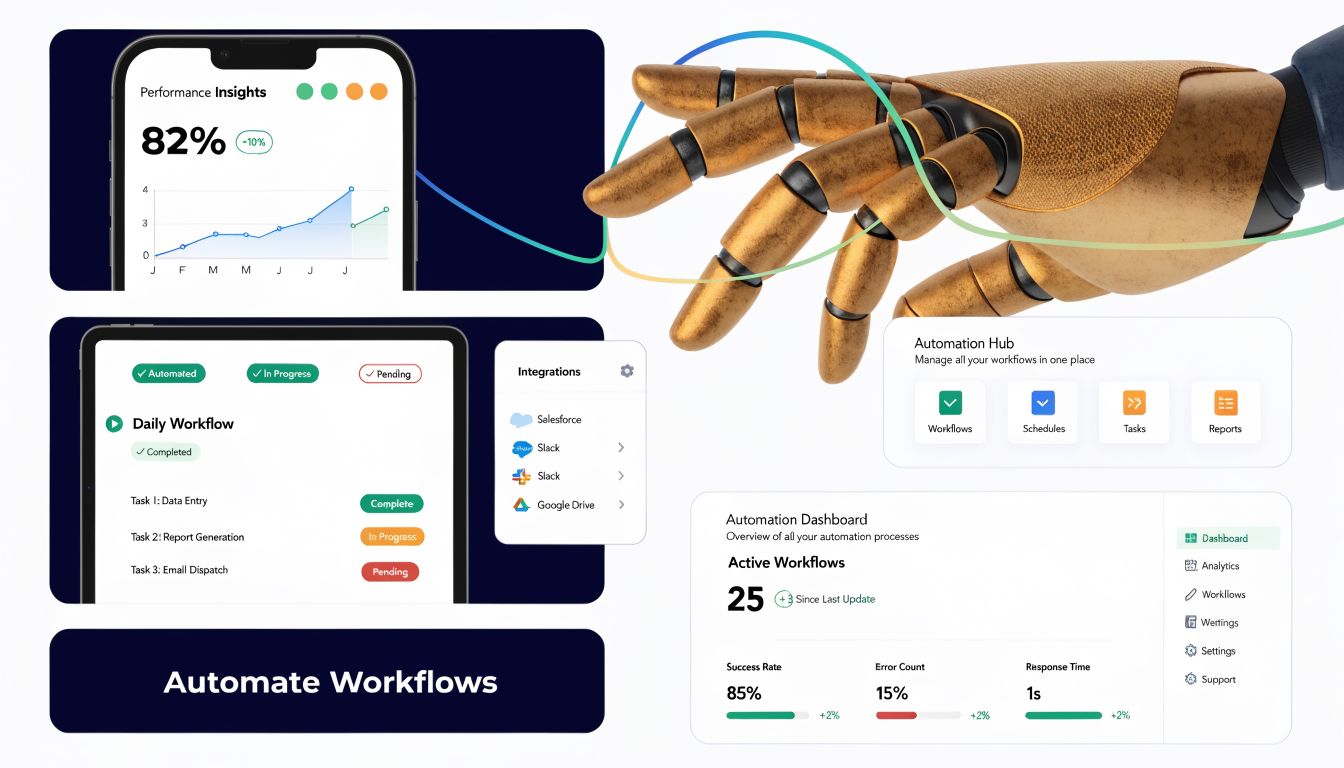
That's not enough. Real reporting automation connects data, delivery, follow-up, and client management in one chain. If the report goes out but nobody is prompted to review, follow up, log client feedback, or trigger the next account action, you've automated distribution, not operations.
AI-driven automation is becoming a real part of this shift. Emerging tools can mimic human behavior for safer data synthesis, and in Upwork-adjacent agency workflows, analogous automation platforms have produced double-digit reply rates and helped replace full-time SDR effort by shortening sales cycles significantly, according to Reportr's discussion of automated SEO reporting and AI-driven workflow trends.
Automate the handoffs, not just the output
When a report is finalized, other work should happen automatically.
For example:
- A scheduled report sends to the client
- A task is created in Asana, ClickUp, or another project tool for account review
- A CRM note logs that the report was delivered
- The account manager gets prompted to follow up if the client hasn't responded
- Any performance anomaly gets flagged for strategist review
Agencies don't lose clients only from bad results; they lose clients from silence, ambiguity, and missed follow-up.
Link reporting with CRM and service workflows
Reporting gets stronger when it feeds the rest of the account system.
If a client asks for more focus on one service line during the monthly review, that shouldn't disappear into meeting notes. It should become a task, a roadmap adjustment, and a CRM record. If the client raises concerns about lead quality, that should appear next month as a tracked commentary thread, not as a forgotten sidebar from a call.
The agencies that scale cleanly treat reporting as a trigger point for operations:
- Delivery teams get next-step tasks
- Account managers get follow-up reminders
- Leadership gets visibility into account risk or expansion opportunities
- Sales teams get language and proof points they can use in future proposals
Automation earns its keep, preventing the monthly report from becoming a dead-end document.
Upwork agencies need the same logic on the front end
If your agency wins work through Upwork, reporting discipline should shape your sales system too.
A lot of agency owners separate delivery operations from lead generation operations. That's a mistake. The same thinking that makes client reporting scalable also makes proposal workflows scalable. Structured inputs, repeatable templates, fast response times, clear qualification criteria, and logged follow-up all matter on both sides.
That includes automation around repetitive sales actions. If your team is manually triaging jobs, drafting first-pass proposals, and chasing message follow-ups, it's worth tightening that system with tools built for workflow automation. This guide on how to automate repetitive tasks is a practical starting point if you're trying to reduce admin drag across both delivery and business development.
Good agencies don't just automate reports. They automate the movement around reports.
Use AI carefully and keep the human layer
There is a trade-off here. More automation creates consistency, but it can also create complacency.
Reports still need strategic review before they reach clients. CRM automations still need sane trigger rules. Proposal automation still needs quality control, especially if the agency wants to sound customized rather than templated.
The best setup uses AI and automation for:
- Data aggregation
- Scheduled refresh
- Draft summaries
- Workflow triggers
- CRM logging
- Internal alerts
And it keeps humans responsible for:
- Narrative framing
- Client communication
- Priority decisions
- Exception handling
- Commercial judgment
That balance is what makes automation useful rather than risky. Done right, it doesn't make the agency feel robotic. It makes the agency feel fast, organized, and hard to replace.
Presenting Results to Build Trust and Retain Clients
A report can be accurate and still fail.
It fails when the client leaves unsure what happened. It fails when the meeting turns into a defense of rankings instead of a conversation about business movement. And it fails when the agency avoids hard news until the client brings it up first.
The presentation is where seo agency reporting becomes retention work.

Lead with outcomes, not dashboards
Open the call with the executive summary. Keep it short and commercial.
Start with the outcome the client cares about most. If that's lead volume, start there. If it's sales, start there. Then explain the SEO inputs that influenced the result.
A clean opening sounds like this:
This month, organic performance improved on the pages tied most closely to lead generation. Visibility gained on priority service terms, and the traffic that arrived from those pages was more qualified. We also saw two pages where rankings improved but CTR didn't keep up, so that's the first area we're adjusting next.
That opening does three things well. It talks business first. It shows you know the details. It signals that action is already underway.
Prepare for the call before you present the report
The agencies that look confident in client reviews usually did the prep work before the meeting.
A simple prep checklist helps:
- Review the narrative: Decide the main story of the month in one sentence.
- Identify one win: Choose the result that matters most commercially.
- Identify one risk: Know where performance softened or uncertainty increased.
- Bring the explanation: Have a clear reason or working hypothesis for both.
- Bring the next move: Never present a problem without a response.
Clients don't expect perfection. They do expect control.
Handle good news without overpromising
Good months create their own trap. Agencies can get loose with language and imply that linearly positive growth will continue if everyone just stays the course.
Don't do that. Strong presentation balances confidence with realism.
Try language like:
- Rankings improved in the right keyword set, which is encouraging because it aligns with the pages built to convert
- Organic traffic increased, but we're paying closer attention to which pages drove that lift and whether quality held
- The content updates appear to be gaining traction, so the next step is to reinforce the pages showing the clearest commercial intent
That kind of framing sounds measured. It tells the client you're watching for signal, not celebrating noise.
Deliver bad news with a plan
Every agency has months where performance dips, tracking shifts, or a major bet takes longer to pay off. Clients can handle that if the communication is direct.
What breaks trust is vagueness.
A useful structure for hard conversations is:
- State the issue plainly
- Explain the likely reason
- Clarify the business impact
- Present the response plan
Example:
Organic traffic pulled back on informational content this month, and that reduced top-of-funnel volume. The main driver looks like softer visibility across a small group of articles rather than a sitewide issue. Lead-driving service pages were steadier, which limits the commercial damage. Our response is to refresh the affected content cluster, improve internal linking into the converting pages, and monitor whether CTR or ranking shifts drive the next change.
That format keeps the agency in command of the conversation.
To sharpen how your team handles review calls, it helps to study how others structure client-facing communication. This video gives a useful frame for presenting SEO results clearly and confidently.
Use the meeting to expand the relationship
A reporting call shouldn't feel like a courtroom. It should feel like a working session.
That means listening for openings:
- The client mentions a new service line
- Sales says lead quality matters more than volume
- Leadership asks for clearer visibility into non-brand growth
- The team wants better coordination between SEO and CRM follow-up
Those are not side comments. They're expansion signals.
When a report is structured well, it creates natural room to recommend adjacent work. Maybe technical cleanup needs more development support. Maybe reporting should include CRM-stage feedback. Maybe local landing pages need a stronger content sprint.
You don't need a hard sell. You need a useful point of view.
A well-run reporting call doesn't just defend the retainer. It shows the client what the next layer of value looks like.
Choose a cadence the client can actually absorb
Most SEO experts report monthly, which is a sensible default mentioned in the earlier research. But not every client needs the same rhythm of communication around that monthly report.
Some accounts benefit from a light weekly keyword or issue update alongside the formal monthly review. Others are better served by a monthly report plus a deeper quarterly business review. The right cadence depends on decision speed, stakeholder involvement, and how fast the underlying work changes.
What matters is consistency. If your reporting cadence shifts whenever the agency gets busy, clients notice.
A reliable communication pattern might look like this:
- Monthly report: Performance, insight, next steps
- Mid-month check-in: Quick update on major movements or blockers
- Quarterly review: Broader goals, roadmap changes, service expansion discussion
That rhythm gives the client enough visibility without burying them in noise.
Close every meeting with decisions
Don't end on “any questions?”
End on decisions and ownership. Recap what the agency is doing next, what the client needs to provide if anything, and what success will look like before the next review.
A clean close sounds like this:
- We'll prioritize the two pages with strong rankings but weak CTR
- We'll continue supporting the content cluster that's driving qualified traffic
- You'll confirm whether CRM lead quality notes can be shared before next month's report
- Next review, we'll evaluate whether service-page improvements translated into stronger conversion quality
That final minute matters more than most agencies think. It turns a presentation into a working agreement.
Done well, seo agency reporting doesn't just prove work happened. It proves the agency understands the business, controls the process, and knows what to do next.
If your agency relies on Upwork to win new business, Earlybird AI helps you build the same kind of repeatable system on the sales side that strong reporting creates on the delivery side. It automates proposal drafting, fast replies, follow-ups, and multi-user workflows so your team can respond quickly, stay organized, and connect lead generation with the rest of your agency operations.