
← Back To Blog
E Mail Marketing Freelancer: The Upwork Guide for 2026
You’re good at email. You can map a welcome flow, clean up weak copy, and spot a broken automation in minutes. Then you open Upwork and it feels like none of that matters.
Clients post vague jobs. Cheap offers flood the feed. Strong projects get buried under a pile of copy-paste proposals. Most email marketers don’t fail because the skill is weak. They fail because their positioning is generic and their sales process is manual.
That’s the gap.
An e mail marketing freelancer who knows how to package segmentation, automation, reporting, and platform execution can build a serious business on Upwork. Not by applying to everything. By showing up as the person who solves expensive email problems for the right clients.
The Uncapped Potential of an Email Marketing Freelancer
The opportunity is bigger than most freelancers realize.
The freelance market is projected to surpass $500 billion by 2025, and email marketing sits inside the broader demand for specialized digital skills. At the same time, email marketing delivers 3600% ROI, or $36 revenue per $1 spent, which is why businesses keep funding it even when they cut elsewhere (clientmanager.io on freelance market growth and email ROI).
That combination matters on Upwork.
Clients can hesitate on brand strategy. They can delay a redesign. They rarely ignore a channel tied directly to revenue. If you’re an e mail marketing freelancer, you’re not selling “emails.” You’re selling retention, lifecycle revenue, abandoned cart recovery, reactivation, lead nurture, and cleaner handoff between traffic and conversion.
Why email freelancers win when generalists stall
Generalist marketers usually compete on availability. Specialists compete on outcomes.
An email specialist can walk into a client conversation and talk about:
- Flows instead of one-off sends
- Segmentation instead of blasting a whole list
- Click behavior instead of vanity metrics
- Revenue logic instead of “engagement” language
That changes how clients see you. The best Upwork buyers aren’t looking for the cheapest pair of hands. They’re looking for someone who can own a revenue channel without constant supervision.
The fastest way to stop sounding cheap on Upwork is to stop describing tasks and start describing business problems.
What this means in practice
If you’ve been sending broad proposals to any “email marketing” job, stop.
Instead, narrow your pitch around one or two buyer types:
- ecommerce brands on Klaviyo
- SaaS companies needing lifecycle and onboarding emails
- B2B teams needing nurture and outbound support
- agencies that need white-label execution
That kind of focus feels limiting at first. It isn’t. It’s what makes a crowded marketplace manageable.
Building Your Arsenal Before the First Bid
Most freelancers bid too early.
They create a profile, upload a headshot, write “email marketing expert,” and start applying. Then they wonder why nobody replies. Before your first serious bid, you need proof. Not perfect proof. Usable proof.
Build the skill stack clients purchase
Clients rarely hire for “email marketing” in the abstract. They hire for a mix of execution and judgment.
Your baseline stack should include:
- Platform fluency
Know at least one core ESP thoroughly. Klaviyo, Mailchimp, and ActiveCampaign are common asks. You should be able to build flows, troubleshoot triggers, handle lists, and explain why one setup is stronger than another. - Copy that matches intent
A welcome email, a winback, and an abandoned cart sequence should not sound the same. Strong freelancers write to the stage of the customer, not just the brand voice. - Segmentation logic
This is a real differentiator. Segmented campaigns generate 14.31% higher open rates and 100.95% higher click-through rates than non-segmented campaigns, which is why portfolio samples that show segmentation strategy stand out (codecrew.us on segmentation performance). - Basic analytics judgment
You don’t need to become a data scientist. You do need to explain what happened, what to test next, and what should change in the sequence.
Your starter portfolio doesn’t need client permission
A weak portfolio says, “I can do email marketing.” A strong portfolio shows how you think.
If you’re new, build spec work. Make it look like real client work without pretending it was paid work.
Create pieces like these:
- A welcome series teardown
Pick a fictional ecommerce brand. Write the strategy, map the trigger logic, and draft the emails. Show where education, trust, and offer sequencing happen. - An abandoned cart recovery flow
Don’t just write the emails. Show timing, message angle, fallback conditions, and how you’d segment first-time visitors versus returning buyers. - A lead nurture sequence for B2B
Use a service business or SaaS example. Explain how the emails move a lead from curiosity to booked call. - A reporting sample
Build a one-page audit or campaign review. Point out likely bottlenecks, missed segmentation opportunities, and testing ideas.
What to include inside each portfolio item
Don’t upload screenshots with no context. Add a short write-up.
Use this structure:
- the business type
- the goal
- the audience segment
- the automation or campaign logic
- the copy angle
- the KPI you’d prioritize
That last part matters. Clients want to see that you know which metric deserves attention for which project.
Practical rule: Every portfolio piece should answer one question before the client asks it. “Why did you set it up this way?”
Tools and assets worth preparing
Before bidding, have these ready in a folder:
- One-page service list with clear offers like audits, flows, campaigns, and monthly management
- Three portfolio samples adapted for different client types
- A short onboarding checklist you can send after a call
- A discovery question bank for ecommerce, SaaS, and B2B leads
- A reusable audit template so you can review a client account quickly before or after the first conversation
A freelancer with skill but no assets looks unprepared. A freelancer with a simple, organized system looks hireable.
Crafting an Irresistible Upwork Profile
Your Upwork profile isn’t a biography. It’s a landing page with one job: get the right client to message you.
Most profiles fail because they read like a resume. Clients don’t care that you’re “passionate about digital marketing.” They care whether you can fix weak automations, lift conversion from email, and manage the work without chaos.
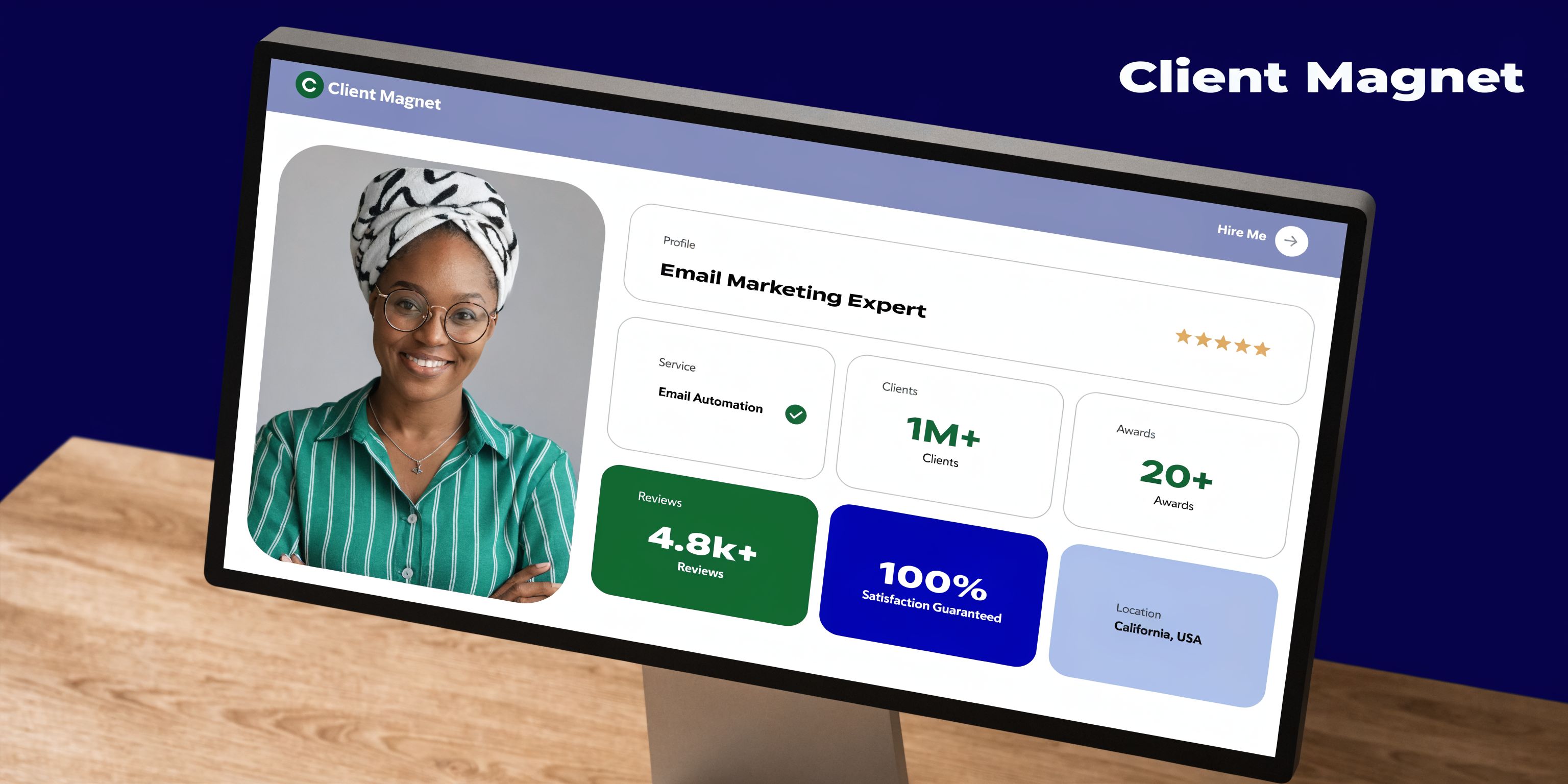
Start with a title that filters buyers
A vague title attracts vague work.
Bad examples:
- Marketing Freelancer
- Digital Marketing Expert
- Email Copywriter
Better examples:
- Klaviyo Email Marketing and Automation Specialist
- Email Lifecycle Marketer for Ecommerce Brands
- B2B Email Marketing Freelancer for Lead Nurture and Campaigns
The right title does two things. It improves relevance inside Upwork search, and it tells the client you already work on their kind of problem.
Fix the first lines of your overview
The opening lines should speak to buyer pain, not your background.
Weak opening:
I’m an experienced marketing professional with a passion for helping businesses grow.
Stronger opening:
I help ecommerce and B2B teams turn underperforming email lists into structured revenue channels through segmentation, flows, campaign planning, and account cleanup.
That kind of summary works because it names the problem and the mechanism.
After that, keep the profile focused on:
- what you handle
- which tools you use
- what kinds of clients you serve
- how you work
Show offers, not a pile of skills
Clients buy packaged clarity.
Instead of listing twenty tools, present a few clean service lines:
- welcome and abandoned cart flow setup
- monthly campaign planning and execution
- email account audit and optimization
- segmentation and list cleanup
- lifecycle strategy for SaaS or B2B
That structure makes it easier for a client to see where they fit.
For portfolio presentation ideas, this guide on how to structure your portfolio in Upwork is useful because it focuses on packaging work in a way buyers can scan quickly.
Make portfolio descriptions do selling work
Most freelancers waste the portfolio section by naming the asset and moving on.
Don’t write:
Klaviyo welcome flow example.
Write:
Built a welcome flow for a skincare brand concept with audience split by first-time subscriber intent, education-first messaging, and offer timing designed to move subscribers toward first purchase without discounting too early.
That language shows decision-making.
Profile details that subtly influence trust
These details aren’t glamorous, but they matter:
- Profile image
Clear, direct, professional. Not overly styled, not cropped from a wedding photo. - Specialized profile
If Upwork gives you room for specialized versions, use one for email marketing. Don’t mix it with broad social media or SEO services if email is the main play. - Project catalog
Set up fixed-scope offers clients can understand at a glance. This helps anchor value before a call.
Buyers don’t read every word. They skim for signs that you’ve solved their exact problem before.
A strong profile won’t close every client. It does something more important. It makes your proposals land in a context that already supports your expertise.
The Anatomy of a Proposal That Gets Replies
Most proposals fail in the first two lines.
They’re generic, polite, and forgettable. They say things like “I’d love to help” and “I have five years of experience.” None of that gives the client a reason to respond.
A proposal that gets replies does three things fast. It proves attention, shows relevance, and lowers the effort required for the client to continue the conversation.
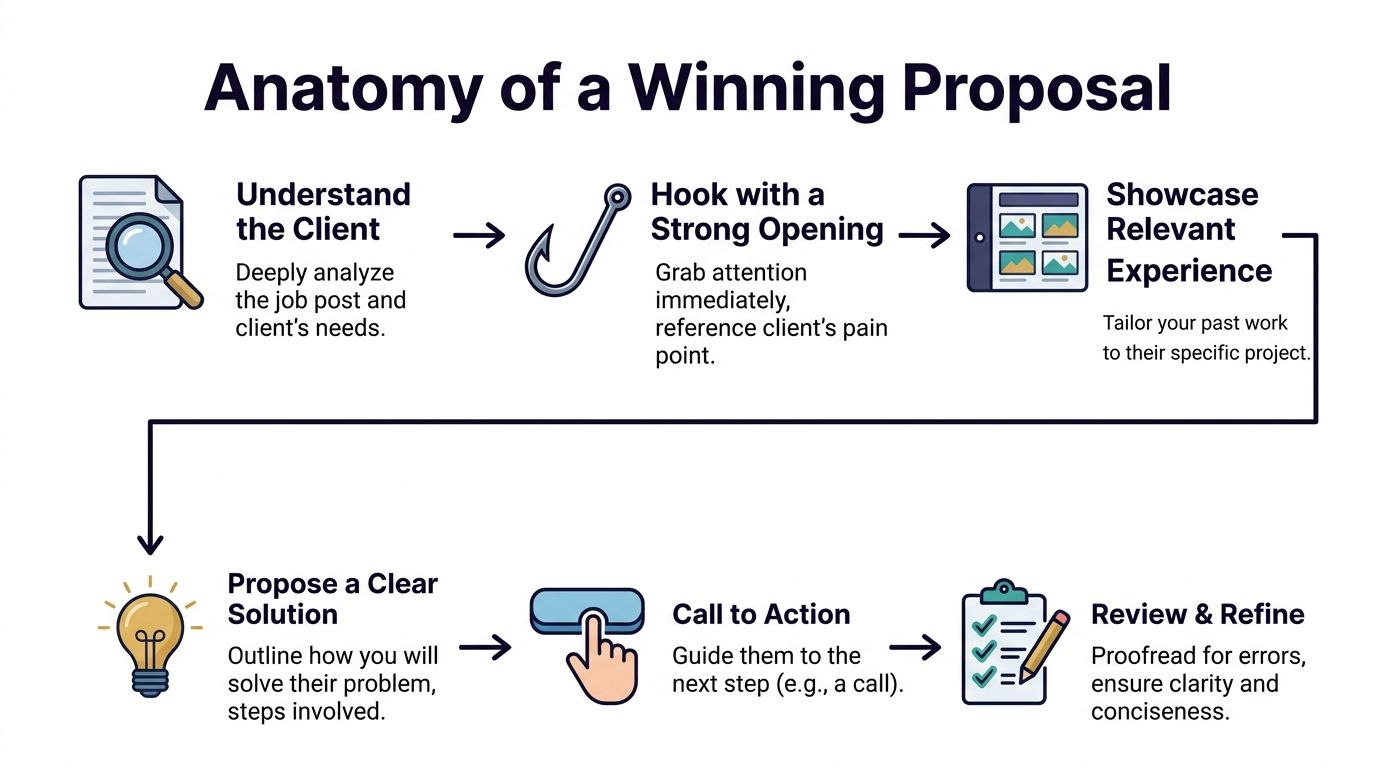
Use the Hook, Prove, Propose structure
This framework works because it matches how clients read.
Hook
Open with something that shows you read the post thoroughly.
Not:
Hi, I’m an email marketing expert interested in your project.
Better:
You don’t need “more emails.” You need a cleaner post-purchase and winback system, because right now your list is doing one job when it should be doing three.
That opening does two things. It signals diagnosis, and it sounds like a specialist.
Prove
Now connect your thinking to the client’s goal.
You don’t need to invent results. You do need to show relevant competence. If the client mentions low engagement, point to your segmentation or testing approach. If they mention weak flows, reference a similar workflow from your portfolio.
You can also use value framing grounded in real email performance benchmarks. Personalizing outreach can lift ROI by 260%, and A/B testing can boost returns by 86% (marketingltb.com on personalization and A/B testing gains). Use those numbers carefully. Don’t promise them. Use them to explain why your process includes personalization and testing.
Propose
Finish with a brief plan.
Example:
I’d start by reviewing your current flows, list structure, and recent campaign cadence. From there I’d map quick fixes first, then build a cleaner sequence plan around your key conversion points. If helpful, send over the account screenshots or a brief Loom and I’ll tell you where I’d begin.
That feels practical. No hype. No essay.
A proposal template you can adapt
Here’s a modular version you can use:
- Opening observation
Mention one specific issue from the post. - Relevant proof point
Tie in a portfolio sample, tool expertise, or process. - Short execution view
Explain how you’d approach the project in a few steps. - One or two smart questions
Questions show expertise better than claims do. - Low-friction CTA
Invite a reply, Loom exchange, or short call
If you want to study the structure in more detail, this breakdown of an Upwork proposal example is a helpful reference.
Questions that improve reply quality
Strong questions pull the client into a real conversation.
For ecommerce:
- Are your current flows segmented by customer stage or product category?
- Which matters more right now, first purchase conversion or repeat purchase revenue?
For B2B:
- Is this list mostly warm leads, outbound prospects, or old pipeline contacts?
- Do you already have a defined handoff point from email engagement to sales follow-up?
For agencies:
- Do you need strategy, execution, or white-label fulfillment under your process?
What doesn’t work
A few habits destroy proposal response rates:
- Long autobiographies
Clients don’t need your origin story in message one. - Templates with fake personalization
If every proposal starts to sound the same, buyers can tell. - Instant pricing without context
Price should follow scope clarity, not replace it. - Overpromising
If you guarantee outcomes too early, experienced clients get cautious.
A strong proposal sounds like the first minute of a useful working relationship.
Navigating the Critical Path from Reply to Contract
Getting a reply feels like progress because it is. But many freelancers lose control of the sale at this point.
A typical exchange starts like this. The client replies, “Thanks. What’s your rate?” Most freelancers answer with a number and wait. That’s the mistake.
A better response to the rate question
If you answer too early, the client compares your price to everyone else’s. If you ask one smart question first, the client starts comparing approaches.
A stronger reply looks like this:
“Happy to price it accurately. Is this mainly a one-time flow build, or do you also need campaign management and account strategy after setup?”
That response does three jobs:
- it shows that scope affects price
- it teaches the client that email work has layers
- it moves the conversation away from commodity pricing
Vet the client while they vet you
Not every reply deserves a call.
Good signs:
- they answer questions clearly
- they can explain the business model
- they know what tool they use
- they care about process, not just speed
Red flags:
- they want “everything” but can’t define the goal
- they avoid basic context
- they ask for strategic thinking while treating the work like admin support
- they push for unpaid samples after you’ve already shown relevant work
A bad client can absorb more time than a hard project.
Run a call like an operator
On the first call, don’t try to impress with jargon. Lead the conversation with structure.
A simple agenda works:
- business model and offer
- current email setup
- list quality and segmentation state
- current campaigns and flows
- decision-maker expectations
- next step
If the client is scattered, your calm structure becomes part of the sale.
Clients often decide you’re the right hire before the proposal is discussed in detail. They decide when the conversation starts feeling organized.
Use onboarding as a closing tool
Most freelancers treat onboarding as something that happens after the contract. Smart freelancers use it to make the contract easier to sign.
Say something like:
“Once we start, I’ll send a short onboarding checklist so we can gather access, brand assets, flow priorities, and communication preferences without wasting the first week.”
That creates confidence.
Your onboarding checklist can include:
- account access requirements
- brand voice materials
- offer and product priorities
- existing flow screenshots or exports
- reporting expectations
- approval process
- weekly communication rhythm
When a client sees that you already have a system, they stop picturing risk and start picturing relief.
The close is usually simple
You don’t need aggressive sales tactics.
At the end of a good conversation, summarize:
- what they need
- what you’ll handle first
- what success looks like
- how you’d structure the engagement
Then ask a clean closing question:
“Would you like me to send the contract for the initial scope we discussed?”
Direct beats clever here.
Stop Bidding Manually Scale Your Freelance Practice with AI
Manual bidding works at the start because it teaches you pattern recognition. You learn which jobs are real, which briefs are sloppy, and which buyer language signals budget or urgency.
Then manual bidding becomes a bottleneck.
If you’re checking the feed throughout the day, rewriting proposals from scratch, and trying to respond quickly while also delivering client work, your business starts to split in two. Half operator, half hunter. That setup burns people out.

The growth ceiling of doing it all yourself
A lot of email freelancers think the problem is proposal quality. Sometimes it is. More often, the issue is consistency and speed.
You might write strong proposals, but if you only send them when you have energy, or hours after the job went live, your process is fragile. Sales activity becomes mood-dependent.
That’s not a skill issue. It’s a systems issue.
Why AI now belongs in the workflow
There’s a clear gap between AI adoption in proposal work and AI adoption in email-campaign-related freelance operations. A 2025 Upwork report indicates 68% of freelancers now use AI for proposals, yet only 12% apply it to email campaigns. The same source notes tools like Earlybird AI can launch automated, personalized Upwork proposals in under 10 minutes with reported 10-15% reply rates (6figurecreative.com on AI proposal usage and Earlybird AI reply rates).
That’s the practical use case. Not replacing strategy. Replacing repetitive top-of-funnel motion.
One useful reference on this shift is this guide about how to automate Upwork proposals.
What automation should handle and what you should keep
Use automation for:
- scanning for relevant jobs
- filtering bad-fit opportunities
- creating a first-draft proposal structure
- fast initial response handling
- follow-up consistency
Keep these human:
- niche positioning
- portfolio quality
- call handling
- pricing decisions
- client strategy
That split matters. If your underlying offer is weak, automation just helps you scale weak outreach faster. But if your positioning is good, automation protects your time.
A short demo helps make the workflow concrete.
The trade-off nobody tells new freelancers
Automation reduces manual grind. It also forces you to get sharper about targeting.
If your saved criteria are broad, you’ll end up reviewing low-quality leads. If your examples and feedback loops are sloppy, the output won’t sound like you. The fix isn’t to abandon automation. The fix is to train the system with clearer signals.
That means:
- define your ideal client tightly
- keep offer language consistent
- review proposal output early
- refine based on actual reply quality, not just volume
The point of automation isn’t to remove judgment. It’s to reserve judgment for the moments where it matters.
For an e mail marketing freelancer trying to move from solo hustle to agency rhythm, this is usually the turning point. You stop treating lead generation as a task you squeeze in, and start treating it as a system the business runs every day.
Frequently Asked Questions for Email Marketing Freelancers
A lot of the hard questions show up after you get traction. Not before. That’s when pricing gets messy, fit matters more, and weak habits start costing real money.
How should I price email marketing work on Upwork
Start with scope, not with your hourly comfort zone.
A client asking for “email marketing help” might need a one-time audit, a flow build, campaign management, list strategy, or all of them. If you price too early, you collapse all of that into one number and make yourself easier to compare.
The bigger issue is underpricing. In the current climate, 72% of freelancers undervalue their services by 30-50%. The same source argues freelancers need to calculate and communicate ROI more clearly, especially in niches where personalized cold email can reach 15% response rates, which can justify retainers of $5k+/month (YouTube discussion on freelancer underpricing and ROI-based retainers).
The practical move is simple:
- price audits and setup work separately
- separate one-time builds from ongoing management
- explain what the client is purchasing beyond “emails”
How do I justify a higher rate without sounding defensive
Tie your fee to business logic.
Don’t say, “I charge more because I’m experienced.” Say, “This work affects conversion, retention, and list performance, so the process includes segmentation, automation review, and testing priorities, not just copy production.”
That framing changes the conversation from labor cost to revenue system value.
Should I take small jobs when I’m new
Yes, but only if they help you build positioning.
Good small jobs:
- a welcome flow cleanup
- a campaign calendar setup
- a segmentation pass
- an account audit
Bad small jobs:
- undefined “marketing support”
- inbox babysitting with no strategy
- random admin work attached to email
Early on, a small project can buy you proof. It shouldn’t trap you in a business model you don’t want.
What kind of clients should an e mail marketing freelancer avoid
Avoid clients who can’t connect email work to an actual goal.
If they say they want “better engagement” but can’t explain whether they care about purchases, booked calls, repeat orders, or pipeline movement, expect confusion later. You can help shape strategy, but you can’t create seriousness where none exists.
Also be careful with clients who:
- insist on urgent turnaround for every request
- have no approval process
- want strategic ownership but resist discovery questions
- treat email as a cheap add-on
Do I need to specialize in one niche
You don’t need a lifetime niche. You do need a current lane.
Upwork gets easier when your profile, portfolio, and proposal language all point in the same direction. That could be ecommerce lifecycle, SaaS onboarding, B2B nurture, or agency white-label support. Pick one lane long enough to build momentum.
What should I focus on after I get my first few clients
Don’t rush into expansion. Tighten delivery first.
Focus on:
- cleaner SOPs
- reusable onboarding
- stronger reporting language
- better client communication rhythm
- a clear upsell path from one-time work to retainer work
That’s how a freelancer starts becoming an agency without chaos.
If you want a more systematic way to handle Upwork outreach, Earlybird AI is built for freelancers and agencies that want to automate job discovery, proposal drafting, fast replies, and follow-up while keeping their client acquisition process more structured.