
← Back To Blog
Email Marketing B2B Lead Generation: A 2026 Playbook
Most advice about email marketing b2b lead generation is still stuck in a lazy formula. Build a list, add first-name personalization, send a sequence, hope for demos.
That isn't how strong pipelines get built now.
The teams getting results treat email like an operating system, not a tactic. They start with list quality, tighten the offer, protect deliverability, and use automation where speed matters. That matters even more in high-velocity environments like Upwork, where a delayed reply or a generic proposal loses the deal before your sales process even starts.
Email still works. Bad email doesn't.
Why Email Is Your Strongest B2B Lead Engine in 2026
The idea that email is old news doesn't survive contact with buyer behavior. Email remains the cornerstone of B2B lead generation, with 87% of businesses actively using it as their primary channel, 73% of B2B buyers preferring email contact from sellers, and 59% of B2B marketers identifying email as their most effective channel for revenue generation, according to the 2025 B2B lead generation report from Dux-Soup.
Email keeps winning for one simple reason. It reaches decision-makers in a channel they already use to evaluate vendors, forward offers internally, and continue sales conversations.
Social content can create awareness. Search can capture demand. Webinars can educate. But email is usually where the commercial conversation starts.
Why buyers still respond to inbox-first outreach
In practice, email does three jobs better than most channels:
- It gives you direct access to the person who can say yes, no, or not now.
- It supports long sales cycles because you can layer education, objection handling, and follow-up over time.
- It fits both outbound and inbound because the same infrastructure can power cold outreach, lead nurture, webinar promotion, and reactivation.
That's why strong operators stop asking whether email still works and start asking whether their system is built to support it.
Email isn't crowded because it's broken. It's crowded because buyers still use it.
This is also why the old volume game fails. Sending more emails to weaker lists doesn't create pipeline. It creates bounces, silence, and reputation damage.
The advantage isn't volume
The strongest campaigns usually look boring from the outside. Clean data. Tight segmentation. Offers tied to real buyer problems. Follow-ups that add context instead of nagging.
That matters on standard outbound. It matters even more on freelance marketplaces, where response windows are short and buyers compare options fast. On Upwork, a proposal often behaves like a cold email with even less patience from the buyer. Speed matters. Relevance matters more.
If you want more angles on building a pipeline around these realities, this breakdown of B2B lead generation ideas is a useful companion.
Building Your Foundation with High-Quality Lead Lists
Most email programs don't fail in the copy. They fail before the first draft gets written.
The list is wrong.
A weak list creates fake problems. You start blaming subject lines, CTAs, and send times when the underlying issue is that you targeted companies with no pain, no budget, or no reason to care.
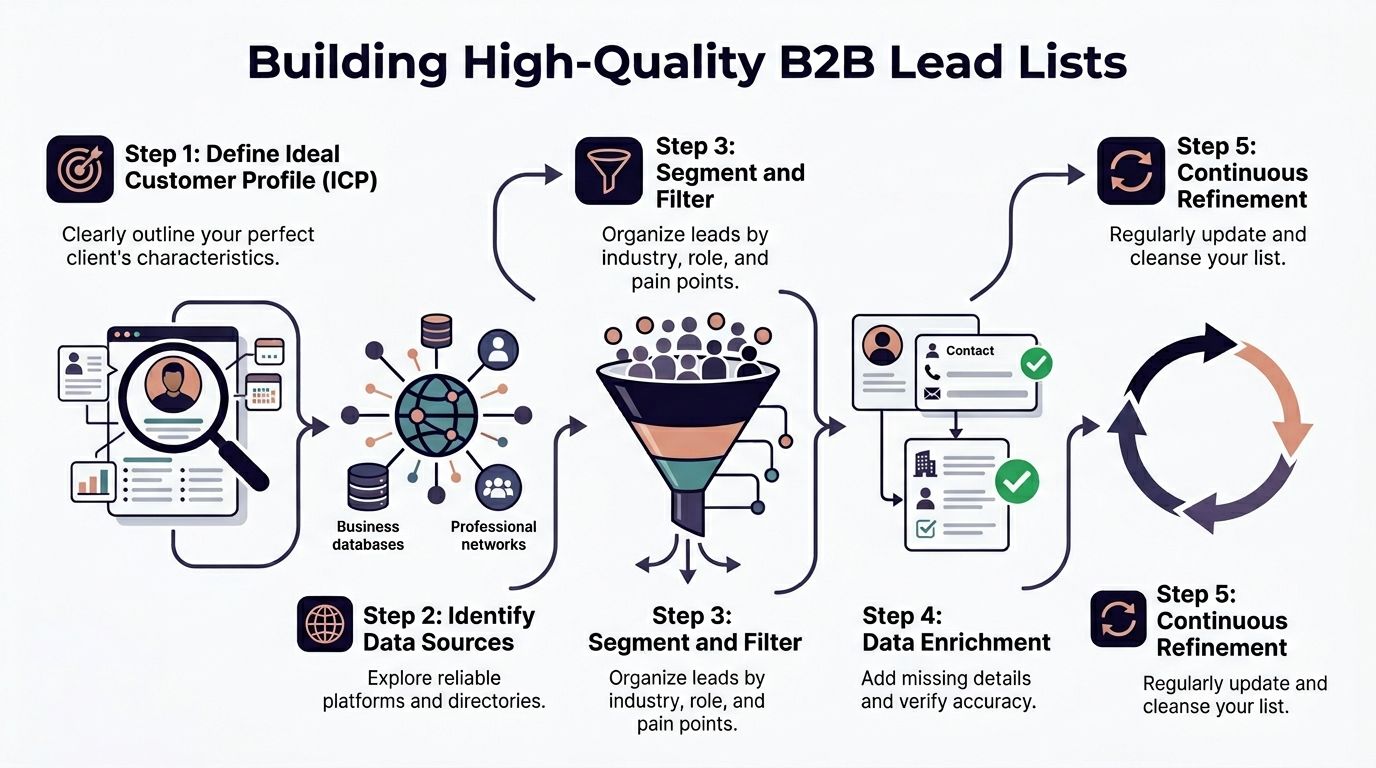
Start with the ICP, not the database
A usable list begins with a sharp ideal customer profile.
That means defining the businesses you can help, not the businesses you wish would buy. For most agencies, that profile should include practical filters such as industry, company size, service maturity, team structure, and signs that the prospect already spends money in your category.
LinkedIn Sales Navigator is usually the cleanest place to start for role and company filtering. Company websites, hiring pages, podcast appearances, webinar panels, and public case studies help validate whether the account fits.
A good ICP answers questions like these:
- Who feels the pain most acutely
- Who can approve or strongly influence a purchase
- Who already shows buying intent through public behavior
- Who looks profitable after delivery costs, not just easy to close
If you can't describe the account in one sentence, the targeting is too loose.
Build segments before you write emails
Segmentation isn't a cleanup step. It's part of list building.
A cybersecurity agency shouldn't send the same message to a SaaS founder, an IT director at a healthcare company, and an operations lead at a manufacturing firm. The surface problem might sound similar, but the language, urgency, and buying logic are different.
Break your list into useful groups before any campaign starts:
- By industry so the examples and pain points feel familiar
- By role because a founder, marketer, and procurement lead don't evaluate risk the same way
- By trigger such as hiring, funding, service expansion, or a visible go-to-market shift
- By source because an inbound webinar registrant should not receive the same first touch as a cold prospect
Practical rule: If you can't explain why someone is in a segment, that segment shouldn't exist.
On Upwork, segmentation matters just as much. Agencies often treat all job posts in a category as equal. They're not. A client posting a rushed one-off task is different from a buyer with a clear brief, budget ownership, and follow-on work potential. Smart teams segment projects by fit, urgency, account quality, and expected lifetime value.
Don't confuse data volume with data quality
Buying giant lists or scraping indiscriminately usually creates more cleanup work than pipeline.
Good list building is slower at the start and much faster later. You spend more time qualifying accounts, but less time repairing deliverability and less time chasing bad-fit leads.
That also applies to inbound capture. When building opt-in forms, each additional field can drop conversion rates by approximately 11%, and simplifying forms to just a name and email with a high-value gated content offer can boost conversions 5-10x compared to a generic newsletter signup, according to CXL's B2B email marketing analysis.
That has two practical implications:
- Keep initial conversion friction low. Ask for the minimum needed to start the relationship.
- Collect richer detail later. Use follow-up questions, sales conversations, or progressive profiling after trust exists.
Teams often do the opposite. They ask for too much up front, get fewer conversions, then wonder why the pipeline is thin.
What a strong list looks like
A strong list isn't necessarily large. It's usable.
Look for these signals:
- Clear fit: The account matches your ICP, not just your hope.
- Clear angle: You can explain why now, not just why someday.
- Clear owner: You know who should receive the first message.
- Clear next move: The record is detailed enough for personalization without turning research into a full-time job.
Weak lists usually contain records that force guesswork. Missing role context. Generic company data. No visible trigger. No real reason for outreach this week.
For Upwork-focused agencies, the equivalent is a job feed full of low-fit opportunities that burn proposal bandwidth. Better operators filter aggressively, then attack the right jobs fast.
Keep refining the list while campaigns run
List quality isn't a one-time setup.
As replies come in, update your assumptions. Which verticals respond well. Which titles engage but don't buy. Which triggers create conversations. Which accounts move to sales and which stall.
That feedback loop matters more than any enrichment tool.
The best list-building process is simple. Define fit, collect enough context to personalize credibly, segment early, and remove anything that doesn't support a focused message.
Crafting Compelling Sequences and Follow-Ups
Most cold sequences die after one email because the sender assumes silence means rejection. In B2B, silence usually means something less dramatic. Busy. Distracted. Interested later. Forwarded internally. Seen on mobile and forgotten.
That's why good email marketing b2b lead generation relies on sequences, not one-shot messages.

Strategic follow-ups are critical. The first follow-up within 3 days can boost replies by 31%. Overall, 220% more leads reply to a follow-up email than to the initial one, yet 79% of leads are lost due to poor nurturing and lack of follow-up, according to Martal's B2B cold email statistics.
That should change how you think about performance. If the first email opens the conversation, the follow-ups usually win it.
The weak sequence many teams send
Here's the pattern that underperforms.
Email one introduces the agency with generic positioning. Email two asks whether the prospect saw the last note. Email three says "just bumping this up." Email four closes the loop.
Nothing in that sequence gives the buyer a reason to reply. It creates activity for the sender, not value for the recipient.
A weak opener often sounds like this:
Hi Sarah, I help B2B companies scale growth through effective digital strategies. We specialize in end-to-end solutions across marketing, branding, and automation. Would you be open to a quick call this week?
This fails for obvious reasons. It says too much and nothing at all. The offer is vague. The pain is vague. The proof is absent. The CTA feels premature.
What a stronger sequence does differently
A stronger sequence narrows the problem, gives the buyer context, and changes the angle across touches.
Try a structure like this:
- Email one: Lead with a specific problem or trigger you observed
- Email two: Add a useful idea, teardown, or short insight
- Email three: Reframe the problem in financial or operational terms
- Email four: Offer a low-friction next step or ask if timing is the issue
The first message might sound more like this:
Hi Sarah, noticed your team is pushing deeper into partner-led growth. When agencies make that shift, email usually breaks in two places first: list segmentation stays too broad, and follow-ups don't match buyer stage. If that's a priority this quarter, I can send over a short teardown of what I'd fix first.
This works better because it sounds observed, not sprayed. It gives the recipient a reason to continue the conversation without forcing a meeting request too early.
For more examples worth modeling, this collection of lead generation emails is useful.
Follow-ups should add a new reason to reply
The mistake isn't sending follow-ups. The mistake is sending the same follow-up repeatedly.
Each touch should do one of these jobs:
- Add evidence through a relevant insight, asset, or observation
- Reduce friction by offering an easier next step
- Clarify fit so the buyer can quickly decide whether it's relevant
- Create timing context by referencing something current in their business
A few practical examples:
- Second touch: Share a short observation about their funnel, hiring, or positioning.
- Third touch: Mention a webinar, guide, or framework that addresses the issue.
- Fourth touch: Ask whether the problem is real but not urgent, which often gets a cleaner answer than another meeting ask.
Later in the nurture path, richer assets matter.
Webinars are especially effective here. 53% of marketers confirm that webinar content generates the most high-quality leads, according to The Insight Collective's B2B demand generation data. If you've got a useful webinar, workshop replay, or product walkthrough, it's often a better follow-up asset than another pitch email.
A quick explainer on sequence mechanics can help sharpen the structure:
How this changes on Upwork
Upwork compresses the timeline.
A proposal acts like email one. Your first reply in messages often acts like email two. If the client goes quiet, your follow-up strategy matters just as much as it does in classic outbound.
But the tone has to adapt. Buyers on Upwork don't want a mini brochure. They want evidence that you understood the brief, can solve the problem, and can move quickly.
A strong Upwork sequence usually includes:
- A fast initial proposal tied tightly to the posted problem
- A short reply when the client engages that clarifies scope without overwhelming them
- A follow-up that advances the deal with a concrete suggestion, not a generic check-in
The best follow-up often isn't "circling back." It's "I looked at the brief again, and here's the first issue I'd fix."
That approach preserves personalization while matching the speed of the platform.
What to cut immediately
If you're reviewing underperforming sequences, remove these first:
- Long company intros that belong on your website
- Multiple CTAs in one message
- Fake personalization like name-only subject lines with generic body copy
- Needless politeness loops that bury the ask
- Follow-ups with no new information
Strong sequences feel conversational, but they're built with discipline. Every touch has a job. Every sentence earns its space.
Ensuring Deliverability and Measuring What Matters
A good campaign can still fail before a prospect reads the first line. That's usually a deliverability problem, not a messaging problem.
When teams say email stopped working, they often mean their messages stopped reaching the primary inbox.
Deliverability is operational, not mysterious
You don't need to become a mail infrastructure specialist to manage deliverability well. You do need a clean process.
At a practical level, deliverability depends on a few basics:
- Authentication: Your sending setup should be properly verified so inbox providers trust that your emails are legitimate.
- Reputation: Repeated bounces, spam complaints, or reckless volume will hurt future sends.
- List hygiene: Bad data damages performance fast.
- Cadence control: Sharp volume spikes and erratic sending behavior create avoidable risk.
If you're launching from a fresh account or domain, go slowly. Keep messages relevant. Watch engagement patterns. Remove bad records quickly.
The fastest way to hurt inbox placement
Most deliverability issues come from operator behavior, not platform behavior.
Common causes include:
- Uploading weak data from scraped or stale sources
- Sending broad generic campaigns to mixed audiences
- Ignoring negative signals like poor reply quality or unsubscribes
- Treating warm nurture and cold outbound as the same program
Cold outreach especially needs restraint. The more your targeting and message match the recipient, the more likely your campaign produces replies instead of complaints.
Field note: Deliverability improves when recipients behave like recipients, not when marketers stare at dashboards.
That's why content matters here too. Better content creates better engagement. Better engagement supports inbox placement.
One format stands out in nurture programs. Webinars are a particularly potent asset, with 53% of marketers confirming that webinar content generates the most high-quality leads, as noted earlier from The Insight Collective. If your nurture sequence promotes a useful webinar or replay, people are more likely to click, reply, and continue interacting with future emails.
Measure pipeline movement, not vanity
Open rate can tell you something. It can't tell you enough.
The numbers that matter are tied to commercial progress:
- Reply quality: Are responses positive, neutral, or negative
- Meetings booked: Did the campaign create real sales conversations
- Lead progression: Did those conversations move forward
- Lead-to-customer conversion: Did the channel produce revenue, not just activity
Clicks also need context. A click on a generic blog post isn't equal to a reply asking about next steps. The metric matters less than the intent behind it.
Use a simple review loop
A practical campaign review usually asks four questions:
- Did the right people get the emails
- Did the emails land in the inbox
- Did the replies indicate fit and interest
- Did sales accept and progress the leads
If the answer to the first question is no, fix targeting. If the second is no, fix sending practices. If the third is no, fix the message. If the fourth is no, fix handoff and qualification.
Many teams skip straight to rewriting copy. That's rarely the first problem.
Scaling B2B Outreach with Smart Automation
Manual outreach breaks long before strategy does.
A founder can handcraft messages for a while. A small sales team can manage a few active sequences. An agency can survive on hustle. Then the cracks show up. Leads sit untouched. Follow-ups get missed. Responses come in after the buyer has already hired someone else.
That's the point where automation stops being optional.
According to Venture Harbour's B2B lead generation strategies analysis, automation can generate twice the leads, yet only 13% of B2B organizations have implemented email marketing automation. That gap matters because the competitive advantage isn't theoretical. It's operational. The team using automation gets more shots on goal without dropping sequence quality.
What automation should handle
Good automation doesn't replace judgment. It replaces repetition.
The right system should take over work like:
- Lead routing and segmentation
- Sequence enrollment based on behavior or source
- Follow-up timing
- Reply alerts and handoffs
- Nurture progression when a lead doesn't convert immediately
That frees people to focus on account research, offer refinement, objection handling, and closing.
The biggest mistake is automating bad process. If the list is weak and the messaging is vague, software just spreads the problem faster.
Why Upwork changes the automation case
Upwork is where the need becomes obvious.
The platform rewards speed, consistency, and responsiveness. If you're manually checking new projects, writing every proposal from scratch, and replying in gaps between delivery work, you're already behind. A slower bidder can still win if they're more relevant. But a slow bidder with inconsistent follow-up usually loses.
That's why platform-specific automation is different from standard outbound tooling. It's not just about sending messages. It's about reacting in time.
For agencies running multiple bidders or freelancer accounts, the primary bottlenecks usually look like this:
- New projects appear and disappear quickly
- Proposal quality drops when volume rises
- Client replies come in at awkward times
- No one owns follow-ups consistently
- Managers can't see where deals stall across accounts
A purpose-built system solves for workflow, not just message sending.
Smart automation should still feel human
Many tools get this wrong. They optimize for throughput and flatten everything else.
Strong automation should preserve three things:
- Context
- Timing
- Natural language
That means using real buyer signals, adapting messages to project details, and avoiding robotic cadence. On Upwork, it also means respecting platform behavior patterns. Fast doesn't mean reckless. Automated doesn't mean obviously automated.
The best automation doesn't make you sound like a machine. It makes sure the right human move happens every time.
For agency leaders, this also changes staffing economics. Instead of hiring more people just to monitor job feeds and send routine follow-ups, automation can absorb the repetitive layer while your team handles qualification and closing.
Where to automate first
If you're scaling from founder-led sales or patchy SDR execution, automate in this order:
- First, lead capture and routing
- Next, follow-up consistency
- Then, behavioral triggers and nurture
- Finally, multi-user workflow visibility
That sequence matters. Many teams jump straight to AI-written outreach before they've solved handoff and response timing.
If you want a useful mental model for where automation belongs in the sales stack, this overview of what sales automation is is worth reading.
The practical trade-off
Automation introduces a real trade-off. You gain speed and consistency, but only if you keep quality controls tight.
That means reviewing message templates, watching reply quality, monitoring lead flow, and making sure the system escalates the right conversations to a person. The answer isn't less automation. It's better automation design.
For Upwork agencies, that's the difference between having a tool that spams bids and having an always-on sales layer that behaves more like a disciplined coordinator.
Frequently Asked Questions About B2B Email Lead Generation
How many follow-ups are too many
Too few is the more common problem.
Many teams quit early and call it respect for the buyer's inbox. In reality, they haven't given the prospect enough chances to engage. Follow-ups work when each one adds a fresh angle, a useful asset, or a clearer next step.
Too many follow-ups become a problem when the messages are repetitive, guilt-based, or detached from the buyer's context. If you're just sending "checking in" again and again, stop.
A better rule is simple. Keep following up while you still have something relevant to say.
What's a realistic expectation for cold email replies
Set expectations carefully.
Reply rates depend on list quality, market fit, timing, offer strength, and message quality. A campaign aimed at a narrow ICP with a strong trigger will perform very differently from a broad list with a vague offer.
What matters most is not raw reply count. It's the share of replies that turn into qualified conversations. Plenty of teams celebrate activity while sales rejects the leads.
For Upwork, the same principle applies. Proposal response volume matters less than whether the right clients engage and move toward a call or paid test.
How do I know whether the issue is copy or targeting
Look at the type of failure.
If nobody replies, the problem may be targeting, deliverability, or a weak opening. If people reply but say they're not the right fit, targeting is usually off. If they engage but don't advance, your offer or next step may be too vague.
Review campaigns in layers:
- First, list quality
- Then, inbox placement
- Then, message relevance
- Then, sales handoff
Most underperforming programs have issues in more than one layer.
Is automation safe on platforms like Upwork
It depends on the tool and the behavior it produces.
Safe automation should respect the platform's operating patterns, avoid reckless activity, and support human-like pacing. It should also protect account access and give teams visibility into what the system is doing.
Unsafe automation usually shows up as brute-force behavior. Generic proposals. erratic sending patterns. No oversight. No workflow controls.
Agencies should evaluate platform-specific tools on a few practical criteria:
- Does it personalize based on the actual brief
- Does it support fast but believable timing
- Can multiple team members collaborate without chaos
- Does it reduce manual work without creating compliance risk
The goal isn't to remove humans. It's to remove delays and inconsistency.
Should I prioritize quality or quantity
This is usually the wrong debate.
You need quality first, then quantity on top of it. Automation helps you scale quantity only after the targeting, messaging, and follow-up logic work.
A small list of strong-fit accounts with disciplined sequencing beats a giant low-fit list every time. Once the system proves it can create qualified conversations, then scale becomes valuable.
That's especially true for Upwork-driven lead generation. More proposals don't automatically mean more clients. Better-fit proposals, sent faster and followed up consistently, create the edge.
What's the best content to include in nurture emails
Use content that helps the buyer make a decision, not content that fills your calendar.
Short teardowns, practical guides, webinar replays, and focused explanations tend to work better than broad brand storytelling. The closer the asset is to an active buying problem, the more useful it becomes in sequence.
If a prospect could consume the content and immediately understand what to do next, it belongs in nurture.
What should I fix first if results are weak
Start where failure is most expensive.
If deliverability is shaky, fix that first. If the list is weak, tighten the ICP and segmentation. If follow-ups are inconsistent, automate the cadence before writing new templates. If replies come in but deals stall, work on qualification and handoff.
Many teams want a copy tweak. Many teams need a system fix.
Earlybird AI helps agencies and freelancers turn this playbook into an always-on sales workflow on Upwork. It learns which projects fit, searches for opportunities, crafts personalized proposals, replies quickly, follows up consistently, and gives teams visibility across accounts without the usual manual chaos. If you want a faster, safer way to scale marketplace outreach, take a look at Earlybird AI.