
← Back To Blog
Email Marketing for Lead Generation: A Tactical Playbook
If you're getting most of your work from referrals or freelance platforms, you already know the pattern. One strong month makes everything feel stable. Then replies slow down, invite volume drops, old leads go quiet, and you're back to chasing the next project by hand.
That cycle usually isn't a lead problem. It's an ownership problem. You don't control the platform, the algorithm, or whether a prospect who liked your proposal ever comes back. Email fixes that by turning scattered conversations into a system you own.
For service businesses, especially agencies and freelancers selling on Upwork, email marketing for lead generation works best when it's tied to intent. Not random list building. Not bulk sends. A tight process that captures interested prospects, qualifies them, and moves them toward a booked call.
Why Your Business Needs an Email-Driven Lead Engine
Most freelancers wait too long to build an email list because email feels like something bigger companies do later. That's backwards. You need it early, when your pipeline is still fragile and too dependent on outside platforms.
A platform lead is rented attention. An email subscriber is an owned contact. That difference matters when you're trying to smooth out revenue and build a repeatable sales process.
Email still has the scale and commercial value to justify serious focus. Nearly 4.5 billion people used email globally in 2025, and that figure is projected to surpass 4.8 billion by 2027, according to Sixth City Marketing's email marketing statistics roundup. The same source also notes that B2C brands ranked email as their best ROI channel, ahead of paid social and content marketing.
That doesn't mean every freelancer should become a newsletter publisher. It means email deserves a role in your sales stack because it gives you a controlled environment to follow up, educate, and convert.
What changes when you own the follow-up
Once a prospect is on your list, you don't have to hope they remember you when timing changes internally. You can stay visible without chasing them across inboxes, DMs, and platform messages.
That matters a lot in service sales because buyers rarely move in a straight line. A lead might like your work today and still wait weeks before asking for a call. If you rely only on the original thread, you disappear the moment that thread dies.
Practical rule: If a lead has shown interest once, build a path to continue the conversation outside the platform where that interest started.
Why this matters more on Upwork
Upwork is great at surfacing demand. It isn't built to be your CRM, nurture engine, and long-term audience database. If you're an agency owner or solo operator, you need a second layer after the first reply.
That layer is email. It lets you package your expertise into assets, qualify buyers by behavior, and move from reactive bidding to proactive pipeline management. Done right, your email list becomes the place where cold contacts turn into warm opportunities.
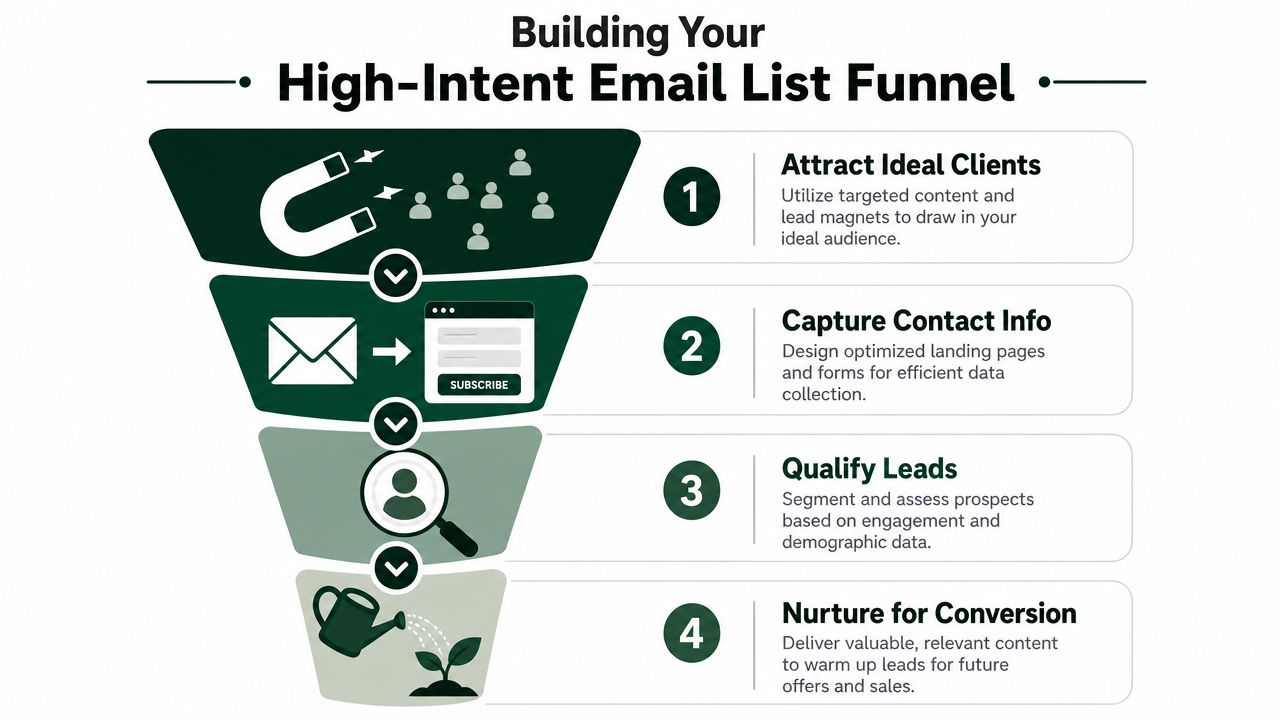
Building Your High-Intent Email List
A useful email list isn't a collection of addresses. It's a filtered group of people who have a reason to hear from you again.
For freelancers and agencies, the simplest mistake is chasing volume. They put a generic newsletter signup on their site, ask for too much information, and then wonder why the list doesn't convert. High-intent list building starts with a narrow promise tied to a real buying problem.
Build the lead magnet around a decision
The best lead magnets for service businesses help a buyer evaluate something important. They don't need to be long. They need to be useful.
A freelance developer might offer:
- A teardown checklist for spotting performance issues before a rebuild
- A migration planning brief for businesses moving from a fragile custom stack
- A scope template that helps non-technical buyers compare proposals
A marketing agency might offer:
- A lead audit worksheet for diagnosing where inquiries stall
- An email sequence breakdown showing how to structure nurture after an inbound lead
- A campaign review framework buyers can use to judge whether their current vendor is underperforming
These work because they attract people who are already thinking about buying. That's the right kind of list growth.
Keep the form lean and the ask clear
If the asset is good, don't sabotage it with a heavy form. For most service businesses, name and email is enough. Sometimes just email is better.
Your landing page only needs a few things:
- A sharp headline tied to one pain point
- A short promise that tells the visitor what they'll walk away with
- A simple form with minimal friction
- A clear next step so the user knows what happens after signup
What doesn't help:
- Vague positioning like "join our newsletter"
- Early qualification overload with job title, company size, budget, and phone number
- Mixed offers where the page asks the visitor to download a guide, book a call, and browse services at the same time
More fields don't create better leads. Better offers create better leads.
Protect deliverability from the first signup
Most list-building advice focuses on conversion rate and ignores what happens after the form fill. That's a mistake. If your acquisition flow pulls in weak, low-consent, or low-interest contacts, your sender reputation will suffer before your nurture sequence has a chance to work.
Recent reporting highlighted by American Eagle on email lead generation tactics notes that AI-assisted inbox ranking and stricter authentication requirements, including Google and Yahoo's 2024 sender rules, make list quality, engagement, and consent more important than raw send volume.
For Upwork sellers, that means you should be selective about who enters your list. Someone who replied to your proposal, viewed your portfolio, or requested more detail is a better email contact than a scraped prospect with no relationship to your work.
Put your signup points where intent already exists
Most agencies leave money on the table. They create a decent lead magnet, then hide it on a resources page no one visits.
Place it where prospects already evaluate you:
- Your website service pages with an offer matched to that service
- Your portfolio and case study pages where buyers want proof
- Your LinkedIn profile and content
- Your Upwork portfolio and post-project assets, where allowed and appropriate
- Follow-up conversations after a prospect asks a thoughtful question
If you also run outbound or prospecting workflows, your list-building asset should fit inside that motion. For example, teams using AI for sales prospecting can route engaged prospects into a focused email capture path instead of treating each reply as a one-off exchange.
Designing Your Automated Nurture Sequence
The first email after signup does more than deliver a file. It sets the tone for every message that follows. If the lead feels like they've entered a generic funnel, you lose momentum immediately.
Automation works because it gives every serious prospect the same strong first experience. Personalization makes that automation feel relevant instead of robotic.
The performance gap is hard to ignore. Porch Group Media's email marketing statistics reports that personalized emails can improve open rates by 29% and click-through rates by 41%. The same source says automated emails produced 52% higher open rates, 332% higher click rates, and 2,361% better conversion rates than regular scheduled campaigns.
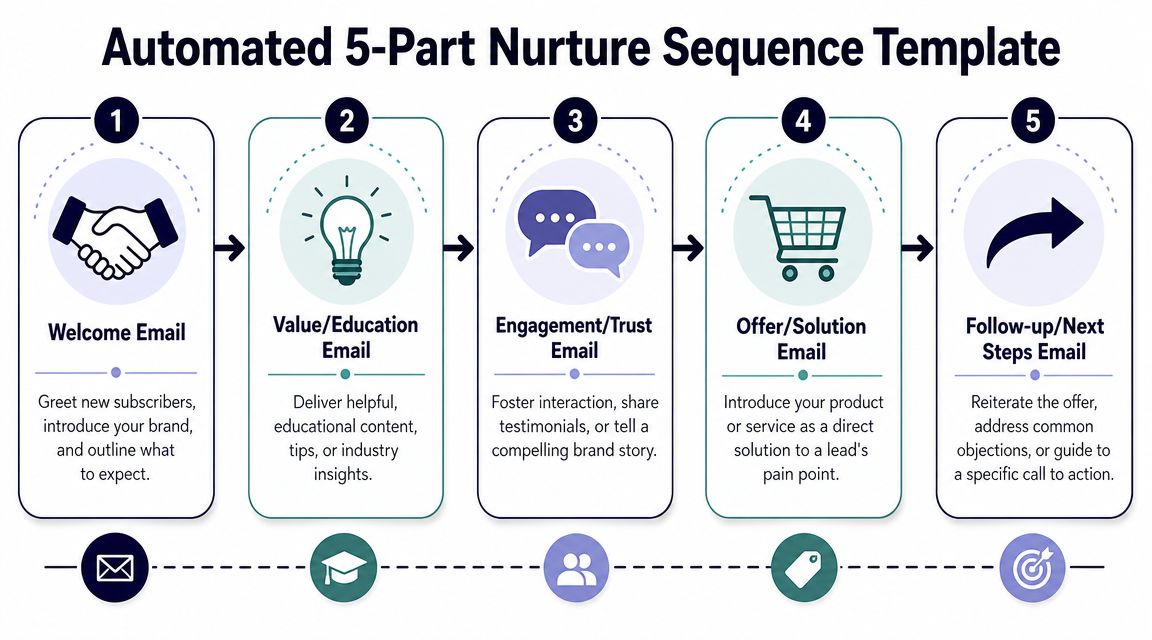
The five-email sequence that warms up service leads
Think about this from the subscriber's side. They requested a resource because they have a problem. Your sequence should help them understand that problem, trust your judgment, and see a next step.
A simple five-email structure works well for freelancers and agencies.
Email one delivers and orients.
Send the promised asset immediately. Thank them for requesting it. Tell them what kind of emails they'll get next, in plain language. Keep the call to action light. Ask a short question or point them to one relevant service page.
This section is worth seeing in action:
Email two teaches one useful thing.
Don't pitch yet. Pull one insight from the lead magnet and expand it with a practical example. If you're an SEO agency, explain a common indexing or conversion mistake. If you're a developer, explain how scope errors create delays and budget drift.
Email three builds trust through specificity.
Share a short story about a client situation, a project pattern, or a before-and-after process change. You don't need inflated claims. You need enough detail to show you know what the buyer is dealing with. Explain the issue, the decision, and the lesson.
Buyers don't trust claims of expertise. They trust accurate diagnosis.
Email four introduces your service as the obvious next step.
Now you've earned the right to connect the problem to your offer. Keep this direct. Show who the service is for, what kind of problem it solves, and what the first engagement looks like.
Email five handles hesitation and asks for movement.
Many sequences tend to go soft here. Don't end with "just checking in." Address one or two common objections. Timing, budget uncertainty, internal complexity, or not knowing whether the project is ready. Then invite the lead to reply, request an audit, or book a call.
Basic segmentation that actually matters
A nurture sequence gets stronger when subscribers don't all receive the same path. The easiest way to segment is by entry point and behavior.
Useful tags include:
- Lead source such as website guide, portfolio asset, or outreach follow-up
- Service interest like web development, paid media, lifecycle email, or SEO
- Engagement behavior including clicked service links, replied to a question, or ignored the full sequence
- Commercial intent based on actions such as viewing your pricing page or requesting examples
That gives you practical branching logic. Someone who downloads a conversion audit and clicks your case study should not receive the same next emails as someone who grabbed a general guide and never engaged again.
Keep the voice human
Most automated sequences fail because they sound like automation. They over-format, over-explain, and push too hard too early. Service sales usually work better when the emails feel like concise notes from a smart operator.
A few habits help:
- Write shorter than you think you should
- Use one message per email
- Ask real questions that a buyer can answer quickly
- Avoid fake urgency unless there's an actual deadline
- Send from a real person, not a faceless department address
If your sequence reads like marketing copy, trim it until it sounds like the kind of message you'd send after a useful first conversation.
Crafting Campaigns That Convert Leads
After the welcome sequence, many lists go stale because the sender has no campaign rhythm. They either disappear for months or send updates that don't lead anywhere. Good campaigns keep trust alive while giving the reader one clear action.

The easiest way to stay sharp is to rotate between three campaign types. Each has a different job. Together, they keep the pipeline moving without exhausting your list.
The value newsletter
This isn't a roundup of links. It's a short email built around one useful lesson.
A strong version looks like this:
- Subject line with specificity that names the problem
- Opening that identifies a familiar mistake
- One practical takeaway the reader can apply quickly
- A soft CTA to read a deeper resource, reply with a question, or view a related service
Example angle for a design agency: why homepage redesigns fail when the underlying issue is offer clarity. Example angle for an automation consultant: why fast response time matters less if the handoff after reply is weak.
The case study launch
When you finish a project with a strong lesson inside it, turn that into an email. Don't make it a chest-beating announcement. Make it a diagnostic story.
Structure it like this:
- What the client thought the problem was
- What was actually blocking progress
- What changed in the process
- What type of buyer should care
This format works because it helps leads recognize themselves in the problem. They don't have to be ready now. They just have to think, "that's uncomfortably familiar."
A good campaign email doesn't try to close the sale. It creates the next conversation.
The direct-offer email
This is the one many agencies either avoid or overdo. A direct offer works when it's narrow, timely, and easy to understand.
Keep the anatomy simple:
- One offer
- One audience
- One reason to act
- One CTA
For example, instead of promoting all your services, offer a strategy session for ecommerce teams struggling with abandoned lead flow after a site inquiry. Instead of "book a discovery call," try language tied to the actual problem you're solving.
A few conversion habits matter here:
- Write for mobile first, because long intros get skipped
- Use one primary link or reply CTA
- Avoid image-heavy layouts that look promotional
- Keep subject lines grounded, not clickbait-heavy
- Let the body do the selling, not the formatting tricks
The campaigns that convert usually feel plainer than marketers expect. That's a good sign. Clear, relevant, well-timed emails outperform fancy ones in service businesses all the time.
Measuring and Optimizing Your Lead Generation Funnel
You don't improve email marketing for lead generation by sending more. You improve it by identifying where the funnel breaks and fixing that specific point.
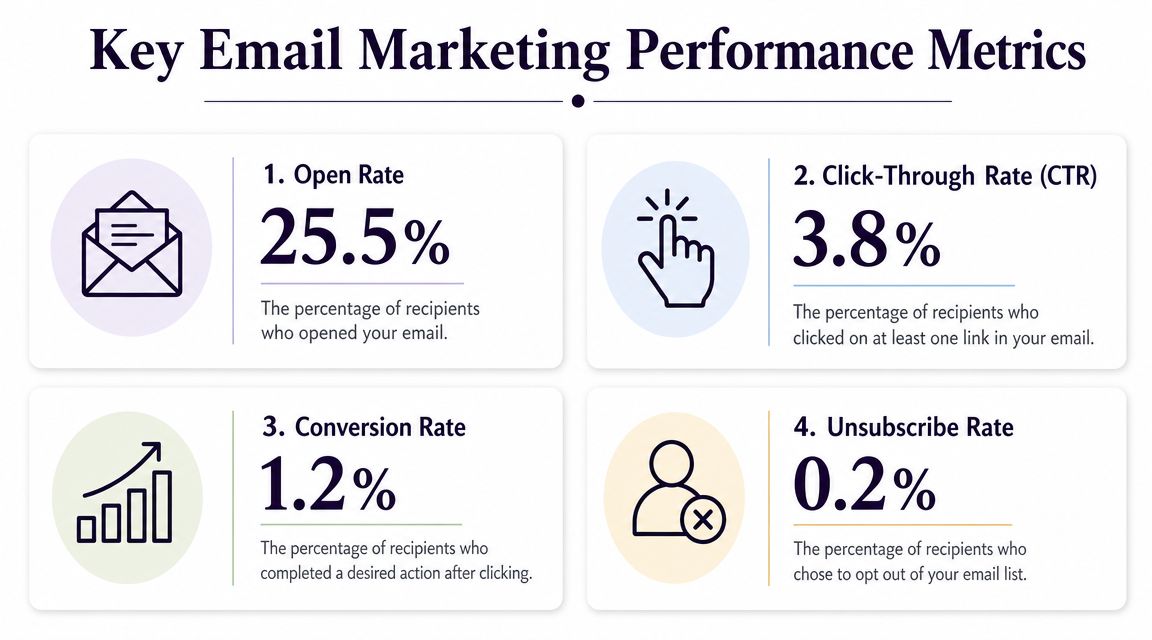
The upside is real. Zen Agency's email marketing lead generation overview cites an average return of $42 for every $1 spent on email marketing, while also stressing that performance depends on disciplined optimization. The same source recommends a KPI stack that includes open rate, click-through rate, conversion rate, and unsubscribe rate, along with A/B testing on subject lines, CTAs, and send times.
What each metric is telling you
Don't stare at dashboards without making decisions. Every metric should trigger an action.
- Open rate is weak. Your subject line probably doesn't match the reader's current interest, or your sending pattern has gone stale. Test tighter subject lines, cleaner preview text, and audience relevance before rewriting the whole email.
- Click-through rate is weak. The body isn't carrying enough weight. Usually the issue is one of three things: the hook is vague, the CTA is buried, or the offer doesn't feel connected to the email's promise.
- Conversion rate is weak. The email may be doing its job, but the landing page or booking flow isn't. Check message match, friction, and whether the next step asks for too much commitment.
- Unsubscribe rate rises. That's usually a relevance or expectation problem. The reader either didn't want these emails in the first place or the content drifted away from what they signed up for.
A practical testing routine
A/B testing only works when you isolate variables. Too many teams change the subject line, body, CTA, and send time all at once. Then they can't tell what improved the result.
A better rhythm:
- Test the subject line first when opens are the issue
- Test the CTA and body structure next when clicks are lagging
- Test send timing after you've fixed relevance and message quality
- Roll the winning version into automation so improvements compound
For agency owners, process, above all, beats inspiration. You don't need brilliant copy every week. You need a repeatable testing habit.
List hygiene is part of conversion optimization
A bloated list can make you feel productive while insidiously damaging deliverability and engagement. If large groups never open, never click, and never reply, they're not an asset.
Clean your list regularly. Re-engage cold subscribers with a focused message. If they still don't engage, suppress them. That's not list shrinkage. That's list quality control.
If your sales process needs more structure beyond email metrics, sales pipeline management becomes the next layer. Email tells you who is responding. Pipeline management tells you what stage they are in and what action should happen next.
Integrating Email with Your Upwork Outreach
The strongest setup for Upwork sellers uses the platform for discovery and email for controlled follow-up. Upwork generates conversations. Email turns those conversations into an asset you can segment, nurture, and revisit.
This matters most when a lead doesn't book immediately. Maybe they replied to your proposal, asked a smart question, then went quiet. That's still intent. If you can move that person into your email ecosystem with a relevant resource, the conversation doesn't die with the thread.
Use reply behavior as your first segmentation signal
Segmentation should start with behavior, not demographics. CleverTap's guide to email marketing for lead generation reports that segmented campaigns have been reported to achieve 30% higher open rates and 50% higher click rates. The same guidance points to behavioral triggers as the first useful filter.
For Upwork, that's practical:
- Proposal reply received means the lead deserves a more direct, service-specific follow-up
- Question about scope or pricing signals later-stage intent
- Ghosted after initial interest calls for a softer educational sequence
- Viewed portfolio or requested examples suggests a proof-driven nurture path
Platform automation and email should connect cleanly. If you're already using tools to speed up top-of-funnel activity, the next step is to capture and organize intent, not just generate more messages. Teams that automate Upwork proposals can use email as the system that takes over after the first positive signal.
Move conversations off-platform without forcing them
You don't need to push every lead into a hard sell. A softer bridge often works better. Offer a resource tied to the exact issue they mentioned. If they asked about lead quality, send an audit checklist. If they asked about workflow, send a process brief.
That gives you three advantages:
- You capture consent-based contact information
- You learn what service or problem they care about
- You create a reason to continue the conversation later
The long game is simple. Upwork can fill the top of the funnel. Your email system should capture the value of that attention, classify it, and keep it alive long after the original job post disappears.
If your team wants a tighter connection between Upwork outreach and a real nurture system, Earlybird AI can handle the top-of-funnel work of finding projects, drafting personalized proposals, and replying fast, so you can focus on moving engaged prospects into your email-driven sales process and turning interest into booked calls.