
← Back To Blog
Freelancer vs Upwork vs Fiverr A Guide for Modern Agencies
The real difference between freelancing on your own versus using a platform like Upwork or Fiverr boils down to a simple trade-off: control versus convenience.
When you go direct, you're in the driver's seat. You keep all the profit and call all the shots. Platforms, on the other hand, offer a shortcut to a steady stream of clients, but that access comes at a cost—both in fees and in following their rules. For agencies looking to scale with bigger, better clients, Upwork often provides the clearest, most structured path forward.
Choosing Your Growth Model: Freelancing vs. Platforms
Every freelancer and agency eventually hits a crossroads. Do you build your business independently, or do you plug into a massive, ready-made marketplace? Picking between direct freelancing, Upwork, and Fiverr isn't just about where you find your next gig; it’s a core strategic decision that shapes how you attract clients, run your projects, and grow your income.
This guide breaks down the pros and cons of each model to help you decide which path makes the most sense for you.
Here's a quick visual overview of the core models we'll be digging into.
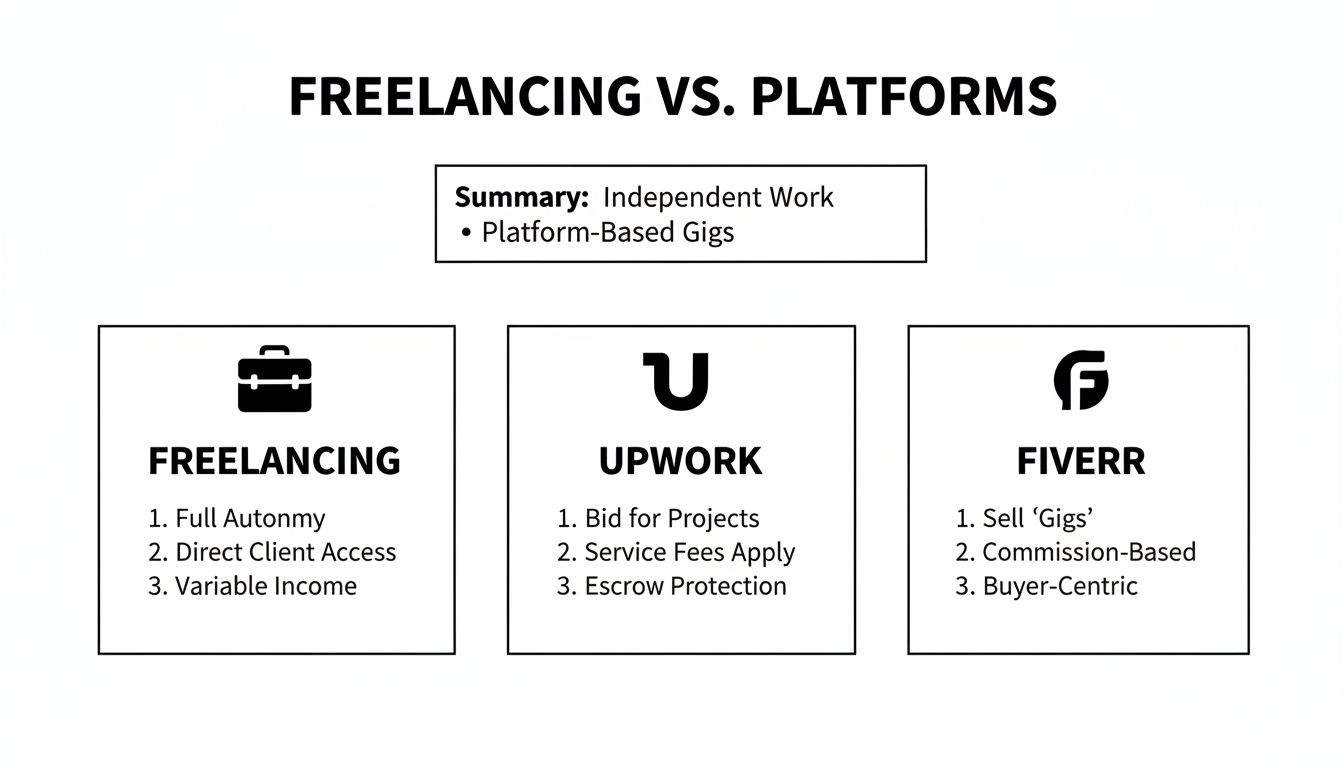
The central theme here is that each option involves a unique balance of autonomy and access. To really get to the bottom of the "freelancer vs. Upwork vs. Fiverr" debate, we need to analyze them based on the factors that actually affect your business and your bank account.
The Four Pillars of Your Decision
We'll be comparing these three models across four make-or-break business areas:
- The Financials: This covers everything from platform fees and payment protection to your ultimate earning potential.
- Clients & Acquisition: We'll look at the quality of clients each model attracts and what it really takes to land them.
- Operational Control: How much say do you have over your brand, client relationships, and the way you work?
- Scalability & Long-Term Growth: What does each path offer for expanding your operations and building a real agency?
Getting these trade-offs right is everything. Your choice determines whether you're building a brand from scratch or leveraging a pre-built ecosystem to get clients in the door faster.
By digging into these four pillars, you can map your business model to where you want to be in the long run. Let's start with a high-level look at how they stack up.
At-a-Glance Comparison: Freelancing vs. Upwork vs. Fiverr
This table offers a quick snapshot of the key differences, giving you a baseline understanding before we dive deeper into the nuances of each approach.
As you can see, the models are fundamentally different. Direct freelancing offers complete freedom at the cost of having to build everything yourself, while platforms offer structure and client flow in exchange for significant fees and less control.
Upwork vs. Fiverr: A Strategic Platform Showdown

When you stack Upwork against Fiverr, it’s easy to get lost in the features. But the real difference isn't in the buttons you click—it's in their entire business philosophy. These platforms aren't just competitors; they represent two fundamentally different ways of connecting with clients, and that difference will shape everything from project scope to your agency's bottom line.
Think of it this way: Upwork is a talent marketplace. Clients come with complex, often long-term needs, post detailed job descriptions, and wait for skilled professionals to submit proposals. It’s a model that naturally attracts experienced freelancers and agencies ready to tackle high-value, nuanced work.
Fiverr, on the other hand, is a service-as-a-product catalog. You package your skills into predefined "Gigs" that clients can browse and buy, just like ordering from a store. The entire system is built for speed and simplicity, making it a powerhouse for quick, well-defined tasks.
Market Position and User Base
The sheer scale of these platforms tells a story about the kind of opportunities you'll find. For agencies looking to tap into a massive and varied client pool, Upwork's size is a game-changer.
Upwork is the undisputed giant, with over 18 million freelancers spread across 180+ countries. In the United States alone, there are 3.7 million registered freelancers. This dominance translates to a projected 8.86% market share in 2025, which easily eclipses Fiverr's 5.81%. For more details, you can explore the freelance market landscape.
But this isn't just about big numbers. The scale directly influences the client profile. Upwork attracts a much larger share of enterprise-level companies, the kind of clients looking to hire entire teams and forge long-term partnerships.
Client Acquisition and Project Flow
How you land work on each platform couldn't be more different, and it dictates your entire sales process. On Upwork, you’re in the driver's seat. You actively hunt for projects that match your agency's skills and submit custom bids. It’s a proactive approach that gives you a ton of control over your client pipeline.
Fiverr is the opposite—it’s a more passive game. You build your Gigs, optimize them for search, and wait for clients to find you. Your success hinges on how well you can package your services into an irresistible offer and play the algorithm.
Upwork rewards proactive outreach and tailored proposals, putting you in control of lead generation. Fiverr rewards sharp marketing and productized services, requiring clients to come to you.
This is a critical distinction for agencies. The Upwork model feels a lot like traditional business development, letting you zero in on high-value targets. Fiverr demands a completely different mindset, one focused on optimizing a "product" for visibility and conversion. Before you dive in, it’s worth asking if Upwork is legit for your specific goals; you can learn more about its legitimacy in our detailed guide.
Strategic Suitability for Agencies
For an agency on the rise, the choice between Upwork and Fiverr really boils down to the kinds of client relationships you want to build.
- Upwork is ideal for: Complex, multi-stage projects. Think software development, end-to-end marketing campaigns, or ongoing consulting retainers. The platform is built to support custom proposals, hourly contracts, and lasting client partnerships.
- Fiverr excels at: Standardized, high-volume tasks. This is the place for things like logo designs, quick voiceovers, or single-page content writing. Its structure is perfect for services you can productize and repeat efficiently.
At the end of the day, Upwork's framework is far better suited for building a scalable agency that depends on deep client relationships and high-ticket projects. Fiverr serves a different—but equally important—niche for agencies offering quick, transactional services.
Calculating the True Cost of Platform Fees
When you're weighing direct freelancing against platforms like Upwork or Fiverr, the first thing that hits your wallet is the fees. They might look like small percentages at first glance, but they add up quickly and can make a serious dent in your agency's cash flow and overall profitability. Before you commit to a platform, you have to know exactly what it's going to cost you.
Going direct is the cleanest model. You set your rate, and that’s what you invoice for. Your only real cost is the payment processor—think Stripe or PayPal—which usually takes around 2.9% + $0.30 per transaction. After that, 100% of the revenue is yours. It’s the most profitable route per project, but the trade-off is that you're on the hook for everything: invoicing, chasing payments, and absorbing all financial risk.
Freelance platforms, on the other hand, have built-in fees; it's the price of admission for access to their clients and infrastructure. The difference in fee structures between Upwork and Fiverr isn't just a minor detail—it has a huge impact on your take-home pay.
Upwork vs Fiverr Service Fee Showdown
This is where the financial models really diverge. Fiverr’s approach is brutally simple: they take a flat 20% commission from every single order, no matter the size or your history with the client. It’s a steep price that can be a major drag on profits, especially for larger, agency-level projects.
Upwork’s model is much more forgiving for serious freelancers and agencies. They simplified their structure in 2023 to a flat 10% service fee on all contracts, down from a previous sliding scale. This puts Upwork's commission at half of Fiverr's, which is a massive difference.
Let's break that down. On a $1,000 project, you'll pocket $900 on Upwork. On Fiverr, that same project only nets you $800. And don’t forget the client-side fees: on Fiverr, the client pays an extra 5.5% (plus $3 on orders under $100), bringing their total cost to $1,058. You can discover more insights about these platform fee comparisons online.
That 10% gap between Upwork and Fiverr is more than just a number. It’s a significant chunk of revenue that could be reinvested into your agency's growth but is instead lost to platform costs.
Uncovering the Hidden Costs
The sticker price isn't the whole story. Beyond the main service fees, a collection of smaller charges can quietly chip away at your earnings.
Getting your money out isn't always free, for instance. Both platforms offer multiple payout methods, and some come with their own transaction fees. Clients also pay their own fees on both sides, which can indirectly squeeze their budget and make them less willing to accept your higher rates.
The true cost isn't just the percentage you see on the surface. It's the combination of service fees, withdrawal charges, client-side costs, and optional subscriptions that determines your final net income.
Upwork also has its Freelancer Plus subscription. For a monthly fee, you get perks like more "Connects" (the tokens you use to apply for jobs), a custom profile URL, and the ability to see what competitors are bidding. It’s not required, but for many agencies trying to stay competitive, it becomes a necessary operational expense.
A Practical Project Cost Scenario
Let's put some real numbers to this. Imagine your agency just completed a $5,000 project. Here’s what your take-home pay looks like across the three models:
- Direct Freelancing: You invoice for $5,000. After a standard 2.9% Stripe fee, your net is $4,855.
- Upwork: The contract is for $5,000. Upwork’s 10% fee leaves you with $4,500.
- Fiverr: The client buys a $5,000 gig. Fiverr’s 20% commission means you only get $4,000.
In this one project, choosing Fiverr over Upwork costs your agency $500. And going direct earns you $355 more than even the most favorable platform. This simple math shows why digging into the fee structure is the absolute first step in deciding where to build your business.
Evaluating Agency Scalability and Growth Potential
For any agency, growth isn't just about getting more clients. It's about building repeatable systems that can handle bigger projects, more team members, and increasing complexity. When you stack direct freelancing, Upwork, and Fiverr side-by-side on this, you realize they offer fundamentally different paths to scaling your business. The best fit really comes down to your agency's long-term goals.
Going the direct route gives you limitless potential, but it’s also the heaviest lift. You're on the hook for building every single piece of your infrastructure from the ground up—lead funnels, CRMs, project management systems, invoicing, you name it. While this gives you total control, it can quickly become a bottleneck where your agency's growth is tied directly to how much manual sales and outreach you can personally handle.
Fiverr, on the other hand, is built on a "gig" model. This is fantastic for productizing your services and churning out high volumes of standardized tasks efficiently. But that very structure becomes a scaling problem for agencies. It’s designed for individual sellers, making it a real headache to manage complex, multi-stage projects or build the kind of deep, consultative relationships that high-value clients expect.
Upwork's Agency-Focused Features
This is where Upwork was clearly built with agency growth in mind. It has a suite of tools that directly tackle the common pain points of scaling a service-based business, allowing you to manage multiple clients and team members all under one roof.
It’s these agency-specific features that really set it apart:
- Multi-User Workflows: As an agency manager, you can add your team, assign specific roles, and control permissions. It creates a central hub for all your client work.
- Shared Earnings History: Your agency's reputation and Job Success Score are pooled together. This lets you build social proof much faster than any single freelancer could on their own.
- Centralized Proposals: Your sales or business development lead can submit proposals on behalf of the entire agency, keeping your brand messaging and voice consistent.
These features move Upwork beyond being a simple marketplace and turn it into a legitimate operational backbone for a growing team. If you're serious about building an agency, our guide on starting an SEO agency lays out a roadmap that pairs perfectly with the infrastructure Upwork provides.
Client Acquisition and Project Management at Scale
How you get clients is a massive piece of the scalability puzzle. Direct freelancing depends on your personal network and outbound marketing efforts, which can be wildly inconsistent. Fiverr’s model is passive and inbound—you have to wait for buyers to find you, which is unpredictable and nearly impossible to scale proactively.
Upwork, however, offers a steady stream of pre-qualified leads. The marketplace is full of clients who are actively looking for skilled teams to handle complex, long-term projects. While the bidding process is competitive, it lets your agency zero in on specific high-value contracts and build a predictable sales pipeline—the lifeblood of any sustainable business.
For agencies, the scaling potential clearly favors Upwork over Fiverr and going it alone. Upwork caters to everyone from solopreneurs to major enterprises, with 145,000 clients spending $5,000+ each year. It offers a Talent Marketplace and access to the top 1% of talent—capabilities that Fiverr's buyer-driven gig model simply can't replicate.
Cash flow is another critical factor. Fiverr's 7-14 day payment release combined with its 20% fee can put a real strain on your finances. In contrast, Upwork's faster 5-10 day releases, a lower 10% fee on most earnings, and direct contract options give you the financial agility a growing team needs to hire more talent and invest in operations.
The Verdict on Long-Term Growth
So, when you look at the long-term growth potential in the freelancer vs. Upwork vs. Fiverr debate, the picture becomes pretty clear.
Direct freelancing gives you ultimate freedom, and Fiverr is a machine for productized services. But for an agency looking to truly scale, Upwork provides the most structured and supportive environment. Its blend of agency-specific tools, access to high-value enterprise clients, and a framework designed for team collaboration makes it the strongest choice for building a sustainable, high-growth business. It successfully bridges the gap between the total independence of going solo and the restrictive nature of a pure gig economy.
How Automation Creates an Unfair Advantage on Upwork
Most comparisons between direct freelancing, Fiverr, and Upwork miss a game-changing variable that can completely tip the scales for an agency: automation. Direct outreach is a manual grind, and Fiverr’s model is mostly passive. But Upwork’s active bidding system? That’s where the opportunity lies. With the right tools, you can transform Upwork from a frustrating, competitive slog into a predictable lead-generation machine.
This isn't about spamming out hundreds of generic, copy-pasted proposals. Smart automation is far more sophisticated. It’s designed to solve the two biggest headaches on Upwork: the endless time suck of searching for good jobs and the absolute necessity of being one of the first people to apply. The best projects get buried in proposals within the first hour, making speed everything.
Reclaiming Time and Gaining Speed
If you've ever tried to scale on Upwork, you know the routine. Manually hunting for jobs, vetting clients, and writing custom proposals is practically a full-time job on its own. For any agency trying to grow, this manual work is a serious bottleneck that caps how many good leads you can actually go after. This is exactly where strategic automation flips the script.
A well-built automated system can scan for new job postings 24/7, instantly flagging projects that fit your ideal client profile. Then, it can draft and submit a highly personalized proposal in minutes, not hours.
By automating that first touchpoint, you solve the speed problem. Your proposal lands in the client's inbox while your competitors are still sipping their morning coffee and scrolling the job feed. Right away, your agency looks like a top contender.
This efficiency changes the entire value proposition of the platform. Instead of a source of random, inconsistent gigs, Upwork becomes a reliable, automated sales channel that’s always working for you.
The screenshot below shows how an automation platform can queue up opportunities, letting you make quick, intelligent decisions instead of getting lost in the noise.
An interface like this takes the chaotic job feed and turns it into an organized, actionable sales pipeline.
From Marketplace to Predictable Sales Engine
Once you bring automation into the picture, the whole "direct vs. Fiverr vs. Upwork" debate looks different, especially for growth-minded agencies. Fiverr's gig-based structure doesn't really allow for this kind of proactive automation, and direct freelancing is built on manual outreach that's notoriously hard to scale.
With automation, your agency suddenly has the power to:
- Respond Instantly: Get a tailored proposal in front of a client just minutes after they post a job, grabbing that critical first-mover advantage.
- Filter with Precision: Let the system sift through thousands of irrelevant jobs to find the handful of high-value contracts that are a perfect match for you.
- Maintain Personalization: Use AI to draft proposals that reference specific details from the job description, so every bid feels like it was written by hand.
This approach gives you the massive scale of a marketplace combined with the targeted precision of a dedicated sales team. If you're wondering how this all works behind the scenes, getting familiar with the principles of what is sales automation is a great starting point. By pairing Upwork’s enormous pool of clients with smart automation, you can build a genuinely unfair advantage and start converting more leads with a fraction of the manual effort.
A Framework for Choosing Your Best Path
Deciding between going direct, using Upwork, or building a presence on Fiverr isn't about picking the "best" platform. It’s about figuring out which one fits your agency's model, your services, and where you want to go in the long run. Let's break down how to make a strategic choice that actually works for your business.
This isn't just a simple pro/con list. It’s a way to match a platform's real-world strengths to your specific needs and growth plans.
Assess Your Agency Stage and Service Type
First things first: take a hard look at your business. Are you set up for quick, standardized jobs, or are you built for custom, long-term partnerships? The answer will immediately start to narrow your options.
If you’ve managed to productize your services into neat, defined packages, Fiverr is practically built for you. Its gig-based model is perfect for high-turnover work where speed and a clear scope are the name of the game.
On the other hand, if your bread and butter is custom work, consulting, and ongoing retainers, you’ll find Upwork’s structure much more suitable. The platform is designed to handle the back-and-forth and detailed communication that these higher-value relationships demand.
Define Your Ideal Client Profile
Who are you actually trying to work with? The client demographics on these platforms are worlds apart, so your target audience should be a huge factor in your decision.
- Choose Fiverr if: You’re targeting small businesses, solo entrepreneurs, or anyone who needs a quick, affordable fix for a specific problem. They're looking for speed and clarity, not a long-term strategic partner.
- Choose Upwork if: You’re aiming for mid-market to enterprise clients who need skilled teams for complex, multi-phase projects. These clients expect expertise and are ready to pay a premium for it.
- Choose Direct Freelancing if: You already have a solid network of quality leads or a marketing machine that can consistently bring them in the door on its own.
The platform you choose is a direct reflection of the client you intend to serve. Fiverr attracts transactional buyers, while Upwork is a hub for relational, long-term partners. Direct freelancing puts you in control of finding your own ideal client, wherever they may be.
Evaluate Your Need for Control vs. Convenience
There's a fundamental trade-off here: do you want total operational freedom or a built-in support system? Your comfort with risk and your need to control your brand, pricing, and client communication are the deciding factors.
Going direct gives you 100% control. You build your brand exactly how you want, set your own terms, and keep all the revenue (minus standard payment processing fees). This path offers the highest possible ceiling for profit and brand equity, but it also means you're on the hook for all the sales, marketing, and administrative heavy lifting.
Platforms offer convenience, but it comes at the cost of control. They handle payments, deal with disputes, and serve up a stream of potential clients, but you have to play by their rules and pay their fees. The question is, what are you willing to give up in exchange for security and a ready-made marketplace?
The Final Verdict: Situational Recommendations
Putting it all together, we can map out some clear, practical recommendations. Think of this less as a comparison and more as a guide to plugging your agency into the right growth engine.
Go with Direct Freelancing when:
- You have a strong personal brand and a well-established professional network.
- Maximizing profit margins and retaining 100% control are your absolute top priorities.
- You have the skills and systems in place to run your own sales and marketing pipeline.
Go with Upwork when:
- Your primary goal is to land high-value, long-term contracts with serious businesses.
- You need solid project management and team features to scale your agency's output.
- You plan to lean on automation to build a predictable client acquisition system.
Go with Fiverr when:
- Your services are highly standardized and can be easily sold as "productized" packages.
- You're focused on high-volume, low-touch projects that require a fast turnaround.
- Your business model is basically a professional services e-commerce store.
By thinking through your service type, ideal client, and how much control you truly need, you can get past the surface-level noise. This framework helps you pick the path that not only works for you today but also sets your agency up for growth tomorrow.
Frequently Asked Questions
You’ve got questions, and that's a good sign—it means you're thinking strategically about where to invest your time and energy. Let's tackle some of the most common ones that pop up when weighing direct outreach against platforms like Upwork and Fiverr.
Is It Really Safe to Use an Automation Tool on Upwork?
I get this question a lot, and the answer comes down to how the tool is built. The right kind of automation is designed to work with Upwork, not against it. Safe tools mimic natural human behavior—they don't store your password and they use clean, regional IPs so your activity never raises a red flag.
Think of it less as a bot and more as a hyper-efficient assistant. A well-engineered tool can spot a perfect-fit job and submit a personalized proposal in minutes, getting your agency's name in front of the client before anyone else. It's about gaining a competitive edge while respecting the platform's rules.
Can Agencies Actually Find High-Quality Clients on These Platforms?
Definitely, but where you look matters—a lot. If you're hunting for high-quality, long-term clients who need agency-level work, Upwork is structured to be a much happier hunting ground.
It's a simple matter of incentives. Upwork attracts more established businesses with features built for complex projects and thousands of clients who spend over $5,000 a year. Fiverr, on the other hand, is built around a gig-based model, which naturally pulls in clients looking for quick, one-off tasks. It’s just not the ideal place to build a stable foundation for agency revenue.
Should My Agency Be on Every Platform at Once?
It’s tempting to cast a wide net, but this is one of those times where focus wins. Trying to be everywhere at once usually means you don't gain real traction anywhere. Your sales efforts get diluted, and you end up spinning your wheels.
A much smarter play is to master one primary channel first. Nail it down, create a predictable flow of leads, and then think about expanding. For most agencies I see, the winning strategy is to go all-in on Upwork, especially when you pair its massive client pool with the speed of automation. Once that engine is running smoothly, you can start layering in other channels.
Ready to make Upwork your most predictable source of new clients? Earlybird AI is like having a sales team that never sleeps, finding the best jobs and sending personalized proposals in minutes. It's time to stop the endless scrolling and start booking more meetings. See how Earlybird AI can automate your agency's growth.