← Back To Blog
Get seo leads: Scale your agency with proven outreach

If you want to get SEO leads consistently, you have to stop chasing every random opportunity that pops up. The key is to build a predictable system, and that system starts with a solid foundation: truly understanding your ideal client and building your entire message around their specific needs.
Get that right, and everything else—from your Upwork bids to your cold emails—becomes infinitely more effective.
Building Your Predictable SEO Lead Pipeline
We've all been there. One month, you're drowning in client work; the next, you're desperately scraping for new projects. This feast-or-famine cycle is exhausting, and it’s the number one thing holding back most SEO agencies and freelancers.
Breaking free means shifting your mindset. You have to stop reacting and start building a deliberate, strategic pipeline that brings a steady flow of high-quality SEO leads to your door. It’s not about luck. It's about putting a system in place with repeatable actions that get consistent results. Real growth is born from predictability, not just random activity.
Define Your Niche and Ideal Client
The first move toward building a predictable pipeline is to get focused. If you're an SEO for "everyone," you're really an expert for no one. It's the specialists who stand out and command higher rates because they become the go-to authority in their space.
So, what does that look like in practice? It means picking a specific corner of the market you can dominate. You could specialize by:
- Industry: Think B2B SaaS, e-commerce stores, or local businesses like dentists and law firms.
- Platform: You could be the person for Shopify SEO, WordPress SEO, or even Amazon SEO.
- Service: Go deep on one thing, like technical SEO audits, high-authority link building, or local SEO.
Once you’ve staked your claim, you can build an Ideal Client Profile (ICP). Get specific. Are you trying to reach the CMO at a fast-growing tech company? Or are you talking to the owner of a small-town plumbing business? Knowing their exact challenges, goals, and even the words they use is what allows you to craft a message that actually hits home.
I can tell you from experience, niching down is a game-changer. My own proposal response rate tripled when I stopped trying to be a jack-of-all-trades and focused on a single client type. Your expertise becomes more concentrated, your value skyrockets, and your message cuts right through the noise.
Craft a Compelling Value Proposition
Knowing exactly who you're talking to makes this next part much easier. It’s time to nail down your value proposition. This isn't just a boring list of services. It's a powerful, clear statement that tells your ideal client what tangible business results you deliver for them.
For instance, "We do SEO" is generic and forgettable.
But what about this? "We help B2B SaaS companies get more qualified demo requests by ranking them for the high-intent keywords their best customers are already searching for." See the difference? One is a service; the other is a solution.
This focused approach is the engine of a predictable lead system. As you can see below, narrowing your niche and defining your value are the first crucial steps to attracting the right clients.
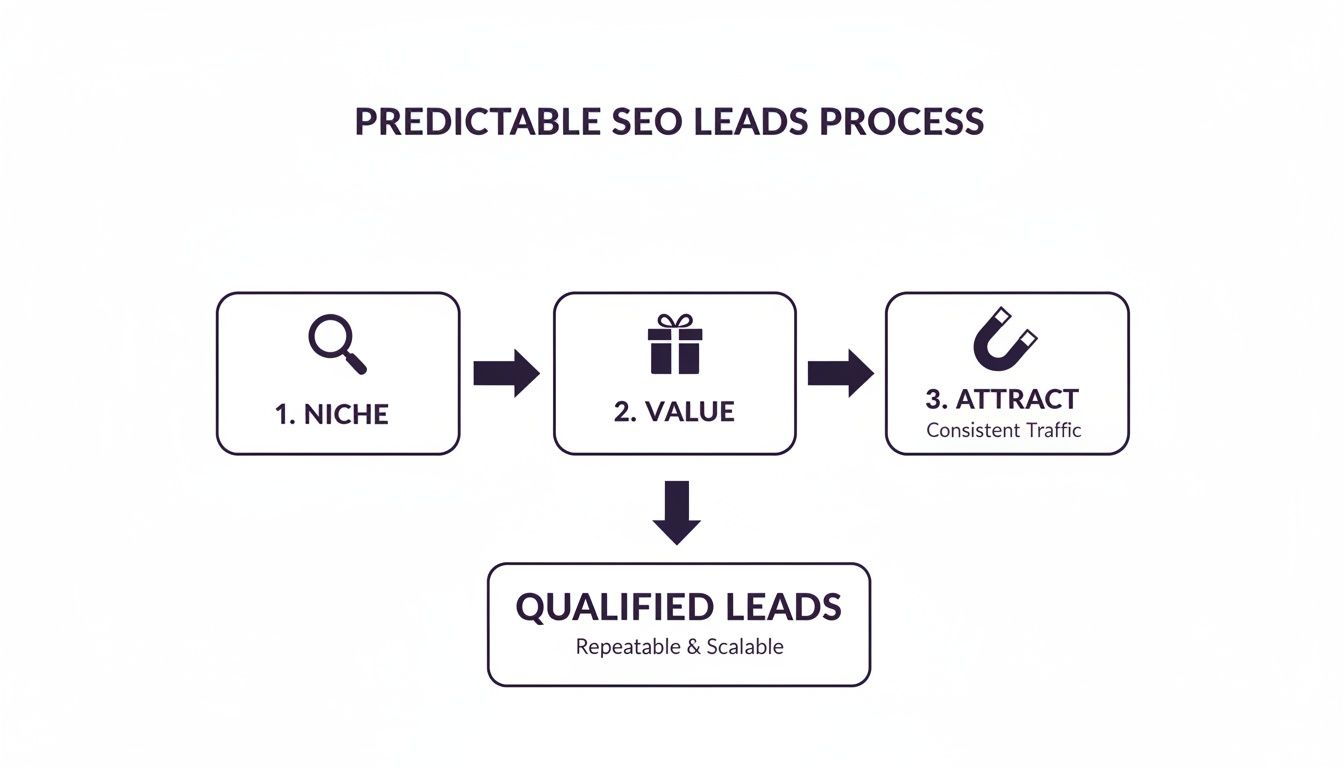
Starting with a tight focus allows you to offer specific value, which makes attracting your ideal clients feel almost automatic. This foundation is what supports effective sales pipeline management, the very system that drives consistent growth. If you want to go deeper on this, you can learn more about what is sales pipeline management in our detailed guide.
Don't Just Wait for Leads to Find You—Go Get Them
Relying on your website's SEO to bring in new clients is playing the long game. And while it's a great asset to build over time, you can't just sit around and wait for the phone to ring. If you want to build a stable, growing agency, you need to get proactive and build a lead generation machine that you're in control of.
Think of it this way: if one channel dries up for a month, it shouldn't cripple your business. By diversifying where your leads come from, you build a much more resilient operation. We're going to walk through three of the most effective channels I've used to consistently land clients: freelance marketplaces, smart cold outreach, and powerful referral networks.

Winning High-Value Clients on Freelance Marketplaces
Most people hear "freelance marketplaces" and think of Upwork as a race to the bottom on price. That’s a huge mistake. These platforms are packed with quality clients who are actively searching for real SEO experts and are ready to pay for them. The trick is to avoid looking like a commodity.
Your profile is your digital storefront. It needs to instantly show your specialty and prove your value. Stop listing every SEO service under the sun. Instead, focus your entire profile on solving a specific client's biggest problems.
- Your Headline: Don't be "SEO Expert." That's what everyone else says. Get specific: "Shopify SEO Specialist | Helping E-commerce Brands Double Their Organic Revenue." This immediately filters for the right clients.
- Your Overview: Treat this like a mini case study. Start with the problem, walk them through your process, and show off the results. Sprinkle in real client testimonials and hard numbers to build instant trust.
- Your Portfolio: Only showcase projects that align with the clients you want to attract. For every entry, lay out the client's initial challenge, what you did to fix it, and the specific results you delivered (e.g., "Grew organic traffic by 150% in just 6 months").
When your profile is built around expertise and outcomes, you stop competing on price entirely. You start competing on value, and that's a much better game to play.
Cold Outreach That Actually Works
Let's be honest: cold outreach has a terrible reputation because most of it is just spam. Blasting a generic template to a list of a thousand people is a waste of everyone's time. But a strategic, highly personalized outreach campaign can quickly become one of your best ways to get SEO leads.
The goal of that first email isn't to close a deal. It's just to start a conversation.
A great outreach campaign has two main parts. First, you need a small, hand-picked list of prospects. These should be companies that are a perfect fit for your services. Tools like LinkedIn Sales Navigator are perfect for finding the right decision-makers.
Second, you have to do your homework. I spend at least 10-15 minutes researching every single prospect and their business. Look for a real, specific "in." Did they just get a round of funding? Hire a new CMO? Is there a glaring technical SEO issue you spotted on their site?
Your opening line is everything. Ditch "Hope you're having a great week" and try something that shows you've paid attention: "Saw your recent feature on TechCrunch about scaling your sales team—congrats! It made me wonder how you're approaching organic growth to support that." My own outreach using this simple, personalized method consistently gets a 40% reply rate.
Keep the email short and focused on their world. End with a clear, low-commitment next step, like offering to hop on a 15-minute call to share a couple of quick ideas.
Building Your Referral Engine
Some of your absolute best leads will come from people who already know and trust you. Building a referral network is all about turning your existing connections into a source of new business—without feeling salesy or awkward.
Your happiest clients are your best salespeople. Once you've delivered fantastic results, it's the perfect time to ask if they know anyone else who could use similar help. Don't frame it as asking for a favor; frame it as an opportunity for you to help their network.
But don't stop with clients. Your professional network is a goldmine.
- Web developers
- PPC and paid media specialists
- Content marketing writers
- Business coaches and consultants
These folks serve the same types of clients you do, but they aren't your competition. Build real relationships with them. Be the first to send a lead their way. That generosity almost always comes back to you in the form of high-quality, pre-vetted SEO leads. The key is to make it easy for them by being crystal clear about who your ideal client is and the exact problems you solve.
Using Content and SEO to Let the Best Leads Find You
Chasing down leads is part of the game, but the real win is when high-quality clients start coming to you. This is where you have to practice what you preach: turn your own website into a lead-generating machine with top-notch SEO. When a prospect finds you on their own terms, the entire dynamic of the sale flips in your favor.
Suddenly, you're not just another name in a long list of bidders. They sought you out. They landed on your site because they believed you had the answer to their problem. This immediately frames you as the expert, which almost always leads to smoother sales calls, higher close rates, and frankly, better client relationships built on respect.
Zero In on the Keywords That Actually Drive Business
Right now, your ideal clients are on Google searching for a solution. Your job is to meet them there. For a moment, forget about broad, high-volume keywords and get laser-focused on the long-tail phrases that scream, "I'm ready to hire someone."
You have to get inside their head. What is the specific problem keeping them up at night?
- A founder launching a new Shopify store isn’t just typing "SEO" into Google. They’re searching for an “e-commerce SEO consultant for Shopify.”
- A marketing director at a B2B software company isn’t looking for "link building." They need a “technical SEO audit for SaaS platform.”
- A local dental practice trying to get more patients is looking for a “local SEO agency for dentists.”
These keywords might have lower search volumes, but the traffic they generate is pure gold. Every single visitor is essentially pre-qualified. They arrive on your site with a burning business problem and are often ready to invest in a solution.
The numbers don't lie. For B2B companies, organic traffic from SEO is the single biggest source of leads. In fact, SEO leads have a staggering 14.6% close rate, while outbound leads barely scratch the surface at 1.7%. And for agencies that consistently publish content? They see 13 times more leads at a 62% lower cost. When you consider that the top three search results on Google get 54.4% of all clicks, showing up for these money-making terms isn't just a good idea—it's essential. You can dig into more of the powerful statistics behind SEO's impact to see just how critical this is.
Create Content That Screams "Authority"
Once you know which keywords you're targeting, it's time to create content that doesn't just rank, but proves you’re the best in the business. This means moving past generic 500-word blog posts and building genuine assets.
Pillar Content: Think of these as your ultimate, in-depth guides on a core topic. If you specialize in "SEO for law firms," your pillar post might be something like "The Complete Guide to Dominating Local Search for Legal Practices." This becomes the definitive resource that people link to, share, and reference, cementing your expertise.
Detailed Case Studies: Honestly, this is your most powerful sales tool. A killer case study tells a compelling story. It lays out a client's initial problem, walks through the strategy you built for them, and then—most importantly—shows off the results with concrete data.
Imagine a potential client seeing a case study titled: "How We Boosted New Client Inquiries by 78% for a Multi-Location Law Group." You’d break down exactly how you did it, from revamping their Google Business Profiles to creating content targeting high-value practice areas.
When a prospect reads a story about a business just like theirs, the sale is already halfway made. You’re not just pitching a service anymore; you’re showing them a proven path to success that they can instantly see themselves following.
Turn Your Website Into a Lead-Capturing Machine
Getting traffic to your site is only half the battle. You need a clear and compelling way to turn those visitors into actual conversations. Every single piece of content you publish must have a call to action (CTA) that makes sense in context.
Ditch the generic "Contact Us" button. Get specific.
- On a post about technical SEO audits? Offer a "Free Technical SEO Teardown of Your Website."
- On a case study about e-commerce growth? Invite them to "Book a 15-Minute E-commerce Strategy Call."
When you align your content with the specific pain points of your ideal client, you build an inbound lead system that works for you around the clock. This frees you from the endless grind of cold outreach and fills your pipeline with people who are already convinced of your value before you even say hello.
Automating Your Upwork Outreach with AI

If you've spent any time on marketplaces like Upwork, you know the feeling. You find the perfect SEO project, you read the description, and you start crafting a thoughtful proposal. By the time you hit "send," 20 other freelancers have already applied. The manual grind is exhausting, and it often feels like you’re showing up late to the party.
There's a much smarter way to play the game. Instead of trying to outwork everyone, you can use AI automation to put your lead generation on autopilot. Think of a tool like Earlybird AI as your 24/7 sales assistant, constantly working to get SEO leads for you. This isn’t about spamming generic bids—it's about applying a personalized, high-touch strategy with speed and precision that’s impossible to achieve manually.
How Smart Automation Puts You First
Imagine having an assistant who knows exactly what your ideal project looks like. That’s essentially how this works. You connect your Upwork account and train the AI with simple feedback: a thumbs-up for good-fit jobs and a thumbs-down for bad ones. It learns your preferences surprisingly fast.
Once it knows what you want, it gets to work scanning for new jobs. The moment a perfect match appears, the system springs into action.
- Be the First to Apply: Your proposal can be submitted within 10 minutes of a job being posted. This consistently puts you in the first wave of applicants, which is a massive advantage since clients often hire from that initial group.
- Personalize Every Single Bid: The AI doesn’t just use a template. It reads the job description and drafts a unique proposal that speaks directly to the client's pain points, pulling in relevant details from your profile to showcase your expertise.
- Book Meetings Instantly: When a client replies, the system can send an immediate, intelligent message back, often scheduling a call before your competitors even know you've been in touch.
This automated approach finally solves the quality vs. quantity problem. You can maintain a personal touch on every bid without spending all day chained to your computer, ensuring you never miss out on a top-tier opportunity.
Scaling Up: A Game-Changer for Agencies
For SEO agencies running multiple accounts, this kind of automation is a complete game-changer. It’s more than just a bidding tool; it becomes the command center for your entire Upwork sales pipeline. You can manage several freelancer profiles, monitor performance with real-time data, and maintain a consistent brand voice across all your proposals.
The real goal isn't just to bid faster; it's to start conversations faster. By automating the outreach and initial follow-up, you consistently land in the client's inbox and calendar first. One new client you win this way can easily pay for the technology for an entire year.
The system is built to act like a human, using clean regional IPs and safe practices to keep your account in good standing while you scale your outreach. You can learn more about how to automate your Upwork proposals and see how it can effectively replace the manual work of a full-time sales rep.
Ultimately, bringing AI into your Upwork strategy is about buying back your most valuable resource: time. It frees you up to focus on what you do best—strategy, client calls, and delivering amazing results—while your automated sales engine keeps the pipeline full of qualified SEO leads. It’s the unfair advantage you need to win on competitive marketplaces.
From Proposal to Paid Project: How to Win the Deal
So, you’ve got a bite. A potential client is interested. That's great, but an inquiry isn't a signed contract. The real work starts now, and this is where many freelancers and agencies stumble. Turning that initial spark of interest into a paid project is a skill—one that separates the pros from the people who are just spinning their wheels.
You did the hard work to get their attention. Now, you need a solid process to guide them across the finish line. It comes down to three things: a killer proposal that speaks their language, a sharp qualification process, and a follow-up game that keeps you top of mind.

Your Proposal Isn't a Menu—It's a Solution
Let's get one thing straight: a winning proposal is never just a price list. Your clients aren't buying "SEO services." They're buying solutions. They want more traffic, better leads, and a healthier bottom line. Your proposal's number one job is to draw a straight line from your activities to their business goals.
After sending out hundreds of these over the years, I've found the most effective proposals tell a story.
- Here's Your Problem: I always start by playing back their pain points, often using their own words from our discovery call. This immediately shows I was listening and I get it.
- Here's What a Win Looks Like: Next, I paint a clear picture of the future. What does their business look like once this problem is solved? Think bigger revenue, higher market share, less stress.
- Here's How We Get You There: This is where you detail your strategy. Frame your services not as a list, but as the concrete steps we’ll take together to get from their current state to that successful future.
- The Investment: Finally, present your pricing. It’s not a cost; it’s an investment to achieve the goals you just outlined.
This approach flips the script. You’re no longer a vendor they’re haggling with; you’re a strategic partner they can’t afford to lose.
Don't Waste Your Time: Qualify Every Lead
Not every lead is a good lead. In fact, most aren't. Chasing the wrong prospects is the single biggest time-suck for any consultant or agency. Your discovery call is your filter. It's where you ruthlessly separate the real opportunities from the tire-kickers.
To do this, I rely on a simple framework known by the acronym BANT. I try to get a clear answer for each of these four points on every single call.
- Budget: Can they actually afford a real solution?
- Authority: Am I talking to the person who can sign the check?
- Need: Is solving this problem a burning priority for them right now?
- Timeline: Are they looking to start next week, next quarter, or "sometime next year"?
You have to ask direct questions without being awkward. Instead of blurting out, "What's your budget?", try framing it collaboratively: "To build the right plan for you, it helps to know what you’re thinking for an investment. Typically, comprehensive projects for a business your size fall in the $X to $Y range. Is that in the ballpark of what you were expecting?"
A disciplined qualification process is the best friend of a profitable agency. It ensures you only pour your valuable time into proposals for prospects who are ready, willing, and able to move forward. Your close rate will thank you.
Master the Smart Follow-Up
Most deals are not won on the first call. It often takes persistence, but there’s a massive difference between being persistent and being a pest. A simple, structured follow-up sequence keeps the momentum going without driving prospects away.
Here’s a rhythm that has worked wonders for me:
- The 24-Hour Check-In: The day after sending the proposal, I shoot them a quick email just to make sure they got it and to ask if any initial questions popped up.
- The Value-Add (3-4 Days Later): I follow up again, but this time I bring a gift. It might be a link to a case study of a similar client or a blog post that expands on a topic we discussed. No "just checking in" fluff.
- The Nudge (One Week Later): A simple, no-pressure email or call. "Hey [Name], just wanted to quickly follow up on the proposal. Is there any more information I can provide to help with your decision?"
- The "Breakup" Email: If two weeks go by with radio silence, it’s time to close the loop. I send a friendly final email letting them know I'm closing their file for now, but the door is always open if things change. It’s professional, creates a little urgency, and often gets a response.
Keeping track of your sales process is just as important as your SEO work. If you want to dive deeper into turning these conversations into cash, check out our guide on how to improve your sales conversion rate.
Frequently Asked Questions About Getting SEO Leads
Trying to build a consistent pipeline of SEO clients? You're going to have questions. It's a universal part of the journey. Below, I’ve answered some of the most common ones I hear from freelancers and agencies trying to scale their SEO business.
How Many Leads Do I Need to Hit My Revenue Goals?
This is a question I love because the answer is just simple math. The best way to figure out your magic number is to work backward from your revenue target.
Let’s walk through it. Say you want to hit $10,000 in monthly revenue. If your average client pays $2,500 for a project or retainer, you know you need to land four new clients every single month. Simple enough.
Now, factor in your close rate. A realistic benchmark for qualified leads is 20%. If you close one out of every five good conversations, you'll need 20 qualified leads each month to land those four clients (4 clients / 0.20 close rate).
Honestly, if you aren't tracking your average client value and close rate, you're flying blind. Once you have those numbers, you can build a predictable growth engine instead of just hoping for the best.
Is Cold Outreach Still Effective for SEO Agencies?
Absolutely, but the old "spray and pray" method is completely dead. Sending hundreds of identical, generic emails is a waste of time and will get your domain flagged as spam. Forget quantity; it's all about quality now.
I call this "smart outreach," and it's a completely different game. It’s built on:
- Real Research: Digging into a prospect's business, seeing what they're up to, and identifying a genuine pain point you can solve.
- Hyper-Personalization: Writing a message that makes it obvious you've done your homework. Mention a recent blog post, a new product launch, or a competitor who's outranking them.
- Leading with Value: The first email isn't a sales pitch. It’s the start of a conversation. Offer a specific, useful insight that helps them right away.
When you approach it this way, cold outreach becomes one of your most reliable channels. You control who you talk to and how many people you reach out to, giving you direct control over your pipeline.
Should I Niche Down My SEO Agency?
For almost every agency I've seen, the answer is a resounding yes. I get it—it feels terrifying to turn away potential business. But narrowing your focus is one of the fastest shortcuts to growth.
Think about it. When you specialize in something specific, like "SEO for e-commerce brands on Shopify" or "technical SEO for B2B SaaS companies," everything clicks into place. Your marketing gets so much easier because you know exactly who you're talking to and what keeps them up at night. You quickly become the go-to expert in that niche.
And the best part? You get to charge more. Generalists are a dime a dozen and compete on price. Specialists are rare, and clients will gladly pay a premium for an expert who truly understands their world. Focusing on a smaller pond makes you a much bigger fish.
How Can I Compete on Upwork Without Lowering My Rates?
You don't. You refuse to play that game. Instead of competing on price, you need to compete on value and speed. On a platform drowning in low-cost offers, the way to win is to be the premium, obvious expert.
Here’s the playbook:
- A Specialized Profile: Don't just list skills. Turn your profile into a focused sales page that speaks directly to your ideal client, highlighting specific results you've achieved for businesses just like theirs.
- Proposals That Aren't Templates: Your proposal has to prove you’ve actually read the job post and understand the client's problem. Address their goals head-on and explain why you are the perfect person to help.
- Be First in the Door: This is your secret weapon. Most clients on Upwork hire one of the first few qualified people they talk to. Submitting a top-tier proposal before anyone else is a massive advantage.
This is where smart automation comes in. It's not about spamming; it's about getting your perfectly personalized pitch in front of the client moments after they post the job—before your competition has even seen it.
Ready to stop manually chasing jobs and start automatically winning them? Earlybird AI acts as your 24/7 sales team on Upwork, finding ideal projects and crafting personalized proposals in minutes. See how our members are doubling their reply rates and landing more clients with less effort. Discover the power of smart automation at https://myearlybird.ai.