
← Back To Blog
How Do Creative Agencies Find Clients: 2026 Strategy Guide
You're busy delivering client work, answering messages, reviewing rounds, and trying to protect margins. Then a project wraps, the pipeline looks thin, and the familiar question shows up again: where is the next client coming from?
That cycle is why so many agency owners keep searching how do creative agencies find clients. The problem usually isn't a lack of tactics. It's a lack of system. A referral comes in, then nothing. A cold email campaign works for a week, then stalls. A marketplace proposal lands a project, but nobody repeats the process.
The agencies that grow with less drama treat client acquisition like an operating system, not a series of sales stunts. They define who they want, build channels that feed those opportunities, convert interest with sharp proposals, and track the whole process like a pipeline. If your sales activity still lives in scattered notes, inboxes, and memory, start by tightening your sales pipeline management process. Predictability starts there.
From Feast or Famine to a Predictable Client Pipeline
Feast or famine usually comes from one root issue. The founder is still the acquisition engine.
When the founder posts, networks, follows up, and asks for introductions, leads appear. When delivery gets heavy, sales effort disappears, and the pipeline dries up a few weeks later. That pattern feels normal in small agencies, but it becomes expensive fast because hiring, resourcing, and pricing all get harder when revenue timing is unclear.
A better model is to build a client acquisition engine with four connected parts:
- Targeting so the team knows exactly who fits
- Inbound so reputation and relationships generate opportunities
- Outbound so you can create demand on purpose
- Conversion so qualified interest turns into signed work
A healthy pipeline doesn't depend on your mood, your bandwidth, or whether a past client happens to remember you this month.
That shift changes how you make decisions. You stop asking, “What should we try next?” and start asking, “Which part of the engine is underperforming?” If referrals are strong but close rates are weak, the proposal needs work. If proposals are solid but lead flow is inconsistent, outbound or content likely needs attention. If lots of leads come in but they're wrong for your agency, the ICP is the primary issue.
Most agencies don't need more random activity. They need fewer moving parts and tighter execution.
Stop Chasing Everyone Define Your Ideal Client
The fastest way to waste time is to market to “businesses that need creative help.” That sounds broad enough to create opportunity, but in practice it creates proposal churn, pricing pressure, and clients who treat your team like order takers.

A strict Ideal Client Profile, or ICP, fixes that. It also improves channel performance. Creative agencies using a data-informed, multi-channel acquisition methodology see 40% more consistent lead flow than single-channel strategies, and that process starts with a strict ICP, according to Eazi-Business's 2026 client acquisition benchmarks.
Start with your best past projects
Don't build your ICP from aspiration alone. Build it from work you'd gladly repeat.
Review your strongest clients and look for patterns like:
- Business context. Was the client growing, repositioning, launching, or fixing a visible problem?
- Decision quality. Did the buyer understand creative value, or did they just compare line items?
- Team behavior. Were approvals clear, feedback useful, and timelines realistic?
- Commercial fit. Did the work lead to follow-on projects, retainers, or strong referrals?
That review usually tells you more than generic market research. Many agencies think they need “bigger clients” when they really need clients with clearer urgency and better internal alignment.
Define pain, not just demographics
Most ICP documents stop at industry, size, and title. That's not enough.
A useful ICP includes problem-awareness. You want buyers who already understand the cost of weak branding, inconsistent design, poor UX, low-performing creative, or scattered messaging. Agencies close faster when the client already feels the problem.
Use prompts like these:
- What problem do they already know they have?
- What event makes that problem urgent?
- Who owns the budget and who influences the decision?
- What type of engagement suits them best, project, retainer, or ongoing production support?
Practical rule: If you can't explain why this client would buy now, your ICP is still too vague.
Turn the ICP into a filtering document
Your ICP should help the team disqualify as much as qualify.
Write it in plain language. One page is enough if it's sharp. Include your preferred industries or company types, common trigger events, likely buyer roles, budget posture, service fit, and red flags. Then use it everywhere: website messaging, outbound lists, referral asks, and marketplace bidding.
A simple bad-fit list also helps. Examples include buyers who want strategy for free in the proposal stage, clients who need every stakeholder to approve every detail, or prospects who say they want a partner but clearly want a pair of hands.
That document becomes the spine of your sales process. Without it, every channel gets noisier.
Activate Your Inbound Engine with Referrals and Content
A lot of agency owners treat inbound like weather. They hope it stays sunny.
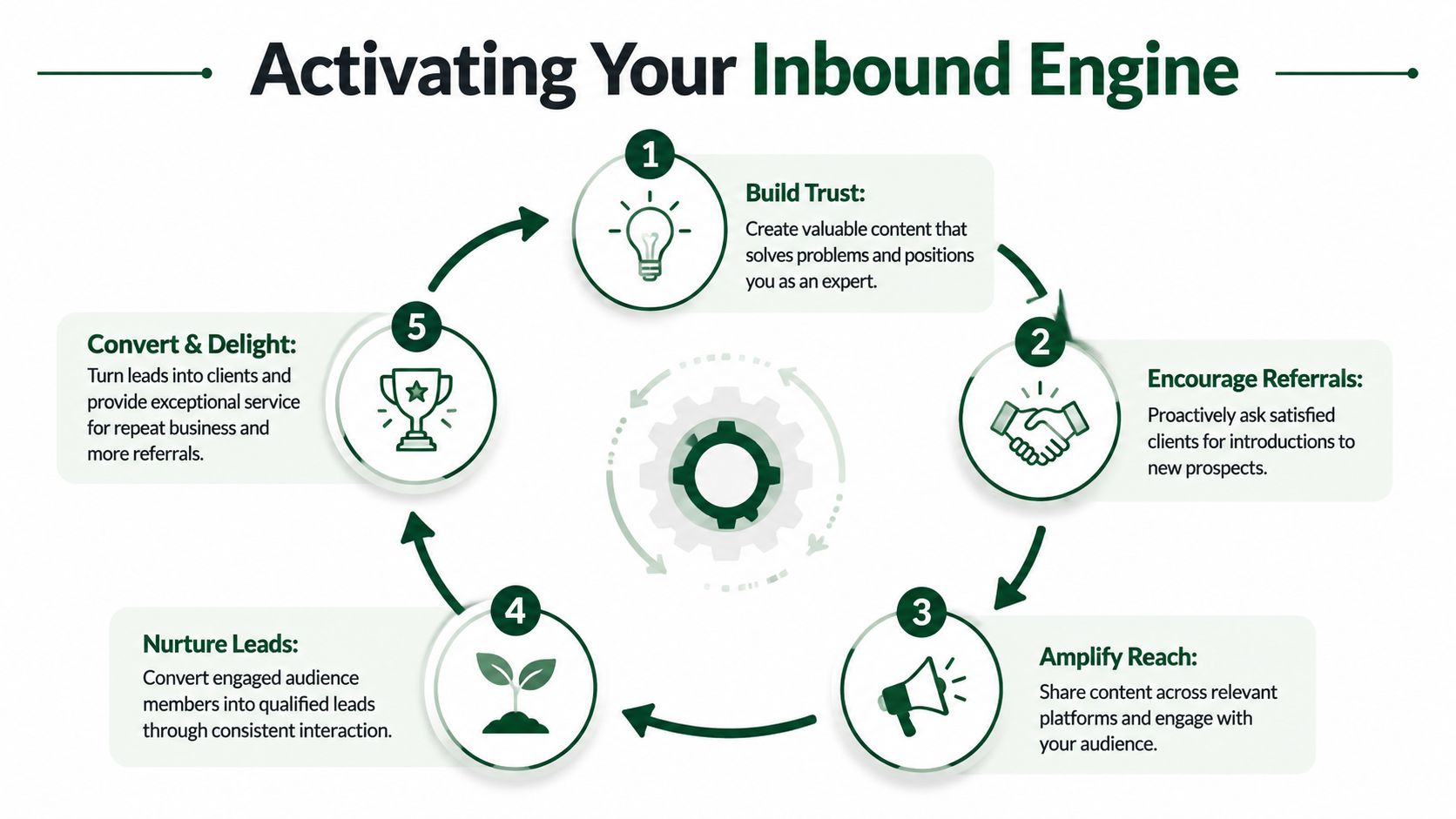
That's a mistake. Referrals and content work best when they're operationalized, not admired from a distance. Referrals account for about one-third of new business for creative agencies, which is why they remain the dominant organic acquisition channel according to Promethean Research's analysis of how marketing agencies get clients.
Ask for referrals like an operator
Passive word of mouth is nice. A referral system is better.
The best time to ask is right after a visible win. That might be after a launch, a successful handoff, a strong review meeting, or a message from the client saying the work landed well internally. The ask should be specific and easy to answer.
Try language like this:
We've loved working with your team on this. Do you know another [business type] owner or marketing lead who might need help with [specific service]?
That wording matters because it gives the client a mental search prompt. “Know anyone?” is vague. “Do you know another ecommerce founder preparing a rebrand?” gets a much better response.
A lightweight referral process should include:
- A trigger point. Decide when the ask happens.
- An owner. Someone on the team sends it every time.
- A tracking field. Log who referred whom and when.
- A follow-up step. Thank the referrer and update them.
If you use LinkedIn actively, pair this with a practical LinkedIn lead generation approach for agencies so your referral network has current content and proof to share.
Give people something easy to forward
Referrals travel faster when they have supporting assets. Clients don't want to write your pitch for you.
Create content that makes introductions easier:
- Short case studies that explain the problem, your approach, and the outcome qualitatively
- Portfolio breakdowns that show your thinking, not just polished visuals
- Opinion pieces on common mistakes in your niche
- Process explainers that reduce fear around how your team works
Many agencies underperform in this specific area. They showcase finished work but not business relevance. The buyer doesn't need more beauty shots. They need confidence that you understand commercial context.
Build a content flywheel from delivery
The strongest agency content often starts inside existing projects.
After a win, extract the story. What was broken? What changed? What decisions mattered? Which objections came up before the client said yes? Turn those into a case study, a LinkedIn post, a sales follow-up asset, or a proposal insert.
Good content doesn't sit beside your sales process. It reduces friction inside it.
That creates a compounding loop. Great work creates trust. Trust creates stories. Stories create inbound interest and make referrals easier. Then inbound leads arrive warmer because someone has already seen your thinking.
When owners ask how do creative agencies find clients without living in constant outreach mode, this is the honest answer. They build trust assets that keep working after the project ends.
Master Scalable Outbound on Marketplaces and Beyond
Inbound compounds slowly. Outbound creates opportunities now.
That's why every agency needs a scalable outbound motion, especially when growth can't wait for referrals or SEO to mature. Modern outbound is not blasting templates to a huge list. It's using a tight ICP, a real observation, and a low-friction next step.

Data-driven cold outreach with personalized reports reaches reply rates of 8-15%, which is 3-5 times higher than generic cold emails, according to B2BLeadFinder's guide to how agencies find clients.
What bad outbound looks like
Most weak outreach has the same problems:
- It leads with services. “We're a full-service creative agency...” is about you, not the buyer.
- It lacks context. No sign you know their market, offer, or current issue.
- It asks too much too soon. A meeting request before earning attention.
- It sounds mass-produced. Even if it isn't, it reads like it is.
Good outbound does the opposite. It starts with something specific, points to a gap, and offers a next step that feels useful.
For a creative agency, that might be:
- a homepage critique
- a brand consistency observation
- a UX teardown
- a review of ad creative mismatch
- a quick portfolio or conversion path audit
A simple outreach structure that still works
Use this frame for email or LinkedIn:
- Observation
Mention one concrete issue or missed opportunity. - Implication
Explain why it matters in business terms. - Offer
Share a brief audit, idea, or point of view. - Soft CTA
Ask if they want you to send it over.
Example:
Noticed your landing pages and paid social creative are telling slightly different stories. That usually creates friction once traffic clicks through. I recorded a short teardown with three fixes. Want me to send it?
That works because it doesn't sound desperate. It sounds informed.
Use timing, not just targeting
A decent message sent at the wrong time still loses.
Recent data cited by Agency Management Institute's guide on how digital marketing agencies find clients shows that agency outreach timed to buying signals such as funding rounds or executive changes has a 42% higher close rate. For creative agencies, other useful signals include a site relaunch, a visible hiring push, a new product category, or a leadership change that often triggers repositioning work.
Outreach lands better when the buyer already has internal pressure. Your job is to show up while that pressure is active.
A useful walkthrough on this broader approach is below.
Treat marketplaces like a channel, not a backup plan
Many agencies dismiss Upwork and similar platforms because they only notice the low-budget jobs. That's the wrong lens. Marketplaces are active demand pools. The client is already looking. Your job is to filter hard and respond fast.
Use your ICP on marketplace listings the same way you'd use it for outbound lists. Skip jobs with vague scopes, unrealistic budgets, or obvious commodity buying behavior. Prioritize projects where the buyer knows the problem, values expertise, and has a scope that matches your offer.
Three things matter most on marketplaces:
- Speed. Strong proposals sent early get seen first.
- Relevance. Mirror the client's language and restate the problem clearly.
- Proof. Show similar work, or explain your approach in a way that reduces uncertainty.
If your team wants a system for fast, personalized Upwork response, these Upwork alternatives and platform options for agencies are worth comparing as part of your channel strategy. One tool in that workflow is Earlybird AI, which connects to an Upwork account, identifies matching projects, drafts personalized proposals, and manages replies for teams that want a more structured marketplace process.
Craft Winning Proposals and Smart Pricing Packages
Getting the lead is only half the job. Plenty of agencies lose winnable deals because their proposal reads like a service menu.
Clients don't buy deliverables in isolation. They buy confidence, clarity, and a plan that fits the moment they're in. That matters even more when your outreach is timed well, because the buyer is already evaluating how quickly someone understands the problem.
Write proposals around the buyer's problem
A strong proposal usually follows a simple sequence:
- State the problem clearly
Show that you understand what's happening and why it matters. - Agitate the cost of staying still
Explain what continues to break if they do nothing. - Present your approach
Focus on the solution logic, not just outputs. - Scope the engagement cleanly
Define what's included, what isn't, and how decisions happen. - Price the options
Give choices that align with different levels of commitment.
This keeps the proposal anchored in business context. It also gives the client language they can use internally when they need stakeholder approval.
Package pricing so the buyer can choose
Creative agencies often undercut themselves by presenting one flat price with no framing. A better approach is to package the engagement.
A simple option structure might look like this:
- Starter engagement for a focused deliverable or diagnostic project
- Core package for the main transformation the buyer needs
- Ongoing support for implementation, optimization, or retained creative work
The point isn't to confuse the buyer with too many options. It's to make trade-offs visible. When you price this way, clients compare levels of investment instead of debating whether your entire agency is “expensive.”
Match the pricing model to the work
Different engagement types need different pricing logic.
Project pricing
Use this when the scope is finite and the end state is clear. Brand identity work, website design, launch campaigns, and defined creative sprints often fit here. This is clean and easy to approve, but it can limit upside if the relationship should continue.
Retainers
Use retainers when the client needs recurring output, ongoing optimization, or strategic continuity. This works well for design support, performance creative, ongoing content production, or cross-channel creative direction. It also creates a steadier delivery rhythm for your team.
Value-oriented packaging
This works when your agency's contribution is tightly connected to a meaningful business shift, such as a repositioning effort, a conversion-focused redesign, or a launch where creative quality directly affects performance. The proposal should then emphasize business stakes, not hours.
The proposal should answer one question before the client asks it. Why is this the right engagement for this moment?
Proposal language that raises confidence
Use plain, direct phrasing:
- “You're seeing inconsistent conversion paths across key pages.”
- “The current brand system doesn't support a premium market position.”
- “The launch needs message clarity before more traffic hits the funnel.”
Avoid soft filler:
- “We're passionate about helping brands succeed.”
- “We offer a wide range of creative services.”
- “Our team can support all your design needs.”
The first group sounds like diagnosis. The second sounds interchangeable.
Measure and Refine Your Client Acquisition Machine
If you can't see the machine, you can't improve it.
A lot of agencies track revenue and maybe proposal count. That's not enough. You need a view of where opportunities come from, how long they take to move, where they stall, and which channels bring the right kind of client.
There's a reason this matters so much with referrals. Referral systems are the top client acquisition channel, yet only 24% of agencies systematically operationalize them with tracking and automated triggers, according to Ravetree's breakdown of agency client acquisition strategies. Most firms leave one of their best channels half-managed.
Track the few metrics that change decisions
You don't need a huge dashboard. You need metrics that help you act.
Start with:
- Lead source so you know whether referrals, outbound, content, partnerships, or marketplaces are producing fit
- Lead-to-call rate to show whether messaging and targeting are aligned
- Proposal-to-close rate to reveal whether your sales process converts
- Sales cycle length to spot drag in follow-up or approval
- Average engagement type so you can see whether projects or retainers dominate
If you already track CAC or LTV internally, use them. If not, don't invent complexity. Begin with the metrics your team will update every week.
Build a review rhythm
Client acquisition improves when someone reviews the pipeline on a schedule. Weekly is usually enough for small agencies.
Ask:
- Which leads advanced?
- Which stalled, and why?
- Which source produced the best-fit conversations?
- Where are we over-personalizing low-value opportunities?
- Which objections are repeating in proposals or calls?
That cadence turns random selling into pattern recognition.
Keep scripts and templates, but update them
Templates save time. Static templates kill relevance.
Keep reusable drafts for:
- referral asks
- cold outreach
- proposal follow-ups
- marketplace proposals
- re-engaging old leads
Then revise them based on live feedback. If buyers keep asking for examples earlier, add proof sooner. If referral asks feel awkward, shorten them. If proposals stall after verbal yeses, tighten your next-step language.
A few simple scripts to keep on hand:
“Wanted to circle back. Still happy to send over the short audit if it would help your team evaluate options.”
“If timing is the main issue, I can follow up when this becomes a priority on your side.”
“We've just wrapped a strong phase together. If someone in your network is dealing with a similar challenge, I'd appreciate an introduction.”
The point is not to automate your voice into oblivion. It's to reduce friction so the team can execute consistently.
A real acquisition engine gets sharper with use. Each conversation improves the ICP. Each closed deal improves positioning. Each lost proposal exposes a gap in timing, packaging, or qualification. That's how agencies move out of feast or famine and into control.
If your agency wins work on Upwork or wants that channel to become more predictable, Earlybird AI gives you a way to turn marketplace outreach into a repeatable process. It connects to your Upwork account, learns which jobs match your ICP, drafts personalized proposals, replies to prospects, and gives teams analytics and workflow support so lead generation doesn't depend on who happens to be online.