← Back To Blog
How to Get Clients on Upwork A Guide to Winning High-Value Work
Feel like your Upwork proposals are getting sucked into a black hole? I get it. The secret to actually winning clients isn't just about being good at what you do—it's about changing how you approach the platform entirely. You have to stop acting like a job applicant and start thinking like a business owner hunting for their next big contract.
That means building a profile that screams "problem-solver" and writing proposals that offer a taste of your value right from the first sentence.
Why Your Current Upwork Strategy Isn't Working

If you're blasting out proposal after proposal and hearing nothing but crickets, you’re in good company. Countless talented freelancers get stuck in this exact cycle, making it feel like the platform is rigged against them. The issue usually isn't a lack of skill; it's a broken strategy.
Let's face it, the platform is crowded. Post a decent project, and it's not uncommon to see over 50 proposals flood in within the first hour. In that sea of competition, your generic, copy-paste bid is dead on arrival. Clients simply don't have the time or patience to sift through dozens of messages all saying, "I'm the best person for this job."
The Real Cost of Generic Bids
Sending out those unfocused proposals isn't just a waste of time—it's a direct hit to your wallet. Every bid eats up your "Connects," which is the currency you need to apply for jobs on Upwork. Burn through them on applications that were never going to land, and you'll be empty-handed when that perfect-fit project finally shows up.
Worse, this shotgun approach forces you into a defensive corner, making you compete on price instead of value. It's a quick race to the bottom that undervalues your expertise and tends to attract the worst kind of clients—the ones looking for a bargain, not a brilliant outcome.
The single biggest mistake I see freelancers make is treating Upwork like a traditional job board. To actually succeed, you need a total mindset shift. You're not looking for a job; you're generating sales leads for your business.
A New Game Plan for a Changing Platform
Upwork isn't the same platform it was five years ago. It’s steadily attracting bigger businesses and even enterprise-level clients who are more than willing to pay top dollar for specialized talent. These clients aren't hunting for the cheapest freelancer. They're looking for a partner who can step in and solve a very specific, often expensive, problem.
To get their attention, your strategy has to evolve. Here’s what that looks like in practice:
- Niche Down, Hard: Stop trying to be everything to everyone. Specializing in a particular service or industry instantly shrinks your competition and makes you look like the go-to expert.
- Become a Proactive Prospector: Start treating your Upwork time like a focused sales activity. You're not just browsing; you're identifying high-potential clients and crafting every single interaction to address their unique needs.
- Turn Your Profile into a Sales Page: Your profile isn't just a resume. It’s your landing page. It needs to speak directly to your ideal client's biggest challenges and show them you're the solution.
When you ditch the high-volume, low-effort approach, you start positioning yourself as a premium expert. And that's when the high-value clients you actually want to work with start to notice.
Building an Upwork Profile That Attracts Premium Clients

Let's get one thing straight: your Upwork profile is your most critical asset. It’s not just a digital resume; it’s a sales page that’s working for you 24/7, convincing clients to hire you before you've even sent a proposal.
Too many freelancers fall into the trap of just listing their skills and past jobs. But here's the reality—high-paying clients aren't just looking for a list of qualifications. They're looking for someone who can solve their specific, often expensive, problem.
To stand out, you need to completely reframe your profile. Stop talking about what you do, and start talking about what you can do for them. Every single part of your profile, from your title down to your portfolio, needs to scream that you understand their goals and can deliver the results they need. A thoughtfully constructed profile makes you look like the expert you are, making you the obvious choice.
Craft a Benefit-Driven Title and Overview
Your profile title is the first impression you make. It has to pack a punch and show your value instantly. A generic title like "Content Writer" is forgettable and blends in with thousands of others.
Instead, get specific and focus on the outcome. A title like "SaaS Content Strategist Driving MQLs with SEO-Optimized Articles" is a world apart. It doesn't just say what you do; it shows the high-value result you deliver.
Apply this same client-first logic to your overview. Ditch the tired opener, "I am a dedicated professional with X years of experience." Nobody cares. Lead with their pain point. Start with a question or a bold statement that hits on a struggle you know your ideal client is facing. Then, position yourself as the only logical solution.
Think of your profile overview as the start of a conversation. It should be the answer to the silent question your ideal client is asking as they search for help. Show them you're already in their world before you've even had a call.
To really nail this section:
- Speak Their Language: Use the same terminology and jargon your clients use. It shows you're an insider.
- Showcase Tangible Results: Don't just say you're good. Prove it. Mention metrics like "increased user engagement by 30%" or "helped a client secure $50k in funding."
- Include a Call to Action: End your overview with a clear next step. Invite them to look at a specific portfolio piece or send you a message to discuss their project.
Curate a Portfolio That Sells
A portfolio filled with random screenshots is a waste of a client's time. Each entry needs to be a mini case study that tells a story of success. High-value clients don't just want to see the pretty final product; they want to understand your process and how you think.
You can see how all these pieces come together by reviewing a solid sample profile for Upwork that breaks down each element.
For every project you showcase, follow this simple framework:
- The Challenge: Briefly explain the client's problem. What business pain were they trying to solve?
- Your Solution: Detail the exact steps you took. More importantly, explain the why behind your strategic choices.
- The Impact: This is the most crucial part. What was the result? Quantify it with real data whenever you can. Connect your work directly to their business success.
This narrative approach builds incredible trust. It positions you as a strategic partner who solves problems, not just a freelancer who completes tasks. When you transform your profile into a client-focused sales tool, you'll start attracting better invites and give every proposal you send a massive head start.
Writing Proposals That Actually Get a Response

Let’s be honest: a winning proposal isn't a cover letter. It’s a conversation starter. Far too many freelancers treat it as a formal application, listing their skills and essentially begging for the job. But here’s the thing—high-value clients aren't looking for a beggar. They're looking for a partner who instantly gets what they're trying to do.
The trick is to stop selling your services and start demonstrating your value from the very first sentence. It’s a simple mental shift from "I can do this for you" to "Here's the outcome you'll get." This small change completely reframes the dynamic, positioning you as a consultant from the get-go.
The Anatomy of a Winning Proposal
Your proposal has to do three things, and it has to do them fast: prove you actually read the job post, offer a glimpse of the solution, and make them want to reply. Clients usually only see the first two lines of your proposal in their dashboard preview, which means your opening is everything. Ditch the "Dear Sir/Madam" and get straight to the point.
A powerful proposal that I've seen work time and time again follows a simple, repeatable framework:
- The Hook: Acknowledge their specific need or a key challenge mentioned in their post. This immediately signals that you've paid attention and aren't just copy-pasting a template.
- The Solution: Briefly outline how you'd approach their problem. This isn’t a full project plan, just enough to connect your expertise directly to their pain point.
- The Proof: Casually mention a relevant portfolio piece or a similar result you’ve achieved. This builds instant credibility and shows you’ve navigated this territory before.
- The Call to Action: End with a clear, low-pressure next step. Asking a smart question about the project is almost always better than a demanding "Let's schedule a call."
This structure turns your bid from a generic application into a mini-consultation.
From Self-Focused to Client-Focused Language
The single most common mistake I see is proposals that are all about "me, me, me." The client doesn't care about your 5 years of experience in a vacuum; they only care about what those 5 years can do for their bottom line.
Let's look at a quick before-and-after.
Self-Focused (The one that gets ignored):
"Hello, I am a web developer with 5 years of experience building e-commerce sites. I am proficient in Shopify and can build the custom theme you need. I am a hard worker and available to start immediately."
Client-Focused (The one that gets a reply):
"Building a Shopify theme that actually converts requires more than just clean code—it needs a deep understanding of the customer journey. Looking at your project, it seems the biggest hurdle will be creating a mobile-first checkout process that slashes cart abandonment. My approach focuses on..."
See the difference? The second example immediately diagnoses a potential problem and kicks off a strategic conversation. It proves you’re already thinking about their business goals, not just checking off a task list. For a more in-depth look, there are some great resources on how to approach submitting a proposal on Upwork that really break this down.
Your proposal should be your first act of providing value. Give them an insight, ask a smart question, or offer a suggestion that proves you're already invested in their success. That's how you get a response.
When you adopt this client-centric mindset, you automatically lift yourself above 90% of the competition. You're no longer just another name in a long list of bidders; you're a potential partner who's already adding value.
Finding the Best Freelance Jobs Before Anyone Else
On Upwork, speed is everything. The best jobs—the ones with clear descriptions, sane budgets, and clients who actually know what they want—are swarmed by top talent almost instantly. It’s not an exaggeration to say many of these roles are gone within a few hours.
If you’re just casually scrolling the job feed a couple of times a day, you’re missing out. To win consistently, you have to stop being a passive browser and become an active hunter. This means building a system to find the right jobs the moment they hit the platform. Just relying on the default feed is like trying to fish in the open ocean; you need to know exactly where the good fish are biting.
Master Your Search and Set Up Alerts
The bedrock of any good job-hunting system is knowing how to use Upwork's search filters. Don't just type in a keyword and start scrolling. That's a recipe for frustration. Instead, you need to build a laser-focused search that cuts through the noise and delivers only the gigs worth your time.
Start by creating a saved search that includes specific green flags for quality clients.
- Client History: Always filter for clients with a verified payment method and a real hiring history. If you see they've spent thousands on the platform before, that's a fantastic sign.
- Job Type: Decide if you prefer fixed-price or hourly projects and stick to it.
- Experience Level: Filter for "Intermediate" or "Expert" roles. This is the quickest way to avoid the race-to-the-bottom pricing that plagues entry-level jobs.
- Keywords: Get smart with boolean search operators. For instance, a content writer might search for
"SaaS" AND "blog" -entry -"cheap". This tells Upwork you want jobs that mention "SaaS" and "blog" but to exclude any that contain "entry" or "cheap."
Once you've built a search that consistently pulls up great leads, save it and turn on notifications. Think of this as your personal job scout, pinging you the second a perfect-fit project is posted. This simple setup ensures you’re one of the first freelancers to apply, dramatically increasing the odds your proposal even gets opened.
Being first matters. A lot. When a client is motivated to hire quickly, the first few quality proposals they see often become the benchmark. Your entire goal is to make sure you’re in that first batch, every single time.
Spotting High-Value Opportunities
Beyond the filters, you have to develop a gut feeling for what makes a great client. Some are just worth more than others, and the platform’s own data backs this up. A recent analysis revealed that while the total number of active clients on Upwork dipped, the average spend per client went up.
In Q1 2025, the gross sales value per client actually rose 3% to $4,912. That's a pretty big deal. It shows a clear trend toward higher-value, more meaningful projects on the platform. You can read more about Upwork's evolving client trends to see the data for yourself.
What does this mean for you? It means you shouldn’t just be looking for any job. You should be looking for clients who are serious about investing in good freelance talent.
Look for posts that describe a business problem, not just a task list. A client talking about their goals, their challenges, and their vision is looking for a partner, not just a pair of hands to do a task. That's the mindset shift that turns Upwork from a source of random gigs into a reliable, high-earning lead machine.
Using Smart Automation to Scale Your Outreach
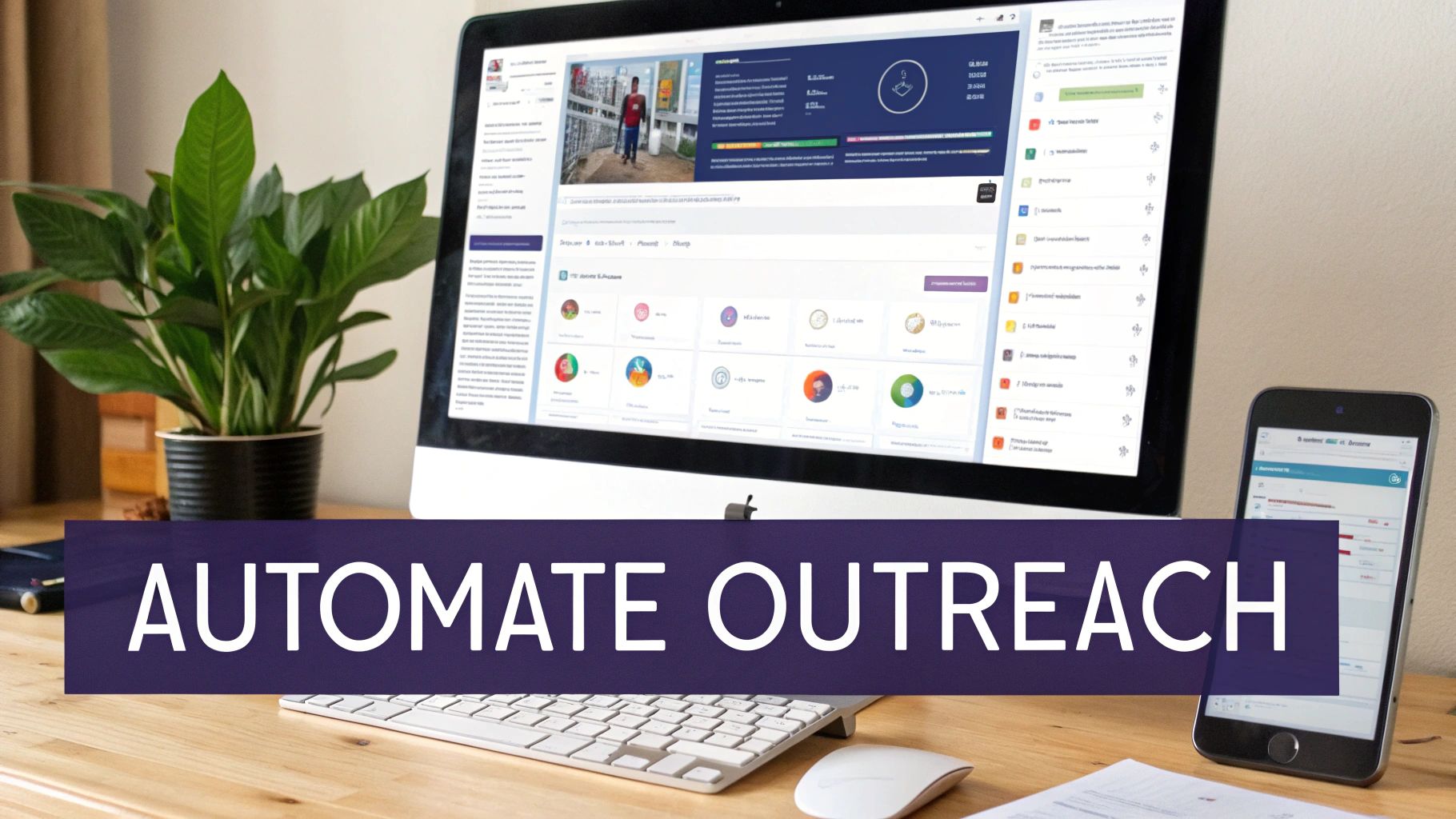
If you're a serious freelancer or agency owner, you've probably hit a wall. There’s a very real limit to how much you can grow when you’re doing everything by hand. The cycle of hunting for jobs and writing custom proposals creates a bottleneck, putting a hard cap on your income. You just can't be everywhere at once, and on a platform where speed gives you a massive advantage, that manual limit is a serious handicap.
This is where smart automation changes everything. I’m not talking about blasting out generic, spammy bids. The right approach uses technology to execute your outreach strategy with a speed and precision you could never match manually. It's like having a sales assistant who works 24/7, getting your perfectly crafted proposals in front of ideal clients just minutes after they post a job.
Escaping the Manual Grind
Think about your daily routine: endless refreshing of the job feed, sifting through posts, and trying to whip up tailored proposals. It’s a massive time sink. That’s time you could be spending on billable work, planning your next move, or just logging off for the day. Automation takes care of those repetitive, low-value tasks so you can focus on what actually matters.
With the right AI-powered tools, you can:
- Instantly find ideal jobs that perfectly match your skills and target client profile, day or night.
- Generate highly personalized proposals that draw from your best case studies and expertise, making every bid relevant.
- Get your application in within minutes of a job going live, landing you at the very top of the client’s inbox.
This systematic approach is how you get a real edge. When a potential client gets a thoughtful, well-written proposal moments after they hit "post," it leaves a powerful first impression.
The point of automation isn't to replace your strategy—it's to execute it flawlessly at a scale you could never achieve on your own. It's about turning your winning formula into a consistent, automated lead-gen machine while you focus on the conversations that lead to closed deals.
Competing in a Crowded Marketplace
The intense competition on Upwork isn't just in your head—the numbers prove it. The platform has exploded with freelancers, but the money is concentrated at the very top. As of 2025, there are 18.2 million active freelancers, yet the top 5% rake in 67% of all platform revenue. Meanwhile, a staggering 89% of freelancers earn less than $1,000 per month. You can see more on the intense competition on Upwork at uphunt.io.
Those stats paint a clear picture: it’s a fierce battle for the best projects, and speed is your weapon. Manually applying just can’t compete with freelancers who are already using technology to their advantage. Smart automation levels the playing field and lets you compete for the best jobs without burning out. To get a better sense of how this works, you can check out this great guide on what is sales automation.
By automating your initial outreach, you guarantee your profile is consistently getting in front of the right clients, giving you a real shot at breaking into that top tier of earners.
Answering Your Top Questions About Winning on Upwork
Diving into Upwork can bring up a ton of questions. Even when you have a good system down, you’ll run into specific situations that make you wonder, "Am I doing this right?" Let's clear up some of the most common questions freelancers ask when they're trying to land better clients.
How Many Proposals Should I Send Every Day?
Forget the magic number. The old "spray and pray" method of blasting out 20 generic proposals a day just doesn't work anymore. You’re far better off sending 3-5 highly specific, thoughtful bids to jobs that are a perfect match.
Think of it this way: your real goal isn't just to get your application in. It’s to actually start a conversation. When you focus your energy on jobs squarely in your wheelhouse, you can write a proposal that shows you’ve really read the brief and are already thinking about how to solve their problem. That’s what gets replies.
Is the "Available Now" Badge Actually Worth Using?
Honestly, it can be a double-edged sword. On one hand, for a client who needed something done yesterday, that little green badge can make you stand out. It signals you're ready to go right now, which can be a tie-breaker for urgent gigs.
On the other hand, the best clients aren't just looking for the first person available; they're looking for the best person for the job. Being perpetually "available" can sometimes send a subtle signal that you aren't busy, which might make some clients pause.
My advice? Use it when you genuinely have a gap in your schedule you want to fill quickly. Just don't depend on it to be your main client magnet. A killer profile and a compelling proposal will always beat a green badge.
The top earners on Upwork aren't the ones who are always available; they're the ones who are always valuable. Focus every part of your profile and proposal on proving your value, and the right clients will happily wait for you.
How Do I Actually Negotiate My Rates?
Talking money is all about demonstrating value, not just defending a number. When a client pushes back on your price, your first move shouldn't be to offer a discount. Instead, pull the conversation back to the results you're going to deliver for them.
Here’s a practical approach:
- Talk About Their ROI: Instead of just saying, "My rate is what it is," frame it around their goals. Try something like, "This rate allows me to dedicate the strategic time needed to not just get this done, but to hit that X business goal you’re aiming for."
- Give Them Choices: If their budget is truly fixed, don't just walk away. Offer a smaller package or a reduced scope of work that fits what they can spend. This shows you're flexible but also protects the value of your full-service work.
- Know Your Walk-Away Number: Before you ever hit "send" on a proposal, you need to know your absolute minimum rate. Having this number in your head keeps you from making a bad decision in the heat of a negotiation and ensures you're not working for free.
When you frame the discussion around investment and results, it completely changes the dynamic. The client stops seeing you as a cost and starts seeing you as a solution worth paying for.
Tired of the manual grind and ready to start landing more high-value clients? Earlybird AI can become your automated outreach partner. It finds the perfect jobs for you and sends out personalized proposals just minutes after they go live. It’s time to change how you find work and get back to doing what you do best.
Find out how it works and get started with Earlybird AI.