← Back To Blog
How to Get Jobs on Upwork A Guide for Freelancers and Agencies
Long before you ever hit "submit proposal," the groundwork for winning your next Upwork job is already laid. It all comes down to your profile. Think of it less as a resume and more as a powerful, 24/7 sales page working for you even while you sleep. A truly great profile doesn't just list what you can do; it sells the solution you provide, making a potential client feel confident in you before you've even spoken.
This is what separates the freelancers who get lost in a sea of applicants from those who become the only choice.
Build a Profile That Attracts High-Value Clients

Let's be blunt: your Upwork profile is your single most important asset on the platform. High-value clients are busy. They aren't going to spend time digging through a generic profile to uncover your hidden genius. They need to see, in a matter of seconds, that you get their problem and have the skills to fix it.
This means every single part of your profile—from your title to your portfolio pieces—needs to be crafted with a clear purpose. The big mindset shift is this: your profile isn't about you. It's about what you can do for them. Once you make that switch, you’ll see a dramatic difference in the quality of clients you attract.
Frame Yourself as a Problem-Solver, Not a Task-Doer
I see this mistake all the time. Freelancers write profile overviews that are just a laundry list of tasks they can perform. But clients aren't really hiring a "writer" or a "developer." They're hiring someone to get them more sales, boost their app's user engagement, or clean up a messy operational workflow.
Your title and the first couple of sentences of your summary need to speak directly to their pain points.
- Instead of: "Experienced Content Writer"
- Try: "SEO Content Strategist Driving Organic Traffic for SaaS Companies"
See the difference? One is a generalist waiting for instructions, the other is a specialist who delivers a specific, high-value business outcome. Weave this "problem-solver" theme throughout your entire profile.
Showcase Results in Your Portfolio
A portfolio full of pretty pictures is nice. But a portfolio that shows tangible business results? That's what gets you hired. High-paying clients are looking for a return on their investment, and your portfolio is where you prove you can deliver it.
Don't just upload a screenshot and call it a day. For each project, add a short, punchy description that tells a story of success.
- Project Title: "E-commerce Website Redesign for [Client Name]"
- Description: "Overhauled the user checkout flow, resulting in a 15% reduction in cart abandonment and a $25,000 increase in monthly revenue within the first quarter."
Focus on quantifiable metrics whenever possible: ROI, user growth, lead generation, time saved, or revenue increased. These numbers provide the social proof that builds immediate trust and justifies a premium rate.
When you frame your work in terms of its impact, you're not just showing what you did; you're demonstrating the value you create.
Curate Skills and Testimonials for Maximum Impact
That skills section on your profile isn't just for show. It's a critical piece of the puzzle that helps Upwork's algorithm match you with the right job postings. Take a few minutes to research the top skills listed in the best-paying jobs in your niche and make sure they're on your profile.
Testimonials are another goldmine. Don't be shy about asking a happy client for a quick review you can add to your profile—even if they were an off-platform client. A glowing review from a real person can be the final nudge a potential client needs to hit that "invite" button.
Your goal is to build a profile so compelling that it does most of the selling for you, making your proposals stand out before they're even opened.
Find and Qualify the Best Upwork Projects

If you're just reacting to every job that pops into your feed, you're on a fast track to burnout. The real key to learning how to get jobs on Upwork isn't about applying more; it's about applying smarter. You have to become a hunter, selectively tracking down high-value projects that are a perfect match for your skills and financial goals.
This is a mindset shift. Stop being a passive scroller and start actively seeking opportunities that are genuinely worth your time and effort. The platform is crowded, but that's actually your edge. While everyone else is fighting over low-quality scraps, the best projects are left for those who know exactly what they're looking for.
Master the Upwork Search Engine
Most freelancers barely scratch the surface of Upwork's search tool. If you're just typing in a basic keyword and scrolling, you're missing out on the best gigs. The first thing you need to do is get aggressive with the advanced filters.
You can instantly cut through the noise by filtering for:
- Job Type: Hourly vs. Fixed-Price
- Client History: No hires vs. 1-9 hires vs. 10+ hires
- Client Info: Payment verified
- Budget: Set a minimum to filter out the tire-kickers.
Just by checking "Payment verified" and "10+ hires," you're immediately looking at jobs from serious, established clients who know how to work with freelancers and have a history of paying them.
Now, let’s get a bit more advanced with boolean search queries. These simple operators are your best friend for pinpointing the exact jobs you want.
- Use quotes ("content writer") to find that exact phrase.
- Use a minus sign (**-**entry) to get rid of jobs you don't want to see.
- Use parentheses and OR ((SaaS OR tech)) to find jobs that mention either keyword.
Putting it all together, a search like "SEO content writer" (SaaS OR tech) -entry will instantly pull up higher-level writing jobs in the tech space, hiding all the beginner roles.
The goal isn't just finding a job for today. It's about building a repeatable system that brings the right jobs to you, day after day. This is how you stop wasting hours scrolling and sending proposals into the void.
Spotting Red Flags and Green Flags
Finding a promising job post is only half the battle. You need to get good at quickly sizing up a project to decide if it’s a golden opportunity or a disaster waiting to happen.
Red Flags to Watch For:
- A vague, one-sentence project description. This screams "I don't know what I want."
- An obviously unrealistic budget for the work involved.
- A client history filled with bad reviews or an unusually low average hourly rate paid.
- Any request for free "test" work before a contract is in place. Never do this.
On the flip side, green flags tell you that a client is professional and ready to hire. You're looking for detailed project scopes, a history of great feedback, and budgets that reflect the value of the work. A client who has already spent over $5,000 on Upwork is almost always a sign of a serious buyer.
Yes, the competition is real. For context, in Q2 2025, Upwork reported having 796,000 active clients. While that number fluctuates, it represents a massive pool of potential work. You can find more stats on the Upwork user base on Backlinko.com. These clients are spending money, and the freelancers who can spot the green flags and avoid the red ones are the ones who win their business consistently.
Write Proposals That Actually Get You Hired
Alright, you've done the hard work. Your profile is sharp, and you’ve found the perfect job post. Now comes the moment of truth: the proposal. This is where most freelancers fumble the ball.
Hitting "submit" on a generic, copy-pasted proposal is the fastest way to get your application tossed in the digital trash bin. This is your one shot to prove you not only read the job description but that you get it. The goal is to shift the conversation from "Here's a list of my skills" to "Here's exactly how I'm going to solve your problem."
Deconstructing a High-Converting Proposal
Every proposal that has ever landed me a great client follows a simple, powerful formula. It’s not about writing an essay; it’s about making a high-impact connection, fast.
You need to grab their attention, build a sliver of trust, and give them a clear reason to talk to you.
Think of it as a mini-sales pitch:
- The Hook: Your first two sentences are everything. Clients see these in their preview, and it’s what determines if they click "read more" or "archive." Make them count.
- The Problem: Quickly show them you were paying attention. Restate their core challenge in your own words to prove you understand what they're up against.
- The Solution: This is your mini-plan. You don't need to give away the entire strategy, but you do need to show them you have a clear, logical approach in mind.
- The Call-to-Action (CTA): End with a clear, confident next step. Don’t be passive; tell them what you want to happen next.
A great proposal isn't a long-winded story about your entire career. It's a short, laser-focused message that proves you understand the client's goal and have a credible plan to get them there.
The Psychology of a Proposal That Works
Beyond the basic structure, the real magic is in the psychology. The best proposals don't feel like a job application at all. They feel like the beginning of a conversation with a partner who is ready to solve a problem.
How do you do that? By showing you’re already thinking about their project on a deeper level.
One of the most powerful things you can do is ask a single, insightful question. A smart question proves you've done your homework and are already thinking critically about their specific situation.
Let's say a client needs a series of blog posts for a new software tool:
- A generic freelancer might say: "I am an expert blog writer and can create high-quality content for you."
- A winning freelancer would ask: "I see your target audience is enterprise-level CTOs. Since security and compliance are often their biggest hurdles when adopting new tools, have you considered making that the focus of the first article?"
That one question instantly puts you in a different league. For more practical examples, our guide on cover letter examples for Upwork breaks down several winning formulas.
Tailoring Your Proposal with Evidence
Talk is cheap. Every claim you make needs to be backed up with specific, relevant proof. Don't just attach your entire portfolio and hope they find something good. Be a surgeon.
Cherry-pick one or two case studies that are a direct match for what the client needs.
If they need an e-commerce website redesign, don't show them your blog design. Show them the e-commerce site you redesigned that led to a 20% conversion lift. If they're looking for SEO articles, send a link to an article you wrote that's now sitting on the first page of Google.
This makes their decision incredibly easy. You're not just a good freelancer; you're the perfect freelancer for this job.
I've broken down these essential components into a simple table to help you visualize the flow of a winning proposal.
Anatomy of a High-Converting Proposal
This table outlines the key sections of a proposal that consistently gets responses. Think of it as your checklist before you hit "submit."
By following this framework, you stop being just another applicant in a long list. You become a potential partner who is already adding value before you're even hired.
Scale Your Outreach with Smart Automation
Let's be honest: the biggest thing holding you back on Upwork is time. Manually scrolling through jobs, vetting clients, and writing custom proposals is a massive time-sink. Every hour you spend hunting for your next project is an hour you’re not getting paid.
This is where smart automation becomes your secret weapon.
This isn’t about blasting out hundreds of generic, copy-paste bids. That's a surefire way to get your account flagged and burn through Connects. Instead, think of it as building an incredibly efficient system that executes your winning strategy for you, 24/7. It’s about getting your perfectly tailored proposal in front of a client moments after they hit "post."
The real advantage here is speed. High-quality clients often get swamped with proposals in the first hour. By using automation, you can be one of the first in their inbox, instantly putting you ahead of the competition before they've even finished their morning coffee.
The Power of an Always-On Sales Team
Imagine a system that not only finds your ideal jobs but also gets the conversation started. Smart tools can send automated replies to new messages, showing clients you're responsive and keeping you top-of-mind.
This follow-up is where most freelancers drop the ball. A simple, polite check-in can be the one thing that separates you from a dozen other forgotten proposals. Automation handles this for you, removing the mental burden of tracking who to follow up with and when, so you can focus on what you're actually good at: doing the work.
Staying Safe and Compliant on Upwork
The word "automation" can sound scary, especially when your Upwork account is on the line. But there's a world of difference between a risky, spammy bot and a compliant, intelligent platform. Safe automation is built from the ground up to protect your reputation.
Here’s what you should look for in a safe automation tool:
- It acts human. It doesn't perform thousands of actions a minute, which is a major red flag for Upwork. It works at a natural pace.
- It uses clean, dedicated IPs. Your account activity should always look like it's coming from you, not a server halfway across the world.
- It never asks for your password. Modern tools use secure, authorized connections that you control, keeping your credentials private.
The point of smart automation isn't to game the system; it's to make your proven process more efficient. It takes what you already do well—finding the right jobs and writing great proposals—and does it faster and more consistently than you ever could on your own.
The flowchart below shows the exact proposal structure that this kind of automation helps you scale.
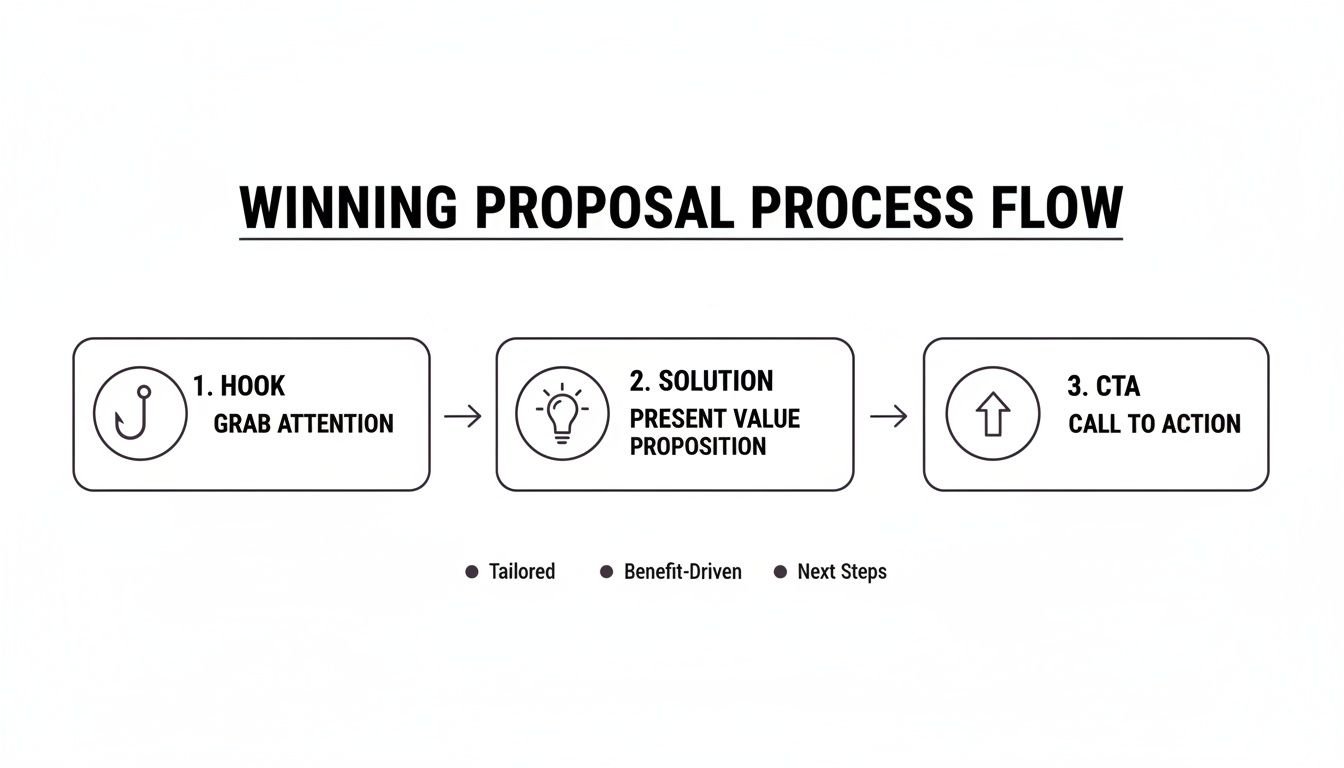
It’s a simple but incredibly effective formula: hook them fast, show them the solution, and tell them what to do next.
Scaling Your Agency with Intelligent Tools
For agencies or teams, this becomes even more essential. How do you keep your messaging consistent and ensure you're bidding quickly when multiple people are involved? It’s a huge operational headache. This is where AI-driven platforms really shine.
If you run an agency in design, development, marketing, or SEO, tools like Earlybird AI can be a game-changer. You train the AI on your ideal projects, and it starts crafting personalized proposals and following up until you have a call booked. We've seen agencies boost their reply rates into the double-digits with this approach.
Ultimately, this replaces the need for a full-time sales person slogging through Upwork all day and can pay for itself with just one new client.
By truly understanding what is sales automation, you can stop the manual grind and build a predictable engine for landing new clients. The goal is simple: spend less time chasing work and more time delivering it.
Turn Interviews into Signed Contracts

Getting the interview is a huge step, but the job isn't yours yet. This is where the real work begins. You have to transition from just another applicant to their go-to partner. The secret is to stop thinking of it as an interview and start treating it like a collaborative strategy session.
Too many freelancers fall into the trap of passively answering questions, waiting for their turn to speak. Don't do that. You need to confidently guide the conversation, showing them you’re not just there to take orders, but to solve their problem and deliver real results.
Master the Pre-Call Prep
Walking into a client call cold is the quickest way to blow the deal. Seriously. The handful of minutes you spend on research beforehand signals that you’re a professional who is already invested in their success.
Before you ever hit that "Join Meeting" button, run through this quick checklist:
- Scope out their business: Spend five minutes on their website. What do they actually do? Who are their customers? What’s their vibe?
- Check their Upwork history: Read the feedback they’ve left for other freelancers. This is a goldmine of information about what they value (and what drives them crazy).
- Arm yourself with questions: Don't wait to be asked if you have any questions. Prepare two or three smart, insightful questions that prove you've done your homework and are already thinking strategically.
A killer question I love to ask is: "Fast forward three months—what does a home run on this project look like for you?" This immediately shifts the focus from tasks to outcomes and shows you care about their long-term success.
This prep work isn't just about looking smart; it allows you to frame your skills specifically to their needs, making your value impossible to ignore.
Steer the Conversation Towards Value
On the call, your mission is to talk less about what you do and more about why it matters for their bottom line. Every skill you mention, every piece of experience you share, should be tied directly to a benefit for them—saving time, making money, or reducing headaches.
Instead of just listing your skills, tell a story. When they ask about your background, don't just say, "I'm a good writer." That's boring. Give them a concrete example.
You could say something like, "For a similar SaaS client, I overhauled their blog strategy to focus on long-tail keywords. Within the first quarter, they saw a 40% increase in organic demo requests." See the difference? You’ve just framed your skills in terms of measurable business impact.
Confidently Navigate Rate Negotiation
Talking about money feels awkward for a lot of people, but it doesn't have to be. You need to walk into this part of the conversation with confidence, ready to justify your rate based on the immense value you deliver, not just the hours you put in.
When the price comes up, anchor the discussion to the results you can generate. If a client pushes back on your rate, resist the urge to immediately offer a discount. Instead, use it as a chance to double down on your value.
Here’s a simple script you can adapt:
"I definitely understand my rate is a considered investment. It’s a reflection of my deep expertise in [Your Niche], which lets me deliver [Specific Result] much more efficiently. My clients usually find this saves them money in the long run by avoiding costly revisions and hitting their goals faster."
A confident, value-first response like this shows you’re a professional expert, not just another commodity.
Seal the Deal and Set Up for Success
Once you get the verbal "yes," the final steps on Upwork are simple but critical for kicking things off right. When that official offer lands in your inbox, read it. Every word. Make sure the scope, deliverables, and payment terms all match what you talked about.
Never be afraid to ask for clarification or suggest a small tweak before you click "Accept." A rock-solid contract is the bedrock of a great client relationship. After you accept, send a quick, professional message to confirm the next steps and share your excitement. This little touch sets a positive, proactive tone right from day one.
Common Questions I Hear About Winning on Upwork
Even with a solid game plan, Upwork can feel like a maze. It’s natural to have questions, and getting straight answers is the fastest way to build the confidence you need to really start winning. Let's tackle some of the most common hurdles I see freelancers run into all the time.
Think of this as plugging the final gaps in your strategy. Getting these details right often separates the freelancers who struggle from those who build a steady stream of fantastic clients.
How Many Proposals Should I Send Every Day?
Honestly, there's no magic number. The one rule that always holds true is quality over quantity. I'd much rather see you send three to five incredibly well-researched, personalized proposals than watch you blast out 20 generic ones. The point isn't just to apply; it's to start a real conversation.
When you're just starting, your main goal is to land that first gig and get some social proof on your profile. This might take anywhere from 10 to 30 of those high-quality proposals. The most important metric to watch is your response rate.
If you've sent out 20 proposals and heard nothing but crickets, the issue isn't how many you're sending. It's almost certainly your proposal's message, how well your profile aligns with the jobs, or both. Use those stats as direct feedback to adjust your approach, not as an excuse to double down on a broken strategy.
Should I Use an Hourly or Fixed-Price Rate?
This one trips up a lot of people, but the answer is simple: be flexible. As a general rule, you should absolutely display an hourly rate on your profile. It sets a clear benchmark for clients, it’s a requirement for many direct invites, and it just positions you as a pro who knows their value.
But here’s the key: you’re never locked into that rate.
You can—and should—bid with a fixed price whenever a project has a clearly defined scope. This protects you from the dreaded scope creep and gives clients the budget certainty they often crave. A great way to handle this is to set your professional hourly rate on your profile, and then, in your fixed-price proposals, briefly explain how you arrived at the total cost. It shows transparency and reinforces the value you’re bringing.
How Can I Possibly Compete with Cheaper Freelancers?
Let me be blunt: you don't. Trying to compete on price is a race to the bottom you will never, ever win. It's a losing game from the start.
Instead, you compete on value. The best clients aren't hunting for the cheapest deal; they're looking for the best solution with the least amount of risk.
Your job is to make your profile, portfolio, and proposals scream "value" and "expert." Here's how you do it:
- Drill down on your specific expertise. Don't be a generalist.
- Showcase case studies with real, measurable results. (e.g., "Grew organic traffic by 40% in 6 months for a SaaS client.")
- Use your proposal to prove you've actually read the brief and understand their business goals on a deeper level.
You need to position yourself as a strategic partner who solves painful problems, not just a service provider waiting for a task list. A client will happily pay a premium for an expert who delivers results and saves them from costly headaches.
Is It Safe to Use Automation on My Upwork Account?
This is a huge—and critical—question. The answer comes down to what kind of automation you're using. If you use a cheap, simplistic bot that scrapes the site and violates Upwork's Terms of Service, you're practically asking for an account suspension. It's just not worth it.
However, smart, compliant platforms are built from the ground up with account safety in mind. They work within Upwork's guidelines by mimicking natural human behavior, not by trying to game the system. For instance, they use dedicated, clean regional IPs to avoid security flags and interface with your account through secure, authorized methods. Most importantly, a safe tool will never ask for or store your password.
The whole point of safe automation is to make you more efficient, not to cheat. It helps you apply your winning strategy faster and more consistently, giving you an edge while keeping your account in good standing. Many freelancers have questions about the platform's reliability, which we dive into in our guide asking, is Upwork legit and safe for professionals?
Ready to stop the manual grind and start winning more high-value clients? Earlybird AI acts as your always-on sales team, sending hyper-personalized proposals within minutes of a job posting and following up until you have a call booked. Scale your outreach safely and effectively with Earlybird AI.