← Back To Blog
How To Get More Clients As A Freelancer: Proven Strategies

Most advice on how to get more clients as a freelancer is outdated by omission. It tells you to polish your portfolio, post on LinkedIn, ask for referrals, and wait for trust to compound. None of that is wrong. It’s just incomplete.
Clients don’t buy in a vacuum. They buy in a moment. On platforms like Upwork, that moment is short, crowded, and brutally operational. A strong brand helps. A clear niche helps. But if your proposal lands after the client has already scanned the first wave of applicants, your branding work is trying to recover from a timing problem.
That’s the shift many freelancers still miss. Winning more work today isn’t just about being credible. It’s about being relevant quickly, packaging your value for the right buyer, and building a system that keeps you visible when demand appears.
The Hidden Rule of Freelance Success
A polished personal brand won’t save a slow sales process.
That sounds harsher than most freelance advice, but it matches what happens in real buying environments. General guidance still leans on networking and content creation, yet an overlooked angle is timing and speed in proposal submission as a competitive advantage. For Upwork in particular, existing guidance often misses the reality that clients can receive dozens of proposals within minutes, and being first in the inbox by submitting within 10 minutes creates a structural advantage, as noted in this discussion of proposal speed on Upwork.

Brand matters, but timing decides who gets read
Freelancers love long-term assets because they feel durable. A strong portfolio, clear positioning, and thoughtful content all compound over time. The problem is that clients often make their first filtering decision before any of those assets get a fair shot.
They skim the first proposals. They reply to the first people who sound competent. They move interviews forward with whoever reduced uncertainty fastest.
Practical rule: If your sales process depends on a client scrolling far enough to discover you, you’re already at a disadvantage.
This is why so much generic advice underperforms on marketplaces. It assumes client selection is calm and linear. In reality, client selection is messy. Buyers are overloaded, short on time, and usually trying to solve a problem now, not next week.
Operational speed is a business skill
Speed isn’t just about typing faster. It’s about reducing the lag between opportunity and response.
That means:
- Saved targeting filters: You should know exactly which jobs fit your offer.
- Reusable proof assets: Keep portfolio samples, short wins, and niche-specific hooks ready.
- Fast qualification: Decide quickly whether a project is worth pursuing.
- Response systems: Treat messages like sales conversations, not inbox clutter.
A lot of freelancers resist this because it feels mechanical. They want every inquiry to feel bespoke. That instinct is understandable, but it creates a bottleneck. The freelancers who grow don’t choose between personalization and speed. They build a workflow that allows both.
What doesn’t work anymore
Three habits subtly kill momentum:
- Applying to everything: This burns time and weakens positioning.
- Writing every proposal from scratch: It feels thoughtful, but it slows you down too much.
- Treating all channels the same: Upwork, LinkedIn, referrals, and direct outreach each have different conversion mechanics.
If you want more clients, stop thinking only about visibility. Start thinking about response position, buyer intent, and sales throughput. That’s where the practical edge is now.
Build Your Foundation for High-Value Clients
The fastest way to stay broke as a freelancer is to chase volume without defining who you want to serve.
A better approach is to target buyers with real budgets, recurring needs, and problems tied to revenue, retention, or delivery. That isn’t theory. In Q1 2025, Upwork’s revenue grew even as active clients fell 7%, while average gross sales value per active client increased 3% to $4,912, which points to a market shift toward fewer, higher-spending clients and larger projects, according to Upwork Q1 2025 reporting.
Pick a niche that solves an expensive problem
Most freelancers define their niche by skill. “I’m a designer.” “I write copy.” “I do paid ads.” That’s too broad to guide acquisition.
A useful niche has three parts:
- The work: SEO content, lifecycle emails, conversion design, paid social creative, Shopify development.
- The buyer: B2B SaaS teams, ecommerce brands, agencies, funded startups, local service businesses.
- The problem: Low conversion, weak retention, launch delays, content bottlenecks, poor lead quality.
When those three line up, your outreach gets easier. Your profile gets sharper. Your proposals stop sounding interchangeable.
For example, “email marketer for DTC brands with repeat purchase problems” is easier to sell than “freelance marketer.” The second describes a person. The first describes a business solution.
Build an ideal client profile, not a wish list
An ideal client profile should be practical enough to guide who you ignore.
Use this framework:
- Budget reality
Look for clients who can support ongoing work or larger scoped projects. Cheap clients often want senior outcomes with junior budgets. - Urgency level
Buyers with delivery pressure move faster. They don’t need to be convinced they have a problem. They need help solving it. - Operational maturity
The best clients usually have a team, a process, and clear ownership. That doesn’t mean huge enterprise accounts only. Small and midsize businesses can be excellent if they know what they need. - Channel fit
Some clients hire on Upwork. Others respond better to LinkedIn or warm introductions. Your ICP should include where they already look for talent.
A niche should narrow your sales process, not your ambition.
Stop trying to win every job
Early-stage freelancers often say yes to anything because they’re trying to create momentum. That can work briefly, but it creates messy positioning and weak referrals. You end up with a portfolio full of unrelated work and no obvious pattern for the next client to trust.
A stronger filter looks like this:
- Good fit: Clear scope, relevant industry, visible business problem, sensible communication.
- Borderline fit: Decent budget but weak strategic match.
- Bad fit: Low clarity, low urgency, low respect, low ceiling.
If a project sits in the third category, decline it or ignore it. The hidden cost of bad-fit clients isn’t just stress. It’s the opportunities you miss while servicing them.
Aim for fewer, better buyers
The market signal from Upwork’s 2025 numbers is useful because it forces the right question. Don’t ask, “How do I get more clients?” first. Ask, “Which clients are worth building a process around?”
That changes everything:
- Your profile speaks to a narrower buyer.
- Your samples become more convincing.
- Your proposals need less explanation.
- Your pricing gets easier to defend.
High-value clients usually don’t want the lowest bidder. They want the person who understands their environment quickly and can reduce risk. Build your foundation around that buyer, and the rest of your acquisition system starts making sense.
Optimize Your Profile for Maximum Conversion
Your profile doesn’t need to impress everyone. It needs to convert the right buyer.
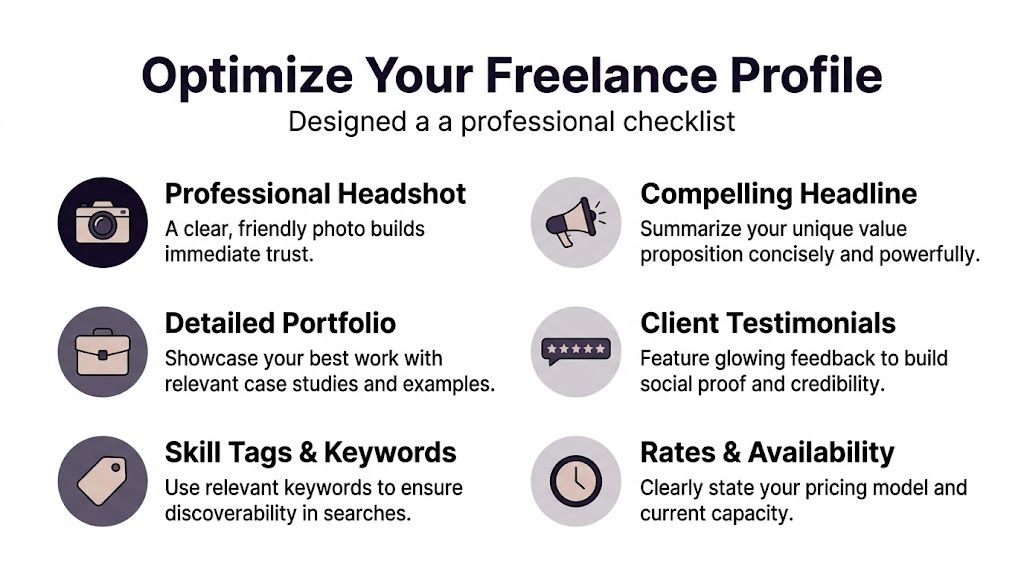
That’s where many freelancers lose momentum. They write profiles like online resumes, full of biography and generic capability statements. Buyers don’t read profiles that way. They scan for fit, proof, and clarity. On Upwork, that matters even more because platform-specific mechanics shape who gets seen and who gets ignored. General freelancer advice often misses factors like keyword optimization and conversion dynamics unique to Upwork, which is why platform-specific tailoring matters, as explained in this piece on attracting freelance clients.
Write for the buyer’s scan pattern
A buyer usually checks your profile in a predictable order. Headline first. Then the first lines of your overview. Then portfolio. Then work history and signals of reliability.
That means your profile should answer four questions fast:
- Who do you help
- What do you help them achieve
- Why should they trust you
- What kind of work should they contact you for
If your first paragraph starts with your background story, you’re wasting prime space. Lead with the client’s problem and your specialty.
Bad version: “I’m a passionate freelance copywriter with several years of experience helping businesses grow.”
Better version: “I write lifecycle and conversion emails for SaaS teams that need stronger onboarding, activation, and retention messaging.”
The second one tells the buyer whether to keep reading.
Fix the parts that usually underperform
Most profiles need improvement in the same places.
- Headline: Don’t list job title only. Add niche and outcome.
- Overview opening: Replace self-description with client-facing positioning.
- Portfolio captions: Explain the business context, not just what the file contains.
- Skills and keywords: Use the terms buyers search for on the platform.
- Call to action: Tell clients what to invite you for.
A portfolio item shouldn’t say “Landing page design for fintech company.” It should say what problem the page addressed, what you handled, and what type of similar project you want next.
Turn your profile into a decision aid
Clients aren’t looking for abstract talent. They’re looking for evidence that you’ve solved adjacent problems.
Use your overview to make selection easier:
- Name the kinds of projects you take on.
- Mention the industries or business models you understand.
- Clarify your working style if it matters to delivery.
- Show enough specificity that weak-fit clients self-select out.
This is also where your profile should align with your proposal strategy. If you pitch yourself as a specialist in one thing but your profile reads like a generalist menu, conversion drops.
Your profile should confirm the promise your proposal makes. It shouldn’t introduce a different business.
Upwork-specific profile choices that matter
Upwork is not a generic directory. It has its own search behavior, buyer expectations, and ranking logic. That means profile optimization should be intentional.
Focus on:
- Keyword placement: Put your core service terms naturally in your headline, first paragraph, and skills.
- Specialized profile alignment: If you use multiple service angles, keep each one tightly scoped.
- Availability signals: Use platform features that make it easier for buyers to see you’re open to work.
- Proof density: Don’t make the client hunt for your strongest evidence.
If you want a useful benchmark for structure, review a sample profile for Upwork and compare it against your own. Most freelancers notice immediately that their headline is vague, their opening is too personal, or their portfolio lacks business framing.
A simple profile test
Read your profile and ask:
- Could a buyer tell within seconds what I specialize in?
- Would my ideal client feel like this profile was written for them?
- Do my samples support the exact work I want more of?
- Is there any section that sounds like a resume instead of a sales asset?
If the answer to any of those is no, revise before sending more proposals. More traffic to a weak profile doesn’t solve anything. It only exposes the conversion problem faster.
Master Proactive Client Prospecting Channels
A good profile helps. It doesn’t replace outbound effort.
Freelancers who rely on inbound only usually have inconsistent pipelines because demand doesn’t arrive on schedule. The fix is simple in theory and demanding in practice. Use multiple prospecting channels at the same time, each with a clear role. One catches active demand. One creates demand. One compounds trust.

Channel one is marketplaces
Marketplaces are for active buyer intent. The client already wants help. Your job is to filter aggressively and respond while the opportunity is still fresh.
This channel works best when you stop browsing casually and start operating with rules:
- Keep saved searches tight around your niche.
- Exclude low-fit project types fast.
- Prioritize buyers with clear scope and realistic expectations.
- Apply while the post is still new, not after it’s saturated.
Many freelancers treat marketplaces like lottery boards. They scroll, react emotionally, and apply inconsistently. That creates noise, not pipeline. A better method is to check opportunities at set times, qualify quickly, and move.
Channel two is LinkedIn outreach
LinkedIn is where you build a list instead of waiting for one.
A practical outreach funnel starts with 100 target brands, then moves into 10 to 15 personalized connection requests daily, supported by posting niche insights 1 to 5 times per week. When tracked properly, that system can convert 5% to 10% of connections into consultations within 4 to 6 weeks, based on the methodology described in this LinkedIn outreach guide for freelancers.
Here’s what that looks like in real use:
- Build the list first: Use LinkedIn Sales Navigator or advanced search filters to find the right companies.
- Track everything: A Google Sheet is enough if you maintain it.
- Send personalized requests: Reference something specific about the company, role, or content.
- Post to support your outreach: Your profile should reinforce your specialization when prospects click through.
- Follow up without drifting into spam: Stay relevant and short.
If you want a deeper walkthrough of that workflow, this guide on lead generation with LinkedIn is a solid companion to your own outreach system.
What this looks like week to week
A steady cadence beats random bursts.
One workable weekly rhythm:
- Research and add new target accounts.
- Send fresh connection requests each business day.
- Follow up with prior contacts already in motion.
- Publish a post that reflects your niche expertise.
- Leave useful comments where your target buyers are active.
That’s not glamorous. It is effective because it creates repetition without chaos.
The mistake isn’t that freelancers avoid outreach. It’s that they do it in short, desperate bursts, then disappear before compounding starts.
Channel three is content plus community monitoring
Content alone is slow. Cold outreach alone can feel transactional. The hybrid model tends to work better because each side supports the other.
Use one primary platform. LinkedIn is usually the simplest for B2B services. Post practical observations, small teardown-style insights, and lessons from your niche. Then pair that with monitoring communities where buyers actively ask for help.
Later in your workflow, this kind of teaching content can support your authority:
The point isn’t to become a creator first. The point is to remove friction when someone checks whether you know your craft.
Don’t let one channel carry the whole business
Each channel solves a different acquisition problem:
- Marketplaces: Best for immediate demand.
- LinkedIn outreach: Best for targeted pipeline creation.
- Content and communities: Best for trust and repeat visibility.
Freelancers get stuck when they expect one channel to do all three jobs. That’s why their pipeline feels unstable even when they’re “doing marketing.” Use each channel for what it’s good at, and your client acquisition stops depending on mood, luck, or referrals arriving at the right time.
Craft Proposals and Messages That Get Replies
A proposal doesn’t need to be clever. It needs to get read, make the client feel understood, and lower the risk of replying.
That’s why speed and relevance beat long introductions. Small and midsize businesses already hire independent talent at scale. Over 50% of SMBs hire independent talent, citing flexibility at 25% and quick onboarding at 23% as key reasons. That buying behavior makes response speed decisive, and freelancers who submit proposals in about 10 minutes and reply to messages in under 5 minutes are better positioned to win attention, according to Backlinko’s roundup of Upwork user trends.

Why long proposals often fail
Freelancers confuse effort with effectiveness. They write several paragraphs about their background, process, certifications, and enthusiasm. Clients skim the first lines, don’t see immediate relevance, and move on.
A reply-driven proposal usually does four things in a tight structure:
- Mirrors the problem
Show that you understand what the client is trying to solve. - Adds one relevant observation
Mention a constraint, risk, or angle that proves you read the post. - Offers a clear next step
Suggest a short call, quick audit, or direct answer to a key question. - Supports with proof
Include one or two relevant examples, not your whole history.
A proposal framework that works in practice
Use this structure as a base:
- Opening line: Refer to the client’s actual need, not your introduction.
- Short relevance statement: Explain why your background fits this project.
- Specific approach: Mention how you’d handle the work or what you’d check first.
- Proof: Link or reference a closely related sample.
- Call to action: Ask a simple question or suggest a next step.
Example shape:
“Your team doesn’t just need more blog content. You need content that matches product positioning and can be produced consistently without heavy editing. I work on that type of workflow with B2B marketing teams. If helpful, I can outline how I’d structure the first batch and what I’d need from your side to keep review cycles light.”
That works better than “Hello, my name is X and I have several years of experience.”
Use hooks from the job post
Every strong proposal starts with extraction. Before you write, pull out:
- The deliverable
- The likely pain point
- Any timing pressure
- Any language that reveals what the client is worried about
If the client says they need someone “reliable,” they may have been burned before. If they mention “fast turnaround,” speed is part of the offer. If they list multiple channels or stakeholders, coordination may be the hidden challenge.
Write to that. Don’t just restate the brief.
Buyers reply when they feel you understood the job behind the job.
Follow-up is part of the proposal
Most freelancers either never follow up or they send weak check-ins. A good follow-up adds something small but useful. It can clarify your approach, answer an objection, or mention one relevant sample that fits better than the first one.
Keep follow-ups calm and short. You’re not trying to pressure the buyer. You’re trying to help them make a decision.
If proposal drafting is your bottleneck, build a repeatable system around it. Reviewing tools for AI proposal writing workflows can help you speed up first drafts while keeping enough room for job-specific personalization.
Pricing and message tone
Low-confidence pricing language hurts replies. So does aggressive certainty. The middle ground is best. Be clear, direct, and easy to engage with.
Good tone sounds like this:
- You understand the work.
- You’re selective, but available.
- You can explain your thinking clearly.
- You’re easy to talk to.
Bad tone sounds either desperate or over-scripted. Clients can feel both immediately.
If you want more replies, don’t chase perfection. Chase fast relevance. That’s what moves conversations forward.
Systematize Your Growth with Analytics and Automation
Freelancers stay stuck when client acquisition lives in memory.
They remember that one good week. They remember a few proposals that hit. They remember a prospect who ghosted after a promising call. None of that is a system. If you want stable growth, you need a process that produces data, and then you need to adjust based on that data.
Track the few numbers that matter to action
You don’t need a complicated dashboard. You need a short list of metrics that change your behavior.
Track these consistently:
- Proposal send rate: How many qualified proposals are you sending?
- Reply rate: Which proposals earn a response?
- Interview rate: Which replies turn into conversations?
- Close rate: Which conversations become signed work?
- Channel source: Did the lead come from Upwork, LinkedIn, content, referral, or direct outreach?
Once you track this for a few weeks, bottlenecks get obvious. If sends are low, your workflow is too manual. If replies are low, your targeting or proposals are weak. If interviews happen but closes don’t, the issue is likely sales conversation, offer design, or pricing confidence.
Run small experiments instead of full reinventions
Most freelancers overreact. They get a bad stretch and rewrite everything at once. That makes it impossible to tell what changed.
A better operating model is to test one variable at a time:
- Try a different proposal opening.
- Narrow your job filters.
- Adjust your portfolio order.
- Shift to a tighter niche message on LinkedIn.
- Change your follow-up wording.
Review the pattern after enough activity to notice a signal. Then keep what improves conversion and drop what doesn’t.
Systems win because they turn frustration into diagnosis.
Automate the repetitive parts, not the judgment
Automation helps most when it removes delay, not when it replaces thinking.
The best parts to automate are:
- Job discovery and filtering
- Draft generation for first-pass proposals
- Message routing and reminders
- Follow-up sequences
- Pipeline tracking
The parts that still need your judgment are fit, positioning, pricing, and call handling. If you automate those badly, you scale the wrong behavior.
Many freelancers often get nervous. They hear “automation” and imagine spam. That’s the wrong model. Good automation preserves relevance while reducing the time lost to repetitive actions.
One factual example in the Upwork workflow category is Earlybird AI, which connects to an Upwork account, searches for matching projects, crafts personalized proposals, replies to client messages automatically, and follows up until a call is booked. The product information provided by the publisher also states that proposals are submitted within about 10 minutes of posting and replies land in under 5 minutes, with analytics, profile optimization tools, and multi-user workflows available for agencies.
Build a client acquisition operating rhythm
Treat acquisition like a standing function in the business.
A practical weekly rhythm looks like this:
- Review which channels produced replies.
- Check which proposals got ignored and why.
- Update your saved responses, samples, and hooks.
- Refine target criteria based on deal quality.
- Keep outreach running even when delivery work is busy.
That last point matters most. Freelancers often stop prospecting as soon as they get work, then panic when the pipeline empties. A system solves that by separating sales activity from mood and workload.
What works and what doesn’t
What works:
- Consistent outreach tied to a narrow offer
- Fast response times
- Profile and proposal alignment
- Tracking every lead source and stage
- Light automation supporting human judgment
What doesn’t:
- Rewriting your business every slow month
- Sending generic proposals at volume
- Treating referrals as a plan
- Depending on memory instead of a pipeline
- Waiting until work dries up to start selling again
Freelancing gets easier when you stop asking, “How do I find clients this week?” and start asking, “What system keeps qualified conversations moving every week?”
That’s the shift. More clients isn’t the result of one tactic. It’s the result of a machine you maintain.
If you want a more systematic way to handle Upwork lead generation, Earlybird AI is built for that workflow. It’s designed to help freelancers and agencies search for matching jobs, draft personalized proposals, respond quickly to client messages, follow up automatically, and track performance so client acquisition doesn’t depend on manual effort alone.