
← Back To Blog
How to Get SEO Clients: A Proven Roadmap for Agencies and Freelancers

Figuring out how to get SEO clients isn't just about chasing leads. It’s about building a foundation so solid that high-value partners are drawn to you. You need to shift your mindset from being just another service provider to becoming a mission-critical asset for their business.
This all starts with three key things: getting laser-focused on your ideal client, packaging your expertise as a high-ROI investment, and crafting a value proposition that screams tangible business results.
Building Your Foundation to Attract High-Value SEO Clients
Before you even think about sending a cold email or submitting a proposal on Upwork, you have to do the groundwork. This is what separates the pros who land great clients from the freelancers stuck in a race to the bottom.
Too many SEOs just throw together a generic service list and hope for the best. That's a recipe for attracting price-shoppers and clients who will never truly grasp the long-term value of what you do. Instead, your goal should be to build an offer so compelling and a portfolio so convincing that the right clients see you as the only person for the job.
This isn't just about what you do; it's about who you do it for and the specific, measurable outcomes you can deliver.
Define Your Ideal Client with Precision
One of the biggest mistakes I see is people defining their ideal client by a vague industry, like "dentists" or "law firms." That's not nearly specific enough. You need to go deeper and focus on their specific business pains and growth opportunities.
Are you the go-to expert for a local brick-and-mortar shop struggling to get feet through the door? Or maybe your sweet spot is helping an e-commerce brand break its addiction to expensive paid ads.
Think about these deeper characteristics:
- Business Stage: Do you thrive with startups desperate for their first taste of traction, or are you better at helping established businesses scale their market share?
- Revenue Level: Targeting businesses with healthy revenue ensures they actually have the budget to invest in a proper SEO strategy that will move the needle.
- Specific Pain Points: Get crystal clear on the exact problems you solve. For example, "I help local service businesses with a high customer lifetime value generate a consistent stream of qualified leads online."
Nailing this down makes every other part of your client acquisition process a hundred times easier. It sharpens your messaging, dictates which case studies to feature, and tells you exactly where to spend your time prospecting.
Package Your Expertise as a Business Investment
Stop selling "SEO services." Seriously. Start selling business outcomes.
Clients don't buy keyword research, technical audits, or link building. They buy what those things get them. Your packages should be framed entirely around the return on investment they can expect.
For instance, don't offer a "Basic SEO Package" that just lists a bunch of tasks. Call it the "Lead Generation Engine." See the difference? This immediately shifts the conversation away from a monthly cost and toward a predictable source of new revenue. Your value proposition needs to speak their language—the language of profit and loss.
Key Takeaway: When you frame SEO as a system for lowering customer acquisition costs and increasing revenue, you move from the "expense" column to the "investment" column in a business owner's mind.
This isn't just playing with words; it's a strategic repositioning. It justifies higher price points and attracts clients who are focused on growth, not just on trimming their budget.
Prove Your Worth with Outcome-Driven Case Studies
Your portfolio is your single most powerful sales tool. But it needs to do more than show off some "before and after" ranking charts. A truly killer case study tells a story of business transformation.
Structure your case studies to walk a potential client through this journey:
- The Challenge: What specific, painful business problem was the client facing when they came to you?
- The Solution: What was your strategic approach, and why did you choose that particular path?
- The Results: How did your work directly impact their bottom line? Showcase the metrics that matter: lead quality, conversion rates, and most importantly, revenue growth.
This approach proves your value before you ever get on a sales call. The data is clear on this: leads coming from search engines have a massive 14.6% close rate, completely blowing away the 1.7% from outbound tactics like cold calling. And with 53.3% of all website traffic coming from organic search, positioning yourself as the expert who can capture it is a no-brainer.
By building this solid foundation first, you stop chasing clients and start creating a magnet for the right ones. For anyone just getting into the game, starting an SEO agency with this strategic framework will put you leagues ahead of the competition from day one.
Mastering Outreach and Lead Generation That Actually Works
Once you've got a killer offer and a solid foundation, it's time to start filling your pipeline. This isn't about throwing spaghetti at the wall to see what sticks. It's about strategic, multi-channel outreach that gets your value proposition in front of the right people, at the right time. The goal is to create a consistent, predictable flow of qualified leads.
This takes more than just firing off a few emails. A winning strategy combines smart automation on competitive platforms, value-first cold outreach that builds real relationships, and a powerful network that sends ideal clients your way.
Let's break down how to make each of these channels work for you. First, remember that all successful outreach is built on a few key fundamentals.
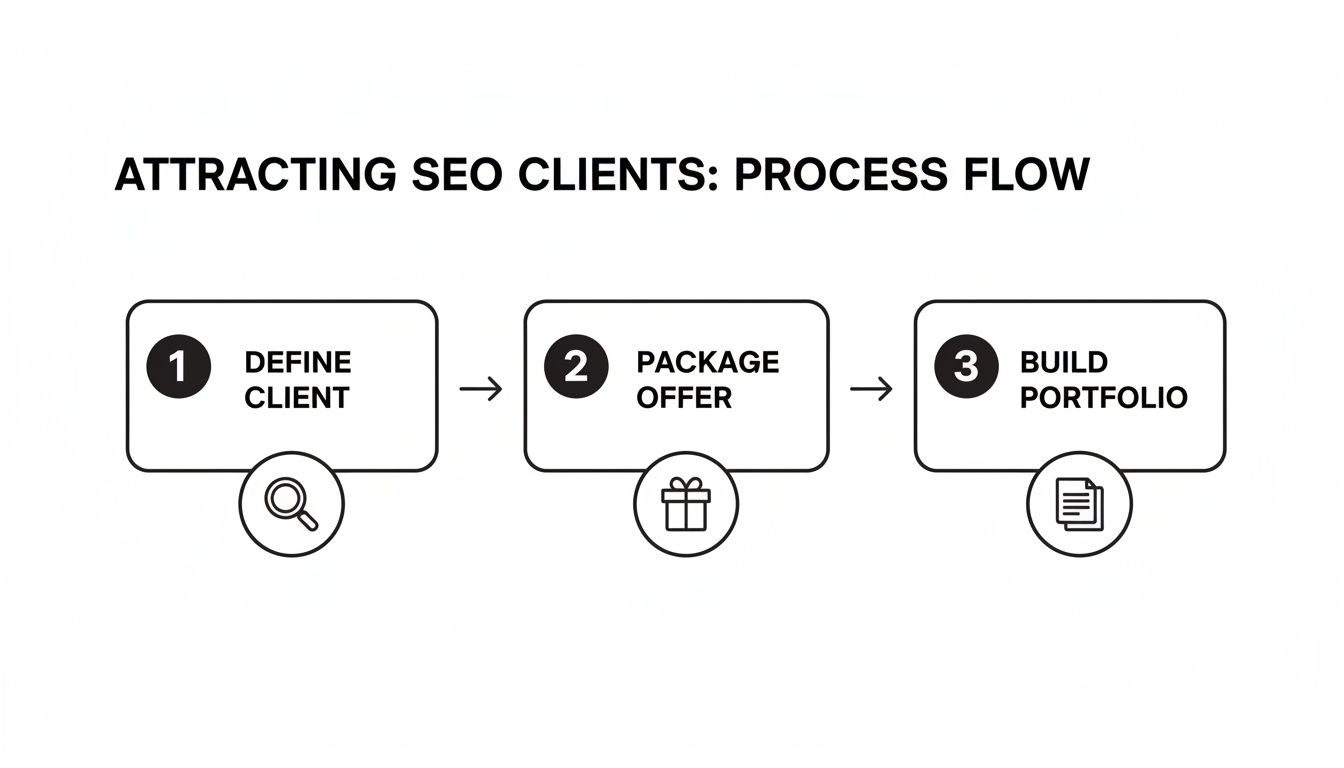
As you can see, you need to know who you're targeting and what you're selling before you even think about sending that first message.
Automate and Dominate on Freelance Platforms
Platforms like Upwork are absolute goldmines for finding clients who are actively looking for SEO help. The catch? The competition is insane. Speed and personalization are everything. If you're manually refreshing job feeds and writing proposals from scratch, you've already lost. The best jobs are often snapped up within the first hour.
This is where automation becomes your unfair advantage.
A tool like Earlybird AI can be a game-changer, letting you be the first to submit a hyper-personalized proposal the moment a relevant job goes live. The system learns what your ideal project looks like and crafts compelling bids for you, making sure you’re always a top contender. This isn’t about spamming generic templates; it's about using technology to get speed and scale without sacrificing quality.
A well-tuned automation system doesn't just send proposals—it gets you noticed. By consistently being one of the first applicants with a relevant and personalized message, you dramatically increase your chances of getting that initial reply and starting a conversation.
This approach flips the script, turning a reactive chore into a proactive lead generation machine that works for you 24/7.
Execute Cold Outreach That Provides Real Value
Let's be clear: cold outreach still works, but only if you do it right. The days of mass-blasting generic emails are long gone. Today’s strategy is built on personalization, empathy, and providing value before you ask for anything.
Your goal is not to sell your services in the first email. It's to start a conversation.
Here are a few tactics that actually cut through the noise:
- The "Loom" Video Audit: Don't just tell them what you can do—show them. Record a quick, 90-second screen-share video using Loom where you audit a specific page on their website. Point out one or two high-impact opportunities they're missing. This is an instant credibility booster.
- The Compliment & Question: Find something genuinely cool about their business—a recent blog post, a product launch, a great press feature. Mention it in your outreach, then tie it to a thoughtful question about their growth. It shows you've done your homework.
- Focus on a Specific Competitor: Run a quick analysis showing how a direct competitor is outranking them for a high-value keyword. Present this data not as a threat, but as a clear, tangible opportunity you can help them seize.
While cold outreach has its place, the data shows just how powerful inbound is. Around 60% of marketers see SEO-driven content as their top source for high-quality leads. Inbound leads have a close rate of 14.6%, which blows outbound's 1.7% out of the water. For freelancers on Upwork, tools like Earlybird AI help bridge that gap by automating proposals that feel more like a warm introduction than a cold pitch.
Build a Powerful Referral Network
One of the most sustainable ways to get incredible SEO clients is to have other professionals send them straight to you. Building strategic partnerships with businesses that serve your ideal clients—but don't compete with you—is a long-term play that pays off in a big way.
So, who should you be connecting with?
- Web Design and Development Agencies: They build beautiful websites, but they often lack the in-house expertise to make them rank. They constantly get asked, "What about SEO?" You need to be their go-to answer.
- PPC and Paid Media Specialists: These pros are fantastic at driving traffic quickly, but they know organic search is the key to long-term, sustainable growth. A partnership lets you both offer clients a more holistic marketing solution.
- B2B Consultants and Coaches: Business consultants, marketing strategists, and sales coaches have deep insight into their clients' biggest growth challenges. When SEO becomes the solution, you want to be the first person they think of.
These relationships take time to nurture. Offer a referral fee, deliver incredible value to the clients they send you, and always, always make them look good for introducing you. You can dive deeper into this topic by exploring our guide on crafting effective lead generation emails.
Crafting Proposals and Pitches That Actually Convert
Getting a lead is just the first step. The real challenge? Convincing a potential client that you're the right person to help them grow. Firing off a generic, copy-paste proposal is a surefire way to get ignored. It screams low effort and shows you haven't taken the time to understand their business.
If you want to win more deals, you need to craft a pitch that speaks directly to a prospect’s unique problems and ambitions. That whole process starts long before you ever write a single word. It begins with a quick, insightful audit to uncover their most pressing needs and biggest growth opportunities. By doing this homework, you can build a proposal that sells a tangible outcome, not just a to-do list.

Find Their Pain Points with a Pre-Proposal Audit
Before you can pitch a solution, you have to truly understand the problem. A quick pre-proposal audit is your chance to show off your expertise and gather the ammo you need to build a compelling case. This isn't a full-blown technical deep dive—think of it more like a strategic recon mission.
Your goal is to find high-impact issues you can solve.
Look for the low-hanging fruit and obvious gaps:
- Keyword Gaps: Are their competitors ranking for high-intent keywords they're completely missing?
- On-Page Issues: Do their most important money pages have weak title tags, missing meta descriptions, or super thin content?
- Local SEO Flaws: If they're a local business, is their Google Business Profile a ghost town? Are their citations a mess?
- Site Speed: Does the site load at a snail's pace on mobile? A quick check with PageSpeed Insights can reveal some major opportunities.
This initial research lets you walk into the conversation armed with specific, actionable insights. Instead of a weak "I can do SEO for you," you can hit them with, "I noticed your top competitor is scooping up all the traffic for 'emergency plumbing services in Boston,' and your page for that service isn't even indexed. We can fix that." See the difference?
Structure Your Proposal Around Business Outcomes
Let's be clear: your proposal is a sales document, not a technical manual. Clients don't really care about canonical tags or schema markup. They care about results—more leads, more sales, and a better return on their investment. Every single part of your proposal needs to tie your SEO activities back to these core business goals.
A proposal structure that actually wins deals usually looks something like this:
- Here's What I Heard: Start by summarizing their goals and challenges in their own words. It immediately shows you were paying attention.
- The Opportunity: Frame their problem as a clear opportunity for growth. Use the data from your audit to show them what’s possible.
- Our Game Plan: Outline your high-level strategy. Focus on the "what" and the "why," not just the nitty-gritty "how." For example, "We'll start by overhauling your three core service pages to capture high-intent local search traffic."
- Expected Results & Timeline: Connect your strategy to real results. Be realistic about when they can expect to see progress and, eventually, a solid ROI.
- The Investment: Always present your pricing as an investment in their growth, never just a "cost."
Key Insight: The most persuasive proposals don't sell SEO tasks; they sell a vision of the client's future success. They paint a clear picture of what their business will look like after they hire you.
This outcome-focused approach makes your pricing feel like a no-brainer and completely changes the dynamic of the sale.
Justify Your Price with Data and Credibility
High-value clients are more than willing to pay premium prices, but you have to give them undeniable proof of value. Your proposal must build a rock-solid case for why you're worth every penny. This is where you bring in the hard data and your own track record.
Your case studies are gold here. Don't just link to them—pull out the most relevant success story and weave it right into the proposal. For instance, "For another B2B SaaS client facing a similar lead quality issue, our content strategy drove a 150% increase in marketing-qualified leads within six months."
Back that up with industry-specific ROI data to ground your pricing in reality. Landing top-tier SEO clients means proving a massive return is possible, and the numbers don't lie. A 2026 report from First Page Sage broke down industry-specific returns, showing financial services can hit an 11.10 ROAS and 1,031% ROI over three years, while eCommerce sees a 3.65 ROAS and 317% ROI. Presenting this kind of data makes your pitch incredibly powerful.
By combining a clear strategy with hard data and social proof, you turn a simple quote into an irresistible business case. To see how this comes together in practice, check out these different examples of a job proposal for more inspiration.
Pricing Your SEO Services for Maximum Profitability
Let's talk about one of the trickiest parts of landing new SEO clients: pricing. It's a real balancing act. Go too low, and you'll end up with difficult clients and leave a ton of money on the table. Price too high without the right justification, and you can scare away fantastic prospects before you even get a chance to show them what you can do.
The real secret is to completely shift how you think about your work. Stop focusing on your time and start focusing on the value you create. When a client begins to see your service as an engine for profit, not just another line item on their expense report, the entire conversation around money changes.
Choosing the Right SEO Pricing Model
There’s no single, perfect pricing model that works for every situation. However, after years in the trenches, I've found a few that consistently work best for SEO pros. The key is to pick the one that aligns with the scope of the work and, most importantly, the client's goals.
Here are the most common and effective options I've used:
- Monthly Retainer: This is the holy grail for ongoing SEO. The client pays a fixed fee every month for a clearly defined set of services and continuous optimization. Since SEO is a marathon, not a sprint, this model is ideal. It gives you predictable income and ensures the client gets the sustained effort needed to see real results.
- Project-Based Fee: This is your go-to for specific, one-off jobs. Think of things like a deep-dive technical SEO audit, a complex website migration, or setting up a local SEO foundation from scratch. You charge one flat fee for the whole project, which clients love because the cost is clear and upfront.
- Hourly Consulting: While I don't recommend this for full-service SEO, charging by the hour is great for specific consulting gigs, team training sessions, or troubleshooting a thorny issue. It's flexible, but be warned: it can be tough for clients to budget for and can actually penalize you for being efficient and working quickly.
For most of us, whether you're a freelancer or running a small agency, the monthly retainer is the goal. It stabilizes your cash flow and lets you build the kind of deep, long-term relationships where you can truly drive and demonstrate massive ROI.
Shift from Billing Hours to Pricing Value
The most successful SEOs I know don't sell hours—they sell outcomes. Your price tag should reflect the incredible value and potential return you bring to a client's business, not just how many hours you spend behind a screen.
Put it this way: if your SEO work helps a client acquire a single new customer with a lifetime value of $10,000, is your $2,000 monthly retainer an expense? Or is it an absolute bargain?
Key Takeaway: Stop calculating your rates based on what you think your time is worth. Start calculating them based on the tangible business results you can generate for your client. This value-based approach is how you command higher fees and attract clients who are serious about growth.
To pull this off, you have to get comfortable talking about their business numbers during the discovery call. Ask about their average customer lifetime value (LTV), lead-to-customer conversion rates, and profit margins. Armed with this info, you can frame your fee as a small investment poised for a huge return.
Create Tiered Packages That Anchor Your Value
Walking into a negotiation with just one price gives the client a simple choice: "yes" or "no." But when you offer tiered packages, you reframe their decision from "Should I hire this person?" to "Which of their options is the best fit for me?"
This strategy leverages a powerful psychological principle called price anchoring. By presenting a premium, high-ticket package first, your mid-tier option suddenly seems incredibly reasonable and packed with value by comparison.
A classic three-tier structure might look something like this:
- Starter/Foundation Package: This covers the non-negotiable essentials. It's designed for businesses on a tighter budget that just need to get the fundamentals right.
- Growth/Professional Package: This should be your sweet spot and the one you want most clients to pick. It includes everything from the starter package plus more impactful strategies like a content marketing plan or a link-building campaign.
- Scale/Enterprise Package: This is the all-in, premium offering for clients who want to grow aggressively. It includes your full suite of services deployed at a much higher intensity.
This approach does more than just cater to different budgets. It paints a clear growth path for your clients. They can get started where they're comfortable and immediately see how they can scale their investment with you as their business expands.
Onboarding and Retaining Clients for Long-Term Growth
Winning a new SEO client is a huge rush, but the real work—the work that builds a sustainable agency—starts the moment the contract is signed. The difference between a one-off project and a high-value, long-term partnership is all in your process. A sloppy onboarding experience creates doubt, while a solid retention strategy built on proactive communication turns clients into your biggest fans.
Landing the client is just the first checkpoint. Your next goal is to make yourself so valuable they can't imagine their business without you. This isn't luck; it's a system for how you welcome them and consistently prove your worth month after month.

Nail the Onboarding Process Every Time
A killer onboarding process sets the tone for the entire relationship. It's your chance to establish clear expectations, build immediate trust, and make the client feel like they absolutely made the right choice. This isn't just about getting access to their accounts; it's about getting everyone aligned and excited about the same vision for success.
A disorganized, chaotic start can poison a project before it even gets off the ground. Your mission is to make the client feel guided and secure from day one.
Here’s a simple checklist that has worked for me time and time again:
- The Welcome Packet: Send a clean, professional PDF that outlines the next steps, introduces their main point of contact, and spells out your communication schedule. No guesswork.
- The Kickoff Call: This is your single most important meeting. Use this time to dig deep into their actual business goals (not just rankings!), confirm the KPIs that matter to them, and set a realistic timeline.
- Secure Credential Sharing: Never ask for passwords in an email. Use a secure tool like LastPass or 1Password to get the access you need for Google Analytics, Search Console, their CMS, and anything else.
- Internal Setup: On your end, get them loaded into your project management software, rank trackers, and reporting dashboards. Be ready to go.
Following a structured process like this shows you're a pro who has this down to a science. It's an instant confidence booster for your new client.
Deliver Reports That Speak Their Language
Let's be honest: most clients don't care about keyword ranking fluctuations or anchor text ratios. They care about business results. If your monthly reports are just a data dump of technical SEO jargon, you're missing a massive opportunity to prove your value.
The best reports I've ever seen tell a story. They connect the dots between your SEO activities and the metrics that matter to the C-suite—leads, sales, and revenue. You have to translate your work into their language.
Key Takeaway: Stop reporting on what you did and start reporting on what it achieved. Frame every result around business impact, not just SEO metrics. A report showing a 25% increase in qualified demo requests is infinitely more powerful than one showing a jump in domain authority.
Structure your reports to lead with the good stuff. Show them the chart with the upward trend in organic conversions first, then provide the supporting SEO data as context. This simple flip in framing makes your value impossible to ignore.
Build Loyalty with Proactive Communication
Don't let the monthly report be the only time your clients hear from you. Proactive communication is the absolute bedrock of client retention. It builds incredible trust and stops small questions from snowballing into big problems. When clients feel you're in their corner, they're far less likely to churn.
Implement a simple communication cadence to keep them in the loop:
- Weekly Check-ins: A quick email summarizing progress, outlining the plan for the week, and flagging anything you need from them is often enough to keep the momentum going.
- Quick Win Alerts: Did you just score a killer backlink or see a huge ranking jump for a money keyword? Fire off a quick, celebratory email. Let them share in the wins as they happen!
- Quarterly Business Reviews (QBRs): This is a strategic, forward-looking meeting, not just another report walkthrough. Use it to review progress against their big-picture goals, talk about industry trends, and pitch new ideas or upsells that will drive even more growth.
By consistently communicating and tying your work back to their success, you transform from a "vendor" they pay to a "partner" they rely on. That's how you keep clients for the long haul.
Got Questions? Let's Talk About Landing SEO Clients
Even with the best playbook, you're going to run into some tricky situations when you're out there trying to land new SEO clients. It’s just part of the game. Let's tackle a few of the most common questions I hear from other SEOs, both freelancers and agencies, and get you some straight answers.
"I Have No Portfolio. How Do I Get My First SEO Client?"
This is the classic chicken-or-the-egg problem, and it feels like a huge wall to climb. But you can absolutely get over it. The trick is to manufacture your own proof before anyone pays you.
Find a local business you like or a non-profit and offer them a free, comprehensive SEO audit. Don't just phone it in—treat it like a $5,000 project. Document every single step, from your initial analysis to your final recommendations. Boom. That’s your first case study, and it shows you know how to think strategically.
At the same time, you need to start acting like the expert you are.
- Write what you know: Start a blog or post on LinkedIn about a niche you genuinely find interesting. A super-detailed article on "Local SEO for HVAC Companies" will catch way more attention than a bland resume.
- Show your work: A deep dive into a specific topic proves you can do more than just talk a big game.
- Think small to win big: On platforms like Upwork, hunt for smaller, well-defined gigs. The goal here isn't a massive payday; it's getting those first crucial reviews and building momentum.
When you write your proposal, make it clear you’ve done your homework on their business. A hyper-personalized pitch that shows you understand their specific challenges can easily beat a generic one from an SEO with a decade of experience.
"What’s the Best Way to Find High-Paying SEO Clients?"
Forget looking for a single silver bullet. The real money is in combining smart inbound marketing with highly targeted outbound sales. And underpinning it all? Specialization.
When you're the go-to SEO expert for B2B SaaS or luxury e-commerce, you're not a commodity anymore. You're a specialist. High-paying clients don't want a generalist; they want an expert who understands their world and can deliver a massive, industry-specific ROI.
Inbound is your long game. Creating genuinely helpful content positions you as an authority, so warm leads come to you already convinced of your expertise. For quicker wins, you have to be more direct. Strategic outreach on LinkedIn or setting up automated, laser-focused bids on freelance sites can get you in front of the right people, fast.
And never, ever forget about referrals. Building a network of web designers, PPC agencies, and marketing consultants who serve the same clients you want is a goldmine. They can send you a steady stream of high-quality, pre-qualified leads for years to come.
"How Do I Deal With a Prospect Who Says SEO Is Too Expensive?"
Let's be clear: this objection is almost never about the price. It's about value. When a prospect tells you you're "too expensive," what they're really saying is, "I don't understand how this investment will make me more money than it costs." Your job isn't to lower your price; it's to reframe the entire conversation.
Start by asking questions that make the value tangible.
- "What's the average lifetime value of a new customer for you?"
- "Realistically, how many new customers a month would you need from this to feel like it was a huge success?"
- "What is it costing your business right now to not rank for your most important keywords?"
These questions shift their focus from expense to opportunity. Back up your points with industry ROI stats to anchor your pricing in proven results. If they're still on the fence, don't just cave and offer a discount. Instead, suggest a smaller, high-impact starter project—maybe a technical SEO audit or a local SEO setup. This "foot-in-the-door" offer lets you prove your worth and build trust, making it much easier to upsell them into a full retainer later on.
Finding and winning high-value SEO clients on platforms like Upwork is a game of speed, personalization, and smart follow-up. Earlybird AI essentially becomes your automated sales assistant, sending out incredibly personalized proposals just minutes after a relevant job gets posted. It even handles the follow-ups to get you more sales calls. Stop the manual grind and start closing more deals—see how you can do it with Earlybird AI.