← Back To Blog
How to Get SEO Customers Your Agency Needs to Grow

Getting a steady stream of SEO clients isn't about luck or just blasting out emails. It starts with a solid game plan. The real secret is to zero in on a specific niche, get crystal clear on who your ideal client is, and then craft an offer that speaks directly to their biggest headaches. When you're this focused, your marketing naturally pulls in the high-value clients you actually want to work with.
Stop Chasing Everyone: Define Your Niche to Attract Better Clients
Let's be real: trying to be the SEO solution for every business is a recipe for disaster. Before you can even think about how to get clients, you need to decide which clients are right for you. Vague targets like "local businesses" are way too broad. It's like shouting into a crowded room—your message gets lost in the noise and connects with no one.
The foundation of a great SEO agency or freelance business isn’t casting a wide net; it’s throwing a sharp spear.
Find Your Sweet Spot: The Profitable Niche
First things first, you need to build your ideal client profile (ICP). I’m not just talking about basic demographics. I mean digging deep into the specific industries where you can genuinely make an impact. Think about your past successes or your genuine interests. Have you killed it for SaaS companies? Do you know e-commerce SEO inside and out? Or maybe you have a knack for helping local pros like dentists and plumbers dominate their city's search results.
Picking a niche is a game-changer. It allows you to:
- Become the Go-To Expert: When you live and breathe an industry, you build serious authority. People trust the specialist over the generalist every single time.
- Sharpen Your Marketing: All of your content, from blog posts to proposals, can speak directly to the pain points of that one specific audience. It just hits different.
- Charge What You're Worth: Specialized expertise is rare, and clients are willing to pay a premium for it.
For example, an SEO expert who specializes in "B2B SaaS" gets it. They understand the world of MQLs, long sales cycles, and the importance of demo requests. That's the kind of insider knowledge a high-growth tech company is actively searching for—and willing to pay top dollar for.
Pinpoint the Exact Problems You Solve
Once you’ve got your niche, shift your focus to the problems you solve. Clients don't buy "SEO." They buy solutions. They buy more leads, higher quality traffic, and the satisfaction of finally outranking that one competitor who’s been bugging them for years.
Your unique value proposition (UVP) is your answer to one simple question from a potential client: "Why you?" It’s where what you do best meets what they need most.
Maybe your UVP is that you deliver incredibly detailed technical audits that find critical issues other agencies miss. Or perhaps you're the undisputed champ of a specific niche, like legal SEO. It could even be that your reporting is the most transparent and actionable in the business.
When you nail your ICP and UVP, everything clicks. Every email you send, every proposal you write, and every call you jump on will resonate with the exact people you're meant to help.
Mastering the Channels Where Your Ideal Clients Live
Once you’ve nailed down who you’re targeting, the real work begins: finding out where they actually hang out. Sourcing good SEO leads is a bit of an art, blending strategies that pull clients toward you with direct outreach that puts your agency front and center. It's all about building a system that keeps new opportunities bubbling to the surface.
Let's be real—finding clients isn't just about being a great SEO. It's about being visible in the right places, at the right time. Relying on a single source for leads is a recipe for a feast-or-famine cycle. A multi-channel approach is what builds a stable, predictable pipeline for your business.
The groundwork we covered in the last section—choosing your niche, defining your Ideal Client Profile, and honing your Unique Value Proposition—is what makes your channel strategy work.
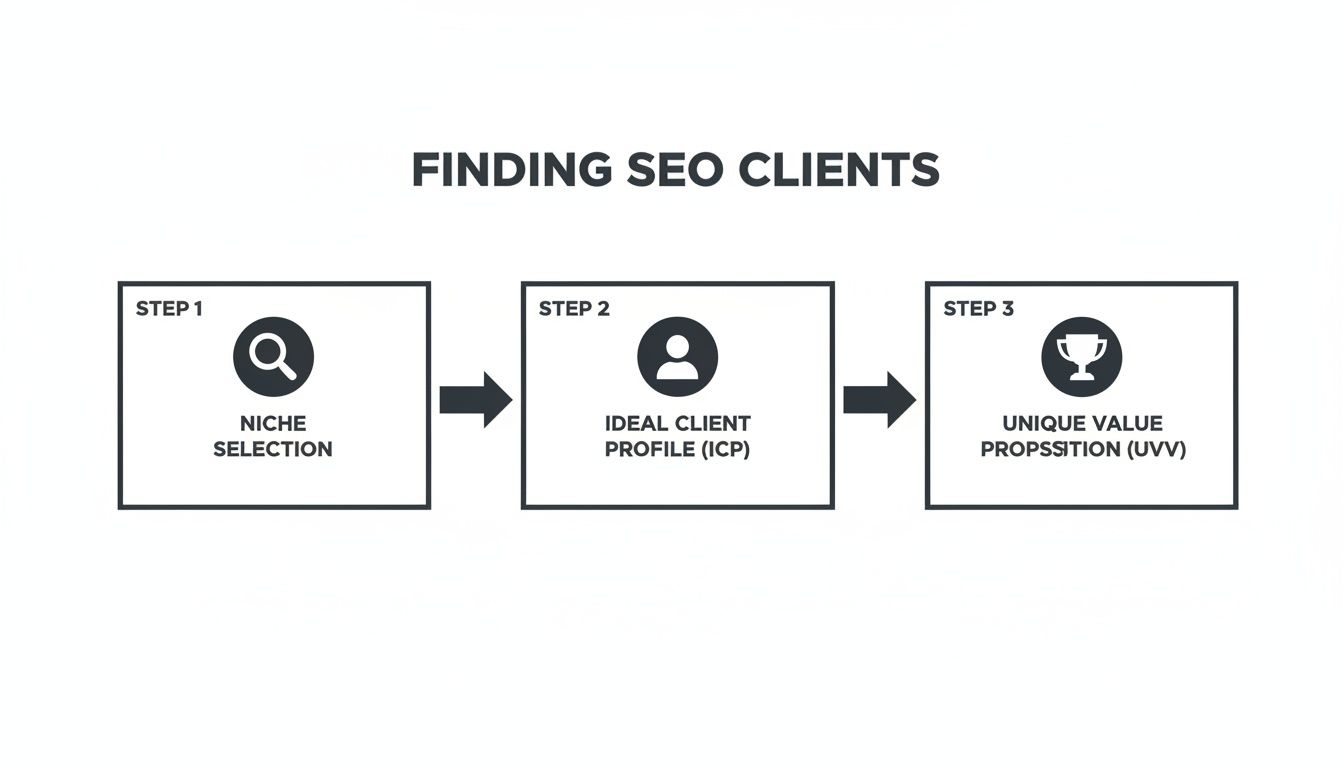
With that foundation, every message you send, on any platform, will be sharp, relevant, and hit home with the right audience.
Winning on Competitive Marketplaces Like Upwork
Freelance platforms, especially a giant like Upwork, can be an absolute goldmine for SEO clients—if you know how to play the game. The whole challenge is standing out in a sea of proposals. This is where your niche specialization becomes your secret weapon. Generic, copy-pasted proposals get deleted instantly by clients looking for a true expert.
To win here, you need two things: speed and personalization. The best jobs often get flooded with dozens of proposals within the first hour. If you're one of the first to apply, your odds of getting noticed shoot way up. But speed alone is worthless.
Your proposal has to immediately prove you’ve read and understood their specific problem. Mention a detail from their job post, use their company name, and draw a straight line from your past results to their stated goals. For agencies on Upwork, creating a system to rapidly spot and respond to ideal jobs is a massive competitive advantage.
The top freelancers on these platforms essentially operate like an always-on sales team. They've combined a killer profile with a system for rapid, hyper-personalized outreach. This ensures they're the first to talk to the best leads.
This is where a smart mix of manual effort and automation comes into play. Manually refreshing the job feed and writing every proposal from scratch is a huge time-suck and simply doesn't scale. Using a tool like Earlybird to find the right jobs and draft initial proposals frees you up to focus on the high-touch personalization that actually seals the deal.
Blending Inbound and Outbound Strategies
Beyond the active marketplaces, your client acquisition strategy needs a healthy mix of both inbound and outbound methods.
- Inbound Marketing: This is the long game. It’s all about creating genuinely valuable content—blog posts, detailed case studies, industry reports—that showcases your expertise and attracts clients to you. When a prospect finds you through your content, they're already halfway sold on your authority.
- Targeted Outbound: This is where you proactively go after your ideal clients. Think personalized cold emails, thoughtful LinkedIn outreach, or even networking at industry events. The trick is to always lead with value, not a hard sales pitch.
Having both inbound and outbound strategies running in parallel is key. You'll have leads coming in while you sleep (inbound) and the power to go after specific, high-value targets whenever you need to (outbound). This creates a much more robust system that delivers a consistent flow of opportunities.
Crafting SEO Proposals That Actually Close Deals
Think of your proposal as the final handshake before a partnership begins. It's the moment you transition from talking about what you can do to showing exactly what you will do. The best proposals I've ever seen don't just list services; they sell a clear, compelling solution to a specific business problem. This is a make-or-break moment in landing that new SEO client.
A generic, one-size-fits-all template is a deal killer. Seriously. Every proposal should feel like a custom strategy document built exclusively for that client. It instantly proves you’ve listened, done your homework, and are already invested in their success.

The Anatomy of a Winning Proposal
A killer SEO proposal is much more than a price list. It tells a story, positioning your services as the only logical next step for the client's growth. To build that narrative, you need to include a few key components that flow together seamlessly.
Your document should be structured to guide the prospect from their current challenges to a future where you're their partner in success. Each part has a job to do.
- Executive Summary: Kick things off with a tight overview that hits on their business goals. Reiterate the pain points you discussed and frame your SEO strategy as the direct answer. Remember, this isn't about you; it's about them.
- Mini-Audit and Opportunities: This is where you flex your expertise and provide immediate value. A quick, insightful mini-audit that uncovers a few "low-hanging fruit" opportunities shows you're proactive and already thinking strategically about their business.
- Crystal-Clear Scope of Work: Ambiguity is your enemy here. Clearly define deliverables, timelines, and what success actually looks like. I like to break my process down into phases so the client knows exactly what to expect and when. For more practical tips on this, checking out some solid examples of job proposal structures can really help.
Shifting from Cost to Investment
Let’s talk about one of the biggest hurdles: pricing. How you frame your fee can make or break the entire deal. You have to stop presenting it as a cost and start positioning it as an investment in their growth. This all comes down to connecting your SEO activities to tangible business outcomes.
The most successful proposals don't sell hours or tasks; they sell results. Frame your work in terms of ROI, lead generation, and increased revenue to move the conversation away from price and toward value.
To pull this off, you have to understand their key business metrics. This is why the discovery call is so important. Ask pointed questions like, "What's the average lifetime value of a new customer?" or "What's your current lead-to-close rate?"
Once you have their numbers, you can start projecting potential ROI. For instance, if you can realistically increase their organic traffic by 30% and you know their conversion rate is 2%, you can build a credible estimate of the new leads and customers your work will generate. This data-driven approach transforms your proposal from a simple expense sheet into a strategic growth plan, making the decision to hire you a no-brainer.
Using SEO to Attract Your Own SEO Customers
Let's be honest, the most convincing sales pitch you'll ever make is your own success story. When a potential client searches for the exact services you offer and finds you at the top, the conversation completely changes. It’s no longer, "Can you do this?" but "How soon can we start?"
This is the power of practicing what you preach. You’re not just telling prospects you’re an expert; you're showing them in real-time. By applying your own SEO skills to your agency's website, you build an automated engine that consistently brings high-quality, inbound leads right to your doorstep.

This strategy isn't just about showing off; it's smart business. For a small agency or freelancer trying to grow, getting customers through SEO is incredibly efficient. It costs an average of just $500 per customer, which is even better than paid search at $600.
When you look at the bigger picture, inbound strategies like SEO cut customer acquisition costs by 15% compared to paid channels. That’s a huge win, especially when you consider that organic traffic accounted for 58% of all website traffic in 2024. The numbers don't lie.
Create Content That Solves Real Problems
Your content strategy can't just be about pumping out generic blog posts. To make this work, you need to create laser-focused content that tackles the most painful, urgent problems your ideal clients are facing. This is how you build trust and establish authority long before you ever jump on a sales call.
Here are a few content types that I've seen deliver fantastic results time and again:
- Detailed Case Studies: Nothing builds credibility faster than tangible proof. Turn your client wins into compelling stories that walk through the initial problem, the strategy you implemented, and—most importantly—the measurable results you delivered.
- Niche Industry Reports: Dive deep into your target industry. Conduct original research or compile existing data to create a valuable resource. This positions you as a go-to expert and creates a powerful, link-worthy asset.
- Practical "How-To" Guides: Create genuinely helpful guides that allow your potential clients to solve a small piece of their SEO puzzle on their own. This isn't giving away the farm; it's demonstrating your expertise and giving them a taste of the value you provide.
The secret is to treat your own agency's keyword research with the same discipline you would for a paying client. Zero in on high-intent, long-tail keywords that decision-makers are actually typing into Google when they’re ready to hire someone. Think less "what is seo" and more "seo services for dentists chicago."
The best content doesn't just attract traffic; it pre-qualifies and warms up leads. By the time a prospect contacts you, they should already be convinced of your expertise because your content has done the heavy lifting.
This approach turns your website from a static digital brochure into your hardest-working salesperson. It's on the job 24/7, attracting the right kind of people and filling your pipeline with prospects who are already sold on working with you. For a more detailed walkthrough, you can explore our full guide on starting an SEO agency.
Securing the Deal with Smart Follow-Up and Onboarding
Getting a great proposal out the door feels like a huge win, but don’t celebrate just yet. The truth is, most deals are won or lost in the quiet days that follow. You need a follow-up strategy that’s persistent without being annoying.
The key is to add value with every single interaction. Stop sending those "just checking in" emails. Instead, every touchpoint should be another small demonstration of your expertise, reminding them why they were so interested in the first place. This shifts you from a salesperson into a trusted advisor.
Designing a Value-Driven Follow-Up Sequence
Your follow-ups should feel like helpful nudges, not desperate pings. Here’s a simple cadence I’ve used that works wonders without burning bridges.
- Touchpoint 1 (3-4 Days After Proposal): A few days after they’ve had a chance to digest things, send a quick note. Confirm they received it and ask if any questions have come up. If you really want to stand out, include a link to a recent article or a case study that reinforces a key point from your proposal.
- Touchpoint 2 (7-10 Days After Proposal): Now, show you're still thinking about their business. You could share a quick insight, like "Hey, I noticed a new competitor just started ranking for one of your target keywords," or mention a recent Google update that’s relevant to their industry. It's a low-pressure way to show you’re proactive.
- Touchpoint 3 (14-20 Days After Proposal): If it's been a couple of weeks with no response, it's time for the final check-in. I usually say something like, "Assuming your priorities may have shifted for now, but I'm here if things change." This creates a professional exit and leaves the door open for the future.
A polished onboarding process does more than just kick off a project; it builds immediate trust and sets the tone for the entire partnership. It’s your first opportunity to prove your agency is as organized and professional as you claimed during the sales process.
Creating a Seamless Onboarding Experience
When you finally get that "yes," the transition from prospect to client has to be buttery smooth. A clunky, disorganized onboarding process is the fastest way to trigger buyer's remorse. Your immediate goal is to make them feel brilliant for choosing you.
It all starts with a structured kickoff call. This isn't just a casual chat; it's a strategic meeting. Use this time to align on goals, clarify communication channels, and define exactly what success will look like in 30, 60, and 90 days.
Next, make it easy for them to give you what you need. Send over a clear, comprehensive questionnaire to gather all the essentials at once—logins, brand guidelines, competitor info, and target audience details.
Finally, get the administrative stuff handled immediately. Set them up in your project management system, establish the reporting schedule, and introduce them to their main point of contact. This level of day-one transparency shows you're ready to get to work and starts the partnership off on the right foot.
Keeping Clients Happy and Growing Your SEO Business
Landing a new client feels great, but the real magic in building a lasting SEO business happens after the contract is signed. Getting clients in the door is just the start; keeping them happy for the long haul is what creates predictable income and lets you truly scale.
Your mindset needs to shift from constantly hunting for the next project to delighting the clients you already have. This means being proactive. Don't just show up once a month with a report. Consistent, clear communication is what builds deep trust and turns you from just another vendor into a partner they can't imagine losing.
Make Your Reports a Reason They Stay
Let's be honest: most agencies mess up their reporting. They fire off a dashboard packed with jargon like "impressions" and "CTR," then wonder why the client isn't impressed. Your reports need to tell a story, and that story must connect your SEO work directly to the things they actually care about: leads, sales, and cold, hard cash.
So, instead of just showing them that a keyword went up in the rankings, show them how that ranking drove a 20% increase in qualified demo requests. See the difference? That simple change reframes your fee from an expense into a critical investment in their growth.
The goal is to make your service so valuable that the thought of cutting it would feel like a direct threat to their revenue. Your best weapons for this are proactive communication and reporting that focuses on results.
Regular strategy calls are also a must. Use these meetings to celebrate recent wins, get on the same page about what's next, and find new ways to add value. This is where upselling happens naturally. For example, if you've knocked their local SEO out of the park, you can pitch a broader content strategy to help them capture a national audience.
Create Systems to Handle Growth
You can't manage a growing list of clients with sticky notes and a good memory. As you expand, your systems and processes become your most valuable assets. Documenting everything in Standard Operating Procedures (SOPs) is the key to delivering consistently great work.
Think about creating SOPs for your most important tasks. This ensures every single client gets the same high-quality experience.
- Onboarding Checklists: A simple, repeatable guide to make sure you get all the access and info you need right from the start. No more "oops, I forgot to ask for that" emails.
- Reporting Templates: Build a standard report that always highlights business outcomes. This makes them faster for you to create and easier for your clients to understand.
- Technical Audit Workflows: A consistent checklist for every site audit guarantees you never overlook a critical technical issue.
When you put these systems in place and manage them with a solid project management tool, you build a well-oiled machine. This is what allows you to take on more clients without your quality of work taking a nosedive, setting you up for sustainable growth.
Your Top Questions About Finding SEO Clients, Answered
Let's face it, landing new clients can feel just as complex as a technical SEO audit. You've probably got questions, and that's a good thing. Here are some quick, no-fluff answers to the questions I hear most often from other SEO pros.
What Should I Be Charging for My SEO Services?
This is the million-dollar question, isn't it? The honest answer is: it depends. Your pricing will shift based on your own experience, the client's specific goals, and how deep the work goes.
Most of us stick to one of three models:
- Monthly Retainers: This is the gold standard for ongoing SEO. Think content, link building, and reporting. A good starting range is $1,000 - $5,000+ per month.
- Project-Based Fees: Perfect for well-defined tasks like a one-time technical audit, a keyword research deep-dive, or a tricky site migration. These can run anywhere from $1,500 to $25,000+.
- Hourly Rates: If you're consulting or doing very specific, time-boxed tasks, billing by the hour makes sense. Rates typically fall between $75 and $200 per hour, based on your expertise.
My best advice? Always frame your pricing as an investment that drives real business growth, not just another line item on their expense sheet.
What's the Best Way to Land That First SEO Client?
When you're just starting out, your existing network is your lowest-hanging fruit. But for building a real portfolio fast, platforms like Upwork are hard to beat. It’s the perfect place to get your feet wet and collect that all-important social proof.
Those first few projects are everything. They become the case studies and testimonials that let you climb the ladder to bigger and better clients later on. Pour everything you have into getting amazing results for them. After all, a solid SEO strategy can slash customer acquisition costs by a massive 87.4% compared to paid ads, which is a seriously powerful stat to have in your back pocket. You can read more about why SEO is crucial for business growth to arm yourself with more data.
Tired of manually searching for clients on Upwork? Earlybird AI finds the perfect jobs, writes proposals that actually sound like you, and handles initial messages in minutes. It gets you in front of the best clients, first. See how it works with a quick demo.