
← Back To Blog
How to Prioritize Sales Leads for Agency Growth
You open Upwork in the morning and see a full dashboard. New invites. Fresh job posts. A few messages. On paper, that looks like momentum.
In practice, it often means noise.
One client wants senior-level work for a bargain budget. Another wrote a job post so vague it could mean anything. A third looks promising until you check their history and realize they've burned through freelancers without clear scope or direction. If you run a small agency or you're the person handling business development yourself, that pile of “opportunity” can eat half your day before you've sent a single good proposal.
That's why learning how to prioritize sales leads matters more on freelancer marketplaces than almost anywhere else. You don't need more leads. You need a way to identify the ones worth immediate attention, the ones worth a controlled response, and the ones that should never make it onto your calendar.
Moving from Lead Overload to a Curated Pipeline
The biggest mistake I see on Upwork is simple. Agencies treat every job post like it deserves equal effort.
It doesn't.
When you bid on everything, you train yourself to react instead of choose. Your proposal quality drops, your follow-up becomes inconsistent, and your team spends premium hours on low-probability work. The result isn't just lower close rates. It's burnout.

Marketplace selling is a pipeline problem before it's a writing problem. If your pipeline is full of weak-fit clients, even great proposals won't save you. If your funnel is curated, your proposals get sharper because you're writing to buyers who already make sense.
That's the shift. Stop asking, “How do I answer more jobs?” Start asking, “Which jobs deserve a fast, serious response?”
Why speed matters more than volume
Freelancer platforms reward fast action, but not random action. They reward fast response to the right lead.
Research summarized in these sales statistics on speed to lead says engaging web leads within 5 minutes can increase the chance of a successful connection by 9x. The same summary also notes that 80% of sales require at least five follow-up calls, while 44% of salespeople stop after just one follow-up. That matters on Upwork because buyers often compare several providers quickly, then move forward with the first person who looks credible and relevant.
On a marketplace, the first useful proposal often beats the tenth generic one.
Practical rule: Fast is valuable only when the lead already passes your filter.
If you want a cleaner view of this from a pipeline perspective, it helps to think in terms of sales pipeline management, not just bidding activity. That mindset changes how you spend your day.
What a curated pipeline actually looks like
A curated pipeline isn't complicated. It means every lead falls into one of three buckets:
- Act now: Strong fit, strong intent, no major red flags.
- Respond carefully: Some upside, but you need clarification first.
- Ignore: Weak fit, weak economics, or obvious risk.
That alone removes a lot of wasted motion.
A healthy Upwork pipeline usually feels smaller than people expect. That's a good sign. You're not trying to fill your CRM or your saved jobs tab. You're trying to protect proposal energy for clients who can become stable, profitable accounts.
The agencies that grow on platforms aren't the ones touching everything. They're the ones sorting faster than everyone else.
Defining Your High-Value Lead Signals
Your ideal client profile is only useful if you can spot it in under a minute.
That's where many freelancers get stuck. They know the kind of client they want in theory, but they haven't translated that into visible signals on an Upwork profile or job post. If you can't scan for quality quickly, you'll fall back on gut feel, and gut feel gets expensive in a high-volume marketplace.
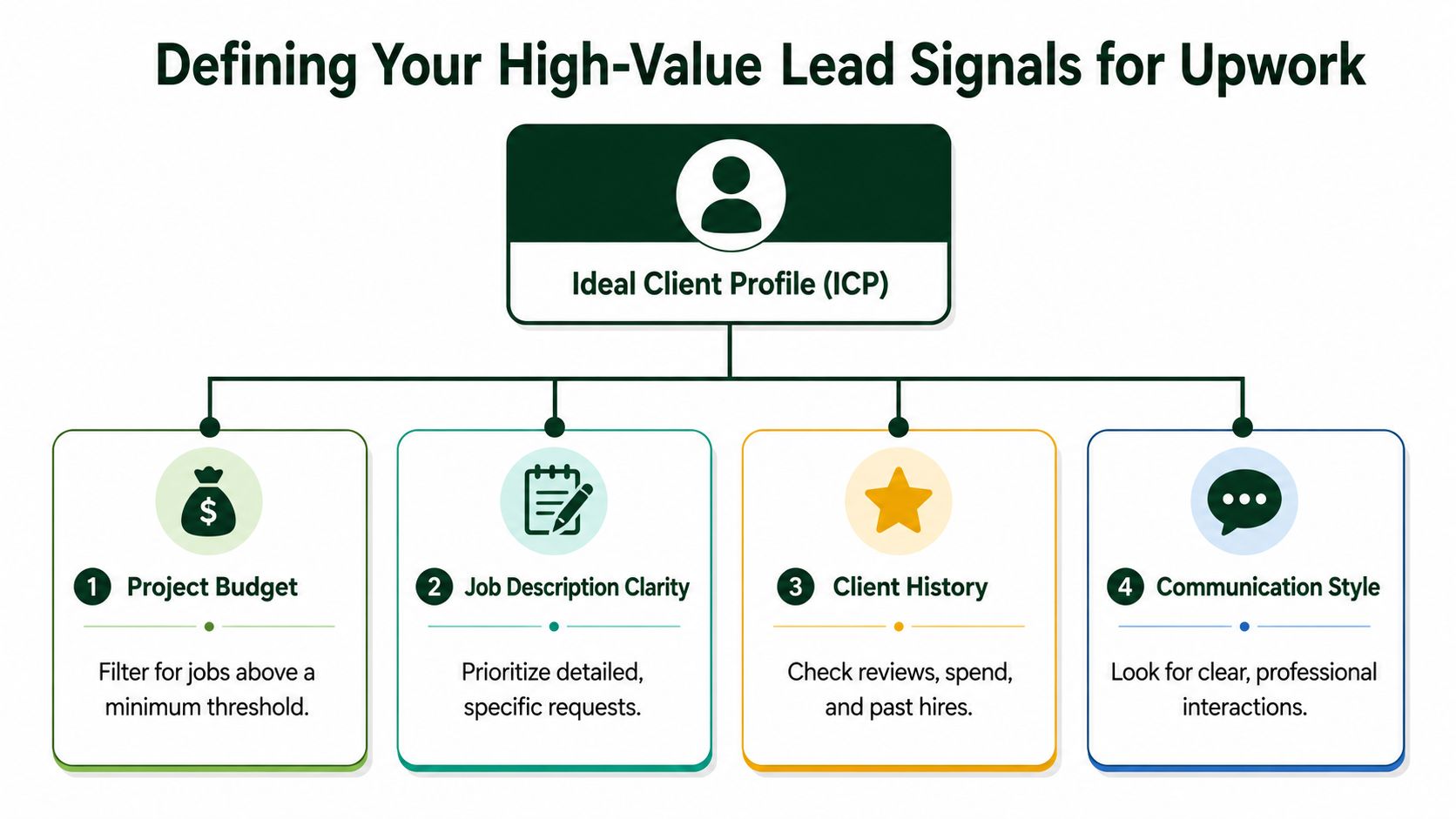
A peer-reviewed B2B lead-scoring study found that the most important predictors of conversion were objective variables such as Lead Source and Interest Level, which supports ranking leads with data rather than intuition, as discussed in this B2B lead-scoring research paper. The marketplace version of that idea is straightforward. Don't score based on vibes. Score based on signals you can observe.
Look at client-level signals first
Before reading the brief too closely, check the client.
A weak client can ruin a good-looking project. A strong client can turn a modest first engagement into repeat work. This is why client-level signals should usually come before project-level excitement.
Here's what I'd scan first:
- Payment behavior and platform credibility: Verified payment, evidence they hire, and signs they transact like a buyer instead of a window shopper.
- History with freelancers: Reviews, hiring patterns, and whether past freelancers describe the client as organized, respectful, and decisive.
- Spend quality: Not just whether they've spent, but whether their past hiring behavior matches the level of service you sell.
- Role and business context: A founder hiring for growth work is different from an assistant collecting quotes without authority.
A lot of agencies skip this step because the job title or budget pulls them in. That's backward. The client tells you whether the opportunity is likely to close cleanly.
Then assess project-level evidence
Once the client passes the first screen, read the post like a buyer qualification document.
You're not looking for perfection. You're looking for signs that the client knows what they want well enough to hire.
Strong project signals often include:
- Clear scope: The post explains the problem, deliverables, timeline, or expected outcomes.
- Relevant budget framing: The client seems to understand what competent work costs in your category.
- Specific language: Real requirements beat generic phrases like “need expert ASAP.”
- Useful constraints: Good briefs mention platform, stack, funnel stage, or business objective.
A detailed brief usually signals decision readiness. A vague brief often signals unpaid discovery disguised as a job post.
If you want a framework for tightening this part of your process, qualifying sales leads is the right lens. Qualification isn't separate from prioritization. It feeds it.
Intent signals matter on marketplaces
On Upwork, intent is often visible in small details.
A recently posted job, a responsive client, targeted questions, and a realistic next step all suggest active buying behavior. A stale post with no movement and no meaningful detail may still convert, but it shouldn't jump the queue ahead of something more active.
I'd separate signals into three simple groups:
- Fit signals: Is this the kind of client and work you want?
- Intent signals: Does this person appear ready to hire?
- Friction signals: What could make this engagement painful even if you win it?
That third category is where many get blindsided. They spot fit. They spot urgency. They ignore friction.
Then they win the wrong client.
Building Your Simple Lead Scoring Matrix
Once your signals are clear, turn them into a scoring system.
You don't need a RevOps team. You don't need a complex CRM build. You need a repeatable way to rank opportunities so your team stops renegotiating the same decision every day.
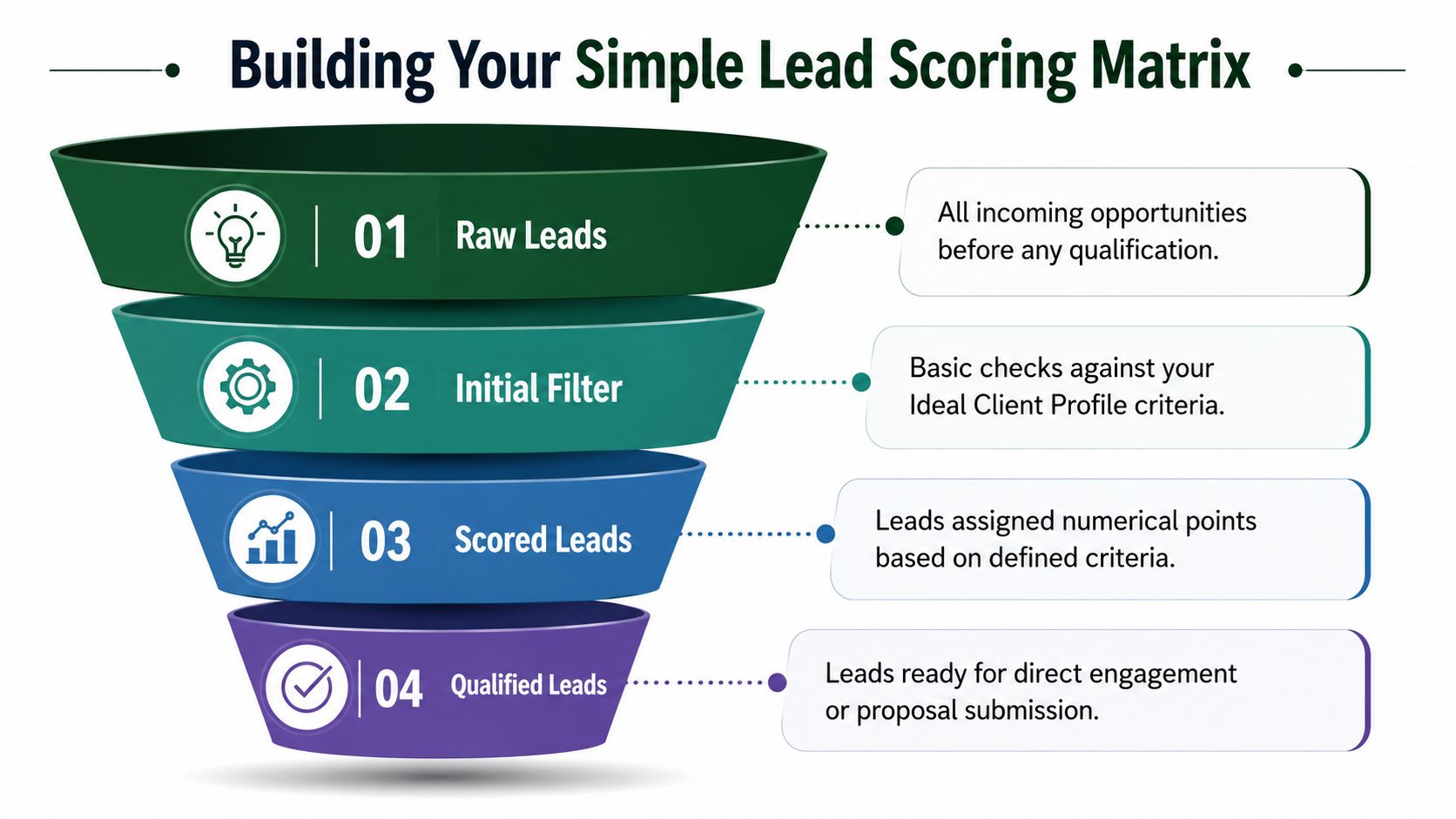
The cleanest guidance on this comes from Bombora's explanation of lead scoring and prioritization. Their recommendation is practical: define the ICP, choose fit and intent signals that correlate with wins, assign weights from historical conversion data instead of intuition, set handoff thresholds, and keep a feedback loop so false positives force recalibration.
That logic translates well to Upwork.
Start with weighted categories
Don't give every signal equal value. Some matter more.
A simple marketplace scoring matrix can use three weighted categories:
Fit
This is the foundation. If the lead isn't a fit, speed won't save it.
Examples of fit criteria:
- Service match: The job matches what your agency sells.
- Buyer type: The client resembles past accounts that were profitable and easy to retain.
- Commercial viability: The project looks financially sensible for your delivery model.
Intent
Intent decides urgency.
You might score intent based on:
- Freshness of posting
- Specific questions from the client
- Evidence they're actively interviewing
- Clarity around start date or next step
Risk
Here, you subtract points.
Risk indicators might include:
- Request for free strategy or free test work
- Contradictory scope
- Poor freelancer feedback
- Communication that signals chaos, disrespect, or shopping behavior
Use tiers instead of chasing perfect precision
Don't overengineer the score. The point isn't mathematical beauty. The point is action.
I like a three-tier model:
- Tier A leads: Respond immediately with a custom proposal and personalized opening.
- Tier B leads: Respond with a semi-custom structure, then qualify further.
- Tier C leads: Decline, archive, or watch only if pipeline is thin.
That's enough for most agencies.
To make the idea more concrete, here's a practical way to think about it without pretending there's one universal formula:
- A clear brief from a proven client in your niche gets pushed upward.
- A broad but attractive project from a client with weak hiring history gets held for review.
- A badly scoped job with bargain framing drops out, even if the headline budget looks tempting.
Here's a quick visual before you build your own version:
Build the feedback loop early
Most scoring systems fail because they freeze.
You need a simple review habit. Look back at the leads you won, the leads that replied, and the leads that wasted time. Then ask which signals showed up repeatedly. If “high-scoring” leads keep turning into messy calls or stalled conversations, your model isn't wrong in theory. It's stale in practice.
Score the lead before you write the proposal. Re-score your system after the result.
That's how to prioritize sales leads without letting the process become rigid.
How to Handle Conflicting Lead Signals
Most lead systems falter at this point.
A lead looks great on one dimension and shaky on another. The budget is strong, but the brief is thin. The client is a perfect fit, but they've shown almost no activity. The project is small, but the buyer is responsive, clear, and likely to move now.
Guidance usually stops at “score fit and intent.” It rarely explains what to do when those signals collide. That gap is explicitly called out in Cognism's discussion of lead prioritization, which notes that prioritization often breaks down when you're weighing a high-fit account with low activity against a lower-fit account with stronger intent.
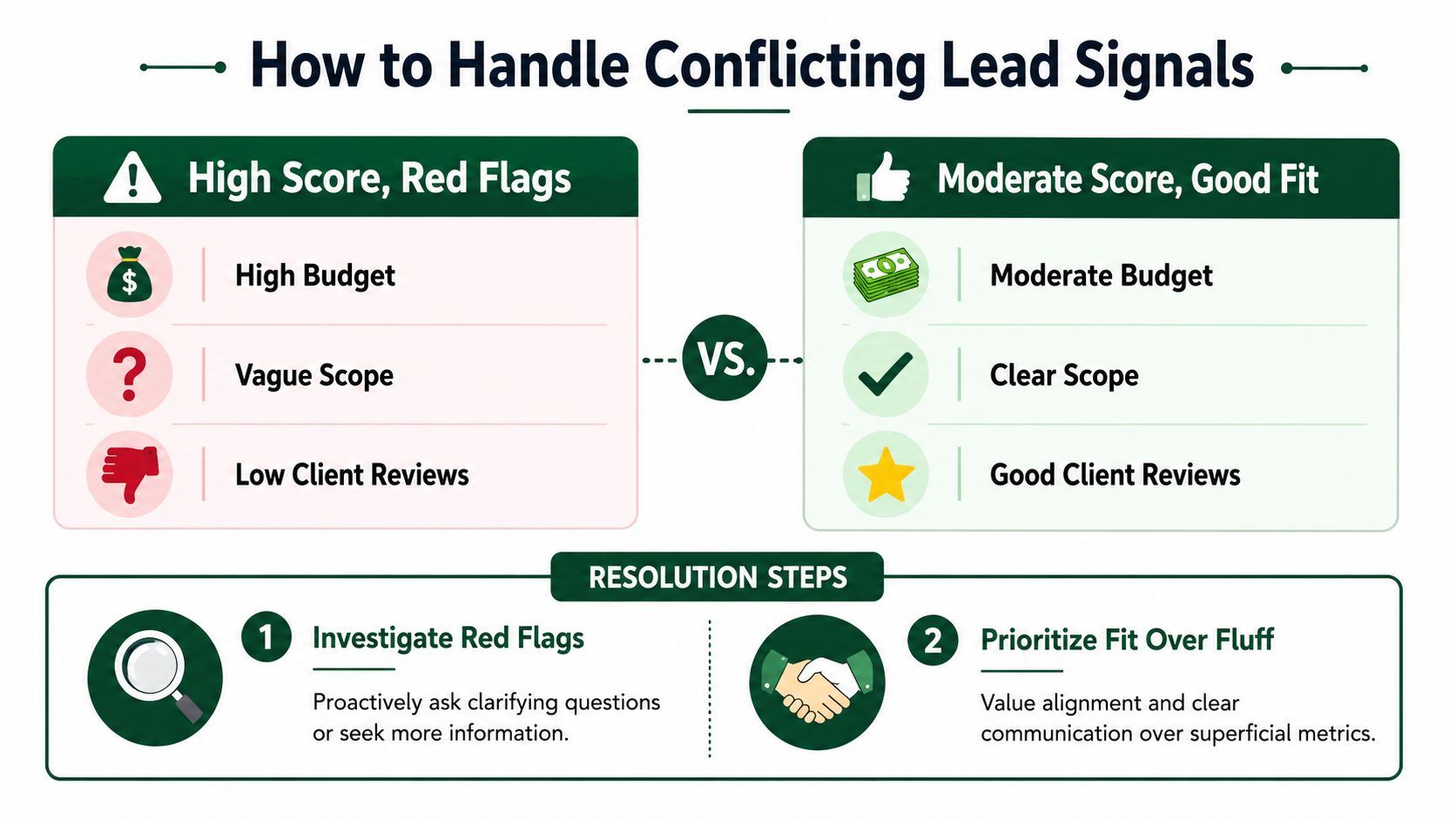
The high-score lead with red flags
This is the trap lead.
It checks the obvious boxes. Maybe the budget is attractive. Maybe the brand looks impressive. Maybe the category fits your portfolio. But the post is vague, the client history is thin, or their communication hints at scope creep before the project has even started.
Don't let top-line attractiveness overrule execution risk.
When I see this pattern, I don't rush to submit a full proposal. I move into a short validation step. That means asking pointed questions that expose seriousness fast.
Try questions like:
- Decision clarity: What does success look like in the first phase?
- Scope control: Which deliverable matters most if we had to prioritize?
- Process reality: Who signs off on the work and timeline?
If the client answers cleanly, the lead can move back up. If they dodge, delay, or expand the ask without structure, the score should fall.
The moderate lead with strong buying behavior
This lead often gets overlooked because it doesn't look flashy.
The budget may be modest. The company might not sound glamorous. But the client explains the problem well, responds quickly, and shows signs of being easy to work with. That combination often beats a bigger but messier opportunity.
Prioritize clients who are easy to sell to and likely to be easy to deliver for.
For agencies, this matters even more when capacity is tight. If your team has room for only a few serious conversations this week, a cleaner buyer with a smaller opening project may be the better use of attention than a larger project that's already waving operational red flags.
Use a tie-breaker that reflects your current stage
When signals conflict, use one tie-breaker. Not five.
Pick the one that matches your business reality:
- If cash flow is the priority: Favor faster-closing, lower-friction work.
- If portfolio position matters most: Favor category fit and brand alignment.
- If your team is stretched: Favor clarity, low management drag, and solid communication.
- If you're entering a niche: Favor strategic fit, even if the first deal is smaller.
A lead score is useful. A lead decision is better. The score should support judgment, not replace it.
Automate and Measure to Scale Your Wins
Manual triage works when you're small. It stops working when lead flow increases.
At that point, the bottleneck isn't finding opportunities. It's reviewing them fast enough, replying while the buyer is still active, and keeping your quality threshold intact. That's where automation earns its keep.
Guidance on automated prioritization increasingly emphasizes real-time buying signals and minute-level routing, especially for short-lived opportunities in high-volume environments, as described in this guide to prioritizing sales leads with automation. That principle fits Upwork perfectly. Marketplace opportunities age quickly.
Automate the filter before you automate the message
A lot of people jump straight to proposal generation. That's backward.
First automate the repetitive checks:
- Lead collection: Pull in new jobs, invites, and inbound messages.
- Signal tagging: Mark jobs by service fit, client quality, urgency, and risk.
- Score assignment: Push each opportunity into your A, B, or C bucket.
- Routing: Send the best leads to immediate action and leave the rest alone.
Then automate parts of the response workflow.
That's where sales automation becomes useful in a real way. Not as a gimmick, but as a system for protecting response time without lowering standards.
Track the right outcomes
If you don't measure by lead tier, your scoring model won't improve.
The metrics that matter most on a marketplace are usually operational:
- Reply rate by tier
- Interview rate by tier
- Win quality by tier
- Time spent per won client
- Follow-up outcomes
You don't need a giant dashboard. You need enough visibility to spot patterns. If Tier A leads aren't producing better conversations than Tier B, your scoring model needs work. If certain red flags consistently lead to poor-fit clients, increase the penalty. If a certain client pattern keeps leading to repeat business, weight it more heavily.
Automation scales what your system already does. If the logic is weak, automation multiplies mistakes. If the logic is sound, automation gives you speed without chaos.
If you want that kind of always-on Upwork lead handling without building the workflow yourself, Earlybird AI is built for it. It helps freelancers and agencies find matching projects, send personalized proposals quickly, respond to client messages fast, and keep improving based on real marketplace feedback. If your team is stuck between manual bidding and inconsistent outreach, it's a practical way to turn lead prioritization into a repeatable growth system.